Logo Design Principles: Build Trust for Your Brand
You might be looking at your current logo on a sign, a website header, or a social profile and thinking, “This doesn't feel like us anymore.” The practice may be polished, the patient experience may be thoughtful, and the care may be excellent, but the logo still feels stuck in an earlier version of the […]
LElemurJune 6, 202615 min read
In this piece
You might be looking at your current logo on a sign, a website header, or a social profile and thinking, “This doesn't feel like us anymore.” The practice may be polished, the patient experience may be thoughtful, and the care may be excellent, but the logo still feels stuck in an earlier version of the business.
That reaction matters. For a dentist, attorney, eye doctor, or medspa owner, a logo isn't decoration. It's often the first visual cue people get before they read reviews, call the office, or walk through the door. If that mark feels dated, generic, or hard to read, it can subtly create friction before your team ever has a chance to build trust in person.
Good logo design principles exist for a reason. They were formalized as branding matured in the early 20th century, when businesses needed marks that could be recognized instantly across mass media, and those rules still shape effective logos today across signage, print, and digital channels, as outlined in VistaPrint's overview of logo design principles. If you want a stronger foundation before reviewing design options, it also helps to spend a little time understanding brand strategy fundamentals, because a better logo starts with clarity about who you serve and how you want to be perceived.
A logo works best when it grows out of a bigger brand system, not when it tries to solve branding on its own. That's why many practice owners benefit from looking at the broader picture of branding for growing businesses before making design decisions.
Why Your Practice Logo Is More Than Just a Pretty Picture
A practice owner usually notices the problem in a small moment. The office gets renovated, the website gets refreshed, the photography improves, and then the logo starts to stand out for the wrong reason. It may not be terrible. It just no longer matches the standard of care the business delivers.
That gap creates a branding problem, not just a design problem. A logo sits on the front door, appointment reminders, intake forms, social icons, staff apparel, and search listings. It tells people what kind of experience to expect. For professional practices, that first impression often needs to communicate competence, steadiness, and attention to detail long before anyone meets the doctor, lawyer, or provider.
It shapes expectations before anyone speaks to you
Think of a logo like the front desk of your visual brand. If it feels cluttered, awkward, or inconsistent, people may assume the experience behind it is the same. If it feels clean and composed, they're more likely to expect professionalism.
That's why the best logos don't try to impress through decoration alone. They communicate clearly. They make a practice look established, intentional, and easy to trust.
A strong logo doesn't need to say everything about your practice. It needs to say the right thing quickly.
It helps owners make better decisions
Understanding logo design principles makes you a better buyer of design. You can review options more clearly, ask stronger questions, and avoid getting distracted by personal taste alone.
That matters because the wrong feedback often sounds harmless. “Can we make it pop more?” “Can we add a symbol so it feels premium?” “Can we make the font more exciting?” Those requests usually push a logo away from clarity and toward clutter.
A better question is simpler: does this mark help the right people trust us faster?
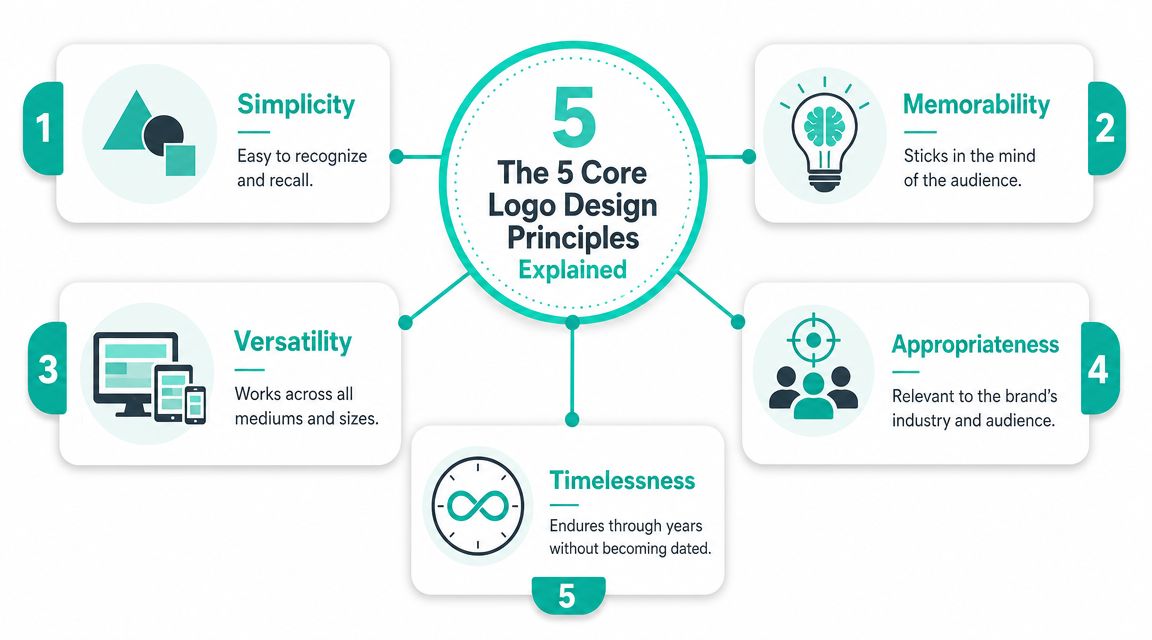
The 5 Core Logo Design Principles Explained
Most logo advice gets reduced to buzzwords. In practice, the principles are more useful when you treat them like job requirements. If a logo can't do these jobs, it isn't finished.
If you're comparing concepts or planning a rebrand, it helps to view the logo as one part of a larger visual system. A solid understanding of professional design work for brands makes it easier to judge whether a mark will hold up in various applications.
Simplicity
A simple logo is like a clean storefront. You know where to look, what matters, and what to remember. Nothing fights for attention.
This is more than a style preference. An industry roundup reported that 64% of consumers favor simplicity in design, and 39% prefer simpler branding over more complex alternatives, according to Linearity's logo statistics summary. For a busy local market, that matters. Patients and clients rarely give a brand a long, careful study.
Simplicity doesn't mean bland. It means disciplined. One clear idea beats five decent ideas crowded into the same mark.
What usually doesn't work:
Too many elements: An icon, a tagline, a border, a pattern, and a decorative font all in one lockup.
Tiny details: Thin lines, small shapes, and subtle effects that disappear at practical sizes.
Visual noise: Extra flourishes that don't improve recognition.
Memorability
Memorability is what makes a logo stay in someone's head after a quick glance. Not because it's loud, but because it has a distinct shape or structure that's easy to retain.
Experts often stress a practical test: the brain retains shape and color before detail, so a logo should still be identifiable when it's blurred, reduced, or shown without the brand name, as discussed in this logo recognition guidance. If recognition disappears as soon as the details soften, the design is leaning too hard on ornament.
That's why memorable logos often have one dominant visual move. A particular letterform. A clean silhouette. A balanced relationship between symbol and wordmark.
Practical rule: If you need to explain the logo for people to “get it,” the concept is doing too much.
Timelessness
Timelessness is often misunderstood as “old-fashioned” or “safe.” It really means the logo won't feel trapped in a design era. It still feels credible after your website changes, your office gets updated, and your marketing evolves.
A trendy logo can create a short-term hit of freshness. It can also age quickly. Heavy gradients, novelty fonts, and effects that depend on current style cues often become the visual equivalent of dated office furniture. You don't always notice the change happening, but patients do.
Timeless logos usually rely on fundamentals:
Clear structure: A mark with a stable, readable form.
Confident typography: Fonts chosen for fit, not fashion.
Restraint: Fewer trendy effects means fewer things to outgrow.
Versatility
A logo has to work in the places your practice uses it. That includes signage, business cards, scrubs, appointment cards, social icons, website headers, presentation slides, and vendor materials. If it only looks good in one polished mockup, it isn't ready.
Versatility is the practical side of logo design principles. A strong mark survives size changes, background changes, and production constraints without losing clarity.
Here's one simple way to understand:
Application
What the logo needs to do
Social profile
Stay recognizable at a very small size
Outdoor sign
Read clearly from a distance
Printed form
Reproduce cleanly without effects
Embroidery or merch
Hold its shape with limited detail
A logo that fails in any of those environments creates workarounds. Workarounds lead to inconsistency, and inconsistency weakens trust.
Appropriateness
Appropriateness is the principle many businesses skip, because it sounds less exciting than creativity. But for professional services, it's often the deciding factor.
Appropriate doesn't mean generic. It means the logo fits the audience, the category, and the promise behind the brand. A pediatric dental office may have more room for warmth and playfulness than an estate law firm. A luxury medspa may lean refined and minimal. An eye clinic may need calm clarity more than bold personality.
Strategy matters. The logo should attract the right people, not all people.
A useful gut check:
Would a first-time patient feel reassured by this mark?
Would a referral partner feel comfortable sending people to this business?
Does this look like the level of service the practice provides?
If the answer is no, the logo may be visually interesting but strategically off.
Applying Principles to Healthcare and Professional Practices
Professional practices don't operate under the same visual rules as lifestyle brands or startups. A medspa, law office, or dental clinic can't rely on novelty alone. People often arrive with anxiety, uncertainty, or a high need for reassurance. The logo has to meet them there.
Trust comes before cleverness
For regulated or relationship-driven businesses like law firms and dental practices, a logo has to balance timelessness with trust and category fit. A mark that feels too experimental can seem untrustworthy, while one that's too generic disappears, as noted in the UK government design guidance on principles for great logo design.
That creates a real trade-off. If you push too far toward creative distinction, you risk looking unserious. If you play it too safe, you look interchangeable.
In healthcare and professional services, appropriateness usually shows up through choices like:
Type style: Clean serif or sans serif fonts often signal professionalism better than novelty scripts.
Symbol restraint: A subtle mark tends to age better than a literal icon with too much explanation built into it.
Visual tone: Calm, steady, and composed usually performs better than loud or chaotic.
A law firm owner thinking through this balance may find it helpful to review examples of mastering law firm logo creation, especially when trying to stand out without losing authority.
Current without becoming disposable
Some owners hear “timeless” and assume their logo should avoid anything contemporary. That can backfire too. If a practice logo feels frozen in a previous decade, people may read that as outdated service, even when the business itself is excellent.
The better standard is audience expectation. Your logo should feel current enough that people believe your practice is active, relevant, and paying attention. It should also feel stable enough that they trust you with something important.
For practices, the goal isn't trendiness. It's credible relevance.
A dental office might use softer geometry and generous spacing to feel modern and approachable without becoming playful. A medspa might use elegant typography and a refined mark to signal premium care without drifting into a generic beauty aesthetic. An attorney may choose a more classic structure, but still simplify the mark so it feels confident rather than old-fashioned.
The strongest logos in these categories don't shout. They reassure.
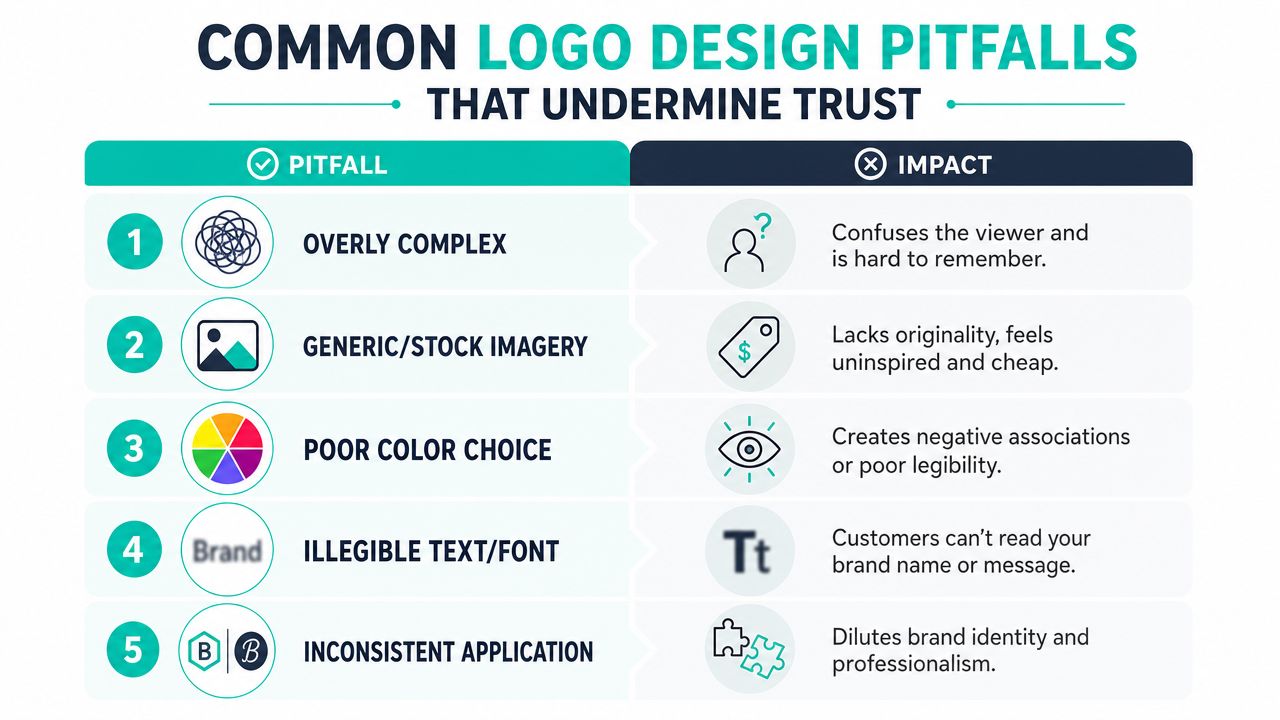
Common Logo Design Pitfalls That Undermine Trust
A logo doesn't have to be ugly to create doubt. More often, it fails by sending subtle signals that something is off. In healthcare, legal, and aesthetic practices, those signals matter because people are already asking a trust question before they ever call your office.
Too much detail for real-world use
A logo may look polished on a presentation slide and still fail everywhere that counts. Reception signage, appointment cards, social icons, embroidered uniforms, website headers. These are the places where weak decisions show up fast.
I see this often with professional practices that want the logo to explain everything at once. A dentist adds a tooth, a sparkle, a smile curve, and a full wordmark with credentials. A lawyer stacks initials, a crest, a slogan, and decorative rules into one tight lockup. A medspa adds fine-line illustrations and soft gradients that disappear the moment the logo gets small.
The result is friction. People should recognize your mark in a glance, not study it like a brochure.
Common signs the design is carrying too much:
Overbuilt icons: Multiple symbols or visual effects competing for attention.
Crowded lockups: Name, tagline, credentials, and symbol forced into one arrangement.
Fragile details: Thin strokes, textures, and tiny flourishes that break down across print and digital formats.
Clutter suggests uncertainty. For a practice, uncertainty is expensive.
Category cues that slide into cliché
Professional services do need category signals. A law firm should not look like a nightclub. A medspa should not look like an accounting office. The problem starts when familiar cues become copy-and-paste shortcuts.
Teeth, scales, pillars, leaves, faces, crosses, eyes. None of these are automatically wrong. They become weak when they are used in the most expected way, with no distinct shape language, no memorable typography, and no clear point of view.
That trade-off is easy to miss. Owners often choose the safest symbol in the category because they want to look credible. Then they end up looking interchangeable.
If your logo could sit on a competitor's website without anyone noticing, it is not doing enough brand work.
The better approach is selective familiarity. Keep the signal that helps people place you in the right category, then build distinction through proportion, spacing, lettering, or a more restrained symbol. That is how a practice looks appropriate without looking generic.
Amateur execution in high-trust categories
People do not inspect kerning or vector paths. They do notice when something feels off.
That feeling usually comes from execution problems:
Weak typography: Fonts that feel cheap, dated, or mismatched to the level of trust you need to earn.
Color dependence: A logo that only works in one polished mockup and falls apart in black and white.
Inconsistent versions: Different marks used on signage, social profiles, business cards, and the website.
Template artifacts: Generic symbols or awkward spacing that make the brand feel assembled rather than designed.
For a restaurant or a local event brand, rough edges may read as casual. For a dental practice, law office, or medical aesthetic brand, they can read as a lack of standards. Patients and clients may never say, “This logo feels homemade.” They instead keep scrolling and choose the practice that looks more established.
A strong logo does not need to be flashy. It needs to look deliberate, repeatable, and trustworthy wherever people encounter it.
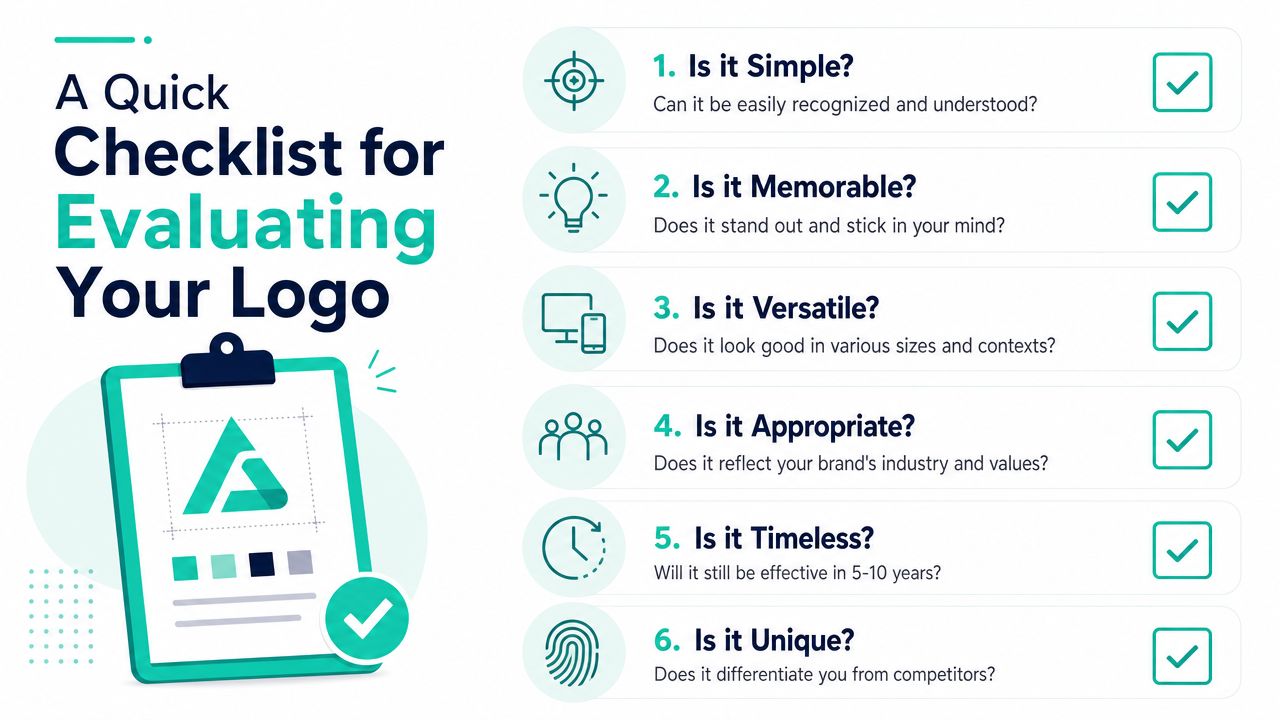
A Quick Checklist for Evaluating Your Logo
You don't need design training to spot whether a logo is working. You need a clear set of questions and the discipline to answer them objectively.
The self-audit
Use this as a yes-or-no review for your current logo or any new concept.
Is it easy to describe? If you can summarize the mark in one plain sentence, the idea is probably focused.
Does it stay clear at small sizes? Check it as a social icon, favicon, or tiny footer mark.
Does it still work without color? A dependable logo shouldn't rely on color effects to remain recognizable.
Does the typography feel credible for your category? The font should match the level of trust your practice needs to earn.
Does it feel distinct from nearby competitors? Not wildly different for the sake of it, but clearly your own.
Would you still feel good about it years from now? If it already feels tied to a passing style, that's a warning sign.
What a strong yes looks like
There's also a technical side to evaluation. A professionally prepared logo should exist as a vector master file, because vectors preserve quality at any scale, and black-and-white testing helps confirm the mark doesn't depend on color to survive, as explained in HubSpot's guidance on logo design tips and scalable logo files.
That matters more than many owners realize. If your only logo file is a small PNG pulled from an old website or a flattened JPEG from a previous designer, you don't really have a flexible brand asset. You have a limited image.
A practical review table can help:
Question
Strong answer
Can it scale up and down cleanly?
Yes, because the source file is vector based
Can vendors reproduce it easily?
Yes, because there are clean versions for different uses
Can it survive low-ink or one-color applications?
Yes, because the mark still reads in black and white
If several answers are no, the logo may be creating more friction than you realized.
Your Logo Is Your First Handshake
A logo does its work before your staff answers the phone, before a patient reads your reviews, and before a referral source sends someone your way. It is your first handshake. Quiet, visual, and constant.
That's why logo design principles matter so much for professional practices. They help you judge whether a mark is clear, credible, usable, and right for the audience you serve. They also protect you from a common mistake, treating the logo as personal art instead of strategic communication.
The strongest practice logos don't need to be flashy. They need to feel trustworthy, distinctive, and consistent with the experience people will have once they choose you. When that alignment is there, the logo stops being a decorative expense and starts working like a business asset around the clock.
If your practice is investing in a stronger brand presence, the logo should also connect to the rest of your digital experience, including website development for professional practices. A thoughtful brand only works when every touchpoint reinforces the same level of trust.
If your practice is ready for branding and marketing that feels intentional, authentic, and built for long-term growth, Leaping Lemur Media helps practices clarify who they are, how they show up, and how to connect with the people who need them most.