How to Start a Marketing Agency: A Founder’s Guide
You're probably here because freelancing has stopped feeling like freedom. You know how to run campaigns, write copy, build landing pages, manage SEO, or guide strategy. Clients trust your work. But the business side still feels improvised. One month is busy, the next is thin. Every new lead wants something different. You're selling tasks when […]
LElemurJune 12, 202617 min read
In this piece
You're probably here because freelancing has stopped feeling like freedom.
You know how to run campaigns, write copy, build landing pages, manage SEO, or guide strategy. Clients trust your work. But the business side still feels improvised. One month is busy, the next is thin. Every new lead wants something different. You're selling tasks when what you really want is to build a firm with a point of view.
That shift matters more if you want to serve trust-based local businesses such as dentists, lawyers, medspas, and eye doctors. These clients don't just need traffic. They need the right message, the right reputation, and a marketing partner who understands that every lead touches patient trust, legal credibility, or community standing. If you want to learn how to start a marketing agency in that world, the generic advice about “pick a niche and post on LinkedIn” won't carry you very far.
The good news is that a smaller, focused agency can build a strong business by being more useful, more consistent, and more trusted than a generalist shop. That usually means thinking like an operator early. It also means building a company around partnership, not one-off execution. Teams that work this way tend to resemble firms like Leaping Lemur Media's partnership-first approach, where the agency position is closer to long-term advisor than disposable vendor.
From Freelancer to Founder The Vision for Your Agency
Freelancers usually hit the same wall. You become good enough to attract work, then your income depends on staying personally involved in every task. You can't disappear for a week, you can't standardize your calendar, and you can't build real margin if every deliverable still runs through your hands.
An agency solves that problem only if you build it around a clear promise. Otherwise, you've just created a more stressful freelance business with extra admin.
For trust-based local businesses, the strongest promise is rarely “we do digital marketing.” It's something narrower and more believable. A dentist wants steady patient demand and a brand that feels credible in the local market. A law firm owner wants intake that matches the practice area and positioning that doesn't feel cheap. A medspa wants growth without eroding trust. Those are business problems, not channel problems.
Partnership changes the kind of agency you build
The founders who build durable agencies stop pitching disconnected tactics. They start owning outcomes, communication, and client experience. That changes the sales conversation. It also changes who hires you.
Practical rule: If your offer sounds interchangeable with dozens of other agencies, buyers will compare you on price first.
This is why the jump from freelancer to founder isn't mainly about getting a logo or hiring contractors. It's about deciding what kind of firm you're building. A partnership-driven agency tends to keep clients longer, learn the client's business more thoroughly, and produce better referrals because the relationship itself becomes part of the value.
That matters even more in local service categories where reputation is part of the sale. Patients and legal clients don't convert the same way commodity buyers do. The agency has to understand tone, urgency, follow-up, and how a business earns trust before someone ever submits a form or books a consult.
The better goal
A lot of people start agencies because they want independence. That's fair. But independence alone isn't enough to sustain the business when delivery gets messy and cash flow gets tight.
A better target is a focused agency with a stable offer, repeatable systems, and clients who see you as part of their growth plan. That kind of agency can grow without becoming bloated. It can charge with confidence because the work isn't random. And it's far more satisfying to run than a shop built on one-off gigs and constant reinvention.
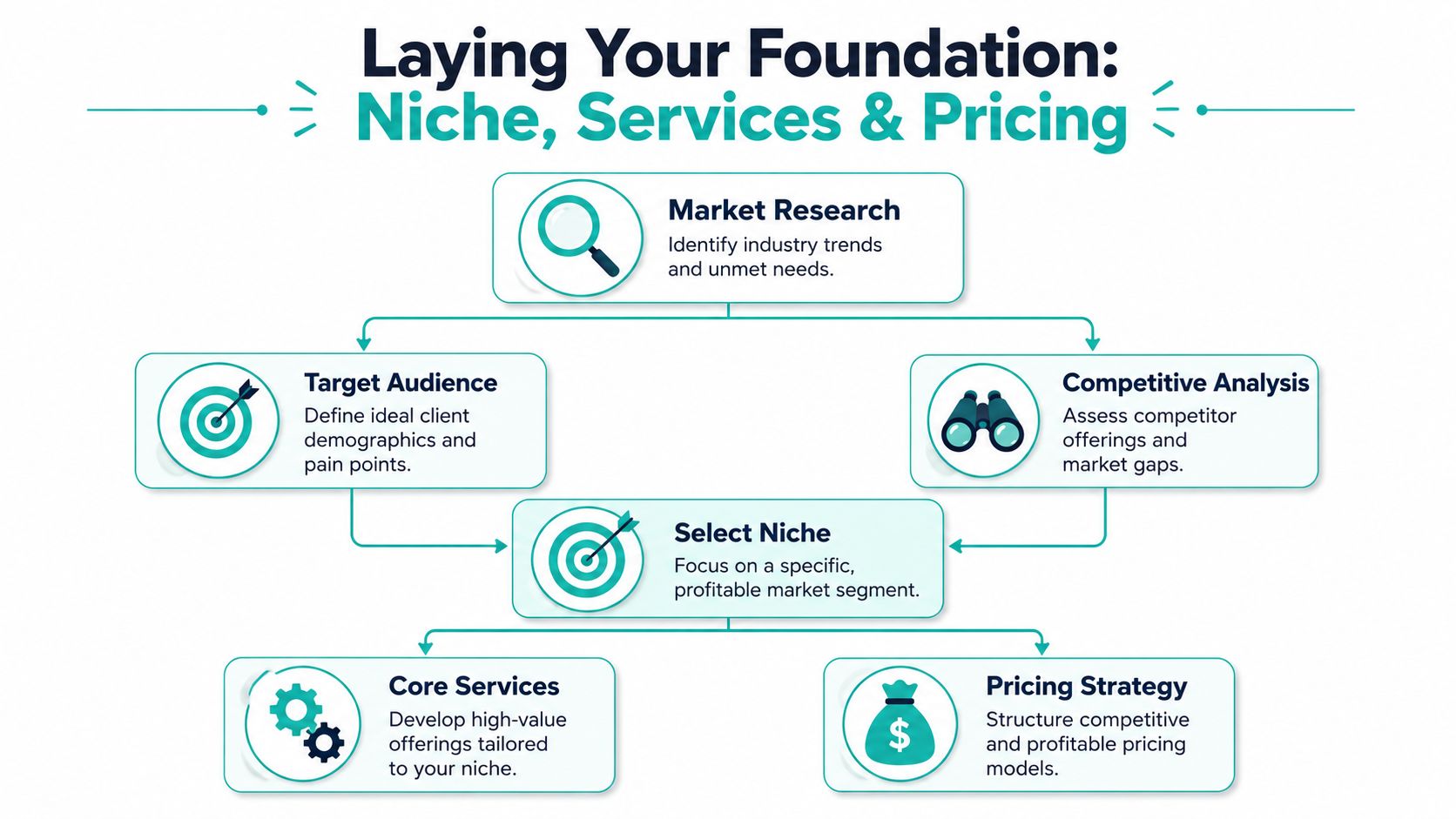
Laying Your Foundation Niche Services and Pricing
The most important decision you'll make is what kind of agency you are not.
The industry has become more crowded. One marketing agency statistics roundup reported about 346,000 marketing agencies worldwide in 2014 and 433,400 a decade later, a rise of 25.26%. The same roundup noted that large U.S. agency holdings such as WPP, Omnicom, Publicis, and Interpublic generate a combined revenue of $33 billion. That combination of growth and concentration is a strong argument for specialization, not broad positioning in this agency market overview.
Why generalist positioning breaks early
A new generalist agency usually runs into three problems.
Messaging gets fuzzy. If you help “small businesses with everything,” prospects can't tell why they should trust you.
Delivery gets messy. Every client needs a different mix of channels, reports, and workflows.
Pricing stays weak. Buyers compare you to freelancers, overseas teams, and larger agencies with more proof.
Specialization fixes all three. You get sharper language, more repeatable systems, and stronger authority.
For trust-based local businesses, the niche can come from three directions:
Vertical expertise such as dentists, family law, medspas, or optometry.
Buyer problem such as lead quality, local visibility, intake flow, or brand repositioning.
Service specialization such as local SEO, paid search, website conversion work, or reputation-driven content.
The smartest early move is usually to combine a vertical with one primary service category.
How to choose a trust-based niche
A niche should be narrow enough to make you memorable and broad enough to support repeat business.
Ask yourself:
What buyers do I already understand? If you've worked with clinics, practices, or professional services before, that's a real advantage.
Where do trust signals matter most? In law, healthcare, and aesthetics, the buyer often checks reviews, site quality, messaging, and responsiveness before ever speaking to the business.
What problem can I solve repeatedly? A cosmetic dentist may care about higher-value treatment inquiries. A family law attorney may care about clear positioning and better intake quality. Those are different sales environments.
Can I explain the value in plain English? If your pitch requires a long technical explanation, it will be harder to sell.
Buyers in trust-based categories often hire the agency that feels safest to work with, not the one with the longest list of tactics.
That's why broad service menus often hurt new founders. If you offer SEO, PPC, branding, social, web design, email, video, and automation from day one, you usually create operational drag before you create authority.
If you want a useful benchmark for how a focused service mix can look, review a niche-oriented service page like these agency service categories. The point isn't to copy the list. The point is to see how clear positioning makes the offer easier to understand.
Match services to the buying problem
Once the niche is clear, build a service around the immediate business need.
A dentist usually doesn't buy “marketing support.” They buy more booked patients, a stronger local presence, and fewer weak leads. A lawyer usually doesn't buy “content.” They buy trust, authority, and a cleaner path from search to consult request.
That means your opening offer should be tightly scoped. Examples of focused offers include:
Local SEO and Google Business Profile management for practices that need local discovery.
Search ads and landing pages for firms that need higher-intent lead flow.
Website messaging and conversion improvement for businesses with traffic but weak inquiry quality.
Reputation and reporting systems for owners who want cleaner trust signals and steadier communication.
Avoid bundling everything too soon. Founders often confuse “more services” with “more value.” Clients usually experience the opposite.
Choose a pricing model you can sustain
Most guides skip the hard part. Pricing isn't just a sales decision. It's a cash flow decision, a scope decision, and a stress decision.
A strong agency plan should include pricing strategy, revenue goals, cash-flow projections, and profit and loss forecasting, not just client acquisition, as noted in this business planning guidance for digital agencies.
Here's the practical comparison.
Model
Best For
Pros
Cons
Hourly
Small advisory work, audits, strategy sessions
Simple to start, easy to explain
Caps upside, invites scope creep debates
Project-Based
Website builds, launches, setup work
Clear deliverables, defined start and finish
Hard to estimate if your process is still loose
Retainer
Ongoing SEO, paid media, content, reporting
Predictable revenue, deeper client relationship
Requires confidence in scope and communication
If you're learning how to start a marketing agency, here's the blunt version. Retainers usually create the healthiest agency model, but only after you've tightened your process. Until then, a project or pilot can be safer.
A simple progression works well:
Start with a pilot engagement
Turn successful pilots into retainers
Reserve hourly work for strategy or limited consulting
Undercharging is common because new founders price based on what feels safe to ask for. That's backwards. Price based on the work required, the communication load, the tooling, and the margin you need to stay consistent. If the client needs constant access, custom reporting, and fast turnaround, the price has to reflect that reality.
Making It Official Legal Financial and Brand Setup
You don't need a corporate maze to launch. You do need a clean business container.
Set up the business like you plan to keep it
A lot of new agency owners delay the legal and financial basics because they want to “just get clients first.” That usually creates friction later, especially when contracts, taxes, and bookkeeping catch up with them.
Start with a short checklist:
Choose a business structure. Many founders compare sole proprietorship and LLC options because liability protection matters once you're signing contracts and handling client work.
Get your EIN and registration in order. You want a real business identity before invoices and vendor setups start piling up.
Open a separate business bank account. Don't run agency cash through your personal account if you can avoid it.
Create a lightweight bookkeeping routine. Use software early, categorize expenses, and review cash flow on a set schedule.
Use a contract from day one. Scope, payment terms, timelines, approval process, and ownership terms should be clear before work starts.
One of the more useful realities from neutral planning guidance is that agency founders need a plan that includes pricing, cash flow, and profit tracking, not just lead generation. That's why legal and financial setup isn't admin for admin's sake. It's what lets you understand whether the business is working.
Build a brand that looks stable
New founders often overbuild the brand and underbuild the message.
You do not need an elaborate identity system to look credible. You need a name that's easy to say, a domain you can keep, a clean visual style, and a website that tells the right client three things fast:
who you help
what problem you solve
what the next step is
That's enough for an early agency.
For trust-based niches, calm branding usually works better than loud branding. Dentists, lawyers, and medical aesthetics owners aren't looking for edgy agency theater. They want confidence, clarity, and signs that you can communicate with adults.
Your brand doesn't need to look expensive. It needs to look organized.
A simple one-page site can do the job if it includes a focused headline, a short services section, proof elements, and a clear call to action. If branding is part of your positioning, a reference point like this branding-focused agency page shows how niche-aligned messaging can stay polished without feeling bloated.
Acquiring Your First Clients Sales and Onboarding
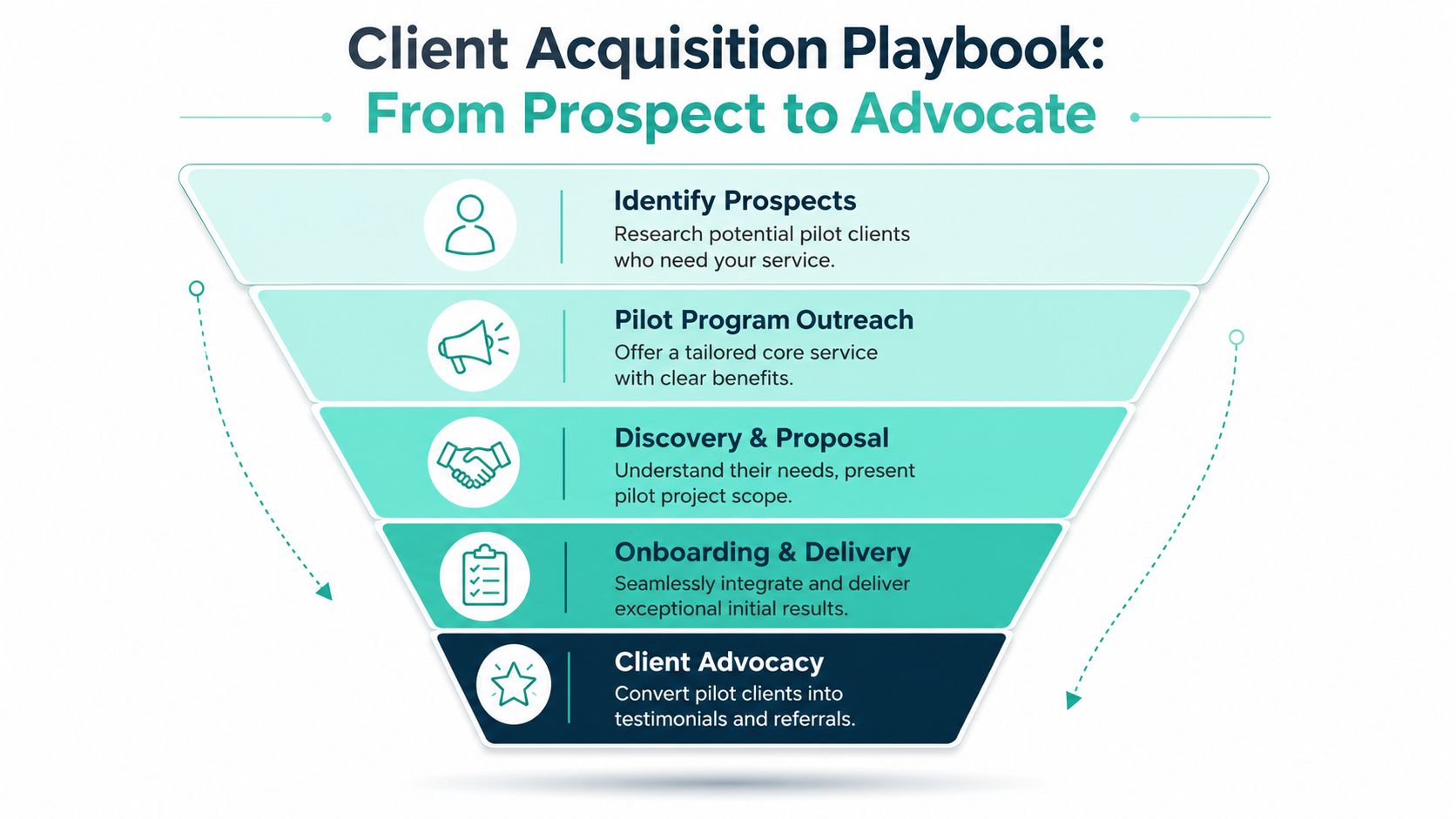
Your first clients shouldn't come from a huge service menu. They should come from a pilot.
Industry playbooks recommend defining a specific market, mapping core workflows, and validating services with a small pilot group before scaling. That approach reduces the usual startup mistake of launching with too many offers and unclear positioning, as described in this step-by-step agency launch playbook.
Start with a pilot not a full agency menu
A pilot gives you three things early founders need badly:
Proof that the offer solves a real problem
Process because you learn where delivery gets messy
Positioning because you hear the language buyers use
A good pilot is narrow. It might be local SEO for dentists, paid search plus landing page optimization for medspas, or intake-focused web messaging for a family law firm. It should have a clear scope, a defined timeline, and one main outcome.
Don't call it a discount just to get work. Frame it as an early partnership with limited availability and a focused deliverable. That protects your positioning.
Find prospects through relevance not volume
The easiest first clients are often one degree away from your current network. Former clients, friends in adjacent industries, referral partners, and local business contacts are all more useful than blasting generic cold emails.
If you use outbound outreach, keep it specific. Mention the business, the issue you noticed, and the service you provide. Inbound and outbound work differently, and if you want a practical breakdown of how to think about each, these insights from hireSDR.io on sales are a useful primer.
A simple early outreach pattern looks like this:
Build a short prospect list. Focus on businesses that clearly fit your niche.
Review their public presence. Website, local visibility, ad messaging, reviews, and intake path.
Send a brief note. Point out one relevant observation and one likely opportunity.
Offer a conversation, not a pitch deck. Early sales should sound like diagnosis, not theater.
The first sale is often trust in your judgment before it's trust in your process.
That's especially true for law firms and healthcare-adjacent businesses. They want to know you understand their world, not just ad platforms.
Use onboarding to prove you're different
Many agencies lose trust right after the sale. The prospect signs, then gets a vague kickoff, a scattered request list, and radio silence for a week. That makes the buyer feel like they hired a vendor, not a partner.
A tighter onboarding flow changes the whole relationship.
Client onboarding checklist
Signed agreement and invoice: Get paperwork and payment expectations squared away before work starts.
Primary goal alignment: Confirm what success means in the client's words, not just yours.
Access request list: Ask for only what you need now. Don't send a giant spreadsheet of credentials unless the work requires it.
Kickoff call: Review scope, timeline, communication cadence, approvals, and known constraints.
Client intake form: Gather brand voice, services, market focus, competitors, and common objections.
Shared workspace setup: Create one place for communication, files, deadlines, and reporting.
First-30-day plan: Show the client what happens first, what happens later, and what you need from them.
A smooth onboarding experience often becomes your first proof asset. It tells the client you're organized. It lowers anxiety. It makes future reporting easier because expectations were clear from the start.
The first few clients should also help you create your proof library. Ask for testimonials when the client has experienced a meaningful win or a smooth process milestone. Document what changed, what you did, and how the engagement evolved. Case studies don't need hype. They need clarity.
That's the engine of early growth. Website first. Then clients. Then case studies. Then stronger pricing and expansion.
Building Your Operations and Tech Stack
Operations become the business faster than most founders expect.
The usual sequence for a new agency is to build a professional website and portfolio, secure initial clients, document outcomes as case studies, and use those results to expand. A solid stack for project management and reporting supports that rhythm, as noted in this operational guide for new digital agencies.
Give each tool one job
Don't build a bloated stack because someone on social media has a screenshot of twelve dashboards. Early on, each tool should solve one operational problem.
A lean setup might look like this:
Tool category
Job it does
Simple options
Project management
Tracks tasks, owners, deadlines
Trello, Asana
Client communication
Keeps updates organized
Slack, email
Reporting
Shows progress clearly
Looker Studio
Accounting
Invoices, expense tracking, bookkeeping
Wave, QuickBooks
Forms and intake
Collects client info and requests cleanly
Typeform, Jotform
For forms alone, agencies often underestimate how much admin they can eliminate with better intake and request workflows. If you're comparing options, this guide on form tools for agencies is a practical place to start.
The key is restraint. If Trello already keeps your pilot clients organized, you don't need an enterprise project suite. If Looker Studio gives clients readable reporting, don't overcomplicate the dashboard.
Document delivery while the agency is still small
Founders usually wait too long to write things down. They assume SOPs are for later. In reality, the best time to document a process is right after you've repeated it twice.
Start with the core workflows:
Sales to kickoff
Client onboarding
Monthly reporting
Content approvals
Campaign launch checks
Offboarding and handoff
Keep each SOP simple. A checklist, a short Loom video, and a folder template are enough in the beginning.
This is also the right place to mention one category of outside support. If you don't want to execute every function yourself, a specialized partner can cover focused work such as branding, local growth strategy, or practice-focused digital execution. For example, Leaping Lemur Media operates as a digital growth agency for practice-oriented businesses. That kind of specialist partner can fit into your delivery model if your agency stays narrowly positioned.
Systems don't make your agency less personal. They make your service more reliable.
That's what clients remember. Not the app stack itself, but the feeling that deadlines, updates, and deliverables arrive the way you said they would.
From Founder to Leader Scaling Your Agency
The hardest part of scaling isn't hiring. It's accepting that your personal involvement can't be the quality-control system forever.
A lot of founders say they want to grow, then structure the agency so every decision, edit, and approval still depends on them. That isn't scale. It's bottleneck management.
The first hire is a capacity decision
You'll know it's time to make a first hire or bring in regular contractor support when the same pattern keeps showing up:
good-fit leads are waiting too long for a response
client quality starts slipping because you're context-switching all day
reporting, follow-up, and admin begin crowding out strategy
you delay selling because you're worried about fulfillment
Your first support hire usually shouldn't be based on prestige. It should remove the work that most consistently blocks delivery. For some founders, that's fulfillment help. For others, it's project management or account coordination.
What matters is documentation. If the process only exists in your head, delegation will feel risky because it is risky.
Trust-based niches scale on consistency
Many generic agency guides fall short regarding this aspect. In trust-based verticals such as dentistry or law, scaling doesn't come mainly from adding more channels or louder branding. It comes from operational trust signals such as clear reporting, clean onboarding, consistent communication, and a long-term partnership mindset, a gap highlighted in this discussion of specialization in trust-based markets.
That means your growth plan should protect the things clients already value:
Clear communication cadence
Reliable reporting
Defined ownership of tasks
Messaging that respects the client's professional reputation
A service model built for continuity, not one-off wins
The founder's real job changes here. You stop being the person who does all the work. You become the person who protects standards, sharpens positioning, and builds a team that can deliver trust at scale.
If you get that shift right, you won't just learn how to start a marketing agency. You'll build one that clients stay with.
If you want a model for a partnership-driven agency serving practices and local businesses, take a look at Leaping Lemur Media. Their positioning is a useful example of how an agency can build around trust, community, and long-term growth instead of one-off marketing tasks.