Law Firm Social Media Marketing: A Practical Playbook
A lot of law firms are in the same place right now. A partner knows the firm should show up on social media, someone on staff is posting when they can, and nobody feels fully comfortable with the compliance risk or the time commitment. The result is usually a half-active profile, a few firm announcements, […]
LElemurJune 16, 202617 min read
In this piece
A lot of law firms are in the same place right now. A partner knows the firm should show up on social media, someone on staff is posting when they can, and nobody feels fully comfortable with the compliance risk or the time commitment. The result is usually a half-active profile, a few firm announcements, and a quiet suspicion that this probably isn't doing much.
That's the wrong way to judge law firm social media marketing.
For most firms, social media works best when it is treated as a trust channel first and a lead channel second. Prospective clients look for signs that a firm is current, credible, and responsive. Referral sources do the same. They are not usually looking for the loudest lawyer online. They are looking for the lawyer who appears knowledgeable, steady, professional, and safe to recommend.
That changes the strategy. You don't need to chase every trend, publish hot takes every day, or build a personality brand that makes your ethics counsel nervous. You need a focused system that helps the right people see your firm, understand what you do, and feel more confident sending work your way.
Why Social Media for Law Firms Is No Longer Optional
The hesitation is understandable. A managing partner hears “you need to be on social media” and immediately thinks of bad client comments, accidental legal advice, and time wasted on posts that nobody sees. That instinct isn't irrational. Law firms do face a tighter ethical line than most businesses.
But the market moved anyway.
One 2025 legal marketing statistics report says 79% of law firms maintain an active presence on at least one social media platform, with 82% of those firms using Facebook and 71% connecting with clients on Facebook, LinkedIn, and Instagram. That matters because social media is no longer a novelty for legal marketing. It's part of the baseline digital presence prospects expect to find.
A practical example makes the point. A referral source hears your name, searches the firm, and finds a decent website. Then they check LinkedIn or Facebook and see one of two things. Either the firm appears current, active, and credible. Or the profile looks abandoned, sparse, or inconsistent with the website. That second impression doesn't always lose the referral outright, but it does create friction.
Practical rule: Social media doesn't have to be your loudest channel. It does need to confirm that your firm is active, credible, and paying attention.
For high-trust services like legal representation, that public layer of reassurance matters. People often compare firms before they call. They look for signs of professionalism, signs of life, and signs that the attorneys understand real client concerns.
That's why the better question isn't “Should we be on social media?” It's “How do we use social media in a way that supports trust, referrals, and compliant growth?”
Laying Your Strategic and Compliant Foundation
Most firms get into trouble when they start with content ideas instead of business goals. A lawyer says, “We should post more on LinkedIn,” and the team starts filling a calendar without deciding what success looks like.
That approach creates motion, not strategy.
A 2026 legal marketing report found that 71% of lawyers say they have generated new leads from social media, with an average 3-year ROI of about 526% for law firms. Social can produce measurable business value. But firms that see results usually know what kind of result they want.
Start with business goals, not platforms
For a law firm, useful social media goals usually fall into a handful of categories:
Referral visibility: Stay top of mind with accountants, therapists, financial advisors, physicians, business owners, and other attorneys who may refer work.
Practice area authority: Show steady expertise in one or two areas instead of trying to sound broad and impressive.
Trust building: Give prospects enough helpful context that they feel safer reaching out.
Recruiting support: Help future hires understand the firm's culture and standards.
Reputation reinforcement: Make sure the public-facing brand feels current and professional.
SMART goals help here, but they need to be grounded in legal reality. “Go viral” is not a strategy. “Increase qualified consultation requests from estate planning content” is much better. “Strengthen referral engagement with local business contacts on LinkedIn” is better still.
A narrow goal usually produces better social content than a broad one. Firms post better when they know exactly who the post is for.
The next decision is platform fit. Many firms overextend. They open accounts everywhere and manage none of them well. A smaller number of active, well-run profiles almost always beats a scattered presence.
Choose platforms by audience fit
Use the practice area, buyer type, and content format to choose where you'll focus first.
Media-facing professionals, policy watchers, attorneys following legal developments
Appellate, public policy, employment, white-collar, firms with strong commentary discipline
Timely observations, article sharing, event commentary, media interaction
A few practical rules help:
B2B firms usually start with LinkedIn: It fits professional referral building and thought leadership.
Consumer-facing firms often benefit from Facebook first: It supports community presence and approachable education.
Instagram works when the firm can communicate visually: If your team won't create graphics, photos, or short video, it becomes hard to sustain.
X needs discipline: It rewards speed and commentary, which can create unnecessary risk for firms without a clear review process.
If your team is small, pick one primary platform and one secondary platform. Build a repeatable system there before expanding.
Developing Your Content and Editorial Calendar
A partner approves a post about a recent win. Intake loves it. The social manager posts it. A week later, the firm realizes the post said almost nothing about who the firm helps, what questions those clients ask, or why a referral source should feel confident sending someone over.
That is how many law firm content calendars start. They revolve around what the firm wants to announce, not what builds trust.
A better calendar answers three practical questions before anything gets scheduled: who needs to trust this firm, what do they need to understand before they refer or hire, and what can the firm publish consistently without creating review chaos. That approach produces fewer empty “engagement” posts and more content that supports reputation, referral confidence, and qualified inquiries.
Build around content pillars
Content pillars keep the firm from posting whatever is easiest that week. They also help balance two audiences that often overlap in legal marketing: prospective clients and referral sources. Both are evaluating judgment, clarity, and professionalism.
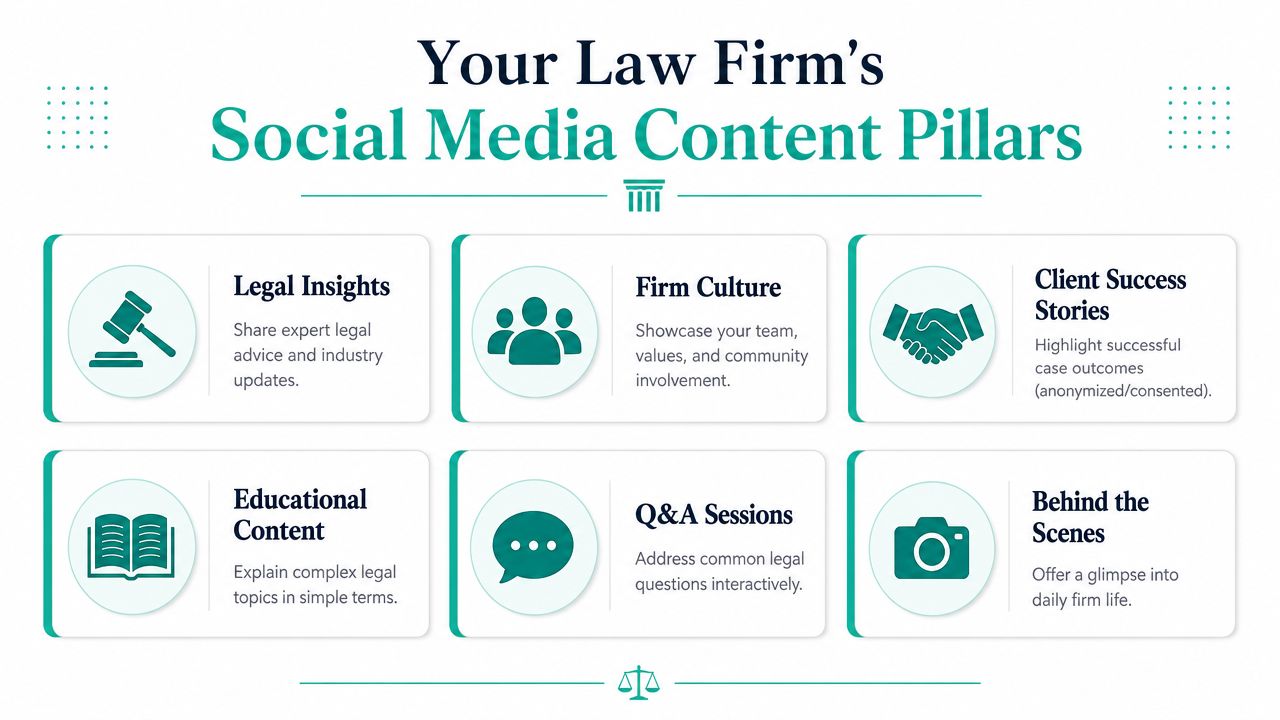
These six pillars give firms enough range without turning the feed into a random mix:
Legal insights: Brief commentary on legal developments, recurring mistakes, or procedural issues clients often misunderstand. A business attorney can explain where founders create risk in operating agreements. A family lawyer can clarify what courts examine in custody disputes.
Educational content: Plain-English guidance that lowers anxiety and helps people know what to expect. Posts like “What happens after an arrest?” or “What documents should you bring to a probate consultation?” usually build more trust than generic self-promotion.
Client success stories: Use these with restraint and only where the facts, consent, and local rules allow it. The stronger angle is often the process, the strategy, or the problem solved. Not victory-lap copy.
Firm culture: Introduce attorneys and staff, highlight training, community service, professional recognition, or milestones that show the firm is stable and credible.
Q&A content: Pull real questions from consultations, intake calls, seminars, and referral conversations. Those questions are usually better than brainstormed social prompts because they reflect actual client uncertainty.
Behind-the-scenes content: Show preparation and standards. Trial prep sessions, CLE attendance, case strategy meetings without client details, and event setup often signal seriousness better than polished brand statements.
A simple test helps here. If a post would make a good referral source more comfortable sending a matter to the firm, it belongs on the calendar. If it only fills space, cut it.
Here is what that mix can look like in practice:
Content Type
What It Builds
Example
Educational explainer
Trust and clarity
“Three things to bring to your first estate planning meeting”
Attorney perspective
Authority
“How employers can reduce wage and hour risk during onboarding”
Community post
Local credibility
Photos from a bar event, charity partnership, or neighborhood sponsorship
Team spotlight
Human connection
“Meet our intake coordinator and what clients can expect on the first call”
Ethical success story
Social proof
“How we helped a business owner resolve a contract dispute efficiently”
FAQ post
Engagement and relevance
“Can grandparents seek visitation rights?”
Useful firms usually outperform loud firms on social. For legal services, that matters more.
Turn ideas into a workable calendar
A content plan fails when it asks attorneys to create from scratch every few days. The firms that stay consistent usually work from a repeatable monthly process, not last-minute requests.
Posting cadence should match the firm's capacity to produce thoughtful, reviewed content. Hootsuite's guidance on social media frequency suggests consistency matters more than overposting, especially when each post needs quality control and audience fit (Hootsuite's posting frequency guide). For most firms, a modest schedule on one or two channels is enough if the content is useful and the review process is realistic.
Batching solves the workload problem. One strong attorney interview, one list of intake FAQs, and one community event can become several posts across a month.
A practical monthly workflow looks like this:
Collect raw material: Gather intake questions, recurring client misunderstandings, legal updates, speaking topics, community photos, and attorney commentary.
Sort each idea by pillar: This keeps the calendar balanced and prevents three weeks of self-promotional posts.
Draft in batches: Write several captions, outlines, or video prompts in one sitting. That saves time and improves consistency of tone.
Review before scheduling: Confirm wording, disclaimers, confidentiality, and whether any claim needs support or softening.
Schedule the approved posts: Use tools such as Buffer, Hootsuite, or Sprout Social so the calendar does not depend on someone remembering to post between hearings.
The calendar itself can stay simple. A Google Sheet or Airtable board is enough if it tracks:
Platform
Post date
Content pillar
Draft copy
Visual asset needed
Reviewer
Call to action
Status
For firms with several attorneys, the calendar also does quiet internal work. It sets expectations, spreads visibility fairly, and stops social media from becoming a stream of one-off requests from the loudest person in the partnership.
Leave a little room for timely posts. Build the calendar around recurring themes first. That is how firms stay visible without slipping into shallow volume chasing.
Navigating Attorney Advertising and Ethical Rules
For law firms, ethics is not a side note in social media. It is the operating system.
The firms that stay consistent online are usually not the firms taking the biggest creative swings. They are the firms with clear internal rules. They know what can be posted, who approves it, how to respond to public questions, and when to say nothing.
Treat every post like public-facing firm communication
A social post may feel informal. Regulators and complainants won't see it that way.
If the post promotes the firm, discusses outcomes, invites contact, or speaks to legal issues in a way that could influence hiring decisions, treat it like attorney advertising. That means the content should be accurate, supportable, and reviewed with the same discipline you would apply to website copy.
The most common risk areas are familiar:
Promises and guarantees: Avoid language that implies a result is assured.
Misleading comparisons: Be careful with claims that suggest superiority unless you can support them and your rules allow them.
Client confidentiality: Even “harmless” details can identify a client when combined with timing, location, or facts.
Testimonials and past results: These often require special caution, disclosures, or both.
Jurisdiction issues: Make it clear where the attorney is licensed when needed.
Informal legal advice: A post can drift from education into specific guidance faster than many lawyers realize.
Good disclaimers help, but they do not fix bad content. “This is not legal advice” is useful when paired with educational content. It does not cure a post that is misleading, too specific, or noncompliant under local rules.
A safer posting style sounds like this:
“General information only”
“Results depend on the facts of each matter”
“Prior outcomes do not guarantee a similar result”
“Contact our office to discuss your specific situation”
It does not sound like this:
“We win these cases”
“You will get compensation”
“Message us and we'll tell you what to do”
“This kind of case is easy to beat”
Compliance lens: If a post would make you uncomfortable on firm letterhead, it probably doesn't belong on social media either.
Use clear boundaries in comments and messages
Many otherwise careful firms slip here.
Someone comments on a Facebook post about divorce and asks, “My spouse moved out with the kids yesterday. Can I change the locks?” An employment lawyer gets a LinkedIn message with a termination letter attached. An immigration prospect sends dates, locations, and family details through Instagram DM.
The wrong response is to answer substantively in public or to start analyzing the facts in direct messages.
The better response is short, professional, and controlled:
Thank them for reaching out.
State that you can't provide legal advice through comments or DMs.
Direct them to the proper intake channel.
Avoid saying anything that suggests representation has begun.
A clean response might be: “Thanks for your message. We can't provide legal advice in comments or direct messages. If you'd like to discuss your situation, please contact our office through the intake form on our website.”
That protects the firm and the person asking for help.
It also reinforces trust. People notice when a firm behaves carefully online. In legal services, caution often reads as professionalism.
Measuring Performance and Proving Real ROI
A managing partner looks at the monthly social report and sees rising impressions, more followers, and a post that drew plenty of likes from other lawyers. Then intake reports show no meaningful change in retained matters. That gap is common. It usually means the firm is measuring visibility instead of business impact.
For law firms, ROI rarely comes from viral reach. It comes from trust built over time, stronger recall with referral sources, and a small number of high-intent inquiries that fit the firm well. A post that sends two good referral partners to your profile can matter more than one that gets broad local engagement from people who were never likely to hire or refer.
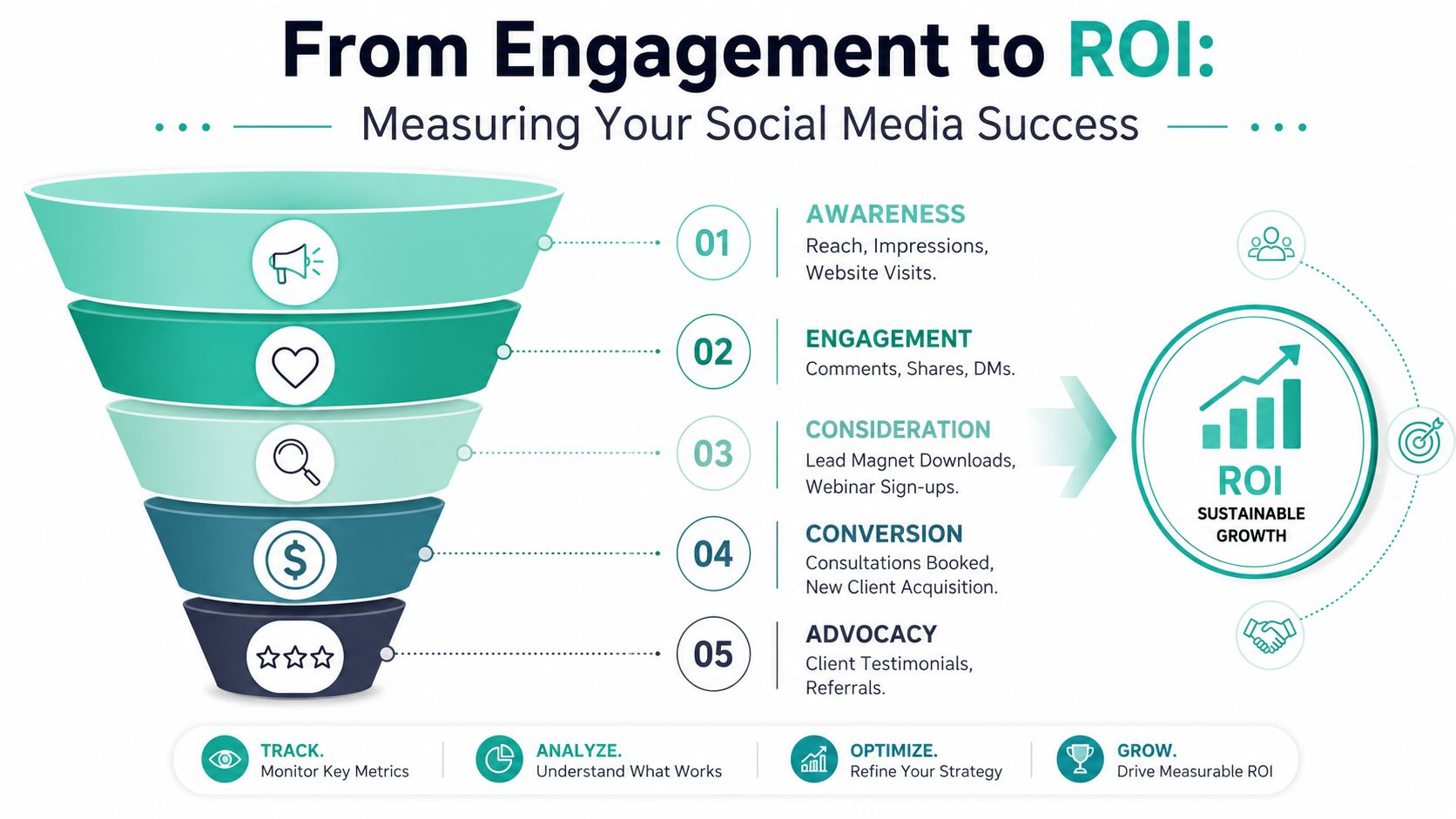
Track business signals, not vanity metrics
The reporting standard should be simple. Measure what shows intent, trust, and revenue potential.
Useful metrics include:
Website clicks: Focus on practice area pages, attorney bios, and contact pages.
Consultation requests: Track inquiries that originated from social posts, profile links, or social-assisted visits.
Qualified direct messages: Count messages that show a real legal issue or a credible referral opportunity.
Referral-source engagement: Note comments, reposts, private outreach, or profile visits from accountants, therapists, physicians, former clients, and other attorneys.
Content-assisted intake: Record when a prospect says they saw a lawyer's video, post, or commentary before reaching out.
Retained-matter quality: Look at fit, case value, and conversion to signed engagement, not just raw lead count.
Many firms falter in this regard. They count every inquiry the same way. A rushed intake from a poor-fit matter and a referral from a respected professional contact do not carry equal value.
Use intake attribution with more discipline. Ask every lead how they found the firm, then ask one follow-up question if the answer is broad. “Social media” is not enough. “LinkedIn post from your employment partner” or “saw your custody video, then searched your firm” is useful. That level of detail shows which content earns attention from the right people.
Build a practical review loop
A law firm does not need a complicated attribution model to improve social performance. It needs a repeatable review process and someone who owns it.
HubSpot's digital marketing research points to a simple operating habit: publish consistently, review performance by content type, adjust, and test again through the next cycle in this HubSpot digital marketing survey resource.pdf). That approach fits legal marketing well because it keeps the team focused on patterns instead of one-off spikes.
A monthly review should answer a short list of business questions:
Question
Why It Matters
Which posts led to consultations or screened intake calls?
Shows what drives real inquiry, not passive engagement
Which posts attracted referral partners or past clients back into the conversation?
Identifies trust-building content with downstream value
Which topics produced poor-fit leads?
Helps reduce intake waste and sharpen positioning
Which formats consistently underperform?
Tells the team where to stop spending time
Which calls to action led people to the proper intake path?
Improves conversion without creating compliance risk
The patterns are usually clear within a few months. FAQ-style education often supports conversion because it reduces uncertainty. Attorney commentary on legal developments often performs well with referral sources and professional peers. Community posts can help local recognition, but they should support the brand, not carry the whole strategy.
That last point matters. For high-trust legal services, the best social program often produces fewer leads than a broad consumer campaign, but better ones. Fewer poor-fit inquiries means less intake drag, fewer awkward consultations, and more time spent on matters the firm prefers. That is a stronger return than a report full of activity with no effect on revenue or referral quality.
Actionable Resources and Checklists for Your Firm
Most law firms don't need a bigger social strategy document. They need a smaller execution system.
That system should help the firm publish consistently, review quickly, and avoid the most common mistakes.
A pre-publication checklist
Before any post goes live, run through this list:
Accuracy check: Is every factual statement true, supportable, and current?
Confidentiality check: Could anyone identify a client from the details, image, timing, or context?
Advertising check: Does the post need a disclaimer or labeling under your jurisdiction's rules?
Advice check: Does it stay general, or does it drift into specific legal guidance?
Tone check: Does it sound professional, measured, and consistent with the firm brand?
Jurisdiction check: If the post could imply licensure or availability, is that clear enough?
CTA check: Does it direct people to the proper contact path instead of encouraging back-and-forth legal analysis in comments?
A designated reviewer should own that process. If everyone can approve, no one really does.
Tools that make execution easier
A lean stack is enough for most firms:
Buffer or Hootsuite: Useful for scheduling and maintaining consistency.
Sprout Social: Helpful when the firm wants stronger reporting and team workflows.
Canva or Adobe Express: Good for branded graphics, quote cards, and carousels.
Google Sheets or Airtable: Enough for an editorial calendar and approval tracking.
Your intake system or CRM: Necessary for tying social activity to actual consultations and retained matters.
If a firm wants outside help, Leaping Lemur Media offers social media management as one option alongside internal tools and freelance support. The right choice depends on whether the firm needs strategy, production help, review discipline, or day-to-day posting capacity.
The strongest law firm social media marketing programs are not flashy. They are consistent, compliant, and useful. They make the firm easier to trust. For legal services, that's what turns visibility into better referrals and better matters.
If your firm wants a clearer social media process that supports compliant growth, Leaping Lemur Media can help build a strategy that fits your voice, your audience, and the way your practice works.