
A lot of practices reach a point where the business is healthy, referrals are steady, and the owner has built a strong reputation, but the brand still looks like it belongs to an earlier chapter. The website feels dated. The logo still reflects what the practice looked like years ago. The signage, social media, intake forms, and front-desk materials don't feel like they belong to the same business.
That gap creates friction.
A prospective patient or client may hear great things about your dental practice, medspa, or law firm, then land on a website that feels generic, inconsistent, or unclear. They won't usually say, “Your branding cost you this lead.” They'll just hesitate, compare you to someone else, and move on. That's why small business branding services matter more than many owners realize. They shape first impressions, reduce uncertainty, and make a strong reputation easier to believe before someone ever calls your office.
Table of Contents
- Is Your Practice's Brand Keeping Up with Its Reputation
- The Core Components of Professional Branding Services
- Typical Deliverables Timelines and Pricing
- Measuring the ROI of a Strong Practice Brand
- How to Choose the Right Branding Partner for Your Practice
- Branding in Action Scenarios for Professional Practices
- Frequently Asked Questions About Branding Services
Is Your Practice's Brand Keeping Up with Its Reputation
A common scenario looks like this. A dentist has an excellent chairside manner, a loyal patient base, and a schedule that stays full. A law firm has built trust through years of good outcomes and referrals. An eye doctor has invested in better technology and a better patient experience, but the brand still feels pieced together from old decisions.
The problem isn't vanity. It's mismatch.
When a practice delivers a premium experience but presents itself like a commodity, new prospects feel the disconnect immediately. They may not know why your competitor feels more established or more trustworthy. They just know one practice feels clearer, more polished, and easier to choose.
That's where branding stops being an artistic exercise and becomes an operational one. In a 2026 branding roundup on consistency and revenue impact, 68% of companies said brand consistency added 10–20% to revenue growth, with some reporting up to a 23% revenue increase from consistent branding efforts. For a service business, that matters because consistency influences trust before the first appointment, consultation, or call.
Practical rule: If your reputation has improved but your brand hasn't, your marketing has to work harder than it should.
For professional practices, reputation often grows faster than presentation. Owners stay focused on clinical quality, legal work, hiring, operations, and patient care. Branding gets delayed because it feels less urgent than opening another treatment room or improving intake flow. That's understandable. It's also why many successful firms and practices eventually hit a ceiling in perception before they hit a ceiling in capability.
A solid brand closes that gap. It helps the outside of the business match the inside.
That means your website, patient handouts, signage, social profiles, ad creative, and front-desk experience all reinforce the same message. Not because uniformity is fashionable, but because consistency reduces doubt. And in dentistry, medspa marketing, and legal services, doubt is expensive.
The Core Components of Professional Branding Services
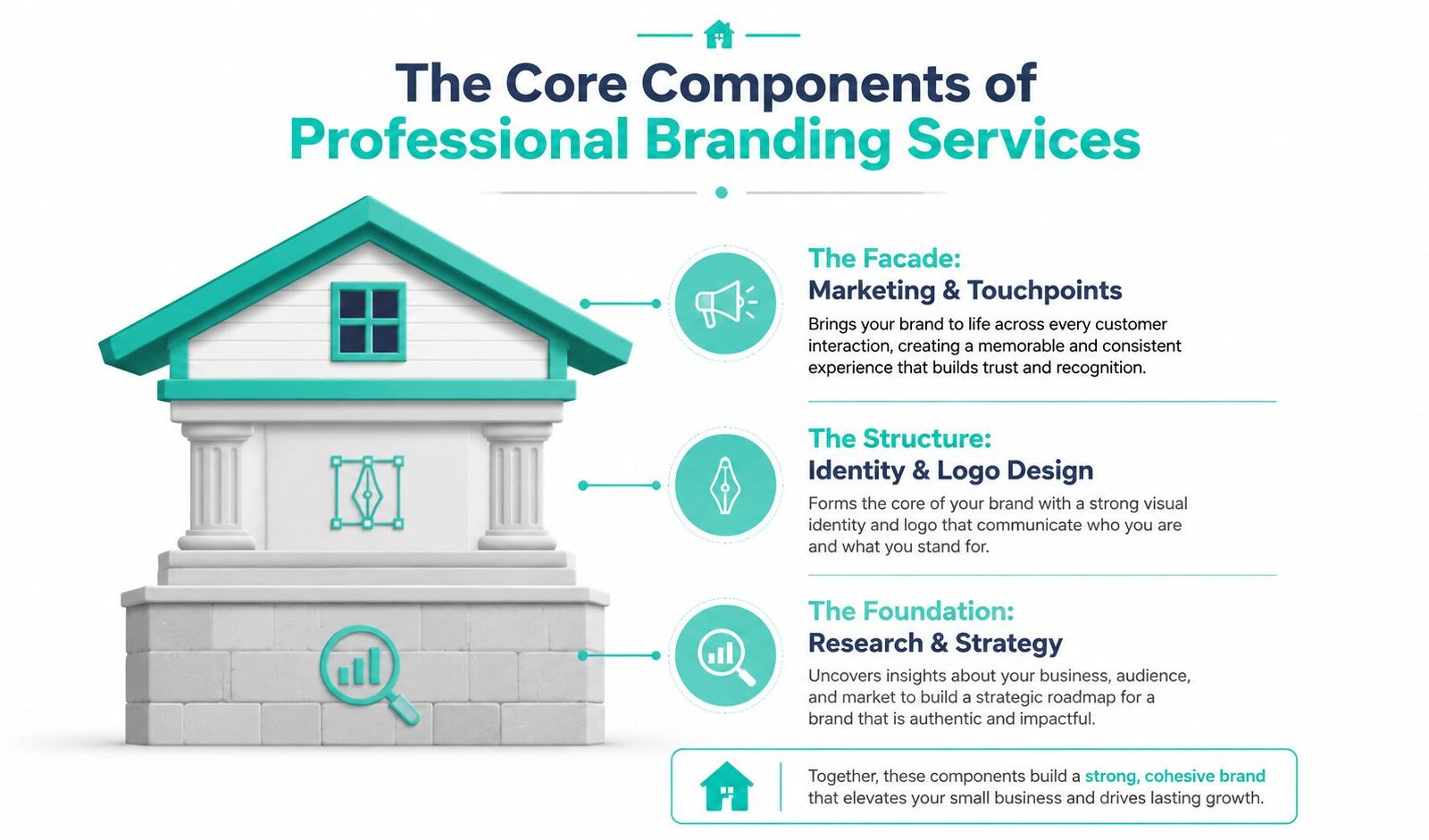
Most owners hear “branding” and think logo, colors, and maybe a new website header. That's too small. Good small business branding services work more like designing and building a custom home. You don't start with backsplash samples. You start with a blueprint.

Strategy comes first
The foundation is brand strategy. In this phase, the practice defines its market role, ideal audience, differentiators, and the promise it wants prospects to remember. Brandville's overview of branding services notes that a practical service stack includes positioning, visual identity, messaging, website and touchpoint branding, and rollout support, and that this order matters because the brand should define market role and differentiation before execution begins, as explained in their breakdown of expert branding services for small businesses.
Without that strategic layer, design work often turns into decoration. A medspa might look luxurious but say nothing clear about its expertise. A law firm might sound authoritative but also distant or intimidating. A dental office might claim to serve everyone and end up resonating with no one in particular.
A useful strategy package usually includes:
- Positioning statement: The clearest expression of where you fit in the market.
- Audience clarity: Who you want more of, and who you don't need to chase.
- Brand pillars: The few themes your messaging should keep returning to.
- Implementation standards: Rules that keep future content from drifting off-brand.
The visible and verbal system
Once strategy is solid, the visual and verbal parts can do their job.
Visual identity includes the logo system, typography, color palette, image style, layout direction, and brand guidelines. This is the architecture and interior design of the house. It gives the business a recognizable shape.
Brand messaging and voice decide how the practice sounds. That includes homepage copy, service descriptions, tagline options, intake language, social media voice, and even how the front desk confirms appointments. A family law firm, for example, may need to sound calm and capable rather than aggressive. A cosmetic dentist may need language that feels premium without sounding self-important.
Naming matters less often for an established practice, but it becomes vital during a launch, merger, or specialty repositioning. A weak name creates confusion that even strong design can't fully fix.
The brand should answer three questions fast. What do you do, who is it for, and why should someone trust you?
For many practices, the next layer is touchpoint design. That's where branding shows up in the physical world. The website, welcome packet, business cards, office signage, social templates, paid ads, and printed forms all need to feel like one business.
Where branding meets growth
This is the point many agencies skip. They hand over files, then disappear.
Rollout support matters because most brand problems occur after launch, rather than during concept development. Teams start improvising. A vendor updates signage without guidelines. A staff member creates social graphics that do not match the new look. The website copy slides back into old language. Consistency breaks down without anyone noticing.
That's why branding has to connect to implementation. If you're also thinking about campaign execution, Cloud Present's piece on demand generation through branding campaigns is a useful companion read because it shows how brand clarity supports outreach, not just appearance.
And if the project includes translating the brand into digital assets, a dedicated brand and design service should cover more than logo files. It should create standards your internal team, printer, website developer, and ad manager can use.
Typical Deliverables Timelines and Pricing
Branding projects feel opaque when proposals are vague. Owners see a line item for “brand package,” but they can't tell what's included, how deep the process goes, or whether they're paying for strategy or just production. The easiest way to evaluate small business branding services is to look at the actual deliverables.
What you should expect to receive
A solid branding engagement usually produces a mix of strategy documents, design assets, and rollout tools. The exact list depends on scope, but most worthwhile projects include some version of the following:
- Strategy documents: Positioning, audience definitions, competitor context, brand pillars, and tone guidance.
- Identity files: Primary logo, alternate logo marks, color palette, typography system, and usage rules.
- Messaging tools: Tagline options, key messaging, service-page direction, boilerplate copy, and voice examples.
- Touchpoint assets: Website design direction, social templates, print collateral, signage guidance, and intake or presentation materials.
- Rollout resources: Brand guidelines, file organization, vendor instructions, and launch sequencing.
If a proposal lists only “logo, colors, and fonts,” that's not a branding system. It's a design starter kit.
Sample Small Business Branding Packages 2026 Estimates
| Package Tier | Best For | Key Deliverables | Typical Price Range |
|---|---|---|---|
| Brand Foundation | Established practice with inconsistent visuals or messaging | Brand discovery, positioning summary, logo suite, color palette, typography, mini style guide, homepage messaging direction | Lower to mid four figures |
| Practice Growth | Practice preparing for expansion, new services, or a stronger market position | Deeper strategy work, full visual identity, messaging framework, website wireframe direction, social templates, print collateral standards, brand guidelines | Mid to upper four figures |
| Complete Brand Overhaul | Mature practice with outdated positioning, fragmented touchpoints, or post-merger complexity | Full positioning work, naming support if needed, comprehensive identity system, messaging architecture, website brand direction, office collateral system, launch support, vendor coordination | Upper four figures to five figures and above |
These are directional ranges, not fixed market rates. Pricing changes based on who's doing the work, how much research is included, how many decision-makers are involved, and how many touchpoints need updating.
A website often sits right behind the brand project in the investment sequence, because once the positioning and messaging are clarified, the site needs to reflect them. If you're budgeting both at once, it helps to review how a website development process for practices typically fits into the rollout.
What changes the price
Three things usually move the budget more than anything else.
First, strategy depth. A practice with one owner and a clear niche is simpler than a firm with multiple partners, locations, or service lines. Alignment takes time.
Second, application count. Rebranding a logo is one task. Rebranding a logo, signage, website, intake packet, presentation deck, and ad templates is another.
Third, decision friction. The fastest projects have one or two final decision-makers. The slowest ones involve committees, unclear preferences, and repeated subjective revisions.
A cheaper branding project often becomes expensive later when the team has to redo the website, rewrite the messaging, and rebuild files no one can use.
As a practical benchmark, most branding work moves in weeks, not days. If someone promises a full strategic rebrand almost immediately, they're usually compressing discovery, reducing stakeholder input, or skipping the harder thinking entirely.
Measuring the ROI of a Strong Practice Brand
For a service business, the right question isn't whether the new brand looks better. It's whether it makes the practice easier to trust, easier to choose, and easier to recommend.

A useful framing comes from Green Will Techs, which argues that the key issue for service businesses is how branding services translate into measurable business outcomes, and that consistent branding across touchpoints can affect KPIs such as call volume, booked consultations, no-show reduction, and referral rates, as discussed in their article on small business branding mistakes and how to fix them.
What to measure after a rebrand
A strong brand tends to improve business performance in ways owners can clearly observe. Not every effect shows up on a spreadsheet in week one, but the patterns become visible.
Look at metrics such as:
- Lead quality: Are you getting more inquiries from people who fit the services you want to grow?
- Consultation conversion: Are more prospects showing up ready to move forward because the practice already feels credible?
- Referral confidence: Are existing patients or clients sending others to a business that presents itself as professionally as it performs?
- Price resistance: Do prospects ask fewer defensive questions because the value feels clearer from the start?
- Team alignment: Does the staff describe the practice the same way, or does every person improvise?
Branding often changes the pre-conversion stage first. The caller feels more certain. The website visitor understands the offer faster. The patient walking into the office gets the same impression they got online.
How branding improves other marketing channels
Branding doesn't replace marketing. It makes marketing work better.
If you're investing in local visibility, paid ads, social media, referral campaigns, or content, your brand affects how well those channels convert. Better targeting helps, but clarity matters just as much. A sharp local SEO program can bring the right traffic, but if the site and messaging don't inspire confidence, you've only improved the number of people who leave unconvinced. That's why brand work and local search strategy for practices usually perform better together than separately.
Branding is an operational trust system. It lowers friction before your team ever gets the chance to sell.
This is especially true for professional services where buyers can't fully evaluate quality in advance. A patient can't judge clinical skill from a homepage alone. A legal client can't easily compare firms based on technical expertise. They use signals instead. Clarity, tone, consistency, and polish become part of the trust calculation.
How to Choose the Right Branding Partner for Your Practice
Most practice owners start by looking at portfolios. That's reasonable, but it's not enough. Attractive work can still come from a process that misses your market, ignores your team, and produces a brand that looks polished but doesn't help the business grow.

The more important question is whether the partner can create consistency across the full experience. Tailor Brands reports that 90% of users expect a similar brand experience across all channels, which is why execution discipline matters so much for service businesses, as noted in their branding statistics overview.
Questions worth asking before you sign
Ask direct questions. Good branding partners won't be bothered by them.
- How do you handle strategy before design? If they jump straight into logo concepts, they may be skipping the highest-value work.
- What experience do you have with professional services? A restaurant brand and a family law brand don't solve the same trust problems.
- What deliverables do we keep and control? You should leave with usable files, clear standards, and documented guidance.
- How do you build for rollout? The project should account for your website, social media, print pieces, signage, and internal use.
- Who will do the work? Some firms sell senior strategy and hand the execution to juniors without context.
- What does your revision process look like? This tells you whether they have a decision framework or just endless rounds of opinion.
One practical option in this space is Leaping Lemur Media, which offers brand strategy, identity, and design services for practices and businesses that need clearer positioning and more consistent marketing. The important point isn't the vendor name. It's whether the process matches the level of business you've built.
Red flags that show up early
Some warning signs are obvious once you know what to look for.
A partner may be wrong for your practice if they:
- Lead with mood boards only: Visual taste isn't a substitute for market clarity.
- Use generic intake questions: Professional practices have regulatory, reputational, and trust-specific concerns that require more depth.
- Can't explain success beyond aesthetics: If they can't connect branding to conversion behavior, they may be solving the wrong problem.
- Avoid implementation talk: The brand has to survive outside the presentation deck.
- Promise instant answers: Good positioning usually involves trade-offs, not quick slogans.
Choose the team that asks better business questions, not the team that shows the flashiest mockups first.
The best partner acts like a strategist and translator. They pull the strongest parts of your practice into language, visuals, and systems your market can understand quickly.
Branding in Action Scenarios for Professional Practices
A cosmetic dentist with the wrong first impression
A dentist may be clinically excellent at veneers and smile makeovers, yet the practice still looks like a general office from a decade ago. The website emphasizes insurance, the photography feels generic, and the logo says nothing about the premium experience inside the office. Prospective cosmetic patients don't feel the difference, so they compare on convenience or price.
After a focused rebrand, the practice presents itself with sharper positioning, more refined visuals, and messaging that reflects aesthetic expertise. The result is often a better match between what the practice wants to sell and what new patients expect when they arrive.
A family law firm that needed warmth
Some law firms look competent but emotionally inaccessible. That's a problem in family law, where the client often feels overwhelmed before they ever schedule a consultation.
A better brand doesn't make the firm look soft. It makes the firm look steady, clear, and humane. Warmer language, more approachable photography, and a calmer visual system can improve the quality of incoming calls because the right clients feel understood before speaking to anyone.
A medspa stuck in price competition
Many medspas blend together because they borrow the same luxury cues without defining a point of view. If the market sees no meaningful difference, prospects start comparing packages and promotions.
A stronger brand gives the business a more defensible position. It may emphasize medical oversight, treatment planning, results-focused care, or a specific client experience. Once that promise becomes clear across the website, consult flow, and in-office materials, the medspa has a better chance of attracting buyers who care about fit and trust, not just discounts.
Frequently Asked Questions About Branding Services
Do successful practices really need branding work
Yes, sometimes success is the reason to do it. A practice that's grown through referrals can coast on reputation for a while, but growth usually exposes inconsistencies. Branding helps protect the position you've earned and makes future marketing easier to convert.
Is a cheap logo tool enough
Usually not. A cheap logo tool can generate a mark, but it can't create positioning, voice, audience clarity, or touchpoint standards. The logo is only one piece of the system.
How much time will it take from my team
Less than owners often fear, but more than zero. You'll need time for discovery, feedback, and decision-making. The smoothest projects usually have one clear internal lead and a short approval chain.
For practices trying to connect branding with broader visibility efforts, it helps to think beyond isolated tactics. MD TECH TEAM offers a useful overview of building a local digital marketing system that complements brand work by showing how consistent messaging supports local outreach.
Branding is worth doing when the outside of your business no longer reflects the quality of what happens inside. That's the moment to fix the gap before it starts costing you trust.
If your practice has outgrown its current identity, Leaping Lemur Media can help you translate reputation into a clearer brand system that supports trust, differentiation, and growth. The work should leave you with more than a better logo. It should leave you with a brand your team can use consistently across the places patients and clients make decisions.