Eye Doctor Marketing: A Nashville Playbook for 2026

You're probably feeling this right now. You know your practice delivers good care, your patients trust you, and your team works hard. But when someone in East Nashville, Green Hills, Franklin, or Brentwood searches for an eye doctor, another practice keeps showing up first, and your schedule still has openings you'd rather not see.

That gap usually isn't a clinical problem. It's a visibility problem, a positioning problem, or a follow-up problem. Most Nashville eye doctors don't need “more marketing” in the abstract. They need a system that helps the right patients find them, understand what makes the practice different, and book without friction.

Table of Contents

Your Nashville Practice Deserves to Be Seen

A Nashville optometrist can do everything right inside the exam room and still struggle to grow. The front desk is kind. The doctor is thorough. Patients leave happy. Then a new family moves into 12 South, searches on Google, sees a competitor with a cleaner profile, better reviews, and clearer service pages, and books there instead.

That's why eye doctor marketing matters more than it did a few years ago. The opportunity is real. The U.S. vision care market was estimated at USD 37.2 billion in 2025 and is projected to reach USD 71.5 billion by 2035, with a projected CAGR of 6.7%, according to Future Market Insights on the U.S. vision care market. That growth is tied to aging populations and rising screen-related eye strain, which means more people are actively looking for exams, medical eye care, and preventive support.

For a local practice, that doesn't mean you need flashy campaigns. It means the demand is there already. Your job is to make sure patients in Nashville can find you before they choose the easier, louder, or more convenient-looking option.

Practical rule: In a growing market, visibility gaps get more expensive. If a patient can't quickly understand what you do, where you are, and how to book, they move on.

The practices that win in Nashville usually don't win because they market everywhere. They win because they show up clearly in the places their patients already check. Google. Reviews. Local recommendations. A fast website on mobile. A service page that matches the patient's actual concern.

That's good news. It means growth is usually less about reinvention and more about alignment. When your local presence, website, and follow-up all work together, eye doctor marketing stops feeling scattered and starts producing steady momentum.

Defining Your Ideal Nashville Patient

Most practices make marketing harder than it needs to be because they target “everyone who needs an eye exam.” That sounds logical, but it creates bland messaging. A Nashville parent in Brentwood, a young professional in The Gulch, and a retiree near Belle Meade don't search the same way, worry about the same things, or respond to the same offer.

A better approach is to define patients by local context. Neighborhood, life stage, family setup, work habits, and likely eye-health concerns matter more than a generic persona template downloaded from the internet.

A diagram outlining key factors for defining an ideal Nashville patient for eye doctor marketing strategies.

Start with neighborhoods, not generic personas

Nashville is not one audience. It's a collection of micro-markets.

A practice near downtown may see more young professionals dealing with screen fatigue, contact lenses, and convenience-driven booking behavior. A practice serving Franklin or Brentwood may attract more families asking about pediatric exams, school-year scheduling, and whether the office feels calm and organized for kids. A clinic with a stronger medical focus may draw older adults who care less about frames on Instagram and more about trust, diagnosis, and continuity.

Use a simple worksheet and build two or three profiles around what your staff already hears every day.

  • Neighborhood context
    Write down where your best patients live and work. Don't just list your city. Note whether they come from Green Hills, East Nashville, Franklin, Hendersonville, or nearby office corridors.

  • Daily life triggers
    Identify what pushes them to act. Parents often move when school routines kick in. Office workers tend to act when symptoms interrupt work. Older patients often book when another provider refers them or when vision changes affect daily life.

  • Decision style
    Some patients call. Some book online late at night. Some compare reviews carefully before they ever reach out. Your marketing should match the way they prefer to decide.

Build patient profiles your team can actually use

The best profiles are short enough that your front desk, doctor, and marketing partner can all use them without overthinking.

Here's a practical format:

Profile What they care about What they search for What helps them choose
Young professional in The Gulch Convenience, digital eye strain, modern experience screen-related symptoms, contact lenses, eye exam near work online booking, mobile-friendly site, clear hours
Family in Brentwood or Franklin pediatric care, scheduling ease, trust kids eye exam, family eye doctor, school-year reminders family-friendly messaging, reviews, simple insurance and booking info
Older adult in Belle Meade or nearby medical expertise, continuity, specialty support dry eye, glaucoma co-management, diabetic eye exam specialist pages, doctor credibility, clear care pathways

A good profile also includes digital behavior. Where does that patient spend attention? Some respond to Google Search. Some notice local Facebook activity. Some rely heavily on referrals from schools, pediatricians, or neighbors.

If your team can't answer “Who is this page for?” in one sentence, the message is probably too broad.

One more point matters here. Modern optometry isn't limited to routine exams. Review of Optometric Business reported projections showing routine exams rising from 111 million in 2020 to more than 113 million by 2030, while medical eye exams were projected to grow from 60 million to over 76 million, nearly 27% growth. That same projection included growth in advanced diagnostic testing and cataract surgery volume. For Nashville practices, that changes who you target and how you describe your services.

If your strongest opportunities are in dry eye, myopia management, diabetic eye care, or pediatric vision, your marketing should reflect that reality. Generic “general eye care” language won't do enough lifting on its own.

Winning Local Search and Creating Content That Connects

Local visibility and useful content should work together. Too many practices treat them like separate jobs. One person updates the Google Business Profile. Someone else writes an occasional blog. The website says “full-service eye care” and hopes for the best.

That setup rarely wins against a stronger local competitor.

A magnifying glass focusing on eye clinics on a colorful illustrated city map for local SEO.

Own the local search results first

When someone searches “eye doctor East Nashville” or “optometrist Franklin TN,” they're not looking for a brand story. They want a trusted local option with clear next steps.

Start with the basics and do them well:

  • Google Business Profile completeness
    Make sure categories, hours, services, photos, and appointment options are current. Use real images of your exterior, reception area, optical, and exam spaces.

  • Location-specific website pages
    If you serve multiple parts of the Nashville area, create clear location pages or service-area content that reflects how people search.

  • Service pages tied to intent
    Don't bury dry eye, pediatric care, diabetic eye exams, or contact lens fittings on one generic page. Give each service its own page and booking path.

  • Review management
    Ask consistently, respond professionally, and don't let your most recent online impression be six months old.

If you need a cleaner framework for local optimization, this overview of SEO and local search for service businesses is a useful starting point.

Turn specialty care into patient-friendly content

Many eye care websites lose momentum because they either sound too clinical or too generic.

Patients don't search like doctors write. A person with dry eye may search for burning, watery eyes, blurry vision at the computer, or eyes feeling tired by afternoon. A parent worried about a child may search for headaches after school, squinting, or trouble seeing the board.

Your content has to translate expertise into plain language without watering it down.

One of the clearest opportunities in eye doctor marketing is specialty content. Little Rock Eye noted that specialty-service pages convert better than general “eye exam near me” queries because searchers have high intent and are already problem-aware. That matters because a Nashville practice often can't out-convenience a big-box chain, but it can absolutely out-educate and out-position one.

A strong specialty page usually includes:

  1. The symptom language patients use
    “Scratchy eyes,” “eye fatigue,” “blurred vision after screens,” or “child struggling to focus.”

  2. A simple explanation of the condition or service
    No heavy jargon in the opening section.

  3. What evaluation looks like at your office
    Patients want to know what happens next.

  4. Who the service is for
    Adults at screens, children, contact lens wearers, patients with ongoing irritation, and so on.

  5. A direct booking prompt
    Not “contact us for more information.” Give them a clear appointment action.

Strong local SEO pages answer one question well. Weak pages try to rank for everything and end up sounding interchangeable.

What works and what stalls out

What works in Nashville is relevance. If your office is near Green Hills and you have a strong dry eye offering, say that plainly. If you're convenient for downtown workers needing lunch-hour appointments, make that obvious. If your pediatric care is a real strength, build content around the parent concerns that drive bookings.

What tends to stall out looks like this:

  • A homepage trying to sell every service at once
  • Blog posts written only for keywords, not patients
  • Paid traffic sent to a generic “services” page
  • Medical services hidden under vague navigation
  • Content that talks about the practice more than the patient problem

Eye doctor marketing gets easier when the website reflects the way people search. Local pages bring in discovery. Specialty pages capture high-intent demand. Reviews reduce hesitation. Then booking becomes the natural next step.

Building Community Trust Beyond the Clinic Walls

A parent in East Nashville sees your booth at a school fundraiser on Saturday. On Tuesday, their child mentions headaches after reading. By Wednesday, that parent is searching your practice name, not just “eye doctor near me.” That is how local trust works in Nashville. It builds before the website visit.

Practices here often spend heavily on reach and treat community presence as optional. In eye care, that usually costs more than it saves. Patients want clinical skill, but they also want familiarity. They want to feel confident sending a spouse, a parent, or a child to your office.

Paid channels can bring attention fast. Community credibility changes how that attention converts. Invigo Media reports that consumers prefer buying eyewear at their doctor's office over large chains by a 2-to-1 margin. For a Nashville practice, that matters. If people already associate your name with helpful education, neighborhood involvement, and consistent care, they are more likely to book with you and more likely to buy from your optical instead of price-shopping elsewhere.

The trade-off is straightforward. Ads can fill short-term gaps in the schedule. Community trust takes longer, but it supports referrals, recall compliance, and higher-quality word of mouth.

Outreach that fits the Nashville market

The best outreach plan matches the patients you want more of and the time your team can realistically give. A practice near Green Hills may get more from parent-focused partnerships than from broad public events. A clinic serving downtown professionals may get better results from employer wellness talks, apartment community events, or screen-fatigue education sessions in The Gulch and SoBro.

A few examples work well in this market:

  • School and parent connections
    Pediatric-focused practices can build steady visibility through PTO events, school newsletters, teacher partnerships, and family-oriented community calendars in Brentwood, Franklin, and Williamson County.

  • Neighborhood festivals and pop-up events
    Street fairs, health expos, and local markets can work if your team is prepared to collect contact information, answer common questions, and follow up with a clear exam offer.

  • Workplace education
    Downtown employers, co-working spaces, and creative firms in Berry Hill often have staff dealing with dry eye, headaches, and screen strain. A short lunch-and-learn can open more doors than a month of generic social posting.

  • Review and referral follow-through
    After a strong patient visit, ask for the review while the experience is fresh. Reply with specific, human language that reflects the care your office gave.

Execution matters more than activity count. One recurring partnership with a school, church, employer, or neighborhood group usually does more for a Nashville practice than showing up once at five unrelated events.

If your team wants wider local visibility, press coverage and community placements can help reinforce that credibility. A practical public relations strategy for local brands often has a longer shelf life than another social post that disappears in a day. The same applies to follow-up. If event leads sit in a spreadsheet for a week, the opportunity is gone. A simple workflow, or even a light guide to AI-driven automation, can help your staff respond while the interaction is still fresh.

Nashville patients have choices. Independent practices win this part of eye doctor marketing by becoming known in the neighborhoods they serve, not just visible on a screen.

Turning Clicks into Patients with Automation and Ads

A lot of ad budgets get wasted because the campaign wasn't the main problem. The patient clicked. The page was confusing. The form asked for too much. The office replied the next day. By then, the patient had already booked somewhere else.

That's why paid growth only works when the system behind it is ready.

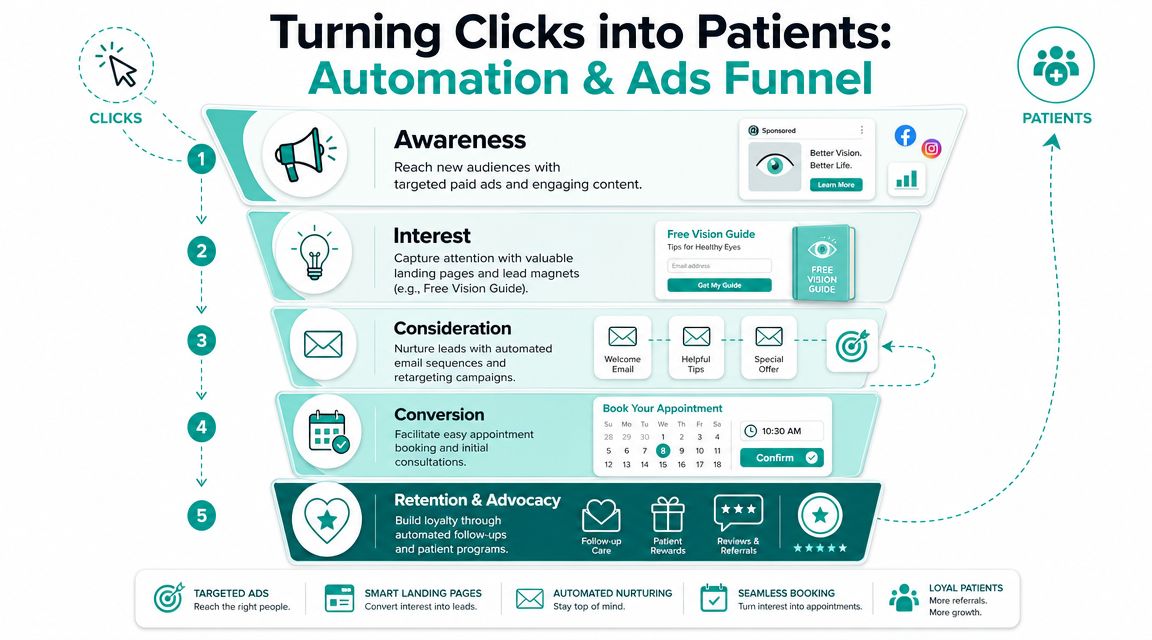
A funnel diagram illustrating an automated patient acquisition strategy for eye care practices from clicks to loyal patients.

The correct order for paid growth

The order matters more than the platform. A strong eye doctor marketing system starts with discoverability, then conversion, then retention. Cardinal Digital Marketing emphasizes that high-performing eye-care growth depends on a connected workflow across SEO, PPC, social ads, CRO, reputation management, and analytics. The common failure is sending paid traffic to a site that doesn't convert or treating ads and email like separate projects.

In practice, the sequence looks like this:

  1. Make sure local search basics are in place
    Your Google profile, reviews, and service pages should already support credibility.

  2. Send ad traffic to a focused landing page
    One page. One service. One audience. One booking action.

  3. Capture the lead cleanly
    Use a simple form, tracked phone call, or direct scheduler.

  4. Follow up automatically when needed
    Text confirmations, reminder emails, recall messages, and reactivation sequences keep demand from slipping away.

  5. Close the loop with staff training
    Automation helps, but the front desk still determines whether interest becomes a scheduled appointment.

Paid ads don't fix a broken booking experience. They expose it faster.

A simple automation flow for eye care

Most practices don't need complicated funnels. They need consistent follow-through.

A workable setup often includes:

  • New lead response
    If someone fills out a form for dry eye, pediatric care, or contact lenses, send an immediate confirmation and route the request to the right team member.

  • Appointment reminders
    Use text and email reminders tied to your scheduler so fewer people forget or delay.

  • Recall campaigns
    Reach patients due for routine care, contact lens renewals, or follow-up evaluations.

  • Reactivation
    Contact past patients who haven't returned and give them a simple way to schedule.

If you're exploring how AI can support those touchpoints without making the experience feel robotic, this guide to AI-driven automation offers practical ideas for marketers building follow-up systems.

Where paid ads fit in Nashville

Google Ads usually fit bottom-of-funnel demand. Someone searches for a service, location, or symptom and wants help soon. Facebook and Instagram can work well when the targeting and message are specific enough, especially for family care, screen-related issues, or educational offers tied to a known concern.

The mistake is trying to advertise the whole practice at once.

Instead, think in focused campaigns:

  • myopia management for parents in family-heavy areas
  • dry eye treatment for adults dealing with daily irritation
  • pediatric exam reminders tied to school routines
  • contact lens exam campaigns for younger professionals

Each campaign should have its own landing page, message, and follow-up path. If you need support coordinating campaign structure and tracking, ads management for local service businesses is one way practices organize paid acquisition more cleanly.

Good automation doesn't replace your staff. It protects their time, speeds up response, and makes sure every click has a better chance of becoming a patient.

Measuring Real Growth and Planning Your Next Steps

The easiest way to waste a marketing budget is to celebrate activity instead of outcomes. More traffic feels good. More impressions look impressive. Neither one guarantees a fuller schedule.

Track booked appointments, not vanity metrics

The benchmark that matters most is booking performance. RevolutionEHR advises optometry practices to focus on booking outcomes such as new-patient appointments, source of new patients, and inquiry-to-scheduled conversion rates, rather than traffic alone. That's the right lens for Nashville practices too.

Here are the numbers worth reviewing regularly:

  • Appointment requests
    Count web forms, calls, and online bookings separately so you can see where friction exists.

  • New-patient appointments
    This is the growth signal most owners care about.

  • Source of new patients
    Ask every new patient how they found you, then standardize the answer categories in your practice software.

  • Inquiry-to-scheduled conversion
    If leads are coming in but not booking, the problem may be response speed, front-desk scripting, or landing-page clarity.

  • Review trends and recall response
    These often reveal retention strength before revenue reports do.

  • Cost per booked appointment for paid campaigns
    This matters far more than cost per click.

A channel is only performing if it produces booked appointments you want more of.

If you're trying to make better use of automation while staying practical about budget, these Lynkro.io insights on AI for small business can help you think through where simple automation supports growth and where human follow-up still matters most.

Sample 12-Month Marketing Timeline and Budget Allocation

The right budget depends on your goals, competition, service mix, and current foundation. What matters most is sequence. Don't spend heavily on ads before your website, reviews, and service pages are ready.

Phase (Months) Primary Focus Key Activities Estimated Budget Allocation
Months 1 to 3 Foundation audit Google Business Profile, update website calls to action, improve service pages, tighten tracking, request reviews consistently Higher share toward website, local SEO, tracking setup
Months 4 to 6 Local visibility publish location-aware and service-specific content, strengthen review flow, launch recall and reactivation campaigns Higher share toward content, SEO, email and text workflow
Months 7 to 9 Paid acquisition launch focused Google Ads and selected social campaigns tied to strongest services, test landing pages and follow-up Higher share toward paid ads and conversion optimization
Months 10 to 12 Scale and refine shift spend toward best-performing services, improve inquiry handling, expand community partnerships and retention campaigns Balanced mix across ads, retention, and ongoing SEO

That table is a planning model, not a rigid formula. Some practices need to spend more time cleaning up basics. Others already have a solid base and can move into paid acquisition faster.

When to keep marketing in-house and when to get help

Keep it in-house if your team can consistently do three things well: update local listings and reviews, maintain useful website content, and follow up quickly with leads and recall patients.

Bring in outside help when one of these is happening:

  • your team is constantly reacting instead of following a plan
  • paid ads are running without clear landing pages or tracking
  • no one owns reporting
  • the website no longer reflects your actual services
  • growth depends too heavily on referrals alone

A hybrid setup is often the most realistic path. Your office keeps the patient voice, community relationships, and operational insight. A marketing partner handles strategy, execution, reporting, or channel management where your team doesn't have time or specialized skill.

That's usually when eye doctor marketing starts feeling manageable again. Not because the work disappears, but because each part of the system has an owner and a purpose.


If your Nashville practice needs help turning local visibility, content, ads, and follow-up into a more reliable patient growth system, Leaping Lemur Media works with service-based businesses on SEO, ads, websites, and brand strategy built around how real patients choose.

Scroll to Top