What Is a Meta Ad Agency & How to Hire the Right One
LE
lemur June 19, 202616 min read
You're busy running a practice, not trying to decode Meta Ads Manager between patients, staff issues, and payroll. Still, the pressure is real. You know Facebook and Instagram matter because that's where people spend attention, compare options, and decide who feels trustworthy enough to contact. But if you've tried running ads yourself, you've probably had the same reaction most owners do: the platform looks easy until your budget starts disappearing.
That's why the question has changed. It's not just “Should I run Meta ads?” It's “With Meta pushing more AI automation, do I even need a Meta ad agency anymore?”
My opinion is yes, but only if you hire the right kind. If an agency's value is just clicking buttons in Ads Manager, Meta is already squeezing that work. If the agency brings strategy, creative direction, first-party data integration, testing discipline, and business judgment, that's still valuable. For a practice owner, that difference is everything.
Your Practice Needs Patients Are Meta Ads the Answer
If your schedule has gaps, Meta ads can help. If your schedule is full but you want better-fit patients, Meta ads can help there too. The platform isn't the problem. The problem is that most practices either run ads with no clear strategy or hire someone who treats healthcare marketing like generic lead generation.
Meta works well for practices because patients don't always search the moment they're ready. A family may notice a pediatric dentist on Instagram before they ever type a search query. Someone considering LASIK might need repeated exposure before booking a consult. A medspa client often chooses the provider whose brand feels credible, polished, and familiar.
That makes Meta useful. It also makes it easy to waste money.
Most failed Meta campaigns don't fail because the platform is weak. They fail because the message is bland, the offer is unclear, or the follow-up process inside the practice breaks.
The bigger issue now is automation. Meta increasingly wants advertisers to provide the basics and let AI handle more of the execution. That sounds convenient, and in some cases it is. But convenience isn't the same as strategy. AI can distribute budget and help with delivery. It can't decide what makes your practice distinct in your market, which patient motivations matter most, or how to position a treatment in a way that feels trustworthy rather than salesy.
For a practice owner, that's the line to watch. Don't hire a Meta ad agency because you want someone to “run ads.” Hire one because you want someone who can turn attention into booked appointments and long-term patient value.
What a Modern Meta Ad Agency Actually Does
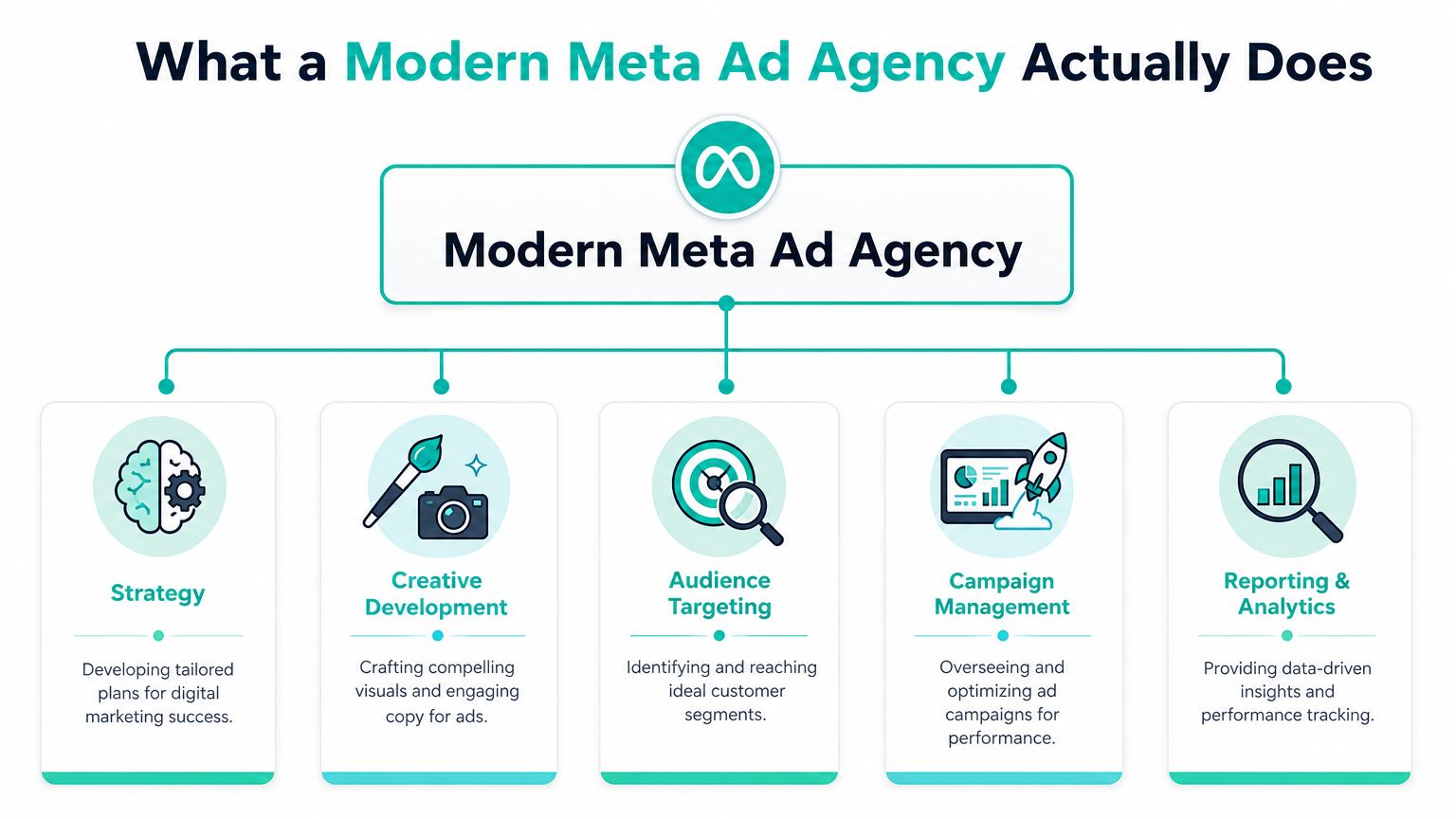
A modern Meta ad agency should be doing far more than launching campaigns and sending you screenshots. Its core job is connecting your business goals to the right message, the right audience, and the right follow-up path.
Here's the practical version of what that looks like.
Strategy
This comes first. Always.
A good agency starts by asking what kind of growth you want. More hygiene appointments and new patient exams require a different approach than LASIK consultations or injectable bookings. The campaign objective, the offer, the creative angle, and the landing experience all need to match the business goal.
A weak agency jumps straight to audiences and ad copy. A strong one defines the patient journey first.
That strategy work should include:
Offer clarity: What exactly are you asking a prospective patient to do?
Service prioritization: Which treatments are worth promoting now based on margin, demand, and operational capacity?
Market positioning: Why should someone choose your practice instead of the option down the street?
Conversion path: Will the ad send people to a landing page, a form, a call flow, or direct booking?
If you're reviewing agency options, look for a team that also understands how paid social connects to your broader marketing. Some agencies bundle ads into a wider service stack, like digital growth services for practices, while others focus only on media buying. Either can work. What matters is whether they can tie ad decisions back to patient acquisition.
Creative Development
Creative is the biggest lever most practices underinvest in. Not because they don't care, but because they confuse “nice looking” with “effective.”
Your agency should know both the message and the mechanics. For Feed placements, the standard creative specs are 1080 x 1350 pixels (4:5 ratio) or 1080 x 1080 pixels (1:1 ratio), with a maximum file size of 30 MB for images and 4 GB for videos. For Feed, Stories, and Reels, agencies also need to respect safe zones, leaving about 14% or roughly 250 pixels clear at the top, and protecting the bottom 20 to 35% on vertical formats from interface overlays. The recommended video duration is 15 to 60 seconds, with H.264 codec and AAC audio for compatibility. Clean creative still matters because Meta tends to favor ads with minimal overlay text, even though the old 20% text rule is no longer an official restriction.
That detail matters because sloppy creative gets clipped, compressed, or visually buried.
Practical rule: If your agency can't talk clearly about placements, safe zones, file sizes, and clean creative, they're not ready to manage creative at scale.
Audience Targeting
Targeting isn't dead. It's just less manual than it used to be.
A smart agency still thinks carefully about who should see the ad first, which people need retargeting, and how your own first-party data can improve campaign quality. For practices, that can mean segmenting by treatment interest, geography, patient stage, or service line. It should never mean random audience stacking because someone found an outdated tactic online.
The best agencies also understand that audience strategy and creative strategy are tied together. Different patient motivations need different ads.
Campaign Optimization
Agencies either earn their fee at this point or expose that they're basically dashboard operators.
Real optimization includes budget management, testing offers, identifying weak conversion steps, and deciding when a creative idea needs a refresh. It also means resisting the urge to make constant random edits just to look active.
Modern practitioner guidance increasingly favors testing distinct buyer motivations, often called angles, and comparing similar ads in a focused testing campaign instead of fragmenting performance across too many ad sets. That shift matters because many advertisers still follow an older playbook that breaks every idea into separate structures, which often creates more noise than insight.
Reporting and Analytics
Reporting should help you make decisions. It should not be a data dump.
You want an agency that can explain what happened, why it happened, and what they're changing next. If a report is full of reach and clicks but light on appointment quality, lead handling, or patient fit, the agency is protecting itself with vanity metrics.
A useful report answers practical questions. Did the campaign bring in the right kind of demand? Did one service line outperform another? Did the landing page or front desk process become the bottleneck? Those are business questions, not platform questions.
The Right Agency as a Growth Partner for Your Practice
The right agency for a practice doesn't think like a generic e-commerce team. You're not trying to sell impulse purchases. You're asking people to trust you with their health, appearance, comfort, or confidence. That changes the tone, the creative, and the follow-up.
Why practices need a different kind of partner
A strong practice campaign has to balance persuasion with professionalism. The ad has to feel approachable without sounding cheap. It has to create urgency without pressure. It has to attract the right patient, not just any click.
That's why the best agency relationships feel collaborative. You bring the clinical credibility, real patient questions, and operational realities. The agency turns that into a message the market can understand. If you want to know whether an agency operates with that kind of partnership mindset, their about page and philosophy usually tells you a lot before the sales call does.
Three practice examples
A dental practice often needs consistency more than novelty. One month it's new patient exams. The next it's filling hygiene gaps. A capable agency would build creative around common friction points such as insurance confusion, fear of judgment, or convenience. The ad isn't just “Book now.” It speaks to why someone has delayed care and why your office feels easier to choose.
An eye doctor promoting LASIK consultations needs a different message. That patient usually doesn't need basic awareness of the procedure. They need reassurance, credibility, and a reason to take the next step now instead of “sometime later.” The campaign should focus on motivations like freedom from glasses, lifestyle convenience, and confidence, then direct those clicks into a consult experience that feels premium and clear.
A medspa launching a new service needs precision. The wrong creative can attract discount shoppers who never become loyal clients. A better campaign positions the new treatment within your brand, shows who it's for, and uses visual storytelling that aligns with how your ideal client wants to feel.
The best healthcare ads don't sound like ads. They sound like a trusted answer to a problem the patient already has.
What ties these examples together is this: the agency's job isn't just audience selection. It's translating your expertise into a reason someone acts.
How to Evaluate and Hire Your Meta Ad Partner
Most practice owners ask the wrong opening question. They ask, “How much experience do you have with Meta ads?” That matters, but it's not enough. Plenty of agencies know the platform. Far fewer know how to tie it to scheduling realities, patient quality, staff follow-up, and long-term brand trust.
Start with how they think.
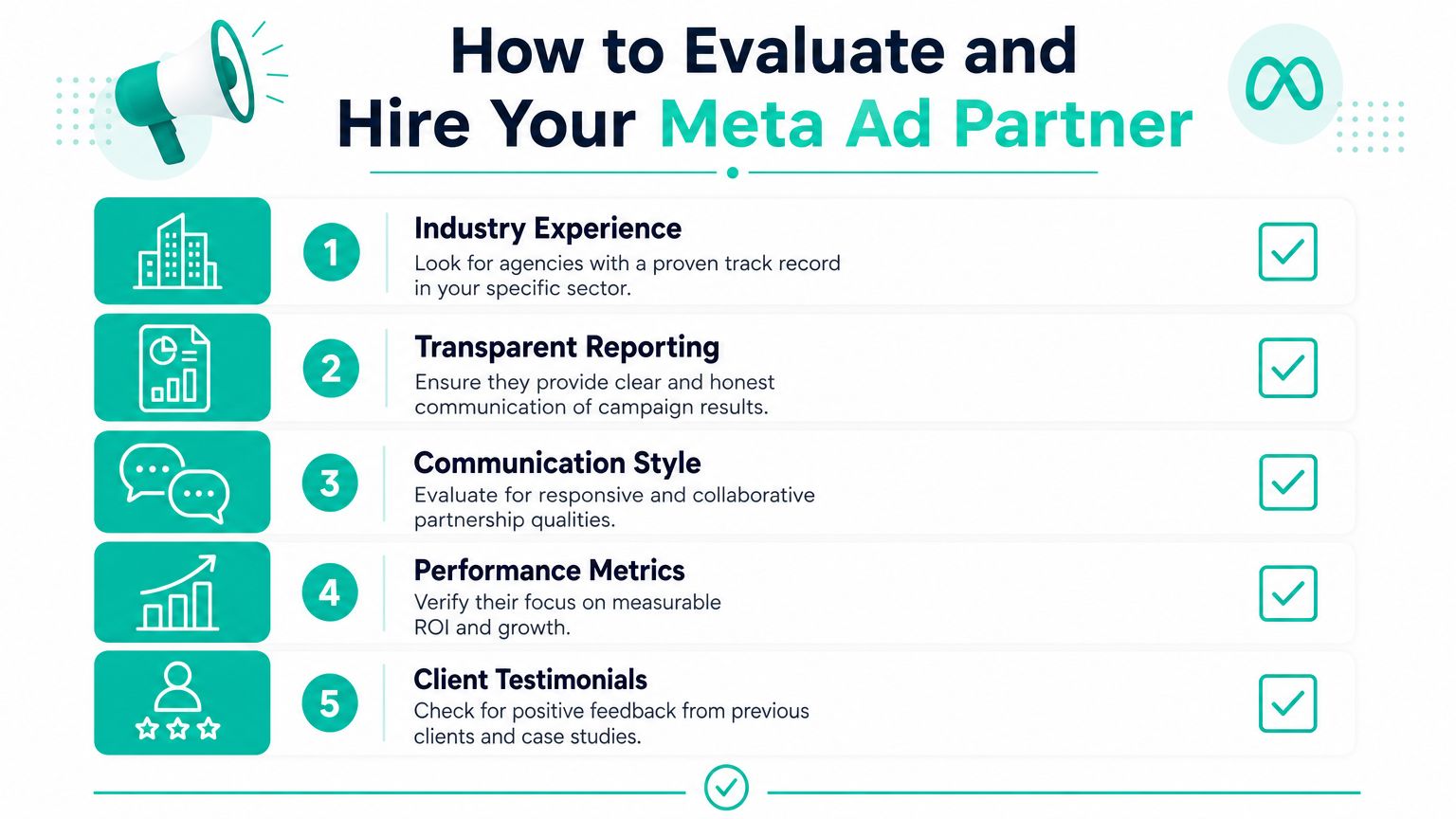
What to judge first
A strong partner should be easy to evaluate if you focus on the right signals.
Industry understanding: They don't need to work only with practices, but they should understand longer decision cycles, reputation sensitivity, and the difference between a lead and a qualified patient.
Communication quality: If they explain strategy in vague jargon during the sales process, reporting won't improve later.
Business focus: They should care about consultations, booked appointments, show rates, and service-line priorities more than vanity metrics.
Operational clarity: Good agencies have a defined onboarding process, clear ownership boundaries, and a way to gather approvals without chaos.
If you want a second perspective on vetting options, this Facebook ads agency hiring guide is a useful companion read because it frames the selection process around transparency, performance, and fit rather than hype.
Questions worth asking in every agency call
Don't ask generic questions and expect meaningful answers. Ask questions that force the agency to reveal how they operate.
How do you define success for a practice like mine beyond ROAS?
How do you decide which service lines to prioritize in campaigns?
What does your creative testing process look like?
How do you handle landing page recommendations and front-desk follow-up issues?
How often do you refresh creative, and what triggers that decision?
What would onboarding require from my team in the first month?
Who is doing the work each week?
How do you report on lead quality, not just lead volume?
A good agency will answer directly. A weak one will drown you in platform terminology.
The technical litmus test
There's one practical detail that tells you a lot about whether an agency is buttoned up or winging it.
For a Meta Ads agency to manage accounts properly, they should request Full Control access to the ad account, pixel, pages, and related assets through Business Settings. That matters because it protects data integrity, allows automated reporting systems to work correctly, and reduces the permission errors that interrupt campaign performance. The professional standard is granting access asset by asset for the specific employee, with Full Control rather than partial access.
This is not a red flag. It's usually the opposite.
If an agency asks for vague access or can't explain permissions clearly, be cautious. If they explain why Full Control is needed, how it works, and what stays under your ownership, that's a better sign.
What you should expect from a professional partner:
Clear ownership rules: Your business should retain ownership of the ad account and assets.
Specific permission requests: They should name exactly what they need access to.
Plain-language explanation: They should tell you why reporting and optimization depend on that setup.
No mystery process: If they rush this step or dodge questions, move on.
The best agencies aren't secretive about the technical side. They explain it because good partnership depends on trust.
Understanding Engagement Models and Typical Pricing
Agency pricing confuses practice owners because the same service can be packaged in completely different ways. That doesn't mean anyone is lying. It means you need to understand incentives.
Three common ways agencies charge
Monthly retainer is the simplest model. You pay a set fee each month for ongoing strategy, creative coordination, campaign management, and reporting. This is usually the cleanest setup for a practice that wants consistency and predictable budgeting.
Percentage of ad spend means the fee rises as your media budget rises. Some owners like this because it feels aligned to campaign scale. The downside is obvious. If spend goes up, fees go up, even if the workload doesn't increase at the same pace.
Project-based pricing is common for audits, account rebuilds, launch setups, or short-term creative sprints. It can work well if you already have someone internal managing campaigns and only need specialized help for a defined piece of work.
Here's the blunt advice. If you need an ongoing partner, retainers are usually easier to manage. If you need a one-time cleanup or a launch package, a project fee may make more sense. Percentage-of-spend models can work, but you need to watch incentives carefully.
Comparing Meta Ad Agency Pricing Models
Model
Best For
Typical Range (Monthly)
Pros
Cons
Monthly Retainer
Practices that want consistent management and strategic support
Brands increasing budget and wanting fees tied to spend levels
Varies by ad spend and contract structure
Scales with campaign size, familiar model in paid media
Incentives can tilt toward spending more
Project-Based
Audits, launches, rebuilds, or temporary support
Varies by deliverables
Clear start and finish, good for defined needs
Not ideal for ongoing optimization
A few recommendations matter more than the pricing model itself:
Ask what's included: Creative strategy, landing page input, reporting, and meetings are not always bundled.
Clarify revision limits: Especially for creative and copy.
Check contract flexibility: A long contract with vague deliverables is a bad combination.
Tie fees to real scope: A practice with one location and one core service line shouldn't be paying for an enterprise process it won't use.
Cheap agency pricing usually means one of two things. Minimal strategy, or heavy account load with little actual attention on your business.
Price matters. Fit matters more.
The Agency's Role in a World of AI Advertising
Meta's direction is clear. The platform wants more automation in creative generation, copy, targeting, and budget optimization. Industry analysis has framed the issue well: if advertisers can provide a product image and a budget while AI handles more of the execution, the agency's value has to move beyond “we manage ads” and toward incrementality testing, first-party data integration, landing-page optimization, and media-mix decisions as discussed in Artefact's analysis of Meta and agency relevance.
That shift is healthy. It exposes weak agencies and strengthens good ones.
What AI should handle
You should absolutely let Meta's systems do some of the heavy lifting. AI is useful for delivery optimization, budget allocation inside campaigns, and finding patterns that human buyers can't inspect manually at scale. Refusing automation on principle is stubborn, not strategic.
For busy practices, automation can also improve speed elsewhere in the funnel. If your ads generate leads and your team struggles to answer every call quickly, tools like SkipCalls on AI-powered call assistants are worth understanding because response handling affects marketing outcomes just as much as ad delivery does.
What your agency still must own
What AI still can't replace is judgment.
A strong Meta ad agency should own the creative strategy. That means defining the different buyer motivations behind a service, building ads around those distinct angles, and testing them systematically. Current practitioner guidance increasingly argues that most advertisers still don't have a real creative strategy, and that testing similar ads in a dedicated testing campaign often works better than fragmenting ideas across too many ad sets.
For practices, that's a big deal. A patient considering Botox, LASIK, or a new dentist doesn't respond to generic copy. They respond to a message that matches their concern. One angle may be convenience. Another may be confidence. Another may be fear reduction. AI can remix assets. It can't decide which emotional frame should lead your market positioning.
The agency should also own first-party data strategy and channel judgment. They should know when Meta is the right push, when your landing page is weakening results, and when another channel deserves budget instead.
AI can optimize within the system. Your agency should decide whether the system is pointed at the right business goal in the first place.
That's the new standard. If an agency still sells itself as a team that “manages Facebook ads,” it's behind. If it sells strategic judgment backed by strong execution, it's still useful.
Conclusion Finding a Partner Who Builds With You
A Meta ad agency can still be a smart investment. But the reason has changed.
You're not hiring someone just to publish ads, tweak budgets, and send monthly charts. You're hiring someone to help your practice attract the right patients, shape the right message, build a cleaner conversion path, and make better growth decisions. That's what still matters even as Meta keeps automating the mechanics.
The right partner will understand your services, your patient experience, and the difference between attention and trust. They'll explain the technical parts without hiding behind jargon. They'll care about business outcomes, not just campaign activity. And they'll act like an extension of your team, not a disconnected vendor.
If you want to keep learning before you hire anyone, spend some time with the Leaping Lemur Media blog and use that perspective to sharpen your questions. The more clearly you understand what good partnership looks like, the easier it is to spot.
If you want a marketing partner that builds with intention and keeps the focus on real practice growth, Leaping Lemur Media is one option to explore. The right fit should help you turn Meta from a frustrating expense into a more disciplined patient acquisition channel.