Local Practice Growth: Community Engagement Marketing 2026
LE
lemur May 29, 202617 min read
If you run a dental practice, medspa, eye clinic, or law firm, you've probably felt this tension. You invest in ads, post on social media, maybe sponsor a local event, and still wonder why your practice doesn't feel more rooted in the community around it. People may recognize your name, but that's different from trusting you, recommending you, or choosing you when the need is personal and urgent.
That gap is where community engagement marketing matters. For local service practices, growth rarely comes from visibility alone. It comes from being known, trusted, remembered, and talked about in the circles that shape decisions. A parent asks another parent about a pediatric dentist. A neighbor mentions an estate attorney. A friend shares where they went for skincare treatment after seeing a real result and having a good experience.
The practices that win locally usually aren't the loudest. They're the ones that become part of local life in a way people can feel.
A lot of local owners think community engagement marketing means posting more on Facebook, sponsoring a 5K, or showing up at a chamber event with a tablecloth and branded pens. Those things can help, but by themselves they aren't the strategy.
Think of it this way. A billboard talks at people. A good block party host talks with people, remembers names, asks questions, introduces neighbors, and makes everyone feel welcome. That's the difference.
Modern community engagement marketing is built on two-way relationship building, not one-way promotion. MaRS describes the shift clearly: success is now measured less by impressions and more by interaction metrics such as participation rate, event attendance, and community sentiment in its overview of community engagement. For a local practice, that means your marketing has to create participation, not just exposure.
What this looks like in practice
For a dentist, it might mean asking families what prevents them from booking preventive visits, then adjusting reminders, school-season messaging, or office resources based on that feedback.
For a law firm, it might mean learning that potential clients are confused by process, timing, and cost expectations, then creating clearer local educational content and live Q&A opportunities.
For a medspa, it might mean noticing that many prospects hesitate because they don't feel represented in the imagery or language used in the category, then changing how the brand speaks and who it features.
Community engagement marketing works when people feel your practice participates in local life instead of renting attention for a week.
The mindset shift local practices need
This approach changes how you plan marketing:
From campaigns to relationships: You're not only asking, “How do we get attention this month?” You're asking, “How do we stay useful and trusted over time?”
From generic reach to local relevance: A broad message can get seen. A locally grounded message gets remembered.
From brand presence to community role: The strongest practices become a familiar, helpful part of the area they serve.
If you want a good companion resource for thinking about neighborhood-level relevance, Hellomail's hyper local marketing guide is useful because it pushes the conversation closer to how people choose nearby services.
Why Local Practices Thrive with Community Engagement
Local service businesses don't compete the same way large consumer brands do. A dentist isn't just selling cleanings. A law firm isn't just selling documents or case management. These are trust-based decisions, and trust usually builds through repeated signals over time.
That's why community engagement marketing gives local practices an advantage. It creates familiarity before the appointment, consultation, or intake call ever happens. When people keep seeing your practice show up in helpful, relevant, and consistent ways, they stop seeing you as just another option.
Retention matters more than most owners realize
Community work often gets mislabeled as a soft brand activity. In reality, it supports some of the business outcomes owners care about most: repeat visits, referrals, stronger reviews, and more durable loyalty.
According to Alexander Jarvis's analysis of community engagement in ecommerce, engaged customers are 50% more likely to make repeat purchases, community-driven loyalty programs increase retention by 15%, and increasing customer retention by just 5% can increase profits by as much as 95%. Those figures come from ecommerce, but the strategic lesson applies cleanly to local practices. When a patient or client feels connected to your practice, they're less likely to drift to the next office that runs a discount ad.
That doesn't mean community engagement replaces paid marketing. It means it makes every other channel work harder.
It builds a moat against impersonal competitors
Large chains and aggregators often have bigger ad budgets. What they usually can't replicate is local credibility with texture. They can target a ZIP code. They can't easily become part of the community memory of that ZIP code.
That's where local practices can win:
Trust compounds: People remember who answered questions before asking for a sale.
Referrals come easier: Community relationships create conversations your ads never reach.
Reviews improve in quality: When someone feels known, they usually describe more than the transaction.
Price pressure eases: Trusted practices don't always have to be the cheapest option.
Practical rule: If your only local presence is promotional, people will compare you on price. If your presence is relational, people will compare you on trust.
There's also a search benefit. Community activity often leads to better branded searches, more review mentions, and stronger local relevance signals. If you want to strengthen that side of the equation, this guide to local SEO for businesses is a useful reference, and so is this resource on local search visibility.
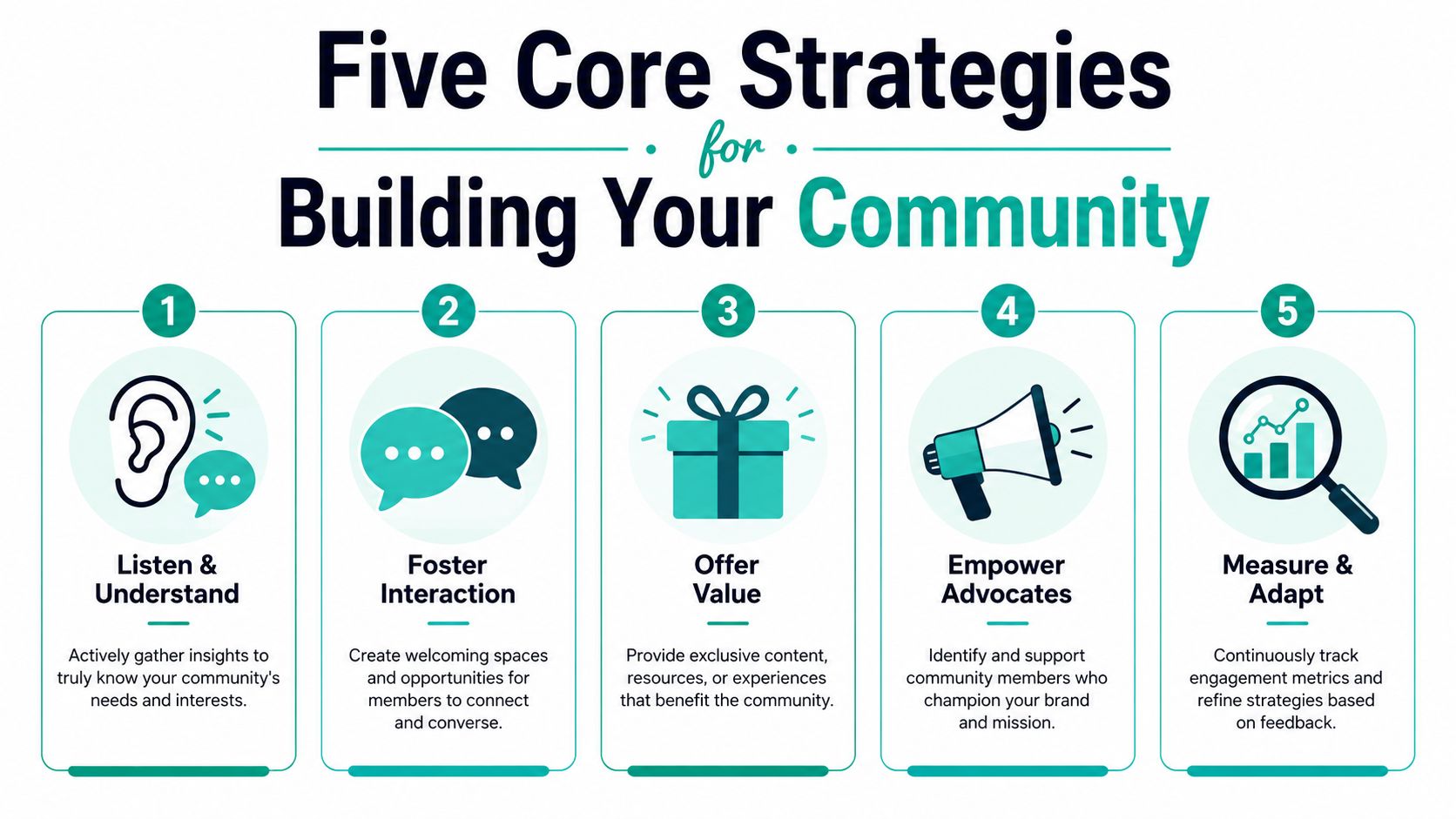
Five Core Strategies for Building Your Community
Most practices don't need more random tactics. They need a small set of repeatable strategies they can sustain. The right question isn't “How do we do everything?” It's “Which community actions fit our audience, our voice, and our capacity?”
Local events that create real conversations
Events work when the practice contributes something useful. They fall flat when the whole point is logo placement.
A pediatric dentist might host a free mouthguard fitting day before youth sports season. An estate planning attorney might hold a community seminar at a library focused on common mistakes families make when they wait too long. A medspa could participate in a wellness event with a short educational session instead of a hard pitch.
What works is interaction. What doesn't work is standing behind a table waiting for strangers to walk up.
Strategic partnerships with trusted local groups
Partnerships are powerful because they borrow trust the right way. You're not renting someone else's audience. You're creating something of value with an organization people already rely on.
A few strong fits:
Schools and youth groups: Dentists, pediatric specialists, and family practices often fit naturally here.
Fitness and wellness businesses: Medspas, physical therapy clinics, and eye doctors can create thoughtful collaborations.
Nonprofits and advocacy groups: Law firms can offer educational support around specific community concerns.
Senior centers and caregiver networks: Estate, elder law, vision care, and family health services often belong in these conversations.
The trade-off is time. Good partnerships take coordination, follow-through, and mutual respect. But they create deeper trust than one-off sponsorships.
Hyper-local content that sounds like your town
A lot of practice content fails because it could have been written for any city in the country. Local content should reflect local questions, local seasons, local stress points, and the language people use.
That might include:
Seasonal reminders: School sports, allergy months, summer travel, holiday scheduling.
Local explainers: What first-time patients ask in your area. What families worry about. What new residents need to know.
Community spotlights: Featuring partner organizations, local educators, coaches, or event organizers.
Many practices benefit from having a content partner that can shape audience research into usable messaging. For example, Leaping Lemur Media's public relations approach is positioned around helping practices communicate more intentionally with the communities they serve.
Digital community hubs that extend the relationship
Community doesn't stop when the event ends. The digital side matters because it keeps the connection going between appointments and in-person touchpoints.
A digital hub could be:
An email newsletter: With practical local advice, event recaps, and community resources.
A private social group: If you have a specific audience that benefits from peer connection.
A recurring Q&A series: Short videos or posts that answer common questions from actual patients or clients.
A review and feedback loop: Not just asking for ratings, but asking for specific insights you can learn from.
Reputation management as a community signal
Reviews aren't just proof. They're feedback from the field.
The best practices treat reputation management as part of community engagement marketing because reviews show how people describe their relationship with your practice in public. Strong outreach also has to be authentic. Guidance on underserved audiences emphasizes that trust comes from sustained participation and shared value, and that people can tell when a brand is only present for sales in PRNEWS's guidance on authentic community connection.
That matters in real life. If your outreach doesn't reflect local barriers, language preferences, or cultural context, no amount of polished branding will fix the disconnect.
Community Engagement Examples for Your Practice
A strategy gets easier to use when you can picture it in motion. These examples show what community engagement marketing can look like when it's tied to the way people choose a local provider.
Dentists
A family or pediatric dental practice often has a natural opening with schools, youth sports, and parent communities. One strong model is to support a local league or school event, but attach a helpful service to it.
A pediatric dentist could coordinate a back-to-school dental education week with a nearby elementary school, offer a free mouthguard fitting day for student athletes, and then share follow-up content answering the questions parents asked most often. The value isn't the sponsorship line item. The value is that families experience the practice as helpful before they ever need treatment.
That sequence creates multiple trust points. Parents meet the team in a low-pressure setting. Kids become more comfortable with the office. The practice earns community visibility that feels earned, not forced.
Eye doctors
An optometry or ophthalmology practice can build community trust by tying its outreach to daily life. Vision affects school performance, driving confidence, work productivity, and aging in place.
A local eye doctor might partner with a senior center for an educational session on vision changes and safe driving, then create a simple follow-up resource for caregivers and adult children. Another good fit is a school or nonprofit collaboration focused on vision awareness for families who may not know when to schedule an exam.
This type of engagement works because it starts with concerns people already have. It doesn't start with a product pitch.
Medspas
Medspas have to be especially careful with tone. The fastest way to lose trust is to sound transactional, image-obsessed, or detached from concerns people have about treatment, safety, and comfort.
A stronger approach is a community wellness partnership. A medspa could collaborate with a yoga studio, nutrition coach, or women's networking group for a small educational workshop on skin health, recovery expectations, or treatment planning. Instead of leading with offers, the practice leads with clarity and inclusion.
The community signal here is subtle but important. The medspa shows that it understands hesitation, welcomes questions, and respects different starting points.
Law firms
Law firms often have the biggest opportunity and the biggest credibility hurdle. Many people need legal help but delay reaching out because they feel intimidated, embarrassed, or unsure whether their issue is serious enough.
A family law, estate, or small business attorney can create strong local trust by offering plain-language education in places people already gather. That might look like a workshop with a local nonprofit, a resource night for small business owners, or a recurring Q&A hosted with a community group.
The best law firm community engagement doesn't try to close people on the spot. It lowers the barrier to the first conversation. If you want more examples of how practices turn educational content into trust-building assets, this collection of practice marketing articles and insights can help spark ideas.
Measuring What Matters with Your Community Efforts
A dentist sponsors a school event, a medspa hosts a skin health workshop, or a law firm runs a community Q and A. The room is full, people are warm, and the staff leaves feeling good about it. Two months later, the owner is left with the harder question. Did any of that build trust, lead to consultations, or increase referrals?
That is where many local practices lose the thread. They measure what was easy to count, then struggle to defend the time, cost, and staff energy behind the effort.
Community engagement marketing should be measured by relationship movement and business impact. Attendance, likes, and reach can still be useful, but they are only early signals. For a local practice, the primary test is simpler. Did this activity reduce hesitation, strengthen trust, and lead to action?
Yotpo's community engagement marketing guide highlights metrics such as active members, member-to-member interaction, user-generated content, retention, lifetime value, and the use of narrower prompts to collect more useful feedback. For dentists, medspas, and law firms, those ideas matter because they shift attention away from visibility alone and toward the behaviors that usually show up before referrals, repeat visits, and stronger reputation.
What to track instead of vanity metrics
Start with the points where community activity can be tied back to the practice.
Use detailed intake source fields: Replace broad options like “online” or “referral” with specific choices such as school event, chamber talk, nonprofit workshop, local physician, past patient, or community seminar.
Tag community contacts in your CRM: Mark people by touchpoint so you can compare outcomes later. Event attendee, partner organization, educational workshop lead, and past attendee are all useful tags.
Review review language: Look for patterns in how people describe your practice. Mentions of patience, clarity, staff warmth, or a specific event often reveal what community work is reinforcing.
Compare retention by engagement history: Patients or clients who meet your team in lower-pressure settings often convert differently and stay longer than people who arrive cold from an ad.
Track referral conversations manually if needed: Many community wins appear first at the front desk or in consult calls. “My neighbor heard you speak.” “We met you at the parent night.” If your software misses that, create a simple logging habit.
If your reporting only shows exposure, you still do not know whether the work changed trust.
Community Engagement KPIs for Local Practices
KPI
How to Measure
Why It Matters
Active members
Count people who engage more than once through events, email replies, feedback forms, community groups, or repeat participation
Shows whether interest is turning into an ongoing relationship
Member-to-member interaction
Track referrals, tagged conversations, comments, discussions, or peer responses tied to your practice
Signals that people are talking about your practice with each other, not just responding to your posts
User-generated content rate
Measure reviews, testimonials, event photos, social mentions, or written feedback from patients and clients
Indicates public trust and willingness to attach a real experience to your name
Retention rate
Compare follow-up visits, repeat appointments, or continuing matters among engaged and non-engaged contacts
Helps connect community trust to long-term behavior
Customer lifetime value
Review revenue and long-term value by patient or client segment in your system
Helps owners decide whether community work is producing stronger clients and patients, not just more impressions
Better questions produce better data
Generic feedback forms usually create generic answers. A local practice needs sharper input than “How did we do?”
Ask about the point of hesitation, the point of clarity, or the reason someone finally booked. That is where community engagement often leaves its mark.
For example:
Dentists: “What concern did you have before scheduling?”
Eye doctors: “What part of the visit helped you feel informed?”
Medspas: “What information helped you feel comfortable with treatment?”
Law firms: “What did you need to understand before reaching out?”
Those answers help owners improve intake, staff training, follow-up, and messaging. They also make it easier to connect community work to real business outcomes. If five new clients mention that your workshop made the process feel less intimidating, that is not a soft metric. It is evidence that trust-building changed behavior.
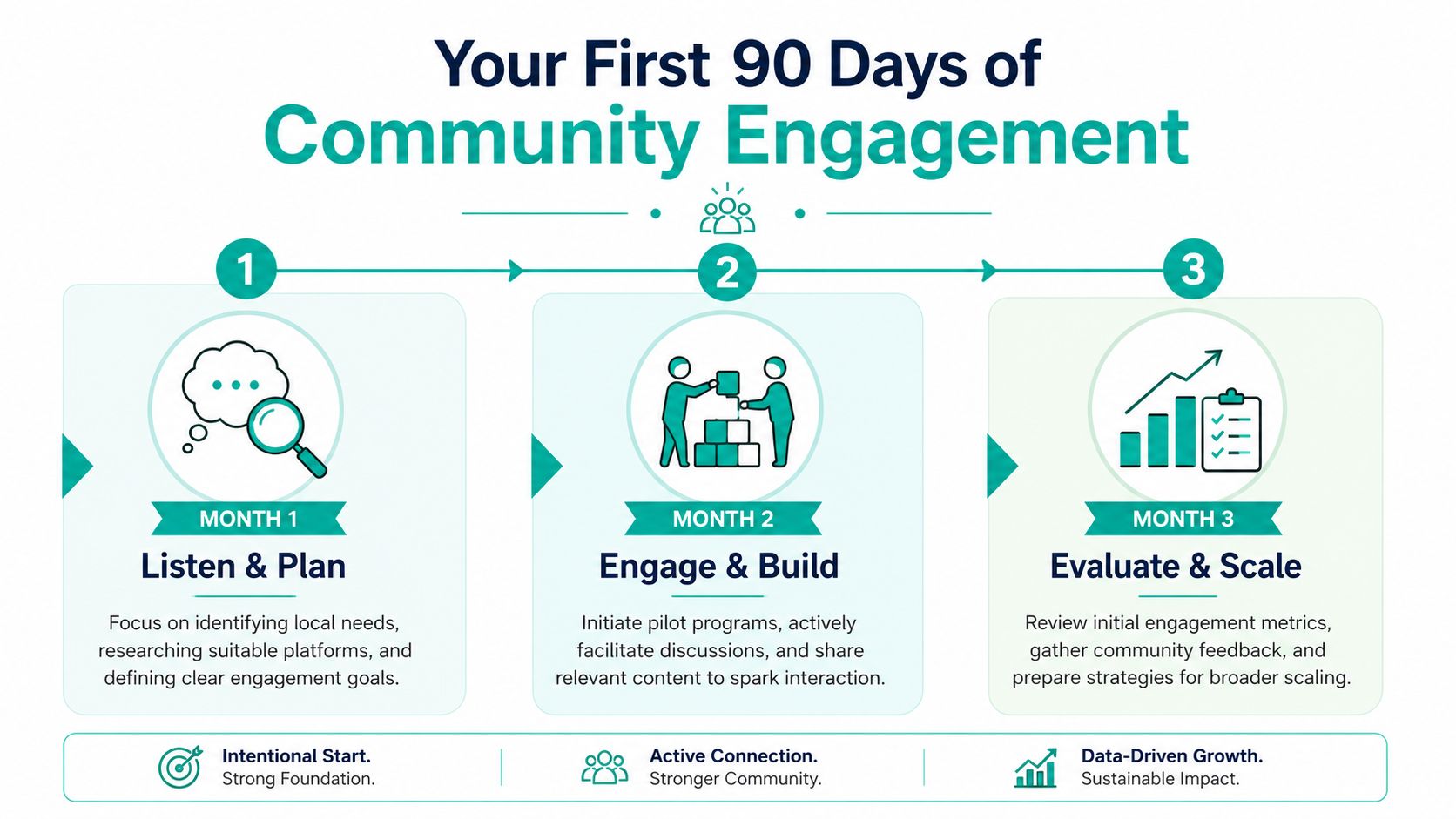
Your First 90 Days of Community Engagement
The biggest mistake busy owners make is trying to launch a full community program all at once. A better approach is to start small, learn fast, and build a repeatable rhythm.
Days 1 through 30 listen and plan
Start by identifying the actual communities that influence your practice. Not every resident is your audience. A pediatric dentist may need to know school leaders, parent groups, coaches, and daycare directors. A law firm may need to understand nonprofit networks, financial professionals, local business groups, or faith communities.
Visible Network Labs recommends beginning with stakeholder segmentation and recurring feedback loops using formats such as surveys, interviews, and observation in its community engagement framework. That's a useful model for local practices because it forces clarity before outreach.
Use this first month to:
List your priority groups: Patients, referral partners, schools, nonprofits, community leaders, local businesses
Note influence and relevance: Who shapes opinion. Who sends referrals. Who hears concerns first
Gather input: Short surveys, brief interviews, front-desk observations, intake notes
Days 31 through 60 launch one focused initiative
Choose one activity that matches both your audience and your capacity. One good partnership beats five weak ones.
Examples include a school-facing dental resource event, a legal education workshop with a local organization, a medspa wellness collaboration, or a caregiver-focused eye health session. Keep the scope tight enough that your team can follow through well.
Small, well-run community efforts build more trust than larger efforts that feel generic or rushed.
Days 61 through 90 review and improve
By the third month, you should have enough signal to assess response quality. Look at who participated, what questions came up, whether follow-ups happened, and which contacts moved closer to booking or referring.
Then refine:
Keep what created conversation
Fix what created confusion
Drop what looked good but produced no relationship signal
This cycle matters because community engagement marketing improves through repetition. Each round should make your practice more informed, more relevant, and easier to trust.
Building a Practice Your Community Can Count On
The strongest local practices don't treat community engagement marketing as a side project. They treat it as part of how the practice operates, communicates, and earns trust over time.
That changes the standard. Success isn't just being seen. It's being the office people mention with confidence. It's being the firm people feel safe calling. It's being the medspa or clinic that shows up with consistency, respect, and usefulness.
For dentists, eye doctors, medspas, and law firms, that usually means three things. Listen before you broadcast. Participate in ways that fit your community's real needs. Measure whether that participation is changing trust, referrals, and long-term value.
The payoff isn't only marketing performance. It's resilience. A practice with deep local roots is harder to displace because it occupies more than ad space. It holds a place in the community's decision-making, memory, and recommendation chain.
That's the long game, and it's the one worth building.
If you want help turning community engagement into a practical marketing system, Leaping Lemur Media works with practices on audience clarity, positioning, and intentional execution so your marketing reflects how you want to show up in the communities you serve.