You’re probably in one of two places right now. Either you’ve run Facebook ads before and watched a few random leads trickle in without much confidence that they’d ever become the kind of patients you want, or you’ve avoided the platform because it feels like a noisy marketplace built for discounts, not dentistry.
That hesitation is reasonable. Most advice about facebook ads for dentists treats the work like a media-buying puzzle. Pick an audience, write a headline, set a budget, hope the leads are cheap. What gets lost is the part that matters most to a practice owner: whether the campaign attracts people who trust your approach, value your care, and are likely to stay.
Facebook can absolutely work for a dental practice. But the best campaigns don’t feel like digital billboards. They feel like a clear introduction from the right practice to the right patient.
Beyond the Billboard An Introduction to Authentic Dental Marketing
A lot of dentists don’t need more leads in the abstract. They need better-fit patients. They need families who value consistency, cosmetic patients who are motivated by confidence rather than bargain hunting, or implant prospects who are ready for a real consultation. That’s a different goal than getting the lowest possible cost per form submission.
Many dental marketing guides focus heavily on click and lead metrics but fail to provide frameworks for tracking true ROI across multiple touchpoints. For practices trying to build real local trust, understanding which stories and messages influence higher-value treatment decisions remains a major gap, as noted in this discussion of dental Facebook ad measurement gaps.
That gap is why so many campaigns feel off. The ad may generate activity, but the activity doesn’t always translate into the kind of patient relationship the practice wants.
Practical rule: If your ad strategy ignores your practice personality, your campaign may still generate leads. It just won’t reliably generate the right ones.
Facebook works best when you stop treating it like a coupon channel and start treating it like a positioning channel. A warm family practice should not speak the same way as a boutique cosmetic office. A sedation-focused office should not sound like a same-day emergency clinic. Patients notice those differences quickly, even if they can’t fully explain them.
That’s also why broader guides on Facebook ads for local businesses can be useful context. The platform rewards relevance, local specificity, and a strong match between message and audience. Dentistry just raises the stakes because trust, fear, health, appearance, and money are all part of the decision.
What authentic dental marketing actually looks like
Authentic doesn’t mean casual or unpolished. It means the campaign reflects the actual experience of your practice.
If you’re premium: speak to transformation, confidence, clinical detail, and a superior patient experience.
If you’re family-focused: lean into trust, convenience, warmth, and long-term care.
If you’re community-rooted: show recognizable faces, local familiarity, and patient education rather than hard selling.
The strongest campaigns make a promise the practice can keep. That alignment is what improves lead quality.
What doesn’t work
A few patterns show up over and over when ads disappoint:
What goes wrong
What it usually means
Generic offer with generic creative
The ad attracts broad curiosity, not real intent
Stock imagery and sterile copy
The practice feels interchangeable
Success measured only by CPL
The team can’t tell which leads become valuable patients
No connection between ad and brand
The campaign gets attention but not trust
Good Facebook advertising for dentists isn’t about becoming louder. It’s about becoming clearer.
Define Your North Star Before You Spend a Dime
Before you open Ads Manager, define what kind of growth you want. Not “more patients.” That’s too vague to guide a campaign. The better question is: who are you best equipped to serve, and what kind of new patient relationship makes your practice stronger six months from now?
That answer shapes the offer, the creative, the landing page, and the follow-up. If you skip this step, Facebook will still spend your money. It just won’t spend it with much judgment.
Brand fit comes before targeting
Current Facebook ad guides often fail to address how messaging should adapt to a practice’s specific brand positioning. They don’t really explore whether a practice positioned as premium versus family-friendly should use different offers or psychological triggers to attract stronger-fit patients, as highlighted in this analysis of dental ad messaging gaps.
That matters because practices often borrow campaigns that worked for someone else and then wonder why the results feel wrong. A discount-heavy ad can fill a schedule. It can also train the market to see you as a commodity. On the other hand, a highly polished cosmetic campaign can look impressive but feel cold if your true advantage is warmth and continuity of care.
If your practice hasn’t clarified its identity yet, the work usually starts with positioning. A strong dental brand foundation makes ad decisions far easier because you know what you stand for before you try to persuade anyone else.
Your best-performing ad often isn’t the one with the broadest appeal. It’s the one that makes the right patient feel understood quickly.
Build personas from real patient behavior
Skip the shallow version of persona building. “Women ages 30 to 55” isn’t a persona. It’s a targeting bucket.
A useful patient persona includes motive, concern, context, and decision friction. Think in terms like these:
The busy parent: wants convenience, online forms, a calm team, and confidence that the office will be good with children.
The cosmetic researcher: has likely spent time comparing options and needs visible proof, not just promises.
The anxious avoider: may delay treatment because of fear, embarrassment, or past experiences.
The restorative patient: needs education, reassurance, and a reason to trust a larger treatment plan.
Ask questions that lead to better campaigns:
What service matters most right now Is the goal hygiene demand, clear aligners, implants, emergency visits, or full smile cases?
What emotion drives action Is the patient motivated by relief, confidence, convenience, or family responsibility?
What makes your practice distinct Is it your doctor’s philosophy, technology, accessibility, bedside manner, or local reputation?
What objection slows the decision Cost, fear, time, uncertainty, or confusion about options?
One simple way to pressure-test your strategy
Write this sentence before you spend anything: “This campaign is for ______ who want ______ and choose us because ______.”
If your team can’t fill that in clearly, the campaign isn’t ready.
That sentence forces discipline. It helps you avoid broad messaging, mixed offers, and low-quality traffic. It also creates internal alignment, because the front desk, treatment coordinator, and marketing team can all see what kind of patient the campaign is trying to attract.
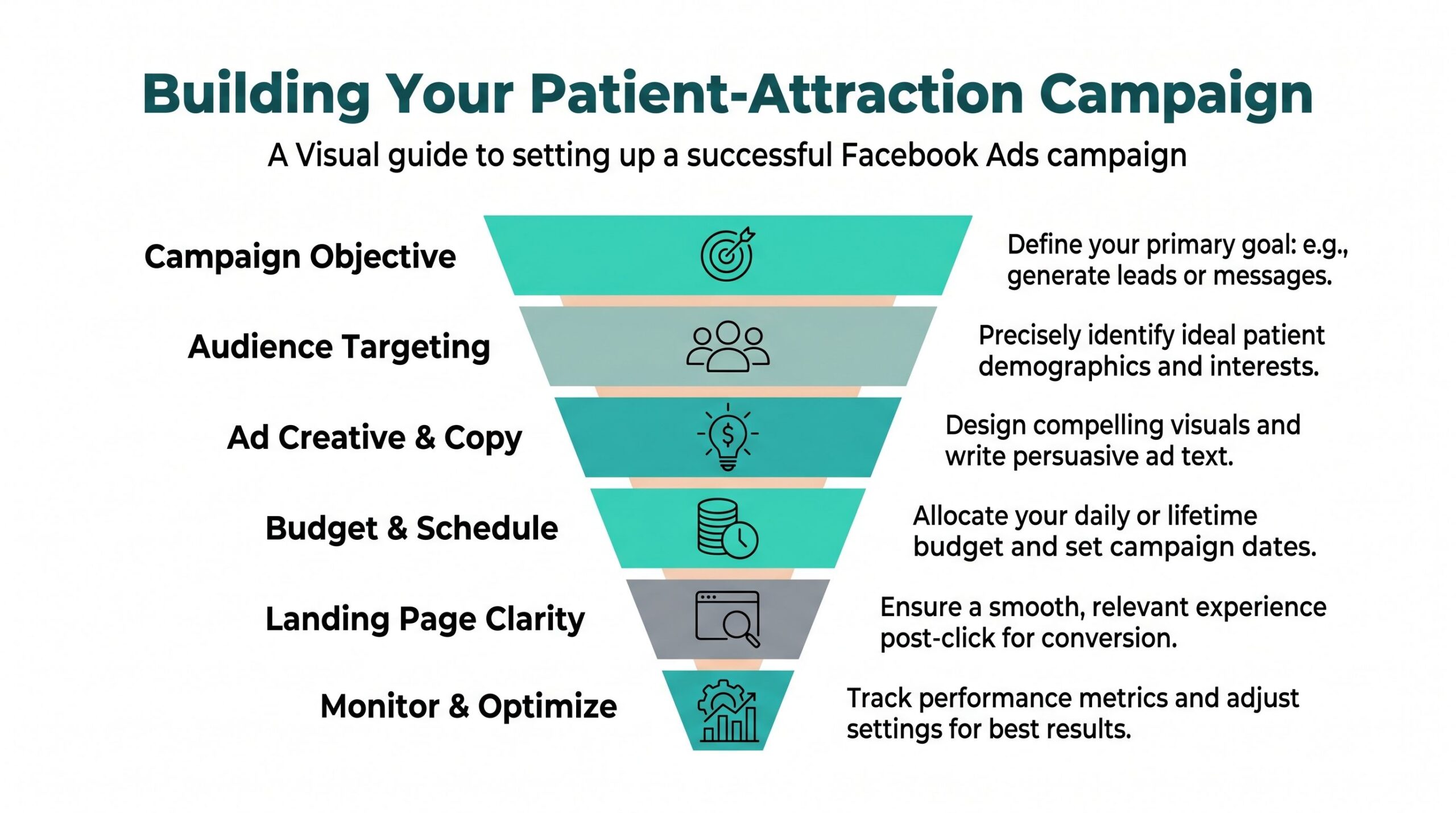
Building Your Patient-Attraction Campaign
A parent sees your ad between school pickup photos and neighborhood updates. An implant prospect sees the same message after weeks of researching options. If both people get the same offer, same tone, and same creative, the campaign usually attracts the wrong clicks.
The build stage is where strategy becomes patient selection. Facebook gives you plenty of settings, but the actual job is narrower. Set up a campaign that reaches the right local audience, frames the service in a way that fits your brand, and screens out people who were never a good match in the first place.
Choose the setup that filters for intent
For local dental practices, simpler campaign structure usually performs better early on. Get Weave’s guide for dentists recommends using the Conversions objective and keeping targeting hyper-local, often within a 10 to 25 mile radius. It also notes that authentic video and carousel creative can produce stronger click-through rates than static, generic ads.
That lines up with what I see across dental campaigns. A local practice does not need broad reach. It needs useful reach. Someone outside the practical service area, price point, or treatment fit can make the numbers look busy while adding little revenue.
Start with a structure your team can manage well:
One campaign per service line: Implants, Invisalign, emergency care, and family dentistry usually need different promises and different patient psychology.
One clear audience per ad set: Keep radius, age range, and targeting focused enough that you can tell what is working.
Two to four creative angles per offer: Test convenience, reassurance, confidence, credibility, or outcome, depending on the service.
This is also where ROI discipline starts. Cheap leads can distract a practice from the bigger question: did the campaign bring in patients who accepted treatment, returned, referred others, and matched the kind of experience the office wants to deliver? If you want a broader view beyond paid social alone, this overview of effective digital marketing strategies to increase patient volume is a helpful complement.
Write ads that sound like your practice
A dental ad should feel like it came from a real office, not a template library.
Stock smiles and vague promises usually attract low-intent curiosity. Real doctor video, real team photos, and copy that reflects how the practice speaks tend to draw better-fit patients. That matters because ad quality shapes expectation before anyone books. If the ad feels polished but impersonal, the practice can get more leads while attracting people who are shopping on price or reacting to the offer instead of choosing the office for the right reason.
Three creative directions work well for different kinds of practices.
Meet the doctor
A short video from the doctor can do a lot of trust-building fast. Keep it plain and direct. Explain who the practice helps, what concern comes up most often, and what the first visit feels like.
Patients are not judging production quality the way marketers do. They are judging warmth, confidence, and credibility.
Office and team familiarity
Photos or short clips of the front desk, treatment rooms, and team interactions reduce uncertainty. This is especially useful for family dentistry, sedation cases, and practices that want to be known for a calmer patient experience.
Before-and-after with context
This fits cosmetic and restorative services best. The image earns attention. The explanation earns trust. Show what changed, who the treatment was right for, and what kind of planning went into the result.
The strongest ads do more than get clicks. They help the right patient self-identify.
Use offers that match the service and the patient
Offer strategy shapes lead quality more than many practices expect. A discount can increase response volume, but it can also pull in people who are unlikely to move forward with a larger plan. A consultation offer may generate fewer form fills, yet produce more serious treatment conversations.
That trade-off matters.
Practice type or goal
Offer style that often fits better
Offer style to be cautious with
Family practice
New patient visit, convenience messaging, family scheduling
Comfort-centered messaging, reassurance, team warmth
Clinical copy with no emotional support
A useful copy structure is simple: problem, solution, proof, call to action.
For example: “Tired of hiding your smile in photos? Get a cosmetic consultation built around your goals, facial features, and timeline. See real results from a team that plans carefully and explains every option. Request your smile assessment.”
That kind of ad does a better job of qualifying interest than “Limited-time special. Book now.”
A patient clicks your implant ad during lunch, lands on your homepage, and sees a slider about family dentistry, a careers link, insurance details, and six different calls to action. That click often dies there, not because the person was a bad lead, but because the handoff felt off.
What happens after the ad click shapes the quality of the patient you attract. Practices that want higher-value cases need more than attention. They need continuity between the promise in the ad and the experience on the page.
Why the homepage usually fails
A homepage serves too many audiences at once. Existing patients want phone numbers and hours. New patients may be comparing services. Job seekers want career information. An ad visitor has a narrower question. “Is this the practice that understands what I need, and what do I do next?”
That is why dedicated landing pages usually outperform general site pages for Facebook traffic. The match matters. If the ad is about veneers, the page should open with veneers. If the ad offers an implant consultation, the page should confirm that offer right away, explain what the consultation includes, and make the next step easy.
Strong campaigns keep that thread intact.
What your landing page must include
A good dental landing page does not need more content. It needs the right content in the right order.
Headline match: Repeat the core promise from the ad.
Clear next step: Explain whether the visitor is requesting a consult, scheduling a visit, or asking for a call back.
Short form: Ask for only the details your front desk needs for first contact.
Trust signals: Show the dentist, team, office, reviews, and location so the page feels real.
Call tracking: Some patients will call instead of submitting a form. That response still needs attribution.
Privacy-aware form handling: Patient inquiries should be collected and routed with care.
Design also affects case quality. A page built for a cosmetic or implant campaign should feel consistent with the level of care the practice delivers. For many offices, that means using a website development strategy built for healthcare practices instead of forcing paid traffic onto a general template.
What to remove
Underperforming pages usually have too many exits.
Cut the navigation menu if the only goal is a consultation request. Remove service lists that have nothing to do with the ad. Replace long introductory copy with a tighter explanation of the offer, who it is for, and why this practice is a fit. Swap weak calls to action like “learn more” for direct language such as “request a smile assessment” or “book an implant consultation.”
The page should answer four questions fast. Who are you? What are you offering? Why should I trust you? What should I do now?
That is the digital handshake. It should feel clear, calm, and consistent with the kind of practice you are running.
Launch Measure and Optimize for True Growth
A campaign can look efficient in Ads Manager and still be a poor business decision for the practice.
That happens all the time with dental Facebook ads. The click cost looks fine. The form count looks healthy. The front desk starts calling, and half the leads want a price quote, live outside the service area, or disappear after the first conversation. If the goal is real growth, measurement has to go past lead volume and cost per lead.
Dental Rank found that strong dental Facebook campaigns can produce solid click-to-lead conversion rates and meaningful return when targeting and offer structure are handled well, in its review of whether Facebook ads are still worth it for dentists in 2025. Useful benchmark. Still, the better question is whether the campaign is producing patients who schedule, show, accept care, and fit the kind of practice you are building.
Budget enough to learn
Small budgets create noisy results. The platform has less room to find patterns, and the practice has less room to judge performance with confidence.
A focused campaign with enough spend to generate consistent data usually outperforms several thinly funded campaigns competing for the same limited budget. For many offices, that means starting narrower than they want. One service. One audience angle. One clear offer. Fund it long enough to see whether the campaign attracts qualified inquiries, not just activity.
The trade-off is simple. A cautious budget feels safer, but it often extends the learning period and makes optimization slower. A disciplined budget, attached to a defined patient goal, gives the campaign a fair test.
Measure the journey, not just the form fill
Cost per lead belongs on the dashboard. It just should not run the whole conversation.
Use a measurement view that follows what happens after the click:
Stage
What to watch
Click
Whether the message is attracting the intended audience
Lead
Form fills, calls, and message quality
Appointment
Which leads actually schedule
Show rate
Whether the campaign brings committed patients
Case value
Which campaigns lead to meaningful treatment
Retention
Whether the patients fit the practice long term
For many dental teams, clarity is often lost. Facebook gets credit for the form. The call handling, follow-up speed, show rate, and treatment acceptance live somewhere else. Without that full picture, an office can scale the wrong ad because it looks cheap on the surface.
A cheap lead that never shows is expensive. A higher-cost lead who accepts treatment and stays with the practice can be a strong investment.
If a practice wants more cosmetic cases, implants, or long-term family patients, the reporting has to reflect that goal. Otherwise the campaign gets optimized toward the easiest conversion, which is often the lowest-intent inquiry.
Optimize with discipline
Good optimization is controlled, not reactive.
Change one variable at a time so the result means something. Test the headline or the image or the offer, not all three at once. Review the quality of inquiries with the front desk every week. They know which leads are ready, which ones are confused, and which ones are shopping on price alone. That feedback should shape the next round of creative faster than click metrics by themselves.
A practical review cadence looks like this:
Test one variable at a time: headline, image, opening hook, or offer
Pause weak creatives: remove ads that attract attention but fail to produce qualified next steps
Scale proven winners carefully: increase budget in small increments so performance stays stable
Review lead quality with the front desk: identify which ads are producing patients who fit the service and the practice culture
Retargeting earns its place here, especially for treatments with a longer decision cycle. Someone considering veneers, implants, or a larger restorative plan may need more trust before taking action. A patient testimonial, a short doctor video, or a reminder about the consultation can bring that person back in a way that matches their decision process.
That is how Facebook becomes a growth channel instead of a lead vending machine.
Your Path to Authentic Patient Connection
Facebook can be a strong growth channel for dentists, but only when the campaign reflects the practice behind it. The mechanics matter. The targeting matters. The landing page matters. But the key differentiator is whether the marketing feels honest, specific, and aligned with the kind of patient relationship you want to build.
That’s the shift that changes results. You stop buying attention from anyone nearby and start inviting the right people into a clearer conversation. The family practice can lean into warmth and reliability. The cosmetic office can lead with confidence and proof. The anxiety-sensitive clinic can communicate safety before urgency. Each approach can work when it matches the patient’s real decision process.
The best facebook ads for dentists don’t chase cheap clicks for their own sake. They attract people who recognize themselves in your message and feel comfortable taking the next step.
If your current ads feel generic, that’s fixable. Start with positioning. Build the campaign around fit. Make the landing page carry the same promise. Then measure beyond the form fill so you know which stories, services, and audiences are creating real practice growth.
If you want a marketing partner that helps your practice attract the right patients with messaging that sounds like you, Leaping Lemur Media is built for that kind of work. Their approach centers on clear positioning, intentional strategy, and authentic growth so your marketing supports the practice you want to become, not just the next batch of clicks.