You're probably juggling the same set of questions most med spa owners face. How do you bring in new patients without wasting money? How do you stand out when every competitor seems to post the same before-and-after photos, the same filler specials, and the same “book now” graphics? And how do you market aggressively enough […]
LElemurJune 1, 202620 min read
In this piece
You're probably juggling the same set of questions most med spa owners face. How do you bring in new patients without wasting money? How do you stand out when every competitor seems to post the same before-and-after photos, the same filler specials, and the same “book now” graphics? And how do you market aggressively enough to grow, while still protecting the trust patients place in you?
That tension is where strong med spa marketing lives.
The owners who build durable growth usually stop thinking about marketing as a pile of disconnected tactics. They stop chasing random posts, one-off ads, and discount campaigns. Instead, they build a system. Their brand is clear. Their website answers real questions. Their ads bring in the right prospects. Their in-office experience turns first visits into repeat visits. Their follow-up earns referrals. Their compliance process protects patient trust instead of treating it like paperwork.
That's the mindset behind effective marketing for med spa businesses. It's not just lead generation. It's trust generation, reputation management, retention, and steady operational discipline.
The fastest way to waste a marketing budget is to promote a med spa that hasn't decided what it stands for. If your message could belong to any competitor in your city, patients won't remember you. They'll compare prices, skim your Instagram, and move on.
The better starting point is simpler. Ask one hard question. What are you the only choice for in your market?
That doesn't mean you offer a treatment nobody else offers. It means you define the combination of experience, positioning, tone, and specialty that makes your spa feel distinct. You might be the med spa that delivers a calm, high-touch experience for busy professionals who want privacy. You might be the one known for a clinically grounded consultation process that helps cautious first-time patients feel safe. You might be the one that pairs refined aesthetics with efficient scheduling for parents and executives.
Start with your only
Write your “only” in one sentence. Then test it.
Use this short filter:
Is it specific: “We care about clients” is invisible. “We help first-time aesthetic patients feel informed, not pressured” is stronger.
Is it believable: If the claim doesn't match your operations, patients will feel the gap.
Is it useful to a buyer: Patients care about outcomes, comfort, trust, convenience, privacy, and fit.
A strong brand is less about graphic design than it is about market clarity. Your visuals matter, but they only become persuasive when they reinforce a real positioning choice. If you need help shaping that identity into something consistent across channels, a structured branding process for service businesses can help turn broad ideas into a usable message.
Practical rule: If your homepage headline could be swapped with a competitor's and nobody would notice, your positioning isn't sharp enough yet.
Build a patient persona that changes your marketing
Most med spas say they serve “women who want to look and feel their best.” That's too broad to guide any serious decision.
A usable persona affects your offers, your photography, your copy, your scheduling flow, and even your follow-up language. Build one around behavior and motivation, not just age.
For example, consider how different these two personas are:
Persona
What they value
What your marketing should emphasize
Busy maintenance patient
Speed, consistency, convenience
Easy booking, efficient visits, clear service menus
Nervous first-time patient
Education, reassurance, trust
Consultation content, process transparency, clinician credibility
Once you define the patient you want most, your content gets easier. You stop trying to appeal to everyone. That restraint is what makes the brand magnetic.
Turn personality into a usable brand voice
Brand voice isn't a mood board word like “refined” or “inspiring.” It's how your med spa sounds in captions, emails, texts, service pages, and consultations.
A useful voice guide answers questions like these:
How formal are you: Clinical and precise, warm and conversational, or polished and boutique?
How do you explain treatments: Minimal and luxe, or educational and detailed?
How do you handle fear: Do you lead with reassurance, expertise, or process clarity?
How do you talk about results: Confidently, but without hype or pressure?
The right voice creates continuity. A patient should feel the same brand when reading a blog post, calling the front desk, receiving a post-treatment email, or sitting in the consult room.
That's the foundation of marketing for med spa growth. Not louder promotion. Clearer identity.
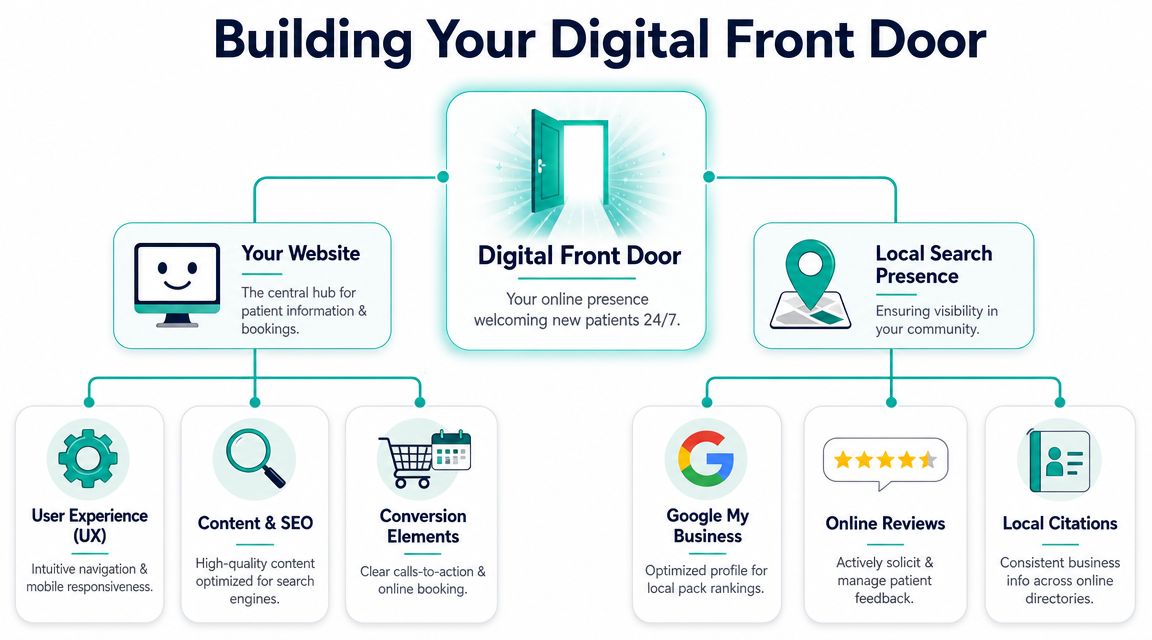
Building Your Digital Front Door
Your website and local presence do the work of a receptionist long before anyone speaks to your team. If they confuse people, hide important answers, or make booking awkward, your marketing leaks trust before the consultation ever happens.
The strongest digital front doors do three jobs well. They explain, reassure, and convert.
Your website should answer and convert
A med spa website isn't a brochure. It's a decision tool. Patients land on it with questions in mind, even if they don't say them out loud. Is this place reputable? Do they offer the treatment I need? Am I the right fit? How do I book? What happens next?
The most effective pages usually include:
Clear service pages: Each core treatment should have its own page with who it's for, what the visit is like, and what the next step is.
Visible calls to action: “Book a consultation” and “Schedule now” should be easy to find without hunting through the menu.
Trust signals: Provider credentials, FAQs, patient process details, and a polished visual presentation all reduce hesitation.
Here are three website actions worth taking this week:
Audit your navigation: Make sure a first-time visitor can find treatments, pricing approach, location, and booking in seconds.
Tighten your service pages: Add plain-language treatment descriptions that answer common pre-booking concerns.
Review mobile experience: Open your site on your own phone and try booking as if you were a new patient.
A lot of med spa owners think local SEO is mysterious. It isn't. It's mostly consistency, specificity, and proof.
When someone searches for a treatment in your area, search engines look for signals that confirm who you are, where you are, and what you do. That means your business name, address, contact information, service categories, and local relevance all need to line up across your profiles and pages.
This week, focus on these moves:
Finish your Google Business Profile
Fill out services, hours, categories, business description, and current photos. Don't leave obvious fields blank.
Match your business details everywhere
Your website, directories, and profile listings should reflect the same core contact information.
Add location language naturally
Your service pages should mention your city and service area in a way that reads like normal English, not a keyword dump.
Your digital front door should answer a nervous patient's unspoken question. “Can I trust this place enough to book?”
Content should reduce hesitation
A lot of med spa content fails because it performs instead of helping. It posts trends, vague beauty tips, and polished visuals without answering the questions that hold people back from booking.
The better content strategy is practical. Create pieces that remove friction.
Useful topics include:
Treatment comparison posts: Botox versus filler, or laser options for different concerns
First-visit guides: What happens during a consultation, what to expect, what questions to ask
Recovery and aftercare education: Clear expectations reduce anxiety
Provider philosophy posts: Why your team takes a conservative or customized approach
Three content actions for this week:
Write one FAQ-based blog post: Start with the question patients ask most often in consults.
Turn one service page into a resource: Add candid answers, not just promotional copy.
Create one local authority piece: For example, a guide designed for patients in your city and climate.
When done well, content doesn't just improve visibility. It shortens the trust gap between discovery and booking.
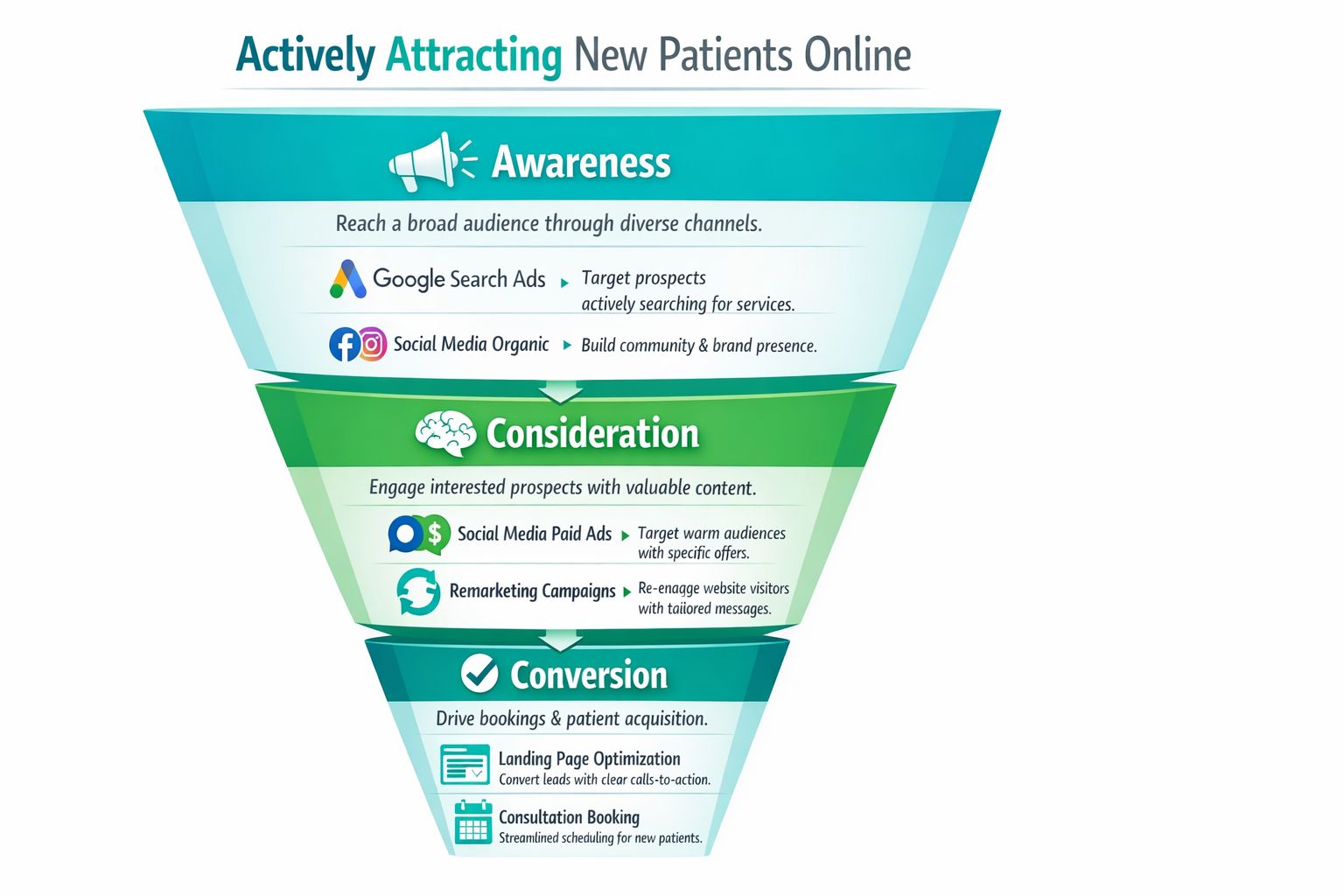
Actively Attracting New Patients Online
Once your foundation is clear, paid traffic can work well. Without that foundation, ads just amplify confusion.
The simplest way to think about acquisition is this. Google Ads captures demand that already exists. Meta Ads creates interest before someone starts searching. Both matter, but they do different jobs.
Google Ads captures intent
If someone searches for “laser hair removal” with location intent, that person is already close to action. They know the category. They may be comparing providers. They may be ready to book a consultation the same day.
That's why search campaigns work best for treatments people actively seek out.
Good Google Ads strategy usually includes:
Tight service alignment: One ad group per core service or closely related service set
Dedicated landing pages: Don't send every click to the homepage
Strong booking path: If the page doesn't make the next step obvious, the click gets wasted
This is also where smart local search strategy matters. If you want another perspective on how search visibility supports acquisition, this guide to local SEO for med spas is a useful companion to paid search planning.
Meta Ads creates demand
Meta works differently. The user isn't always looking for treatment at that moment. They're scrolling. You interrupt that behavior with an offer, a visual, a short video, or an educational hook strong enough to earn attention.
That makes Meta a strong fit for awareness, new treatment launches, seasonal campaigns, and audience building.
Think about the contrast:
Channel
Typical user mindset
Best use
Google Ads
“I'm looking for this now”
Capture high-intent searches
Meta Ads
“I wasn't looking, but this is interesting”
Build interest and create demand
A compelling Meta ad for a newer skin treatment might not convert immediately. But it can start the relationship, drive profile visits, and warm up people who later search your brand or book after seeing repeated proof.
Organic social proves you are real
Organic social sits between branding and conversion. It rarely works when treated as a flyer board. It works when it shows your standards, your personality, and your process.
The med spas that earn attention on Instagram Reels or TikTok usually make patients feel like they've already visited. You see how the team speaks, how the space feels, how consultations are handled, and how results are discussed. That lowers uncertainty.
Content that tends to build trust includes:
Short consult-style videos: Explain who a treatment is for and who should skip it.
Behind-the-scenes clips: Show sanitation, setup, or the tone of the office.
Provider education: Answer one common question per video.
Atmosphere content: Give viewers a feel for the actual experience.
One warning. Don't confuse visibility with strategy. A viral reel that attracts the wrong audience can create more low-quality inquiries than good bookings.
If you want outside support with paid acquisition, platforms like Google Ads Manager, Meta Ads Manager, and service providers such as ads management teams for appointment-driven businesses can help structure campaigns around actual bookings rather than impressions.
The Art of Patient Loyalty and Retention
A lot of med spas treat retention like an afterthought. They focus on getting the first appointment, then hope the patient naturally comes back.
That leaves too much to chance.
The stronger view is that retention is part of your marketing system. Research on med spas found that the strongest loyalty drivers are personalization, customer service, and quality of service, with word of mouth ranked as the most effective marketing channel and referrals second according to this Georgia Southern University proceedings paper. That tells you something important. The most underrated marketing channel isn't another ad platform. It's what happens after the first visit.
Why retention is marketing
Patients don't talk about a med spa because they saw a polished logo. They talk about it because someone remembered their concerns, explained a treatment clearly, followed up thoughtfully, and made them feel cared for without pressure.
That's why discount-heavy growth often feels fragile. It may bring in bookings, but it doesn't automatically build attachment. Personalization does.
The strongest med spa brands often earn their next patient before the current patient even leaves the room.
Retention also supports premium positioning. Patients who value quality, attention, and personalized care are often willing to pay more for an experience that feels considered and personal. That makes follow-up care, communication standards, and membership logic part of brand strategy, not just operations.
Email touchpoints that feel personal
Email still works well for med spas when it behaves like patient care support, not a constant sales blast.
A simple sequence can include:
Welcome email: Reinforce what to expect, where to park, how to prepare, and who they'll meet.
Post-treatment care email: Give instructions in clear language and provide a contact path for questions.
Check-in email: Ask how recovery or results are going and invite conversation.
Maintenance reminder: Reach out when it's appropriate to rebook based on the treatment plan.
VIP or membership updates: Share perks, early access, or service recommendations based on visit history.
The tone matters as much as the automation. “We noticed it may be time to check in on your skincare plan” feels very different from “Limited-time special. Book now.”
What patients remember inside the spa
In-office details shape retention more than many owners realize.
Patients remember whether the front desk felt rushed, whether wait times were acknowledged, whether the provider asked good questions, whether aftercare was explained clearly, and whether they felt sold to or guided. Every one of those moments affects referrals later.
Build consistency around a few touchpoints:
Consult room clarity
Give patients a clear recommendation and a clear reason. Ambiguity kills confidence.
Personal notes
Track preferences, concerns, and prior questions so the next visit feels connected.
Warm follow-up
A short, thoughtful check-in after treatment often does more for loyalty than another promo email.
Marketing for med spa growth becomes more sustainable when retention is built into the care experience itself.
Managing Your Reputation and Navigating Compliance
One of the most common pieces of med spa advice is to post more before-and-afters, more testimonials, and more patient content. The instinct makes sense. Social proof works.
But volume alone is not the win.
The bigger issue is whether your process protects patients while strengthening trust. Using patient information, including before-and-after photos or testimonials, for marketing requires explicit written consent that specifies exactly how the information will be used, as noted by the American Med Spa Association's guidance on marketing strategy. Many marketing conversations skip that operational detail, even though it sits right at the center of trust.
Why more content is not always better
A med spa can post patient results aggressively and still weaken its brand if patients feel exposed, rushed, or unclear about how their image will appear online.
That's why “plaster before-and-afters everywhere” is incomplete advice. A better standard is this: only publish what your process can support ethically, clearly, and consistently.
Your consent workflow should answer practical questions such as:
What exact asset is being used: Photo, video, quote, testimonial, or all of the above
Where it will appear: Website, social media, paid ads, print, or other channels
How long you may use it: Defined in your written process and patient authorization
Who approves it internally: So staff doesn't post casually without review
A simple review and response system
Reputation management also needs structure. If you only ask for reviews when someone remembers, results will be uneven.
A better system looks like this:
Step
What to do
Ask at the right moment
Request feedback after a positive visit or successful follow-up
Make it easy
Send a direct review request by text or email
Respond professionally
Thank positive reviewers and address concerns calmly
Learn from patterns
Repeated complaints often point to an operations issue
For critical reviews, the goal is not to win an argument in public. It's to show future readers that your practice responds with professionalism and care.
Privacy-conscious marketing often feels quieter on the surface, but it builds stronger credibility over time.
Compliance can become part of your brand promise
Patients are trusting you with appearance-related decisions, health-related information, and often deep personal insecurity. In that environment, privacy is not a side issue.
When your med spa treats consent and patient imagery carefully, you create a quiet but powerful brand message. We take your trust seriously. We don't trade your privacy for content.
That positioning matters, especially in markets where patients are selective about discretion. A compliance-first trust system can differentiate your med spa far more effectively than another generic montage reel.
Setting Budgets and Measuring What Matters
Marketing gets easier to manage when you stop treating it like a mystery and start treating it like a financial system.
A lot of owners either underspend and expect miracles, or they spend without a measurement framework and can't tell what's working. Neither approach creates confidence.
A practical budget range
A useful benchmark for med spa marketing is that successful practices typically allocate 5% to 10% of total revenue to marketing, while newer or highly competitive practices often need 10% to 15% to build awareness and market share, according to Kovly Studio's med spa marketing budget analysis. The same source translates that for a practice generating $500,000 in annual revenue to roughly $25,000 to $50,000 per year, or about $2,000 to $4,000 per month, and notes that 52% of med spa practices still invest less than $2,500 per month.
That last point matters. Many med spas expect consistent growth while funding marketing below common operating benchmarks. Underinvestment doesn't always look dramatic. It often looks like sporadic posting, weak ad testing, outdated pages, and slow follow-up.
The numbers worth tracking in plain English
You don't need a complicated dashboard to start. You need a few definitions everyone on your team understands.
Cost per lead
How much you spend to generate one inquiry, form fill, call, or consultation request.
Formula: total marketing spend ÷ total leads
Patient acquisition cost
How much you spend to turn that marketing effort into one actual new patient.
Formula: total marketing spend ÷ total new patients acquired
Lifetime value
The total revenue you expect from a patient across their relationship with your med spa.
Formula: average visit value × average number of visits over time
None of these numbers should be viewed in isolation. A channel with a higher acquisition cost might still be worth it if it brings in loyal patients who return for higher-value services. A cheap lead source may be weak if those leads rarely book or never come back.
Sample monthly marketing budget allocation
Here is a simple planning model for a med spa working with a $4,000/month budget.
Channel / Activity
Allocation
Primary Goal
Google Ads for core service lines
$1,500
Capture high-intent search demand
Meta Ads and remarketing
$900
Build awareness and re-engage visitors
Website and landing page improvements
$500
Improve conversion rate from existing traffic
Content creation and email marketing
$600
Support trust, retention, and follow-up
Review generation and local SEO upkeep
$500
Strengthen local visibility and reputation
Key takeaway: Don't ask whether marketing is expensive. Ask whether your current system can tell you which spending creates booked, returning patients.
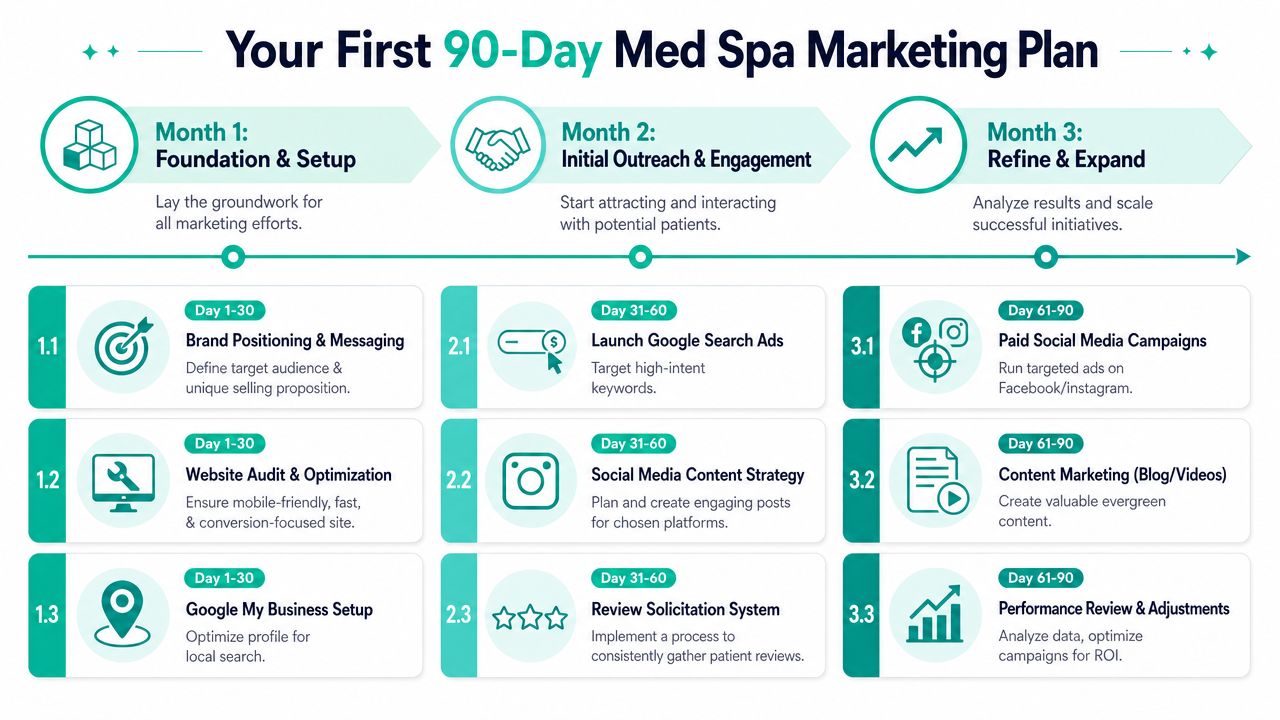
Your First 90-Day Med Spa Marketing Plan
Most med spas don't need a massive rollout. They need a disciplined one.
The smartest approach is to establish a baseline, make limited changes, watch the response, and scale only after the evidence is there. That method aligns with Yocale's recommendation to measure baseline web, social, and conversion metrics first, then roll out changes week by week to limited segments and use analytics to recalibrate creative tone, targeting, or platform before scaling what works, as described in their medical spa marketing methodology.
Days 1 through 30
The first month is about clarity and cleanup.
Start by defining your positioning in a sentence your team can use. Clarify the patient persona you want most. Tighten your homepage headline, your primary calls to action, and your service page messaging so they all reflect the same brand promise.
Then audit the practical basics:
Website usability: Test mobile booking, contact forms, and navigation.
Google Business Profile: Complete missing details, update imagery, and confirm service information.
Review process: Decide exactly when and how patients will be invited to leave feedback.
Baseline metrics: Record current website traffic patterns, consultation requests, social engagement, and booked new patients.
Month one is also when you set rules for patient imagery, testimonials, and approvals. It's easier to build clean than to fix a messy content process later.
Days 31 through 60
The second month is where outreach begins, but in a controlled way.
Pick one core service with strong intent and launch a focused Google Ads campaign tied to a specific landing page. Don't advertise everything at once. One service line gives you cleaner data and faster insight into message quality, lead quality, and booking friction.
At the same time, start publishing a manageable stream of organic content:
One educational short-form video each week
One consult-style FAQ post
One culture or behind-the-scenes post
One patient concern post that addresses hesitation
Your front desk and provider team should also know what campaign is live, what offer or message patients are seeing, and how to continue the conversation when leads come in.
Days 61 through 90
Month three is where many owners make a costly mistake. They either abandon campaigns too early or scale them before they understand why they worked.
Instead, review patterns carefully.
Look at questions like these:
Which service generated the best-quality inquiries
Which landing page language led to more consult requests
What objections kept showing up on calls or forms
Which organic posts created saves, replies, or meaningful direct messages
Whether your follow-up process turned inquiries into appointments efficiently
Then add one retention asset. For most med spas, that should be a simple email automation, such as a welcome flow, post-treatment care sequence, or rebooking reminder tied to a common service cadence.
A practical 90-day checklist looks like this:
Timeframe
Primary focus
Output
Days 1 to 30
Positioning and setup
Clear message, updated profiles, baseline metrics
Days 31 to 60
Controlled acquisition
One search campaign, initial content cadence, review system
Days 61 to 90
Optimization and retention
Performance review, revised creative, first email automation
This kind of progression keeps your marketing for med spa growth grounded in evidence instead of guesswork. Small weekly adjustments are often more valuable than a dramatic rebrand or a burst of random ads.
If you want a marketing partner to help organize your med spa growth around brand clarity, patient trust, lead generation, and long-term retention, Leaping Lemur Media works with service-based practices to build marketing systems that reflect who they are and help the right patients choose them.