A lot of dentists aren't short on activity. They're short on alignment. The schedule looks full enough to keep everyone moving, but too many appointments are low-value, poorly matched, or hard to retain. The phone rings, yet the cases you most want to grow don't arrive consistently. Or maybe you're spending on ads, social posts, […]
LElemurJune 3, 202618 min read
In this piece
A lot of dentists aren't short on activity. They're short on alignment.
The schedule looks full enough to keep everyone moving, but too many appointments are low-value, poorly matched, or hard to retain. The phone rings, yet the cases you most want to grow don't arrive consistently. Or maybe you're spending on ads, social posts, and website updates without a clear sense of what's bringing in the right patients.
That frustration usually isn't a tactics problem. It's a strategy problem. A strong dentist marketing strategy doesn't try to do everything. It builds a system that helps the right people find your practice, trust your team, and take the next step without friction.
Beyond Filling Seats A Modern Dentist Marketing Strategy
One of the most common situations in practice marketing looks like this. A dentist is busy, the team is stretched, and the owner still feels uneasy because the schedule doesn't reflect the practice they want to build. Hygiene may be packed while higher-value services stay inconsistent. New patient flow might exist, but too many people are price-shopping, insurance-driven, or unlikely to return.
That's where many practices make the wrong move. They add more disconnected tactics. Another ad campaign. More social posts. A few boosted posts. A homepage refresh. None of that fixes a weak strategic core.
The bigger shift is patient behavior. A 2026 dental marketing summary reports that 69% of people search online before booking a dentist appointment, and it estimates there are about 200,000 dental practices in the U.S., which is why discoverability now shapes competition long before a phone call happens (2026 dental marketing summary). Patients are making early decisions based on search results, reviews, websites, and how easy it feels to book.
A full schedule and a healthy marketing system aren't the same thing. One can hide problems the other eventually exposes.
That's why the right starting point isn't “Which channel should I add next?” It's “What kind of practice am I trying to grow, and does my marketing reflect that?” Your website often becomes the clearest expression of that answer, especially when it's built around the services, tone, and patient experience you want to be known for. If you're evaluating that foundation, this guide on dentists website design is a useful reference for thinking about structure, trust, and conversion together.
A modern dentist marketing strategy works when every part supports the same outcome. The message attracts the right patient. The website confirms they're in the right place. The booking path reduces hesitation. The office experience makes retention and referrals more likely. That's a growth engine. Everything else is noise.
Build Your Marketing Foundation Who You Serve and Why
A dentist marketing strategy falls apart when the practice tries to appeal to everyone. General messaging sounds safe, but it usually reads as interchangeable. Patients don't choose a practice because it says it offers “quality care in a friendly environment.” Every practice says that.
The stronger move is to define your identity before you choose your channels. That approach lines up with guidance highlighted by RevenueWell, which points to building a plan from patient surveys, community demographics, goals, and staff capacity rather than defaulting to the usual review-and-ads checklist (RevenueWell on dental marketing best strategies). In plain terms, your strategy should fit your practice, your market, and the kind of patient relationship you want to build.
Start with patient fit, not channel choice
Ask a simple question first. Who do you most want more of?
Not “Who can pay?” and not “Who lives nearby?” Those matter, but they're not enough. Think about the patients who fit your systems, respond well to your communication style, accept treatment with confidence, and tend to stay.
That ideal patient often comes into focus when you look at patterns like these:
Life stage: Young professionals, growing families, retirees, anxious adults, cosmetic-minded patients, or people seeking complex restorative work.
Buying behavior: Some patients want speed and online booking. Others want hand-holding, financing clarity, and a longer trust-building process.
Clinical fit: A practice centered on family care should sound different from one built around implants, full-mouth rehabilitation, or clear aligners.
Experience preference: Some patients value convenience and efficiency. Others are looking for calm, education, and relationship-driven care.
If you skip this work, your marketing becomes generic by default. Generic marketing attracts generic demand. That usually means more comparison shopping, more front-desk friction, and more pressure to compete on availability or price.
Practical rule: If your best patients wouldn't recognize themselves in your homepage copy, your positioning is too broad.
A short workshop with your team can help. Review your favorite current patients and ask:
Which patients make the practice feel most aligned?
Which services do they commonly seek?
What questions do they ask before booking?
What objections come up most often?
What parts of your experience do they appreciate most?
Those answers should shape your messaging, photography, service pages, and intake flow. They should also shape your website build. If your site doesn't support that positioning, you may need a deeper rethink of your digital foundation, not just copy edits. For practices reviewing that side of the equation, website development matters most when it supports clarity, trust, and a simple path to action.
Write a value proposition your team can actually use
Once your ideal patient is clear, define why your practice is the right fit for them. This is your value proposition. It shouldn't sound like a slogan. It should sound like an honest explanation of what makes your practice easier to choose.
A useful value proposition includes three parts:
Element
What it answers
Example direction
Who you serve
Who is this practice built for?
Busy adults who want efficient, technology-supported care
What you do best
Which need or outcome do you handle especially well?
Cosmetic and restorative treatment planning with clear communication
Why patients choose you
What feels different in the experience?
Transparent options, calm visits, and a smoother booking process
Here's the test. Your front desk should be able to use this positioning on the phone. Your associate should be able to repeat it in a consultation. Your website should reflect it on every core page. If it only works in a branding meeting, it's too abstract.
A strong example sounds like this in practice: We help anxious adults who've put off treatment feel comfortable getting back on track through calm communication, phased treatment planning, and a team that explains each step clearly.
That statement does more than describe the office. It shapes decisions. It affects which reviews you ask for, which photos you use, which services you highlight, and what kind of language belongs in ads.
When your marketing feels like a true extension of your practice, it becomes easier to maintain. The team knows what to say. Patients know what to expect. And your growth becomes more selective, which is exactly what many practices need.
Map the Modern Dental Patient Journey
A patient rarely moves from need to appointment in one clean step. They bounce between devices, compare practices, read reviews at odd hours, and form impressions long before they contact you.
That's why a dentist marketing strategy works better when it follows the patient's path instead of the practice's internal to-do list. Most practices think in channels. Patients think in questions.
What patients do before they ever call
At the start, the patient usually has a problem, a desire, or a deadline. It might be pain, embarrassment, a broken tooth, an insurance change, or a cosmetic goal before an event. They don't think “I am entering a marketing funnel.” They think “Who can help, and can I trust them?”
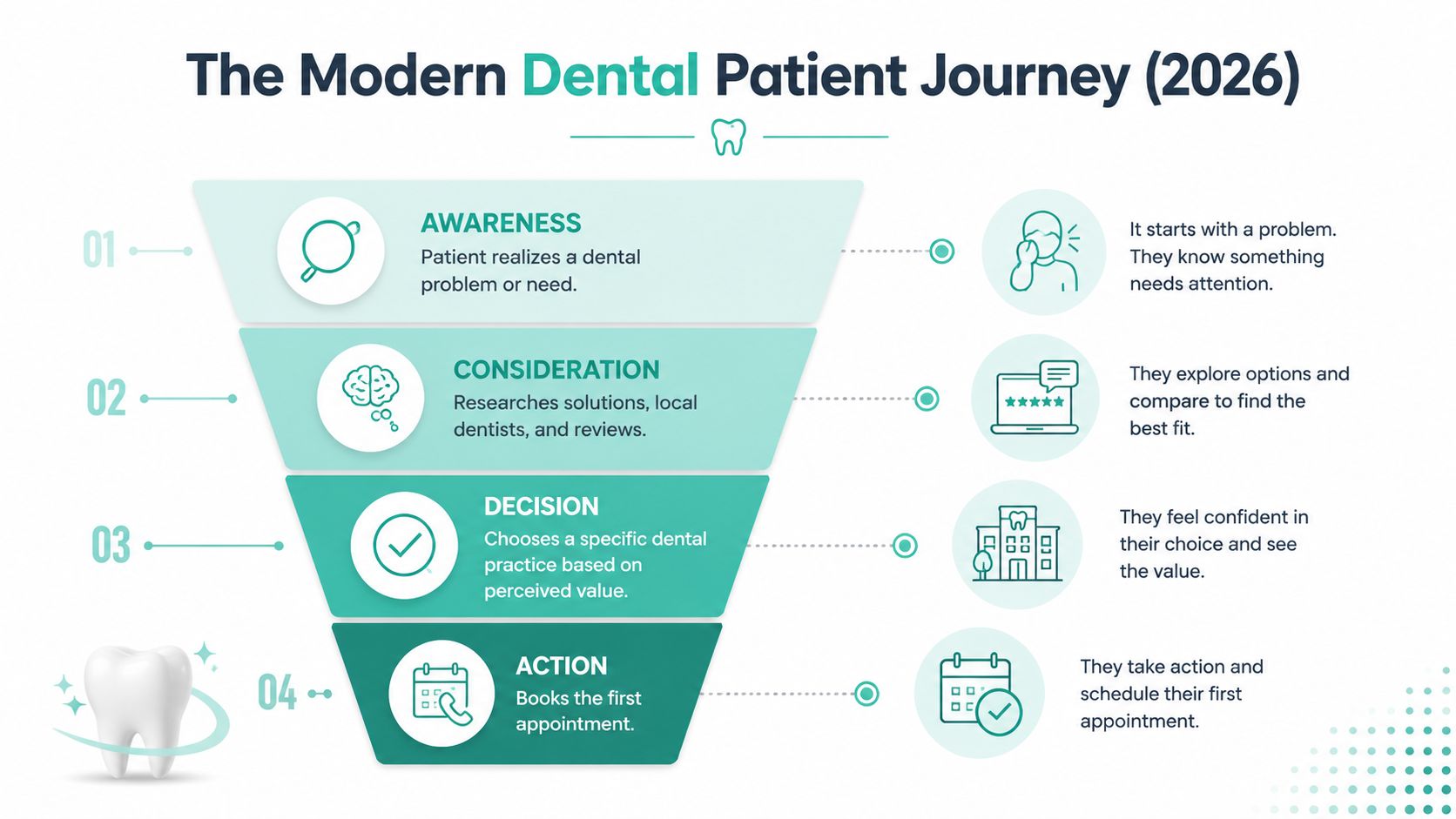
The journey usually looks like this:
Awareness The patient recognizes a need. Search terms tend to be symptom-based, service-based, or local. They're trying to understand urgency and options.
Consideration They compare practices. Your Google Business Profile, reviews, service pages, doctor bio, and photos then start shaping perception. They're asking whether you feel credible, relevant, and convenient.
Decision They narrow the list. Small details matter here. Do you accept their insurance? Can they request an appointment easily? Does your website explain financing, emergency care, or what a first visit looks like?
Action They call, submit a form, book online, or abandon the process because something felt unclear or inconvenient.
A lot of practices only pay attention to stage four. By then, the decision is already mostly made.
Where practices lose momentum
The biggest drop-offs often happen in the handoffs between stages. A strong search presence sends a patient to a weak website. A polished website sends them to a clunky form. A good inquiry comes in, then sits too long before someone responds.
Here are common friction points that undermine conversion:
Unclear service pages: Patients can't tell whether you really offer what they need or whether you just mention it in passing.
Weak trust signals: No recent reviews highlighted, no doctor introduction, no explanation of process, and no sense of personality.
Confusing next steps: “Contact us” is too vague for someone who wants to know how to book, what to expect, or whether you fit their budget.
Front-desk disconnect: Marketing promises one type of experience, but phone handling feels rushed or inconsistent.
No post-visit follow-up: The relationship stalls after the first appointment, which weakens retention and referrals.
The patient journey doesn't end when someone books. It keeps going through the appointment, follow-up, recall, and review request.
A good exercise is to mystery-shop your own practice. Search for your services the way a patient would. Visit your site on a phone. Fill out your own form. Call after hours. Read your reviews in order. The gaps become obvious fast.
When practices map the patient journey, better decisions follow. You stop obsessing over vanity activity and start improving the touchpoints that move a patient forward.
Choose Your Core Marketing Channels
The best channel mix depends on your goals, your market, and your practice model. Still, a few priorities stay consistent. Some channels build visibility. Some capture high intent. Some strengthen retention. The mistake is treating them as interchangeable.
For channel selection, one useful benchmark is that referrals convert at 3.74%, and paid search can convert 35% better than organic search, which supports using a blended acquisition system instead of depending on a single source (NexHealth dental marketing statistics). That doesn't mean every practice should pour money into every platform. It means your marketing is safer and more effective when it has more than one dependable path to new patients.
The non-negotiables
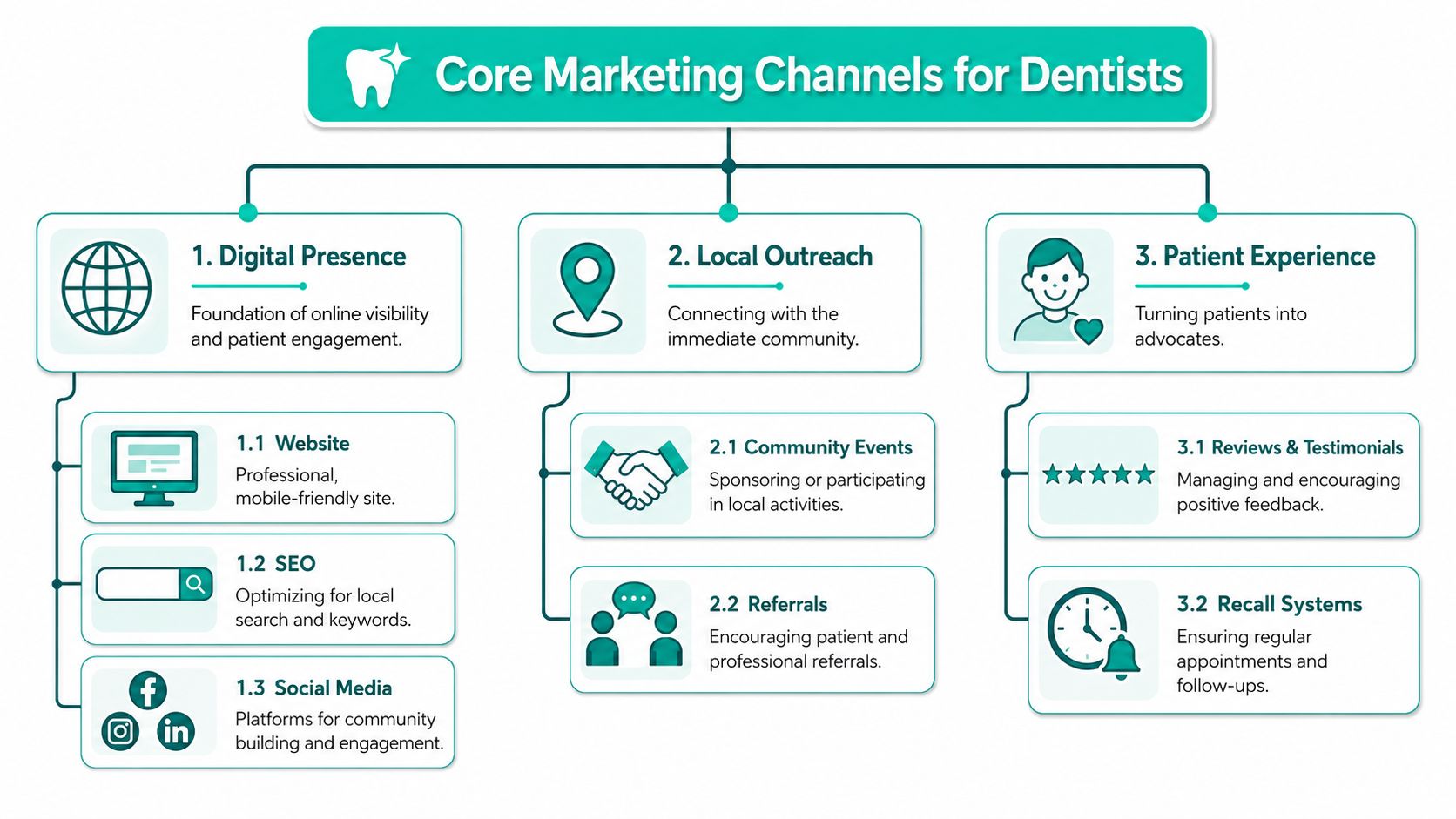
Every serious dentist marketing strategy needs three core pieces in place first.
Local search presence
If local visibility is weak, every other channel works harder than it should. Your Google Business Profile, service relevance, location clarity, reviews, and local signals all affect whether patients find you when intent is highest.
This is especially important for searches with immediate action behind them, such as emergency care, family dentistry, or location-based routine care. If your local presence is thin, fix that before chasing broad awareness campaigns. For a practical outside reference, these key local SEO tips for SMBs are useful because they focus on the basics that often get missed.
A conversion-focused website
Your website has one job beyond looking polished. It has to help the right patient decide and act.
That means:
Clear service architecture: Important services need their own pages, not a single general paragraph.
Visible calls to action: Phone, form, and booking options should be easy to find on mobile and desktop.
Trust-building content: Doctor bios, process explanations, technology, payment details, and real patient reassurance matter.
Fast understanding: Within a few seconds, a visitor should know who you help and how to take the next step.
A site can rank and still underperform. It can also look beautiful and still fail to convert. Practices that want a stronger local visibility foundation usually need SEO and website structure to work together, not as separate projects. That's where local SEO services often become part of the conversation.
Reputation management
Reviews don't just support trust. They help patients compare confidence. In crowded markets, your review profile often becomes the tie-breaker between two similar options.
The strongest review strategy is simple and consistent. Ask at the right moment. Make leaving a review easy. Respond professionally. Use the language patients naturally use to describe your experience. Those words often reveal your actual positioning better than your brand copy does.
The growth channels that depend on your goals
Once the foundation is solid, channel selection becomes more strategic.
Paid search works well when you need high-intent demand now. It's often a fit for emergency care, implants, cosmetic consults, and other services where patients are actively looking. But it only works cleanly when landing pages, call handling, and tracking are solid.
Paid social is different. It can support awareness and consideration, especially for elective services where patients may not search immediately. It's often less about direct capture and more about staying visible, telling your story, and creating familiarity with a specific audience.
Referral systems deserve more discipline than they usually get. Most practices say referrals matter, but many don't actively support them. Patient referrals, specialist relationships, and internal prompts should be intentional. If referrals already bring in strong-fit patients, improve that system before expanding spend elsewhere.
Email and recall communication are often overlooked because they don't feel flashy. But they help protect the value of patients you've already acquired. If your reactivation and reminder systems are weak, new patient marketing has to compensate for preventable leakage.
What to stop doing
Some activities feel productive but don't contribute much.
Posting without purpose: Social content that doesn't support trust, service interest, or local familiarity becomes background noise.
Sending all traffic to the homepage: Service-specific intent needs service-specific pages.
Judging channels by leads alone: A channel can produce plenty of inquiries and still bring poor-fit patients.
Running ads before fixing operations: If forms go unanswered or calls are mishandled, you're paying to expose internal friction.
A channel isn't “working” just because it generates activity. It's working when it brings the right patient into a booking and retention system that holds together.
The best mix usually isn't exciting. It's disciplined. Build local visibility. Make the website easier to trust and use. Keep reviews moving. Add paid search or paid social when the practice goal justifies it. Strengthen referrals and recall so growth doesn't depend on constant new spend.
Budgeting Your Strategy and Planning Your Timeline
Budget questions get messy when the practice hasn't made its priorities clear. Owners ask how much they should spend before they've decided what they're trying to grow, how quickly they want to grow it, or what's already broken in the pipeline.
A more useful approach is to set budget after strategy, then phase execution so the team doesn't try to fix everything at once.
Set a budget that matches your stage
A practical benchmark is to allocate 4% to 7% of annual revenue to marketing, while new practices often spend 15% to 20% in the first year to build a patient base. The same benchmark also notes that successful practices tend to put about 80% of spend on digital channels (dental marketing budget benchmarks).
Those numbers are useful, but they don't answer the real question by themselves. The real question is whether your current spend matches your current bottleneck.
If your issue is weak local visibility, more ad spend won't solve the core problem. If traffic exists but inquiries don't convert, your website and front-desk process may need attention first. If new patients come in but don't stay engaged, retention systems deserve budget too.
A healthy budget usually covers a mix like this:
Foundation work: Website improvements, local SEO, core service pages, tracking setup
Demand capture: Paid search for urgent or high-intent services
Trust assets: Review generation, photography, doctor bios, patient education content
Retention support: Reactivation, reminders, and post-visit communication
Testing room: A portion of budget for trying new messaging, offers, or campaign angles without disrupting the whole plan
Sample 12-month dental marketing timeline
The ADA recommends a 12-month marketing plan with monthly, quarterly, and year-end reviews, plus 4 to 8 weeks to evaluate options before launch and about 25% of one staff member's time if marketing is handled internally. If you're outsourcing paid campaigns, a focused partner for ads management can reduce that internal burden while keeping tracking and decision-making clearer.
Phase
Timeline
Key Focus Areas
Sample Activities
Foundation
Months 1 to 3
Positioning, audit, local visibility, website clarity
Define ideal patient, clarify value proposition, review service pages, improve Google Business Profile, tighten booking paths, set up tracking
Growth
Months 4 to 6
Demand capture and content support
Launch paid search for priority services, publish or refine key service pages, strengthen review request process, align front-desk scripts with messaging
Optimization
Months 7 to 12
Refinement, retention, and smarter allocation
Review lead quality by source, improve underperforming landing pages, adjust spend by service line, strengthen recall and reactivation workflows
A timeline like this prevents a common mistake. Practices often launch ads, redesign pages, start posting, and ask for more reviews all at once. That creates motion, but it also makes it hard to see what caused performance to change.
The better sequence is deliberate. Fix the foundation. Add acceleration where needed. Then optimize based on what the practice learns from real patient behavior.
Measure What Matters Tracking KPIs and Driving Growth
Marketing gets expensive when nobody closes the loop between activity and outcomes. A practice can feel busy with website updates, social posts, and ad reports while still having no clear picture of which efforts turn into actual patients.
The American Dental Association recommends a 12-month marketing plan with performance reviewed monthly and quarterly, yet a 2024 dental statistics roundup found that only 49% of dental practices use automated reminders (ADA marketing plan basics). That gap matters because growth isn't just acquisition. Retention, attendance, and patient experience affect the value of every lead you generate.
Track the handoff from inquiry to patient
The most useful KPIs are the ones that connect marketing to business reality. Not vanity metrics. Not random dashboard screenshots. You want measures that reveal where momentum is being created or lost.
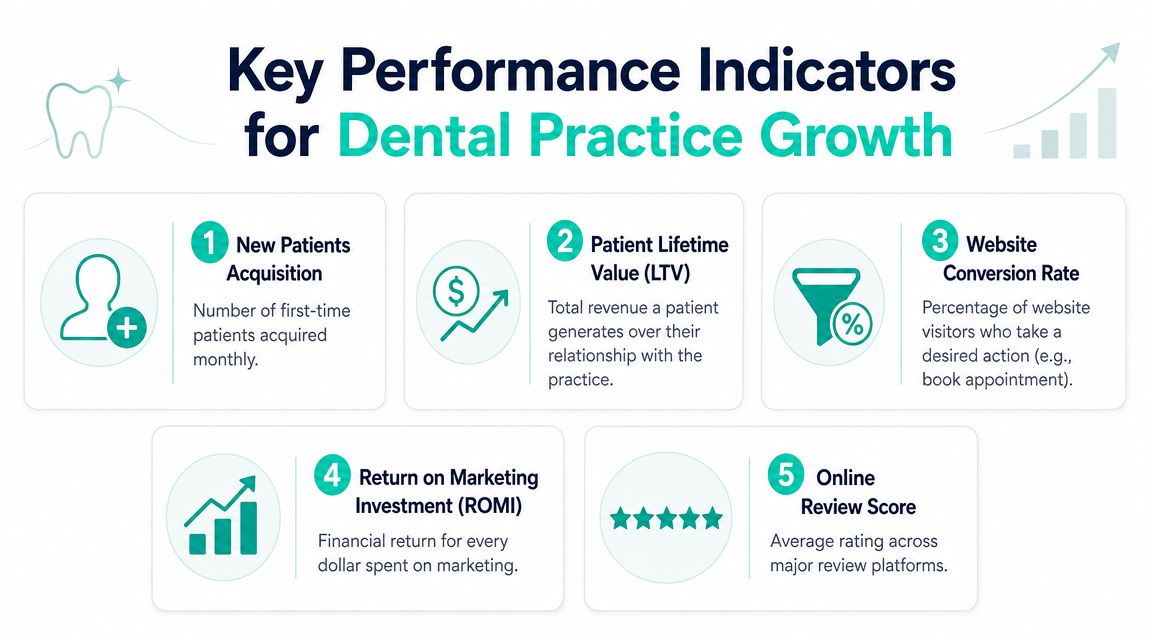
Start with a small set:
New patient acquisition: How many first-time patients entered the practice this month?
Lead-to-appointment conversion: Of the people who called or submitted a form, how many booked?
Patient acquisition cost: What did it cost to acquire a new patient by channel?
Website conversion rate: Are site visitors taking the actions you want them to take?
Patient lifetime value: Are you acquiring patients who stay, accept treatment, and return?
You don't need an overly complex setup to track this. Ask every new patient how they found you. Use clear intake fields. Separate form submissions by service when possible. If you run ads, make sure those inquiries can be traced to actual booked patients, not just clicks or raw leads.
Operator mindset: Track the source, the inquiry, the booking, and the kept appointment. If one step disappears from reporting, decision-making gets distorted fast.
A channel may appear strong because it generates calls. But if those calls don't book, or they book and no-show, the story changes. That's why source-to-patient tracking matters more than surface-level lead volume.
Build a review rhythm, not a reporting ritual
Monthly and quarterly reviews only help if they lead to action. The point isn't to admire numbers. It's to make better decisions.
A useful review cadence looks like this:
Review window
Questions to ask
Monthly
Which channels produced the best-fit inquiries? Where did patients drop off? Which service pages or campaigns underperformed?
Quarterly
Should budget shift between channels? Is the messaging attracting the right patient type? Are front-desk and follow-up systems supporting growth?
Year-end
Which parts of the strategy created durable gains, and which were just bursts of activity?
This is also where retention data belongs. Automated reminders, recall systems, and post-visit communication aren't “operations over there.” They're part of the marketing system because they affect patient experience, reviews, return visits, and referrals.
The strongest practices don't treat marketing as a separate department that generates leads and disappears. They treat it as a feedback loop. Messaging shapes expectations. The website supports action. The team handles the handoff. Follow-up protects the relationship. Reporting tells you what to improve next.
That's how a dentist marketing strategy becomes sustainable. Not because every channel is perfect, but because the practice keeps learning from what real patients do.
If you want a marketing approach that reflects who your practice is, Leaping Lemur Media helps practices build strategy around positioning, patient fit, and intentional growth instead of disconnected tactics.