Your Medical Spa Marketing Agency: A 2026 Partner Guide
You're probably in a familiar spot. The practice is solid. Patients like your team, referrals keep coming in, and the schedule isn't empty. But growth has started to feel uneven. Some months look strong, others feel soft, and every marketing option being pitched to you sounds like a pile of disconnected tasks. SEO. Ads. Social. […]
LElemurJune 16, 202617 min read
In this piece
You're probably in a familiar spot. The practice is solid. Patients like your team, referrals keep coming in, and the schedule isn't empty. But growth has started to feel uneven. Some months look strong, others feel soft, and every marketing option being pitched to you sounds like a pile of disconnected tasks. SEO. Ads. Social. Email. Reputation. New website. More content.
That's usually the moment when a practice owner starts asking the right question.
Not, “Which vendor should I hire?” Instead, “Who can help me grow this practice without turning my brand into generic healthcare noise?”
That distinction matters. A medical spa doesn't need random marketing activity. It needs a partner who understands how aesthetic patients choose, how trust gets built before a consultation, and how to turn interest into booked treatments without losing the voice that made the practice work in the first place.
A lot of med spa owners wait too long to get help because the practice isn't failing. It's functioning. That's exactly why the plateau is easy to ignore.
You might have a talented injector, a loyal patient base, and a front desk team that keeps things moving. You may also have a website that looks fine, a social feed that gets updated when someone has time, and ad campaigns that run without a clear view of what's turning into appointments. Nothing looks broken. But nothing is built to scale.
That's where a real growth partner changes the conversation.
The med spa category got far more competitive as the U.S. industry grew from about 1,600 practices in 2010 to over 9,500 in 2024, creating an $18–19 billion market, and successful practices commonly allocate 5%–10% of revenue to marketing according to this med spa marketing analysis. If you're still treating marketing like an occasional project, you're competing against practices that treat it like infrastructure.
What the plateau usually looks like
It rarely shows up as a dramatic decline. It looks more like this:
Referrals are healthy: But they aren't enough to create predictable growth.
Marketing feels busy: Your team posts, boosts, tweaks, and experiments, but nobody owns the full system.
Good services stay hidden: People who would book Botox, body contouring, or skin treatments in your area don't consistently find you first.
The owner becomes the bottleneck: Every campaign, approval, and decision ends up on your desk.
Practical rule: If your practice depends on your personal involvement to keep marketing moving, you don't have a system yet.
A strong medical spa marketing agency should step in where owner-led improvisation stops working. That means helping you define positioning, tighten your local visibility, and connect marketing activity to booked consultations and repeat visits.
For many practices, local search is the first leak to fix. If that's an issue in your market, this guide to local SEO and search visibility is worth reviewing because being discoverable in your service area is still the baseline before anything else works.
What “ready” actually means
You're ready for a partner when growth matters more than control for control's sake.
That doesn't mean handing over your brand. It means choosing someone who can help you protect it while building a sharper patient acquisition and retention system around it. The right agency won't just ask what services you want promoted. They'll ask where your margin is strongest, what treatments you want more of, what kind of patient relationship you're trying to build, and how your brand should feel in the community you serve.
That's partner thinking. Vendor thinking stops at deliverables.
Why a Specialist Agency Outperforms a Generalist
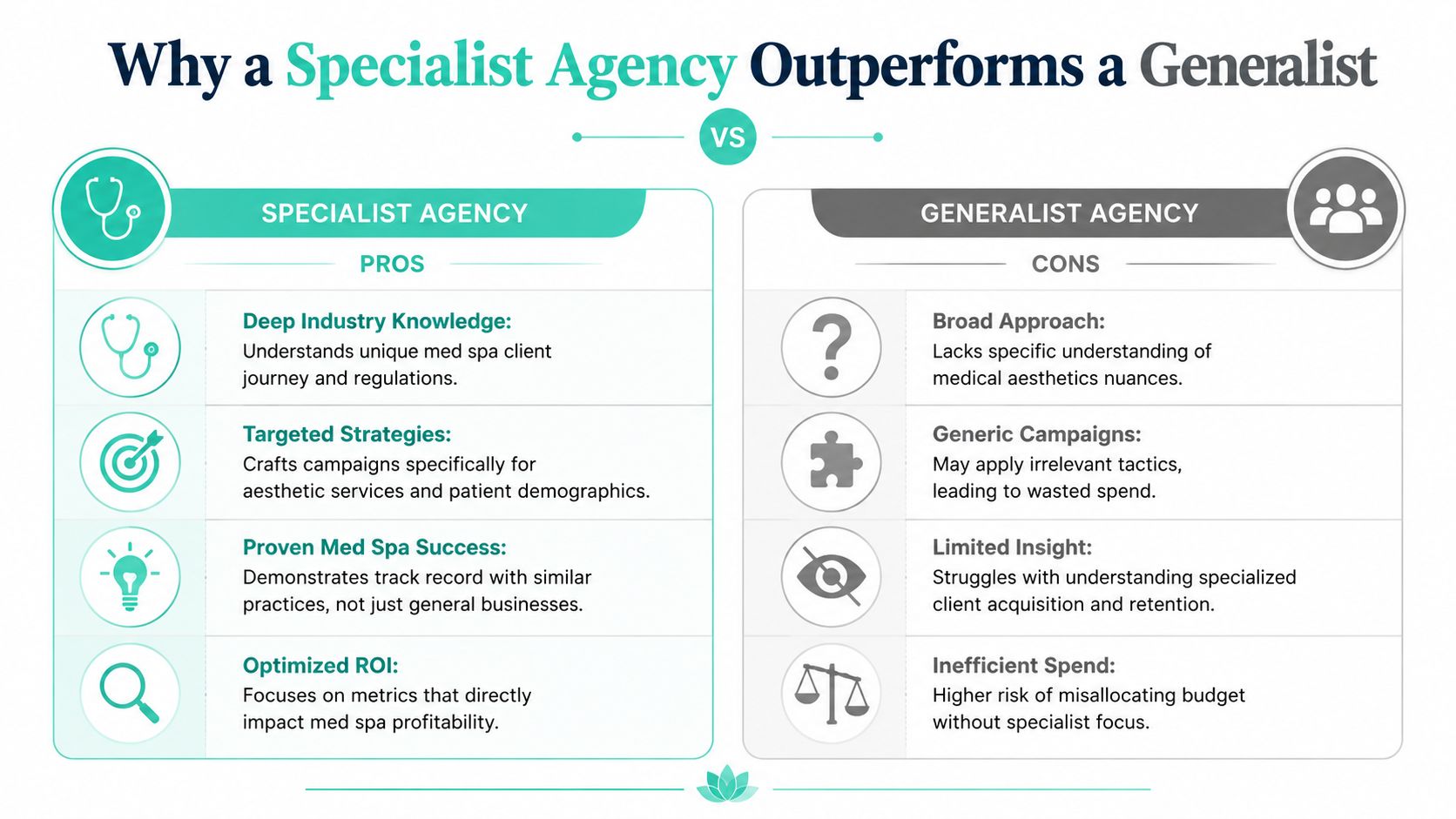
A generalist agency can market a lot of businesses. A specialist agency understands your business before the kickoff call ends.
That's the difference.
If you had a heart issue, you wouldn't want a smart general practitioner managing every layer of the problem if a cardiologist was available. Same logic here. A good general marketer may know ad platforms, websites, and analytics. But a medical spa has a different buying journey, different trust barriers, different compliance exposure, and different messaging needs than a roofing company, restaurant, or ecommerce brand.
The compliance gap is real
In aesthetic marketing, the creative itself can create risk if the agency doesn't understand the rules.
For medical spas, HIPAA compliance is a core marketing constraint because patient images, testimonials, and communications can be protected health information. Agencies that reduce that risk use compliant platforms with signed BAAs and document consent, as explained in this overview of HIPAA-aware med spa marketing practices.
That changes how good agencies operate day to day:
Before-and-after content needs process: Not just design approval.
Testimonials need consent: Not just a screenshot and a caption.
Follow-up systems need compliant tools: Not random consumer software stitched together.
Remarketing needs discipline: Not every audience or asset should be handled casually.
A generalist often sees marketing risk as a legal footnote. A specialist treats it like part of campaign design from day one.
No one books most aesthetic services the way they buy a T-shirt online. Patients compare. They hesitate. They zoom in on photos. They read reviews. They look at the provider's tone, not just the offer.
That means messaging has to do more than generate attention. It has to reduce uncertainty.
A specialist agency usually does three things better than a generalist:
Better alignment between messaging and the consultation decision
Generalist
Broad campaign mechanics across industries
More risk of generic copy and misplaced budget
Strategic specialist
Brand voice plus measurable booking outcomes
Growth that feels consistent with the practice you're building
The right agency doesn't just know how to run ads. They know why a patient hesitates before booking an injectable consultation and how to answer that hesitation in the page, the ad, the review profile, and the follow-up.
When a generalist can still work
There is one honest caveat. Some practices don't need hyper-specialization as much as they need disciplined execution. If your positioning is already clear, your operations are clean, and your treatments are straightforward to market, a strong generalist might be capable.
But if your practice relies on visual proof, trust-heavy messaging, local reputation, and compliant workflows, you'll usually move faster with a specialist. In this niche, “learning your industry as they go” is expensive.
The Core Services Your Med Spa Actually Needs
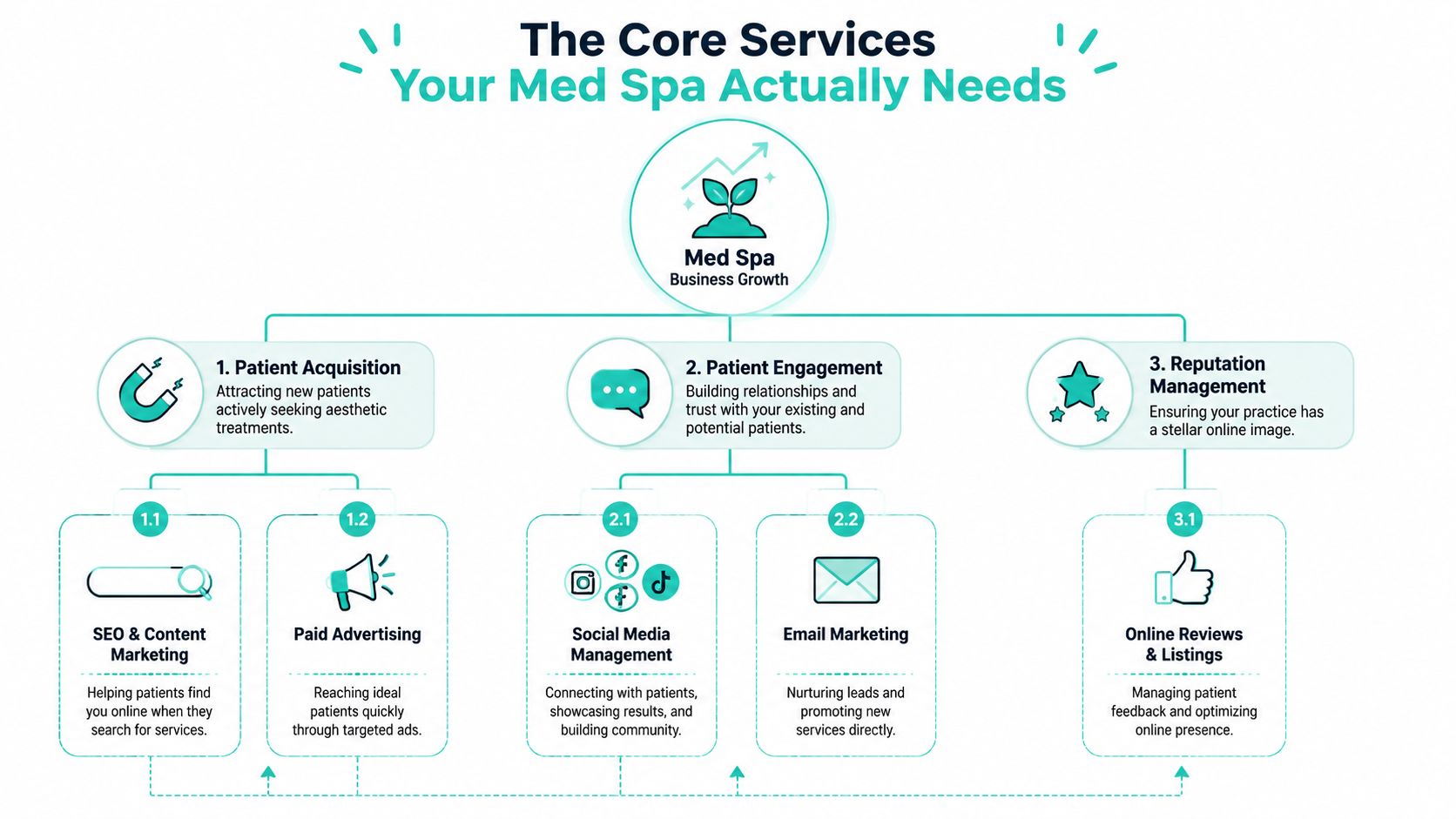
Most agency proposals make the same mistake. They hand you a menu of services instead of a growth system.
You don't need “SEO” in the abstract. You need to show up when someone searches for a specific treatment in your city. You don't need “social media management” as a line item. You need trust, recall, and proof that your team knows what it's doing. You don't need “email marketing” because everyone says you should have it. You need patients to return, rebook, and stay connected.
This visual gets the structure right.
A top medical spa marketing agency should treat your website as a conversion system, not a brochure. That means one dedicated, keyword-targeted page for each service so the site can rank for high-intent local searches and convert visitors into booked appointments, as outlined in this guide to building a med spa marketing plan.
Local SEO that drives treatment searches
If your website has one generic “Services” page, that's a problem.
A person searching for Botox in your city and a person searching for CoolSculpting in your city are not expressing the same intent. They need different pages, different questions answered, different proof, and different calls to action.
Good local SEO for a med spa includes:
Treatment-specific pages: One page per service, with focused copy and booking paths.
Local intent targeting: Service-plus-location language woven into pages naturally.
Google Business Profile alignment: Your site and local listing should reinforce each other.
Conversion tracking: The page should be measured by inquiries and bookings, not just rankings.
If you're evaluating providers, compare whether they build isolated tactics or connected systems. Agencies like Leaping Lemur Media's service model center strategy, search visibility, and brand alignment together, which is the right frame for specialist practices.
Paid ads that support demand, not guesswork
Paid media is useful when it's pointed at the right treatments and landing pages.
It's a waste when an agency sends traffic to your homepage, runs broad offers without understanding patient intent, or reports impressions as if they pay the bills. Strong campaigns are tight. They match search intent or audience intent to a focused page, a clear offer, and a specific next step.
A few signs your ads are built correctly:
The landing page matches the ad promise
The offer fits the treatment decision
Phone calls and form fills are tracked
The practice can see which campaigns lead to real consultations
Social media and content that build trust
Social doesn't need to be constant. It needs to be useful.
For a med spa, content works when it does one of three jobs well: educate, reassure, or prove. That can mean provider-led videos, treatment explainers, myth-busting posts, FAQ reels, or carefully approved before-and-after content. What it should not be is endless trend-chasing with no connection to bookings.
A good content strategy sounds like your providers and answers the questions patients already have before they call.
Reputation management that removes hesitation
Reviews and public responses often matter more than polished branding. Patients read them when they're deciding whether your practice feels safe, skilled, and consistent.
A strong agency should help you build a repeatable review process, keep business listings accurate, and protect the quality of your digital first impression. Reputation isn't a side task. It's part of conversion.
Email marketing that brings patients back
Most med spas underuse email because they treat it as occasional promotion.
That leaves money on the table. Email should support lead nurture, post-visit follow-up, seasonal campaigns, membership communication, treatment education, and reactivation. It's one of the cleanest ways to stay present without paying for every interaction again.
If you want a simple filter for your service mix, use this one: every marketing channel should either help new patients find you, help hesitant prospects trust you, or help existing patients come back. If a service doesn't clearly do one of those jobs, it probably doesn't deserve your budget.
Measuring Success What ROI Really Looks Like
Owners get into trouble when agencies report activity instead of outcomes.
Traffic can go up while bookings stay flat. Social engagement can improve while consultation quality gets worse. A campaign can “perform” on paper and still do nothing meaningful for the business. If your agency can't connect marketing to revenue logic, you don't have reporting. You have theater.
Vanity metrics versus business metrics
Vanity metrics are useful for context. They are not enough for decision-making.
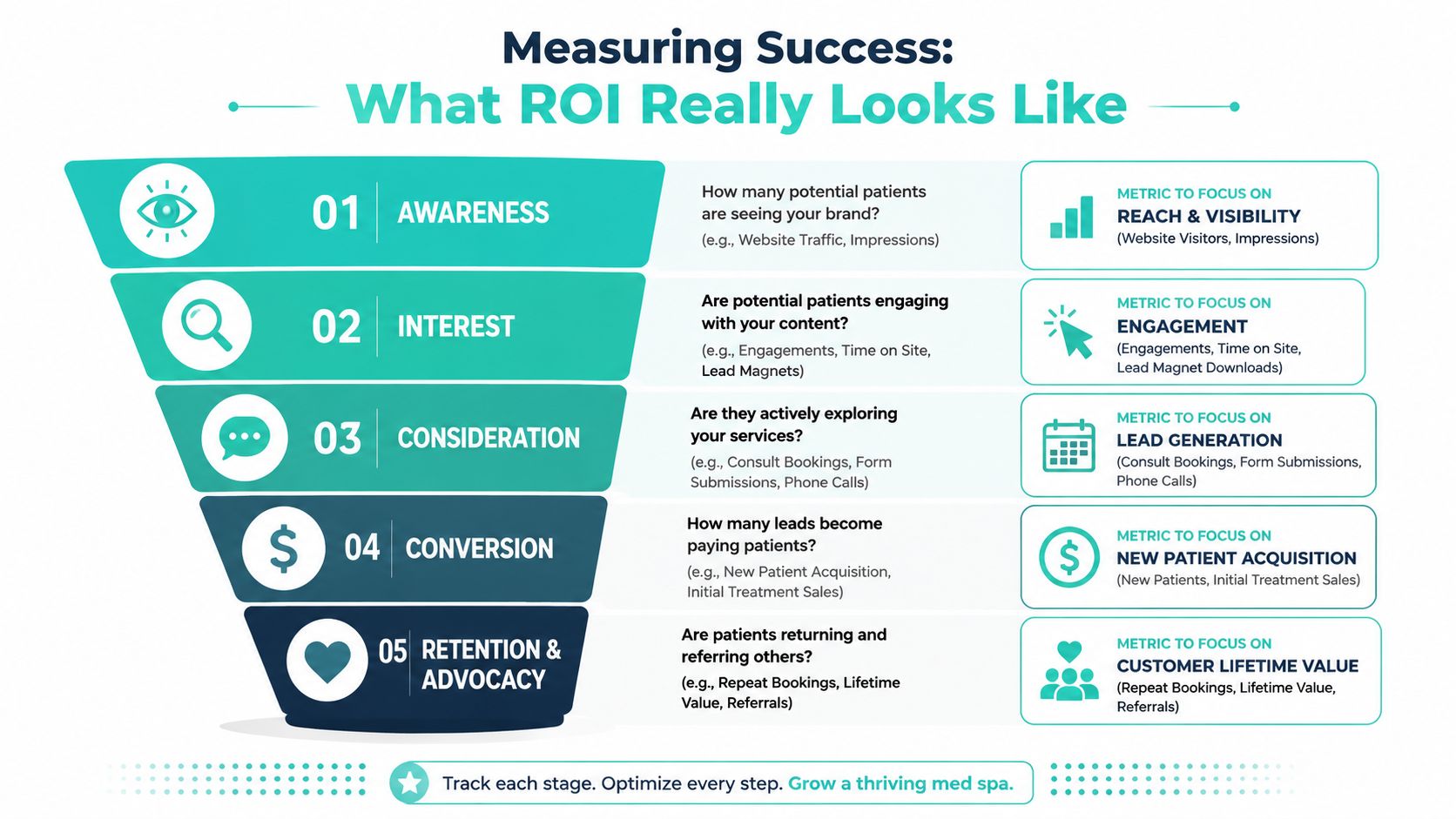
You should know whether people are seeing your brand and interacting with your content, but those signals sit at the top of the funnel. A practice owner needs to know what happens after attention.
Focus on the movement from interest to revenue:
Lead volume: Are qualified inquiries increasing?
Lead-to-booking conversion: Are inquiries turning into consultations or appointments?
New patient acquisition: Are campaigns generating first-time paying patients?
Retention and repeat behavior: Are those patients coming back?
Revenue quality: Are you attracting the treatments and patient types you prefer?
The numbers worth reviewing every month
Even without overcomplicating the dashboard, every med spa should have a short monthly review rhythm.
Metric type
Why it matters
What a good agency should discuss
Consultation inquiries
Shows whether demand generation is working
Channel source, lead quality, missed opportunities
Booked appointments
Reveals whether leads are converting
Front desk response, booking friction, page quality
Treatment mix
Tells you what marketing is actually attracting
Whether high-priority services are getting visibility
Repeat visits
Reflects long-term value, not just first sale
Nurture, retention, and reactivation opportunities
Don't let anyone hide poor business performance behind attractive top-of-funnel charts.
If you want a practical framework for calculating content marketing returns, that resource is useful because it pushes the conversation past vague visibility and toward actual financial contribution.
For paid media, that same discipline matters even more. If your current setup feels murky, reviewing a structured approach to ads management for growth-focused practices can help you see what proper campaign accountability should look like.
The bottom line is simple. A medical spa marketing agency should be able to tell you which efforts generated inquiries, which inquiries booked, which bookings produced revenue, and which patients stayed. If they can't trace that path clearly, they can't manage it well.
How to Choose the Right Agency Partner for Your Practice
The wrong hiring process creates the wrong agency relationship.
If you shop for an agency the way you'd shop for a software subscription, you'll get a vendor. If you choose based on who understands your goals, your economics, your brand voice, and your operating reality, you're more likely to get a partner.
That's the standard to use.
The more nuanced question in 2026 isn't whether specialization is always better. It's whether your practice needs industry-specific positioning or disciplined execution, and whether the agency understands that real growth comes from strategy, retention, and reputation, not just lead generation, as discussed in this perspective on medical spa growth strategy.
Start with strategy, not deliverables
A weak agency leads with output. “We'll do SEO, PPC, social, email, and web updates.”
A strong one starts by diagnosing:
Where growth is currently getting stuck
Which treatments deserve priority
How your brand should be positioned locally
What patient journey gaps are costing you bookings
Whether the problem is visibility, conversion, retention, or all three
This is also where pricing should make sense. Retainers can work well when you need ongoing strategy and execution. Project work can make sense for a website rebuild, brand refresh, or launch. The model matters less than the clarity. You should understand what the agency owns, how progress will be judged, and how communication will work.
Judge the relationship, not just the portfolio
A portfolio can impress you and still tell you very little.
What matters more is whether the agency listens carefully, challenges vague goals, asks operational questions, and speaks plainly about tradeoffs. If they promise everything quickly, be careful. Good partners don't sell certainty where uncertainty exists. They sell process, discipline, and accountability.
If you want another useful lens on vetting performance-focused providers, this guide on how to hire SEM consultants is worth reading. It's not med spa-specific, but the hiring logic carries over well.
Green flag: They talk about your patients, your market, and your internal workflow before they talk about channels.
10 critical questions to ask a potential agency partner
Use this table in your discovery calls. It will save you time.
Question Category
Question to Ask
What to Listen For (The "Green Flag")
Strategy
How do you decide which services or treatments to prioritize first?
They connect priorities to business goals, local demand, and patient fit
Positioning
How will you make our practice sound distinct from nearby competitors?
They talk about voice, differentiation, and community relevance
Website
How should our website support bookings, not just traffic?
They discuss service pages, calls to action, and conversion tracking
Paid Media
How do you decide where ad spend should go?
They explain intent, landing page fit, and revenue focus
SEO
What does local SEO look like for a med spa specifically?
They mention treatment-specific visibility and local search intent
Compliance
How do you handle patient photos, testimonials, and communications safely?
They have a clear consent and process mindset, not casual reassurance
Reporting
What metrics will you review with us regularly?
They focus on inquiries, bookings, revenue logic, and retention
Communication
Who will we actually talk to each month?
They define ownership and don't hide behind a sales handoff
Partnership Style
What do you need from us for this to work?
They describe collaboration, approvals, feedback, and shared responsibility
Fit
When are you not the right agency for a practice?
They answer honestly and show they qualify opportunities carefully
The right answer isn't polished language. It's clarity.
If an agency can explain how it thinks, how it measures, and how it works with your team, you're getting close. If it mostly lists deliverables and avoids specifics, keep looking.
Real-World Examples Agency Partnerships in Action
A new med spa owner opens with strong clinical talent and a beautiful space, but almost no local traction. Friends and family book first. A few referrals trickle in. The website looks polished, yet it doesn't attract consistent search traffic for the actual services the practice offers. A good agency partner steps in, builds treatment-focused local pages, tightens Google Ads around high-intent searches, cleans up the booking path, and helps the practice show up where nearby patients are already looking. The result isn't magic. It's momentum. The phones start ringing for the right reasons, and the owner stops guessing which efforts matter.
A more established practice faces a different problem. The schedule is decent, but the brand feels dated and the marketing no longer reflects the quality of care. Existing patients know the team is excellent. New patients don't see that online. The right agency doesn't just redesign a logo and call it a day. It refreshes the brand voice, rebuilds the website around patient decision-making, updates service messaging, organizes visual proof properly, and creates retention-focused content that keeps the relationship alive after the first visit.
Those are two different businesses. They need two different strategies.
That's the point. A real medical spa marketing agency doesn't drop the same package on every practice. It listens, diagnoses, and builds around the growth stage you're in.
Your Next Step Towards a Flourishing Practice
Choosing a medical spa marketing agency is not a task to delegate casually. It's a strategic decision about who gets to shape how your practice is found, understood, trusted, and chosen.
You don't need a partner who floods you with jargon or hides behind dashboards. You need one who can see the full picture. Brand voice. Local search. Paid acquisition. Consent process. Website conversion. Retention. Reputation. The practices that grow well usually aren't doing one flashy thing. They're doing the basics with discipline, and they're doing them in a way that feels coherent to the patient.
That's why the partnership mindset matters so much. A vendor completes assignments. A partner helps you make sharper decisions.
If you're at the point where referrals alone won't carry the next phase of growth, trust that instinct. It usually means your practice is ready for more structure, clearer positioning, and a smarter system behind the scenes. The right agency won't make your brand louder. It will make it clearer. It will help your marketing sound like you, reflect what your team does well, and turn that clarity into steady growth over time.
That's a much better investment than buying another stack of disconnected tactics.
If you want a no-pressure conversation about what growth could look like for your practice, Leaping Lemur Media offers the kind of strategic discussion that helps owners figure out whether a real partnership makes sense, what's holding marketing back, and how to build a plan that fits the practice instead of forcing the practice to fit a template.