Marketing Agency: Find the Right Partner for Growth
You built your practice by becoming excellent at something hard. You diagnose, advise, operate, negotiate, calm people down, and carry real responsibility. Then marketing lands on your desk and asks you to become a strategist, copywriter, media buyer, analyst, videographer, and local brand builder too. That's where many practice owners get stuck. The work is […]
LElemurJuly 7, 202618 min read
In this piece
You built your practice by becoming excellent at something hard. You diagnose, advise, operate, negotiate, calm people down, and carry real responsibility. Then marketing lands on your desk and asks you to become a strategist, copywriter, media buyer, analyst, videographer, and local brand builder too.
That's where many practice owners get stuck. The work is too important to ignore, but too specialized to improvise. One month you're trying to fix your website. The next you're chasing a social media trend you don't even like. Then an agency salesperson promises more leads, more visibility, more everything, and somehow makes the decision feel even murkier.
This isn't a small side industry either. The global marketing agencies market reached a valuation of USD 473.57 billion in 2026, and digital marketing services account for over 61% of the market, which tells you how much business growth now runs through digital channels rather than reputation alone (Mordor Intelligence on the global marketing agencies market). If you run a dental practice, law firm, medspa, or clinic, that matters. Patients and clients still trust referrals, but they also search, compare, judge, and decide online.
The decision isn't whether to hire a marketing agency. It's whether you'll choose a vendor who completes tasks, or a partner who helps your practice grow with intention.
When You're the Expert in Everything but Marketing
A dentist I once advised described her week this way. Monday was hygiene schedules. Tuesday was an associate issue. Wednesday she was reviewing equipment. Thursday she was answering front desk questions about cancellations. Friday night she was rewriting homepage copy because “nobody else was doing it right.”
That's a common pattern. The practice owner becomes the fallback system for every unresolved problem, and marketing finds its way onto the list. It feels manageable at first because you're smart and resourceful. Then it starts stealing attention from the work only you can do.
Expertise doesn't automatically create visibility
Being excellent at dentistry, law, aesthetics, or medicine doesn't mean your market understands why they should choose you. People rarely see the quality behind the scenes. They see a map listing, a website, reviews, ad copy, and whether your message sounds clear and credible.
A weak marketing setup creates strange outcomes:
Good practices look generic. Their sites sound like everyone else in town.
Strong clinicians attract poor-fit inquiries. The messaging is broad, so the wrong people book.
Owners waste prime time on patchwork. They bounce between freelancers, software tools, and half-finished campaigns.
You shouldn't spend your best judgment on headline testing when patients or clients need that judgment in the room.
The hidden cost of doing it yourself
Most practice owners don't need more tasks. They need better coordination. That's why the right marketing agency matters. Not because you can't learn marketing, but because you shouldn't have to become a part-time operator in an entirely separate field just to keep your pipeline healthy.
The decision gets easier once you stop thinking, “Who can run my ads?” and start asking, “Who can help me build a system that fits how my practice grows?”
That shift changes everything. It moves the conversation from outsourced chores to accountable partnership.
What Is a Marketing Agency Really
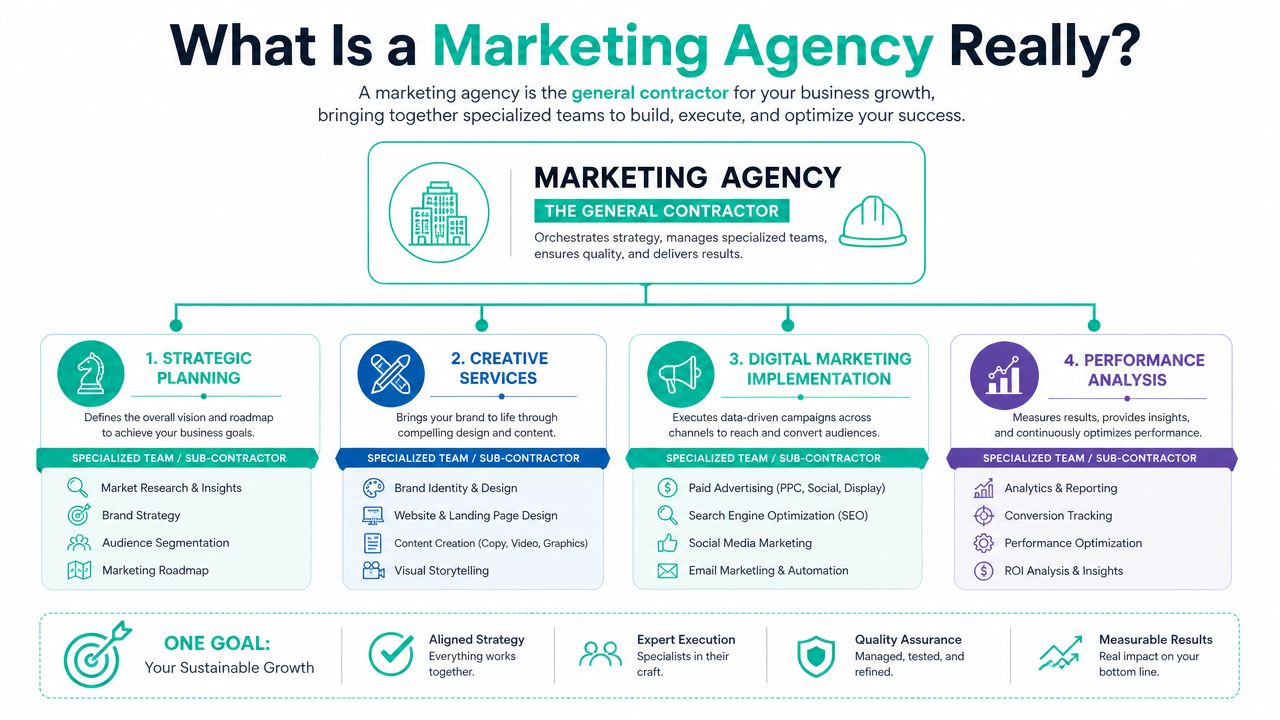
A marketing agency is a general contractor for growth. That's the simplest useful definition.
If you were building an addition onto your office, you wouldn't hire a roofer, electrician, plumber, and cabinet maker separately and hope they all interpreted the same vision. You'd want one person or team to create the plan, sequence the work, manage the specialists, and make sure the finished result functions.
That's what a good marketing agency does.
Strategy comes first or the rest is noise
The agency's first job isn't posting content or launching ads. It's deciding what the practice is trying to achieve, whom it wants to attract, what message will resonate, and which channels deserve attention.
Without that blueprint, marketing becomes a pile of disconnected activity:
SEO without positioning brings traffic that doesn't convert.
Paid ads without intake alignment create leads your staff can't close.
Social content without brand discipline makes the practice feel inconsistent.
Reporting without interpretation gives you charts but no decisions.
The agency should orchestrate specialists
Inside one firm or across trusted partners, an agency often coordinates several disciplines at once. Think of them as specialized crews under one plan.
Function
What it actually means for your practice
Strategic planning
Deciding goals, audience, offers, messaging, and channel priorities
Creative services
Producing website copy, design, photography direction, video, and ad assets
Digital execution
Managing SEO, Google Ads, social campaigns, email, and local listings
Performance analysis
Reviewing conversion data, lead quality, call outcomes, and next-step changes
A real marketing agency connects these pieces. A task vendor usually owns only one slice.
Practical rule: If an agency starts with tactics before it understands your economics, intake process, and ideal patient or client profile, it's not acting like a strategic operator.
The distinction matters more for professional practices than for many other businesses. Your reputation, margins, compliance boundaries, staff capacity, and patient experience all affect what marketing should do. That requires integration, not just execution.
The Menu of Marketing Agency Types and Services
“Marketing agency” is a broad label. That's part of the problem. Two firms can use the same title and deliver completely different value.
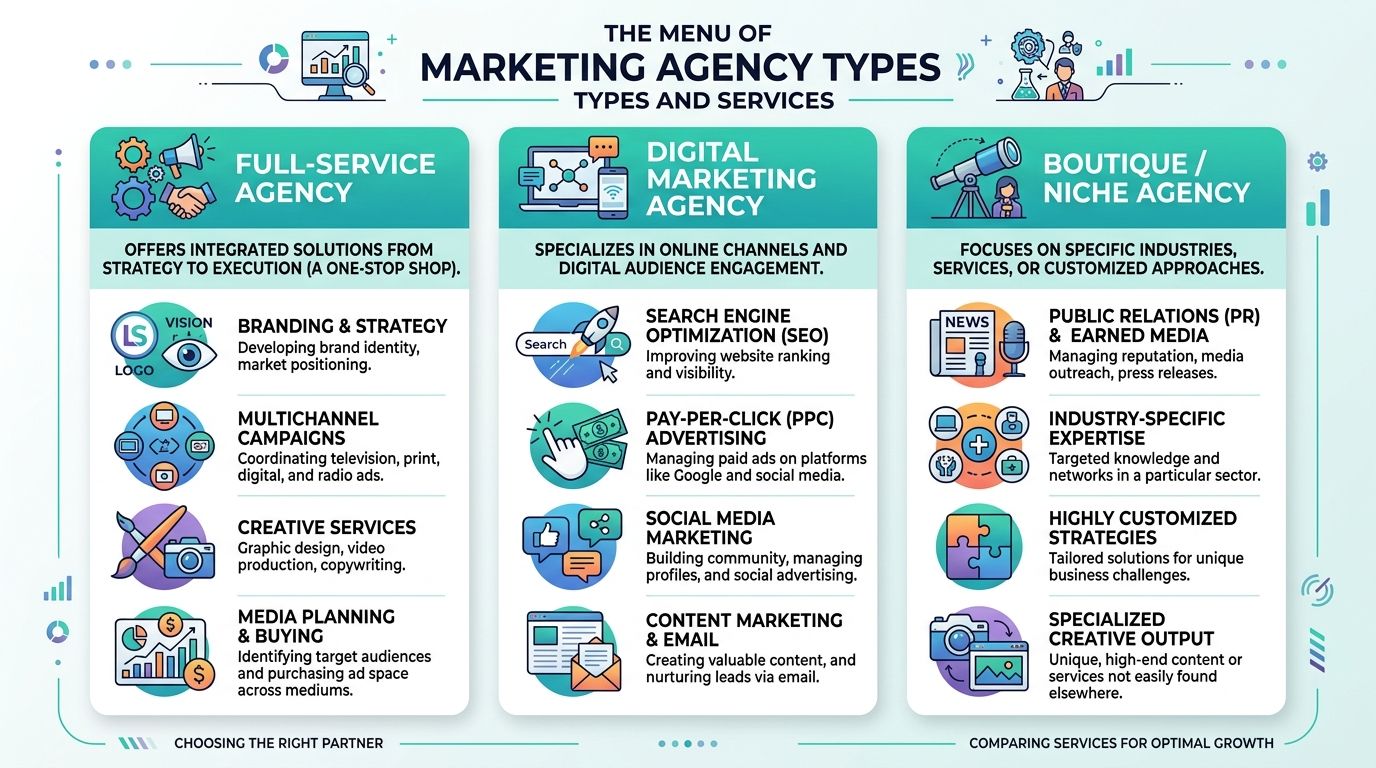
The three models you'll see most often
Full-service agencies handle strategy plus a wide set of channels. That usually includes brand messaging, websites, SEO, paid media, content, and reporting. If your practice needs coordinated growth and doesn't want to manage several vendors, this model makes sense.
Digital agencies focus mainly on online channels. They're often stronger in search, paid ads, landing pages, analytics, and campaign execution than in broader brand work. This can be a strong fit if your main issue is demand capture rather than foundational positioning.
Boutique or niche agencies go narrower. Some specialize by service, like SEO or paid search. Others specialize by industry, like law, dentistry, medspas, or ophthalmology. That specialization can be a major advantage. Hyper-specialized agencies that focus on a niche like law or dentistry are outperforming generalist agencies by 34% in client retention rates (video discussion on niche agency retention performance).
That number matters because retention usually reflects fit. Clients stay when the agency understands the business, communicates clearly, and produces work that doesn't need endless translation.
How services map to real practice needs
Don't buy services the way you'd buy items off a menu. Start with the problem.
If you need more visibility in local search, that points to local SEO, review strategy, location pages, and Google Business Profile management. If consultations are coming in but the wrong prospects are booking, that points to messaging, landing pages, ad targeting, and intake alignment. If your reputation is solid but your digital presence feels thin, you may need content marketing, stronger brand assets, and regular social proof.
Here's a cleaner way to consider it:
SEO helps people find you when they search for solutions you already provide.
Content marketing answers questions, builds trust, and supports search visibility.
PPC and paid social create demand faster, but only if the targeting and conversion path are sharp.
Website strategy and conversion work turn attention into booked appointments or qualified consultations.
Email and automation help with follow-up, nurture, recall, and reactivation.
Video and platform-specific content can matter a lot if your audience researches heavily before contacting you.
If video is part of your plan, it's worth taking time to compare YouTube optimization options so you understand the difference between basic editing support and actual platform strategy.
Some practices also need a partner that can cover multiple channels under one operating model. That's where a broader provider such as Leaping Lemur Media's service mix may fit, especially for firms that want strategy, execution, and performance visibility under one roof.
Broad capability is useful. Deep relevance is better. If an agency knows your field, your buyer psychology, and your intake realities, the work usually gets sharper faster.
Why Your Practice Needs a Marketing Partner Not a Vendor
A vendor completes deliverables. A partner helps you make better growth decisions.
That difference shows up quickly. A vendor asks what you want them to do. A partner asks what kind of practice you're trying to build, what cases or procedures you want more of, what your team can handle, where drop-offs happen, and what “good growth” means for your life.
What changes when the relationship is built right
The first benefit is better-fit demand. More inquiries isn't always progress. A law firm that wants complex, higher-value matters shouldn't flood intake with low-fit leads. A medspa that wants long-term treatment relationships shouldn't optimize for discount shoppers. A dentist who values thorough care shouldn't market like a coupon book.
The second benefit is brand durability. A partner helps your practice become known for something specific in your community. That strengthens referral confidence, hiring, retention, and pricing power. People trust practices that look coherent. They trust them even more when every touchpoint says the same thing.
The third benefit is time reclamation. You stop being the person rewriting ad copy at night or trying to decode reporting dashboards on Sunday morning.
What partnership looks like in practice
Consider a dentist whose schedule has openings but no clear pattern. A vendor may respond by posting more on Instagram or adding a few search ads. A partner will ask which procedures have the healthiest economics, whether the front desk converts calls consistently, what neighborhoods produce the best patients, and whether the website communicates trust before price.
Now take a lawyer. The vendor reports click volume. The partner asks which matter types you want, how your consultation process works, what your response time is, and whether your intake language screens out poor-fit leads.
A medspa owner often faces a different version of the same problem. Demand exists, but the market is noisy. A vendor may chase trends. A partner builds a repeatable message around credibility, outcomes, and the right service mix.
If your agency also advises on creative testing and modern ad workflows, material like these insights for agencies on AI UGC can help you evaluate whether they understand where persuasive content production is going.
The best agency relationships feel less like outsourcing and more like adding a commercially minded operator to your leadership bench.
That's the standard. If the relationship doesn't make your decisions easier, your message sharper, and your time more protected, it's probably a vendor arrangement dressed up as strategy.
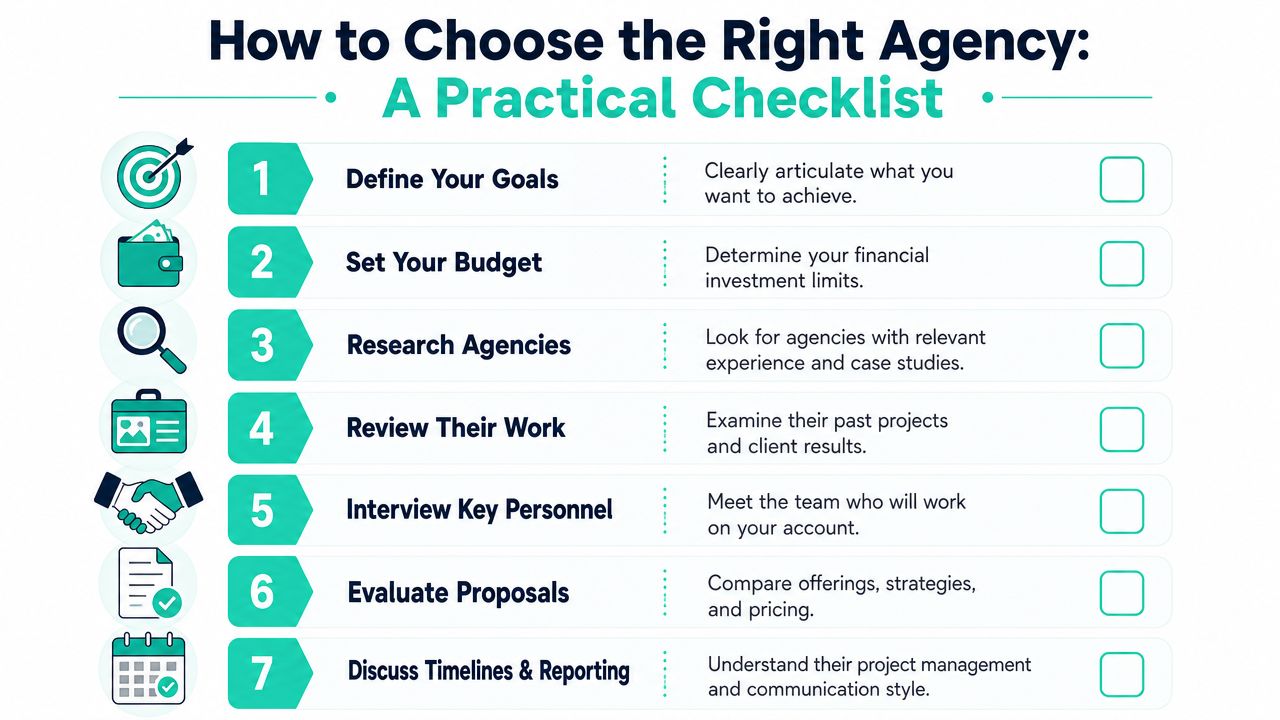
How to Choose the Right Agency A Practical Checklist
You sit through two agency pitches in the same week. Both show polished decks, clean case studies, and confident reporting screenshots. One leaves you feeling sold. The other leaves you feeling understood.
Choose the second one.
Most bad agency hires start with a basic mistake. The owner shops for services instead of a working relationship. For a local professional practice, that approach gets expensive fast. You do not need another vendor completing tasks in isolation. You need a partner who can connect marketing to intake, scheduling, case mix, capacity, and revenue.
Start with business reality, not agency promises
Before you speak with any agency, get clear on the constraints they will inherit. If you skip this step, you will reward the best pitch, not the best fit.
Write down:
Your priority service lines. Which procedures, case types, or offers deserve more demand?
Your geographic concentration. Which towns, ZIP codes, or neighborhoods produce your best patients or clients?
Your intake capacity. Can your team absorb more inquiries, or do you need fewer and better ones?
Your current assets. Website, reviews, ad account history, CRM, email list, call handling, follow-up process.
Your budget range. What can you sustain long enough to judge performance fairly?
Budget discipline matters here. Agency retainers for SaaS and enterprise clients, as well as full-service agencies working with mid-market clients, frequently range from $10,000 to $50,000+ per month (Taskip on digital marketing agency pricing models). Your practice may sit below that range, but the point stands. Serious strategy, execution, and accountability cost real money.
Performance pricing also needs scrutiny. Agencies using a performance model often charge a low base fee plus bonuses such as 5–20% of attributed revenue or 10–30% bonuses for exceeding targets, according to Dojo AI on agency pricing models. That structure only works if attribution is clean and both sides agree on what counts as a qualified result.
Interview for fit under pressure
A good agency should make your practice easier to run, not harder to decipher. The interview should test that.
Ask these questions directly:
How do you learn a new client's economics, intake process, and growth priorities? A real partner has a method. They should talk about discovery, positioning, demand by service line, and conversion points.
Who will do the work each month? Ask for names, roles, and ownership. If the seller disappears after signature, expect frustration.
What decisions do you expect us to make together each month? This question separates collaborators from task-takers. Partners bring decisions to you. Vendors bring activity reports.
What would make this engagement fail, even if your campaigns perform reasonably well? Strong agencies answer this well. They will mention weak intake, poor response time, bad offer design, limited capacity, or internal delays.
What do you need from our side to do great work? Good agencies know they cannot operate in a vacuum.
If your shortlist includes automation-focused firms, review Prometheus Agency marketing automation. It gives useful context for questions about lead routing, follow-up logic, and where automation helps a professional practice versus where a human touch should stay in place.
Read the proposal like an operating document
A proposal should help you see how the relationship will work in real life. If it reads like a menu of deliverables, treat that as a warning.
Use this filter:
What to review
What a strong proposal shows
Business diagnosis
Clear understanding of your practice, your market, and the bottlenecks slowing growth
Strategy
Channel choices tied to service-line priorities and local demand, not a generic package
Scope
Specific deliverables, ownership, meeting cadence, and exclusions
Measurement
Business metrics, reporting rhythm, and how decisions will be made from the data
Timeline
A believable sequence of work, including setup, testing, and optimization
Look closely at what the agency chooses to emphasize. Mature firms explain tradeoffs, assumptions, and dependencies. Weak firms pad proposals with deliverables because deliverables are easier to sell than judgment.
Check whether they can talk about numbers without hiding behind them
You want an agency that understands performance metrics and keeps them in context. A local practice does not grow because a dashboard looks busy. It grows because the right people call, book, show up, and buy the right services.
Ask the agency how they define a qualified lead for your business. Ask how they separate lead volume from lead quality. Ask what happens if campaigns increase inquiries but your front desk cannot convert them. Their answer tells you a lot about whether they think like a partner.
Client satisfaction matters too, but use it as a signal, not a shortcut. Top-tier marketing agencies benchmark Net Promoter Score at 61%, and agencies above 60% are more likely to build long-term partnerships rather than transactional vendor roles (Nexoya on digital marketing benchmarks by industry). Ask how they collect client feedback, what they learned from it, and what they changed because of it.
Do one final check before you sign
Review every proposal against one standard. Will this agency act like an extension of your leadership team, or will they wait for instructions and hide behind deliverables?
That answer decides more than creative quality or channel mix.
If you want another set of practical examples before choosing, browse the agency evaluation articles on the Leaping Lemur Media blog. Good educational content will not make the decision for you, but it will show you how a firm thinks, what it values, and whether it respects the complexity of running a professional practice.
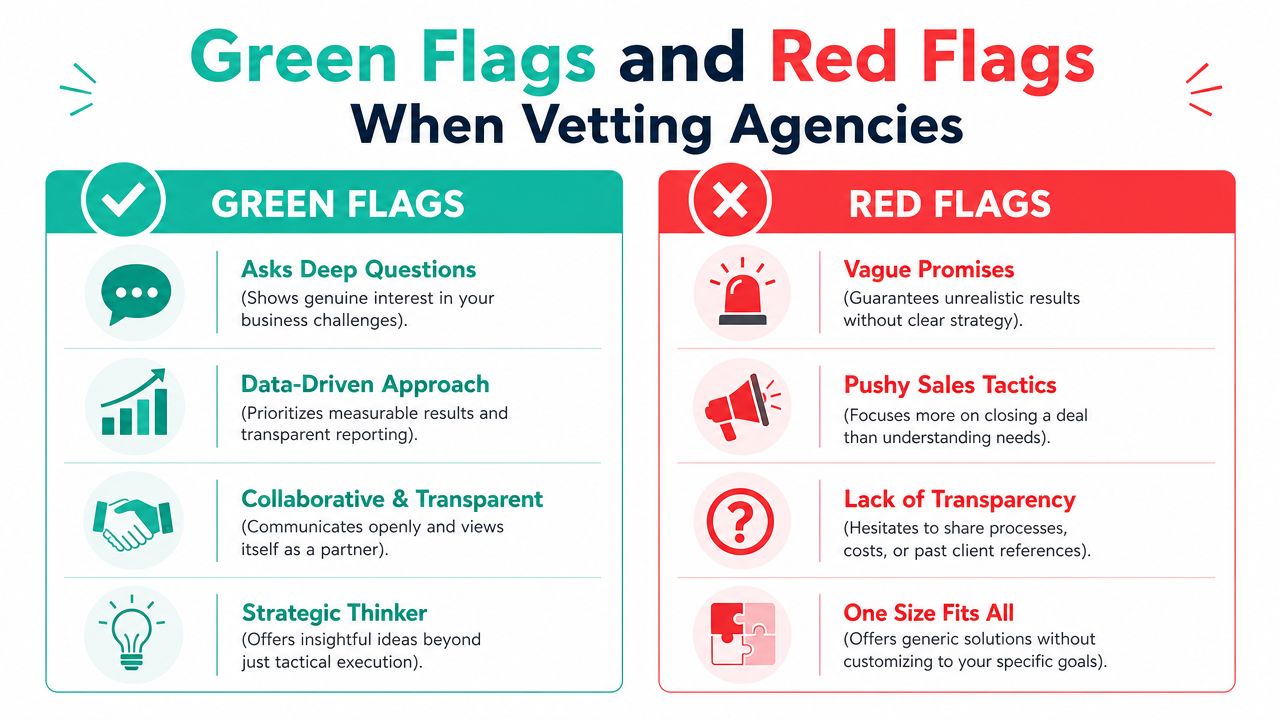
Green Flags and Red Flags When Vetting Agencies
A bad agency rarely surprises you after signing. It usually shows its hand in the sales process.
Green flags worth taking seriously
The best agencies do not spend the first meeting trying to impress you. They try to understand how your practice grows, where it gets stuck, and what a good patient or client is worth over time.
Pay attention to signals that point to partnership.
They ask questions an order-taker would avoid. They want to know your margins, close rates, no-show patterns, intake bottlenecks, staffing limits, and which cases or services you want less of.
They tie performance to business reality. They can explain how they evaluate channel performance in the context of your goals, your geography, and your economics instead of quoting generic dashboard numbers.
They explain tradeoffs without flinching. A serious partner will tell you where to be patient, where to spend, and what to postpone.
They share how decisions get made. You know who owns strategy, who executes, how often results are reviewed, and what changes trigger action.
They teach as they sell. You leave the conversation clearer than when you started. That is a strong sign they will work with you, not around you.
A good agency reduces confusion. It does not hide behind jargon.
Red flags that usually get expensive
Weak agencies usually reveal themselves by acting like vendors before the contract even exists. They stay at the task level because strategic scrutiny exposes the gaps.
Watch for these patterns.
Vague guarantees. “We'll get you to the top of Google” means nothing unless they define the market, the terms, the timeline, and the cost.
Pressure to sign fast. Good partnerships can survive a careful review. Bad ones depend on urgency.
Cookie-cutter proposals. If the same package supposedly works for dentists, personal injury firms, medspas, and home services with only minor edits, you are looking at production, not strategy.
No visibility into the team or process. If you cannot tell who is doing the work, who is accountable, or how recommendations are approved, expect friction later.
Shallow discovery. If they skipped intake, capacity, economics, competitive position, or local market dynamics, they are guessing.
Defensiveness when challenged. A real partner can explain decisions, accept scrutiny, and revise a plan. A vendor protects the pitch.
Use one simple test. After the meeting, do you feel like you met a growth partner or a sales team?
The best agency conversations start before the first call. If you show up prepared, you'll get better answers and spot weak thinking faster.
Bring these five things into your first round of conversations:
A clear growth target: Know what success looks like in 12 months.
A service-line priority list: Decide what you want more of and what you don't.
Basic performance context: Gather current website, lead, call, and intake information.
Budget range: Don't wait for the agency to guess what's realistic for you.
Internal constraints: Be honest about staff bandwidth, approvals, and follow-up discipline.
This preparation changes the tone of the relationship. You stop acting like a buyer collecting pitches and start acting like an owner evaluating operating partners.
If you're ready to have that kind of conversation, start by reaching out through the Leaping Lemur Media contact page. Whether you speak with them or another firm, use the same standard. Look for a marketing agency that respects your expertise, understands your market, and is willing to build with you for the long haul.
Leaping Lemur Media works with professional practices that need senior-led strategy across SEO, ads, AI-supported content, and reporting, with an emphasis on long-term partnership over transactional execution. If you want a clearer view of what growth could look like for your practice, Leaping Lemur Media is a practical place to start the conversation.