Patient Acquisition Strategy: A 2026 Guide for Practices
Somewhere in your week, this probably happened. You looked at the schedule, saw gaps you know shouldn't be there, and thought, “We do good work. People need this care. Why are the right patients still not finding us or not following through?” That's the heart of patient acquisition. It isn't about gaming an algorithm or […]
LElemurJuly 6, 202615 min read
In this piece
Somewhere in your week, this probably happened. You looked at the schedule, saw gaps you know shouldn't be there, and thought, “We do good work. People need this care. Why are the right patients still not finding us or not following through?”
That's the heart of patient acquisition. It isn't about gaming an algorithm or stuffing your calendar with anyone who clicks. It's about building a reliable path between your practice and the people in your community who already need what you do best.
Most owners get pushed toward disconnected tactics. Post more on social. Try ads. Ask for reviews. Sponsor something local. Add online booking. None of those ideas are wrong. They just fail when they're treated like random chores instead of one system. A strong patient acquisition strategy connects your message, your visibility, your intake process, and your local reputation so patients can move from trust to action without unnecessary friction.
A healthy practice rarely grows from one tactic. It grows when the owner gets clear on who they serve, makes the practice easy to find, and removes the little points of friction that cause good prospects to drift somewhere else.
That matters even more for smaller practices. You don't have a national brand doing the heavy lifting. Your advantage is different. You know your community, you understand the kinds of cases you want, and you can build trust in ways larger systems often can't.
That's why I like to treat patient acquisition strategy as part marketing plan, part community infrastructure. Your website, reviews, local listings, referral relationships, events, and follow-up process should all tell the same story. This practice is capable, approachable, and easy to choose.
Practical rule: If your marketing brings attention but your process creates confusion, your acquisition problem is operational, not promotional.
For some owners, that means tightening fundamentals before spending another dollar on ads. For others, it means pairing digital visibility with offline trust builders like educational seminars, screenings, or local partnerships. If you run a specialty office, dental group, medspa, eye clinic, or another local service business, the same principle applies. Focus beats noise. A useful example of that thinking shows up in these dental practice growth strategies, which frame growth around deliberate positioning rather than chasing every new tactic.
If you work with outside help, this is the kind of strategic grounding you should expect from a partner, not just campaign execution. The team behind Leaping Lemur Media's approach puts that emphasis in the right place. Know who you are, know who you serve, and let the marketing reflect that clearly.
Laying Your Foundation by Defining Your Ideal Patient
The fastest way to waste marketing budget is to market to “everyone nearby.” That sounds practical, but it usually produces bland messaging, weak offers, and a website that speaks in generalities.
A better patient acquisition strategy starts with a sharper definition of your ideal patient. Not just age, zip code, insurance status, or household income. Those details help, but they don't explain why someone chooses one practice over another.
Look past age and income
The stronger approach is psychographic segmentation. WebMD Ignite's patient acquisition guide notes that effective segmentation relies on psychographic market segmentation rather than just demographic data, designing marketing efforts to appeal to potential patients' deeper motivations of happiness, freedom, and independence, thereby addressing conscious or subconscious life priorities.
That changes the questions you ask.
Instead of “Who can afford this treatment?” ask:
What outcome do they want most: Relief, confidence, convenience, reassurance, or restored function?
What are they worried about: Pain, embarrassment, downtime, cost confusion, being judged, or wasting time?
What do they value in a provider: Warmth, authority, speed, privacy, advanced technology, or a conservative treatment philosophy?
How do they decide: Reviews, spouse input, physician referral, Instagram content, before-and-after photos, or educational articles?
A medspa owner might attract very different people for the same service. One patient wants polished, natural-looking results and values privacy. Another wants visible change quickly and responds to social proof. Same service. Different buying logic.
The copy on your homepage should sound like it was written for one real person, not for a committee trying not to exclude anyone.
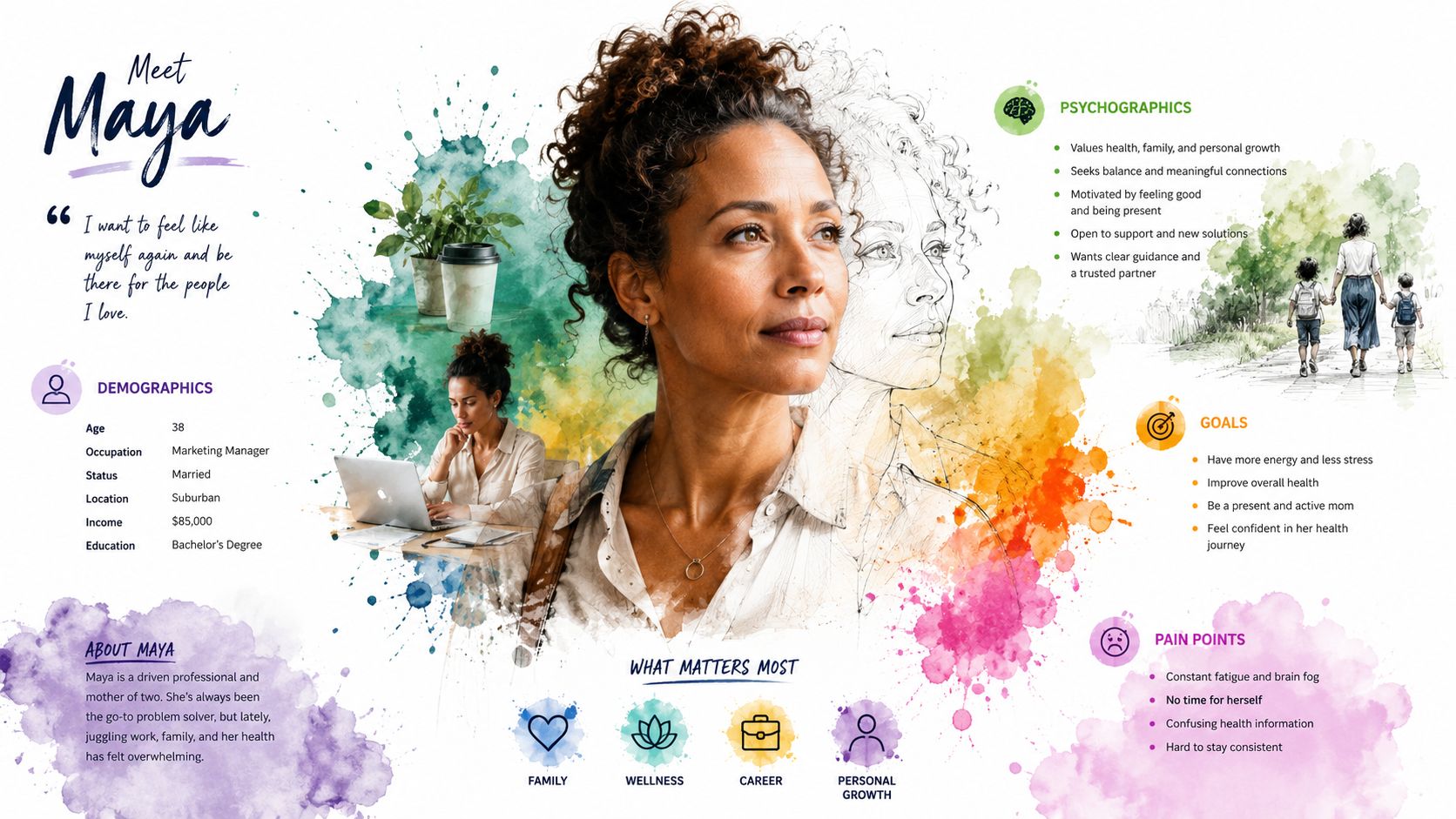
Build one or two working personas
Keep this simple. Most small practices don't need seven personas. They need one or two useful ones they can act on.
A workable persona includes:
Core problem What brings this person into the market for care?
Desired result What does “success” look like in their words?
Decision triggers What finally makes them book now instead of waiting?
Trust builders What proof makes them feel safe choosing you?
Friction points What makes them hesitate, delay, or leave?
Here's what that can look like in practice.
Persona element
Example for a dental office
Example for a medspa
Core problem
Avoiding a worsening issue but nervous about treatment
Wants refreshed appearance without looking overdone
Desired result
Clear plan, gentle care, no surprises
Natural results with clear expectations
Decision trigger
Pain, insurance deadline, trusted referral
Upcoming event, visible concern, strong reviews
Trust builder
Comfort messaging, financing clarity, friendly team
Fear of judgment, unclear pricing, inconsistent branding
Once you've built these personas, use them everywhere. On service pages. In review requests. In ad copy. In event topics. In referral outreach. If you can't point to a specific persona and explain why a campaign exists for that person, the campaign probably isn't focused enough.
Building Your Digital Front Door for Essential Online Visibility
Your website is not the whole game, but it is the center of your digital presence. Patients use it to confirm that your practice is legitimate, relevant, and easy to contact. If it's confusing, outdated, or thin on details, people won't work hard to figure you out. They'll move on.
That matters because online discovery now drives a major share of patient choice. WebMD Ignite reports that over 30% of patients now find their healthcare provider entirely online, and 61% of patients actively use online resources like review sites and local listings to research and compare providers before making an appointment.
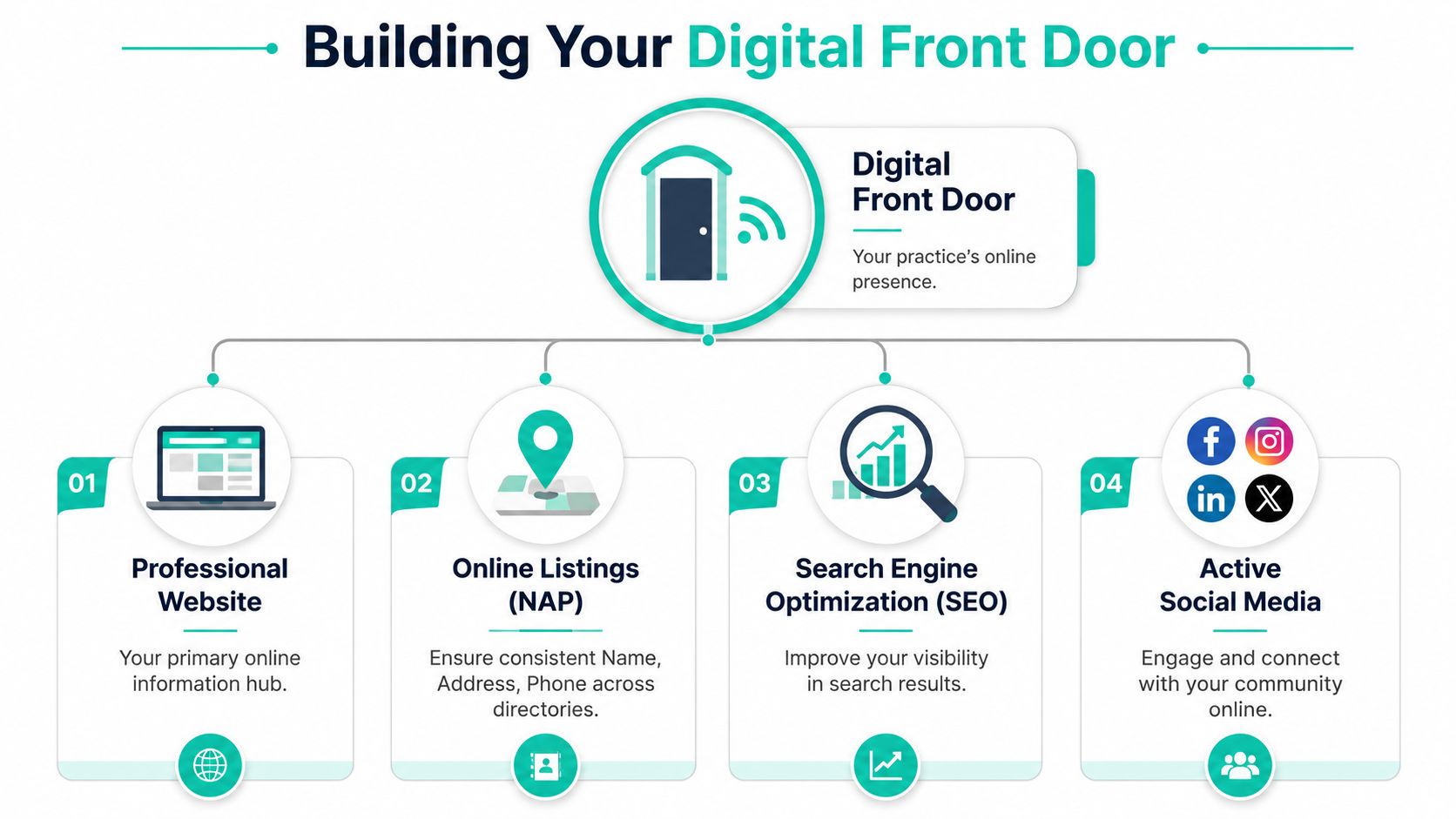
A clean digital front door should look something like this.
What patients need to find fast
When someone lands on your site or your Google Business Profile, they're usually trying to answer a short list of practical questions.
Do you treat my issue: Your service pages should be specific, not vague brand copy.
Can I trust you: Reviews, clinician bios, photos, and clear explanations do this work.
Are you nearby and reachable: Accurate name, address, phone, hours, and directions matter.
What happens next: The path to call, request, or book needs to be obvious.
Many practices struggle with this aspect. They publish polished messaging but bury the basics. A homepage that says “compassionate, patient-centered care” is fine. A homepage that also makes it clear what you treat, where you're located, and how to book is useful.
If you're rebuilding these assets, it helps to think about your site, listings, and content as one connected system rather than separate projects. That's also how strong practice marketing services should be structured. Messaging, local visibility, content, and conversion paths need to support each other.
A simple local visibility checklist
Most local SEO advice gets too technical too quickly. For a small practice, the starting checklist is straightforward.
Claim and complete your Google Business Profile: Add accurate categories, service descriptions, hours, photos, and appointment options.
Keep NAP consistent: Your name, address, and phone should match across directories and your website.
Publish service-specific pages: “Pediatric eye exam” is more useful than one generic “services” page.
Ask for reviews consistently: Not only after exceptional visits. Build a repeatable process.
Create content around real patient questions: Concerns, treatment options, candidacy, recovery, timelines, and what to expect.
Patients don't reward complexity. They reward clarity.
One more trade-off is worth mentioning. Don't try to rank for everything. A practice that tries to own every possible service keyword often ends up with thin pages and muddled positioning. It's usually smarter to get known for a tighter set of services and make those pages strong.
Expanding Your Reach by Choosing the Right Channels
Once your foundation is solid, the next question is where to put your energy. At this stage, owners often get overwhelmed. They assume a patient acquisition strategy needs every channel running at once. It doesn't.
You need the right mix for your practice type, margins, local competition, and operational capacity. Some channels generate attention faster. Some build trust better. Some create volume but not fit. Others bring in slower leads who stay longer.
Patient acquisition channel comparison
Here's a practical way to compare the common options.
Channel
Typical Cost
Trust Level
Lead Volume
Best For
Local SEO and content
Moderate upfront effort, slower payoff
High
Steady
Practices that want durable visibility
Google Ads and paid social
Flexible but can rise quickly
Medium
Fast
New locations, specific service pushes, urgent demand gaps
Professional referrals
Relationship-driven
High
Moderate
Specialists, dental practices, eye care, legal-adjacent service businesses
Patient referrals
Low hard cost, high consistency requirement
Very high
Moderate
Practices with strong satisfaction and clear outcomes
Community events and screenings
Moderate planning effort
Very high
Selective but strong-fit
Local brands that want trust-first growth
The trap is choosing based only on speed. Fast channels can help, especially when you need demand now. But if your intake team is slow, your website is weak, or your messaging is generic, paid traffic exposes those problems rather than solving them.
A similar caution applies to list-based outreach. If you're tempted to shortcut audience building with purchased contacts, read CleanMyList's guide on list buying first. It's a useful reality check on data quality, targeting issues, and the downstream mess bad lists can create. For most practices, trust-based acquisition performs better than cold outreach built on shaky contact data.
How offline trust turns into booked care
This is the part many marketing articles skip. Not every strong patient acquisition strategy starts online. In many local markets, trust is still built face to face.
Phreesia reports that practices leveraging branded local health seminars and free screenings acquire patients with 35% higher retention rates and 28% lower acquisition costs than those relying solely on digital channels. That's a meaningful reminder that community presence isn't old-fashioned. It's efficient when done well.
Offline outreach works best when it's structured, not random. Think about events that fit your actual positioning:
Educational talks: A dentist discussing restorative options, an eye doctor explaining dry eye symptoms, a medspa owner teaching patients how to evaluate treatment plans safely.
Free screenings: Brief, useful encounters that identify fit and create a natural next step.
Local partnerships: Gyms, senior centers, schools, employers, churches, or other professionals who already serve your audience.
The key is what happens after the event.
A community event should feed into a HIPAA-conscious follow-up process with clear permission, documented interest, and a direct path to booking. If attendees leave with vague intentions and no next step, you created goodwill but not a system.
Community trust has to connect to operational follow-through. Otherwise the event feels good, but the schedule never changes.
There's also a strategic filtering benefit here. Events tend to attract people who resonate with your style, your expertise, and your presence in the community. Those patients often arrive with more context and more trust than a cold click from a broad ad campaign.
From Interest to Appointment by Optimizing the Patient Journey
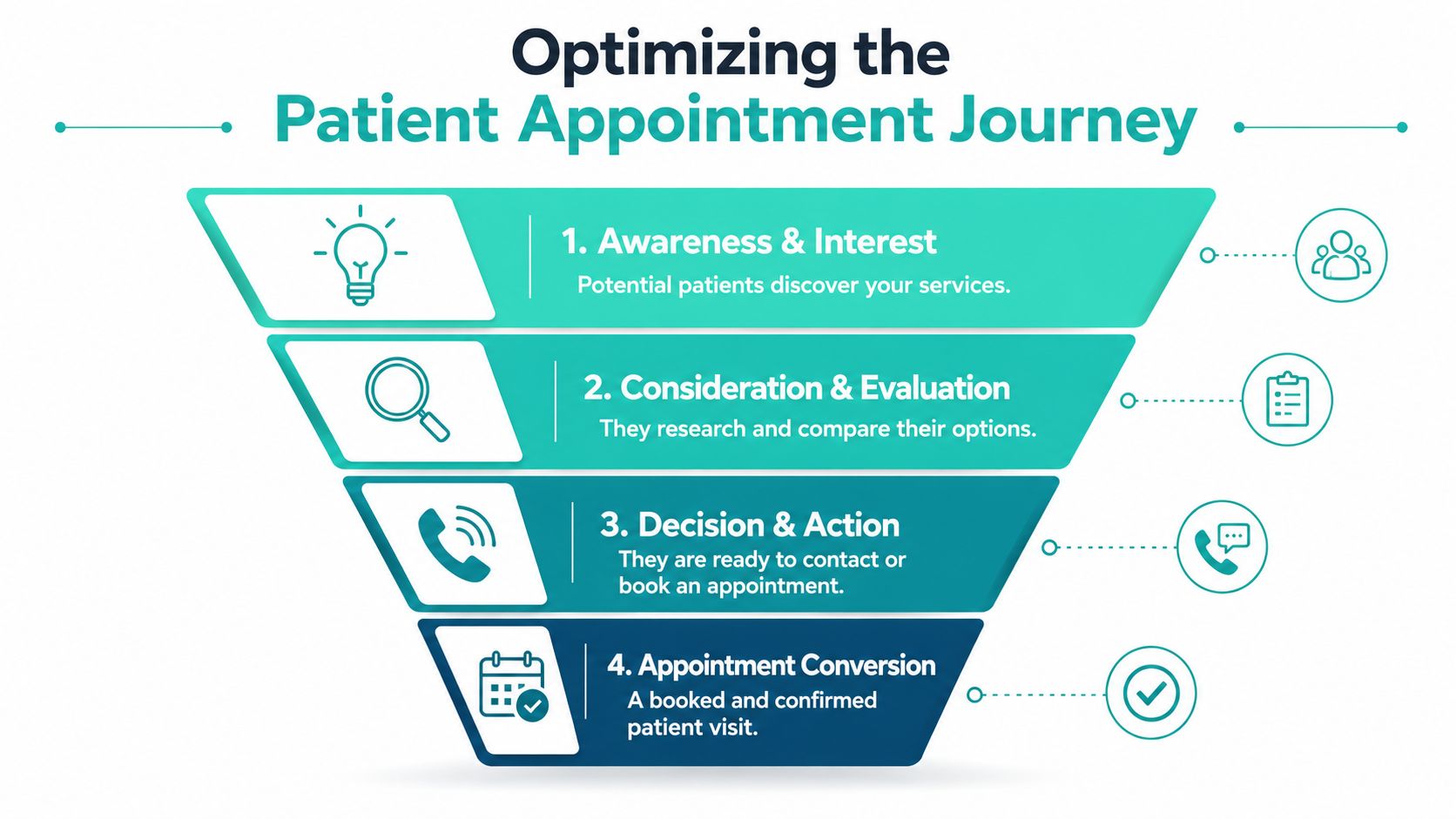
Most practices don't lose patients because demand is weak. They lose them in the handoff between interest and action.
A visitor reads your page, likes what they see, and decides to contact you later. A referred patient waits for a callback that comes too slowly. A prospective patient reaches your front desk, gets put on hold, and keeps searching. Those are acquisition failures, but they look like workflow issues because that's what they are.
The patient journey gets easier to manage when your team can see the handoffs clearly.
Where practices lose ready-to-book patients
The referral handoff is one of the biggest weak spots. In NexHealth's patient acquisition resource, practices using automated, HIPAA-compliant SMS or email nudges within 15 minutes of a referral achieve 3x higher booking rates than those with manual follow-up, and 42% of referred patients never book due to delayed follow-up.
That should change how owners think about conversion. A referred patient is not a lead you can leave sitting until someone has time. That patient already has intent. The job is to make acting on that intent easy.
Online scheduling matters for the same reason. It reduces the gap between decision and action. If your site asks people to call during office hours, fill out a generic form, or wait for a callback, you're introducing hesitation right at the moment they were ready.
Speed matters most when the patient is already convinced.
Build a faster path to booking
A smoother patient journey usually comes down to three fixes.
Make the next step obvious Every major page should have one clear action. Book, call, request a consult, or submit a referral. Not five competing buttons.
Use self-scheduling where it makes sense If a service can be booked safely online, let patients do it. Don't force a phone call just because that's how the office has always worked.
Automate referral response and intake follow-up A quick text or email acknowledgment, a scheduling link, and a clear explanation of what happens next can rescue a surprising number of warm opportunities.
Some practices also benefit from communication tools that extend availability without overloading staff. If you're exploring that route, fonea AI for healthcare practices offers a useful look at how AI voice support can help manage incoming patient conversations and scheduling flow. The value isn't novelty. It's reducing missed calls and narrowing the gap between intent and contact.
When you audit your own process, test it like a patient would. Visit a service page on mobile. Try to book. Submit a question. Refer someone. Time the response. If the path feels clunky to you, it feels worse to a patient.
If you want an outside set of eyes on that path, a direct practice growth conversation can help identify where your funnel is leaking before you spend more on top-of-funnel traffic.
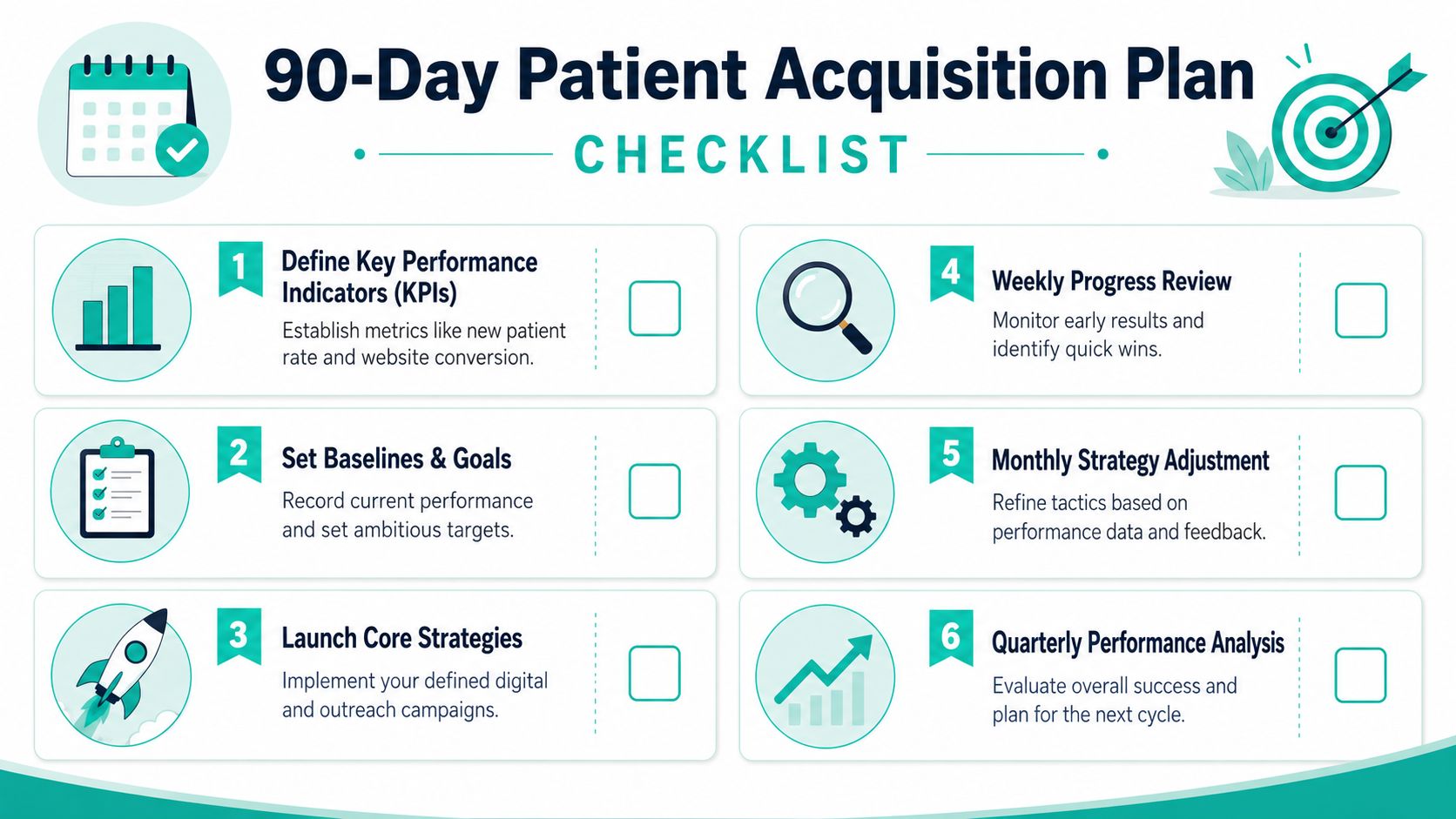
Measure and Refine with Your 90-Day Acquisition Plan
A patient acquisition strategy gets stronger when you measure outcomes that connect to revenue and retention, then make small adjustments without overreacting every week.
Too many owners track what's easy to see. Traffic, impressions, likes, page views. Those numbers can be useful context, but they don't tell you whether the practice is winning more of the right patients.
Track outcomes, not vanity metrics
NexHealth notes that a common acquisition mistake is failing to track performance beyond page views. Success should be measured by appointment requests, procedure inquiries, and patient retention, with key KPIs including qualified leads, customer acquisition cost, conversion rate, and organic traffic.
That gives you a cleaner scorecard.
Use a short monthly dashboard with metrics like these:
Qualified leads: People who match your target services and geography
Appointment requests: The clearest sign of active buying intent
Procedure inquiries: Especially useful for higher-ticket or elective services
Conversion rate: How many inquiries become booked visits
Customer acquisition cost: What you spend to gain a new patient
Organic traffic: A directional signal for your local visibility
Patient retention: Whether new patients become ongoing relationships
If one channel brings lots of inquiries but very few kept appointments, it may be attracting the wrong audience. If another brings fewer leads but stronger retention, it may deserve more budget even if it looks quieter on the surface.
A practical 90-day plan
Keep the first quarter focused. Don't launch everything at once.
Days 1 through 30
Define your core patient personas: Clarify who you want more of and which services matter most.
Audit your digital front door: Website, Google Business Profile, local listings, reviews, and key service pages.
Map your booking flow: Test calls, forms, scheduling links, referral handoffs, and response time.
Days 31 through 60
Fix the highest-friction step: Often this is slow response, weak service pages, or unclear calls to action.
Choose one primary growth channel: Local SEO, paid search, referral development, or community outreach.
Create one repeatable trust asset: A seminar topic, review request workflow, referral outreach script, or service explainer page.
Days 61 through 90
Launch one campaign fully: Not three partial ones.
Review KPI trends weekly: Look for drop-off points, not just top-line volume.
Refine based on fit: Shift effort toward patients who book, show, and stay.
A disciplined 90 days usually beats a scattered year.
The point isn't perfection. It's momentum with feedback. You need enough structure to learn what works in your market, with your team, for the kinds of patients you want to serve.
Leaping Lemur Media helps practices build marketing that feels aligned with who they are and how they serve their communities. If you want a patient acquisition strategy that connects local trust, digital visibility, and a smoother path to booked appointments, take a look at Leaping Lemur Media.