Marketing for Healthcare Practices: A 2026 Playbook
LE
lemur April 27, 202618 min read
If you're running a healthcare practice, you're probably dealing with the same mess most owners face. Your schedule matters. Your reputation matters. Your staff is busy. And marketing keeps sliding into two bad extremes: random activity with no strategy, or outsourced activity that doesn't sound like your practice at all.
That approach burns money and trust at the same time.
Good marketing for healthcare practices should feel like patient care before the appointment ever happens. It should help the right people find you, understand you, trust you, and book with confidence. If your marketing feels disconnected from the way you serve patients, it won't hold up. The practices that grow consistently don't just advertise more. They communicate better, measure better, and show up more clearly.
Defining Your Practice's Authentic Marketing Story
Most healthcare marketing fails before the first campaign launches. The problem isn't the ad platform or the website plugin. The problem is that the practice never decided how it wants to be known.
Patients don't choose a dentist, eye doctor, medspa, or clinic based on services alone. They choose based on whether your practice feels credible, clear, and right for them. That's why positioning comes first. If you skip it, every ad, blog, and landing page feels generic.
Start with the real reason patients choose you
Your authentic marketing story isn't your mission statement pasted from a team retreat. It's the plain-English answer to a few hard questions:
Who do you serve best: families, busy professionals, cosmetic patients, seniors, anxious patients, multilingual communities, or a mix with one clear priority
What do you want to be known for: speed, education, comfort, advanced treatment, affordability, concierge experience, or community trust
Why should a patient believe you: your process, your communication style, your environment, your clinical philosophy, and how your team behaves
This matters even more if you serve underserved populations. A digital-only strategy can miss the people you most want to reach. Research summarized by the point-of-care healthcare marketing trends report found that 75% of physicians distribute printed materials, while only 25% use patient portals, which tells you something important. Convenience matters, but trust, context, and access still shape real patient behavior.
Practical rule: If your messaging only works on a website, it isn't strong enough yet. It should also work at the front desk, in a brochure, in a waiting room handout, and in a community conversation.
A lot of practices say they want more patients. That's too vague to guide real decisions. You need sharper language than that. "We help nervous dental patients feel informed and in control" is usable. "We make advanced eye care approachable for older adults and their families" is usable. "We offer natural-looking medspa treatments with education first and no pressure" is usable.
If you need a deeper framework for turning expertise into useful educational messaging, Sight AI's complete guide for healthcare content marketers is a solid reference. It aligns well with the idea that content should support care, not just promotion.
Build messaging patients can repeat
Strong positioning isn't about sounding clever. It's about being remembered accurately.
Start with three layers:
Core promise What change or reassurance do patients get from choosing you?
Proof points What specific aspects of the experience make that promise believable?
Voice How should the practice sound? Calm, expert, welcoming, direct, family-focused, premium, community-rooted?
Write those down, then test them against real patient interactions. If your team can't say them naturally, rewrite them. If a new patient can't repeat the value back after reading your homepage, rewrite them again.
A practice brand should also match what happens after booking. If you claim warmth and clarity but your forms are confusing and your phone experience feels rushed, your marketing breaks trust. That's why brand work isn't cosmetic. It's operational. A focused healthcare branding process helps practices define the message, visual identity, and patient-facing language before they invest in traffic.
Patients don't experience your brand as a logo. They experience it as expectations kept.
Building Your High-Converting Digital Front Door
Your website is your front desk before business hours. Your Google Business Profile is your street sign. Your service pages are your exam-room introductions. If any of those are weak, you don't have a traffic problem first. You have a conversion problem.
Digital channels deserve that level of attention. The healthcare marketing data compiled by CallRail's healthcare marketing statistics shows 79% of healthcare providers prioritize their website and SEO, ahead of social media at 64% and email marketing at 54%. The same source notes that organic and paid search drive up to 76% of website traffic. That's why your digital front door can't be an afterthought.
Fix findability before you buy more traffic
Start with local visibility. When someone searches for a provider, service, or treatment in your area, you need to show up with complete, consistent information.
Here's the practical checklist:
Google Business Profile: Keep categories, hours, phone number, services, photos, and appointment options accurate.
Service line pages: Create separate pages for real patient intents such as dental implants, pediatric eye exams, dry eye treatment, or injectables.
Location signals: Make sure each page clearly states where you serve patients.
Mobile performance: Most patients won't fight a slow site. If pages lag, they leave.
Navigation: Reduce choices. A patient should know where to click in seconds.
A lot of practices bury high-value services under broad menu labels like "Treatments" or "What We Do." That's lazy architecture. Put your primary services in the main navigation. If a patient is searching for one treatment, they shouldn't need to dig through your whole site to find it.
Turn visits into booked appointments
Traffic by itself doesn't grow a practice. Action does.
Every important page on your site should answer five questions fast:
Question
What the page should show
Am I in the right place
Clear service name and who it's for
Can I trust you
Team credentials, patient-friendly explanations, clean design
What happens next
Simple description of consultation, evaluation, or treatment flow
How do I book
Clear buttons, visible phone number, short forms
Why act now
Relief, clarity, confidence, or convenience stated without hype
Don't write like a medical journal. Don't write like an ad agency either. Write like a good provider explaining options to a patient who is nervous, busy, and comparing you with three other practices.
Your homepage should not try to say everything. It should direct patients to the right next step.
What your site must do on every key page
A high-converting page usually includes a few essentials:
A specific headline: Name the service plainly.
A short reassurance statement: Tell the patient what makes the experience manageable.
Visible calls to action: "Book an appointment," "Request a consultation," or "Call the office" all work better than vague buttons.
Trust elements: Photos of the practice, clinician bios, frequently asked questions, and reviews if you have permission and compliant processes.
Minimal friction: Fewer form fields. Fewer clicks. Fewer dead ends.
If your current site looks polished but doesn't convert, rebuild around user behavior, not internal preferences. A proper website development approach for service businesses should prioritize local search structure, mobile usability, and conversion paths, not just aesthetics.
One more opinionated point. Do not send paid ad traffic to your homepage unless the homepage was built for that exact campaign. Service-specific landing pages usually do a better job because they continue the conversation the ad started.
Attracting Patients with Targeted Ad Campaigns
Paid media works best when it acts like follow-up, not interruption. Too many practices run ads as if one click should instantly produce a booked appointment. That's not how healthcare decisions usually happen.
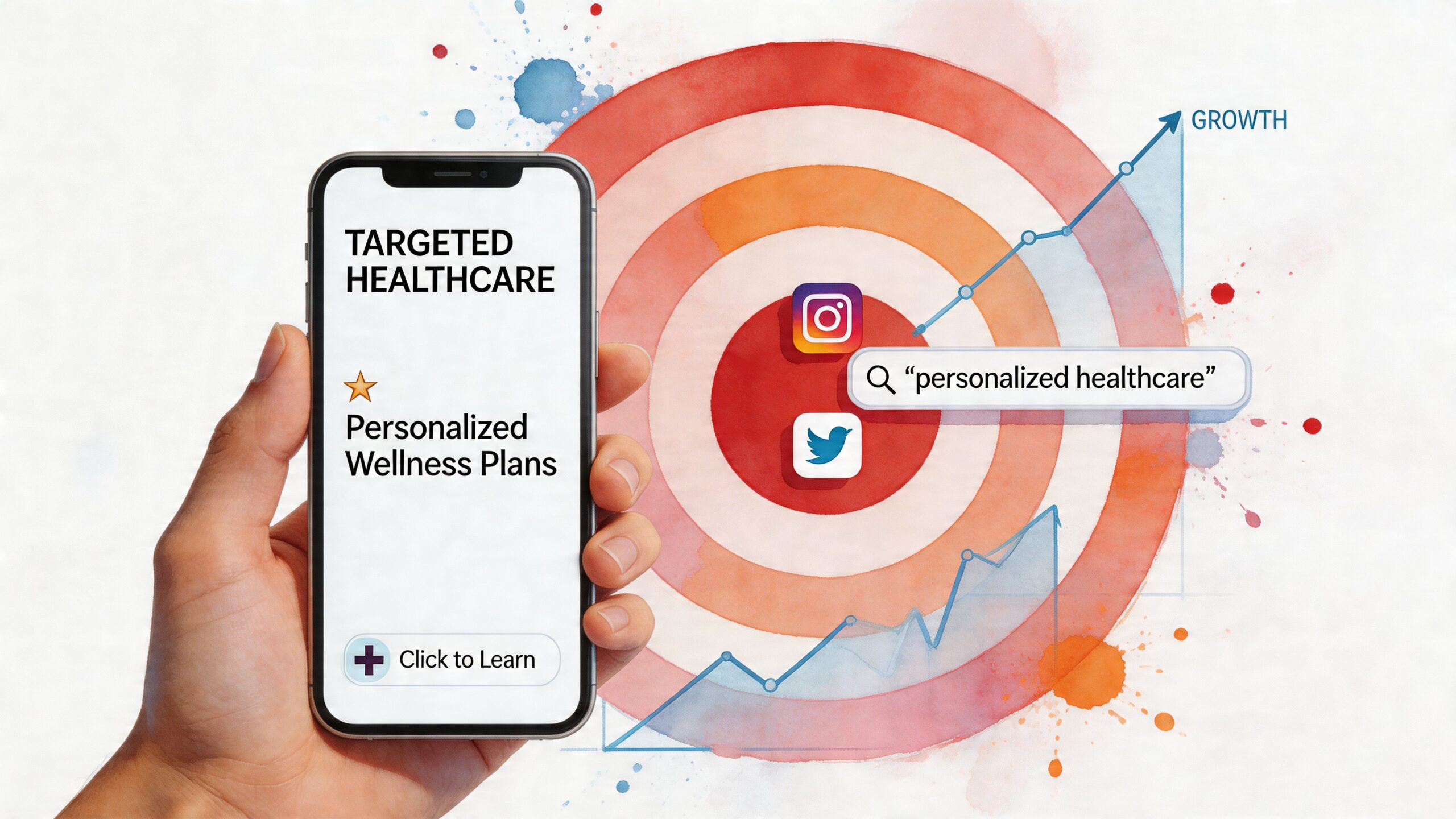
A stronger path is simpler than commonly believed. Start broad enough to create awareness, then narrow the message as the patient gets closer to action. That's the exact sequence we've used in real campaigns: social media ads first, programmatic retargeting next, then a website visit that gives the patient the confidence to convert.
A practical multi-touch path that works
That journey takes this form in practice.
A medspa wants to promote one flagship service. The first ad on Facebook or Instagram doesn't try to close the sale. It introduces the service, answers a common concern, and shows the environment or provider in a way that feels calm and credible. The patient clicks, browses, and leaves.
That's normal.
The next step is retargeting. A follow-up display or programmatic ad reminds that same person what they already viewed. Now the message gets tighter. It may highlight the consultation process, a short educational point, or what makes the experience comfortable. When the patient returns to the site, the landing page needs to finish the job with clear benefits, simple booking options, and no clutter.
Social, PPC, and SEO often work best together because each channel plays a different role. Search captures existing intent. Social creates demand and familiarity. Retargeting recovers attention you already paid to earn.
How to keep paid media disciplined
Most wasted ad spend comes from three mistakes:
Wrong offer fit: You're promoting a service the market doesn't understand yet, with no educational bridge.
Weak landing pages: The ad is focused, but the destination is generic.
Loose compliance habits: Teams move fast and forget that healthcare advertising has privacy constraints.
Your ad system should stay HIPAA-conscious from planning through reporting. That means staff training matters. Our standard is simple: everyone working on healthcare campaigns is trained on HIPAA rules and compliance so marketing operations align with what the practice team already has to protect.
Use channel roles intentionally:
Social ads for awareness, trust, and introducing services visually
Google Ads for patients already searching with intent
Retargeting for people who engaged but didn't book
SEO content to keep lowering dependence on paid traffic over time
If you're evaluating outside help, compare agencies based on how they structure funnels, landing pages, tracking, and compliance workflow. A practical ads management service for local businesses should cover campaign setup, audience logic, creative testing, and reporting that ties back to actual inquiries, not just impressions.
Nurturing Community Trust and Online Reputation
The practices with the strongest reputations don't treat content, social media, and reviews as separate tasks. They use all three to reinforce the same message: we explain things clearly, we treat people well, and our community knows what to expect from us.
That matters because healthcare is personal. A patient might first discover you through a Google search, then check your Instagram, then read reviews, then watch a video about the service they're considering. If those touchpoints feel disconnected, trust drops.
The performance gap is real. The healthcare strategy analysis in MD Consultants' breakdown of why healthcare marketing strategy fails reports that a multi-stage patient journey strategy yields 2-4x higher ROI than promotional-only approaches. It also notes that educational content and segmented nurturing can convert 20-30% of nurtured leads, compared with 2-5% of cold traffic.
Use content to answer the questions patients are afraid to ask
The highest-value content in healthcare is rarely flashy. It is clear.
For most practices, the best-performing formats are blogs and videos that thoroughly explain services. That makes sense. Patients want to know what the service does, who it's for, what the process feels like, what recovery looks like, what questions to ask, and whether they can trust your team.
Good topics include:
Service explainers: what the treatment is and who should consider it
Expectation-setting pieces: what happens before, during, and after a visit
Decision support content: how one option compares with another in plain English
Provider-led videos: short clips where a clinician explains common questions
Don't publish generic wellness content just to fill a calendar. A blog about "tips for staying healthy this season" is fine, but it won't build much local authority if your practice needs more implant cases, dry eye evaluations, or cosmetic consults.
Educational content earns attention without asking for trust too early.
Treat social media and reviews as one trust system
Social media should show your tone and your standards. Reviews prove that those standards are real.
Use social channels to post office updates, explain services, introduce staff, answer common questions, and reflect the personality of the practice. Don't use them as a nonstop sales feed. A nervous patient scrolling your account is looking for signals. Are you polished but cold? Friendly but vague? Clinical but hard to approach? They'll decide quickly.
At the same time, build a steady review process:
Ask happy patients at the right moment.
Make it easy with a direct link or simple follow-up.
Monitor major platforms consistently.
Respond professionally and protect privacy every time.
When you respond to reviews, never confirm treatment details or patient status publicly. Thank people for feedback in general terms. If someone leaves negative feedback, stay calm, invite the conversation offline, and avoid defensiveness. Future patients are reading your response as much as the original review.
A strong reputation strategy also includes offline trust signals. Community events, educational talks, partnerships, and printed materials still matter for many audiences. That isn't old-school thinking. It's realistic thinking.
Turning Patient Experience into a Referral Engine
Referral growth starts inside the practice, not in a marketing dashboard. If the patient experience feels disjointed, no referral script will save it.
Patients refer when they feel cared for, understood, and proud to attach their name to your practice. That means your referral engine is really the result of small moments done consistently well.
Referrals start before the visit ends
Look at the full journey:
Booking: Was it easy to reach you and understand the next step?
Arrival: Did the office feel organized and welcoming?
Clinical interaction: Did the provider explain things clearly without rushing?
Checkout: Did the patient leave knowing what happens next?
Follow-up: Did someone check in, answer questions, or reinforce care instructions?
Any weak point breaks momentum. A great clinical experience followed by confusing checkout is still a damaged experience.
The easiest wins usually come from better communication. Train staff to explain delays, expectations, and follow-up in simple language. Give patients clarity at every handoff. When people feel uncertain, they rarely refer. When they feel guided, they often do.
People don't recommend practices because the marketing is clever. They recommend practices because the experience felt safe, smooth, and respectful.
Build a simple referral process your team will actually use
Most referral programs fail because they're awkward or overbuilt. Keep it straightforward.
Use three channels:
In-person asks: When a patient expresses gratitude or satisfaction, staff can say, "We're glad you had a good experience. If you have friends or family who need this kind of care, we'd be grateful if you sent them our way."
Post-visit follow-up: Include a brief referral prompt in the same communication flow you use for review requests or care reminders.
Patient education assets: Helpful blog posts, videos, and FAQ pages are easy for patients to share with others.
You don't need manipulative language. You need timing and consistency.
Create an internal referral routine your front desk and clinical team can repeat. Decide who asks, when they ask, and how they record referral sources. Then review referral patterns monthly. If referrals are low, inspect the patient journey first. The fix is often operational before it's promotional.
Your Phased Marketing Roadmap and KPIs
Most practice owners don't need more tactics. They need order.
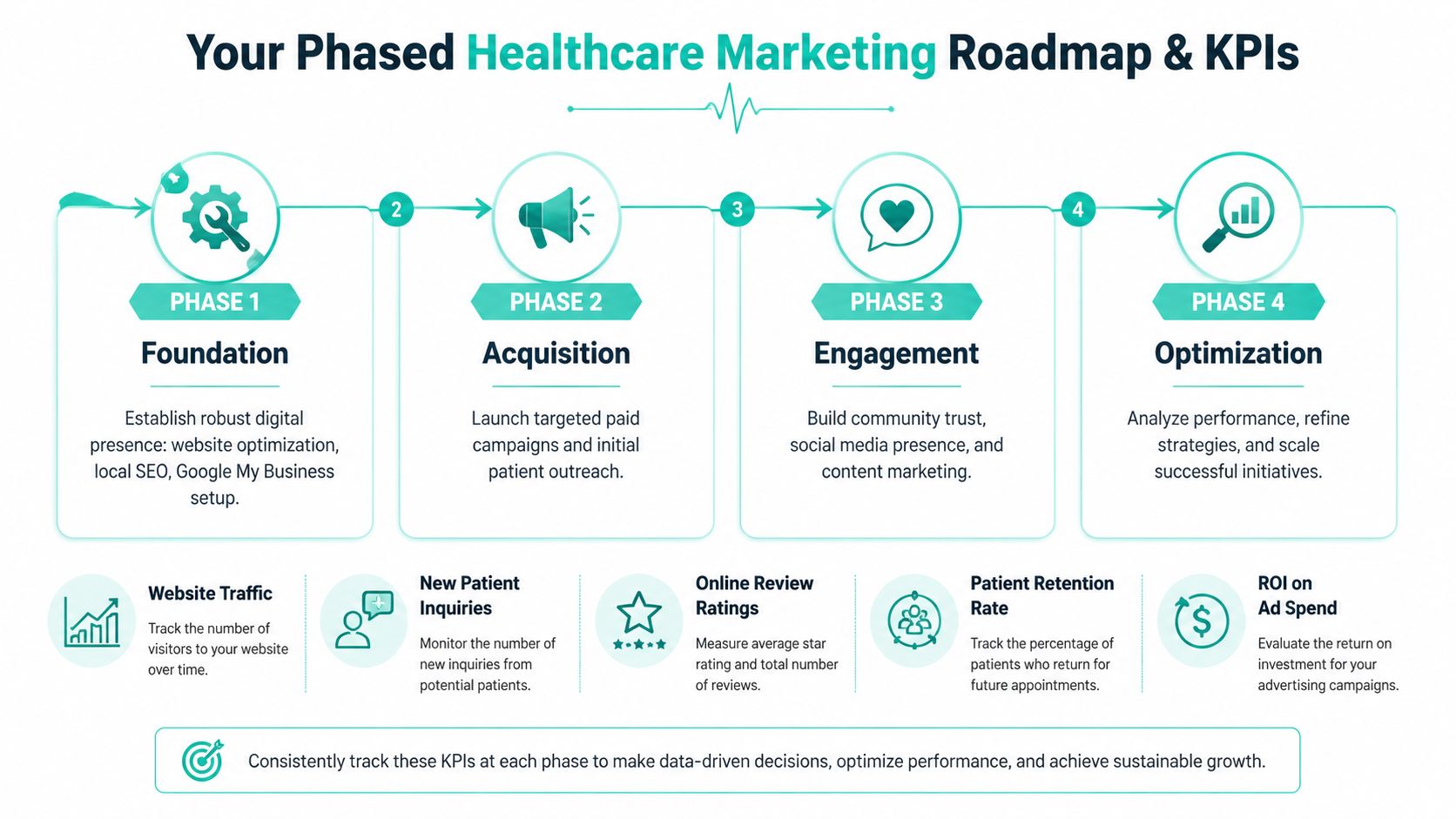
Trying to launch SEO, ads, content, email, social media, review generation, and automation all at once usually creates noise. A phased rollout keeps your team focused and gives you cleaner performance data.
The strongest systems connect marketing inputs to patient value. The data framework outlined in SocialClimb's analysis of bad healthcare marketing data found that practices that integrate front-end metrics with back-end patient LTV achieve 25-35% higher patient retention. The same analysis points to a $5-15 cost per acquired patient benchmark for primary care and a goal of 20-30% year-over-year LTV growth.
The numbers that matter
Track fewer metrics, but track the right ones.
Ignore vanity metrics unless they connect to pipeline movement. A post with strong engagement means little if it doesn't lead to inquiries, bookings, or better retention. For marketing for healthcare practices, the most useful KPI set usually includes:
Patient Acquisition Cost or PAC: Total marketing spend divided by new patients
Lead-to-appointment conversion rate: How many inquiries schedule
Appointment-to-patient rate: How many scheduled visits become completed visits or treatment starts
Retention and LTV: Whether acquired patients stay, return, and generate long-term value
Referral source quality: Which channels attract the patients who fit your practice best
Many practices need better systems, not more campaigns. Your CRM, call tracking, forms, and practice management data should help you see not only who contacted you, but who became a good long-term patient.
Phased Marketing Implementation Roadmap
Phase
Timeline
Key Focus Areas
Primary KPIs
Foundation
First 90 days
Positioning, website fixes, local SEO, Google Business Profile, tracking setup, intake process alignment
Website traffic, inquiry volume, form completion quality
LTV trends, retention rate, referral growth, ROI by channel
A few practical priorities by phase:
Foundation first: Fix the website and tracking before scaling ads.
Acquisition second: Push traffic only after you know where it should land and how calls are handled.
Engagement third: Publish content that supports the services you aim to grow.
Optimization always: Reallocate budget toward channels that bring better-fit patients, not just more clicks.
HIPAA discipline is part of performance
Compliance isn't separate from marketing. It's part of responsible execution.
Your team should know what data can and can't be used, how inquiry information is handled, how forms are secured, what can be said in public review responses, and how vendors manage access. If staff treat privacy rules as someone else's department, mistakes happen fast.
Use this simple internal checklist:
Train everyone touching campaigns or patient communication
Review forms, pixels, platforms, and access permissions
Use de-identified reporting wherever possible
Document response rules for reviews, messages, and testimonials
Make one person responsible for final compliance review
If you want outside support for execution, use one partner or a tightly coordinated group. Fragmented ownership destroys momentum. Leaping Lemur Media is one option for practices that need support across branding, websites, local search, and paid campaigns under one strategy umbrella.
Frequently Asked Questions about Healthcare Marketing
How long does healthcare marketing take to work
Some improvements happen fast. Better call handling, stronger landing pages, and cleaner Google Business Profile information can improve results quickly. SEO, reputation growth, and content authority take longer. The key is sequencing the work so early gains fund longer-term growth.
Should my practice focus on SEO or paid ads first
Fix the website and local presence first. After that, the right answer depends on urgency. If you need patient inquiries now, paid search and paid social can create demand faster. If you want steadier long-term visibility, SEO has to be part of the plan. If you want a deeper read on search visibility, this guide to healthcare SEO strategies is worth reviewing.
What content works best for healthcare practices
The most useful content is usually the content patients already need before they call. Service pages, blogs, and videos that thoroughly explain treatments tend to do more work than broad promotional content. Clear explanation beats clever copy.
How do I know whether marketing is actually profitable
Track inquiries, booked appointments, completed visits, retention, and referral quality. If you're only watching clicks, likes, or traffic, you're missing the business outcome. Tie every major channel to patient value, not surface activity.
How do we keep marketing HIPAA-compliant
Train your staff, limit access, review your tools, and create written standards for forms, ads, review responses, and testimonials. Compliance works when it becomes routine. It fails when teams improvise.
If your practice needs a clearer strategy, tighter messaging, and a marketing system that reflects how you care for patients, Leaping Lemur Media helps healthcare and wellness brands build that foundation with intentional branding, websites, and digital growth support.