

Some chiropractors are doing excellent clinical work and still ending each month with the same question: why does the schedule feel so unpredictable? One week brings a burst of new patients from referrals. The next week feels quiet. You know your outcomes are strong, your patients trust you, and your care matters. But word of mouth alone rarely creates steady growth anymore.
That mismatch frustrates a lot of practice owners because marketing can feel disconnected from patient care. It can seem noisy, manipulative, or built for businesses that want attention more than trust. Good digital marketing for chiropractors should do the opposite. It should help the right patients find you, understand what you do, feel comfortable reaching out, and stay connected after their first visit.
The biggest shift is simple. Nearly half of all patients now discover their local chiropractor through online sources, according to UCFS chiropractic industry trends. If your practice is hard to find online, many people who need your help will never know you exist.
Table of Contents
- Your Practice Is Great Why Are Your Books Not Full
- Build Your Digital Foundation for Patient Discovery
- Create Content That Connects and Educates
- Engage Your Community on Social Media
- Reach New Patients Actively with Paid Advertising
- Nurture Patients for Lasting Loyalty and Referrals
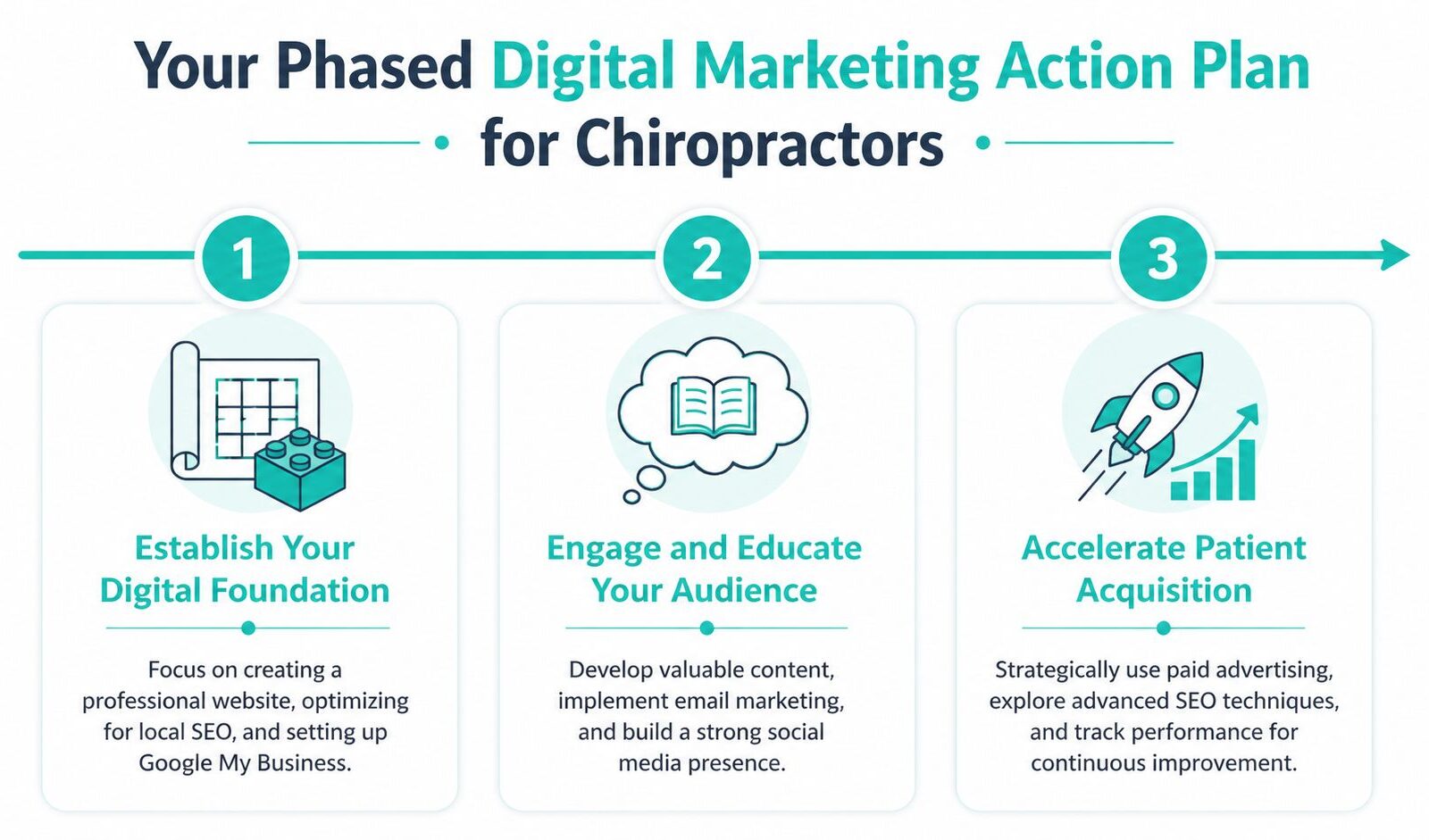
- Your Phased Digital Marketing Action Plan
Your Practice Is Great Why Are Your Books Not Full
A common pattern looks like this. A chiropractor opens the week with a solid schedule, a few loyal patients, and maybe a referral or two from existing families. Then cancellations hit, new inquiries slow down, and the calendar starts to depend on luck.
That isn't usually a care problem. It's a visibility problem.
A strong practice can stay strangely hidden if its online presence is thin, outdated, or inconsistent. Patients don't experience your expertise first. They experience your Google listing, your website, your reviews, and how easy it is to contact you. If those pieces feel incomplete, patients move on before they ever reach your adjusting table.
Good marketing should work like a healthy spine. When the foundation is aligned, everything else moves more smoothly.
Many chiropractors still rely on referrals as the primary growth engine. Referrals matter. They always will. But referrals now happen in two steps, not one. Someone hears your name from a friend, then checks you out online. If that search doesn't confirm trust, the referral goes cold.
Here’s the issue:
- Patients search before they call: They want quick proof that you're credible, local, and relevant to their problem.
- Your digital presence shapes first impressions: Photos, reviews, service pages, and booking flow all influence whether a patient takes the next step.
- Inconsistent marketing creates inconsistent demand: If your online visibility rises and falls, your schedule usually does too.
The practices that grow steadily aren't always the loudest. They're the easiest to find, the easiest to understand, and the easiest to contact. Digital marketing for chiropractors works best when it supports the full patient journey, not just the first click.
Build Your Digital Foundation for Patient Discovery

Treat your online presence like your front desk
Before you spend money on ads or start posting daily, your digital foundation needs to be solid. This is comparable to preparing a clinic before opening day. You wouldn't hang a banner outside if the signage were wrong, the waiting room were confusing, and the phone rang unanswered.
Your Google Business Profile is the digital front door. It tells patients where you are, what you do, when you're open, and whether your practice feels legitimate. According to iMatrix on chiropractic digital marketing, 78% of local mobile searches result in a phone call or visit within 24 hours, and optimized Google Business Profiles can achieve 7 times higher click-through rates in map pack results compared with non-optimized ones.
That means your profile can't be half-finished. It should include accurate name, address, and phone details, clear categories, current hours, service descriptions, interior and exterior photos, and regular posts. Consistency matters. If your website, directories, and profile show different details, patients hesitate and search engines do too.
A strong local presence usually includes:
- Complete profile details: Fill out every relevant field in Google Business Profile, not just the basics.
- Useful service language: Describe services in patient-friendly wording such as care for back pain, neck pain, posture concerns, or mobility support.
- Fresh visual proof: Add real photos of your office, team, treatment rooms, and check-in area.
- Review activity: A profile with recent patient feedback feels alive and trustworthy.
Build a website that reduces friction
Your website shouldn't act like a brochure. It should act like a calm, capable receptionist.
Patients arrive with questions. What conditions do you treat? What happens on the first visit? Do you work with athletes, office workers, or families? Can they book now without calling during office hours? If those answers are buried, your website creates tension instead of trust.
Use simple navigation, clear service pages, obvious calls to action, and mobile-first layouts. Most clinics benefit from a focused booking path, visible contact details, and forms that don't ask for unnecessary information. If you need a benchmark for structure and usability, reviewing examples of professional website development for service-based practices can help clarify what a patient-friendly site looks like.
Practical rule: If a first-time visitor can't figure out how to book within a few seconds, the site needs less decoration and more direction.
A chiropractic website that converts usually includes a few must-have elements:
| Website element | Why it matters |
|---|---|
| Clear service pages | Patients need to know whether you help with their specific concern |
| Mobile-friendly design | Many searches happen on phones, often when someone wants help quickly |
| Strong calls to action | “Book an appointment” works better than vague invitation language |
| Real team and office photos | Patients want to see the environment before they commit |
| Fast contact options | Click-to-call, forms, and directions reduce drop-off |
Make operations part of marketing
A lot of clinics separate marketing from operations, but patients don't. They see one experience. If your ads are polished but your response time is slow, the whole system feels off. That’s why reception, scheduling, reminders, and follow-up all affect marketing performance.
For practices thinking about responsiveness after hours or during busy clinic windows, this piece on the Future of chiropractic clinic operations is useful because it connects communication systems with patient experience, not just staffing efficiency.
Digital marketing for chiropractors starts here. Get found locally. Look credible immediately. Make taking the next step easy. Everything else works better once that alignment is in place.
Create Content That Connects and Educates

Answer the questions patients already have
The best content doesn't begin with keywords. It begins with the questions patients ask when they're worried, skeptical, or trying to decide whether chiropractic care is right for them.
That changes the purpose of content. You're not filling a blog calendar. You're scaling patient education.
A useful article or short video can answer the same concerns you explain every day in the office. Questions like whether chiropractic care may help with recurring back discomfort, what a first appointment feels like, how posture habits affect neck tension, or when someone should seek evaluation. When patients find those answers from your practice, they start trusting you before they contact you.
Content also filters fit. The right people feel understood. The wrong people realize your approach isn't what they're looking for, which saves your team time.
A practical content mix often includes:
- Question-based articles: Short, direct pieces built around real patient concerns.
- Myth-busting posts: Clear explanations that reduce fear and confusion.
- Condition education pages: Helpful overviews written in plain language, not jargon.
- Short videos: Simple clips explaining what to expect, how your process works, or who you help.
For inspiration on content structure and topics, a well-organized library of practice marketing blogs and educational content can help you see how useful information is packaged without sounding robotic.
Use formats that feel human
Patients don't connect with content because it's optimized. They connect because it feels honest.
That often means showing the person behind the practice. A welcome video from the chiropractor. A short office tour. A post explaining your care philosophy. A patient success story shared with proper permission and respectful language. These aren't flashy tactics. They're trust builders.
Educational content works like a home exercise plan. Small, consistent actions create stronger long-term outcomes than occasional bursts of effort.
If you're deciding what to publish, avoid trying to sound like a textbook or a trend-driven influencer. Use the voice you use in the treatment room. Calm, clear, and specific wins.
Consider these content angles:
What patients ask before booking
Write for people who are still unsure. Their questions are your editorial calendar.What patients misunderstand
Many prospects carry assumptions, fears, or outdated ideas. Good content lowers that resistance.What makes your approach distinct
If your practice focuses on families, athletes, prenatal care, mobility, or a particular style of communication, explain that plainly.
The strongest digital marketing for chiropractors doesn't chase attention for its own sake. It teaches, reassures, and gives patients a reason to trust your judgment before they ever shake your hand.
Engage Your Community on Social Media
Stop treating social media like a coupon board
A lot of chiropractors dislike social media because they expect it to produce appointments directly. Then they post a few promotional graphics, get little response, and decide the whole channel doesn't work.
That expectation is the problem.
Social media usually isn't the strongest first-touch channel for high-intent patient acquisition. Search does that job better. Social works more like the waiting room conversation, the community event, or the friendly follow-up that reminds people who you are and what you stand for. It builds familiarity, not just clicks.
When a prospective patient checks your Instagram or Facebook page, they aren't only asking, “Can this doctor help me?” They’re also asking, “Do I feel comfortable with this team?” and “Does this practice feel real?”
What to post when you want trust not noise
The best chiropractic social profiles feel active, approachable, and grounded in real life. They show the people, values, and rhythm of the practice.
That doesn't require dancing trends or constant sales language. It requires evidence that there are caring humans behind the logo.
A stronger social mix looks like this:
- Team introductions: Put names and faces to the people patients will meet.
- Community presence: Share local events, sponsorships, school involvement, or wellness talks.
- Patient wins: With permission, tell stories about progress, confidence, and consistency.
- Simple education: Short tips, posture reminders, wellness habits, and FAQ clips work well.
- Behind-the-scenes moments: A day in the office, a look at your check-in process, or how you prepare new patient packets can lower anxiety.
Here’s the trade-off many practices miss. Promotional posts might mention an offer, but relational posts build the comfort that makes someone act later. If every post asks for a booking, the feed starts to feel transactional. If the feed reflects your care style and your standards, referrals become easier because patients know what they're recommending.
People rarely share a generic ad with a friend. They do share a practice that feels thoughtful, local, and trustworthy.
Social media also gives you a listening tool. Comments, messages, and engagement patterns show which concerns resonate with your community. That feedback can shape future content, email topics, and even the language on your website.
Used well, social media supports digital marketing for chiropractors by adding personality and proof. It shouldn't feel like shouting into the void. It should feel like being a recognizable, helpful presence in your town.
Reach New Patients Actively with Paid Advertising

A patient wakes up with sharp neck pain, searches for help on their phone, clicks an ad, and lands on a page that answers the exact concern. Another local parent sees your clinic in their Instagram feed three times over two weeks, watches a short video about posture at a desk job, then remembers your name when headaches start getting frequent. Both paths matter. Paid advertising works best when it supports the full patient journey instead of chasing a single click.
That distinction matters because ad platforms do different jobs.
Google Ads reaches people who are already looking for relief. Social ads help your practice stay familiar before the need feels urgent. Used together, they work like acute care and maintenance care. One addresses an active problem. The other supports long-term awareness that makes future action easier.
Use Google Ads for active demand
Someone searching for a chiropractor for sciatica, back pain, or whiplash is showing clear intent. That is usually your highest-value paid traffic, but only if the message stays consistent from search to booking.
According to SmartSites on digital marketing for chiropractors, PPC campaigns on Google Ads can yield a 2-5x return on ad spend for chiropractors when built around symptom-specific keywords. The same source notes that relevant ad copy and landing pages can boost conversion rates by 15-20%, with cost per new patient of $50-100 in competitive markets.
Practically, that means a search for "chiropractor for lower back pain" should not go to a generic homepage with five competing calls to action. It should land on a page that speaks to lower back pain, explains your approach, shows trust signals, and makes the next step clear. Ad relevance is a clinical matching problem. If the diagnosis and care plan do not fit, confidence drops.
A better Google Ads setup usually includes:
- Tightly grouped keywords: Separate symptoms, services, or patient types so the ad matches the search.
- Specific ad copy: Reflect the exact concern and local area instead of broad clinic language.
- Dedicated landing pages: Continue the same message from the ad and remove extra distractions.
- Fast lead handling: Calls answered, forms routed quickly, and follow-up handled with discipline.
If your team is testing multiple offers or service lines, tools like the ShortGenius AI ad generator can help create ad variations faster without slowing down review and approval.
Use social ads to build recognition before urgency
Facebook and Instagram usually perform better earlier in the decision process. A cold audience rarely books because of one polished graphic. They respond over time to repeated, relevant exposure that makes the practice feel known and credible.
That makes social ads useful for introducing your clinic, promoting educational videos, highlighting a care philosophy, or speaking to a patient segment you serve well, such as athletes, desk workers, or prenatal patients. The goal is not instant conversion from every impression. The goal is to reduce friction later, when that person is finally ready to act.
Here is the practical split:
| Platform | Best job |
|---|---|
| Google Ads | Capture people already searching for help |
| Facebook and Instagram ads | Build local familiarity before the search begins |
What usually wastes ad spend
Paid traffic magnifies whatever happens after the click. Strong ads cannot compensate for a weak intake process.
I see four problems repeatedly:
Sending all traffic to the homepage
Visitors have to sort out what matters to them, and many will leave.Writing copy that is too broad
"Feel better today" is weaker than language tied to a real condition, audience, or concern.Responding slowly to leads
Interest cools fast, especially for patients comparing several clinics at once.Buying volume instead of fit
Cheap leads are expensive if they are outside your service area or not a match for your care model.
Practices that want outside support should treat ads like any other specialty function. Good setup, tracking, and optimization take focused attention. Professional Google and social ads management for chiropractors can help protect budget while connecting acquisition to retention, reactivation, and referrals.
The strongest campaigns do more than fill a schedule next week. They bring in the right patients, set expectations early, and feed a healthier practice over time.
Nurture Patients for Lasting Loyalty and Referrals
The first appointment is not the finish line
A lot of marketing plans stop at acquisition. That’s like focusing only on pain relief and ignoring the care plan that helps maintain progress. If the patient experience goes flat after the first visit, growth gets expensive and fragile.
The deeper opportunity is continuity.
A key challenge in chiropractic marketing is what happens after the first digital touchpoint. As noted by Cardinal Digital on chiropractic digital strategy, a patient who finds your practice through educational YouTube content needs different messaging than someone who arrives through a high-intent Google Ad. The same source emphasizes using first-party data after the visit to create segmented digital experiences that reduce churn and encourage referrals.
That insight matters because not all patients enter with the same mindset. One may need reassurance and education. Another may already be ready for a structured treatment plan. A third may become an excellent long-term patient if your follow-up reinforces consistency.
Reviews and email work better together
Online reviews and email marketing are often treated as separate tools. They work better as part of the same relationship system.
Reviews capture trust publicly. Email nurtures trust privately.
Ask for reviews when a patient has had a positive, meaningful experience and the timing feels natural. Keep the process simple. Don't bury the request in a long message. A short thank-you, a direct link, and a respectful ask work better than a hard push.
Email has a different role. It keeps the connection warm after the visit. Done well, it reminds patients that your care extends beyond the adjustment itself. A good practice newsletter can include health tips, movement advice, office updates, common questions, and encouragement to stay consistent with care.
Use email for substance, not clutter:
- Helpful reminders: Reinforce habits, exercises, or seasonal wellness concerns.
- Relevant updates: Share changes in hours, services, or community involvement.
- Patient education: Link to articles or videos that answer recurring questions.
- Gentle re-engagement: Invite inactive patients back with useful context, not guilt.
The strongest retention systems don't feel like marketing. They feel like attentive care continuing between visits.
Segment follow-up based on source and need
Patient follow-up presents an opportunity for many clinics to differentiate themselves. Don't send every patient the same follow-up path.
A simple segmentation model works well:
| Patient type | Better follow-up approach |
|---|---|
| Educational-content patient | More explanation, FAQs, and expectation-setting |
| High-intent ad patient | Clear next steps, scheduling support, and treatment continuity |
| Existing patient nearing drop-off | Encouragement, practical value, and easy rebooking |
| Happy long-term patient | Review requests, referral prompts, and community connection |
This doesn't need to be complex software wizardry. Even basic tagging in your CRM, email platform, or intake workflow can improve relevance. Patients notice when communication matches what they needed.
Digital marketing for chiropractors becomes sustainable when it supports the entire care relationship. Discovery matters. Retention matters just as much. Referrals grow best when patients feel known, not processed.
Your Phased Digital Marketing Action Plan
A busy practice doesn't need more theory. It needs an order of operations. The most sustainable approach is phased, like building strength after an injury. You stabilize first, then increase capacity, then add intensity.

Phase one establish your digital foundation
Start with the assets patients use to verify credibility and contact your office.
Your checklist should include cleaning up your Google Business Profile, confirming consistent contact details across platforms, improving your website’s mobile usability, tightening service pages, and making booking easy. If your intake or front-desk process creates friction, fix that now too. Stronger traffic won't help if the patient path is broken.
Focus on signals such as:
- Search visibility quality: Are you appearing for your core local service terms?
- Website clarity: Can a new visitor understand your offer quickly?
- Inquiry handling: Does your team respond consistently and helpfully?
Phase two engage and educate
Once the foundation is reliable, begin publishing content and building a steady communication rhythm.
That means answering patient questions through articles, short videos, email newsletters, and social posts that reflect your actual care philosophy. Keep the tone human. Educational content should lower anxiety, not show off vocabulary. Social content should reveal your team and values, not just repeat promotions.
A healthy phase-two rhythm often includes:
- Content with purpose: Publish around real patient concerns, not random topics.
- Email continuity: Stay in touch with useful updates and educational value.
- Social proof: Share real moments, patient stories with permission, and community involvement.
Clinical analogy: Foundation work is diagnosis and stabilization. Content and community are the rehab plan. Ads come later, when the body can handle load.
Phase three accelerate patient acquisition
Now add paid advertising and more advanced optimization. At this point, your practice can convert attention more efficiently because the trust pieces are already in place.
Use Google Ads when you want to capture patients searching right now. Use paid social when you want to stay visible with a local audience over time. Watch lead quality closely. A campaign that brings the wrong inquiries creates work without growth.
Here’s a simple phase view:
| Phase | Primary focus | What success looks like |
|---|---|---|
| Foundation | Visibility and usability | Patients can find you and contact you easily |
| Connection | Trust and education | Your practice becomes more familiar and credible |
| Growth | Paid acquisition and refinement | Marketing becomes more predictable and scalable |
One more note matters. Don't try to launch everything at once. Practices lose momentum when they build five half-finished systems instead of one reliable one. Consistency beats complexity.
Digital marketing for chiropractors works best when it reflects the same principles as good care: clear diagnosis, intentional planning, steady follow-through, and genuine attention to people over time.
If your practice is ready for marketing that feels aligned with your voice and built for long-term growth, Leaping Lemur Media is a team worth talking to. They focus on thoughtful strategy, authentic positioning, and partnership that helps practices get found, trusted, and chosen without losing what makes them different.