Marketing for Dental Practices: A 2026 Playbook

Some Mondays start with a full schedule and end with three cancellations, two unscheduled treatment plans, and a front desk team wondering why calls slowed down. In practices like that, marketing usually comes up as a reaction to stress instead of a system for steady growth.

That approach creates waste.

A lot of dental marketing gets handled as a checklist. Post on social media. Refresh the website. Run a few ads. Ask for more reviews. Each tactic can help, but results stay inconsistent when the message has no connection to the kind of practice you are trying to build.

Patients do not choose a dentist based on visibility alone. They are looking for signs that your office feels trustworthy, familiar, and right for their family, budget, or treatment needs. If your brand says one thing and the patient experience says another, marketing creates attention but not confidence.

The stronger approach is to treat marketing as an extension of the practice itself. A fee-for-service cosmetic office should not sound like a high-volume insurance practice. A family practice rooted in long-term relationships should not market itself like a discount clinic chasing fast clicks. Good marketing makes those differences clear before a patient ever calls.

That clarity affects every channel. Your website becomes easier to write. Review requests sound more natural. Ads attract the cases you want more of. Community outreach supports the same reputation patients see online.

Growth usually gets better when the practice stops asking, "What tactic should we try next?" and starts asking, "What do we want patients to know and feel about us, and does our marketing prove it?"

Table of Contents

Why Your Dental Practice Needs More Than a Website

A website alone doesn’t fix inconsistent patient flow. Plenty of practices have a decent-looking site and still struggle with no-shows, uneven case mix, weak recall, or too many low-intent inquiries. The site exists, but it isn’t doing enough work.

Your digital front door affects first impressions

Patients don’t experience your practice in the order you do. You think in terms of operatories, schedules, team performance, and production. They experience your practice as a search result, a review profile, a website visit, maybe a map listing, and then a phone call or online booking attempt.

That sequence matters. If the first impression is unclear, slow, outdated, or generic, patients don’t wait around to decode it. They move on.

A strong digital presence does three jobs at once:

  • It confirms relevance. Patients need to know you offer the service they’re looking for.
  • It reduces uncertainty. They want to see who you are, what the office feels like, and whether they’ll be comfortable there.
  • It makes the next step easy. If booking, calling, or asking a question feels awkward, many people won’t do it.

Practical rule: Your marketing should remove friction before your front desk ever has to overcome it.

Marketing should reflect the practice patients will actually meet

Many dental offices make a fundamental error. They market one thing and deliver another. The website says “modern complete care,” but the office photos feel dated. Ads promote family dentistry, but the messaging sounds clinical and cold. Social posts try to be playful, while the patient experience is formal and reserved.

Consistency matters more than volume. Marketing for dental practices works better when every channel reinforces the same identity. If you’re known for calm care for anxious adults, that should show up in your copy, imagery, service pages, reviews, and call handling. If you’re a neighborhood family office, your local presence should feel rooted and accessible, not corporate.

That also means a website can’t carry the whole burden by itself. It needs support from clear positioning, good reputation management, local search visibility, and follow-up systems that keep patients engaged after the first visit.

Think of marketing as operational clarity made visible. It isn’t separate from the practice. It’s how patients understand what kind of office you run before they ever sit in the chair.

Building Your Practice Brand Before You Market

A dentist opens the month with a healthy ad budget, a new website, and a full schedule goal. The phones ring, but the wrong cases come in. Price shoppers ask about services the practice does not want to lead with. Anxious patients book and cancel because nothing in the marketing prepared them for a calm, supportive experience. The problem is rarely traffic alone. The practice has not defined what it stands for, who it serves best, and how that identity should show up in public.

A male dentist wearing blue scrubs drawing a smiling tooth illustration on a canvas with watercolors.

Decide what kind of practice you are

Branding sets the rules for the rest of your marketing. It shapes who you attract, what patients expect before they call, and whether your team can deliver the same experience your message promises.

That starts with a clear position in your market.

You might be the family practice parents trust because visits feel organized and friendly. You might be the office known for calm care for fearful adults. You might want to grow cosmetic cases with a stronger focus on smile design and visible outcomes. You might be the practice people remember in an emergency because you answer fast and reduce uncertainty.

Each choice comes with trade-offs. A broad message brings more mixed inquiries. A focused message usually brings fewer bad-fit leads and more of the cases you want. In practice, that is almost always the better deal.

If you need help clarifying that foundation, practice branding work usually starts by identifying what patients already value about the office, where the team performs consistently well, and which services support the owner’s long-term goals.

Build patient segments around real motivations

Patient segments should reflect why someone is searching, not just who they are on paper. A parent booking for two children, a patient embarrassed about years of delayed care, and an adult comparing implant options arrive with different concerns and need different proof.

Researchers at WordStream found that landing pages customized for a specific audience or offer tend to convert better than sending everyone to a general page, which is why service-specific messaging matters in healthcare marketing too. The principle is simple. Relevance reduces hesitation.

Use three questions to build useful segments:

  1. What started the search? Pain, a broken tooth, a move, overdue care, cosmetic frustration, or a child’s first appointment.
  2. What is a common barrier? Fear, cost, time, uncertainty, embarrassment, or confusion about treatment.
  3. What proof helps this person say yes? Financing details, sedation information, before-and-after cases, team bios, or reviews from patients in a similar situation.

A good brand helps the right patient feel understood before the first phone call.

Turn positioning into pages, profiles, and daily communication

Branding should show up in the parts of marketing patients directly touch. I see practices do the hard thinking, agree on their positioning, and then keep sending every visitor to the same generic homepage with the same bland copy. That gap is where good intentions die.

Your brand should direct the structure of your marketing assets:

Brand decision What it should change
You focus on families Add family-centered service pages, parent-friendly scheduling language, and photos that reflect real household concerns
You serve anxious patients well Publish pages on comfort options, appointment pacing, and what your team does to reduce fear
You want more implant cases Build a dedicated implants page that explains candidacy, timeline, consultation expectations, and financing questions
You are rooted in the community Show local involvement, neighborhood familiarity, and a Google Business Profile built to boost local Google search ranking

The article’s larger point emphasizes that marketing is not a layer you add on top of the practice. It is a public expression of the practice’s identity. Offices that treat marketing as a lead machine often sound interchangeable. Offices that treat it as an extension of their values build stronger recall, better trust, and deeper community ties.

That approach takes more discipline. It also makes marketing easier to sustain because the message comes from who you already are, not from whatever tactic is getting attention this month.

Turning Your Website Into a Patient Magnet

A parent finds your practice at 9:40 p.m. because their child cracked a tooth after dinner. They are on a phone, tired, and deciding in under two minutes whether to call you in the morning or keep searching. If your site makes them guess where to click, whether you treat kids, or how to reach the office, that visit is gone.

Your website has one job. Help the right patient feel confident enough to take the next step.

That requires more than clean design. The site has to reflect who your practice is, how you care for people, and what kind of patient experience someone should expect before they ever speak to your front desk. Practices that treat the website as a generic brochure usually sound like every other office in town. Practices that build the site around their identity create stronger fit. They attract patients who are more likely to book, show up, and stay.

What every dental website needs

The basics are rarely glamorous, but they decide whether traffic turns into appointments.

A useful practice site usually includes:

  • A clear homepage message. Say who you help, where you are, and what makes the care experience different.
  • Dedicated service pages. Implants, emergency dentistry, cosmetic work, family care, and sedation should each have their own page if they matter to growth.
  • Real team bios and photos. Patients want to see the people behind the practice.
  • A next step on every key page. Calls, forms, and scheduling options should be easy to find without returning to the homepage.
  • FAQ content written for patients. Answer cost concerns, timing questions, and common objections in plain language.

Convenience matters here. As noted earlier, many dental practices still create unnecessary friction around booking. That leaves room for practices that make the process easier, even if they do not offer full self-scheduling. A request form, limited online booking windows, or a clear new-patient path can still reduce drop-off.

For practices rebuilding the foundation, website development for healthcare practices usually comes down to structure, mobile usability, service-page strategy, and conversion paths. Fancy effects rarely fix weak messaging or poor page flow.

How local search supports appointment flow

Website performance and local visibility are tied together. A strong Google presence gets the click. The site has to finish the job.

That starts with alignment:

  • Keep your practice name, address, and phone number consistent across your site and directory listings.
  • Build service pages around real local intent. If you want more implant consultations in your city, publish a page that explains implants clearly for patients in that area.
  • Keep your Google Business Profile accurate and active. Hours, categories, appointment options, and fresh photos all shape first impressions.
  • Use local page titles and copy naturally. Patients should feel that you serve their area, not that you forced the city name into every heading.

If your team is refining local discovery, optimizing Google Business Profile should support the website, not sit apart from it. The message on the profile, the reviews patients see, and the landing page they reach should all feel like the same practice.

Common website mistakes that cost appointments

A lot of lost opportunities come from small decisions that seem harmless during a redesign.

I see the same problems over and over:

  • Sending every visitor to the homepage. Someone searching for emergency care needs a different page than someone comparing Invisalign providers.
  • Writing for other dentists instead of patients. Clinical accuracy matters, but clarity gets the appointment.
  • Hiding proof. If reviews, credentials, office photos, and treatment philosophy are hard to find, patients fill the gap with doubt.
  • Making mobile use harder than it should be. Tiny buttons, awkward forms, and buried contact details lose people fast.
  • Letting design lead the strategy. A polished site can still underperform if the copy is vague and the next step is unclear.

Patients reward clarity, trust, and ease.

A strong dental website does not need to push hard. It needs to remove hesitation. If a visitor lands on your implants page, understands who the treatment is for, sees who provides it, gets a realistic sense of the process, and can request a consultation without extra work, the site is doing what it should.

Earning Trust with Reviews and Local Visibility

A patient searches for a dentist, sees three nearby practices, and starts making judgments in seconds. If your reviews are thin, your responses feel cold, or your local presence looks neglected, the decision often goes to the office that feels more familiar and more dependable.

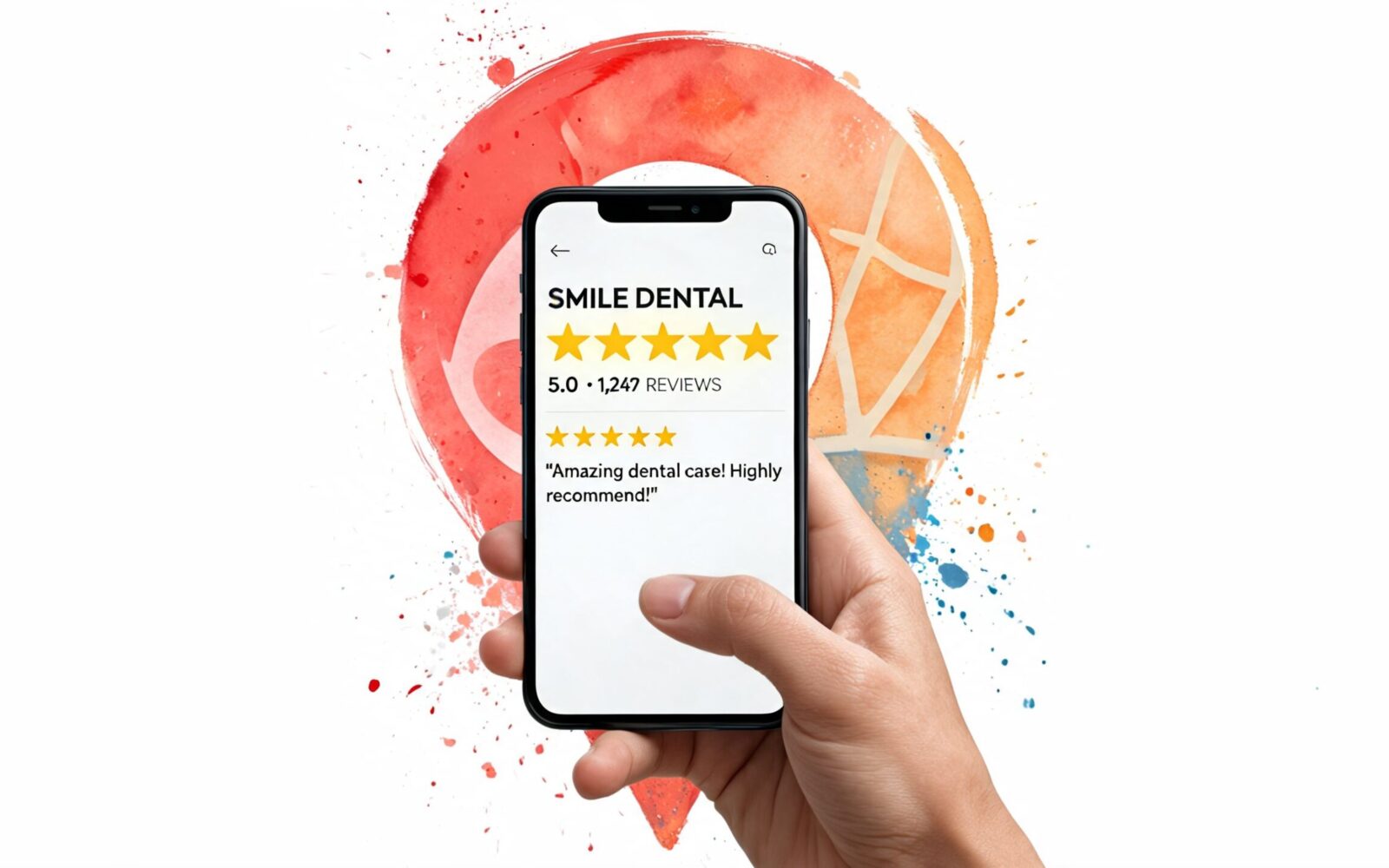
A hand holding a smartphone displaying a five star rating and a positive review for Smile Dental.

Reviews and local visibility shape that first impression. They also reveal something bigger than marketing efficiency. They show whether the practice presents a clear identity and follows through on it in public. That matters because patients are not only choosing a provider. They are choosing a place they expect to trust with their health, comfort, and time.

Build a review process your team can repeat

The strongest review systems are simple enough to use on a busy day.

In most offices, the right time to ask is right after a good appointment, a successful treatment completion, or a moment when a patient clearly expresses relief or appreciation. The request should come from a team member who already has rapport, and the path should be easy, usually a text or email link sent before the patient loses momentum.

A process that works usually includes:

  1. Choosing the moment carefully. Ask after a positive experience, not as a blanket script for every checkout.
  2. Assigning ownership. One person should track that requests are being sent and followed up.
  3. Removing friction. Direct links get more responses than vague verbal requests.
  4. Keeping the language natural. Patients respond better to a sincere ask than a rehearsed line.

Patients rely heavily on online feedback when comparing healthcare providers, as noted earlier in this article. In practice, that means reviews are not a side task for the front desk. They are public proof that your patient experience matches your claims.

Respond for the next patient, not only the last one

A review response is part customer service and part brand signal.

I tell practices to answer reviews with two audiences in mind. The reviewer matters, but the larger audience is the prospective patient reading five or six comments before deciding whether to call. A thoughtful response shows professionalism. A defensive one raises concern fast.

Use a consistent framework:

Review type Better response approach
Positive Thank them, reflect a value the practice stands for, keep it concise
Mixed Acknowledge the concern, avoid excuses, invite an offline conversation
Negative Stay calm, protect patient privacy, show that the office takes concerns seriously

Your tone should sound like your practice. A family-focused office can be warm. A surgical or specialty practice may need a more measured voice. Either way, the response should feel human and aligned with how the office operates.

If your practice wants a stronger local reputation footprint, a good primer on how profiles influence visibility is this guide on how to boost local Google search ranking.

Make local visibility reflect real community presence

Local visibility is stronger when it grows from real involvement, not just profile edits.

That can mean sponsoring a school event, supporting a youth sports team, participating in a health fair, or publishing content tied to concerns patients in your area ask about. For one office, that might be emergency visit guidance during holiday weekends. For another, it may be back-to-school checkups or treatment financing questions in a price-sensitive market.

These efforts do more than help you show up in search. They give patients a reason to recognize your name before they ever need care. That familiarity lowers hesitation.

For practices working on neighborhood search presence, local SEO support for service-area visibility often includes profile work, citation consistency, review planning, and locally relevant content.

Community trust tends to show up twice. First in the search results, then in the chair. When patients see the same values in your reviews, your local presence, and the actual visit, marketing stops feeling like promotion and starts reinforcing the identity of the practice.

Strategic Paid Advertising for Dental Practices

A patient searches “emergency dentist near me” at 7:10 a.m. before work. They are not looking for a brand story. They want fast proof that your office treats emergencies, answers the phone, and can see them soon. Paid advertising works when it meets that moment with the right message and a clear next step.

That is the primary use of ads for dental practices. They should extend the identity of the office, not mask it. A family-focused practice, a high-ticket implant office, and a fee-for-service cosmetic practice should not run the same campaigns, because they are not trying to attract the same patient or make the same promise.

Buy intent, not just clicks

Search campaigns usually perform best when they are tied to treatment-specific demand. Emergency care, dental implants, Invisalign, sedation, and second-opinion cases often carry clearer intent than broad awareness terms.

Google’s automotive, services, and healthcare local advertising guidance makes the same underlying point. Ads perform better when they closely match the service being searched and route visitors to relevant landing pages. In practice, that means a search for “dentist for tooth pain” should not land on a generic homepage with every service crammed into the main nav.

The trade-off is cost. High-intent keywords often cost more per click. That can still be the better buy if the traffic is qualified and the page converts into real appointments, not weak leads.

Build campaigns around service lines and patient fit

A disciplined account structure saves money because it keeps your message specific.

Use separate campaigns for distinct service categories. Emergency, implants, cosmetic cases, and general new-patient exams each need different copy, different offers, and different landing pages. The goal is not more traffic. The goal is more of the right traffic.

A strong setup usually includes:

  • One campaign for one service category. Keep budgets and messaging separate so you can see what is producing booked treatment.
  • Ad copy that reflects the search term. If the keyword is about emergency dentistry, say emergency dentistry in the ad.
  • Landing pages with one job. Confirm the service, answer the main objections, and make contact easy.
  • Clear conversion paths. Call buttons, short forms, online booking, and insurance or financing details where relevant.

Social ads serve a different purpose. They are useful for retargeting, promoting a specific offer, or staying visible in the community between active search moments. They are less dependable for immediate demand capture than search ads aimed at patients already looking for care.

A useful companion to ad visibility is local profile strength. This walkthrough on optimizing Google Business Profile explains some of the local listing details that often support paid and organic performance together.

Increase spend only after the post-click experience works

I have seen practices blame Google Ads when the actual problem was the path after the click. The ad was fine. The page was vague, the phone routing was inconsistent, or the front desk was not prepared to handle the type of inquiry the campaign generated.

Watch the signals that affect booked production:

  • High click volume with few calls or forms. The ad promise and landing page probably do not match.
  • Calls for the wrong service. The copy is too broad or the keyword targeting is loose.
  • Lots of leads, weak case acceptance. The offer may be drawing price shoppers instead of patients who fit the practice.
  • One campaign books well while another stalls. Shift budget toward the stronger service line instead of forcing equal spend across everything.

Paid advertising should feel measured and specific. The best campaigns do more than get attention. They attract patients who fit the practice, reinforce what the office stands for, and make it easy for the right person to take action.

Building Loyalty for Long-Term Growth

A patient finishes treatment, thanks your team, says they had a great experience, and disappears for 18 months. Then the practice spends more money trying to replace that lost production with new patient marketing. I see this pattern all the time, and it is one of the clearest signs that marketing and patient experience are being treated as separate jobs.

A gloved medical professional and a patient shaking hands with a small green plant growing between them.

Retention is the missing part of many marketing plans

Growth gets easier when the practice keeps the trust it already earned. A full schedule is not built only through new patient demand. It is built through recall, reactivation, unfinished treatment follow-up, and the kind of experience that makes a patient comfortable bringing in a spouse, child, friend, or coworker.

This is also where a practice's identity shows up in a practical way. If your office says it values education, your follow-up should help patients make decisions with confidence. If you position the practice around comfort, your recall and reactivation communication should reduce friction and anxiety. If you serve families, the systems should reflect convenience, clarity, and consistency across every touchpoint.

The practices that keep patients longer usually do a few ordinary things well, over and over. They do not treat retention like an afterthought once the first appointment is booked.

Simple loyalty systems that patients notice

Retention works best when it feels personal, organized, and consistent. Patients should feel known by the office, not processed by software.

Focus on systems like these:

  • Recall communication with a human voice. Texts and emails should sound like your team and reflect how the office speaks in person.
  • Reactivation lists with clear ownership. One team member should be responsible for tracking overdue patients and following a set process each week.
  • Follow-up by case type. A hygiene patient, an implant consult, and a cosmetic patient need different communication and different timing.
  • Small moments of appreciation. Thank-you notes, a welcome touch for new patients, or a thoughtful check-in after treatment can stay with people longer than a discount offer.

A useful benchmark comes from Gallup's research on customer engagement, which found that fully engaged customers represent a premium in share of wallet, profitability, and revenue compared with average customers. Dentistry has its own operational realities, but the principle holds. Patients who feel connected to the practice stay longer, accept care with more confidence, and talk about the office more often.

Referrals come from experience, not reminders alone

Referral growth usually comes from a pattern of trust, not a script at checkout. Patients refer when they can describe what makes the practice different in one clear sentence.

That usually comes from several parts of the experience lining up:

  • A front desk that communicates clearly and follows through
  • A doctor and clinical team who reduce uncertainty
  • Handoffs that feel organized from operatory to scheduling
  • Follow-up that reflects the patient's treatment stage
  • A review or referral request placed after a strong visit, not forced into every interaction

The strongest referral message is rarely broad. It is specific and easy to repeat. "They are great with nervous patients." "They explain treatment clearly." "They are organized, and they respect your time." That kind of language grows out of the actual patient experience, which is why loyalty is more than a retention metric. It is the clearest proof that the practice's values are showing up in daily operations.

Measuring Success and Planning Your Marketing Budget

A common pattern plays out in growing practices. The doctor approves a website refresh, starts a Google Ads campaign, asks the front desk to request more reviews, then checks back 60 days later and asks a fair question: are we getting the right patients from this?

If no one can answer clearly, the problem usually is not effort. It is measurement.

A five-step infographic showing the marketing success process for measuring and budgeting strategies for dental practices.

Track the numbers that affect decisions

The goal is not to collect more reports. The goal is to make better calls about where to keep spending, where to cut back, and where an internal process is hurting results.

For a dental practice, a useful scorecard is usually short:

  • Lead volume by source. Calls, forms, online bookings, and referral mentions.
  • Conversion rate from inquiry to scheduled visit. This often exposes whether the issue sits with marketing, phone handling, or both.
  • Appointment quality. Which channels bring in the cases you want more of.
  • Show rate and treatment acceptance by source. A cheap lead that does not show has limited value.
  • Retention and reactivation activity. Especially for hygiene patients and diagnosed treatment that stalled.

That set of metrics ties marketing back to the actual identity of the practice. A fee-for-service cosmetic office, a family practice built on long-term recall, and an implant-focused office should not judge success the same way. If your values center on education, trust, and continuity of care, your measurement should reflect that. Lead count alone does not.

Tools matter, but only if the team uses them consistently. Google Analytics can show how patients move through the site. Call tracking can show which campaigns generate phone calls. Your practice management system should connect scheduled visits, kept visits, and production to the original source. A shared monthly reporting sheet often works better than an expensive dashboard no one opens.

Use a long enough window to measure reality

Dentistry rarely works on impulse. A patient may see an ad, visit the website, read reviews three days later, ask a spouse about timing, then call after payday or after an insurance question gets cleared up.

That delay changes how marketing should be reviewed. Practices that judge a campaign too early tend to cut potential winners or keep weak channels because the numbers looked busy for a week. Khalil Varshon explains the role of incrementality in dental marketing and argues for measuring over a full patient decision cycle rather than reacting to short bursts of activity.

A better review process is simple:

  1. Set a baseline before changes start.
  2. Measure practice outcomes, not just channel metrics.
  3. Review after a full decision window.
  4. Compare lead quality and kept appointments, not just raw inquiries.
  5. Adjust budget once a real pattern shows up.

This is also where many offices underbudget or split spend so thinly that nothing gets enough traction. The U.S. Small Business Administration advises that businesses with revenue under $5 million and margins in a typical range often allocate 7 to 8% of gross revenue to marketing when they need to maintain market share and support growth, though the right number depends on goals, competition, and margins in the specific business (SBA marketing budget guidance). A dental practice does not need to copy that benchmark exactly, but it does support a practical point. Marketing needs enough funding to produce usable data and enough follow-up capacity to convert demand into appointments.

Sample 12-month dental marketing budget and timeline

Use the table below as a planning model. The right allocation depends on your local competition, service mix, production goals, and how reliably your team handles calls, forms, and follow-up.

Phase (Months) Focus Key Activities Sample Monthly Budget Allocation
1 to 3 Foundation Clarify brand position, rebuild core website pages, clean up local listings, set up tracking, create review request process Maintenance level within your chosen marketing budget range
4 to 6 Visibility Publish service pages, strengthen Google Business Profile, improve review flow, begin local SEO content, test one paid search campaign Growth-oriented allocation with more budget directed to search and website refinement
7 to 9 Optimization Compare lead quality by source, refine landing pages, tighten call handling, expand winning campaigns, reactivate overdue patients Reallocate toward channels producing stronger appointment quality
10 to 12 Scale with discipline Increase spend on proven services, expand local content, improve retention systems, plan next year’s service-line priorities Aggressive growth allocation only if tracking and follow-up systems are reliable

A simpler way to budget is to choose one of three operating modes:

  • Maintenance. Protect visibility, keep the website current, generate reviews steadily, and support recall.
  • Growth. Add service-page expansion, stronger local SEO, and tightly managed paid search.
  • Aggressive growth. Increase spend on channels that already produce the right patients, but only after tracking, call handling, and patient experience are consistent.

I usually give practice owners the same advice here. Spend enough to learn. Spend enough to follow through. Do not spend past your team’s operational capacity.

A strong budget is not a statement about ambition alone. It is a statement about who the practice is trying to become in its community, and whether the day-to-day patient experience can support that promise.

If your practice wants a marketing plan that reflects who you are, how you serve patients, and how your community already experiences your office, Leaping Lemur Media offers marketing support for healthcare and wellness practices, including work in branding, websites, local search, and ads management. The right partner should help you build a system that fits the practice, not force the practice to fit a template.

Scroll to Top