
Marketing for Healthcare Professionals: Grow Your Practice

You might be doing everything right inside the practice and still feel invisible outside it.

That's a common starting point. A dentist with excellent chairside care, an optometrist who keeps patients for years, a medspa owner with loyal regulars, a specialty clinic known by local physicians. The care is strong. The word-of-mouth is decent. But online, the practice looks thin, outdated, or inconsistent. Search results show competitors first. Reviews are sparse. The website doesn't reflect the quality of the actual experience.

That gap is where most marketing for healthcare professionals breaks down. Owners get pushed toward random tactics: post more on social media, run ads, hire someone for SEO, send email blasts. The result is usually noise without a system.

A better approach starts with the reality of how people choose care today. Patients compare, cross-check, ask friends, read reviews, visit websites, and come back later when they're ready. Marketing isn't separate from patient care anymore. It's the first part of the patient experience.

Table of Contents

Beyond the Waiting Room A New Era of Patient Connection

A strong local reputation used to carry more of the load. A clean office, a good front desk team, referral relationships, a listing in the local paper, maybe a brochure in another office. That model still matters, but it no longer stands on its own.

A pensive healthcare professional thinking about a network of patients and medical icons in watercolor style.

Why good practices still get overlooked

I've seen this pattern many times. A practice owner says, “Most of our patients love us. We just need more of them.” Then you look at the basics and find three different phone numbers online, a website that doesn't explain services clearly, no recent photos, and no real answer to why a new patient should choose this practice over the one down the street.

That's not a care problem. It's a visibility and trust problem.

Patients now move across channels before they decide. In one recent survey, 84% of prospective patients reported using both online and offline sources to research healthcare providers, and 79% of providers said they planned to prioritize website and SEO as part of reaching new patients, according to CallRail's healthcare marketing statistics roundup. That's why your website can't function like a static brochure anymore. It needs to help people find you, believe you, and take the next step.

Good marketing for healthcare professionals doesn't manufacture trust. It makes real trust visible sooner.

What modern patient acquisition actually looks like

A typical patient journey is messy in a very normal way. Someone hears about your practice from a friend. Later, they search your name. Then they compare you with nearby options, skim reviews, visit your service page, leave, come back, and maybe call from their phone a few days later.

That means three things:

  • Your online presence has to match your real-world reputation. If people hear great things but see a weak digital footprint, confidence drops.
  • Consistency matters more than cleverness. Accurate services, hours, forms, staff bios, photos, and reviews do more work than a flashy slogan.
  • Marketing is part of the care journey. The first click, first call, and first form fill shape expectations before a patient ever walks through the door.

Healthcare practices don't need more random tactics. They need one connected system that starts with identity, continues through search and content, and ends in measurable patient growth.

Before the Marketing Define Your Practice Identity

Most underperforming healthcare marketing starts too late. The team launches SEO, ads, social posts, or print mailers before answering a more basic question: what does this practice stand for, and who is it really for?

Positioning comes before promotion

If your message sounds like every other practice in town, your marketing won't have much to amplify.

A useful exercise is to define your practice identity in plain language. Not branding fluff. Real positioning. Think in terms of what kind of experience you deliver and who values it most.

For example, your practice might be:

  • The family-centered option for parents who want warmth, patience, and a calm environment
  • The high-clarity specialist for patients dealing with complex cases who want detailed explanations and confidence in the plan
  • The convenience-first clinic for busy professionals who care about scheduling ease, speed, and communication
  • The aesthetic-forward provider for medspa clients who want polished results, privacy, and an enhanced in-office experience

If you can't describe your practice clearly, your audience won't understand it quickly either.

A positioning statement doesn't need to be public-facing. It just needs to guide decisions. A simple format works well:

We help [type of patient] choose us because we deliver [distinct value] through [specific experience or approach].

That one sentence can shape your homepage, service pages, reviews strategy, ad messaging, and even the tone of your front desk scripts.

If your current brand feels vague, a structured healthcare branding approach can help turn scattered ideas into a message patients recognize and remember.

Build a patient persona you can actually use

A useful patient persona is not a demographic worksheet that sits in a folder. It should help your staff and your marketing team make daily decisions.

Say you run a pediatric dental practice. You don't just serve “parents with children.” You may be trying to attract first-time parents who are anxious about their child's first visit, recently moved into the area, and want a practice that explains things clearly without making them feel judged.

Here's a practical template.

Category Example: 'Dental Implant Diane'
Age and life stage Midlife professional, balancing work and family
Primary concern Wants a long-term tooth replacement option and clear guidance
Emotional driver Wants to feel confident, not pressured
What they value in a provider Expertise, clarity, before-and-after education, organized staff
Common questions Cost expectations, recovery, timeline, candidacy
Search behavior Searches treatment terms, local provider options, reviews
Preferred content FAQs, short videos, procedure explanations, financing information
Conversion trigger Easy consultation request, strong reviews, clear next steps
Objection Fear of pain, cost uncertainty, confusion about options

A good persona includes both practical and emotional context. That's the part many teams miss.

Practical rule: If your persona can't explain why someone hesitates, it can't help you improve conversion.

Once you define one or two core personas, pressure-test your existing marketing against them:

  1. Homepage check. Does your homepage speak to the right patient in the first few seconds?
  2. Service page check. Are you answering real questions or only describing procedures?
  3. Scheduling check. Is the next step obvious for someone who's interested but still uncertain?
  4. Content check. Are you publishing for your actual audience, or just filling space?

This is the foundation-over-frenzy part. When identity is clear, every later tactic gets easier.

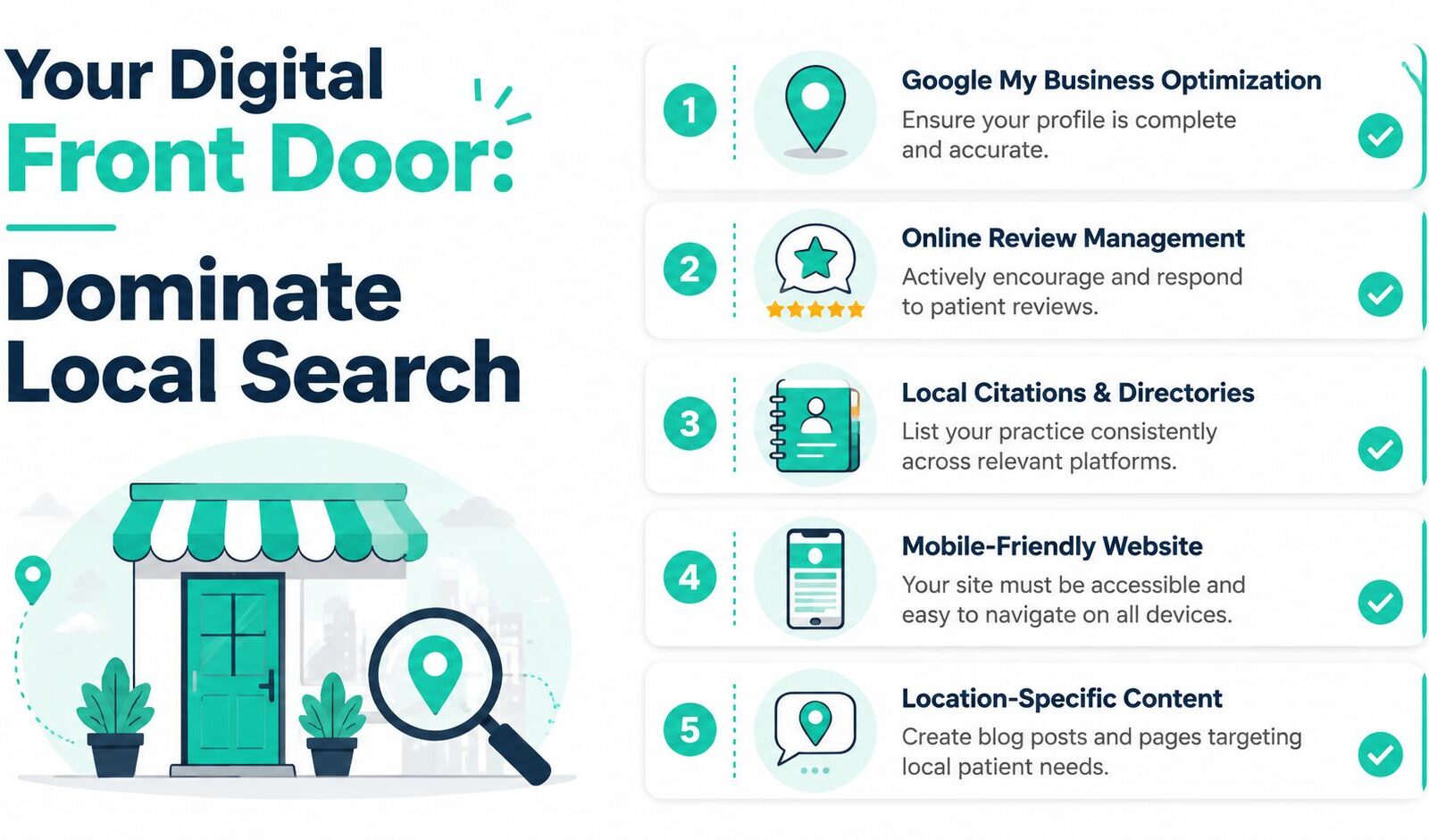
Your Digital Front Door Dominate Local Search

Most new patient searches don't start with loyalty. They start with a practical need and a nearby option. That makes local search one of the most impactful parts of marketing for healthcare professionals.

A marketing infographic illustrating five key steps for healthcare professionals to dominate local search results online.

Start with Google Business Profile

Your Google Business Profile often gets seen before your website. Patients use it to judge legitimacy fast.

Treat it like a live patient acquisition asset, not a listing you set up once and forget.

A solid profile should include:

  • Accurate core information. Practice name, address, phone, hours, category, and website link must match everywhere else online.
  • Real photos. Exterior, reception area, treatment rooms, staff, and provider headshots help reduce uncertainty.
  • Service detail. List specific services in plain language patients recognize.
  • Review activity. Ask consistently, and respond professionally.
  • Questions and answers. Seed common logistical questions so patients don't have to guess.

If you want a practical outside checklist to compare against your current setup, Bruce and Eddy's SEO solutions offer a useful local SEO reference for practice owners and teams.

Fix the website pages that matter most

Many healthcare websites lose patients because they bury essential information under generic copy.

The highest-impact pages are usually simple:

  • Homepage
  • Primary service pages
  • Location or contact page
  • Provider bio pages
  • Appointment or consultation page

Each page should answer a basic question quickly.

Page What the patient wants to know
Homepage Are you credible, relevant, and easy to contact?
Service page Do you treat my problem, and what happens next?
Bio page Who will I see, and can I trust them?
Contact page Where are you, when are you open, and how do I book?

Your site also needs a smooth handoff into action. Online scheduling, compliant forms, mobile usability, and clear phone links matter because friction at this stage wastes the attention you worked to earn.

Practices that need a more formal local visibility framework often organize this work through SEO and local search planning, especially when multiple locations, services, or listings are involved.

Clean data protects both performance and trust

Local search isn't only about rankings. It's also about operational accuracy.

A key best practice is to aggregate data from multiple sources, audit records for accuracy, and standardize how information is maintained so targeting and compliance improve from the start, as outlined in this healthcare data analytics guide from Printing for Less.

That applies to more than directories. It affects form routing, appointment requests, email lists, location information, and follow-up workflows.

If a patient sees one phone number in search, another on your website, and reaches a dead-end form, marketing didn't fail. Operations showed up in public.

Earn Patient Trust with Educational Content

The fastest way to make a healthcare practice sound untrustworthy is to market it like a retail promotion.

Healthcare decisions carry more emotional weight. Even when the service is elective, people still want reassurance, clarity, and evidence that they're in capable hands. That's why educational content outperforms hard selling over time.

Promotion gets ignored education gets remembered

Patients rarely think, “I hope this provider advertises to me more aggressively.” They think, “Can this person help me, and do they understand what I'm worried about?”

That's the standard your content has to meet.

Wolters Kluwer makes the underlying principle clear: in healthcare, trust matters more than reach, and people rely on educational content, peer influence, and clinical proof when making decisions. Marketing that feels like clinical education and peer validation will outperform pure promotion, as discussed in Wolters Kluwer's guidance on healthcare professional engagement.

That applies across specialties:

  • A dentist can explain what recovery after a procedure usually involves.
  • An eye doctor can walk patients through how an exam works and who it's for.
  • A medspa can clarify candidacy, expectations, aftercare, and common misconceptions.
  • A specialty clinic can publish referral-friendly content that helps both patients and local providers understand treatment pathways.

A simple content workflow for busy practices

You don't need a giant editorial calendar to make this work. You need repeatable source material.

Start with questions your staff already hears every week:

  1. What does this treatment feel like?
  2. Am I a good candidate?
  3. How long is recovery?
  4. What are my options if I'm nervous or unsure?
  5. What happens at the first appointment?

Turn each question into one clear asset. A blog post. A short provider video. A social post with a plain-language caption. A pre-consult email. A FAQ block on a service page.

Many practices tend to overcomplicate things. They chase trends instead of documenting expertise.

“If a patient asks the same question three times in a month, that's a content topic.”

A focused content mix often works better than trying to be everywhere:

  • Website blog or resource center for search visibility and depth
  • One social platform where your patients already spend time
  • Email follow-up for education after an inquiry or visit
  • Short-form video when a provider explanation would reduce hesitation

Choose the platform based on patient fit, not habit. If your audience is local parents, one channel may matter more than three neglected ones. If your audience is appearance-conscious medspa clients, visual education may do more work than long captions. If referrals from other professionals matter, polished educational assets can support those relationships too.

Good content doesn't shout expertise. It demonstrates it calmly.

Smart Patient Acquisition Through Paid Advertising

Paid advertising gets a bad reputation in healthcare because many practices approach it backwards. They spend before the offer is clear, send traffic to weak pages, and judge performance too quickly.

Used properly, paid media helps you appear when someone has immediate intent. Used poorly, it amplifies confusion.

An infographic comparing the pros and cons of using paid advertising for patient acquisition in healthcare practices.

When paid ads make sense

Paid search is often strongest when demand already exists. Think emergency dentist queries, urgent eye concerns, consultation-based elective services, or treatment searches where the patient is actively comparing providers.

In those cases, the job of the ad is simple: match intent, reflect the service accurately, and send the visitor to the right page.

Paid social is different. It usually creates or revives interest rather than capturing urgent demand. That can work well for awareness, review generation support, educational promotion, event-based outreach, and selected elective services. It tends to work poorly when a practice expects cold audiences to book complex care from a single ad.

How to target without crossing privacy lines

This is where judgment matters.

Personalization helps, but trust can break quickly if messaging feels invasive. WebMD Ignite notes that healthcare marketing should balance personalized engagement with privacy safeguards, while improving online experience, soliciting reviews, and keeping messaging educational rather than promotional in a regulated environment, as covered in WebMD Ignite's healthcare growth guidance.

A safer approach is to target by context rather than sensitive assumptions.

Better approach Riskier approach
Local radius around your practice Overly narrow audience logic tied to sensitive health inferences
Search intent such as treatment or service terms Messaging that implies private medical knowledge
Educational landing pages Fear-based landing pages
General service categories Ad copy that sounds diagnostic or invasive

That distinction matters. Patients should feel understood, not surveilled.

If you're building paid campaigns as part of a broader growth system, ads management support can help coordinate landing pages, targeting, creative, and reporting with compliance review built into the workflow.

What a healthy ad system looks like

A sustainable paid advertising setup usually includes these pieces:

  • A narrow service focus. Don't advertise every service at once.
  • Dedicated landing pages. Send traffic to pages that match the ad.
  • Clear calls to action. Call, book, request consultation, or complete a form.
  • Review and reputation support. Ads convert better when searchers can validate you fast.
  • Search term and message review. Remove weak traffic and refine language regularly.

Paid ads are not a substitute for trust assets. They're an amplifier. If the practice identity, website, reviews, and intake experience are weak, advertising just helps more people see the weaknesses sooner.

Build an Unbeatable Reputation and Referral Engine

The strongest practices usually don't separate reputation and referrals. They let each one strengthen the other.

A patient hears about you from a friend, checks reviews, sees thoughtful responses, visits your site, and books. Later, that same patient refers a spouse, coworker, or neighbor. Online proof and offline trust keep feeding the same loop.

Reviews and referrals should support each other

A review strategy should be systematic, not awkward.

You don't need scripts that sound robotic. You need a repeatable ask at the right moment. Usually that means after a positive visit, after treatment completion, or after a patient expresses satisfaction directly to staff.

A simple internal system works:

  • Front desk or treatment coordinator identifies happy patients
  • Staff sends a follow-up review request through an approved workflow
  • Team monitors key platforms consistently
  • Practice responds with professionalism and restraint

For referrals, the same principle applies. Don't “hope” patients refer. Give them reasons and cues. Make your specialty areas easy to describe. Make your onboarding smooth. Thank people for trust, not for transactions.

A practice earns more referrals when people can explain clearly who it helps and why the experience feels dependable.

A reputation system that staff can actually run

Most reputation plans fail because they depend on memory.

Build a simple operating routine:

  1. Choose the review moments. Don't ask at random.
  2. Assign ownership. One staff role should monitor and route feedback.
  3. Create response guidelines. Especially for negative reviews.
  4. Share wins internally. Positive feedback improves morale and reinforces service behaviors.
  5. Connect reviews to referral relationships. Strong public proof helps local physicians, businesses, and community partners refer with confidence.

Negative reviews require discipline. Respond calmly, protect privacy, avoid defensiveness, and offer an offline path to resolution. Your response is often less about changing that reviewer's mind and more about showing future patients how your practice handles tension.

That's why reputation management isn't just a defensive task. It's a growth asset.

From Data to Decisions Measuring Your Marketing ROI

A lot of healthcare owners get monthly marketing reports full of charts and still can't answer the only question that matters: did this activity create more qualified appointments?

That's a measurement problem, not a traffic problem.

An infographic showing key marketing metrics for healthcare practices, including patient acquisition cost and lifetime value statistics.

Track the decisions that lead to appointments

McKinsey's healthcare marketing analysis recommends using attribution tools such as regression analysis and A/B testing to understand what drives patient volume and conversion, as outlined in McKinsey's article on improving the consumer experience in healthcare marketing. That matters because healthcare is a high-consideration category. People often need multiple touches before they act.

You don't need to start with advanced dashboards. Start with a handful of decision-grade metrics:

  • Phone calls from Google Business Profile
  • Appointment requests from the website
  • Consultation form submissions by service
  • Booked appointments from paid campaigns
  • No-show and show-up patterns by lead source
  • Reviews generated during the month
  • Top-performing service pages and landing pages

If social is part of your mix, a practical social media effectiveness guide can help your team think more clearly about what engagement should lead to in business terms.

Use a monthly scorecard instead of random reports

A useful scorecard should fit on one page.

Metric What to review monthly
New patient inquiries Total volume and top sources
Booked appointments Which sources created real appointments
High-intent service demand Which services generated the strongest interest
Conversion friction Where people dropped off before booking
Review activity Quantity, themes, and response status
Content contribution Which pages or topics supported inquiries
Ad efficiency Which campaigns produced consults or calls

Review it with both marketing and operations in mind. If leads are coming in but not converting, the issue may be intake. If calls are high but scheduling is weak, front desk handling may need attention. If one service page produces strong inquiry quality, that may deserve more content or paid support.

The goal isn't more reporting. It's better decisions.


If your practice needs a clearer growth system, Leaping Lemur Media works on the pieces that matter most for healthcare brands, including positioning, local search, paid media, and website strategy. The right marketing partner should help you build a plan that fits your practice, your patients, and the reputation you've already worked hard to earn.

Scroll to Top