Patient Journey Mapping: A Practical Guide for Practices
LE
lemur June 16, 202619 min read
A patient books, confirms, then cancels the morning of the visit. Another finishes treatment, says everything went well, then never returns. You review the chart, check the reminders, maybe even ask the front desk what happened. Nothing obvious stands out.
That's the moment patient journey mapping becomes useful. Not as a marketing buzzword, and not as a giant corporate exercise, but as a way to see what patients experience before, during, and after they interact with your practice. Most small practices already track pieces of the story. The missing part is how those pieces connect.
The entire journey rarely stays inside your four walls. Patients talk to spouses, compare providers, call insurance, wait on referrals, get busy at work, lose confidence when costs feel unclear, or drop off because the handoff to the next step feels shaky. If you only study the appointment itself, you miss the reasons people disappear.
Beyond the Appointment Your Guide to Patient Journey Mapping
A new patient calls on Monday, sounds ready to book, then disappears by Thursday. Your team did not necessarily fail at the phone call. The patient may have hit an insurance question no one could answer, waited on a referral that never arrived, or asked a spouse, adult child, or caregiver for input and lost momentum. That is the patient journey. It starts before the appointment and often breaks down outside your four walls.
Patient journey mapping gives a small practice a practical way to see that full path. The goal is simple. Document what patients are trying to do, what gets in their way, what they feel at each step, and which parts your clinic controls versus which parts it only influences.
That distinction matters.
Small practices often focus on the touchpoints they can see clearly, such as scheduling, reminders, chairside communication, checkout, and recall. Those matter, but they are only part of the story. Patients also deal with benefit verification, specialist offices that do not call back, pharmacy delays, transportation problems, family opinions, and the confusion that sets in after they leave with a treatment plan and three unanswered questions.
A useful map makes those blind spots visible. It shows where trust drops, where effort feels too high, and where a patient decides, "I will deal with this later," then never returns. In my experience, owners often label that as low motivation when it is really process friction.
What the map helps you see
For a small practice, patient journey mapping is less about producing a polished diagram and more about spotting avoidable drop-off. A parent may abandon care because the referral step adds two extra calls during work hours. A cosmetic patient may hesitate because the pricing page answered the easy questions but skipped recovery time. A chronic care patient may want to follow through but gets stuck between your office, a specialist, and an insurer.
Each of those problems looks different on the surface. The pattern is the same. The patient has to do too much work to keep moving.
That is why the best maps go beyond the appointment itself. They include the periods of waiting, uncertainty, and handoff where small practices lose patients without seeing the loss happen in real time.
What strong patient journey mapping includes
Strong maps reflect the messy version of care, not the ideal version your SOP describes. They account for the facts that patients compare options online, call with incomplete information, pause to discuss cost at home, and make decisions based on logistics as much as clinical need.
They also separate two kinds of problems. One group sits inside the practice, such as inconsistent scripting, slow callback times, confusing forms, or unclear next steps. The other sits outside it, such as referral lag, coverage limits, caregiver influence, and poor coordination between offices. You may not control those outside factors, but you still need to plan for them if they regularly affect conversion, treatment acceptance, or follow-through.
A patient journey map gives you a way to do that with less guessing and fewer internal debates.
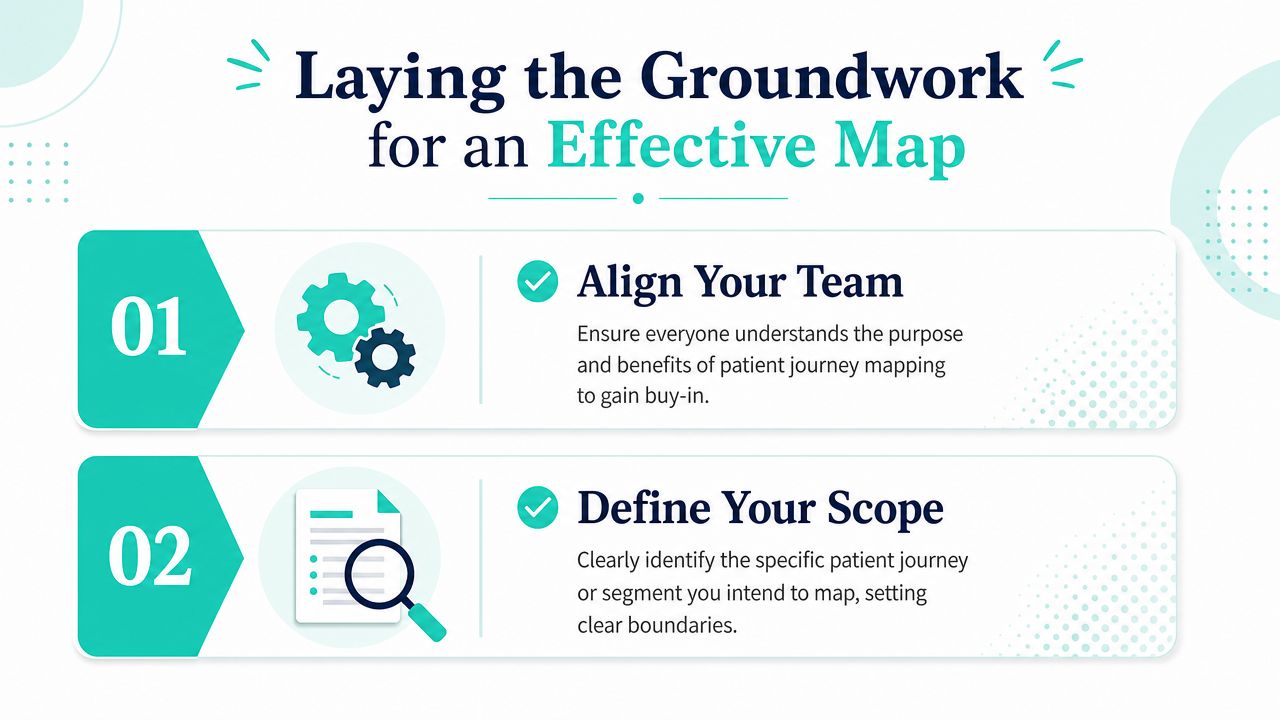
Laying the Groundwork for an Effective Map
Most mapping projects go sideways before the first sticky note goes up. The usual cause is simple. The scope is too broad, and the people who know the friction points best were never brought into the conversation.
A stronger start is narrower and more practical. Workshop guidance on healthcare journey mapping recommends beginning with a narrow objective and audience, then selecting the journey scope carefully because the exercise can get complicated quickly.
Align your team before you map anything
Your front desk, treatment coordinator, assistant, hygienist, technician, biller, and follow-up staff each see a different part of the journey. If you only ask the owner or lead provider, you'll get a polished version of events. If you ask the staff who hear the hesitant phone calls and the confused billing questions, you'll get the full story.
Try these prompts in a short team meeting:
Ask where patients get stuck: “What question do you answer over and over?”
Ask where patients get anxious: “At what point do people start sounding uncertain or frustrated?”
Ask where your team improvises: “What problem do you solve manually because the process doesn't work cleanly?”
Those questions usually surface useful patterns fast. Repeated insurance questions, unclear prep instructions, referral confusion, and inconsistent follow-up are common examples.
Define one journey, not your whole business
Don't start by mapping every patient type. Pick one journey that matters and that your team can influence.
Good first projects often look like this:
New patient consultation path for a dental, vision, or medspa service
Annual recall journey for existing patients
Referral-based specialty intake where delays and confusion are common
Treatment plan acceptance journey for higher-consideration services
Start with the journey that creates the most staff frustration or the most quiet drop-off. That's usually where the clearest opportunities live.
Use a simple who what why filter
Before you collect notes, answer three things:
Question
What to decide
Who
Which patient segment are you mapping?
What
Where does the journey start and end?
Why
What problem are you trying to solve?
If your answers feel fuzzy, the map will be fuzzy too. “All new patients” is broad. “New cosmetic consult patients who inquire online and don't schedule” is workable. That level of specificity keeps the exercise useful.
Creating Simple Patient Personas That Work
A generic “patient” isn't a uniform concept. The person who researches every detail before booking behaves differently from the person who acts on emotion and wants an answer now. If you put both into one map, your team will build for no one in particular.
A simple persona doesn't need stock-photo demographics or made-up backstories. It needs enough detail to help your team predict behavior, hesitation, and communication preferences.
Two contrasting personas from a sample medspa
Take a small medspa offering injectables and skin treatments.
Proactive Paula has been thinking about treatment for a while. She compares websites, checks reviews, reads FAQs, asks friends, and wants to understand outcomes, downtime, and who will perform the service. She doesn't want pressure. She wants reassurance and clarity.
Her journey usually includes multiple visits to your site, a careful review of before-and-after galleries, questions about candidacy, and concern about whether she'll look overdone. If your booking process pushes for a commitment before she feels informed, she pauses.
Last-Minute Liam behaves almost the opposite way. He sees an offer, notices an event coming up, and wants to know whether he can get in quickly. He's less interested in a deep education sequence. He wants fast answers, visible availability, and a frictionless path to booking.
He won't tolerate vague forms, delayed replies, or a website that hides basic next-step information. If your process makes him wait to learn whether the service fits his timeline, he's gone.
A persona template that stays useful
Build each persona with a few practical fields:
Primary goal: What are they trying to get done?
Trigger: What caused them to seek care now?
Concerns: What makes them hesitate?
Preferred channel: Do they want a phone call, text, email, or in-person explanation?
Decision influence: Who else affects the choice, such as a spouse, caregiver, referring doctor, or employer?
Likely drop-off point: Where do they stall if the process feels hard?
That last one matters more than most owners realize. Some patients don't drop off because they dislike your practice. They drop off because your process didn't match the way they make decisions.
What works and what doesn't
What works is grounding personas in things your team sees. Call notes, intake objections, common scheduling questions, portal messages, and review themes are enough to start.
What doesn't work is making personas too polished. If every profile says the patient values convenience, quality, and communication, you haven't created a persona. You've written a slogan.
Keep it lean. A persona should help your staff say, “This is the kind of patient who needs more reassurance before booking,” or, “This person will respond better to a same-day text than a long email.”
Mapping the Journey Stages and Touchpoints
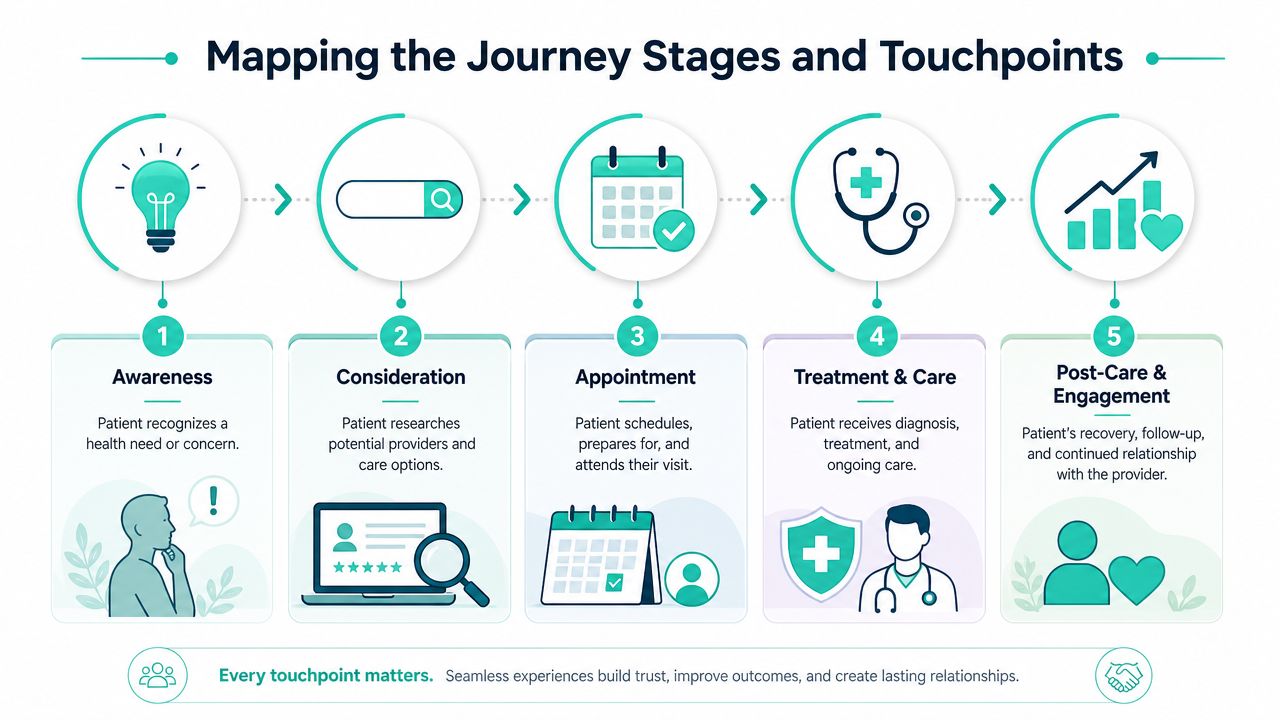
The map gets useful when you stop thinking in terms of appointments and start thinking in stages. A strong healthcare map is built from multiple touchpoints and stages, not a single survey or isolated visit. Best-practice guidance describes these stages as awareness, consideration, decision, treatment, and retention, while recommending a mix of quantitative data such as CRM records, EHR data, claims, call logs, visit frequency, adherence rates, and time-to-treatment, plus qualitative inputs like interviews, focus groups, and patient feedback. That approach helps teams see where people drop off, convert, or continue into long-term care across the journey, as outlined in healthcare journey mapping guidance from Siteimprove.
A practical five-stage view
For small practices, I prefer a version that mirrors how teams work.
Awareness The patient recognizes a need. They may search online, notice symptoms, ask a friend, see a referral recommendation, or respond to an ad. Ask: What first impression do they get? Is your information clear? Are hours, services, location, and next steps easy to find?
Consideration They compare options. This stage often includes website visits, review reading, insurance questions, social proof, and conversations with family. Ask: What questions go unanswered here? What creates uncertainty? What does the patient need before they feel safe moving forward?
Appointment They contact you, schedule, prepare, travel, check in, wait, and complete the visit. Ask: Where does friction enter? Is paperwork repetitive? Do reminders answer practical questions like parking, forms, timing, and prep?
Treatment and Care The patient receives diagnosis, recommendations, treatment, or an ongoing care plan. Ask: Do they understand the plan? Do they know cost, timing, risks, and what happens next? Are handoffs between staff smooth?
Post-Care and Advocacy This is follow-up, billing, aftercare, reminders, satisfaction, rebooking, and whether they recommend you to others. Ask: Does the patient feel guided after the visit, or dropped? Is there a clear path back into care?
A simple table you can use today
Build the first draft in a spreadsheet, whiteboard, or Google Sheet. Keep it plain.
Journey Stage
Patient Action
Touchpoint
Patient Thoughts/Feelings
Pain Points & Opportunities
Awareness
Notices a concern
Google Business Profile, referral, social media
“Do they handle this often?”
Weak service pages, unclear positioning
Consideration
Compares providers
Website, reviews, phone call, insurance check
“Can I trust them, and what will this cost?”
Confusing pricing, unanswered FAQs
Appointment
Schedules and attends
Online form, call, reminder text, check-in
“Did I bring what I need?”
Repeated paperwork, unclear arrival instructions
Treatment & Care
Receives care plan
Provider consult, handoff, treatment room
“What happens next?”
Jargon-heavy explanations, unclear follow-up
Post-Care & Advocacy
Recovers, pays, rebooks
Portal, billing, follow-up call, recall reminders
“Am I done, or do I need another step?”
Silence after visit, vague next-step guidance
Patients don't experience your departments. They experience the handoffs between them.
One more rule matters here. Don't stop at touchpoints you own. Include insurance phone calls, referral wait times, specialist scheduling, pharmacy issues, transportation barriers, and caregiver involvement. Those outside forces often create the frustration your front desk ends up absorbing.
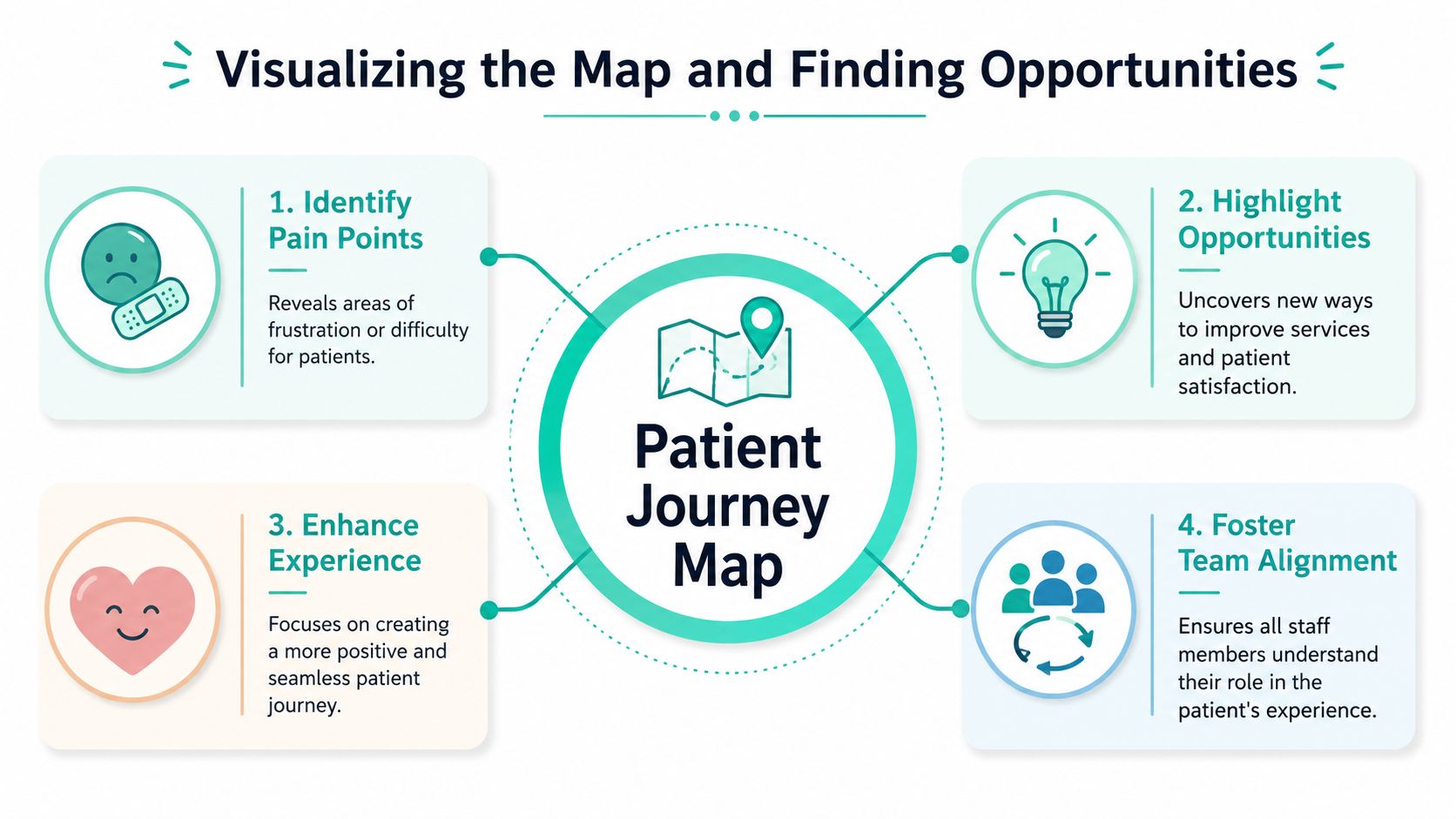
Visualizing the Map and Finding Opportunities
A raw list of touchpoints is useful, but it doesn't help teams see patterns quickly. A visual map does. The point isn't to make something fancy. The point is to create a shared picture of what patients go through and where the experience breaks.
One blind spot shows up in a lot of healthcare work. Many maps focus on interactions inside the clinic and overlook the fragmented path outside it. Discussion of fragmented patient journeys highlights how the patient journey can include primary care, specialists, payers, and social supports, along with financial and logistical burdens that standard marketing-style maps often leave out.
Choose a format your team will actually use
A whiteboard timeline works fine for a first pass. So does a spreadsheet with color coding. If your team likes visual tools, Miro, Google Slides, or Canva can turn the same information into something easier to review in a meeting.
The best format is the one your staff will revisit.
Try one of these:
Linear timeline if the journey is straightforward and sequential
Grid format if you want rows for actions, emotions, pain points, and ownership
Swimlane layout if the journey crosses multiple players such as patient, front desk, provider, payer, and referring office
If you're mapping a fragmented care path, the swimlane view is often the most honest. It shows exactly where responsibility gets muddy.
Add an opportunities layer
The map becomes operational. Review the emotional highs and lows, then mark moments where a small change could remove friction.
A few examples:
Waiting on insurance approval Opportunity: send a proactive update and explain expected timing in plain language.
Referral sent but no next step scheduled Opportunity: create a closed-loop handoff so the patient knows who contacts whom and when.
Patient receives a treatment plan but leaves unsure about cost Opportunity: give a simple written estimate range and a dedicated contact for financial questions.
Post-procedure anxiety after hours Opportunity: improve aftercare instructions and make escalation steps obvious.
A dip in patient confidence is usually an operations clue, not just an emotion to sympathize with.
Look for cross-boundary friction
The strongest opportunities often sit where no single person feels full ownership. That includes referral coordination, records transfer, billing handoffs, and communication between provider and support staff.
Better reminders, clearer forms, faster status communication
That final question matters most. Many improvements don't require a full system overhaul. They require cleaner communication at the exact moment uncertainty spikes.
Putting Your Patient Journey Map into Action
Monday starts with a full schedule, but the phones are already backing up. One patient is asking where to park. Another never understood that a specialist visit had to happen before treatment could start. A third wants to know why the estimate changed after insurance processed the claim. Your map has already shown where those breakdowns happen. Now the job is to turn that insight into a short list of fixes your team can carry out.
The fastest way to lose momentum is to treat the map like a strategy document instead of an operating tool. A separate industry source warns that many journey mapping efforts never lead to real process changes, a problem outlined in this discussion of journey mapping pitfalls. Small practices do not have room for that. Every change needs to reduce confusion, save staff time, or improve follow-through.
Pick quick wins first
Start with two or three changes that solve a recurring problem and fit your current capacity. I usually tell practices to choose one fix inside the clinic, one fix tied to communication, and one fix that addresses an outside dependency such as referrals or insurance expectations. That mix gets results without overloading the team.
Good quick wins usually share three traits:
They solve a repeated frustration. Patients keep calling with the same question, dropping off between steps, or arriving unprepared.
They sit within your control. Your staff can change a script, handout, reminder, or checkout process without waiting on a vendor or hospital partner.
They reduce uncertainty at a handoff. That might mean clarifying what happens after a referral, who calls with results, or what insurance is likely to cover versus what still needs confirmation.
Here is a practical way to sort opportunities:
Opportunity
Patient impact
Team effort
Start now or later
Improve reminder text with parking, forms, and arrival details
High
Low
Start now
Add a one-page next-step summary after consultation, including referral and insurance notes
High
Low to medium
Start now
Rebuild portal workflows across vendors
High
High
Later
Renegotiate referral coordination across multiple organizations
Medium to high
High
Later
Assign ownership and track signs of progress
If a task belongs to everyone, it usually belongs to no one. Give each change one owner who is responsible for getting it live, checking whether it works, and bringing back problems quickly.
That does not mean one person does all the work. It means one person keeps it from stalling.
A clear ownership model might look like this:
Front desk lead owns pre-visit communication updates
Treatment coordinator owns written cost and next-step materials
Provider lead owns changes to consult explanations
Office manager owns map review dates and follow-up on open issues
Then watch a few signals your team can readily see without building a reporting project. Look for fewer repeat phone calls, fewer no-shows tied to confusion, more completed referrals, fewer billing surprises at checkout, and fewer patients asking the same question twice. For small practices, those operational signs often matter more than a polished dashboard.
Build changes around real constraints
Some of the hardest friction points sit outside your direct control. Insurance rules change. Specialists run behind. Caregivers influence whether instructions are followed. Transportation problems delay care. You cannot fix every external factor, but you can reduce the patient's uncertainty around it.
That is the trade-off to manage. Do not promise speed you do not control. Do give patients a clear explanation of the next step, who is responsible, what delay is normal, and when they should call your office back.
For example, if referrals often disappear into a black hole, the first improvement may not be a new referral partner. It may be a simple script at checkout: when the referral is sent, how long scheduling usually takes, and who the patient should contact if no one has called within a set window. That kind of clarity prevents a lot of frustration, even before the larger process gets fixed.
Keep the map in use
A patient journey map stays useful only if it reflects how the practice works this month, not six months ago. Staff turnover, schedule changes, new service lines, software updates, and payer changes all shift the experience. Review the map on a regular schedule and after any meaningful workflow change.
The practices that get value from this work do one thing consistently. They use the map during operating decisions. They do not file it away after the meeting.
Frequently Asked Questions About Patient Journey Mapping
How often should we update the map
Update it whenever a major process changes, and review it on a regular schedule even if nothing dramatic has happened. New software, a staffing shift, a new provider, or changes in referral flow can alter the experience fast. If the map no longer reflects reality, it stops helping.
We're a small team with no marketer. Can we still do this
Yes. Small teams often do this better because the people involved are close to the patient experience. You don't need a formal CX department. You need honest staff input, a clear scope, and one person willing to keep the work moving.
How is this different from a patient satisfaction survey
A survey captures feedback at one moment. Patient journey mapping connects moments. It shows what happened before the visit, what happened after, and where patients got confused, delayed, reassured, or discouraged along the way.
What's the best free or low-cost tool
Start with what your team already uses well. Google Sheets, Google Slides, a whiteboard, or Canva are enough for most first maps. The quality of the discussion matters more than the software.
What if our journey extends beyond our clinic
That's normal. In many practices, the most important friction lives outside direct ownership. Include insurance questions, referrals, caregiver influence, transportation issues, and specialist handoffs. If those pieces affect whether patients continue care, they belong on the map.
How detailed should the first version be
Detailed enough to show decisions, emotions, handoffs, and friction. Not so detailed that your team gets buried in edge cases. A practical first map is usually better than an exhaustive one that never gets finished.
If your practice wants help turning patient journey mapping into clearer messaging, stronger patient acquisition, and a smoother experience from first click to follow-up, Leaping Lemur Media builds marketing that feels like your practice and supports real growth. They focus on helping practices show up with intention, connect with the right patients, and build trust across the full journey.