What Is a Purpose Driven Marketing Agency & Why You Need One
LE
lemur June 16, 202615 min read
You've probably felt this already.
Your practice is busy enough to know marketing matters, but every time you review your website, ad copy, or social posts, something feels off. The pages say the expected things. Experienced team. Modern technology. Personalized care. Convenient location. The campaigns run, but the message could belong to almost anyone in your city.
That gap is where a purpose driven marketing agency becomes useful. Not because “purpose” sounds nice, but because local service businesses win when their marketing reflects the authentic reason patients and clients choose them. A dentist may be known for calming anxious families. A medspa may help clients feel confident without pushing insecurity. A law firm may guide people through stressful moments with unusual clarity and respect. When that truth gets stripped out, marketing becomes generic fast.
For local businesses, purpose isn't a corporate slogan. It's the operating logic behind referrals, reviews, staff culture, and community reputation. It shapes how the phone is answered, what stories get told, what objections are addressed, and which audiences feel understood enough to book.
That's why the strongest brands don't just look polished. They feel coherent. Their message, patient experience, reputation, and outreach all point in the same direction. If you've been trying to close that gap, this is the work.
A dental owner can spend months investing in a new site, paid ads, and polished brand photos, then look at the final result and think, “This doesn't sound like us.” The office may be known locally for helping fearful patients feel safe, but the homepage talks mostly about crowns, veneers, and insurance. The practice's real differentiator got buried under category language.
The same thing happens with medspas. A founder builds a business around thoughtful consultations and natural-looking outcomes, but the public-facing message starts to drift into generic before-and-after marketing. The business still functions. It just stops feeling distinct.
That disconnect matters because people notice when a business sounds interchangeable. The Ad Council reports that 94% of global consumers say they value companies with a strong sense of purpose, and 86% of U.S. consumers are more likely to trust brands that lead with purpose, according to its overview of purpose-driven marketing.
The signal your audience is picking up
For a local service business, trust forms before the first appointment. It starts in search results, review responses, social captions, office photography, and the language on key service pages. If those pieces don't express what you stand for, people may still click, but they won't feel much.
A purpose-driven message gives shape to things your audience already cares about:
Why you opened the business instead of only what services you sell
How you want people to feel before, during, and after they work with you
What role you play locally in the community you serve
What standards you refuse to compromise even when competitors market more aggressively
Your audience usually can't describe “brand alignment,” but they can feel when a business means what it says.
This is especially important for high-trust categories. People don't choose a dentist, medspa, eye doctor, or law firm the same way they choose a commodity. They're often buying relief, confidence, reassurance, clarity, or dignity.
Why generic marketing underperforms
Generic marketing isn't always bad marketing. Sometimes it's clean, competent, and technically sound. It just leaves out the emotional logic behind the decision.
That's why a lot of local owners start looking for a different type of partner. They want strategy that sounds more like their practice, their values, and the experience they've worked hard to build. Agencies that work from that premise tend to ask better questions from the start, including what the business believes, how it wants to be known, and what kind of relationship it wants with patients over time. You can see that philosophy reflected in Leaping Lemur Media's approach, where partnership and community connection are treated as part of the work rather than a tagline.
Beyond Buzzwords What a Purpose Driven Agency Actually Does
A traditional agency often starts with channels. SEO, Google Ads, Meta Ads, email, content. Those tools matter, but they're not the starting point if the business message itself is muddy.
A purpose driven marketing agency starts with a different question. What does this business exist to do beyond filling a schedule?
That doesn't mean abandoning performance marketing. It means the strategy gets built from the inside out. The agency acts like a compass before it acts like a megaphone.
The compass comes before the campaign
For local service brands, purpose usually isn't abstract. It shows up in practical choices.
A family dental office may decide its real promise is making care feel safe and predictable for anxious patients. A medspa may build around honest guidance and subtle results. A small law firm may focus on reducing confusion for clients during stressful cases. Once that purpose is clear, the agency can translate it into concrete assets:
Positioning language for the homepage, service pages, and doctor bios
Ad angles that speak to the right motivations, not just the obvious offer
Content themes tied to patient questions, fears, and values
Reputation strategy that pulls forward stories matching the brand promise
Visual direction so photography, design, and copy reinforce the same message
If you manage marketing internally, it helps to understand the broader service environment too. This comprehensive guide for marketing teams is useful because it breaks down what agencies handle across content, paid, and channel execution.
Purpose also has to be expressed visually. That's where brand work matters. Messaging about comfort, trust, confidence, or community won't land if the identity system sends a different signal. This is one reason some businesses revisit their branding foundation before pushing harder on campaigns.
Traditional Agency vs Purpose Driven Agency
Attribute
Traditional Agency
Purpose Driven Agency
Starting point
Channel selection and promotion tactics
Mission, values, positioning, and audience trust
Core role
Amplify a message
Clarify the message, then amplify it
Campaign planning
Focus on offers, traffic, and conversion mechanics
Connect offers to a larger brand promise
Metrics emphasis
Leads, clicks, cost efficiency
Leads, trust signals, retention, reputation, and mission alignment
Client relationship
Often vendor-style and task-based
Closer strategic partnership
Brand voice
Can sound category-standard
Built to sound distinctive and lived-in
Community role
Usually secondary
Often central for local service businesses
Main risk
Efficient campaigns with weak differentiation
Slower upfront discovery if the business lacks clarity
Long-term goal
Generate demand
Build demand and durable trust
Practical rule: If an agency wants to launch ads before it understands why patients stay, refer, and leave reviews, it's probably operating as a media buyer, not a purpose-led partner.
The trade-off is straightforward. Purpose-driven work often takes more discovery at the start. That can feel slower than jumping directly into campaigns. But when the foundation is sharper, the marketing tends to become easier to scale because every page, ad, and conversation points in the same direction.
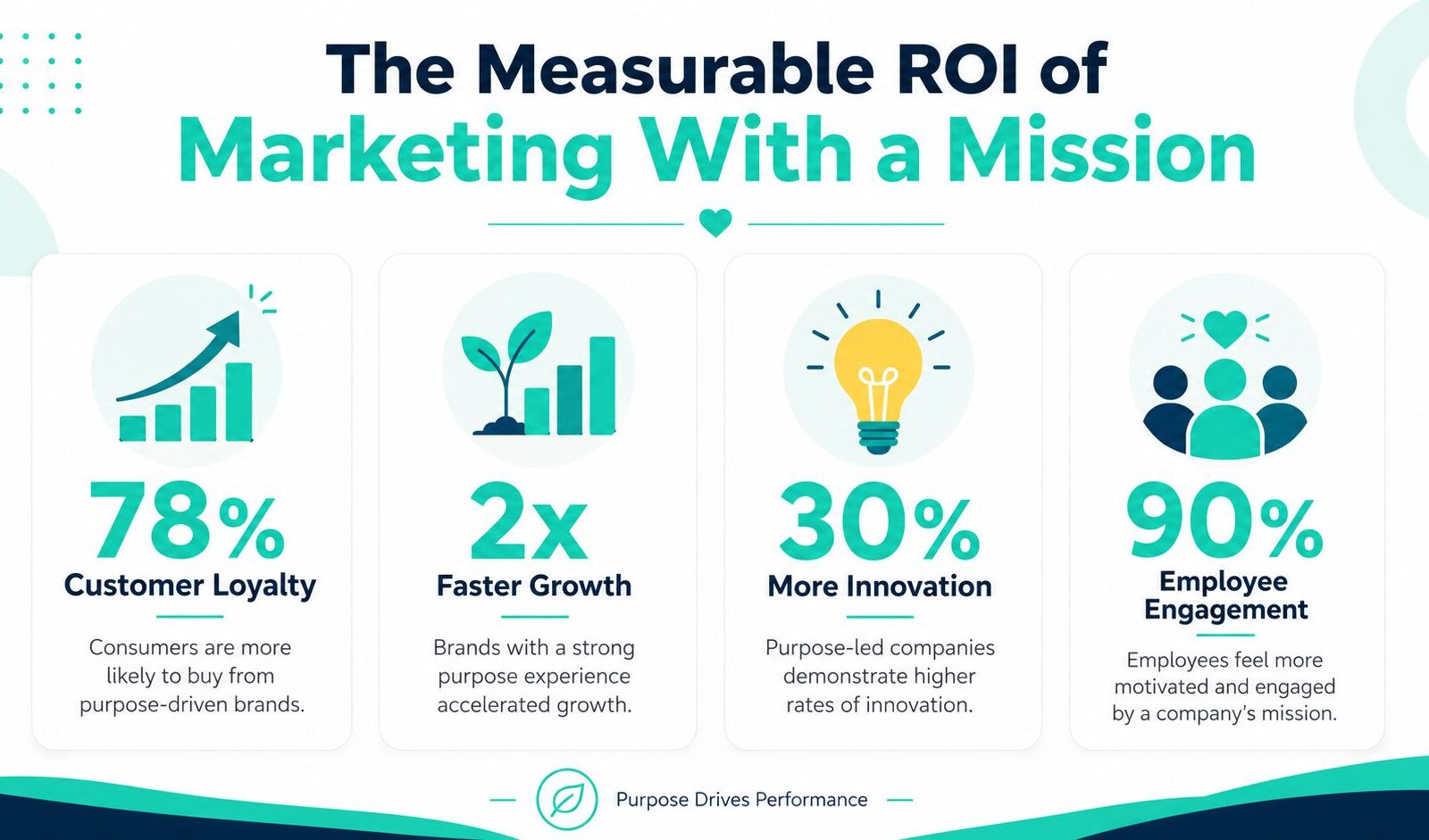
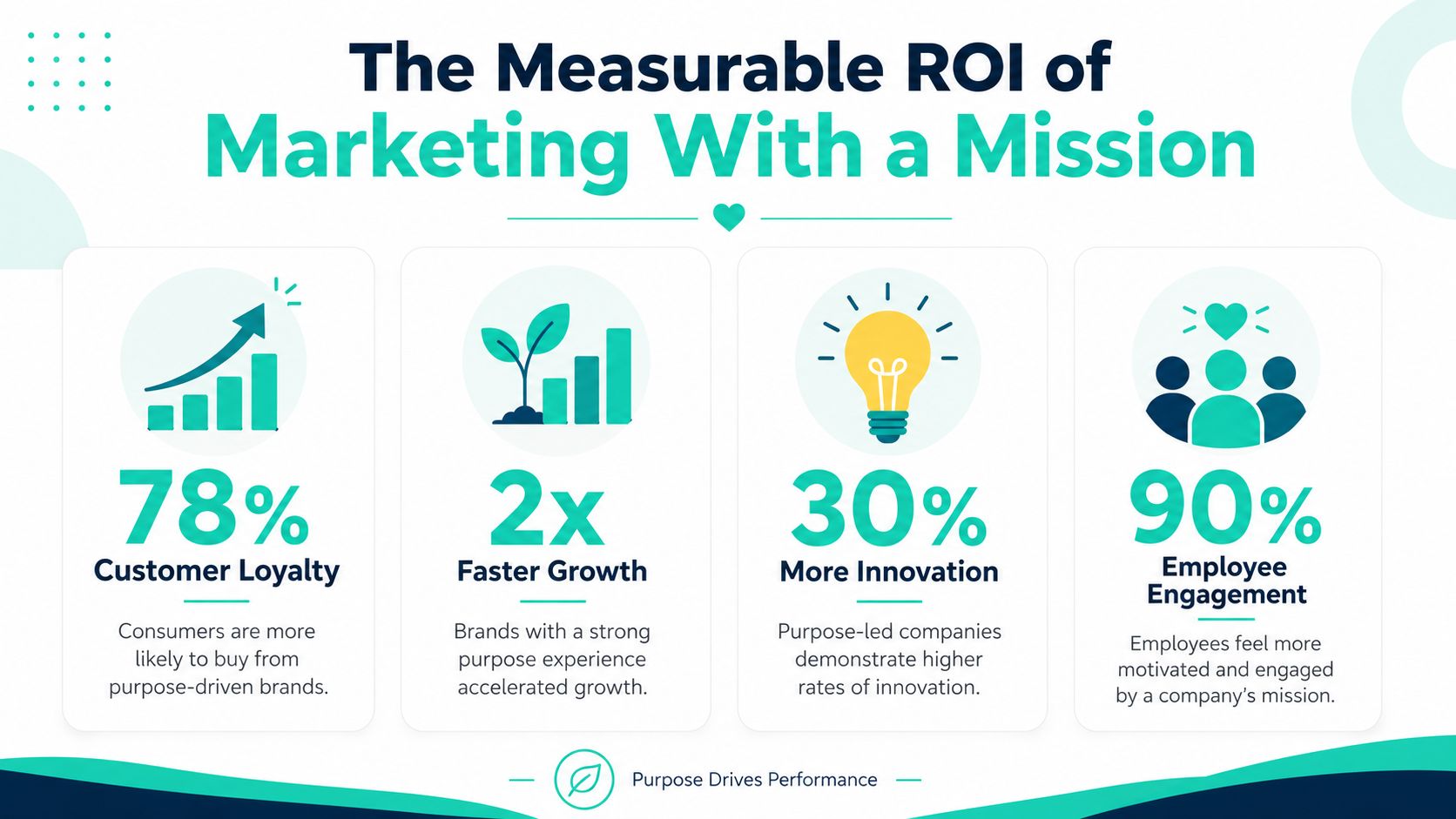
The Measurable ROI of Marketing With a Mission
The financial question is fair. If purpose stays in the realm of sentiment, it won't survive budget conversations.
What makes this approach credible is that major marketing teams now measure it like an operating variable, not a soft idea. A 2026 ANA Marketing Futures Report, summarized by AMRA & Elma, found that 85% of CMOs include brand purpose metrics as a formal KPI. The same source cites Forrester Customer Experience Index data showing purpose-aligned brands have a 34% higher customer loyalty index, 2.1 times higher customer lifetime value, and 29% lower churn than sector averages in a study spanning 65,000 consumers across 14 industries. You can review that summary in these purpose-led marketing statistics.
Trust turns into business outcomes
For local service businesses, the translation is practical rather than theoretical. A stronger purpose-led position can make the market easier to manage because it helps answer the questions prospects are already asking:
Why should I trust this office?
Do they understand someone like me?
Will I feel pushed, judged, or ignored?
Are they just selling procedures, or do they actually care about outcomes?
When those questions are answered well, performance often improves in places owners already watch closely:
Higher-quality inquiries because the message filters for fit
Better consultation conversion because expectations are clearer
More repeat visits because the experience matches the promise
More referrals and reviews because patients can describe what feels different
This is why purpose and paid media belong together. Ads can create attention, but message-market fit determines whether that attention turns into booked appointments. A business investing in ads management should pay close attention to this, because stronger positioning usually improves the quality of traffic before any platform optimization happens.
What local ROI actually looks like
For a medspa, ROI may show up when consults become less price-driven because the brand has framed the experience around guidance and confidence, not discounts.
For a dental practice, it may show up when anxious patients book after reading content that explains sedation options, first-visit expectations, and comfort protocols in plain language.
For a local service firm, it may show up when reviews stop sounding generic and start repeating the same trust signal over and over. Compassionate. Clear. Honest. Gentle. Never rushed. Those patterns matter because they reduce friction in the next buying decision.
A purpose driven marketing agency should be able to connect mission to margin without forcing fake precision. Not every result appears in a spreadsheet immediately. But over time, trust compounds through better fit, stronger retention, and a reputation that lowers your dependence on constant promotional pressure.
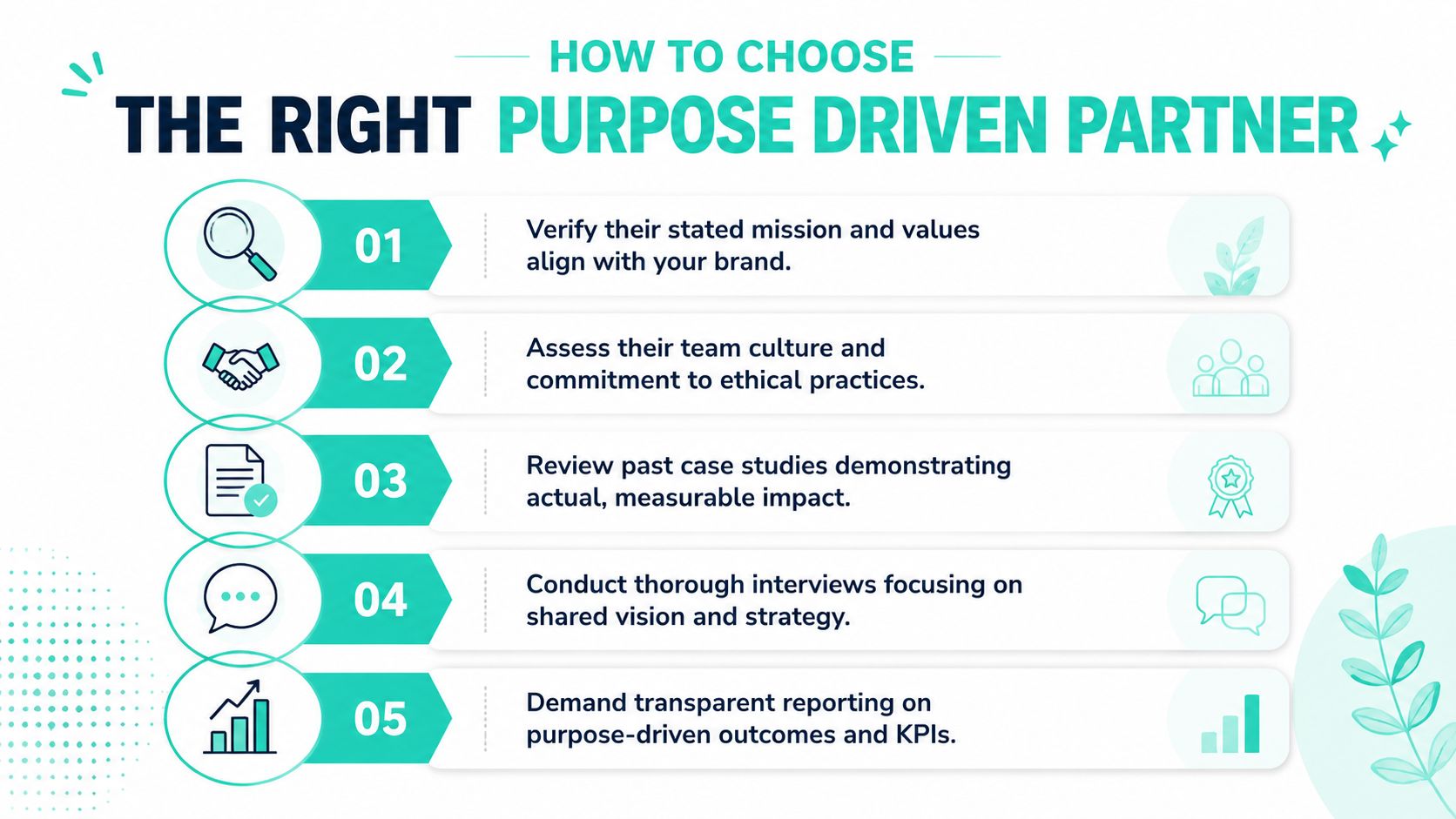
How to Choose the Right Purpose Driven Partner
A lot of agencies can talk about values. Fewer can build a system that proves those values are influencing outcomes.
That's the dividing line. A mature purpose-driven marketing agency operationalizes authenticity as a measurement problem. Grounded describes this as building a KPI stack that includes both business metrics and mission metrics, so the agency can show whether purpose messaging is improving commercial performance and trust. Their explanation of purpose-driven marketing measurement is useful because it pushes the conversation beyond slogans.
What to look for before you sign
Start with how the agency behaves in early conversations. The first call tells you a lot.
They ask about your mission early. If the conversation jumps straight to tactics, platforms, and budgets, they may not know how to build the strategic layer.
They can define your audience in human terms. Good partners talk about patient motivations, fears, and trust barriers, not only demographics.
They discuss proof, not just messaging. Purpose claims need evidence. Community work, patient experience systems, staff training, review patterns, and service delivery all matter.
They talk about reporting with nuance. You want someone who can track both hard outcomes and softer trust indicators without pretending they're the same thing.
Their own brand is coherent. If they market “authenticity” but sound interchangeable, pay attention.
One mistake owners make is overvaluing polished creative and undervaluing diagnostic skill. A strong-looking portfolio matters less than whether the agency can uncover what makes your business credible.
An agency should be able to explain how it will measure both commercial progress and brand trust without hiding behind vague language.
Questions worth asking in the first meeting
Some questions cut through the sales script quickly:
What do you need to learn about our business before recommending channels?
How do you identify the difference between a stated value and a value customers experience?
Which business metrics and mission metrics would you track for a practice like ours?
How do you test whether our message is resonating with the right audience segments?
What would make you push back on our current positioning?
How do you translate purpose into ad copy, landing pages, review strategy, and content?
The best answers are usually specific, a little uncomfortable, and grounded in process. Weak answers stay abstract.
A real partner should leave you with the sense that they'll challenge lazy messaging, demand evidence, and build systems that connect purpose to behavior. If they only offer inspiration, keep looking.
Purposeful Marketing in Action For Your Industry
Purpose-driven marketing gets easier to understand when you stop picturing global campaigns and start looking at local practice decisions.
An effective agency uses a data-driven operating model, which means it establishes baselines, studies channel behavior before and after campaigns, and tests which audiences respond to values-based positioning and which channels convert trust into appointments or sales. Supermetrics outlines that data-driven agency model, and it maps well to local service work.
Dental practices that lead with comfort
A generic dental strategy talks about services. A purposeful one may focus on reducing fear.
That changes execution. The homepage can address anxious patients directly. Doctor bios can mention bedside manner and visit philosophy, not just credentials. Google Ads can speak to same-week emergency care or judgment-free visits. Social content can explain what happens during a first appointment, how sedation works, or how the team helps nervous children.
The purpose isn't “we do dentistry.” It's “we make dental care feel safe enough to start.”
That kind of positioning often attracts the right patients faster because it names a real barrier to action.
Medspas that lead with confidence
Many medspas fall into the same visual language and the same copy. Youthful. Refreshed. Rejuvenated. Results-driven. Those phrases aren't wrong. They're just crowded.
A more grounded strategy might center on informed confidence. That can show up in consultation messaging, treatment education, realistic timelines, aftercare guidance, and content that helps clients choose well instead of pushing every trending service.
A purpose-led medspa brand usually sounds calmer and more assured. It doesn't need to manufacture insecurity to create demand. It earns trust by helping clients feel informed and seen.
If the brand also works with local creators or community personalities, the partnership approach matters. A resource like this strategic partner for creator partnerships can help businesses think through how values alignment should shape collaborations, especially when reputation is part of the product.
Local businesses that lead with community presence
For many small businesses, purpose sits in community role more than category expertise.
A local owner may sponsor school events, support neighborhood causes, train staff carefully, and build long-term relationships with customers. Yet none of that appears clearly in the marketing. The website stays transactional. Social posts stay promotional. The business feels smaller online than it does in real life.
Purposeful local marketing can pull those assets forward through:
Employee stories that show the people behind the service
Community involvement content that proves local commitment
Review mining to find the language customers already use
Offer framing that emphasizes service standards, not just price
Landing pages specific to the neighborhoods and needs you serve
The strongest local brands don't try to sound bigger than they are. They sound more specific, more useful, and more accountable to the people nearby.
That's the pattern across industries. Purpose isn't decoration. It's the lens that helps a business decide what to emphasize, what to stop saying, and what proof belongs in front of the buyer.
Your Roadmap to a Meaningful Marketing Partnership
Most businesses don't need more random marketing activity. They need a clearer operating story.
That starts before you hire anyone. If you can't explain why patients stay, what your team protects, and how you want to be known in the community, no agency can fix that with clever copy alone.
Start inside the business
Write down the basics in plain language.
What do you believe people deserve when they work with you? What frustrations or fears do you reduce? What do your best patients or clients repeatedly thank you for? What would your staff say you never compromise on?
Those answers usually reveal the authentic brand faster than a brainstorming workshop full of abstract values.
Then audit your current marketing against that truth:
Homepage copy that sounds like your category instead of your business
Service pages that explain procedures but not experience
Ad campaigns built around offers with no emotional context
Review profiles that contain useful proof you haven't translated into messaging
Social content that posts regularly but says very little
Build the partnership like an operating system
Once your internal picture is clearer, evaluate agencies the same way you'd evaluate a long-term hire. Look for strategic fit, communication style, measurement discipline, and evidence that they can hold both brand and performance in the same hand.
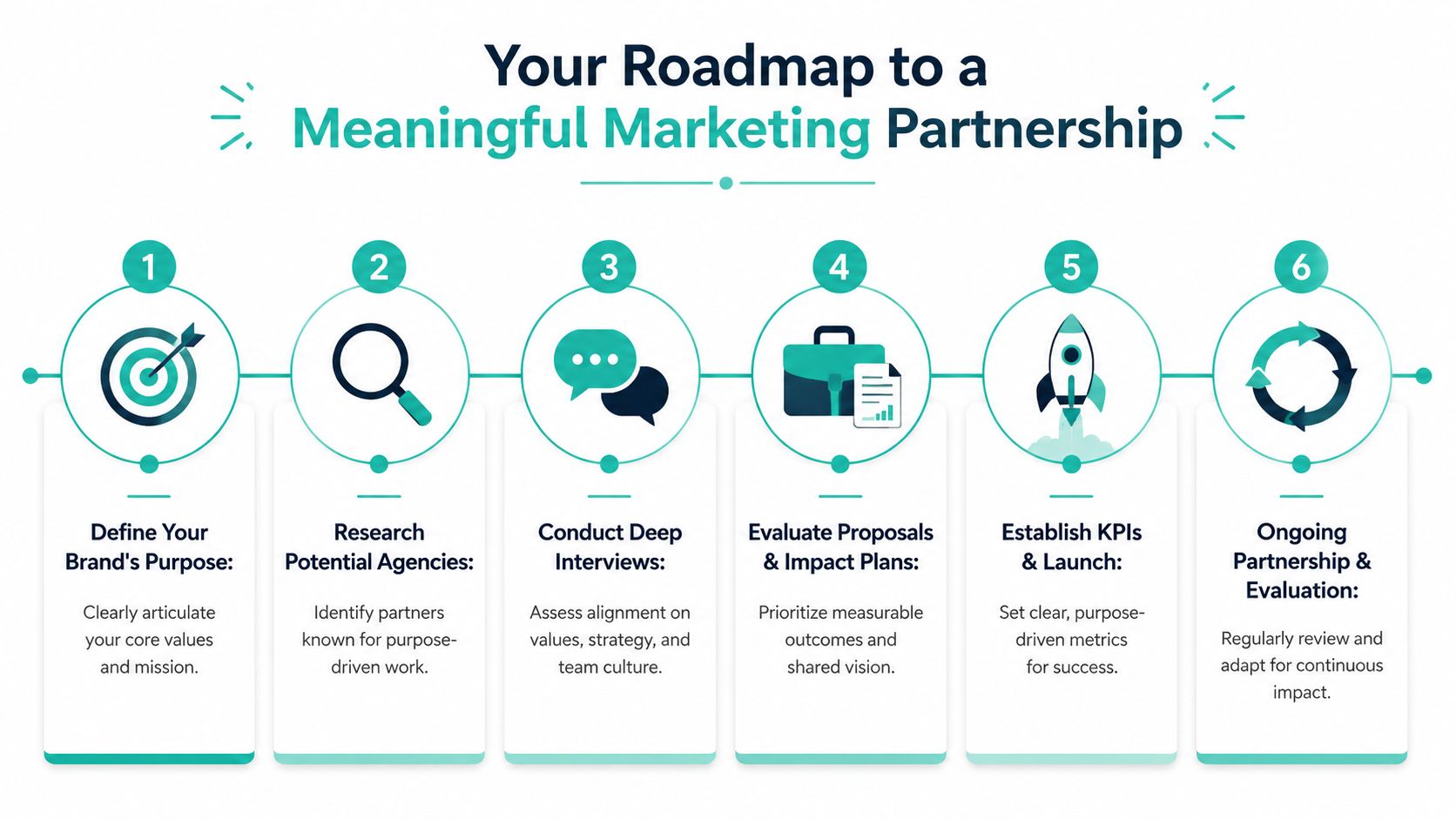
This visual sums up the path well.
A good partnership usually moves in this order:
Clarify the mission your market can understand.
Choose the partner that asks smart questions before prescribing tactics.
Align on KPIs that reflect business health and trust-building.
Translate purpose into assets such as pages, ads, reviews, content, and outreach.
Launch with discipline instead of trying every channel at once.
Review and refine as the market shows you what resonates.
The right marketing should make your business grow and feel more like itself at the same time. When that happens, the strategy stops feeling borrowed. It starts feeling owned.
If your practice or local business is trying to close the gap between what makes you valuable and what your marketing communicates, Leaping Lemur Media is one option to consider. Their work focuses on helping practices clarify positioning, strengthen brand messaging, and connect that message to intentional execution across channels so the marketing reflects who the business really is.