If you're running a practice right now, this probably sounds familiar. The schedule has holes you want to fill, the phone rings in bursts instead of consistently, and every marketing vendor seems to promise more patients without explaining whether those patients will be a good fit for your practice. That tension is where most dental […]
LElemurJune 26, 202618 min read
In this piece
If you're running a practice right now, this probably sounds familiar. The schedule has holes you want to fill, the phone rings in bursts instead of consistently, and every marketing vendor seems to promise more patients without explaining whether those patients will be a good fit for your practice. That tension is where most dental offices get stuck.
The strongest dental practice marketing strategies don't start with ads, trends, or a bigger content calendar. They start with clarity. You need to know who you're trying to attract, what your practice does best, and which services improve the health of the business. A full schedule matters. A profitable schedule matters more.
Too many practices chase activity. More clicks. More impressions. More “leads.” Real growth comes from building trust in your community, removing friction for patients, and measuring whether your marketing supports EBITDA instead of just increasing volume. That shift changes every decision that follows.
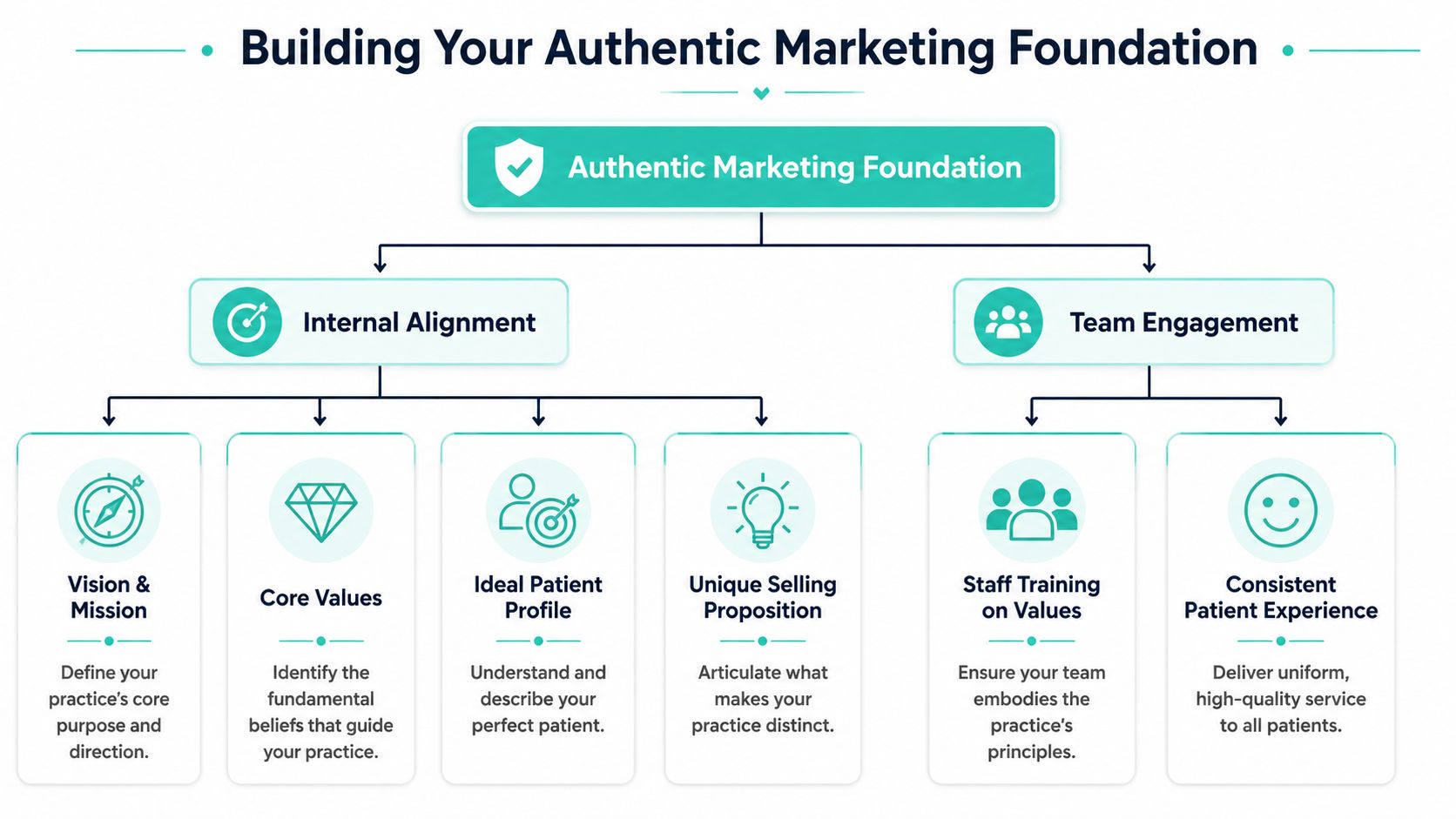
Build Your Marketing Foundation Before You Spend a Dollar
A practice owner approves a new ad campaign, the phones ring for two weeks, and then the friction starts. The front desk is answering questions the ads never prepared patients for. The schedule fills with low-value visits while higher-margin cases stay flat. Production goes up a little, but EBITDA does not.
That problem starts long before ad spend. Marketing works only when it reflects what the practice can deliver well, profitably, and consistently.
Define the promise your practice can keep
A useful practice promise gives patients a clear reason to choose your office, and it gives your team a standard to operate against. It should connect patient experience to the kind of growth you want more of.
In dentistry, this has to be specific. A pediatric office may realize its real strength is not just clinical skill, but a team that knows how to reduce fear in the first five minutes of a visit. That practice can build around “a positive first dental experience” and support it with longer new-patient blocks, child-friendly pre-visit messaging, and recall systems designed for families. A fee-for-service cosmetic practice might center its message on detailed smile planning and high-touch case presentation because that is what supports larger accepted cases and healthier margins.
Write the promise in plain language your team would use at the front desk, not in a branding workshop.
Use this checklist to pressure-test it:
Clarify the outcome you want to be known for: Fewer dental emergencies through consistent preventive care, confident cosmetic results, calmer visits for anxious patients, or reliable access for busy families.
List strengths that show up in daily operations: Same-day emergency capacity, strong insurance explanations, excellent treatment presentation, efficient hygiene reactivation, or a dentist who communicates complex plans clearly.
Name the differentiator in concrete terms: “Early morning appointments for working parents” says more than “patient-centered care.”
Match the message to patient experience: If you market judgment-free dentistry, the team needs a script for overdue patients that sounds warm and respectful, not rushed or corrective.
One sentence is enough if it is true.
Teams that want a wider view of messaging shifts and patient behavior can review this guide to 2026 marketing trends, then decide which ideas fit a healthcare practice and which are distractions.
Build an ideal patient profile from your own numbers
Broad descriptions like “families” or “busy professionals” do not help you decide where to spend, what to say, or which services deserve promotion. A better profile starts with the patients you already serve well and profitably.
Pull a sample of recent new patients and active patients, then look for patterns. Which patients accept diagnosed treatment? Which ones return for hygiene on schedule? Which services produce strong case value without overloading the team? Which patient types create constant rescheduling, insurance confusion, or heavy admin time with weak collections? Those trade-offs matter. A packed schedule can still be a poor marketing outcome if it crowds out the procedures that support practice health.
Build your profile around questions like these:
What problem brought them in? Pain, overdue care, a broken tooth, cosmetic concerns, or a consult for implants.
What stopped them from booking earlier? Fear, cost concerns, time pressure, past bad experiences, or confusion about insurance.
What helped them move forward? Financing, a clear treatment explanation, convenient hours, sedation options, social proof, or trust in the doctor.
What was the financial result? A single low-value emergency visit, a retained family with recurring hygiene, or a multi-visit treatment plan with strong collections.
One of the fastest ways to improve marketing is to compare “patients we like serving” with “patients who support the practice financially” and find the overlap. That overlap should shape your messaging, scheduling priorities, and follow-up systems.
If you want to see the kind of philosophy that supports this identity-first approach, the story on Leaping Lemur Media's about page is a useful example of positioning that starts with who you are before it gets into tactics.
Set a budget that supports profitable growth
Budgeting gets easier once the foundation is clear. You are not funding random activity. You are choosing where to invest to attract the right cases, convert them well, and keep them in care.
For an established practice, I usually want the budget tied to service mix and margin, not just top-line growth. If implant cases, extensive restorative work, or long-term family care improve the business more than one-off low-value visits, the budget should support those goals. That may mean spending less on broad awareness and more on better case presentation, recall reactivation, or targeted campaigns around high-fit services.
New practices often need a heavier lift early because they are building awareness from scratch. Established offices usually get better returns by fixing conversion leaks before increasing spend. If calls are missed, treatment plans are not followed up, or hygiene retention is weak, more traffic only makes the waste more expensive.
A practical budget should answer three questions:
What keeps the foundation healthy? Brand clarity, patient communications, staff training, and the systems that turn interest into booked care.
What creates demand now? Targeted campaigns for priority services or patient segments.
What compounds over time? Reputation, referral momentum, retention, and repeatable patient experience.
If the budget cannot answer those questions, it is probably reacting to slow months instead of building a stronger practice.
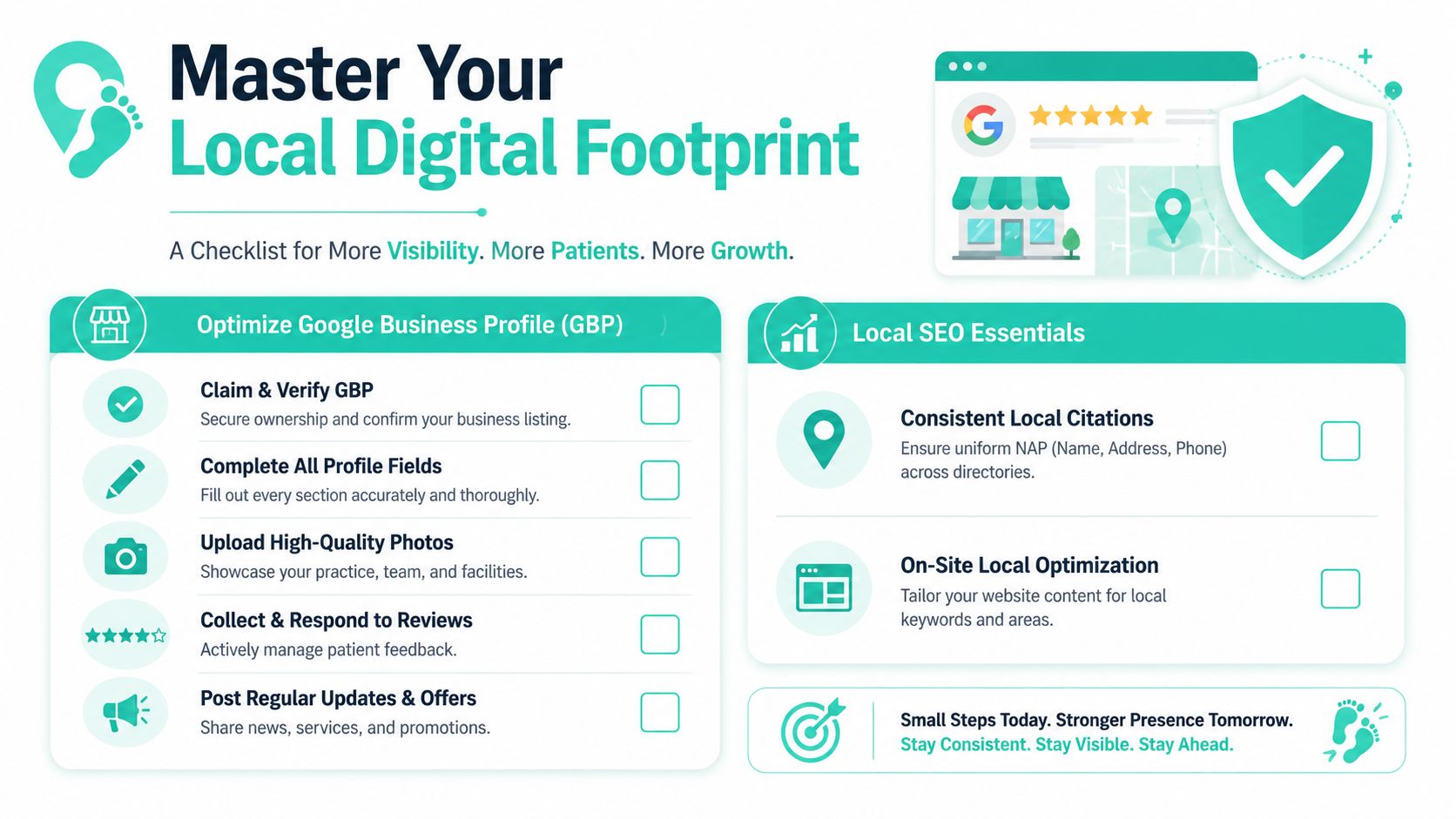
Master Your Local Digital Footprint
Local search is where many patient decisions begin. In practical terms, your Google Business Profile is often your first consultation, your first impression, and your first trust test.
Local SEO is described as the most effective strategy for attracting new patients when it's tied to geo-specific keywords and a strong Google Business Profile, and the same guidance recommends the 70/30 rule for social content, with 70% education and community and 30% promotion in RevenueWell's dental marketing best practices.
Treat your Google Business Profile like your front desk
Many practices claim their profile and stop there. That's like opening a reception area with no signage, outdated forms, and no one greeting patients.
A better approach is operational. Go field by field and make the listing complete, accurate, and useful.
Choose precise categories: Your primary category should match the main service line you want to be known for. Secondary categories should support, not muddy, that focus.
Write a grounded business description: Mention your city, nearby communities, and core services in natural language.
Upload current photos: Exterior signage, operatories, team photos, and reception area images help patients feel oriented before arrival.
Use the Q&A section: Seed common questions about parking, emergency availability, new patient paperwork, payment options, or sedation conversations.
Respond to reviews consistently: Prospective patients don't just read the review. They study how your office responds.
For a broader tactical walkthrough, this resource on strategies for local dental SEO is worth reviewing alongside your own profile audit.
Your Google Business Profile isn't a listing. It's a conversion asset.
Strengthen the local signals on your website
Your site should reinforce what the profile promises. If your profile says you're the go-to practice for implants in a specific area, your website needs location-aware service pages, local wording that sounds natural, and clear contact details.
The most effective local pages usually include:
Website element
What it should do
Service page titles
Pair the treatment with the city or area you serve
Contact page
Show the full practice name, address, phone, hours, and map
About page
Build familiarity with the doctor and team
FAQ content
Answer local patient concerns such as parking, insurance, and first visit expectations
Avoid stuffing town names into every sentence. Patients can tell when copy was written for a search engine first and a human second.
The best local pages also help your staff. When a new patient calls after reading them, the person on the phone should hear the same language the website used. That consistency reduces confusion and increases appointment confidence.
Use social content to support trust, not clutter it
Social media isn't the center of local visibility for most dental practices. It's support. Used well, it reinforces familiarity after patients find you elsewhere.
The 70/30 rule works because it keeps the tone balanced. Educational posts, team spotlights, local event photos, oral health tips, and short videos usually build more trust than constant treatment promotion. If posting feels chaotic, narrow your focus to a couple of channels your team can maintain well.
What doesn't work is the common pattern of posting only when the schedule looks light. Patients notice when social feeds become a string of urgent offers. A calm, steady presence almost always outperforms bursts of desperation.
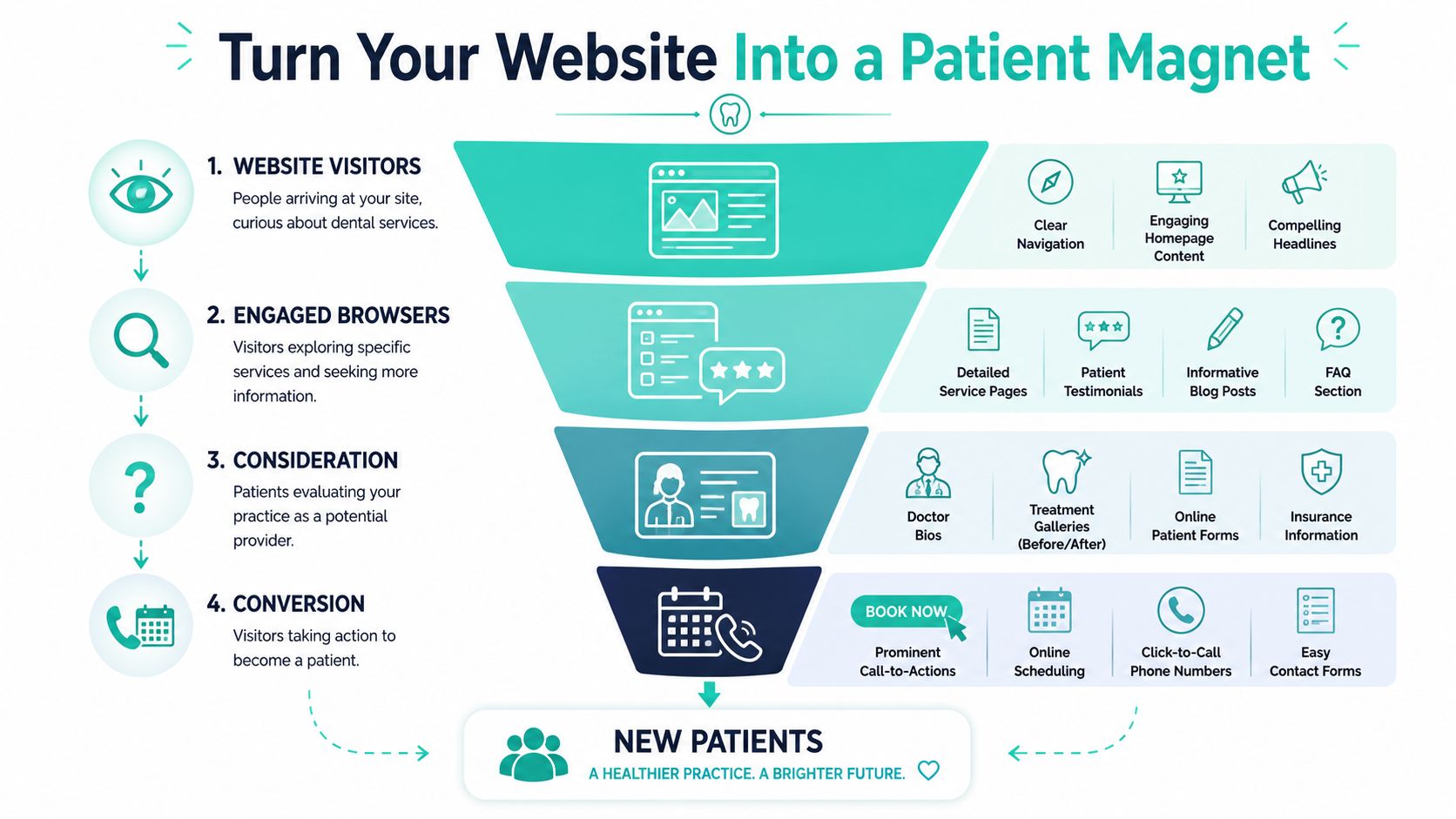
Turn Your Website Into a Patient Magnet
A dental website shouldn't behave like a brochure. It should work like your most reliable team member. It answers questions, reduces doubt, and gives patients an easy next step at the exact moment they're ready to act.
That matters because the website sits in the middle of the decision process. Search gets attention. Trust earns the click. The site decides whether that interest turns into a scheduled visit.
Your website should answer patient anxiety fast
Most visitors aren't looking for clever branding. They're asking simple questions. Can this office help me? Will they treat me with respect? How hard is it to get started?
That means your homepage and service pages should do a few jobs immediately:
State who you help: Family dentistry, cosmetic care, implants, emergency visits, anxiety-sensitive care.
Show real people: Team bios and office photos reduce uncertainty.
Include social proof: Reviews, testimonials, and clear explanations of the patient experience matter more than abstract claims.
Make the next step obvious: Every key page should have a call to action that doesn't force patients to hunt.
If your site loads slowly or feels clunky on mobile, even strong messaging gets undercut. For practices reviewing performance issues, this article on Improving Core Web Vitals scores offers a practical lens for evaluating speed and usability.
Reduce friction at the moment of intent
Convenience is not a side feature anymore. It's part of conversion.
According to NexHealth's dental marketing statistics, only 26% of dental practices offer online booking, yet dental discount and easy payment plans can increase a patient's inclination to visit an office by 66%. That's a clear reminder that patients respond when access feels simple and manageable.
Here is where many sites lose good prospects:
Hidden scheduling options: If booking is buried in the menu, patients drop off.
Weak mobile experience: Most hesitation shows up on phones first.
Unclear financial path: Patients want to know whether payment plans or office membership options exist.
Generic service pages: “We offer complete dentistry” doesn't help someone who needs a specific treatment.
A strong website gives patients multiple low-friction actions. Book online. Call now. Request an appointment. Ask a question. Download forms. The goal isn't to push everyone through one path. It's to make the right path feel easy.
Practices looking for examples of patient-focused digital content can browse the ideas archive on the Leaping Lemur Media blog. The useful takeaway isn't style. It's whether each page makes the next step clearer.
Fuel Growth with Patient Trust and Referrals
The most sustainable growth usually looks ordinary from the outside. A patient has a smooth visit. The team runs on time. The doctor explains treatment without talking down to them. Payment is clear. Follow-up feels thoughtful. Later, a friend asks, “Do you know a good dentist?” and your practice comes up without hesitation.
That pattern still matters more than most offices admit. A 2025 survey found that 77.5% of dental practices identified patient referrals as their most effective marketing channel, and 81% of prospective patients trust feedback from past patients in the MouthWatch dental marketing trends report. Trust doesn't replace marketing. Trust is the thing that makes marketing work.
A simple referral moment most practices miss
The best time to encourage a referral isn't months later in a generic email. It's right after a positive patient experience, when gratitude and confidence are highest.
Think of a common scenario. A patient who delayed treatment because of anxiety finishes an appointment and says, “That was way easier than I expected.” That's the moment a trained team member can respond naturally: “We're glad to hear that. If you know someone who's been putting off care for the same reason, we'd be honored to help them too.”
That doesn't feel pushy because it follows the emotional reality of the visit. It connects the patient's experience to someone they care about. A good referral process keeps this simple:
Make it easy to share: Referral cards, a short follow-up email, or a text with your booking link.
Give staff language they can use in practice: Scripts should sound conversational, not salesy.
Track the source: Ask every new patient who referred them and log it consistently.
Acknowledge the gesture: A thank-you note or small office-approved gesture goes a long way.
Patients don't refer because you asked loudly. They refer because the experience felt worth repeating.
Reviews work best when the request feels natural
Review generation gets awkward when offices treat it like a quota. It works better when the request is tied to a specific moment of satisfaction.
A front desk coordinator might say, “If you'd be open to it, a review helps other patients know what to expect here.” That's better than a generic blast sent to everyone regardless of visit quality.
Good review systems share a few traits:
They ask soon after the appointment.
They keep the path short.
They prepare staff to recognize happy-patient moments.
They respond with professionalism, whether the review is glowing or frustrated.
Referral growth isn't separate from operations. It is operations, seen from the patient's side.
Expand Your Reach with Smart Paid Advertising
Paid advertising works best after the fundamentals are in place. If your website is confusing, your reviews are weak, or your local presence looks neglected, ads merely pay to expose those problems faster.
Handled strategically, though, paid media can accelerate growth. According to 2740 Consulting's dental marketing statistics, paid search ads account for 35% of all traffic to dental offices, have a 35% higher conversion rate compared to organic visits, and digital marketing investment has increased by 12%.
Use Google Ads for active demand
Google Ads is strongest when intent is already high. A person searching for an emergency dentist, a second opinion, or a local implant consultation is not browsing casually. They're trying to solve a problem.
That makes paid search especially useful for:
Emergency care
High-intent treatment searches
Brand protection when competitors bid on your name
New practice visibility while organic presence is still developing
The trade-off is precision. Paid search can waste budget quickly when campaigns mix too many services, use weak landing pages, or send every click to the homepage. Match the keyword, ad copy, and destination page tightly. Emergency terms should land on emergency pages. Implant consult terms should land on implant pages.
Use social ads to create consideration
Social platforms play a different role. They usually create interest rather than capture demand that already exists.
This matters for elective services such as cosmetic treatment, smile makeovers, or clear aligners. People may not be searching actively that day, but a compelling visual story can move them from vague curiosity to inquiry. The key is to sell the problem solved, not just the procedure itself. Confidence, convenience, and clarity outperform technical language.
A strong social campaign usually needs:
Visual proof: Team videos, office familiarity, treatment education.
A narrow audience: Broad targeting burns money.
A low-friction offer: Consultation request, screening quiz, or simple booking step.
Follow-up discipline: Speed matters after the lead arrives.
Where paid campaigns usually go wrong
The biggest mistake isn't spending money. It's spending without a decision framework.
Campaigns fail when practices run Google Ads for every service, boost random social posts, and judge success by how busy the phones felt that week. If you want paid media to support profitable dental practice marketing strategies, each campaign needs a purpose. Capture urgent demand. Introduce a high-value service. Re-engage dormant patients. Those are different jobs.
If you're evaluating outside support for execution, the service overview at Leaping Lemur Media reflects the kind of integrated approach practices should expect from any marketing partner, not isolated tactics with no tracking.
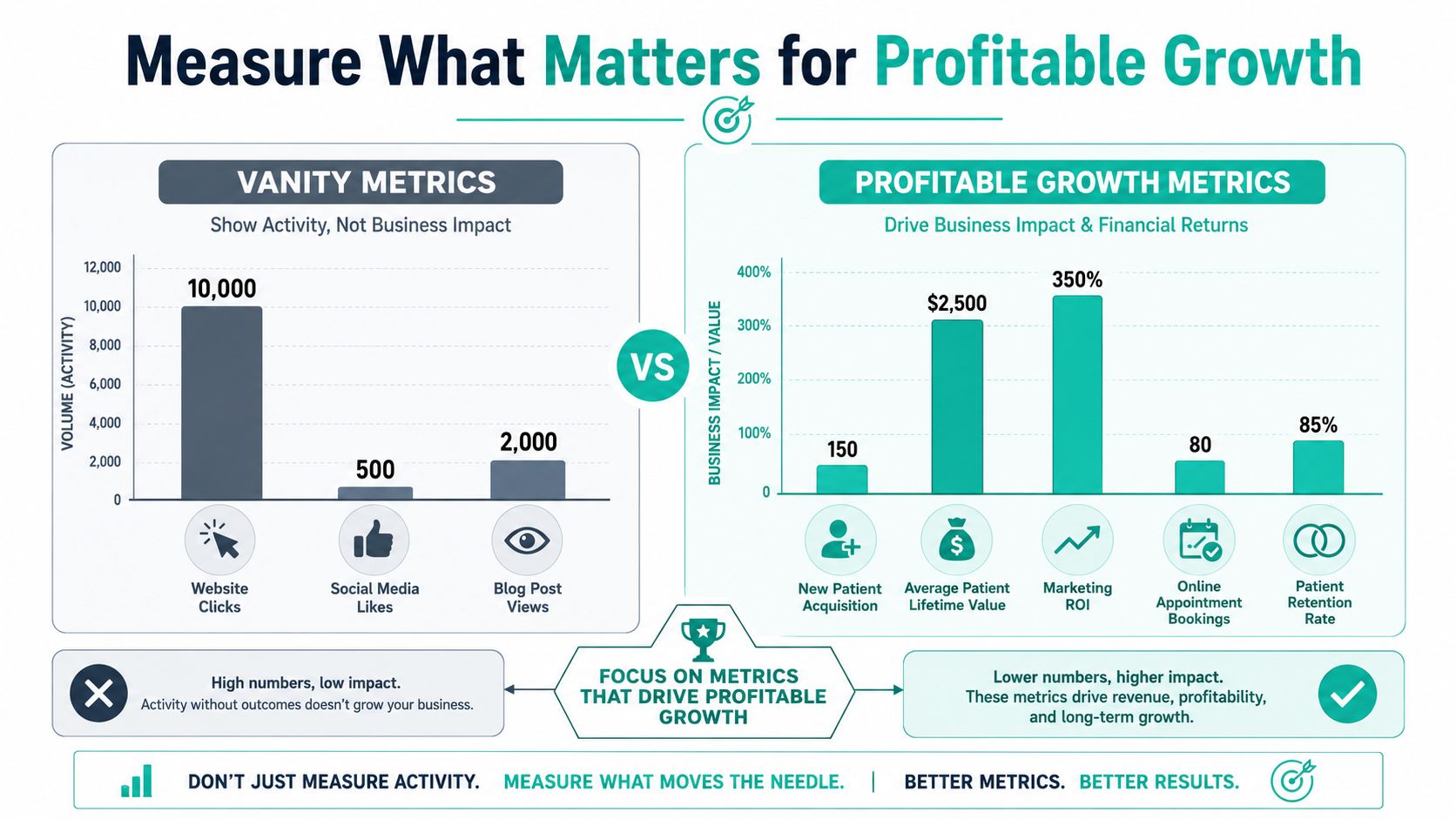
Measure What Matters for Profitable Growth
Many practice owners run into the same problem. The schedule looks full, the team is stretched, and revenue seems stable, yet the month ends with less profit than expected. In most cases, the gap is not effort. It is weak alignment between marketing spend, case mix, and what the practice keeps after delivery costs.
That is why lead volume alone is a poor scoreboard.
Teams usually track calls, forms, booked appointments, and cost per lead. Those numbers help, but they do not show whether a campaign is bringing in the right procedures, the right patients, or enough contribution to support healthy EBITDA.
Stop treating appointments as the finish line
A full schedule can hide weak marketing economics. A practice may fill chairs with low-value, insurance-driven visits from paid search while underinvesting in higher-margin services that strengthen the business. Another may spend heavily to promote implants or cosmetic dentistry without tracking whether those leads show up, accept treatment, and complete care profitably.
Track the procedure, not just the phone call.
I have seen this play out in real accounts. One practice generated a high volume of hygiene leads through Google Ads, but the show rate was inconsistent and very few of those patients moved into larger treatment plans. At the same time, a much smaller paid social campaign for implant consultations produced several qualified cases with strong acceptance. After one month of review, they shifted a large share of spend away from the high-volume campaign and toward the service line that produced better margin.
That kind of decision is what separates busy from profitable.
A simple EBITDA-aware scorecard
You do not need a complicated dashboard. You need a monthly scorecard that connects channel, service line, and financial outcome closely enough to make better budget decisions.
Did the inquiry match the intended service and patient type?
Show and start rate
Did the lead become a visit, then accepted treatment?
Financial contribution
Which procedures produced meaningful contribution after delivery costs and marketing spend?
This review changes how smart owners allocate budget. Some channels generate plenty of inquiries but weak case acceptance or poor fit. Others bring in fewer leads, yet those patients accept care, stay with the practice, and contribute more to EBITDA. If you never connect marketing to margin, "more patients" can become an expensive illusion.
Questions to ask every month
A useful marketing review should sound more like an operator's meeting than a vendor report. Focus on questions that lead to action.
Which service lines produced the best mix of demand, production, and profit?
Where are leads dropping off: inquiry, scheduling, show rate, or treatment acceptance?
Which channels bring in the patient profile the practice wants more of?
What should we reduce, keep, or increase next month based on contribution, not activity?
Profitable growth does not mean ignoring preventive care, community trust, or patient experience. It means protecting those priorities by making sure your marketing supports a stable, well-run business.
The best dental practice marketing strategies strengthen both sides of the practice. They build trust in the community and discipline in the numbers.
If you want a marketing partner that helps your practice grow with clarity, consistency, and a stronger bottom line, Leaping Lemur Media is worth a look. Their approach centers on authentic positioning, community connection, and strategy that fits how your practice operates, so your marketing doesn't just create noise. It creates momentum.