How to Improve Google Rankings: Local SEO Playbook 2026
You're probably in one of two places right now. Either your practice shows up inconsistently on Google and you're tired of wondering why a competitor across town outranks you, or you've invested in a website, a few blog posts, maybe even some SEO help, and the phone still isn't ringing the way it should. That […]
LElemurJune 30, 202615 min read
In this piece
You're probably in one of two places right now. Either your practice shows up inconsistently on Google and you're tired of wondering why a competitor across town outranks you, or you've invested in a website, a few blog posts, maybe even some SEO help, and the phone still isn't ringing the way it should.
That frustration is common for dentists, lawyers, medspas, and other local service practices. Most SEO advice is written for publishers, software companies, or giant ecommerce sites. A local practice doesn't need an endless content machine. It needs a practical system that improves visibility where real decisions happen: the local pack, service pages, review profiles, and a handful of pages that turn searchers into calls and appointments.
If you want to know how to improve Google rankings without turning marketing into a second full-time job, focus on the handful of actions that create local trust fast. Start with the assets Google uses first. Then make your website support the same story. Then measure whether those efforts lead to real inquiries, not vanity metrics.
For a local practice, Google Business Profile is usually the first asset to fix because it can influence visibility and action faster than most website work. Someone searching for a dentist, injury lawyer, or medspa often decides from the map results before they ever click a website. If your profile is weak, incomplete, or outdated, you lose trust before the visit starts.
Google states that businesses should keep their profile complete with details like full address, phone number, business category, parking or Wi-Fi details, and accurate hours including special store hours, because businesses with complete and accurate information are significantly more likely to appear in local results and be shown to customers looking for an immediate visit, according to Google Business Profile guidance.
Why GBP comes first
A strong profile does three jobs at once. It helps Google understand what you do, gives searchers confidence that you're legitimate, and reduces friction when someone wants to call, get directions, or book.
That's why I treat GBP as the first move, not an afterthought. Busy owners often spend months tweaking website copy while their profile still has the wrong category, outdated hours, or missing service details.
Practical rule: If someone can't confirm who you are, what you do, where you are, and when you're open in under a minute, your profile needs work.
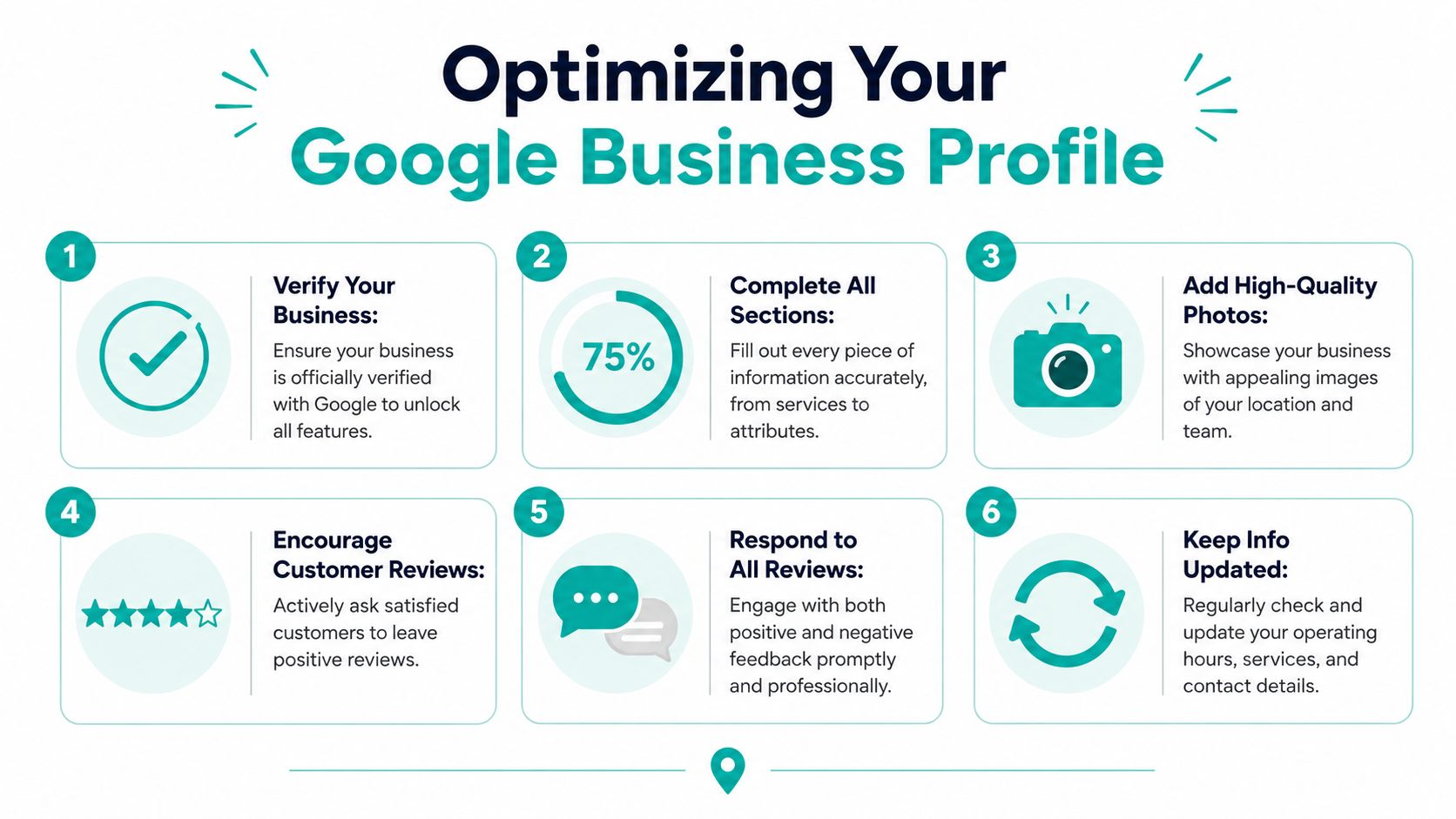
Your must-have GBP checklist
Start with the essentials.
Verification first: Claim and verify the profile so you can manage categories, photos, posts, reviews, and updates.
Core business data: Make sure your name, address, and phone number exactly match your website and major directory listings.
Primary category: Choose the closest fit to your main revenue service. A family dentist should not dilute that with a broad category if general dentistry is the core service.
Secondary categories: Add only the ones that accurately reflect real services.
Hours and special hours: Holiday closings and temporary schedule changes matter more than owners think.
Services and attributes: Fill in treatment or service details, accessibility information, and practical amenities where relevant.
Then add the trust builders.
Photos that look current: Use real images of your office, team, exterior signage, waiting area, and treatment rooms or meeting spaces.
Business description: Write clearly for humans. Say who you help, what you offer, and what makes the experience different.
Q&A monitoring: Seed common questions and answer them cleanly. This helps with hesitation before the call.
Posts: Use posts for promotions, seasonal reminders, events, and service highlights.
A helpful next read if you want a deeper walkthrough is this guide on how to improve Google Business ranking, especially if your local visibility feels stuck despite having a profile in place.
A final note on trade-offs. Don't overcomplicate GBP with constant gimmicks. A complete, accurate, well-maintained profile beats a neglected profile with clever copy every time.
Optimize Your Website for Local Trust
Your website's job isn't to impress other marketers. It's to confirm for Google and for local searchers that your practice is relevant, credible, and easy to choose. That means your homepage and service pages should read like a trusted local practice, not a generic template stuffed with city names.
A solid website foundation also matters for rankings. Google-focused guidance emphasizes that sites should be secure with HTTPS, load quickly, be straightforward to move around within three clicks, and remove indexing blockers by fixing crawl issues, broken links, mobile usability problems, and technical gaps in tools like Search Engine Journal's technical SEO guidance.
What a trustworthy local page looks like
A local service page needs a few things working together.
First, the page should answer the main question quickly. If someone searches for “Invisalign dentist in Austin” or “estate planning attorney in Tampa,” they should know within the opening section that they landed in the right place.
Second, your page title needs to do real work. One useful principle is to place the target keyword at the very start of the title tag, because Google bolds query-matching words in results and early title placement strongly influences rankings. That same guidance also notes that special characters and numbers can improve click-through rate, which increasingly matters alongside dwell time, as explained in this title tag and usability analysis.
Third, the page has to feel local without sounding forced. Mention your actual office location, the communities you serve, nearby landmarks when relevant, and the service details that matter most to a local buyer.
A before and after example
Here's a common weak version of a dentist service page:
Version
What it says
Why it underperforms
Before
“We offer cosmetic dentistry solutions for every smile.”
Too vague, no location signal, no clear service intent
After
“Dental Implants in Scottsdale for Patients Who Want a Stable, Natural-Looking Smile”
Clear service, local relevance, immediate patient benefit
The stronger page usually includes:
A focused title tag: Start with the service and location, not the brand name.
A direct opening paragraph: Explain who the service is for, what problem it solves, and what the next step is.
Clear headings: Break out candidacy, process, recovery, pricing approach, FAQs, and service area details.
Visible trust elements: Reviews, provider credentials, office photos, accepted insurance or financing info, and a clear contact path.
A local page should make a searcher think, “Yes, this practice does exactly what I need, near me, and I know what to do next.”
If you're reviewing whether your current pages support that kind of trust, a fast way to start is to compare your homepage and top service pages against your actual inquiry path. If your contact flow is clunky, fix that too. For teams that want outside help evaluating site structure and conversion friction, the Leaping Lemur Media contact page is one place to start a conversation.
One caution. Don't chase every suburb with thin duplicate pages. It usually creates weak content and maintenance headaches. Fewer strong pages, each built around real services and real service areas, usually work better.
Create Content That Attracts Your Ideal Patient
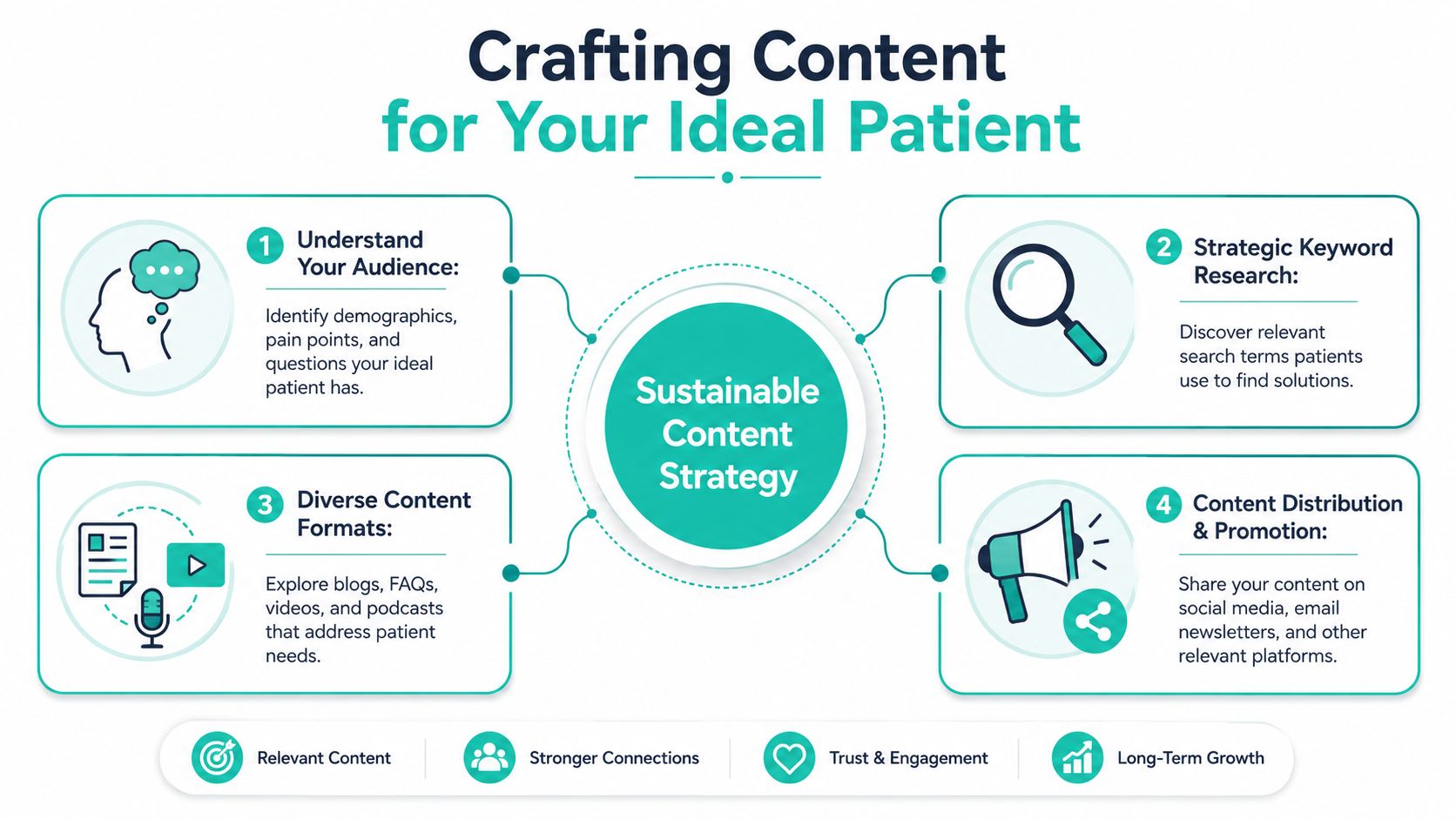
Most practice owners don't need “more content.” They need the right content. The difference is huge.
One optometrist I worked with had the same complaint I hear from many owners: “We know we should blog, but we have no idea what to write.” The problem wasn't creativity. The problem was framing. They were trying to act like a publisher instead of a practice.
The question library approach
The better approach is simple. Build a library of pages that answer the questions people already ask your front desk, intake team, or attorneys every week.
A strategic rule here is to align content with search intent and target low-competition longtail keywords. Content should satisfy what searchers want and place the most important information at the top of the page, as noted in this guidance on content relevance and intent alignment.
That optometrist stopped brainstorming abstract topics and started listing real patient questions:
Appointment questions: “How long does a thorough eye exam take?”
Decision questions: “What's the difference between glasses for computer use and reading?”
Anxiety questions: “What happens during a diabetic eye exam?”
Within a few months, their site felt more useful because it actually mirrored patient conversations.
What to publish first
Don't start with trend pieces. Start with pages tied to high-intent decisions.
A strong first batch often looks like this:
Top service FAQs: One page per major service question.
Expectation-setting pages: What happens before, during, and after a visit or treatment.
Comparison pages: Two options people often compare before booking.
Location-informed pages: Content that reflects practical local concerns, such as commute, scheduling, recovery, or seasonal needs.
Your opening matters more than most owners realize. Put the answer near the top. Don't make people scroll through your mission statement to find basic information.
One good content habit: write the first paragraph as if you're answering a question in the exam room, consultation office, or front desk lobby.
Formatting matters too. Short paragraphs, bullets, numbered steps, and simple visuals help readers scan. For more examples of practical practice marketing content, the Leaping Lemur Media blog is a useful reference point.
What doesn't work? Thin AI-generated pages that repeat the keyword and say nothing new. Google can usually distinguish between surface-level copy and content that helps a person make a decision.
Earn Local Authority Through Reviews and Links
Local SEO gets overcomplicated fast. For most practices, “authority” doesn't come from advanced tactics. It comes from the same things that build reputation offline: happy clients speaking well of you, community presence, and credible local mentions.
That's why I push back on the idea that local linkbuilding needs to look like a national SEO campaign. A dental office, law firm, or medspa usually gets more value from visible community involvement and solid local citations than from chasing obscure backlink schemes.
Reviews are trust signals with conversion value
Reviews affect both ranking visibility and decision-making. A profile with recent, thoughtful reviews gives searchers confidence before they visit your website.
The best review system is simple and consistent:
Ask at the right moment: Right after a positive visit, successful case milestone, or smooth checkout.
Use a repeatable process: Train front-desk staff or intake coordinators to ask the same way every time.
Make it easy: Send the link by text or email while the experience is still fresh.
Respond to every review: Thank positive reviewers and handle negative ones calmly and professionally.
Don't script fake enthusiasm. Ask plainly. “If today's visit was helpful, would you mind leaving us a Google review?” works better than awkward over-selling.
Local links beat complicated linkbuilding
A local business doesn't need hundreds of random backlinks. It needs relevant mentions from places Google can trust.
Good local link opportunities often include:
Professional associations: Dental societies, legal associations, medical directories, chamber listings.
Community organizations: Local charities, school sponsorships, nonprofit events, neighborhood guides.
Local press and newsletters: Stories about awards, new services, office openings, or community education events.
Referral partners: Complementary businesses with resource pages or local recommendation lists.
This is also where page-level improvement matters. If you earn attention but send it to a weak page, the value gets wasted. A practical move is to use a striking distance workflow. Identify queries in Google Search Console where your site averages positions 6 to 15, audit the page for missing subtopics, then strengthen it by frontloading the target keyword and adding semantically related phrases, as described in Orbit Media's striking distance process.
The easiest links to earn are usually tied to real relationships you already have in your city.
What doesn't work well for local practices? Buying low-quality directory links in bulk, publishing generic guest posts on unrelated websites, or chasing backlinks that never send a qualified visitor.
Measure What Matters for Practice Growth
A lot of SEO reporting creates false comfort. Rankings move. Traffic goes up a bit. A dashboard looks busy. Meanwhile, the owner still asks a fair question: did this bring in more calls, consultations, or appointments?
For a local practice, the answer usually lives in a short list of metrics tied to action. That's where your attention should go each month.
The numbers that deserve your attention
Start with the metrics closest to revenue:
Area
What to review
What it tells you
Google Business Profile
Calls, direction requests, website clicks
Whether local searchers are taking action directly from the profile
Website
Contact form submissions, appointment requests, phone clicks
Whether your pages convert trust into inquiries
Search Console
Impressions, clicks, page-level query data
Which topics are visible and where intent may be off
One particularly useful Search Console workflow is this: in the Performance tab, sort keywords by impressions from high to low to uncover terms you're showing up for but not fully optimizing around. Then sort by clicks from low to high to spot queries with weak engagement that may improve when content better matches search intent, according to this Search Console optimization walkthrough.
That process matters because not every ranking problem is a visibility problem. Sometimes Google is already testing your page, but searchers don't find the result compelling enough to click.
A simple monthly review rhythm
Most owners don't need a weekly reporting meeting. A monthly check-in is usually enough to spot movement and make good decisions.
Use this rhythm:
Check GBP actions: Are calls, direction clicks, and website visits moving in the right direction?
Review top service pages: Which pages generated inquiries, and which got traffic without leads?
Inspect Search Console opportunities: Look for high-impression, low-click queries tied to your core services.
Compare content performance: Which FAQ or blog pages brought people into the site, and did they move deeper?
If a page gets impressions but few clicks, the issue may be title relevance or weak intent match. If a page gets clicks but few conversions, the issue is often page clarity, offer strength, or contact friction.
SEO reporting should answer one question first: which search behaviors are turning into booked opportunities?
That's the filter busy practice owners need. Not more charts. Better decisions.
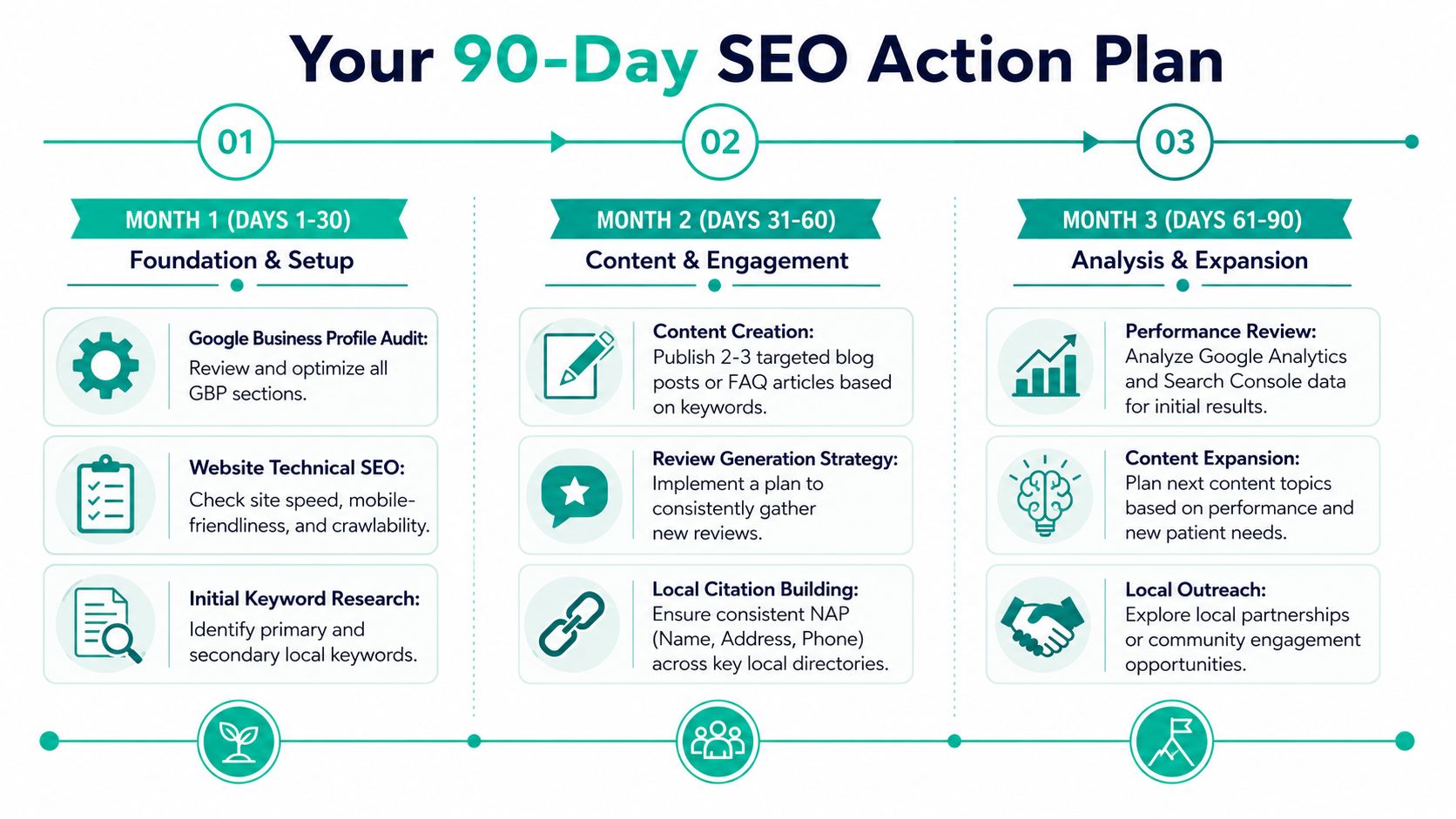
Your 90-Day SEO Action Plan
Good SEO plans fail when they ask owners to do too much at once. The better approach is staged. Build the essentials first, tighten the pages that matter most, then expand based on what the data shows.
If you're wondering how to improve Google rankings without letting the project sprawl, this timeline keeps the work practical.
Days 1 to 30
Use the first month to clean up what already exists.
Google Business Profile audit: Verify every field, category, service, attribute, photo, and business hour.
Homepage and top service page review: Make sure your main pages clearly describe who you help, where you're located, and what action to take next.
Technical cleanup: Confirm your site is secure with HTTPS, mobile-friendly, user-friendly, and free of obvious crawl or broken-link issues.
Tracking setup: Make sure you can see form submissions, phone clicks, and profile actions.
This first phase often delivers the fastest clarity because it removes confusion from your most visible digital assets.
Days 31 to 60
The second month is about relevance.
Build or improve the pages most likely to drive inquiries. That usually means your top service pages first, not a random batch of blog posts.
A strong month-two plan looks like this:
Priority
Action
Why it matters
High
Rewrite page titles so the service keyword appears early
Improves topical clarity and click appeal
High
Expand thin service pages with FAQs, process details, and trust elements
Helps both users and search engines understand page value
Medium
Publish a small set of question-based articles
Captures high-intent searches from undecided prospects
Medium
Add internal links from related pages
Helps users move deeper and supports crawlability
This is also a sensible point to decide whether you want in-house execution, a freelancer, or a partner. If you want an outside team to handle local SEO implementation, content support, and broader search visibility work, Leaping Lemur Media services outlines the types of support available.
Days 61 to 90
The third month is where momentum compounds, but only if the first two months were done well.
Focus on external trust and performance feedback.
Launch a review request process: Make it part of checkout, follow-up, or case completion.
Pursue local mention opportunities: Directories, associations, sponsorships, and community partnerships.
Review Search Console data: Look for pages sitting near page one or queries getting impressions without clicks.
Refresh underperforming content: Add missing explanations, examples, and clearer calls to action.
Decide what to scale: Double down on the service pages and topics that drive inquiries.
A lot of owners expect SEO to feel dramatic. In practice, the best local SEO work feels controlled. Cleaner profile data. Better service pages. More reviews. Better local mentions. Better measurement. Over time, that stack is what makes a practice easier to find and easier to choose.
A key advantage of a 90-day plan is focus. You don't need to win every search. You need to become the obvious option for the searches that signal real buying intent in your market.
If your practice wants a clearer SEO plan without the usual noise, Leaping Lemur Media helps businesses build marketing that reflects who they are, strengthens local search presence, and supports long-term growth with intentional strategy.