
You're probably in the same spot a lot of practice owners hit. The website was rebuilt, the ads got the “boost” treatment, the coordinator is juggling social posts and reviews, and the calendar still has holes that don't make sense. Growth feels busy, but the marketing function doesn't feel under control.
That's usually the moment a fractional marketing team starts sounding less like a trend and more like relief. For dental, eye care, medspa, and law practices, the problem usually isn't a lack of effort. It's that no one senior is tying reputation, local search visibility, lead quality, and booked consults into one accountable system.
Table of Contents
- The Moment a Practice Realizes It Needs Marketing Help
- What a Fractional Marketing Team Is
- What It Costs and How Pricing Actually Works
- When a Fractional Team Beats Hiring In-House
- How to Evaluate and Hire the Right Fractional Team
- KPIs and the First 30 Days of an Engagement
- What This Looks Like for Dentists, Medspas, Eye Doctors, and Small Businesses
- Making the Decision and Starting the Search
The Moment a Practice Realizes It Needs Marketing Help
The owner has already tried the obvious fixes. The website got redesigned, the local ads got turned on, the front desk was told to ask for reviews, and a part-time marketing person was brought in to “keep things moving.” None of it fixed the deeper issue, because the practice didn't have a real marketing system, it had a collection of tasks.
That's when the calendar tells the truth. New patient inquiries arrive, but not in a steady pattern. Some channels look active, but no one can explain which ones lead to booked visits or high-value cases. The P&L gets tighter, and marketing still feels like a cost center instead of a growth engine.
A fractional marketing team is what many owners start looking for at that point, because it changes the shape of the solution. The idea isn't to buy another tool or hire one more generalist. It's to bring in senior strategy and coordinated execution without building a full-time department too early.
Practical rule: If your practice can't answer which marketing activities create trust, booked appointments, and revenue, you don't need more activity. You need leadership.
For local-service practices, that matters even more than raw lead volume. A medspa can generate inquiries and still struggle if consultation quality is weak. A dental practice can buy clicks and still lose if review management, recall, and local trust aren't handled properly. A law firm can get traffic and still miss the point if the inbound calls aren't qualified.
This is why the model keeps coming up in owner conversations. It isn't because it sounds modern. It's because it fits the moment when a practice has outgrown casual marketing but isn't ready to carry the cost and risk of a full internal department.
What a Fractional Marketing Team Is
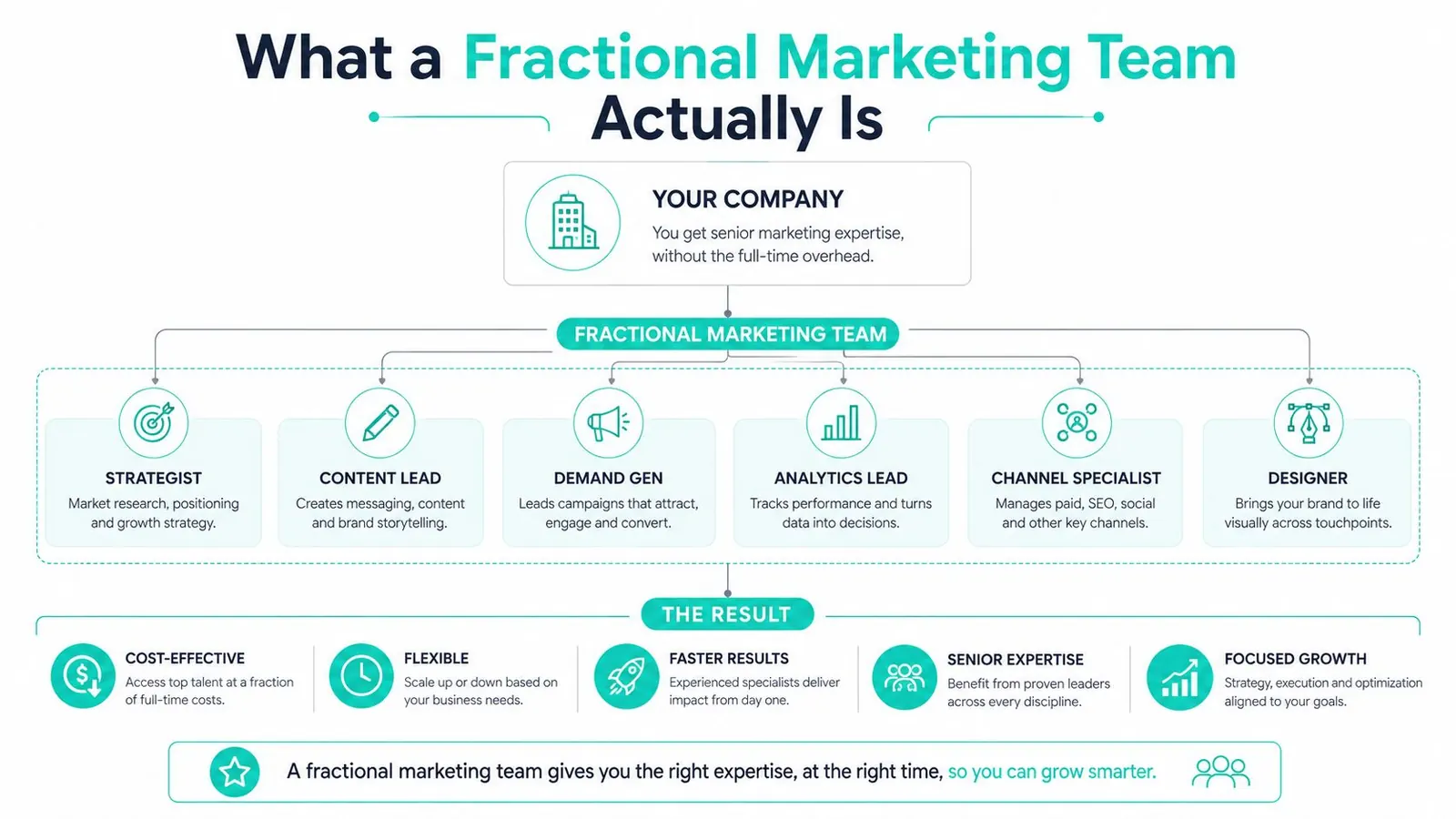
A fractional marketing team is a small group of marketing professionals who work part-time or on retainer, but operate like an embedded department rather than a vendor. The best definition is simple: they give you the strategy and execution capacity of an in-house team without forcing you to pay for full-time overhead you don't yet need. That is what people mean by “partnership over transaction.”
For a trust-dependent practice, that setup matters. A dental office, medspa, eye care clinic, or law firm does not win on raw lead volume alone. It wins when the team can protect reputation, manage reviews, keep local visibility strong, and turn interest into booked appointments without damaging trust.
A specialist medical practice might share a fractional anesthesiologist across several clinics. The clinician isn't “less real” because they're shared; they're just deployed more efficiently. Marketing works the same way when a business needs senior judgment, but not a whole bench of permanent employees.
The four roles that usually matter most
The center of the pod is usually a fractional CMO or fractional marketing director. That person sets direction, prioritizes channels, decides what gets measured, and keeps the team focused on business outcomes instead of vanity activity. In many practices, that is the role the owner has been missing.
Around that leader, you usually see three execution layers. A content and SEO specialist handles educational content, service-page optimization, and local discoverability. A paid media or channel expert manages campaigns where the practice is actively buying visibility. A project manager keeps timelines, approvals, and deliverables from falling apart.
How the engagement should feel
The team should feel like an extension of the practice, not an outside shop tossing over a monthly report. The owner should expect regular communication, clear ownership, and direct accountability. If the relationship feels like a one-off campaign service, it is not really fractional, it is just outsourced.
If you are comparing team models, it helps to review the broader service structure too. You can see how a practice-oriented offering is organized on Leaping Lemur Media's offerings page.
What It Costs and How Pricing Actually Works
The pricing conversation gets messy fast when people try to compare a fractional team to a salary. That comparison is too shallow. A better comparison is the total cost of getting senior strategy, execution, tooling, management, recruiting, and continuity from a real team.
Typical monthly retainer ranges
| Role | Typical Monthly Cost | Time Commitment |
|---|---|---|
| Fractional CMO | $8,000–$15,000 | 10–15 hours per week |
| Fractional Marketing Director | $6,000–$10,000 | Varies by scope |
| Specialist role, such as channel expert or project manager | $3,000–$8,000 | Varies by scope |
Those figures stack quickly, which is why a full fractional marketing team commonly lands in the $15,000–$40,000 per month range. Independent guidance also notes that the model typically saves about 40%–60% versus equivalent full-time hires once benefits and overhead are included, and that many engagements last 1 to 2 years (Prose Media's fractional marketing team FAQ).
That's also why pricing is usually built as a monthly retainer, not hourly billing. You're paying for ownership, continuity, and judgment, not just logged time. In practice, that makes the budget easier to defend because the team's job is to move commercial outcomes, not rack up activity.
For a broader pricing comparison, compare plans to see how retainer-based marketing support is often positioned against other service levels. The useful question isn't whether the number looks low or high in isolation, it's whether the scope matches the stage of the practice.
What the ranges mean in real life
A fractional CMO at the lower end can be enough when strategy is missing but the execution load is still modest. A larger pod makes sense when the practice needs content, SEO, paid media, and reporting to work together. The wrong move is buying too much capacity too early, or too little expertise and expecting it to behave like leadership.
Budget rule: If the team can't tell you what business outcome the retainer is meant to change, don't approve the retainer.
When a Fractional Team Beats Hiring In-House
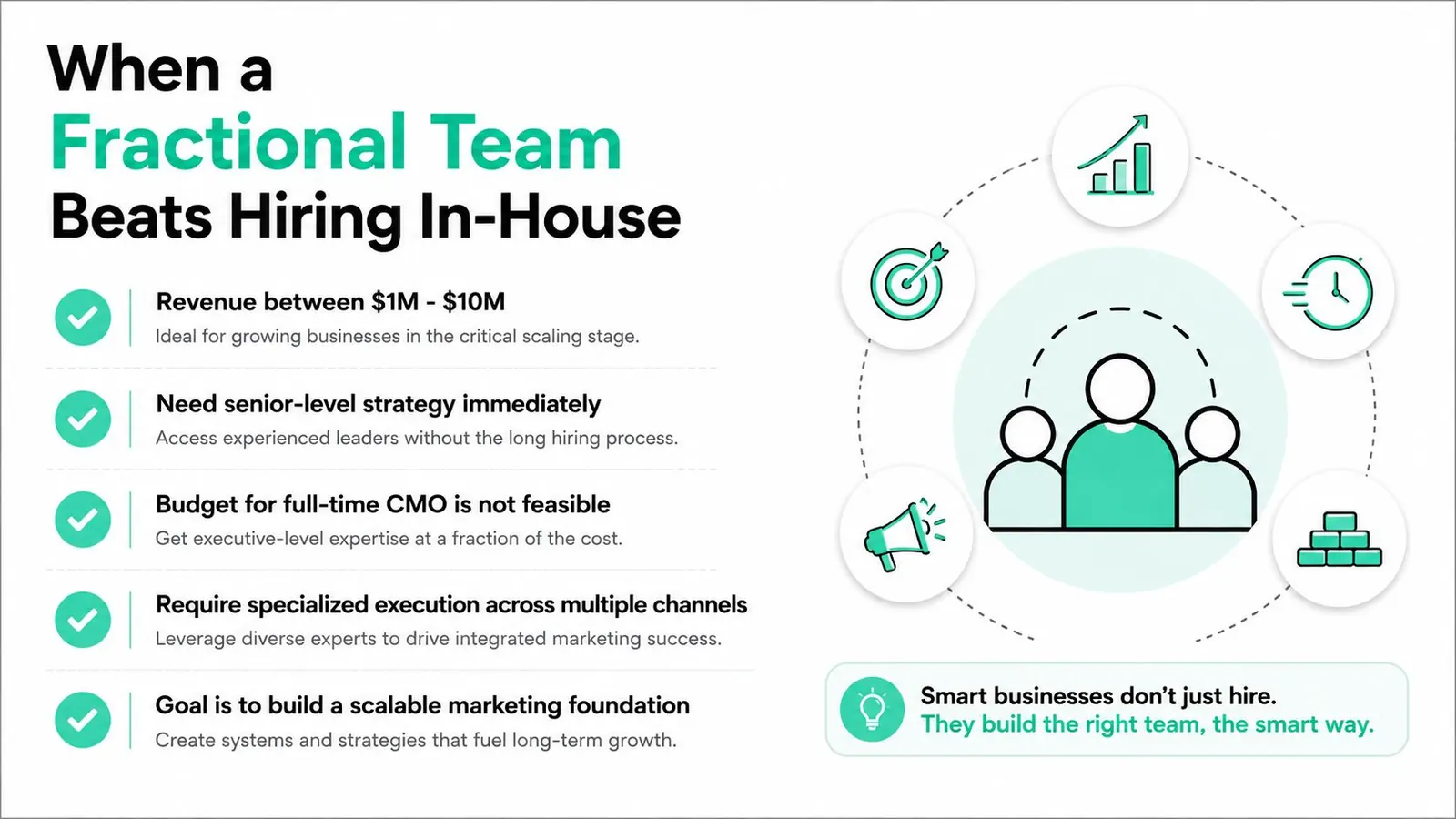
The fractional model wins when the practice needs senior judgment faster than it can realistically recruit it. It also wins when the work is cross-functional, because isolated hires often create new bottlenecks instead of fixing the original one.
Where the model fits best
A fractional team is usually the right move for practices that have enough revenue to justify senior marketing leadership, but not enough internal complexity to justify a permanent department. It also fits businesses in transition, stalled growth, or channel confusion, where the need is a reset in priorities and accountability. Multi-location and multi-service practices benefit too, because coordination matters more than one-off campaign volume.
Where it's the wrong move
It's a poor fit for very early-stage businesses that still need basic market fit, because no team structure can fix a product or offer that hasn't been validated. It's also the wrong move when the issue is operations or sales follow-up, not marketing. In heavily regulated environments, a practice may need more internal immersion than a fractional setup can provide if compliance is the dominant daily burden.
For a practical hiring lens, think in three questions:
- Do we need senior strategy now? If yes, fractional is worth serious consideration.
- Do we need one person or a coordinated pod? If the answer is multiple functions at once, a team is better than a solo hire.
- Can we support an embedded partner? If the leadership team won't share information and decision-making, the model will frustrate everyone.
The most common mistake is overemphasizing headcount and underestimating coordination. A single in-house hire can look simpler on paper, but if they can't cover strategy, execution, and measurement, you'll still end up patching the gaps with vendors.
How to Evaluate and Hire the Right Fractional Team
Hiring a fractional team should feel like bringing on a senior partner, not buying a downloadable service. The goal is to test whether the team can diagnose the business problem, design a plan around it, and stay honest when the numbers don't cooperate.
The four phases that keep you out of trouble
Start by defining the one business outcome you care about most in the next 12 months. That could be booked consults, better lead quality, stronger review signals, or more predictable pipeline. If the team starts with channels instead of outcomes, they're rushing you into tactics.
Next, shortlist two or three teams or leaders with category experience. Practice marketing is not generic marketing, and local trust dynamics matter. Read the team's story on Leaping Lemur Media's about page or any equivalent team bio carefully, because category fluency shows up in what they emphasize.
Then run a paid 30-day diagnostic or pilot. Free strategy calls are usually too shallow to reveal how the team thinks under pressure. A paid diagnostic forces them to show how they audit, prioritize, and communicate.
Finally, pressure-test chemistry. Ask what happens when numbers miss, scope expands, or the front desk isn't following through. That's where maturity shows.
Ten questions every owner should ask
-
Who does the work?
Don't accept a polished pitch if juniors or subcontractors are doing the delivery. -
What are the first 90 days supposed to change?
You need a plan, not a vague promise. -
Which KPIs will you own?
If they can't answer cleanly, they're not ready. -
How do you report results?
Look for a rhythm, not random updates. -
What happens if results stall?
Good teams have an escalation path. -
How do you handle negative feedback or bad news?
If they dodge hard questions, walk away. -
What category experience do you have with practices like mine?
Local-service marketing is its own world. -
How do you coordinate strategy and execution?
If those live in separate silos, things break. -
What data access do you need from us?
Good teams know what they need early. -
What does success look like in writing?
If they won't define it, don't sign it.
Red flag: Vague case studies, no dashboard access, and no written success metrics are enough to end the conversation immediately.
KPIs and the First 30 Days of an Engagement
A lot of practices say they want “more marketing,” when what they need is better signal. The right KPI stack makes that clear fast. It also keeps everyone from celebrating activity that doesn't change the business.
The three KPI buckets that matter
The highest-value framework starts with business outcomes, such as marketing-sourced pipeline or revenue, CAC by channel, conversion rates across funnel stages, and at least one payback or profitability metric (Breakthrough3x's fractional CMO KPI framework). Those numbers tell you whether marketing is creating value, not just attention.
The second bucket is leading indicators. That includes sales-acceptance rate, funnel conversion, and demo or consultation quality. Those metrics show whether the market is responding well before revenue fully shows up.
The third bucket is operating-health metrics, such as CRM hygiene, reporting cadence, and decision velocity. These tell you whether the team can keep the system running without chaos.
Operating rule: A rise in volume means nothing if quality, conversion, or speed to close is getting worse.
For attribution work, a practical resource is Trackingplan's marketing attribution guide. The bigger point is simple, attribution only matters if it helps you separate weak targeting from weak messaging or downstream sales friction.
What the first 30 days should look like
Days 1 to 10 are for access, data plumbing, and goal alignment. The team should review accounts, map the funnel, and identify anything preventing clean reporting.
Days 11 to 20 are for audit and quick wins. That can mean tightening calls to action, fixing tracking gaps, cleaning up landing pages, or improving response processes.
Days 21 to 30 should end with a 90-day roadmap presentation. That roadmap should connect the work to the KPI stack, not just list deliverables.
If the engagement is healthy, the reporting rhythm should be predictable. The 30-day check-in is about setup and signal. The 60-day update should show whether the first changes are producing better lead quality or better operational flow. By 90 days, the team should be able to tell you what's working, what isn't, and what needs to be cut.
What This Looks Like for Dentists, Medspas, Eye Doctors, and Small Businesses
A fractional marketing team should never look identical from one practice to the next. A dental office, a medspa, and an eye care clinic all depend on trust, but they earn that trust in different ways. For local-service practices, the job is usually less about pushing more leads into the pipeline and more about making the practice easier to trust, easier to choose, and easier to recommend.
Dentists
A dental practice usually needs a first hire focused on local SEO, review management, and recall reactivation. Those are the levers that move the business forward because they shape how patients find the office, what they read before booking, and whether past patients come back. The metric that proves traction is not raw traffic. It is whether trust signals improve and more people move from search to booked care. The most common early mistake is chasing generic content while ignoring the patient experience that drives reviews and referrals.
Medspas
A medspa usually needs a pod led by a strategist with strong conversion instincts, plus someone who can handle treatment pages and creative. That setup works because medspa marketing lives or dies on how well the message turns attention into consults. The metric that matters is booking funnel speed, because inquiries without booked consults do not pay the bills. The early mistake is overpolished branding with weak follow-up and thin service-page persuasion.
Eye doctors
Eye care practices benefit from condition-specific education, optical retail support, and community visibility. A strong first hire often starts with content and local discovery, then builds around community partnerships. The metric that proves traction is whether the practice becomes easier to find and easier to remember for specific needs. The common mistake is treating eye care like a generic healthcare brand instead of a community-based service business.
Small businesses more broadly
For small businesses, the first fractional hire is often a strategist who can sharpen positioning and connect founder-led content to a real sales process. That matters when the owner needs marketing that supports sales instead of creating noise. The metric that matters is the lead-to-close feedback loop, because the owner needs to know where good prospects come from and why they convert. The typical mistake is trying to scale channels before the message is clear.
For more perspective on how category fit changes the work, the insights in Leaping Lemur Media's journal reinforce the same point, practices grow faster when the story, the offer, and the community context line up.
Frequently Asked Questions
What is a fractional marketing department?
A fractional marketing department is a small group of marketing professionals who work part-time or on retainer but operate like an embedded in-house team rather than an outside vendor. It typically includes a fractional CMO or director, a content and SEO specialist, a paid media expert, and a project manager, all coordinated around one accountable strategy.
What fractional marketing team services are usually included?
Most pods cover strategy and leadership from a fractional CMO or director, content and SEO work, paid media management, and project coordination. The exact mix depends on the practice's needs, but the goal is coordinated execution across channels rather than isolated, one-off tasks handled by separate vendors.
How does fractional digital marketing differ from hiring a full-time employee?
Fractional digital marketing gives you senior strategy, execution, tooling, and continuity through a part-time retainer instead of a single full-time salary. Full fractional teams commonly run $15,000 to $40,000 per month, built around ownership of outcomes rather than hourly billing, which fits practices that need leadership faster than they can recruit it in-house.
What kind of fractional marketing support should a growing practice expect?
Expect regular communication, clear ownership of deliverables, and direct accountability for business outcomes like booked consults or lead quality, not just a monthly report. A healthy engagement includes a defined KPI stack, a 30-60-90 day reporting rhythm, and a team that explains what's working, what isn't, and what needs to change.
Making the Decision and Starting the Search
The case for a fractional marketing team is straightforward. If your practice needs senior marketing judgment, coordinated execution, and a tighter link between marketing activity and trust-based growth, this model usually beats improvising with scattered vendors or overcommitting to a full-time hire too early.
Start by writing down the one business outcome you need most in the next 12 months. Then list three local competitors whose marketing you respect, and book one 30-minute call with a fractional team that has real category experience this week. The biggest mistake is choosing on price or pitch deck instead of diagnostic depth and chemistry. Good fractional partners don't just show up with ideas, they show up as operators who build with you.
Leaping Lemur Media helps practices build marketing that sounds like them, reflects their community, and supports real growth instead of busywork. If you're ready for a more thoughtful approach to strategy, trust, and execution, visit Leaping Lemur Media and start a conversation about what your practice needs next.