A typical website converts only 2.35% of visitors, while landing pages reach a 6.6% median across industries, and the strongest pages reach 11.5% or more according to a 2026 analysis of 46 billion sessions (GreetNow). For a dentist, medspa, eye doctor, or law firm, that gap matters more than another round of traffic buying. Your website may not have a traffic problem. It may be sending motivated prospects to pages that make them work too hard to understand, trust, and contact you.
Conversion-rate optimization, or CRO, is the practical discipline of removing those obstacles. It combines message clarity, page relevance, speed, form design, measurement, testing, and follow-up. The work isn't about changing button colors at random. It's about finding where prospective patients or clients hesitate, then making the next action obvious.
Table of Contents
- Understanding the Conversion Rate Gap
- Auditing Your Current Funnel and Analytics
- Crafting Hypotheses and Running A/B Tests
- Optimizing Landing Pages, Forms, and Trust Signals
- Improving Page Speed and Traffic Quality
- Measuring, Iterating, and Building Follow-Up Flows
Understanding the Conversion Rate Gap
A site-wide conversion rate can sit near the 2.35% global average, while landing pages show a 6.6% median conversion rate. The top 10% of websites convert 3 to 5 times better than average, and the strongest landing pages reach 11.5% or more, according to the cited benchmark. The important comparison for a dentist, medspa, or law firm is not a generic industry average. It is the gap between an unfocused website and a page built for one high-intent service.
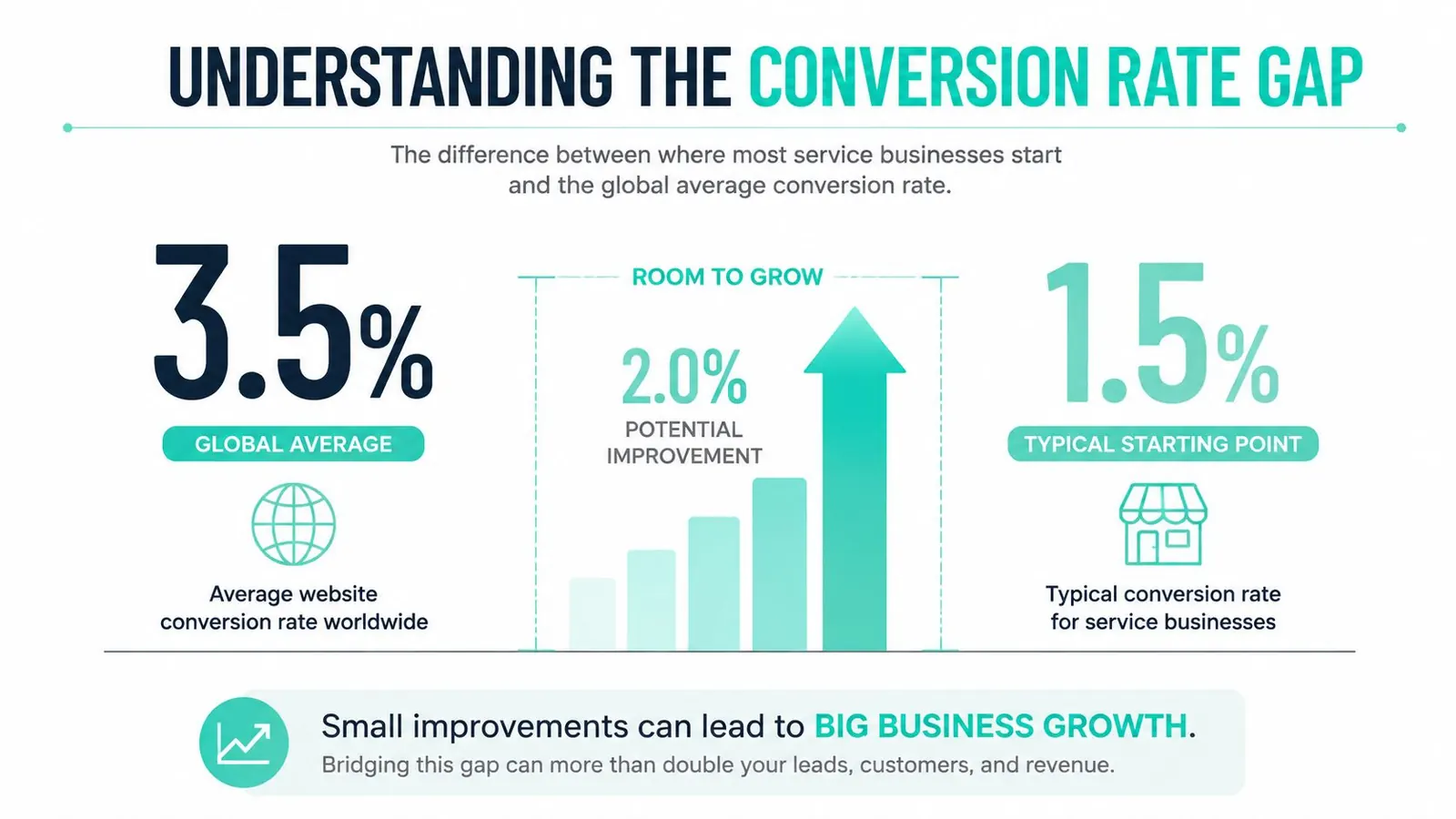
These figures are benchmarks, not promises. Traffic source, location, offer, service complexity, reputation, and booking process all affect results. They do reveal why a whole-domain average can conceal a valuable opportunity on one focused entry page.
Why site-wide averages mislead
A site-wide rate combines visitors with different levels of intent. Someone reading about tooth sensitivity is not comparable to someone seeking emergency dental care. A medspa visitor browsing treatment photos is at a different stage from someone viewing a consultation page. A law firm homepage may serve people researching practice areas, checking credentials, or looking for a phone number.
That blended figure can make a weak entry point appear acceptable. A paid-search visitor sent to a generic homepage must find the relevant service, assess local credibility, understand the process, and locate the contact option. A focused landing page can present those answers in a deliberate order.
Measure conversion rate by page and intent, not only across the domain. Record the entry page, campaign or referral source, requested service, and completed action. A booking page, consultation page, or urgent-service page should have its own benchmark and diagnosis.
What high-performing entry pages do differently
A strong service-business landing page makes four decisions easy:
- Relevance: The headline matches the service or problem behind the visit.
- Clarity: The visitor understands the next step without translating industry language.
- Confidence: Reviews, credentials, team details, policies, and location information reduce perceived risk.
- Action: One primary CTA, such as “Book a consultation” or “Request an appointment,” gives the page a clear purpose.
The practical objective is to send the right audience to a page designed for its intent. Use the principles in this guide to improve website conversion rates, then compare each page's message, friction, and completed actions against its actual traffic source.
Auditing Your Current Funnel and Analytics
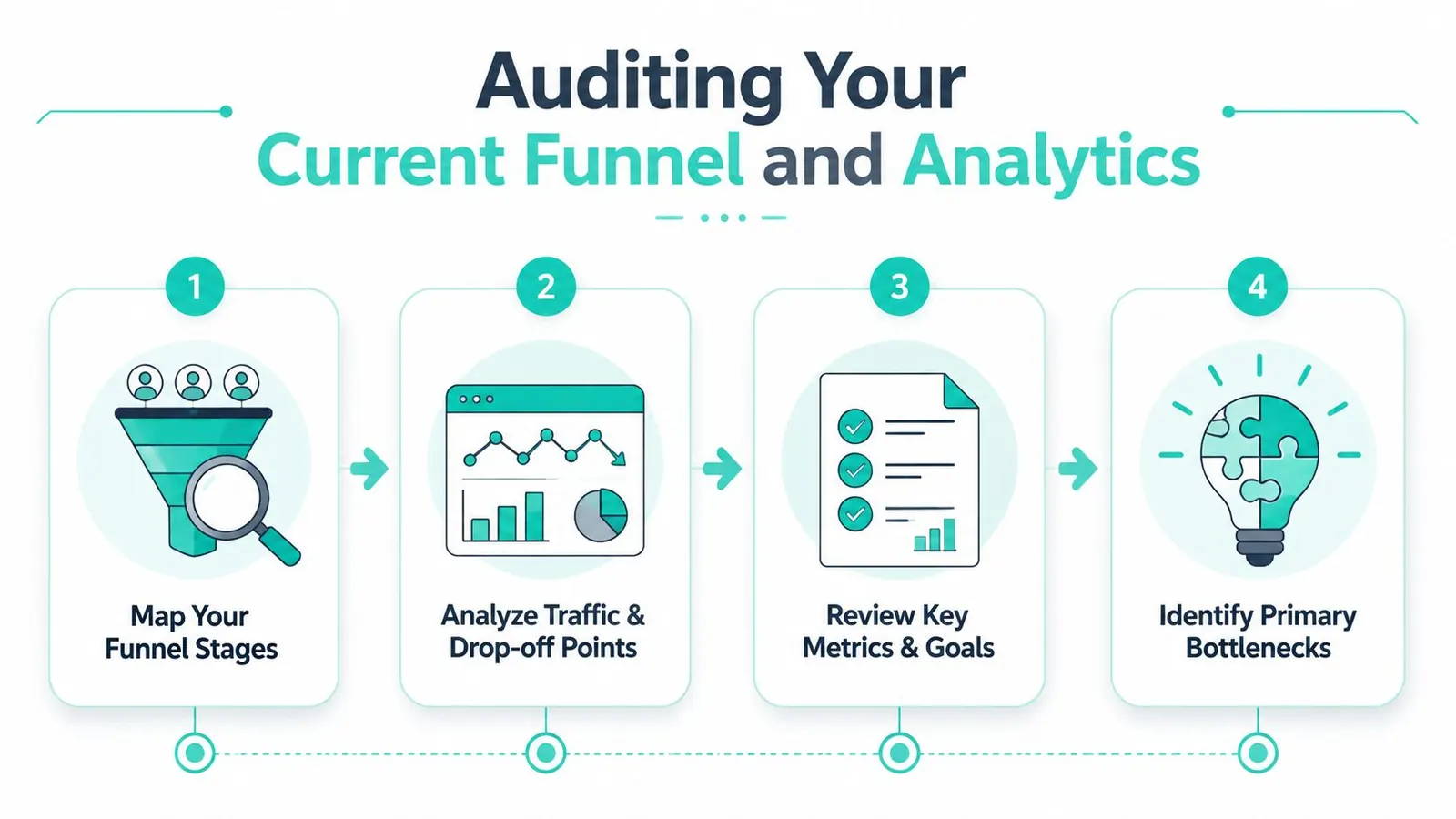
Before changing copy or design, trace the journey from first visit to completed inquiry. A service-business funnel might begin with a local search, paid ad, referral, email, or AI assistant recommendation. It can continue through a service page, pricing or insurance information, a booking tool, a phone call, a form submission, and an appointment confirmation.
Map the path before judging performance
Start with a simple journey map. List the pages and actions a prospect encounters, then identify the intended next step at each stage.
| Funnel checkpoint | What to inspect | Typical service-business risk |
|---|---|---|
| Entry page | Search intent, headline, CTA visibility | A generic homepage receives highly specific traffic |
| Service page | Benefits, process, proof, objections | The visitor can't tell whether the service fits |
| Contact or booking step | Fields, errors, mobile usability | The form asks for too much before trust exists |
| Confirmation | Expectations and follow-up | The prospect doesn't know what happens next |
A dental practice may lose patients between a treatment page and the contact form because the page answers clinical questions but not scheduling questions. A medspa may create hesitation around consultation pricing, preparation, or results. A law firm may lose qualified prospects inside an intake form that asks for sensitive information before establishing enough confidence.
Track micro-conversions, not only submissions
A completed appointment is the primary outcome, but it isn't the only useful signal. Configure analytics to capture form starts, field errors, form abandonment, phone-number clicks, click-to-call actions, chat initiations, booking-tool launches, and confirmation-page visits. These events reveal where intent exists but completion fails.
Review the data by device, landing page, traffic source, service, and location. A form can appear healthy overall while mobile visitors repeatedly abandon it. A phone-click event can show that visitors want immediate help, even if the phone system doesn't record a completed conversation.
Audit rule: Don't label a page a failure until you know whether the problem is poor traffic quality, weak message match, page friction, or a broken measurement setup.
Check analytics against reality. Call tracking, CRM records, scheduling software, and form notifications should agree closely enough to support decisions. If a booking tool sends visitors to an untracked domain, your dashboard may report a visit without the eventual conversion. The Leaping Lemur Media services page offers another reference point for evaluating how marketing and conversion work should connect across a service-business journey.
Crafting Hypotheses and Running A/B Tests
An A/B test should answer a business question tied to a measurable problem. Start with an observed issue, identify its likely cause, propose one focused change, and define the metric that should respond. This approach keeps a redesign from becoming a collection of opinions.
Use a clear hypothesis:
If we change X, then Y will improve because Z.
For example, if a dental inquiry form removes fields that are not needed for the first response, completion may rise because prospective patients can ask for help without preparing insurance details. Track completed inquiries as the primary outcome. Form starts and field abandonment show whether the change reduced friction or merely shifted it.
Prioritize evidence over clever ideas
A dataset of 2,408 A/B tests found that only 17.4% produced a statistically significant winning variant, while 8.4% produced a significant losing variant and 74.2% were inconclusive or showed no detectable difference (Visionary Marketing). Among winning tests, the average lift was 8.4%, with a 6.1% median lift. A dramatic redesign is therefore an unlikely default outcome.
Rank ideas by likely impact, confidence, and implementation effort. A broken booking button outranks a headline refinement. A mobile form that cannot be completed outranks a color preference. A vague promise on a law firm practice page deserves attention before a small spacing adjustment.
For dentists, medspas, and law firms, the strongest test ideas usually come from a specific service journey. Compare the page promise with the action visitors are expected to take, then test the point where uncertainty or effort is highest.
Respect the sample-size problem
The same dataset estimated a median of 14,800 sessions per variation to detect a 5% minimum detectable effect on a 3% baseline conversion rate, at 95% confidence and 80% power. That volume is beyond the reach of many small practices for sensitive website experiments. Use larger changes, longer observation periods, qualitative feedback, and qualified appointment outcomes when traffic cannot support a narrow test (Visionary Marketing).
Do not stop a test as soon as one version leads. Set the audience, primary metric, duration, and stopping rule before launch. Test one major change at a time when you need to understand its cause. If traffic is limited, compare meaningful variations across an agreed period rather than treating an early lead as proof.
Three practical tests for service businesses
A simplified contact form versus a longer intake form tests friction against qualification. If the shorter form creates more inquiries but fewer suitable leads, the trade-off may fail financially. Ask only for information needed for the first response, then qualify during follow-up.
A single primary CTA versus competing choices tests decision clarity. A law firm could compare one “Schedule a consultation” action with phone, email, download, and chat options. Judge the result by qualified consultations, not clicks alone.
Trust-badge placement tests reassurance near commitment. Keep privacy language, identity information, and security explanations relevant to the action. A badge cannot resolve unclear terms or a form that feels unsafe.
A structured testing practice turns inconclusive results into usable learning. The Leaping Lemur Media journal provides further reading for continued CRO and marketing work.
Optimizing Landing Pages, Forms, and Trust Signals
The page closest to a visitor's decision usually deserves the most attention. For a dentist, that may be an implant consultation page. For a medspa, it may be a treatment-specific booking page. For a law firm, it may be a practice-area page that leads to an intake conversation. Site-wide averages can hide a much stronger opportunity on these focused landing pages.
Start with the first screen. State who the service is for, what outcome the practice provides, where it operates, and what the visitor should do next. “Schedule a consultation for dental implants in [location]” gives clearer direction than a broad promise about exceptional care.
Make the copy easy to process
Pages written at a 5th to 7th grade reading level converted at 11.1%, compared with 5.3% for college-level copy, a 109% advantage in the cited Unbounce benchmark data (SHNO). Clear language still needs specificity. Replace “care for gum disease” with a familiar service term, then explain what happens in plain language.
Organize the page around questions a prospect already has:
- What problem does this service address?
- Who provides it?
- What happens during the first visit?
- What should the visitor prepare?
- How can they book or ask a question?
Reduce form friction without losing useful information
A dental practice may find that requesting insurance verification before an initial conversation discourages suitable patients. Ask for information needed to respond, then handle that qualification during follow-up. A medspa can place treatment-specific before-and-after evidence beside the CTA when those visuals reduce uncertainty about expected results. A law firm can split a demanding intake process into two stages, collecting basic contact details first and sensitive case information after the prospect knows who will respond.
These changes require validation against lead quality, response time, and completed appointments. A shorter form may generate more inquiries while increasing unqualified submissions and administrative work. Judge the form by profitable appointments, not volume alone.
If the current form builder limits branding or usability, review options that replace Google Forms with Kiwiform. On mobile, use clear labels, large tap targets, inline validation, useful error messages, and autofill support. The Leaping Lemur Media contact page shows the direct path a visitor should find when ready to start a conversation.
Put reassurance beside the action
Trust signals work best beside the point of uncertainty. Include real reviews, practitioner or attorney identity, credentials, location, privacy language, response expectations, and relevant security or payment information. 12% of people abandon an online checkout when trust badges are absent, according to independent form research (Insiteful).
For sensitive services, explain what happens after submission. “A member of our team will contact you about scheduling” removes ambiguity. Avoid fabricated testimonials, vague claims, and badges that do not explain anything. Reassurance should answer a specific concern and support the next action.
Improving Page Speed and Traffic Quality
Page speed can erase demand before a prospective patient, client, or customer sees the headline. One benchmark reported a 3.05% conversion rate for pages loading in 1 second, compared with 0.60% at 5 seconds, an approximate 80.3% decline from the 1-second baseline (CRO Mastermind).
Another analysis found that more than 3 seconds of load time causes just over half of visitors to leave, and referenced Google's recommendation to keep page load time under 3 seconds (Pingdom). For a dentist, medspa, or law firm, that delay can remove a high-intent visitor before they see proof, pricing context, or the booking option.
Set a speed target in seconds
Measure the landing pages that receive traffic, not only the homepage. Test mobile conditions on paid-search and local-search pages, then identify what delays the main content. Oversized images, unnecessary scripts, booking widgets, and chat tools are common causes. Compress images, remove scripts that do not support a business goal, and defer assets that are not needed immediately.
Speed work involves trade-offs. Removing every third-party tool may improve load time while eliminating call tracking, scheduling, or attribution. Compare each tool's business value with its performance cost. A lower-impact implementation, delayed loading, or a replacement may preserve the function without accepting the full delay.
Separate traffic quality from page quality
A site-wide conversion rate can hide a large gap between average pages and focused landing pages. Traffic source changes the visitor's intent and the page's realistic opportunity. The cited benchmark data reports 19.3% average conversion for email traffic, the strongest source in that comparison and nearly double paid search performance (SHNO). Email recipients may already know the practice, while paid-search visitors may be comparing providers or using broader terms.
Report organic search, paid search, referrals, email, social, direct visits, and AI assistants separately. Recent CRO guidance recommends tracking AI referral conversions separately, since assistants may send fewer visitors with stronger intent (Digital Applied). Match the landing-page headline and proof to the question that brought each audience there.
If engagement is weak, start by diagnosing high bounce rate causes instead of assuming the design needs cosmetic work. A bounce may indicate poor message match, slow delivery, irrelevant traffic, or a visitor who found the needed information without completing the tracked action. Separate those cases before changing the page.
Measuring, Iterating, and Building Follow-Up Flows
CRO becomes valuable when the practice can repeat it. Maintain a dashboard that separates conversion rate by traffic source, landing page, device, service, and action. Add form-start rate, field abandonment, phone clicks, booking completion, qualified-lead rate, and time-to-conversion where the systems support them.
A missed conversion isn't always a lost prospect. Someone may compare providers, wait for a spouse, need insurance information, or postpone a legal consultation. Follow-up should respect consent and the service category. Use confirmation emails, appointment reminders, unanswered-call workflows, and helpful responses to incomplete inquiries. Keep the message tied to the original action instead of sending a generic promotional sequence.
Turn every test into institutional knowledge
After an experiment ends, record the hypothesis, audience, primary metric, result, confidence level, implementation decision, and what the team learned about visitor intent. An inconclusive result may mean the change was irrelevant, the audience was too mixed, the measurement failed, or the test lacked sufficient volume. It still becomes useful when documented accurately.
Winning changes also need scrutiny. A benchmark of completed A/B tests found that 60% of winners delivered under 20% lift, 84% came in under 50%, and only 7.8% showed 100% or greater improvement (Convert). Unusually large results should prompt instrumentation checks, segment review, and repeat validation before a permanent rollout.
Sustainable CRO: A series of credible, modest improvements is more dependable than a dramatic result you can't reproduce.
Set a monthly review for funnel health and a regular pipeline of high-confidence tests. Revisit pages when services, pricing, staff, booking systems, or advertising promises change. Leaping Lemur Media can be one option for practices that need website audits, conversion tracking, landing-page work, and marketing support connected to inquiries and bookings. The operating principle remains the same, whether your team handles the work internally or uses an agency: measure the journey, remove the clearest friction, validate meaningful changes, and follow up with people who weren't ready on the first visit.
Leaping Lemur Media helps dentists, eye doctors, medspas, law firms, and other service businesses connect fast websites, clear messaging, conversion tracking, and patient or client journeys that lead to real inquiries. Visit Leaping Lemur Media to discuss an audit and a practical plan for improving the pages and actions that matter most to your practice.