Most advice on how to shoot a commercial starts in the wrong place. It tells you to chase cinematic lighting, fancy camera moves, and polished visuals before you've decided what the commercial is supposed to do for the business. That's backwards for a dentist, medspa, eye doctor, or law firm, because a commercial is only useful if it builds the right feeling, on the right platform, for the right audience.
Commercial production has changed because distribution changed. A review of commercial length notes that 30-second TV spots dominated in 2017, the average commercial in the 1960s was almost 60 seconds, and digital environments pushed ads down to under 15 seconds, with 6-second digital ads marking a clear milestone in commercial production history (Moonb.io on average commercial length). That shift matters because today's shoot is usually about building a modular asset, not one perfect broadcast spot.
For service businesses, that changes the creative brief. A good commercial doesn't just look expensive, it feels trustworthy, clear, and easy to cut into different lengths and formats. If you need a deeper perspective on positioning and content strategy, Leaping Lemur Media's journal is a useful place to look at how marketing decisions connect to practice growth.
Table of Contents
- Why Most Commercials Fail Before the Camera Rolls
- Planning Your Commercial with a Gated Workflow
- Budgeting and Hiring the Right Crew for Your Goals
- Choosing Shots That Build Trust and Drive Action
- Running a Smooth Production Day on Set
- Post-Production and Delivering for Every Platform
- Common Mistakes That Sink Small Business Commercials
Why Most Commercials Fail Before the Camera Rolls
A commercial usually fails long before anyone touches a camera. The mistake is assuming the shoot day is the hard part, when the actual advantage comes from deciding what the video needs to accomplish, where it will run, and how much flexibility the edit team needs after the shoot. If those decisions are fuzzy, the final video tends to look nice but work poorly.
Strategy beats spectacle
For service businesses, the goal is often trust, authority, or conversion, not visual showmanship. A dramatic low angle might feel powerful, but if a dentist needs patients to feel calm and safe, that same choice can work against the message. The strongest commercial is usually the one that makes the offer obvious fast, then gives the viewer a reason to believe it.
That's why modern commercial production is built around platform fit. A TV-first mindset used to justify a single polished spot, but digital distribution rewards short, adaptable assets that can be reformatted for mobile, social, and paid placement. The work is less about producing one perfect film and more about creating a package of usable footage that can be cut into multiple versions.
Practical rule: if the business goal is clarity, don't let “cinematic” become the creative brief.
The industry numbers show how big this ecosystem is. Commercial production companies in the U.S. generated $45 billion in revenue in 2022, employed 1.2 million people in the U.S. that same year, and the global commercial production market reached $195 billion in 2023, with projections to $260 billion by 2030 (WorldMetrics commercial production statistics). That scale is a reminder that a commercial shoot isn't a small creative gamble, it's a business decision with measurable cost and operational consequences.
Modularity is the new baseline
A modern shoot should be planned like source material for several assets. One hero scene might become a six-second cut, a 15-second ad, a website header video, and a longer testimonial edit. If the footage isn't captured with that in mind, you'll pay for reshoots or settle for an edit that feels cramped.
The right question isn't “How cinematic can we make this?” It's “What footage will still be useful after the first launch?”
Planning Your Commercial with a Gated Workflow
Professional commercial work moves through a sequence for a reason, brief to concept to treatment to storyboard to shot list to schedule. Each gate prevents the next stage from becoming a guessing game. When a team skips one, the production usually pays for it later in revisions, reshoots, or a cut that doesn't reflect what the client thought they approved.
The brief should align people, not just ideas
A useful creative brief doesn't try to be clever. It should define the audience, the offer, the business goal, the tone, and the practical constraints, especially if the shoot has to support multiple formats later. For a dental practice, the brief may prioritize reassurance, cleanliness, and patient comfort. For a medspa, it may lean toward premium experience, expertise, and a polished atmosphere.
A weak brief usually sounds broad, like “We want it to feel modern.” A strong brief sounds operational, like “We need new patient trust, an inviting in-office feel, and footage that can also work as shorter social cutdowns.” That distinction matters because everyone on the project can make better choices when the objective is concrete.
Storyboard sign-off saves the shoot
The storyboard is the decision point. Once the client signs off there, the shoot can be locked around approved hero shots instead of improvised on set. That reduces the chance of discovering too late that a “nice to have” scene is impossible with the available time, crew, or location.
Before the shoot is locked, use the storyboard to make the hard calls. Decide which shots are essential, which can be dropped, and which variations are needed for different platforms. If you need a practical framework for capturing those choices, build a shot list is a useful reference because it connects planning to execution without turning the process into guesswork.
The best commercial plans are boring in the right way, because the decisions are already settled before shoot day.
Budgeting and Hiring the Right Crew for Your Goals
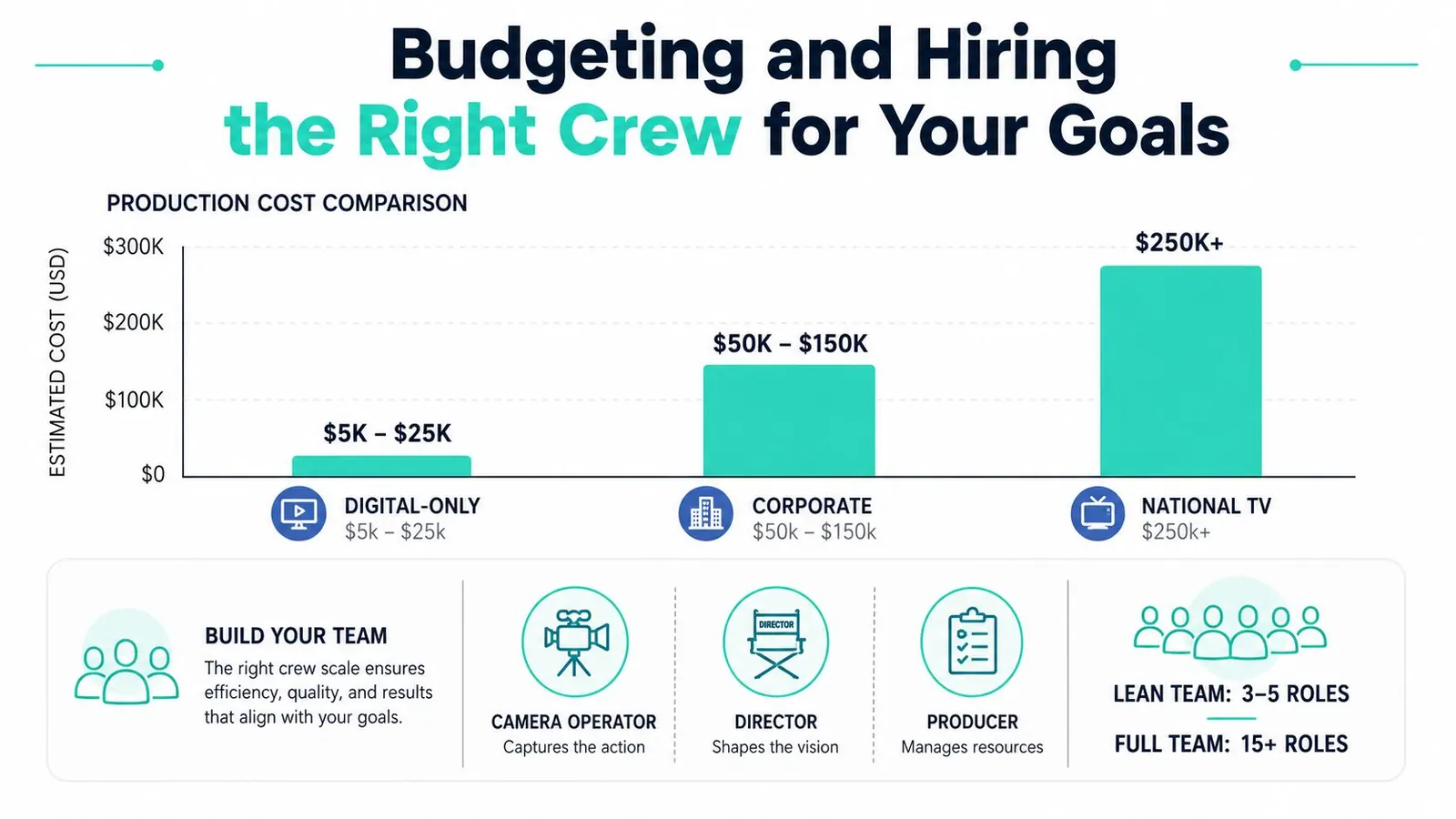
Budgeting for a commercial starts with matching spend to the actual goal. A digital-only piece can be lean, while a larger broadcast-style production needs more crew, more setup time, and more post-production support. The point isn't to spend as much as possible, it's to spend where the viewer will notice the difference.
The cost gap is real. One industry dataset reports that the average cost of a 30-second TV commercial in the U.S. was $105,000 in 2023, up 7% from 2022, while digital commercial production costs averaged $25,000–$75,000 (WorldMetrics commercial production statistics). Those ranges tell you something simple, the same word, “commercial,” can describe very different productions.
Where the money actually goes
Most of the budget pressure lands in a few predictable places: crew, equipment, location fees, talent, and post-production. Small businesses often focus on the shoot day and underestimate how quickly revisions add cost once the edit begins. That's a mistake, because the final version is what the audience sees.
A lean team can work if the concept is simple and the camera plan is disciplined. A larger crew makes sense when the shoot has many setups, multiple locations, or a high-stakes brand presentation. If the video's main job is to create trust, you usually get more value from strong sound, clean framing, and controlled lighting than from adding a dozen extra moving parts.
When to hire up and when to simplify
A full production company is useful when the commercial has multiple stakeholders, requires reliable logistics, or needs a lot of versioning. A freelance crew can be the smarter choice when the concept is focused and the brand only needs a few well-executed scenes. The trick is to be honest about complexity before the quote is signed.
Here's the shortest hiring checklist that matters:
- Director: Keeps the message focused and protects the business goal.
- Director of photography: Controls the look, but should still serve the story.
- Sound support: Essential if anyone speaks on camera or if the ad needs a clean audio bed.
- Editor: Often undervalued, but the edit is where modular footage becomes usable marketing.
For businesses that want a partner handling both creative and delivery, Leaping Lemur Media's services are one example of how production and marketing support can sit in the same workflow.
Choosing Shots That Build Trust and Drive Action
Shot selection should follow business outcome, not vanity. A service business doesn't need a catalog of flashy angles, it needs framing and movement that make the viewer feel something useful, like confidence, calm, or credibility. The same visual treatment can send opposite signals depending on the offer.
Trust, premium positioning, and authority need different shots
For a dentist, an eye-level medium shot usually works better than a dramatic angle because it feels direct and human. Patients want reassurance, not distance. Eye contact, steady framing, and a natural pace make the message easier to trust.
For a medspa, premium positioning often benefits from controlled movement and refined composition. Shallow depth of field can separate the subject from the background, which helps the space feel polished and selective. Slow camera movement can also suggest calm and luxury, but only if the lighting and styling support that feeling.
For a law firm, the goal is often authority and steadiness. Static wide shots, clean backgrounds, and uncluttered compositions convey competence without trying too hard. If the viewer is deciding whether to trust someone with a serious matter, clarity usually beats flair.
A useful test: if the shot makes the business look impressive but not believable, it's the wrong shot.
Match the frame to the promise
The shot should reinforce the promise behind the offer. A service that sells comfort should look approachable. A service that sells expertise should look precise. A service that sells premium experience should look controlled, not chaotic.
A lot of commercials drift off course. Teams choose shots because they're visually interesting, then discover the footage doesn't match the customer's decision process. A shot list built around business outcomes avoids that problem because every frame has a job.
Running a Smooth Production Day on Set
Shoot day goes better when the crew protects the approved shot list and treats time as a finite resource. That sounds obvious, but it's easy to lose discipline once clients, talent, and equipment are all in motion. The best sets stay calm because the team already knows what matters most.
Rehearse before rolling
Rehearsal saves more time than most small businesses expect. It helps talent settle in, gives the crew a chance to confirm framing and focus, and exposes problems before the camera is rolling for real. That matters because weak rehearsal turns into unnecessary takes, and unnecessary takes become expensive in edit time later.
The simplest commercial shoots often perform the best for trust-based businesses. A clean setup, readable lighting, and a short list of essential shots usually beat elaborate camera tricks when the viewer needs to feel safe and informed. Go small and simple when the concept allows it, because execution quality matters more than complication.
Protect coverage and back up immediately
Capture multiple takes, plus B-roll, so the editor has room to pace the story and maintain continuity. If a line delivery feels stiff or a product shot needs variation, coverage is what keeps the cut alive. Without it, the edit can only assemble what's available, not what works.
Once the shoot wraps, back up the footage immediately. If files aren't protected before the crew leaves, the project is exposed to avoidable risk. For final delivery, export at least in 1080p Full HD so the commercial is ready for common distribution needs (YouTube production guidance).
Post-Production and Delivering for Every Platform
Post-production is where the commercial becomes usable marketing. The edit shapes pacing, clarity, and emotion, but it also decides whether the footage fits the platform. If the team shoots without delivery in mind, the post timeline gets longer and the final asset gets less flexible.
Build the edit for multiple versions
A single shoot should produce more than one output. The same hero footage can become different cuts for different channels if the framing, pacing, and composition were planned properly. That's why modular capture matters so much, especially for businesses that want one production to support several campaigns.
The opening seconds matter most on short digital placements, because the viewer decides quickly whether to keep watching. That means the first visual and first line should earn attention immediately, not wait for a slow build. On social platforms, the edit also has to work when sound is off, so captions, visual clarity, and obvious motion all matter.
Match the export to the destination
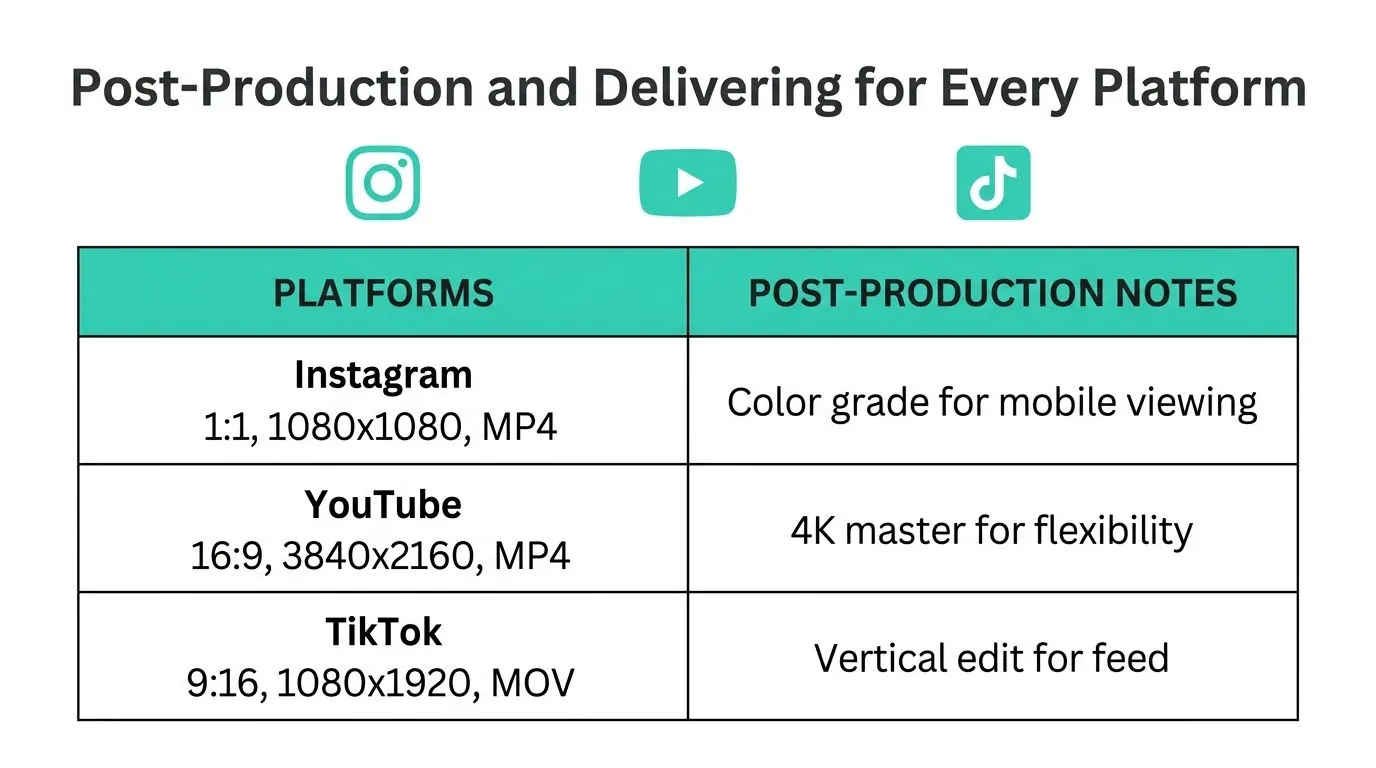
Each platform has its own delivery habits, and the edit should respect them. The infographic above shows how aspect ratio and file format change by destination, but the larger point is strategic. A 4K master gives the team flexibility later, while vertical edits serve feed behavior better than a one-size-fits-all export.
Synthesis point: good post-production doesn't just polish the commercial, it protects the investment by making the footage reusable.
Measuring ROI after launch should be tied to the commercial's actual business role. Watch how the ad performs, look at response quality, and compare appointment bookings or lead behavior against the goal you set before production. If a version stops performing, refresh the edit or retire it before it starts wasting spend.
Common Mistakes That Sink Small Business Commercials
A medspa owner's first commercial usually looks simple on paper, but the project can still go sideways fast. The owner picks a flashy concept, skips storyboard sign-off because the idea feels obvious, and then expects the editor to save a weak shoot. By the time the final cut arrives, the footage looks polished but doesn't say enough about the practice to justify the spend.
The most common mistake is over-investing in style and under-investing in clarity. That usually shows up as dramatic lighting, too many moving shots, or too much time spent trying to make the brand look “cinematic” instead of credible. The second mistake is skipping the approval gate, which means the shoot is locked before everyone agrees on the actual message.
Post-production is where budgets get exposed. Revision rounds are easy to underestimate, especially when the team didn't plan for multiple cut lengths or platform versions. If you need help tightening short edits after launch, optimize short form content can be a useful resource for thinking about how shorter assets should behave once the full commercial is cut down.
The safest final check is simple. Does the commercial support the business goal, does the shot choice match the level of trust or authority the brand needs, and does the edit have enough flexibility for the platforms you care about? If any of those answers is shaky, the project isn't ready yet.
Leaping Lemur Media helps service businesses plan and produce commercial video that fits the brand, the audience, and the channel. If you're ready to turn one shoot into a practical set of assets for your practice or firm, visit Leaping Lemur Media and start with a conversation about the commercial you need.