
You're looking at a report that says the campaign is “working,” but the month still feels tight. The phone rang, a few consults came in, and the dashboard looks healthier than it did last quarter, yet the practice account doesn't match the optimism in the spreadsheet. That's the point where how to calculate marketing ROI stops being a math exercise and starts becoming a business decision.
Most practices don't lose money because they run no marketing. They lose money because they count the wrong revenue, leave real costs out of the math, or give a campaign credit for sales that would have happened anyway. A practical guide to how to measure marketing ROI has to start with that tension, because the number only matters if it helps you decide what to keep, what to fix, and what to cut.
Table of Contents
- Why Your Marketing ROI Numbers Might Be Lying to You
- Defining Goals and Timeframes Before You Calculate Anything
- Choosing the Right Marketing ROI Formula for Your Practice
- Gathering Revenue Data and Attributing It Correctly
- Worked ROI Examples You Can Apply Today
- Common Tracking Mistakes That Inflate Your ROI
- Building a Sustainable ROI Tracking Rhythm for Your Practice
Why Your Marketing ROI Numbers Might Be Lying to You
A practice owner sits down with the monthly report and sees a clean, cheerful ROI percentage. The ad platform says the campaign brought in leads. The front desk says the leads turned into appointments. The spreadsheet says the campaign paid for itself. Then the bank balance tells a different story, because payroll, software, creative work, and untracked labor never made it into the math.
That gap is common. Simple ROI formulas often credit the full sale to the last click or the last form fill, even when some of that revenue would have happened through referrals, repeat patients, or brand familiarity anyway. More advanced guidance points out that proper ROI work has to focus on incremental revenue, not just attributed revenue, and it has to account for margin and payback time instead of treating every booked appointment as pure campaign success. That matters even more when privacy changes and weaker tracking make last-click attribution less reliable, which is why a campaign can look strong on paper and still be weak in practice. Neil Patel's discussion of marketing ROI measurement gets at that incrementality gap clearly.
The report can be right and still be misleading
A dental office might see a burst of consults after a local search campaign launches, then assume the campaign created all of them. A medspa might see a promotion fill the calendar and think the offer was the driver, when some of those bookings were already coming from repeat clients who were primed to buy. A law firm may see a branded search campaign convert well, then overlook that the same leads would have found the firm through direct traffic or an old referral link.
Practical rule: If the report only shows what happened after the click, it's not enough to decide whether the campaign actually created new demand.
The right question isn't, “Did revenue show up?” It's, “What part of that revenue exists because of this marketing, and what part would have happened without it?” Once that shift happens, ROI stops being a vanity number and becomes a filter for better decisions.
Defining Goals and Timeframes Before You Calculate Anything
A campaign can look profitable on paper and still miss the business goal. A practice may celebrate more booked visits, but if those visits are low-value, heavily discounted, or mostly pulled from patients who would have converted anyway, the return is overstated. That is why ROI needs a target before the math starts, and that target has to reflect the kind of demand the practice wants.
Start with the outcome, not the channel
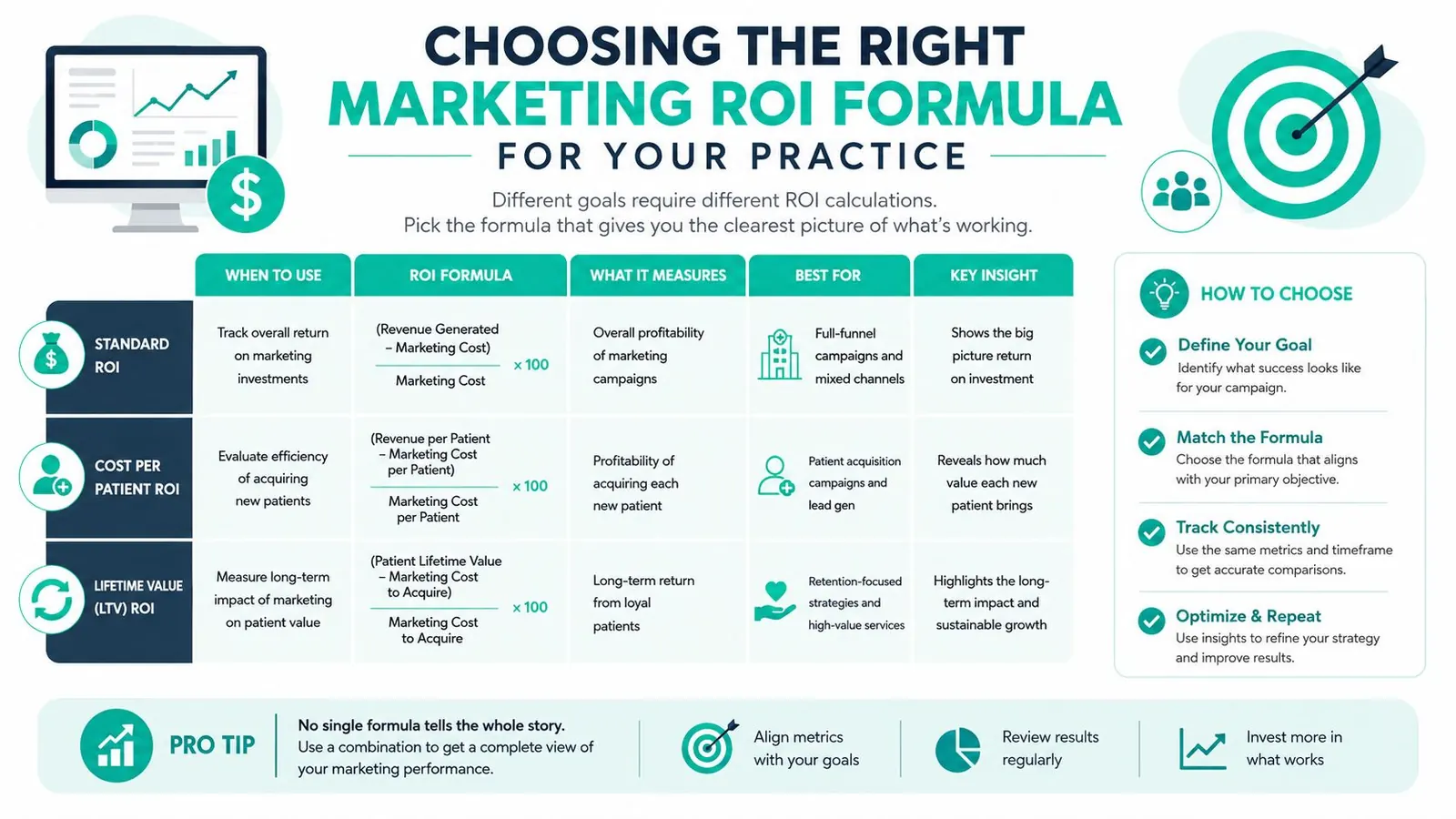
A dental practice might care most about new patient exams. A medspa may care more about booked consultations for one signature treatment. A law firm may need signed retainers, not just intake calls. Those outcomes are not interchangeable, and the ROI setup should not treat them as if they are.
Start by naming the conversion, the source of truth, and the review window before the campaign goes live. If the front desk records booked consults in one system and closed cases in another, both have to be tied back to the same campaign period or the analysis gets muddy fast. That matters even more for services where the sale happens after the first contact, because revenue often lands after the first form fill, not on the day the ad was clicked.
A practice also has to separate attributed revenue from incremental revenue. If a campaign mainly captures people who were already on the fence, the report may show a lift that looks strong while the actual business gain is thin. That gap is where a lot of practices overstate performance, especially when a steady baseline of referrals, repeat patients, and brand searches is already doing part of the work. It is also why practices that model ROI for billing outsourcing need to be just as careful about the goal they assign to a vendor relationship as they are with paid media.
Match the timeframe to the campaign type
A short measurement window can work for paid ads because the response is usually fast. It can fall apart for SEO, content, and reputation work, where the payoff arrives later and is easy to miss if the review window is too narrow. The measurement period should fit the way the campaign produces demand, not force every tactic into the same monthly box. HubSpot's content marketing ROI guide makes that cost-and-window point clearly, especially for campaigns that depend on labor, production, and promotion before revenue shows up.
A dental promotion for whitening consults may be reviewed over a short cycle. An eye care practice publishing educational content for cataract or vision correction services needs a longer horizon. A medspa building trust through before-and-after stories will not show the same payoff pattern as a law firm running urgent search ads. Treating them all with one rigid window invites bad calls, and it makes weak campaigns look healthier than they are.
Set the measurement period long enough to capture the campaign's real behavior, not just its first reaction.
Choosing the Right Marketing ROI Formula for Your Practice
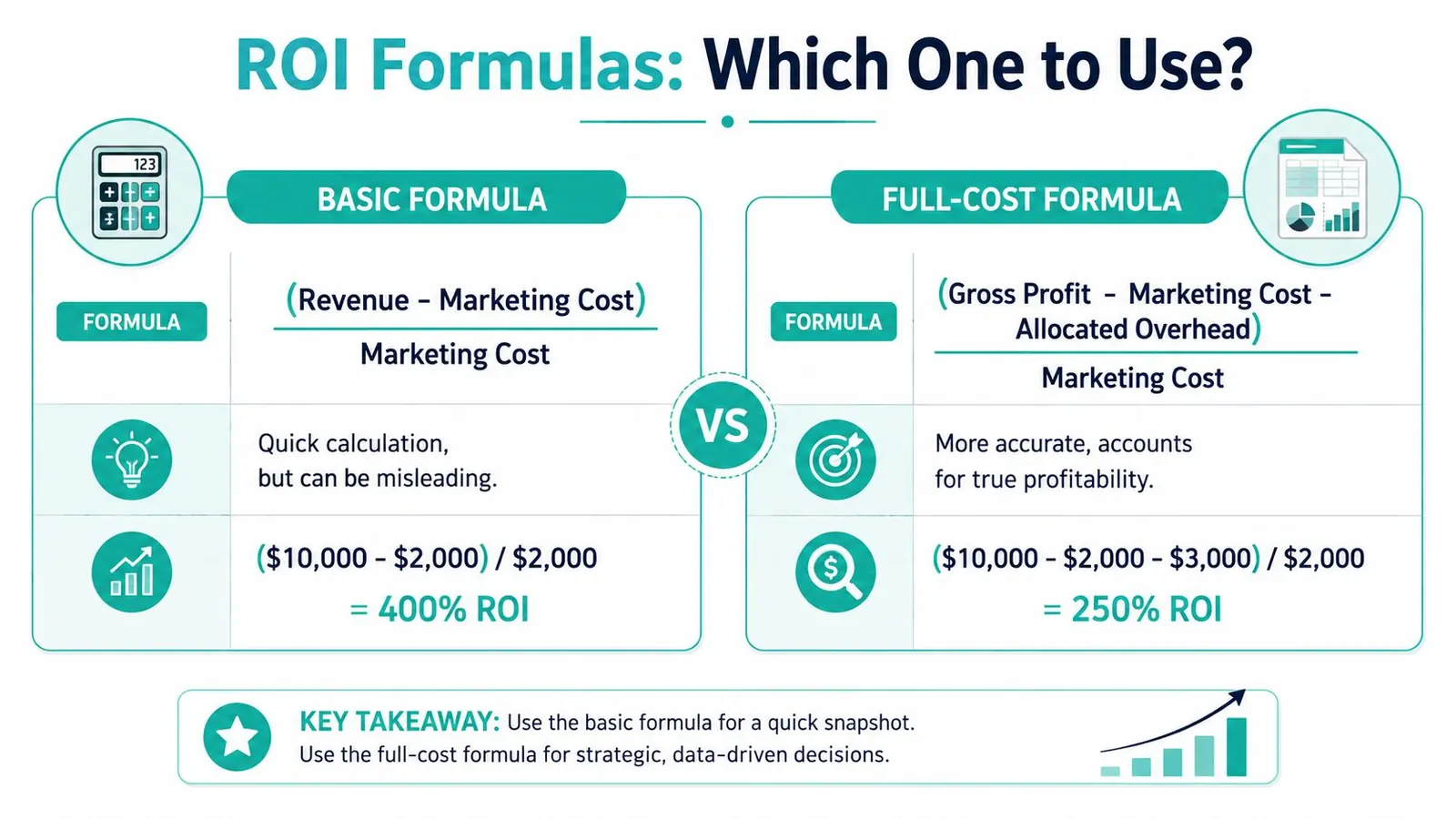
A practice can show a positive ROI on paper and still lose money in practice. That usually happens when the calculation ignores staff time, production costs, software, overhead, or the revenue that would have come in without the campaign. The formula is simple, but the inputs need to reflect the full cost of getting a lead to revenue.
The standard marketing ROI formula is (Marketing Value − Marketing Cost) / Marketing Cost × 100. Salesforce describes the same core approach as (Revenue or Sales Growth − Marketing Cost) / Marketing Cost × 100, which is another way of saying the same thing, the metric measures profit relative to spend and expresses it as a percentage Salesforce's ROI guide. That formula is useful only when the numbers behind it are honest.
The basic formula is easy to use and easy to overstate
The basic version is popular because it is simple. Add the revenue, subtract the cost, divide by the cost, then multiply by 100. It tells you whether the campaign produced more value than it cost, but it often leaves out the expenses that make a campaign real.
That is why a campaign can look excellent when you count only ad spend, then look much less attractive once you add the rest of the load. Improvado's guidance on marketing ROI says to include agency fees, software or platform costs, creative production expenses, and internal team salaries allocated to the campaign, because leaving them out can overstate returns Improvado on full marketing ROI costs. The same issue shows up in practice reviews all the time, especially when the marketing team has relied on outside help. If you work with a partner, a practice marketing services team should be evaluated on the full cost of execution, not just the media bill.
Full-cost ROI changes the story
A serious practice calculation should include everything tied to execution. That means media spend, the strategist's time, the designer's work, production fees, platform subscriptions, and any agency retainer allocated to the campaign. If you leave those out, you are not measuring ROI, you are measuring one narrow slice of spend.
Rule of thumb: If a cost had to be paid for the campaign to exist, it belongs in the calculation.
A useful way to sanity-check the number is to ask whether the campaign still looks profitable after every realistic cost is added. If the answer changes, the original report was incomplete, even if the headline looked strong.
If billing or operations are being outsourced, the same logic applies there too. A useful reference for thinking through added overhead is model ROI for billing outsourcing, because the question is always the same, what does the work cost once every layer is counted?
Gathering Revenue Data and Attributing It Correctly
Revenue data usually lives in more than one place. A practice management system knows what got booked and collected. A CRM may know where the lead came from. The website form tool knows what clicked. If those systems don't line up, the ROI calculation becomes guesswork with a spreadsheet attached.
Pull the data from the systems that actually touch the sale
Start with booked appointments, completed consults, signed cases, or paid invoices, depending on the business model. Then connect those outcomes back to the channel that created them using tracking links, source fields, call tracking, or intake notes. The main job is not to count more revenue, it's to prevent double-counting and misattribution.
That matters in practices where one patient sees multiple touchpoints before converting. A dental patient may discover the office through search, return through social, and call after reading reviews. A medspa lead may click an ad, browse the website, then book after a follow-up email. A legal prospect may arrive through a referral, then convert after branded search ads reinforce trust. If every touchpoint claims full credit, ROI gets inflated fast.
Separate baseline revenue from campaign-driven growth
Incrementality matters most here. Some of the revenue tied to a campaign would have come in anyway. Existing patients rebook. Word-of-mouth keeps flowing. A branded search ad may intercept demand that was already there. Good ROI work tries to isolate the lift above the normal baseline rather than pretending all attributed revenue is newly created.
A practical approach is to compare the campaign period against a similar period with no campaign activity, then ask what changed. Small practices usually can't run perfect control groups, but they can still think in control-group terms. If a campaign produces a spike in consults without any shift in baseline behavior, that's a clue. If the lift disappears after the campaign ends, that's another clue.
For a deeper service-level view, the internal workflows around lead capture and campaign tracking matter too, which is why many teams tie the analysis back to a centralized process like this internal resource. Clean attribution doesn't make the campaign better, it just tells the truth about what happened.

Worked ROI Examples You Can Apply Today
A good example beats a vague rule every time. The first calculation below uses the basic formula that many practices already understand. The second shows what happens when the same campaign is measured with a fuller cost view, so the actual return is harder to hide.
Example one, a straightforward dental campaign
A dental practice spends $1,500 on a campaign. The campaign produces $7,200 in gross profit. Subtract the marketing investment from the gross profit, and the return is $5,700. Divide $5,700 by $1,500, and the ROI is 380%. That matches the arithmetic in a published ROI example, and it gives a clean benchmark for interpreting the number, an ROI above 100% means the campaign returned more than it cost ROI calculation example.
That kind of result may justify scaling the channel, but only if the number reflects the full picture. If the practice only counted ad spend and ignored the labor that supported the campaign, the result would already be overstated.
Example two, a medspa campaign with full-cost math
A medspa runs a campaign that includes paid ads, creative work, software, and internal labor. The campaign looks profitable on media spend alone, but the full-cost view changes the margin. That is the lesson most owners need: a campaign can clear the bar in a narrow calculation and still be a weaker investment once overhead is loaded in.
| Cost Category | Basic ROI Calculation | Full-Cost ROI Calculation |
|---|---|---|
| Media spend | Included | Included |
| Creative and production | Omitted | Included |
| Software and platform costs | Omitted | Included |
| Internal team time | Omitted | Included |
| Resulting interpretation | Looks stronger | More realistic |
If the basic version says “scale,” but the full-cost version says “pause and tighten the process,” the second number deserves more trust. The point isn't to make every campaign look bad. The point is to stop rewarding channels that only look efficient because their true cost is hidden.
If a campaign survives the full-cost test, it's usually worth serious attention. If it only survives the ad-spend test, it's probably flattering the dashboard.
Common Tracking Mistakes That Inflate Your ROI
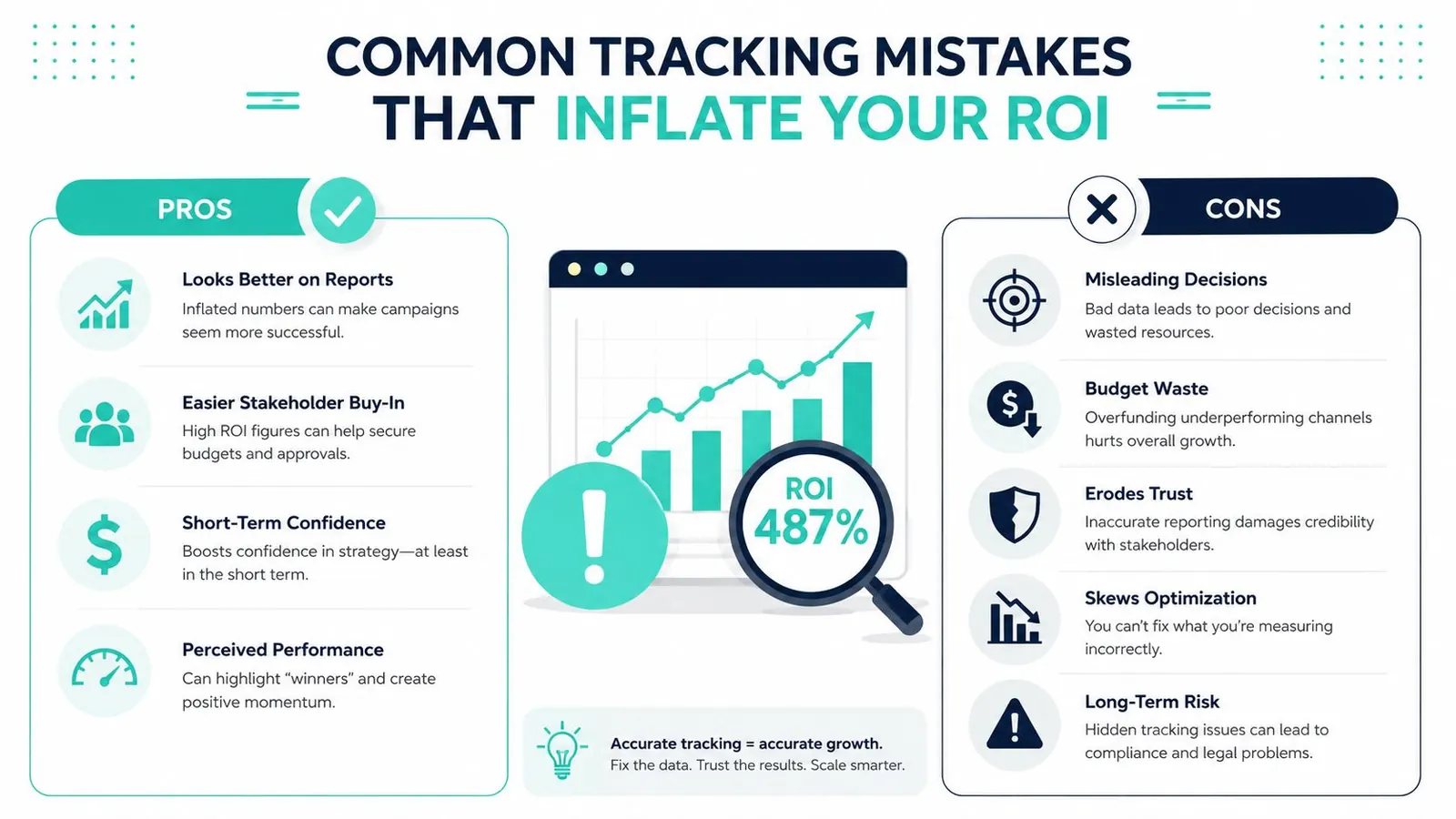
Inflated ROI usually comes from one of four habits. The first is last-click bias, where the final touchpoint gets too much credit. The second is ignoring delay, which makes slower channels look weak because the sale lands after the review window closes. The third is double-counting when multiple systems record the same lead. The fourth is using revenue instead of profit.
The easy mistakes are the most expensive ones
Last-click attribution is the classic trap. A branded search ad often closes the loop, so it gets credit for a lead that was warmed up by content, email, or a referral. Delayed revenue creates the opposite problem, where SEO and educational content appear underpowered because they're judged before they've had time to compound. Double-counting happens when a form fill, a call, and a CRM record all track the same patient separately.
Gross revenue is another common distortion. A practice can celebrate top-line revenue while forgetting that the campaign may have burned too much cash to create that revenue efficiently. That's why profit-based thinking is more useful than simple sales tallies.
Fixes that don't require enterprise software
- Use one conversion definition: Choose one main outcome, such as booked consults or signed cases, so every channel is judged against the same finish line.
- Track time to conversion: Keep a note of how long it usually takes a lead to convert, because a short window can punish channels that work more slowly.
- Reconcile systems weekly: Compare ad platform leads, CRM records, and revenue reports before they drift apart.
- Read profit, not just revenue: If the margin is thin, a campaign needs a much cleaner return to stay worth funding.
An internal review process can help here, and many practices keep their own reporting discussions organized through this journal resource. The goal isn't perfect attribution, it's fewer false positives.
Building a Sustainable ROI Tracking Rhythm for Your Practice
A practice can have a campaign that looks profitable on paper and still lose money once overhead, delayed collection, and baseline demand are counted properly. That is why ROI review cannot be a once-a-quarter fire drill. The review rhythm needs to be simple enough to repeat and strict enough to catch inflated numbers before they guide the next spend decision. For most owners, monthly works well because it keeps the feedback loop short without reacting to every temporary swing.
Keep the review small and consistent
Each review should answer the same questions every time. What did we spend? What did we book? What did we collect? What looked like campaign lift versus normal demand? Those are the questions that keep a team grounded when the numbers start to drift.
The full-cost view belongs in the conversation too. Customer acquisition cost and lifetime value matter even if the main ROI formula stays centered on campaign return. A channel that looks modest on first sale can still make sense if it reliably brings in the right kind of patient or client. A channel that looks flashy can still be a drag if it attracts low-value, low-retention work or if the overhead required to serve that volume eats into the margin.
Most practices also misread incrementality at this stage. If a campaign is capturing demand that would have arrived anyway, the return is thinner than it first appears. That is why I push owners to separate true lift from baseline revenue before they call a channel profitable. If the reporting process keeps getting messy, a direct conversation through this contact page can help tighten the workflow without adding more noise. The goal is a reporting habit that supports decisions, not one that just produces prettier dashboards.
Final filter: Scale the campaigns that stay healthy after full-cost review, adjust the ones that only need cleaner execution, and cut the ones that depend on optimistic attribution to look good.