

A patient is standing at your reception desk, holding a clipboard, while your staff member answers a ringing phone, searches for an intake form, and tries to confirm an insurance detail. Nobody is being careless. Everyone is working. Yet the patient feels unacknowledged, uncertain, and already behind.
That moment explains why a new portal or scheduling app rarely fixes patient experience by itself. Patients judge the whole journey, including whether the practice feels organized, whether communication stays clear under pressure, and whether someone follows through after the visit. If you want to understand how to improve patient experience, start with the behaviors and processes patients encounter before, during, and after care.
Table of Contents
- What Patient Experience Really Means for Your Practice
- Mapping the Patient Journey From First Click to Follow Up
- Front Desk and Clinical Communication That Changes Everything
- Environment, Wait Times, and Operational Trust
- Digital Tools That Actually Help and Where They Hurt
- Staff Training and Feedback Loops That Stick
- KPIs, Benchmarks, and Your 90 Day Action Plan
What Patient Experience Really Means for Your Practice
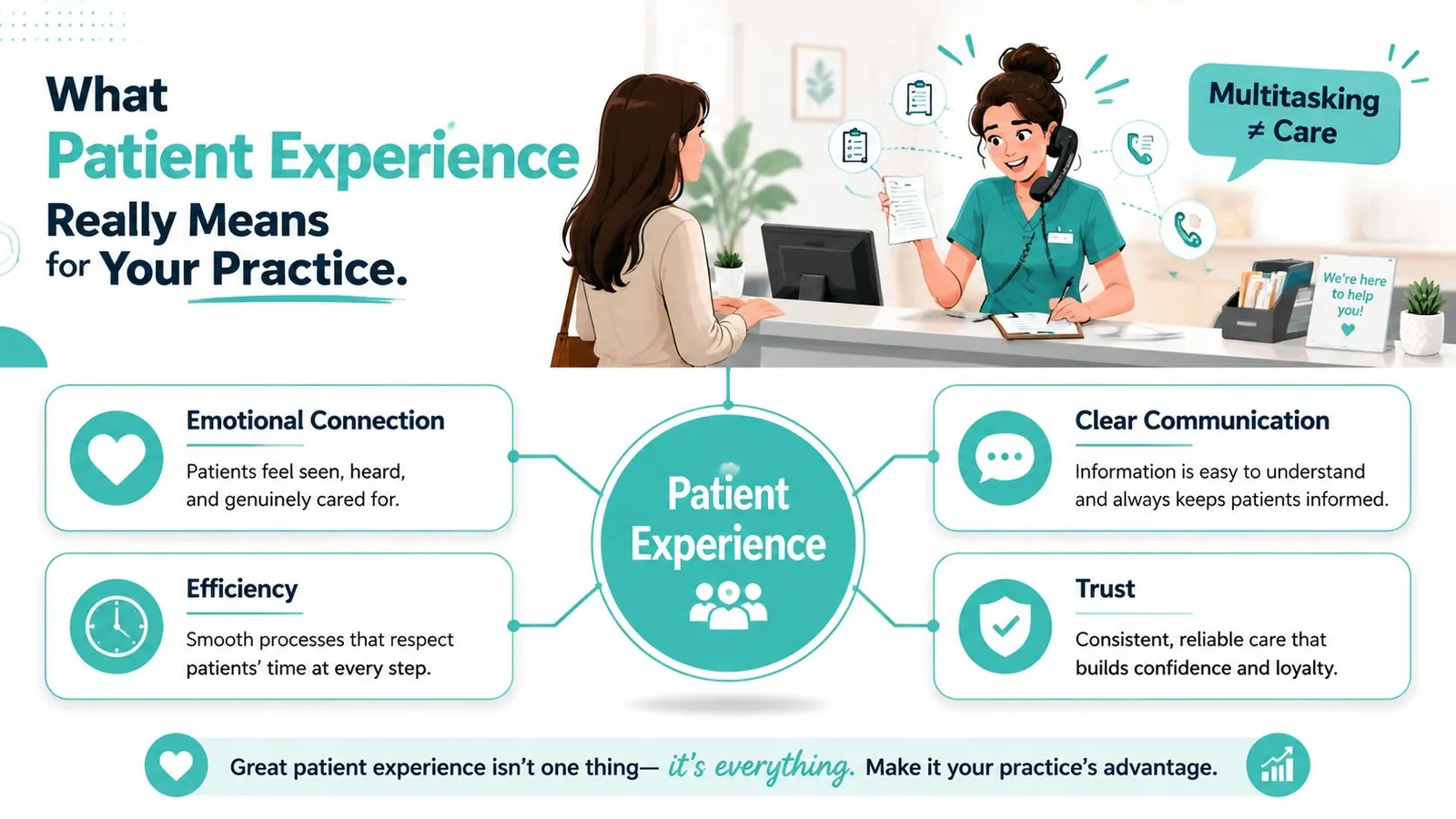
Patient experience is not your website's visual identity or the number of digital features in your technology stack. It's the cumulative result of operational trust, communication quality, and repeatable frontline behavior.
Patients are constantly asking four unspoken questions:
- Do you expect me? Staff know who they are, why they're there, and what happens next.
- Are you informing me? The practice explains delays, costs, instructions, and handoffs in plain language.
- Do you respect me? Employees protect privacy, listen without rushing, and acknowledge emotion.
- Will you follow up? Test results, referrals, billing questions, and post-visit instructions don't disappear into a queue.
HCAHPS helped establish a consistent way to measure these experiences in U.S. hospitals. Developed by CMS and AHRQ, it was the first national, standardized, publicly reported survey of patients' perspectives on hospital care. Its questions cover concrete experience drivers, including communication with doctors and nurses, staff responsiveness, cleanliness, quietness, medication communication, discharge information, care transitions, overall rating, and likelihood to recommend. The results also became the basis for Medicare hospital patient survey star ratings, turning patient feedback into a public quality signal. CMS explains the HCAHPS survey and its role in hospital quality reporting.
The signals your team can influence
The front-desk employee in the opening scene may not control the phone system, staffing level, or provider schedule. They can still make eye contact, acknowledge the waiting patient, explain the next step, and close the loop when the call ends. Those small actions shape trust more than a polished app icon.
A national analysis of HCAHPS data reported in March 2008 and March 2009 found improvement across every measure except doctors' communication, with the largest gains in staff responsiveness and discharge information. Ireland's 2024 National Inpatient Experience Survey also demonstrates the value of structured participation and benchmarking. 12,367 people responded from 30,103 invited patients, a 41% response rate, and 85% rated their overall hospital care as good or very good. The 2024 Irish survey report provides the full findings.
For broader customer loyalty thinking, these boost customer loyalty tips offer useful service principles that can be adapted to healthcare without treating patients like retail transactions. Practices that want their public messaging to reflect these same standards can also review Leaping Lemur Media's about page.
Mapping the Patient Journey From First Click to Follow Up
You can't improve a journey you haven't observed. Start by documenting what patients experience, not what your workflow diagram says should happen.
Map six stages:
- Discovery and scheduling. Look for confusing service pages, unanswered calls, long holds, unclear appointment types, and forms that ask patients to explain the same issue repeatedly.
- Arrival and check-in. Watch for parking problems, unclear entrances, crowded reception areas, privacy gaps, and staff who don't acknowledge a patient immediately.
- The waiting room. Record whether patients know why they're waiting, whether the room feels clean and calm, and whether staff provide updates when the schedule slips.
- The clinical encounter. Notice abrupt handoffs, unexplained terminology, rushed decisions, and instructions that assume the patient already understands the plan.
- Checkout and billing. Identify surprise charges, unclear payment expectations, confusing referral steps, and patients leaving without knowing who owns the next action.
- Post-visit follow-up. Search for silent gaps after discharge, delayed results, missing referral updates, and messages that lack a clear response path.
A practical observation method
Shadow two patient journeys each week. You don't need to record names or sensitive clinical details. Capture four things at each touchpoint:
- Time: How long did the step take, including holds, waiting, and transfers?
- Emotion: Did the patient appear calm, confused, embarrassed, frustrated, or reassured?
- Failure point: What created extra work, uncertainty, repetition, or delay?
- Owner: Which role can change the problem without waiting for a major technology project?
Then score every touchpoint on two dimensions, control and impact. A broken reminder message may be easy for the practice to fix and moderately important. A recurring authorization delay may be harder to resolve but highly consequential. Put both on the map, then rank them rather than allowing the loudest complaint to dictate the entire improvement agenda.
A journey map should end as a prioritized fix list for the next 90 days, with one accountable owner per fix. For customer-journey methodology outside healthcare, optimize eCommerce customer journeys provides a useful comparison because it emphasizes observing each channel rather than judging only the final conversion. Your practice can apply the same discipline to its journal and published resources, especially when patients use online content before calling.
Practical rule: If a patient has to ask, “What happens now?” your process has left a communication gap.
Front Desk and Clinical Communication That Changes Everything
Communication quality under stress is the most effective experience behavior in most practices. Patients remember whether your team made a difficult moment feel navigable, especially when they're anxious, in pain, embarrassed, or surprised by a diagnosis or bill.
The first phone call
A caller shouldn't have to earn your attention. Use a greeting that identifies the practice and invites the need:
“Thank you for calling Riverside Dental. This is Maya. How can I help you today?”
If the caller needs to wait, name the reason and offer a choice when possible:
“I need to confirm that appointment type with the clinical team. I can place you on a brief hold, or I can take your number and call you back after I verify it.”
Avoid promising a precise callback time unless someone owns that commitment. A better handoff sounds like this:
“I'm connecting you with Jordan, who handles referrals. I'll tell Jordan what you've already explained so you won't need to start over.”
The operational behavior matters as much as the words. The next employee should receive the context, the patient should hear the next step, and the caller should know what to do if the connection fails. If your phone system is part of the problem, compare top healthcare phone systems compared while testing the workflow with real staff, not only during a vendor demonstration.
Check-in without making patients invisible
At reception, acknowledge the patient before finishing the task in front of you:
“Good morning, Alex. I see you. I'll be with you as soon as I finish securing this patient's information.”
That sentence protects privacy and reassures the waiting person. During check-in, explain what will happen next:
“I'll confirm your details, collect the copay if applicable, and then the clinical assistant will bring you back. If the provider is delayed, we'll update you.”
For a missed appointment, don't lead with blame:
“I'm glad you reached us. Let's review what happened and find the next available option that fits your care needs.”
For a billing surprise, separate empathy from resolution:
“I can see why this charge is frustrating. I'll review the estimate and identify what we can clarify now. If another team needs to investigate it, I'll tell you who owns the next response and how you'll hear back.”
Difficult in-room conversations
Clinicians should explain the plan, alternatives, risks, and consequences in accessible language. NICE recommends shared decision making as part of everyday care across healthcare settings, supported by training, risk and benefit communication, decision aids, and organizational embedding. Review the NICE shared decision-making guideline.
Close every encounter with a teach-back question:
“I want to make sure I explained that clearly. Can you walk me through what you'll do when you get home?”
Don't ask, “Do you understand?” Patients often say yes to avoid embarrassment. Sit at eye level when possible, pause after emotional information, and name the next action. Before the patient leaves, confirm who will send results, when they should expect contact, and what they should do if symptoms change.
Environment, Wait Times, and Operational Trust
A patient who waits without an update starts questioning whether the practice has control. Clean, quiet, private, easy-to-find spaces support confidence, but visible operational discipline matters more than decorative upgrades. Acknowledge arrivals promptly, explain delays plainly, and make the next option clear.
Use these frontline standards:
- Set a 10-minute update rule. If the appointment has not started, staff explain the delay and offer available options.
- Give updates chair-side when patients are already in an exam room. Silence makes patients assume the schedule has been forgotten.
- Make queue status clear through signage or a consistent verbal process.
- Check parking instructions, entry points, elevator directions, and accessibility before buying new furniture.
- Review lighting, noise, scent, cleanliness, and check-in privacy as trust signals.
Appointment design needs the same discipline. Set buffer rules for procedures that routinely run long. Define when double-booking creates unacceptable downstream delays, and protect same-day capacity for urgent needs. If the schedule requires every visit to end exactly on time, it is not a schedule. It is a hope.
Use a direct delay explanation:
“Dr. Lee is managing an urgent clinical issue and is running behind. We expect your visit to begin after the next patient, but we can't guarantee an exact time. You can wait here, reschedule, or receive a call when the room is ready.”
The wording avoids false reassurance and gives the patient control. Staff should document which option the patient chooses so the handoff does not depend on memory.
| Operational Fix | Patient Impact | Implementation Effort | Priority |
|---|---|---|---|
| Acknowledge every arrival promptly | High | Low | Immediate |
| Provide delay updates using a 10-minute rule | High | Low | Immediate |
| Clarify parking, entry, and accessibility instructions | Medium | Low | This week |
| Review buffer and double-booking rules | High | Medium | This month |
| Improve lighting, seating, and décor | Low to medium | Medium to high | Plan later |
| Add a new digital queue display | Variable | Medium to high | Validate first |
Measure the behavior before funding visible upgrades. Track whether arrivals receive prompt acknowledgement, whether delay updates follow the rule, and whether patients receive a clear choice. Consistent execution builds operational trust faster than a new queue display.
Digital Tools That Actually Help and Where They Hurt
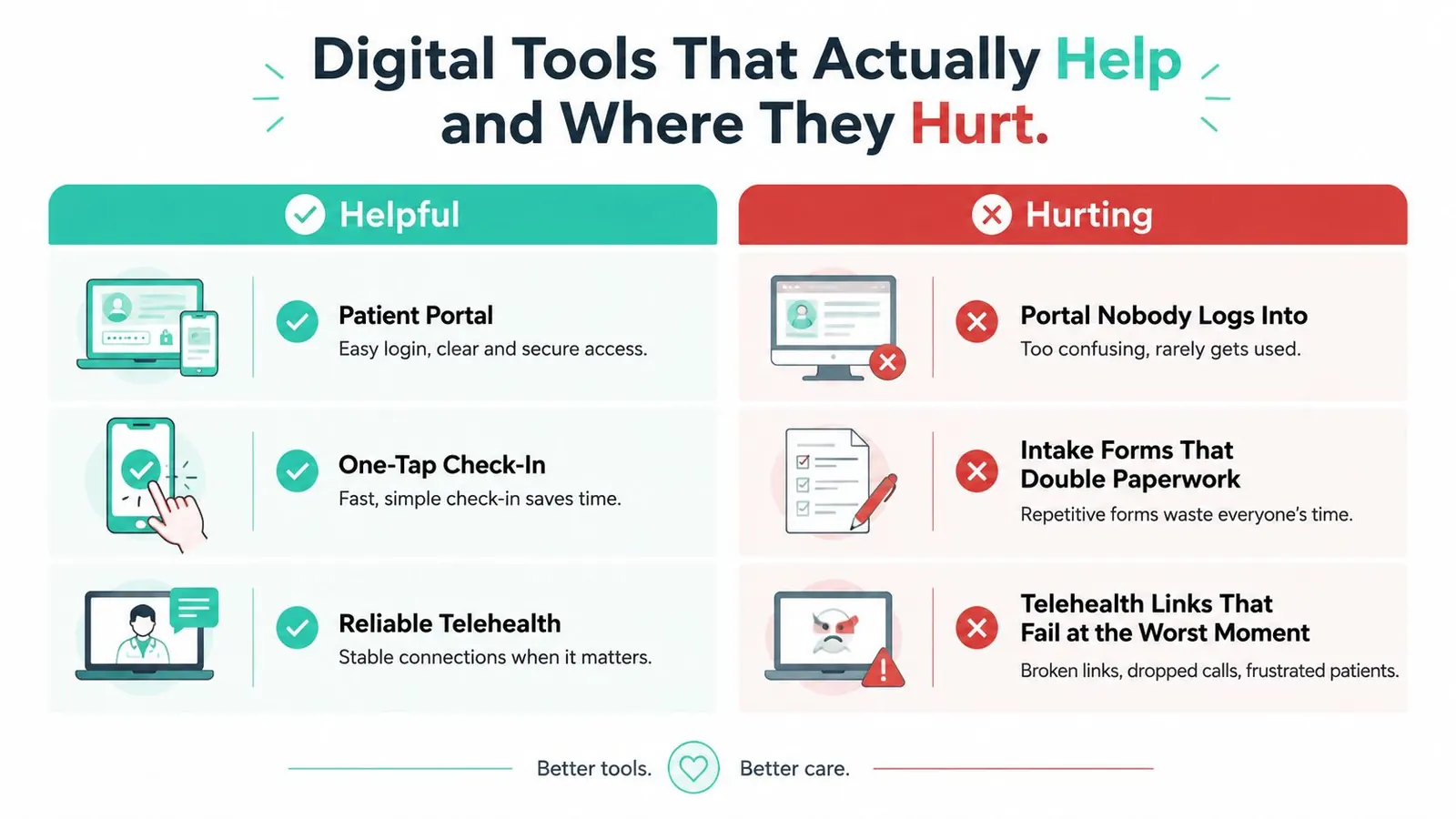
Digital tools should remove a known obstacle. If you can't name the obstacle, don't buy the tool.
| Tool | What it can solve | Where it creates friction | Adoption move |
|---|---|---|---|
| Online scheduling | Phone dependence and limited booking access | Incorrect slot types or poorly protected capacity | Test every appointment reason and escalation path |
| Patient portal | Secure access to messages and records | Login problems and low adoption | Demonstrate sign-in before the patient leaves |
| Telehealth | Travel and access barriers | Failed links, weak audio, unclear technical support | Assign front-desk triage and test the link beforehand |
| Digital intake | Repeated data entry | Duplicate paperwork or inaccessible forms | Remove every field already stored elsewhere |
| Automated reminders | Forgotten appointments and missing instructions | Wrong timing, confusing language, outdated details | Audit messages from the patient's perspective |
The core issue is fit. Online scheduling helps when appointment categories are accurate. It hurts when patients choose the wrong visit type and staff must repair the booking later. Portals improve message access only when patients can log in, understand where to click, and trust that someone will respond.
Communication data reinforces this point. In a U.S. sample of 709,547,678 adults, 5.3% reported low communication. In the following year, that group was more likely to report difficulty accessing care by 2.6 percentage points, delays in needed care by 2.8 points, emergency room visits by 4.2 points, and difficulty paying medical bills by 4.0 points. The PubMed-indexed study details these findings. The practical lesson is clear: don't improve remote access while allowing communication quality to deteriorate.
That same study found remote consultations in England were associated with poorer healthcare-professional communication than face-to-face care, with OR=0.52, while online-only booking improved appointment-making experience, with OR=1.14. Treat those findings as design warnings, not excuses to reject digital care. Build a technology workflow that includes human support.
Choose the minimum viable stack
A small practice may need reliable online booking, mobile-friendly forms, reminders, and a working portal. A larger practice may need scheduling rules, referral tracking, queue visibility, and structured message ownership. Every practice needs a fallback for patients who prefer phone or paper.
Red flags during a vendor demo include a workflow that requires duplicate entry, no patient-facing recovery path when a link fails, vague response ownership, and dashboards that show usage without showing unresolved friction. Before signing, have a receptionist run a complete test from booking through follow-up. Practices seeking help with the digital experience can review Leaping Lemur Media's services as one possible website and patient-journey resource.
Staff Training and Feedback Loops That Stick
Experience programs fail when leaders treat training as an announcement instead of an operating rhythm. Staff hear the new standard, practice it briefly, then return to old habits because no one observes, coaches, or measures the behavior.
Use a repeatable cadence:
- Weekly: Ask front-desk and clinical staff to submit one friction point and one example of a patient question that exposed unclear communication.
- Monthly: Hold a 30-minute huddle focused on one behavior, such as naming the next step, explaining delays, or closing test-result loops.
- Quarterly: Refresh scripts based on complaints, survey comments, workflow changes, and staff feedback.
- Every month or when needed: Role-play the hardest conversations, including billing disputes, bad-news delivery, running late, missed appointments, and emotional responses.
Keep the practice realistic. One employee plays a frustrated patient, another handles the conversation, and a third observes whether the employee acknowledged emotion, explained the next step, avoided overpromising, and confirmed ownership. Rotate roles so the team learns how the same moment feels from different positions.
Make feedback actionable
Use post-visit surveys, CSAT, NPS, complaint logs, and online reviews as separate signals with a shared response process. Assign an owner to each channel, define a response deadline, and record whether the issue was resolved, escalated, or closed with an explanation.
A complaint log should capture the process failure, not merely the patient's name. “Patient upset about bill” is weak. “Estimate did not identify the separate facility charge, and no staff member explained the variance” gives the team something to fix.
A patient and family advisory group can help if recruitment is deliberate. Invite people with different communication needs, visit patterns, ages, accessibility experiences, and levels of familiarity with healthcare. Give them a specific question, show what changed because of their input, and compensate participation when your practice can. Don't use the group as a ceremonial approval panel.
Feedback only creates trust when patients can see what their feedback changed.
Staff need the same evidence. Share one improvement, one unresolved issue, and one behavior to practice at each huddle. That keeps patient experience connected to daily work rather than turning it into a quarterly score review.
KPIs, Benchmarks, and Your 90 Day Action Plan
A dashboard earns its place only when it changes the next action. Six measures give a practice a practical starting point, but a primary care clinic and a specialty practice should not share identical targets. Visit patterns, urgency, and follow-up work differ. Establish your own baseline first, then set an improvement target using your history and a peer benchmark that matches your setting.
The six measures to track
Net Promoter Score, or NPS, measures how likely a patient is to recommend the practice. Calculate it by subtracting the percentage of detractors from the percentage of promoters. Review it monthly, separating results by location, provider, visit type, and new versus returning patients. A single overall score can hide a problem affecting one provider or one part of the journey.
Patient Satisfaction, or CSAT, asks patients to rate their visit. Calculate the percentage of satisfied responses from the selected top categories on your scale, and keep that definition consistent. Review it weekly for operational signals and monthly for broader trends.
First-call resolution shows whether the patient's need was handled during the first contact without a callback, transfer, or repeated explanation. Divide resolved first contacts by total tracked contacts, then review the result weekly. Pair the number with a short reason code, such as scheduling, billing, records, or clinical question, so leaders can address the work creating repeat contacts.
Average wait time runs from arrival or check-in to the start of the clinical encounter. Review it daily at team level and weekly by provider, appointment type, and time block. A practice should also record whether patients received an update during the delay, because a long wait with clear communication creates a different experience from a long, unexplained wait.
No-show rate is missed appointments divided by scheduled appointments, using one consistent rule for cancellations and reschedules. Review it weekly, then examine patterns by reminder status, appointment type, and booking channel. The purpose is to identify a preventable process failure, not to label patients as unreliable.
Digital adoption percentage measures the share of eligible patients who complete one defined digital action, such as online booking, digital intake, portal activation, or telehealth attendance. Select one action at a time, divide completed actions by eligible opportunities, and review it monthly. A high adoption rate has little value if the workflow creates confusion or pushes patients toward the phone.
Avoid universal benchmarks. Compare results with national, regional, organization-type, or top-performer benchmarks that fit your practice, then track changes through a Do-Study-Act loop. The CAHPS quality-improvement framework provides a useful structure for selecting comparisons and organizing improvement work.
A 90-day implementation plan
Days 1 to 30
Prioritize visible behaviors that staff can change without a major system project.
- Practice manager: Assign one owner to each KPI and create a simple weekly dashboard.
- Front-desk lead: Roll out language for greetings, delays, handoffs, billing questions, and missed appointments.
- Clinical lead: Add teach-back and next-step confirmation to rooming and checkout.
- Operations lead: Start wait-time tracking and the 10-minute update rule.
- All staff: Record one patient friction point each week.
Days 31 to 60
Use those observations to fix the journey problems within the practice's control.
- Practice manager: Review the first patient journey map and rank fixes by control and likely impact.
- Front-desk lead: Remove repeated intake questions and make arrival instructions easier to follow.
- Clinical lead: Run role-play drills for late schedules, emotional responses, and difficult explanations.
- Operations lead: Adjust buffer rules, double-booking triggers, and same-day capacity.
- Patient experience owner: Launch a small patient and family advisory group around one defined question.
Days 61 to 90
Make accountability durable and test whether tools support the actual workflow.
- Technology owner: Audit scheduling, forms, portal access, telehealth, and reminders from the patient's point of view.
- Practice manager: Compare KPI trends with suitable regional or organization-type peers.
- Patient experience owner: Automate feedback routing while keeping a named human responsible for responses.
- Clinical and front-desk leads: Refresh scripts using actual complaints and survey comments.
- Owner or medical director: Review the dashboard monthly and approve the next improvement cycle.
Print this checklist and place it where the team can use it:
- Baseline all six KPIs.
- Assign one owner to each metric.
- Observe two patient journeys each week.
- Launch the front-desk and clinical scripts.
- Track delays and provide updates.
- Remove duplicate intake work.
- Run monthly behavior huddles.
- Role-play difficult conversations.
- Review complaints, surveys, and reviews together.
- Test every digital workflow as a patient.
- Compare results with an appropriate benchmark.
- Repeat the Do-Study-Act cycle.
Sustained improvement depends on routine ownership, not launch energy. Review a small set of behaviors, give staff feedback they can use, and assign a real person to every unresolved problem. Empathy, clarity, and follow-through then become operating standards rather than good intentions.
Leaping Lemur Media helps practices improve the patient journey from the first click through booked appointments, visible trust, and follow-up communication with website, review, and journey-mapping support. Visit Leaping Lemur Media to explore a practical marketing partner for making your practice easier to find, understand, and choose.