Most small businesses don't need to market everywhere. They need a recognizable promise, a frictionless path to contact, and consistent proof in the communities they serve. Posting on every platform while your website is unclear, your business profile is incomplete, or your follow-up is inconsistent creates activity without much trust.
These small business marketing tips follow a more practical sequence. First, make the practice recognizable through authentic positioning. Then build owned assets, improve local visibility, educate potential clients, strengthen relationships, amplify what's already working, and measure inquiries instead of chasing vanity metrics. This approach suits dentists, eye doctors, medspa owners, law firms, and other local businesses that have limited time but need every marketing effort to sound credible and feel connected to the people they serve.
Table of Contents
- 1. Define Your Authentic Brand Positioning
- 2. Optimize Your Website as a 24/7 Lead Generation and Client Education Tool
- 3. Leverage Local SEO and Google Business Profile Optimization
- 4. Build a Content Strategy That Educates and Establishes Authority
- 5. Develop a Consistent Social Media Presence That Reflects Your Practice Personality
- 6. Use Video Content to Build Trust and Demonstrate Expertise
- 7. Master Email Marketing for Client Retention and Relationship Building
- 8. Create a Referral and Word-of-Mouth Strategy
- 9. Implement Strategic Local Partnerships and Community Involvement
- 10. Implement Retargeting and Paid Advertising to Amplify Your Best Strategies
- 11. Master Email Marketing for Client Retention and Relationship Building
- 11-Point Small Business Marketing Tips Comparison
- Turn the Best Tips Into a Repeatable Growth System
1. Define Your Authentic Brand Positioning
A recognizable practice starts with a clear answer to a simple question: why should the right client choose you instead of another provider nearby? “Quality service” and “experienced professionals” rarely create useful distinction because almost every competitor can say the same thing.
Look at the values that shape the way you work, the problems your community brings to you, and the experience you want clients to have before, during, and after an appointment. A dental office might emphasize calm, judgment-free care. An eye doctor might focus on thorough education and long-term relationships. A medspa might build its identity around subtle, confidence-supporting outcomes rather than pressure. A law firm might lead with accessibility, clarity, and steady communication.
Practical rule: Your positioning should help a real person recognize themselves in your message, not merely admire your business.
Write a short positioning statement that identifies your audience, the problem you solve, your approach, and the belief behind that approach. Use it across your website, profiles, ads, email, and front-desk conversations. Review your competitors, but don't copy their vocabulary. Your strongest difference may come from your philosophy, process, team personality, or roots in the community.
This work requires honesty and patience. A narrow position may discourage some prospects, but it can attract people who value what you provide and reduce pressure to compete through discounts. The Leaping Lemur Media team takes a similar partnership-first view, helping practices clarify their voice before promoting it.

2. Optimize Your Website as a 24/7 Lead Generation and Client Education Tool
Your website should make recognition and action easy before a prospect calls. State what you offer, who it serves, how your approach differs, where you work, and what the visitor should do next.
Build for phone users first, since local prospects may find your practice while away from a computer. Place the value proposition and primary call to action near the top. Clear service pages, contact details, appointment booking, testimonials, credentials, FAQs, and privacy and security signals answer practical concerns without forcing visitors to search. Use location-specific details when they help someone decide whether you serve their area.
Clarity should guide the design. Fast pages, readable type, useful photographs, descriptive headings, and concise forms generally support inquiries better than elaborate effects. Keep the language consistent with the positioning established across your brand, so the site feels recognizable rather than generic.
A website is an owned channel that can educate prospects while your team is busy. BrightLocal's 2025 SMB marketing research reports that 40% of SMBs had a dedicated website, despite SEO having a medium-to-high impact for 72% of respondents. That gap gives practices room to gain visibility and trust by handling the fundamentals well.
Treat the site as a working system, not a finished project. Update outdated services, test forms, review booking paths, and connect important actions to analytics. A service site such as Leaping Lemur Media's can also illustrate how positioning and next steps are communicated clearly. Review performance regularly, then fix the page or process that is creating unnecessary hesitation.
3. Leverage Local SEO and Google Business Profile Optimization
Local search works best when your business gives Google and prospective clients the same accurate story everywhere. Your Google Business Profile, website, directory listings, service descriptions, categories, hours, phone number, and address should agree.
Claim or complete your profile, choose relevant categories, write a useful description, upload current images, answer profile questions, and add services in plain language. Ask satisfied clients for honest reviews through a process your team can repeat. Respond to reviews with specific, human language rather than copying the same sentence each time.
Local visibility matters because search often happens close to the moment of decision. Google's local-search research found that 50% of consumers who searched locally on a smartphone visited a store within a day, compared with 34% among people searching on a computer or tablet. The relevant lesson for practices is practical: make the next step easy while intent is high.
A local visibility review
- Profile completeness: Confirm categories, services, hours, photos, questions, and contact details.
- Review response: Thank reviewers and address concerns without revealing private client information.
- Citation consistency: Check that names, addresses, and phone numbers match across important directories.
- Location relevance: Explain the areas and communities you serve.
- Conversion path: Test whether a searcher can call, request information, or book without friction.
Use these setup tips for GBP before investing heavily in ads. Local SEO takes maintenance, especially when hours, staff, services, or policies change.
4. Build a Content Strategy That Educates and Establishes Authority
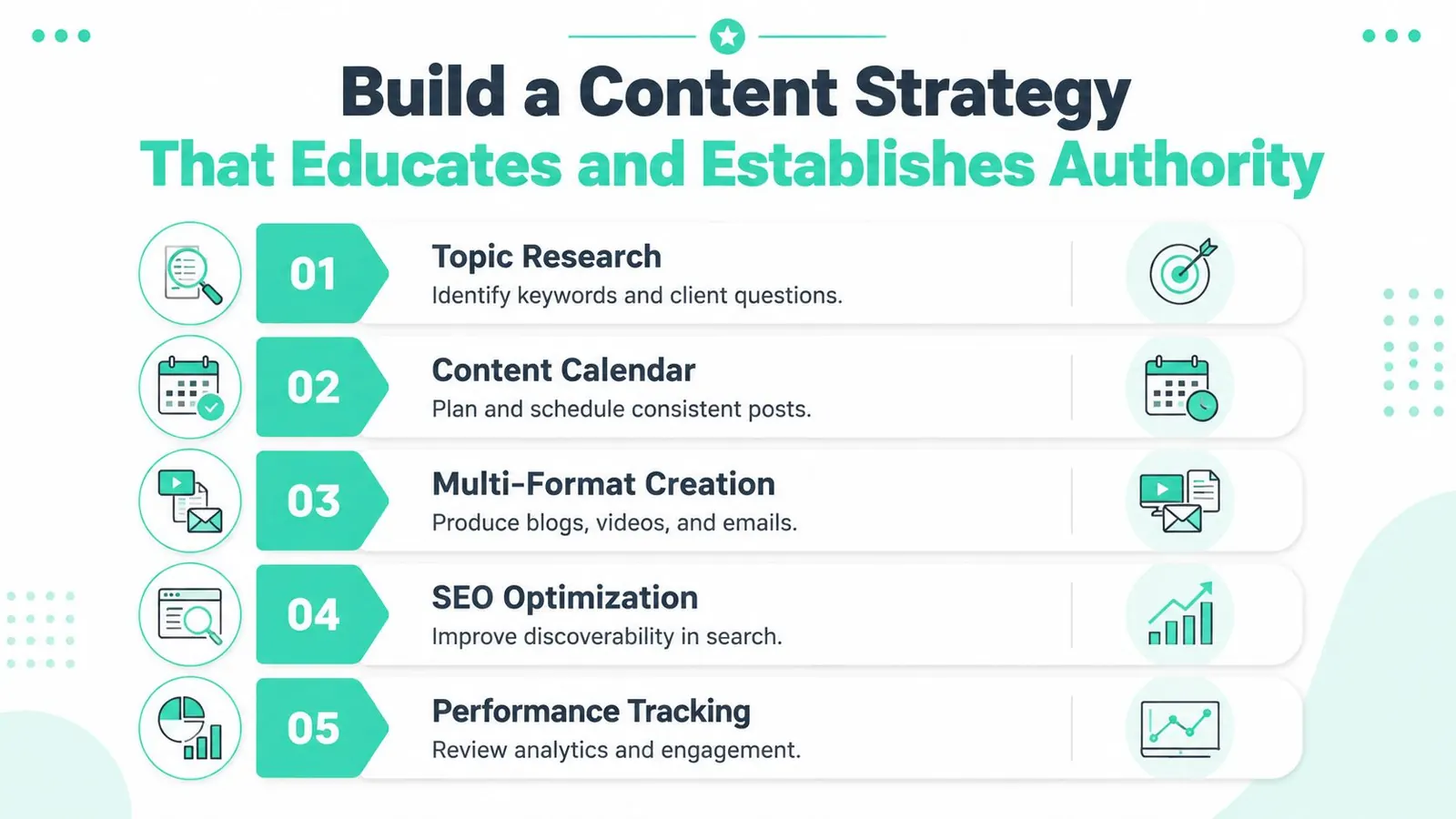
Content shouldn't exist to fill a calendar. It should remove uncertainty for people who may need your service but aren't ready to contact you yet.
Collect questions from consultations, phone calls, front-desk conversations, reviews, and staff experience. Turn those questions into articles, short videos, email explanations, social posts, FAQs, and downloadable resources. A patient wondering what to expect from an eye exam needs a different answer from someone comparing lens options. A legal prospect may need help understanding a process before discussing a case. Useful content respects that decision journey.
The best topics usually have a clear audience and a clear next step. Explain what happens, who benefits, what preparation involves, what questions to ask, and when a person should seek professional advice. Avoid exaggerated promises and generic articles that could belong to any practice in any city.
Create one strong piece, then adapt it. An article can provide material for a newsletter, a short video, a profile update, and a conversation prompt for social media. That reduces the burden on a small team while keeping the message consistent.
The Leaping Lemur Media journal reflects this educational approach, with guidance relevant to dental, eye doctor, cosmetic surgery, and broader practice marketing. Content takes time to build visibility, so judge it by qualified inquiries, useful conversations, search impressions, and assisted conversions, not only immediate bookings.
5. Develop a Consistent Social Media Presence That Reflects Your Practice Personality
Social media is most useful when it helps people understand what it feels like to work with you. It shouldn't become a second website filled with disconnected promotions or a daily obligation that exhausts the team.
Choose the platforms where your clients and professional community already pay attention. For many local practices, doing a thoughtful job on one or two platforms is more realistic than maintaining a weak presence everywhere. Build recurring themes such as education, team introductions, community activity, client questions, service explanations, and occasional offers.
Show personality without losing professional judgment. A behind-the-scenes post can make a practice approachable. A staff introduction can make a first visit feel less intimidating. A response to a common question can demonstrate expertise. For healthcare and other sensitive services, get documented permission before sharing client stories, images, or outcomes, and never discuss private details in public replies.
What to prioritize
- Useful education: Answer questions in language a non-specialist can understand.
- Human context: Show the people, process, and community behind the service.
- Conversation: Reply to comments and messages with care and a clear next step.
- Visual consistency: Use recognizable colors, photography, and tone.
- Review discipline: Treat public complaints as reputation issues, not arguments to win.
Algorithm changes can reduce organic reach, and social media requires ongoing attention. It also shouldn't replace your website or email list. Use it to create familiarity and direct interested people toward assets you control.
6. Use Video Content to Build Trust and Demonstrate Expertise
Video lets prospective clients assess your communication style before they make contact. That matters for services involving anxiety, personal confidence, health, finances, or legal uncertainty.
Start by recording a clinician explaining a common procedure, a team member answering an FAQ, or a provider describing how a consultation works. Good audio, steady framing, captions, and a clear opening matter more than cinematic production. A vertical video can work on social platforms, while a longer explanation may belong on your website, YouTube, or in an email.
Use video to make invisible parts of the experience visible. Show how the team prepares, what a first appointment includes, how clients can get ready, or what questions they should bring. Testimonials can be valuable when clients give informed permission and speak in their own words. Before-and-after content needs particular care, including appropriate consent and context.
One recording can become several useful assets. Pull a short answer for social media, embed the full explanation on a service page, add a transcript for accessibility and search, and send the resource to relevant email segments. If you need help creating short-form content, AI tools for TikTok brand growth can support ideation and production workflows, but automated output still needs a human review for accuracy, tone, and privacy.
Don't force staff members on camera if they're uncomfortable. A clear voiceover, screen recording, animation, or narrated walkthrough can still educate effectively.
7. Master Email Marketing for Client Retention and Relationship Building
Email gives a practice a direct communication channel that it controls more than a social platform. Use it to stay useful between appointments, support follow-up, explain services, welcome new subscribers, and invite appropriate next steps.
A broad newsletter sent to everyone can work occasionally, but relevance improves when you separate audiences by service interest, client status, location, or recent interaction. A new inquiry might need an educational welcome sequence. A past client may need a reminder about continued care. Someone who downloaded a guide may benefit from answers to the next questions they're likely to ask.
Industry benchmarks vary, but independent SMB email research reports average returns of about $36 for every $1 spent, with some retail and e-commerce segments reaching $42 per $1. The same source reports that automated sequences can generate 320% more revenue per email than non-automated broadcasts. Those figures aren't a guarantee for a local practice, but they support a sensible conclusion: automation and segmentation deserve attention before sending more one-off campaigns.
A dependable email foundation
- Permission: Collect addresses transparently and follow applicable email rules.
- Welcome flow: Set expectations and provide an immediate useful resource.
- Follow-up: Send relevant post-inquiry or post-appointment guidance.
- Re-engagement: Reach inactive contacts with a helpful reason to return.
- Measurement: Track clicks, replies, inquiries, bookings, unsubscribes, and revenue where possible.
Email can lose trust if every message asks for a sale. Keep the content helpful, concise, mobile-friendly, and aligned with the promise you made when someone subscribed.
8. Create a Referral and Word-of-Mouth Strategy
Referrals shouldn't depend on a staff member remembering to ask at the perfect moment. Build a simple system around the experience you already provide.
First, identify moments when clients express satisfaction. A positive follow-up message, a successful treatment milestone, a kind review, or a thank-you call may create a natural opportunity. Ask directly but without pressure. Give people a clear way to refer, such as a dedicated page, a shareable message, or a personal introduction process.
Track the source. A simple intake question, CRM field, booking form option, or spreadsheet can reveal which clients, partners, services, and messages generate introductions. Thank the referring person even when the new prospect doesn't become a client. Recognition strengthens the relationship without making every interaction feel transactional.
Referral incentives require care. For some professional and healthcare practices, ethical, regulatory, or industry rules may restrict payments or rewards for referrals. Review the requirements that apply to your business before offering anything. A sincere thank-you, community contribution, educational event, or client appreciation gesture may be more appropriate than a discount.
Referrals are powerful because they transfer trust, but they can't rescue a confusing experience. Make sure the referred person receives a prompt response, understands what happens next, and encounters the same positioning and service quality that motivated the original recommendation.
9. Implement Strategic Local Partnerships and Community Involvement
Community presence becomes credible when it reflects a real commitment rather than a logo placed on every available banner. Choose organizations, causes, businesses, and events that connect naturally with your values and the people you serve.
A dental practice might collaborate with a school or family-focused organization. An eye doctor could support a community group connected to healthy aging or education. A medspa may partner with complementary wellness businesses. A law firm may contribute practical education through a local association. The partnership should create value for the audience, not just exposure for the sponsor.
Look for useful exchanges. A complementary business might host your educational session while you provide a resource for its audience. Two local businesses can create a shared guide, co-host an event, or refer clients when needs overlap. Set expectations in writing, including who owns the event, how names and data are handled, and what each partner will contribute.

Community involvement may produce referrals, goodwill, local recognition, and useful content, but it rarely works as an instant lead source. Build relationships before asking for promotion. Attend events, share partner work, teach something practical, and follow through. People can tell when a business supports a cause only because it wants a marketing asset.
10. Implement Retargeting and Paid Advertising to Amplify Your Best Strategies
Paid advertising should amplify a clear message and a working conversion path. It shouldn't compensate for an incomplete Google Business Profile, a weak landing page, unclear positioning, or slow lead response.
Use Google Search Ads when people are actively looking for a service. Use Facebook and Instagram ads when visual education, local awareness, or retargeting fits the decision process. Retargeting can remind previous website visitors or content viewers about a relevant service, but privacy rules and platform policies need to guide audience setup.
Local relevance is especially important. Google's local-search guidance reports that four in five consumers want search ads customized to their city, zip code, or immediate surroundings in its local advertising research. Use location-specific copy, landing pages, service details, and calls to action rather than sending every prospect to a generic homepage.
Before launch, decide what counts as a conversion. It might be a phone call, booking request, form completion, consultation, or qualified inquiry. Connect ad clicks to a landing page that repeats the promise, answers objections, shows proof, and offers one obvious next step.
Paid campaigns can waste money quickly when targeting, tracking, creative, or follow-up is weak. Start with a controlled test, review the quality of inquiries, and pause what doesn't contribute. If you need help connecting paid promotion with SEO, content, and digital PR, review Leaping Lemur Media's marketing services.
11. Master Email Marketing for Client Retention and Relationship Building
Email belongs in the system twice because acquisition and retention require different messages. A welcome sequence helps a new contact understand your practice. Retention communication helps an existing client continue a relationship, return for appropriate care, or recommend you to someone else.
Separate these purposes instead of sending one campaign to the entire database. A prospective client may need reassurance, credentials, service education, and a consultation invitation. An established client may respond better to useful maintenance guidance, appointment information, relevant updates, or a personal note from the team.
Automation can help, but it shouldn't make the practice sound robotic. Use triggers based on real interactions, review each sequence regularly, and give clients a clear way to update preferences or stop receiving nonessential messages. Marketing automation adoption remains uneven. One SMB automation report cited 64% of SMBs planning to adopt marketing automation within two years, while only 30% of SMBs using email software had automation in place at the time. That gap suggests an approachable maturity path, build a reliable email foundation first, then automate repeatable journeys.
Retention emails also need operational alignment. If a client replies with a question, someone must own the response. If a message promotes booking, the calendar must be accurate. Technology can trigger communication, but the team still creates the trust that turns communication into a relationship.
11-Point Small Business Marketing Tips Comparison
| Strategy | 🔄 Implementation Complexity | ⚡ Resource Requirements | ⭐ Expected Outcomes | 💡 Ideal Use Cases | Key Advantages |
|---|---|---|---|---|---|
| Define Your Authentic Brand Positioning | Medium–High, requires leadership alignment and iteration | Low $ • High time & introspection | ⭐⭐⭐⭐, clearer messaging, better client fit | Rebranding or launching practices that need differentiation | Consistency, trust, attracts ideal clients |
| Optimize Your Website as a 24/7 Lead Generation Tool | Medium, design, content, SEO work | Medium $ • Ongoing maintenance | ⭐⭐⭐⭐, 24/7 lead capture and credibility boost | Practices needing bookings, patient education, SEO foundation | Improves conversions, reduces unqualified inquiries |
| Leverage Local SEO & Google Business Profile Optimization | Medium, setup + continuous review management | Low–Medium $ • Regular review/time | ⭐⭐⭐⭐, strong local visibility and high-intent traffic | Single-location or multi-location practices targeting local search | Cost-effective, drives foot traffic and calls |
| Build a Content Strategy That Educates & Establishes Authority | Medium, planning + consistent creation | Medium–High time or budget for quality content | ⭐⭐⭐, growing organic authority and long-term traffic | Practices that educate clients and aim to rank organically | Evergreen assets, credibility, reduces ad dependency |
| Develop a Consistent Social Media Presence | Medium, platform selection, scheduling, engagement | Low–Medium time; optional creative budget | ⭐⭐⭐, improved visibility and community engagement | Consumer-facing practices building local awareness | Humanizes brand, fosters loyalty with low media spend |
| Use Video Content to Build Trust & Demonstrate Expertise | Medium–High, production and editing workflow | Medium–High $ or skill investment | ⭐⭐⭐⭐, fast trust-building and higher engagement | Demonstrating procedures, testimonials, FAQ answers | Highly shareable, strong conversion lift |
| Master Email Marketing for Client Retention & Relationship Building | Medium, segmentation and automation setup | Low–Medium $ (ESP) • ongoing content time | ⭐⭐⭐⭐⭐, highest ROI; improves retention & LTV | Retention-focused practices and appointment-driven services | Direct owned channel, highly measurable and personalizable |
| Create a Referral & Word-of-Mouth Strategy | Low–Medium, program design and staff training | Low $ • incentives and tracking tools | ⭐⭐⭐⭐, high-quality leads and better conversions | Practices with satisfied clients seeking organic growth | Cost-effective, higher LTV from referred clients |
| Implement Strategic Local Partnerships & Community Involvement | Medium, relationship building and event coordination | Low–Medium time and occasional sponsorship costs | ⭐⭐⭐, earned credibility and referral opportunities | Community-rooted practices and event-driven outreach | Expanded reach, earned media, strengthened local ties |
| Implement Retargeting & Paid Advertising to Amplify Strategies | Medium–High, targeting, creative, and optimization | Medium–High $ (ad spend) • analytics expertise | ⭐⭐⭐⭐, fast, scalable leads with measurable ROI | When accelerating growth or amplifying proven messages | Scalable, precise targeting, amplifies organic wins |
Turn the Best Tips Into a Repeatable Growth System
Strong small business marketing is a connected system, not a stack of isolated tactics. Positioning gives the website, content, and social channels a recognizable voice. The website and Google Business Profile make the practice findable. Educational content and video address concerns before someone contacts you. Reviews, referrals, partnerships, and community involvement make the promise credible. Email and paid promotion keep the practice present when interest is already developing.
Build the foundation before adding another channel. Define the clients you serve best and the experience you want associated with your practice. Then fix the website message, contact path, mobile usability, and trust signals. Complete the local profile and establish a repeatable review process. Publish practical education based on questions your team hears every day.
Add relationship systems once those basics work. Ask for referrals at appropriate moments, build partnerships with complementary organizations, and use email to continue useful conversations. Add automation only after the workflow is stable. Paid advertising belongs later, when you have a credible landing page and a clear method for judging inquiry quality.
Measurement often needs the most practical attention. Constant Contact research found that 23% of decision-makers said they didn't know what was working, while 21% described marketing as too expensive and 19% said it took too much time to manage. A separate global SMB survey reported that 33% struggled to measure performance and 25% lacked a strategy or plan. The response is a smaller set of priorities, clear ownership, and consistent tracking.
Choose one primary goal for the next planning period. It could be qualified consultation requests, booked appointments, repeat visits, or referrals. Assign responsibility for maintaining the profile, approving content, and following up with leads. An elaborate dashboard is not required at the start. Track source, inquiry, response, appointment, and client outcome in a shared spreadsheet or CRM.
Review the pattern regularly. Keep channels that produce useful conversations and clients. Adjust channels that create attention without action, and stop activities that consume time without supporting the goal. This actionable growth strategy for companies turns marketing from a task list into a system that improves through consistent practice.
Leaping Lemur Media can support practices that want marketing to sound like them, reflect their values, and connect with their communities. A suitable partner should listen first, clarify the story, build the systems, and remain involved enough to refine the work as the practice grows.
Leaping Lemur Media helps dental practices, eye doctors, medspa owners, law firms, and other local businesses build positioning, websites, local search, content, email, paid advertising, and community-focused growth systems. Visit Leaping Lemur Media to explore a marketing partnership designed to make your practice recognizable, findable, trusted, and measurable.