You don't have a marketing problem. You have a coordination problem.
If you run a dental practice, medspa, optometry clinic, or small law firm, you probably already have the usual stack, a Google Business Profile, a Facebook page, maybe an Instagram account that gets touched when someone remembers it, an email list that hasn't been cleaned since 2019, and a front desk that's busy enough without becoming a media team. The mistake is trying to be “active” everywhere. The job is getting the right few channels to work together so a person moves from first glance to booked appointment without your staff having to improvise every step.
Table of Contents
- What Multi Channel Marketing Really Means for a Small Practice
- Choosing the Right Channels for Your Practice Type
- Building Consistent Messaging Without Sounding Robotic
- Planning Your First 90-Day Multi Channel Campaign
- Setting a Realistic Budget and Allocating It Across Channels
- Tracking KPIs That Change Your Decisions
- Common Pitfalls and How to Dodge Them
What Multi Channel Marketing Really Means for a Small Practice
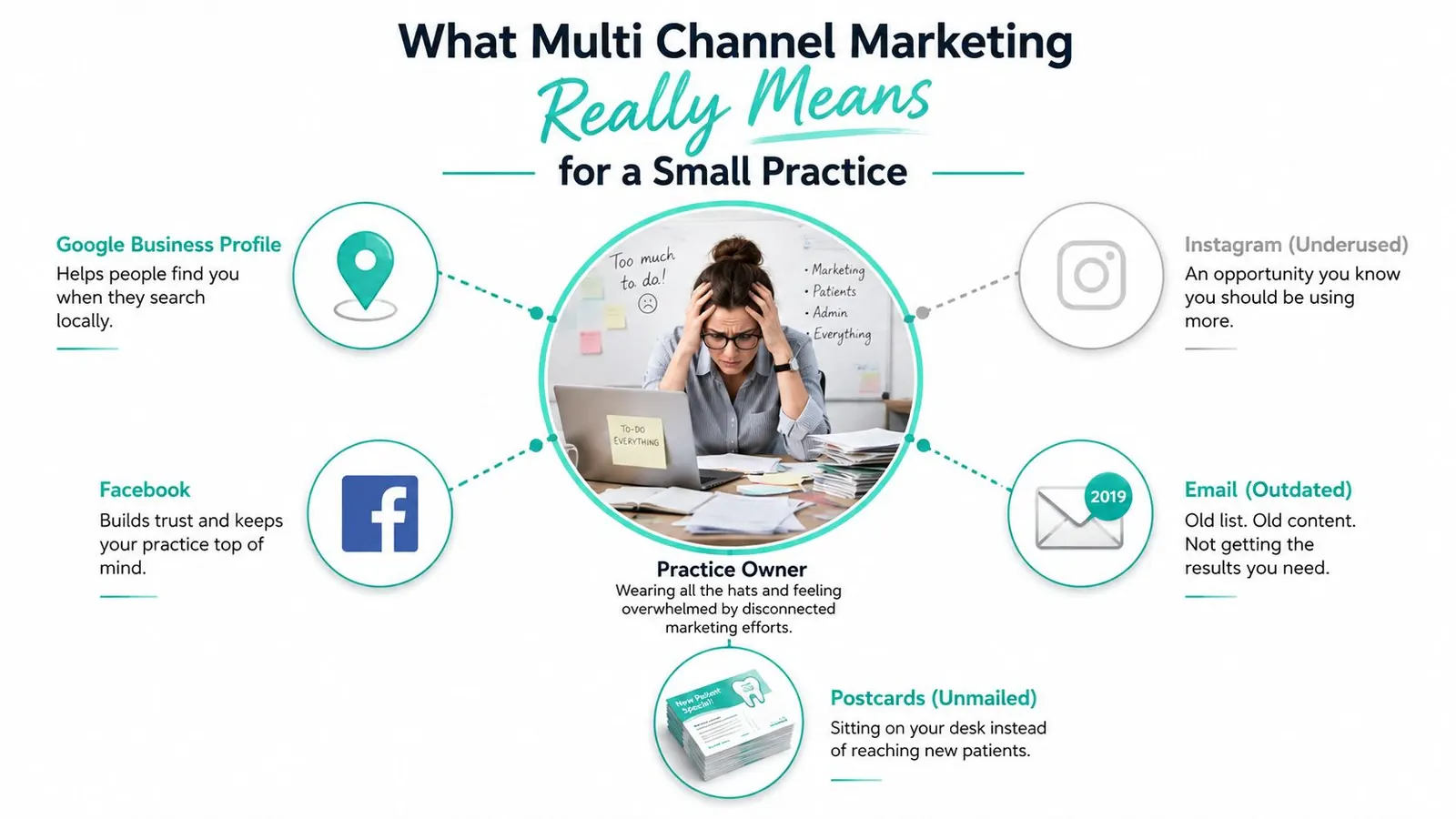
A lot of practice owners think multi channel marketing means posting on more platforms. That's the wrong definition. If your Google Business Profile says one thing, your Facebook page says another, your email says something else, and your front desk answers the phone like it's a different company, you don't have a strategy. You have noise.
Coordination beats presence
For a small practice, multi channel marketing means coordinated touchpoints that move a patient or client from awareness to booked appointment. The channels can be different, but the message, timing, and next step need to line up. That's the point where a good Google search, a short email sequence, a social proof post, and a front desk call script stop acting like separate efforts and start acting like one system.
That's also where people confuse multi channel with omnichannel. Omnichannel is about a fully connected customer experience across touchpoints. Multi channel is less ambitious and more practical. It's the right fit when you need to coordinate several channels without building a giant tech stack or reorganizing the whole practice. If you want a clear side-by-side breakdown, the multi channel vs omnichannel explained resource is a useful reference.
The working definition I'd give your front desk
If I were training a receptionist, I'd keep it simple. Multi channel marketing is the practice of using a few channels on purpose, with one message, one offer, and one booking path. If the person saw you on Instagram, clicked through an email, and called the office, they should feel like the same practice is answering them each time.
Practical rule: if a channel doesn't help someone book, follow up, or trust you faster, it's probably decoration.
The big strategic reason coordination matters is that small practices don't have room for wasted effort. Every extra channel creates more work for content, more pressure on the front desk, and more chances for a promise to get out of sync. Presence is easy to buy. Coordination is what converts.
Choosing the Right Channels for Your Practice Type
Most owners pick channels because a competitor is doing it or a salesperson pitched it hard. That's backwards. Start with the way your patients or clients buy, then match channels to that behavior. The 2025 B2C channel mix makes the point plainly, email is used by 82.4% of marketers, social media by 66.7%, mobile websites by 58%, desktop websites by 52.7%, and mobile apps by 51.6% MoEngage. In other words, people move across a handful of major touchpoints, not a random pile of platforms.
Fit first, not competitor first
A single-location dentist usually needs local search, email, and a clean website before anything flashy. A medspa needs Instagram, email, Google Business Profile, and usually SMS because the purchase is visual and time-sensitive. An optometry practice can lean on local search, email reminders, and reputation-driven content. A small law firm usually wins with search, website, email follow-up, and review management, because the buyer is cautious and comparison-heavy.
The table below is how I'd trim the list if I were walking into each type of practice this quarter.
| Practice Type | Primary Channels | Secondary Channels | Skip or Defer |
|---|---|---|---|
| Single-location dentist | Google Business Profile, website, email, search ads | Facebook retargeting, reviews, SMS reminders | Broad social posting, long-form content engine before basics work |
| Aesthetic medspa | Instagram, Google Business Profile, email, SMS | Short-form video, retargeting ads | LinkedIn, heavy offline campaigns before booking flow is clean |
| Optometry practice | Google Business Profile, website, email, local search ads | Facebook, educational content, SMS reminders | Trend-driven social content with no appointment path |
| Small law firm | Google search, website, email, reviews | LinkedIn, retargeting, educational content | TikTok, broad awareness channels with weak intent |
A useful way to think about it is operational load. If your team can't answer leads fast, don't add channels that create more incoming noise. If your service is high consideration, don't chase channels that are built for impulse. If your budget is tight, prioritize channels that already sit close to the point of booking.
What I'd cut first
If you need to reduce your list to three or four channels, cut whatever has weak audience fit, weak conversion intent, or weak staff capacity. I'd usually start by trimming vanity-heavy channels that look active but don't create booked visits. If you need a service team to manage setup, landing pages, and follow-up, make sure the channel has a real role before you keep paying for it. For agencies that support this kind of channel triage, Leaping Lemur Media's service page is a straightforward example of how multi-channel work gets packaged into execution, not just strategy.
The 46,000-shopper behavior pattern cited in independent coverage makes the same case from a customer angle, 73% used multiple channels during the shopping journey, compared with 7% who were online-only and 20% who were store-only Christoph Olivier Consulting. That's not a retail-only story. It's a reminder that most buyers don't live in one channel, so your practice shouldn't market as if they do.
Building Consistent Messaging Without Sounding Robotic
Consistency is not copying the same post everywhere. That's lazy, and patients can feel it. Consistency means the same practice voice, the same core promise, and the same next step, while the format changes to fit the channel.
Build one message, three layers
I use a simple split.
- Core message: what you want people to remember.
- Tone profile: how the practice should sound.
- Channel rules: how that voice should show up on Google, email, social, and SMS.
For a dentist, the core message might be “gentle care, clear treatment plans, easy scheduling.” The tone profile is calm, reassuring, and professional. Google Business Profile copy should be direct and local. Email can be a little warmer. Social can show faces, office culture, and reviews without losing professionalism.
For a medspa, the core message might be “natural-looking results with guided care.” The tone can be polished and confident, but not cold. On Instagram, that voice can be aspirational. In email, it should become specific and offer-driven. For a law firm, the tone should be clear, grounded, and confident. No drama. No hype.
Write the message once, then make the format do the work.
Here's a quick worksheet you can finish in one sitting:
- What do we want to be known for?
- What do we never sound like?
- What is the one action every channel should push?
- What proof points can we repeat safely?
- What words or claims need to stay identical across the website, ads, and front desk script?
Same message, different channel
Before: “We offer personalized care and great results.”
After on Google: “Personalized cosmetic dentistry in a comfortable local setting. Book a consultation today.”
After on Instagram: “Beautiful results start with a plan that fits your face, your goals, and your timeline.”
After in email: “If you've been thinking about treatment, here's the easiest way to start. Reply or book online and we'll guide you from there.”
The same approach works for legal and aesthetic practices too. A law firm can sound direct on search ads, reassuring in email, and educational on its website without changing the underlying claim. The point isn't to be clever. The point is to be recognizable in five seconds and persuasive in five more.
Planning Your First 90-Day Multi Channel Campaign
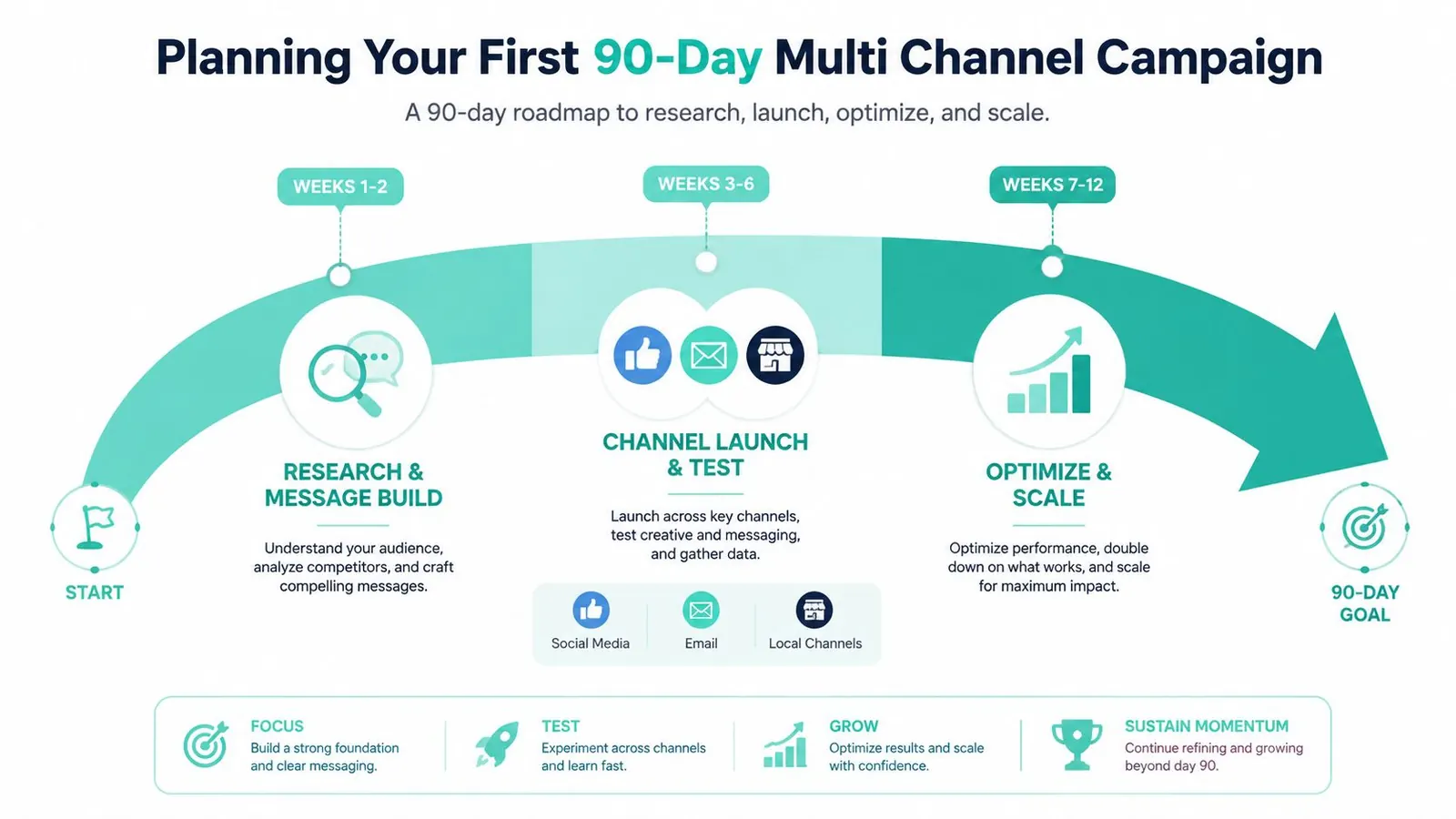
A 90-day campaign should not feel like a giant launch. It should feel like a controlled series of tests around one offer, one audience, and one booking path. If you try to run five offers at once, your front desk will be the first place the confusion shows up.
Start with one offer and four channels
I'd structure the first cycle around one concrete offer, such as a consult, a limited-time package, or a seasonal service. Then I'd choose four channels max, usually email, Google Business Profile, Instagram or Facebook, and SMS if opt-in is already clean. That's enough to create repetition without overwhelming staff.
The launch rhythm should look like this:
- Weeks 1 and 2: research, offer build, messaging, landing page, tracking setup.
- Weeks 3 to 6: soft launch, small audience test, front desk script alignment, first measurement check.
- Weeks 7 to 10: improve the weak points, tighten the offer, shift spend toward the channels that create bookings.
- Weeks 11 to 12: document what worked, package the next quarter, and stop doing the stuff that created friction.
If you want a broader content rhythm resource for short-form creative, TransClipper's short-form video strategy insights are useful as a format reference, especially when a practice needs to turn one message into multiple clips without inventing a new campaign every week.
Sample rhythm for a medspa
If I were promoting a spring laser package, I'd keep the calendar tight.
- Email: launch announcement, reminder, final call.
- Google Business Profile: service post, review pull quote, availability update.
- Instagram: before-and-after style education, clinician face-to-camera, FAQ reel.
- SMS: opt-in only, short reminder, booking link.
The goal is not volume. The goal is repetition with variation. People rarely book the first time they see a service, especially in elective categories. You want the same offer showing up in different contexts so it feels familiar, not pushy.
For practices that need help turning this into an actual workflow, Leaping Lemur Media's contact page is the kind of starting point that makes sense when the issue isn't “more ideas” but “someone has to build and run this.”
Setting a Realistic Budget and Allocating It Across Channels
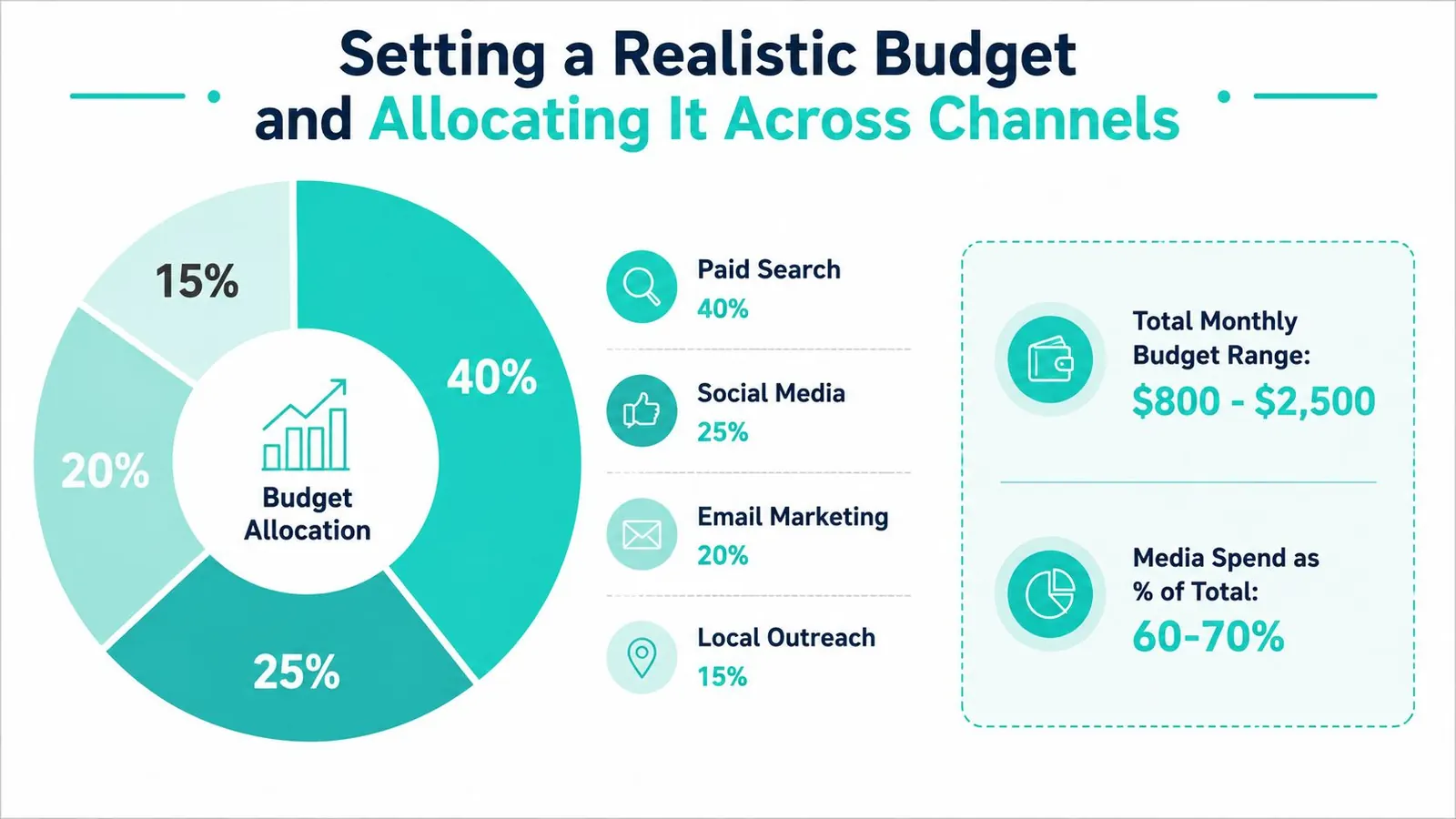
Budgeting fails when owners split money evenly, starve the channels that close business, or forget that staff time is part of the cost. The size of the budget matters less than whether it matches the practice's current ability to absorb leads and follow up well. A $3,000 monthly spend and a $30,000 monthly spend are not the same problem.
Spend by stage, not by ego
If a practice is doing about $20K in monthly revenue, the marketing budget has to stay lean. If it's doing $60K, there's room for a tighter mix with some paid support. If it's doing $150K, the practice can support a more complete system with stronger content, ads, tools, and operational oversight. I'd still tie the split to lead source and maturity, not just channel popularity.
Here's how I'd think about the allocation.
- Paid media: use it to create demand or capture intent.
- Content production: use it to make the practice understandable and credible.
- Tools: use them to keep follow-up and tracking from breaking.
- Staff time: treat it as a real line item, because someone has to answer, route, and clean up the lead flow.
The two items that get cut too early are staff time and measurement tools. That's usually a mistake. If nobody owns the lead response process, paid spend leaks. If nobody can see where bookings came from, the practice starts making emotional decisions instead of operational ones.
If a channel creates work the front desk can't sustain, it's too expensive even when the media cost looks cheap.
A practical split for a small practice usually puts the biggest share into the channel most likely to produce booked visits, then backs it with email, local visibility, and a little support content. Strong omnichannel engagement is associated with much higher retention than weak engagement, with independent coverage reporting about 89% retention for strong engagement versus 33% for weak engagement Porch Group Media. I'd treat that gap as a reminder that retention is part of budget planning, not a separate department.
Tracking KPIs That Change Your Decisions
If you track the wrong numbers, you'll kill good channels and keep bad ones. That's what happens when practice owners chase likes, opens, or followers without tying them to bookings. I'd keep the KPI stack lean and decision-focused.
The four numbers I'd review
- Cost per booked appointment by channel. This tells you what to cut or scale.
- Show rate by source. This tells you whether the lead quality is real or just cheap.
- List growth rate. This tells you whether your audience is compounding or shrinking.
- Channel-attributed revenue. This tells you where the money is really coming from.
A simple rule works here. If a channel is cheap but leads don't show, it is not cheap. If a channel gets attention but does not book, it is not a conversion channel. If a channel drives list growth but not immediate revenue, do not cut it just because it is not the last touch.
The tracker you use can be basic. A CRM with source fields, a scheduling system that writes back, and a monthly review meeting are enough to start. The point is to have one source of truth for bookings, not three platforms telling you three different stories. If you want a practical starting point, the Leaping Lemur Media journal is a good place to look for campaign planning and tracking ideas that keep the work tied to operations.
A simple attribution model that won't break
For small practices, I'd start with a straightforward source-based model. Capture the first meaningful source when the lead enters the system, then compare it against the booking outcome and the show outcome. That is not perfect attribution, but it is enough to make better budget decisions without overbuying software.
If the data starts lying to you, you will see it. The front desk will report leads that never match the CRM. Campaigns will look successful in one platform and dead in another. Staff will stop trusting the numbers. That is your signal to fix the workflow before you add more channels.
The measurement problem is real. Industry analysis says the global multichannel marketing market was estimated at $181.77 billion in 2024, is projected to reach $192.91 billion in 2025, and could reach $349.74 billion by 2035, implying a 6.13% CAGR over that period USA Mask Khan. The multi-channel marketing hubs segment was valued at $6 billion in 2024 and is projected to reach $29.7 billion by 2034 at a 17.7% CAGR. That growth makes one thing obvious, the tools are getting bigger because coordination is harder, not easier.
If you want to keep the stack clean, build in this order. CRM first, then scheduling that writes back, then email and SMS connected to that record, then review requests tied to completed appointments. Avoid automations that sound clever but annoy patients, like blasting reminders too often or sending mismatched offers after someone has already booked.
Common Pitfalls and How to Dodge Them
The same failures show up in practice after practice. They are predictable, which is useful, because you can catch them early instead of blaming the channels.
The mistakes I see most often
- Launching before tracking exists: The symptom is simple, everyone has an opinion on performance and nobody trusts the numbers. Fix it by setting up source capture before the campaign goes live.
- Copying a competitor's channel mix: The symptom is a busy feed and weak bookings. Fix it by choosing channels based on your audience, not their branding.
- Treating email like a billboard: The symptom is decent opens and poor responses. Fix it by writing email as a next-step tool, not a broadcast.
- Ignoring SMS opt-in discipline: The symptom is irritated patients and messy unsubscribe behavior. Fix it by using SMS only where the patient clearly agreed to it.
- Leaving the front desk out of the plan: The symptom is strong lead flow and weak conversion at the handoff. Fix it by giving the team a script, response window, and clear escalation path.
If the front desk can't explain the offer in one sentence, the campaign isn't ready.
One more failure pattern deserves a direct callout, channel overload. The temptation is to add another platform when the first few do not work fast enough. That usually just spreads the problem around. More surfaces do not fix weak offers, messy follow-up, or unclear positioning.
Coordination is the key challenge, not reach. A small practice with limited staff can manage three channels effectively if each has a specific purpose and the front desk understands the next steps. Adding a fourth channel often creates confusion rather than revenue unless the team has established follow-up procedures.
Pick your three channels for the next 90 days. Write the one message every channel has to reinforce. Set the one KPI you will review every month, and do not add a fourth channel until the first three are doing their job. If you want help building a practical multi-channel system for a practice, Leaping Lemur Media works with dentists, medspas, optometry practices, and law firms on the planning, execution, and follow-through that turn scattered marketing into booked appointments.