You're a good dentist. Patients who find you tend to stay. Your team delivers solid care, your office runs well enough, and word of mouth still brings in some appointments. But when someone in your area searches for veneers, emergency dental care, or a new family dentist, your practice barely shows up.
That's the frustration behind most conversations about search engine optimization dentists. The issue usually isn't clinical quality. It's discoverability. In a market where roughly 77% of patients look online before booking a dental appointment, and most never scroll past the first page of search results according to Digitally Top's dental SEO overview, a practice can be excellent and still lose patients to whoever is easier to find.
SEO in 2026 isn't a side project for the office manager. It's the system that helps your community connect your services with their needs at the exact moment they're searching. Done well, it strengthens local visibility, builds trust before the first phone call, and creates a clearer path from online search to booked appointment. Done poorly, it turns into busywork that produces rankings reports but not enough new patients.
Table of Contents
- Why Your Practice Feels Invisible Online
- Dominate the Map Your Local SEO Foundation
- Turn Your Website Into a Patient Magnet
- Create Content That Answers Patient Questions
- Build Authority with Local Links and Partnerships
- Track What Matters Patient Acquisition and ROI
- Your Prioritized Dental SEO Roadmap and FAQs
Why Your Practice Feels Invisible Online
Most dental practices don't disappear online because they lack effort. They disappear because their marketing is fragmented. The website says one thing, the Google Business Profile says another, reviews come in sporadically, and service pages are too thin to compete with practices that have built a stronger local presence.
That creates a common problem. Google sees an incomplete digital footprint, while patients see a practice that feels harder to evaluate. If a competitor has clearer service pages, fresher reviews, better local visibility, and faster load times, they often win the click before your office even gets a chance.
Visibility isn't the same as credibility
A lot of dentists assume that once the website is live, the hard part is over. It isn't. A website is only one piece of the search journey. Patients compare map results, review snippets, office photos, service descriptions, and how confident they feel booking with you.
If you need a plain-English refresher on the mechanics, Feather has a helpful overview of the basics of search engine optimization. It's useful because SEO for dental practices isn't magic. It's the repeated work of making your practice easier for search engines to understand and easier for patients to trust.
Practical rule: If your online presence doesn't answer “Where are you, what do you do, and why should I trust you?” within a few seconds, patients keep searching.
What invisibility usually looks like in a dental practice
It rarely shows up as a single major failure. It usually looks like a cluster of smaller misses:
- Thin service coverage: You offer implants, Invisalign, cosmetic dentistry, and emergency visits, but your site treats them as a short list on one page.
- Mixed local signals: Your office hours, categories, or business details vary across platforms.
- Weak conversion paths: Visitors have to hunt for your phone number, request form, financing info, or next step.
- Low proof of trust: Few recent reviews, outdated office photos, and generic copy make the practice feel less established.
Here's the trade-off. Many practices chase broad rankings and ignore local buying intent. That feels productive because rankings are easy to talk about. But patients don't book because you rank for a vanity term. They book because they found the right service, in the right area, with enough confidence to call.
| What feels productive | What actually helps |
|---|---|
| Publishing random blog posts | Building clear service and location relevance |
| Watching keyword reports daily | Improving pages that drive calls and forms |
| Tweaking home page copy repeatedly | Strengthening local signals across search, maps, and reviews |
The practices that grow through SEO treat it as patient acquisition infrastructure. That mindset changes the work. Instead of asking, “How do I get more traffic?” ask, “How do I become the obvious local choice when someone is ready to book?”
Dominate the Map Your Local SEO Foundation
For dentists, local SEO isn't one channel among many. It's the foundation. For dental services, 78% of Google searches have local intent, meaning that care-seekers typically seek a nearby provider, as noted in Dominate Dental's guide to SEO for dentists.
That changes your priorities. You're not trying to win the whole internet. You're trying to become highly visible in the communities you serve.
Why local search matters more for dentists
A patient looking for a dentist usually has practical constraints. They care about distance, insurance, appointment availability, specialty, office feel, and trust. That's why the map pack often matters more than a standard blue-link ranking.
If your practice serves one city, several neighborhoods, or a few nearby towns, local relevance should shape almost every SEO decision you make. That includes the language on your service pages, the categories in your profile, the reviews you request, and the places your business is mentioned online.
For practices refining local targeting, LucidRank offers a guide to local SEO success that's especially useful for thinking through location-based keyword intent.
What to fix inside your Google Business Profile
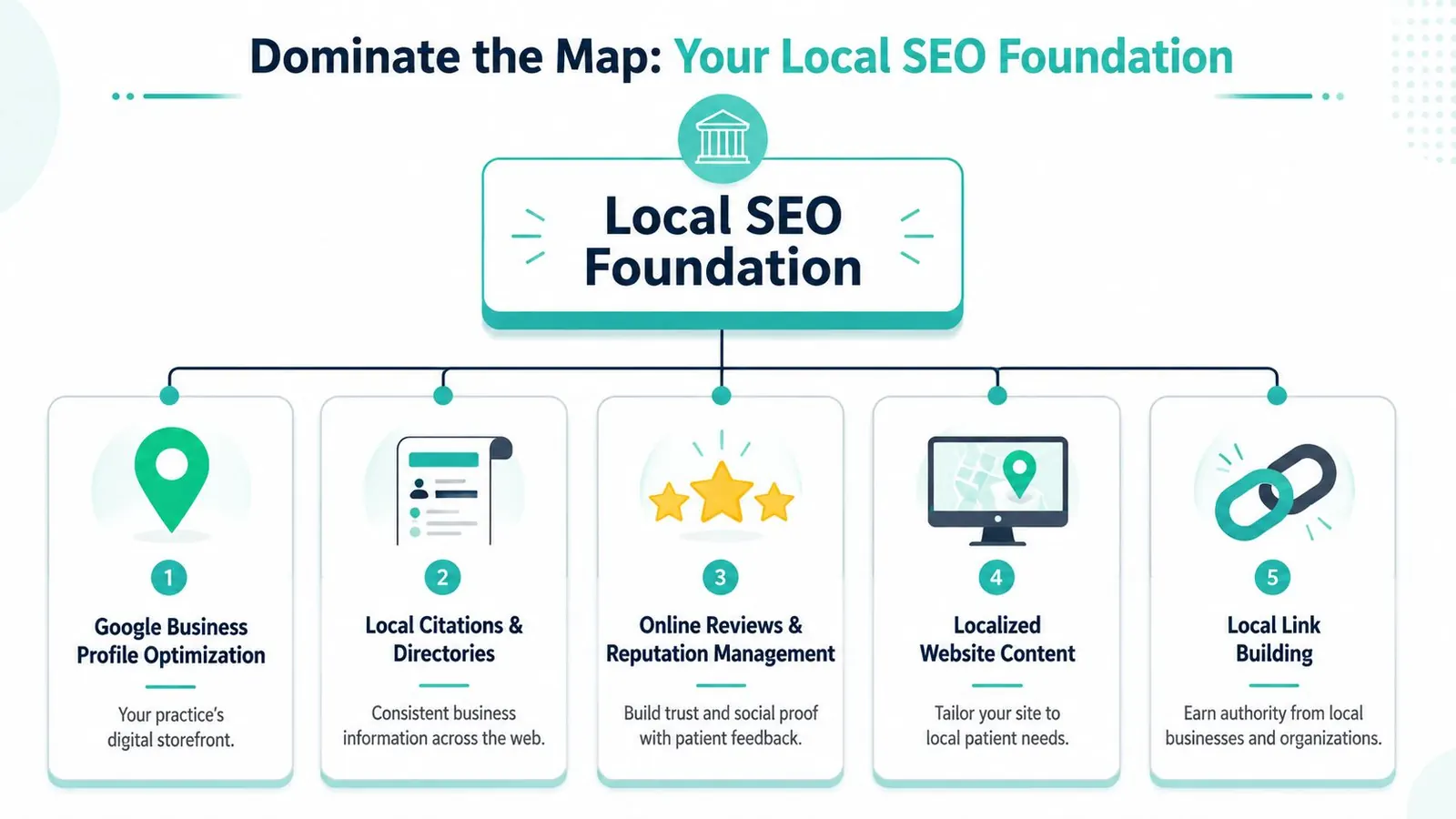
Your Google Business Profile is your digital storefront. Too many practices fill in the basics and stop there. That leaves visibility on the table.
Start with the essentials and then go deeper:
-
Get your core details exact
Your practice name, address, phone number, website, hours, and appointment link need to match reality and stay consistent everywhere else online. -
Choose categories carefully
Your primary category should reflect your main offering. Secondary categories can support specialties, but don't stuff them. -
List services in patient language
Don't rely on internal jargon alone. Use terms people search, such as emergency dentist, dental implants, clear aligners, or teeth whitening. -
Add real office photos
Reception, operatories, exterior signage, team images, and dentist headshots help patients feel familiar before they visit. -
Use posts and Q&A intentionally
Updates about services, seasonal reminders, financing information, or common questions can reinforce relevance and trust.
The strongest profiles feel maintained, not abandoned.
The local signals that support your map visibility
Your map presence doesn't stand on the profile alone. It needs reinforcement from the rest of your digital footprint.
A strong local foundation usually includes:
- Citation consistency: Your business details should appear consistently in major directories, healthcare listings, and local business platforms.
- Review management: Ask happy patients for feedback in a steady, compliant way. Don't batch requests only when numbers feel low.
- Localized site content: Your website should connect services to the places you serve, not just mention your city once in the footer.
- Community authority: Links and mentions from local organizations strengthen relevance.
If you want a practical view of how local visibility fits into a broader strategy, Leaping Lemur Media outlines its approach to local search for community focused businesses.
A useful weekly routine is simple:
- Check profile accuracy
- Respond to new reviews
- Upload fresh photos
- Review top patient questions
- Look for citation mismatches
What doesn't work is treating local SEO like a one-time setup. The map rewards active, accurate, trustworthy practices. If your competitors keep updating while your profile sits untouched, they gain ground without doing anything flashy.
Turn Your Website Into a Patient Magnet
A Google Business Profile gets attention. Your website has to convert it. If the profile is the front door, the site is the consultation room where patients decide whether to trust you enough to book.
That means your dental website can't function like a digital brochure. It needs to match intent, remove friction, and make the next step obvious.
Build pages for services patients actually search for
Many practices hide valuable services inside one general treatments page. That hurts both relevance and conversions. A patient searching for dental implants isn't looking for a broad menu. They want a focused page that answers implant-specific questions.
Strong dental sites usually have separate pages for core services such as:
- Emergency dentistry
- Dental implants
- Invisalign or clear aligners
- Teeth whitening
- Crowns and bridges
- Pediatric or family dentistry
- Cosmetic dentistry
Each page should speak to one intent. It should explain who the service is for, common concerns, what the visit process looks like, and how to take the next step. The page title, heading structure, internal links, and call-to-action should all support that purpose.
For practices reworking their web presence, website development for patient focused businesses is part of the equation because design and SEO affect each other. A beautiful site that hides important information still loses patients.
Speed and mobile experience decide whether people stay
Patients don't browse dental websites with much patience. They're often on a phone, in between tasks, comparing options quickly. More than 53% of users abandon a mobile site that takes longer than three seconds to load, according to Practice Cafe's 2026 SEO myth-busting article.
That's why mobile performance isn't a technical side note. It directly affects patient acquisition.
Common problems include:
| Weak experience | Better experience |
|---|---|
| Giant image files | Compressed, properly sized images |
| Tiny buttons | Thumb-friendly calls to action |
| Buried phone number | Sticky call button or clear header contact info |
| Long text blocks | Scannable sections with service-specific headings |
A slow dental site feels like a front desk that never picks up.
What a conversion focused dental page should include
The best-performing service pages balance clarity and reassurance. They don't sound like a textbook, and they don't read like generic agency copy.
Look for these elements:
- A clear headline: “Dental Implants in [City]” is better than “Restorative Solutions.”
- A trust-building opening: Explain the problem you solve and who you help.
- Visible contact paths: Click-to-call button, request form, and location details.
- Practical FAQs: Cover recovery, candidacy, financing, timelines, or urgency depending on the service.
- Real proof: Team credentials, office photos, and patient-centered explanations.
What doesn't work is stuffing pages with city names or writing copy that sounds optimized for a robot. Search engines have gotten better at detecting pages that exist only to rank. Patients can spot them even faster.
Create Content That Answers Patient Questions
The old advice was simple. Start a blog, post regularly, and traffic will come. For dentists, that advice is incomplete. A random stream of generic articles won't do much if the topics don't match patient concerns or local service intent.
Search behavior has changed, and so has the way search results are presented. As of 2026, practices must win two battles simultaneously: Google's local map pack and AI-generated answer engines, as explained in Dentalscapes' article on adapting to AI search.
Stop publishing generic blog posts
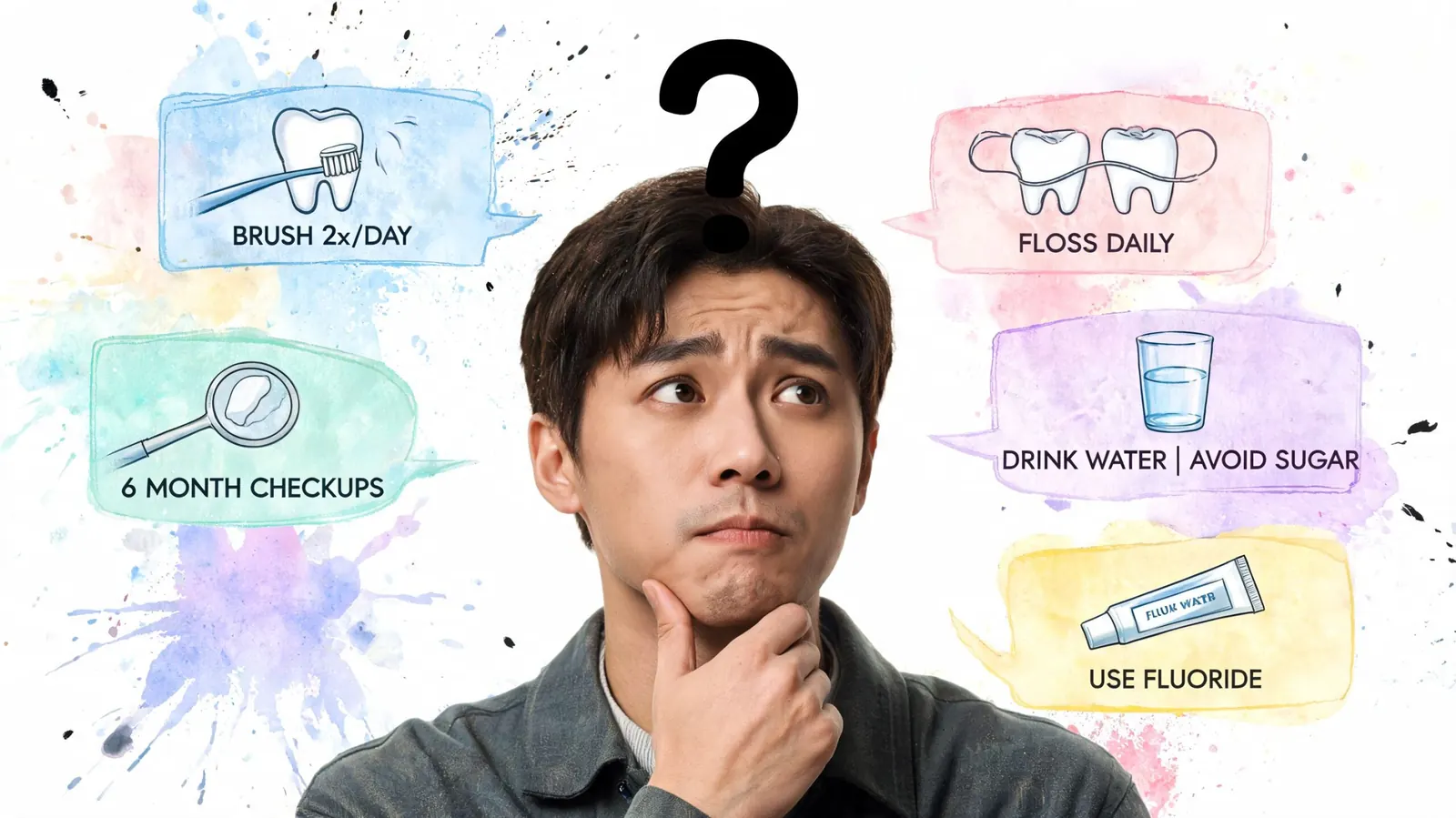
A post titled “Why Dental Health Matters” won't move much. It's too broad, too familiar, and too far from booking intent.
Useful dental content starts with actual patient questions. Think about what your front desk hears every week:
- Does a root canal hurt?
- How soon should I come in for a broken tooth?
- What's the difference between veneers and bonding?
- Am I a candidate for Invisalign?
- How long do dental implants take?
- What should I do if my child chips a tooth?
That kind of content works because it meets patients in moments of uncertainty. It also gives your practice a chance to sound calm, informed, and human before a call ever happens.
How to structure content for AI summaries and human readers
AI-driven search surfaces reward clear structure. That doesn't mean writing for machines first. It means formatting your expertise so both people and search systems can understand it easily.
A stronger format looks like this:
-
Lead with the answer
Open with a direct response in plain English. -
Break the topic into clear subheads
Use headings that match the patient's mental checklist. -
Add practical detail
Explain symptoms, options, timing, risks, next steps, or when to call the office. -
Connect to care
Include when professional evaluation matters and how to book.
Short, clear answers near the top often perform better than long introductions.
A few content habits help a lot:
- Use one page for one main question: Don't cram multiple unrelated concerns into a single article.
- Write like a clinician speaking clearly: Skip fluff and heavy jargon.
- Support service pages with question content: Educational content should lead naturally toward care pages when relevant.
- Refresh aging content: If a page is useful but outdated, improve it before creating something new.
If your practice publishes educational material regularly, keeping it organized matters. A well-structured library of dental blog content and patient education pages is easier to maintain, easier to link internally, and more likely to build authority over time.
What doesn't work in 2026 is content for content's sake. Every page should answer a real question, support a real service, or strengthen real trust.
Build Authority with Local Links and Partnerships
Link building sounds technical until you translate it into normal business behavior. For a dental practice, most worthwhile links come from relationships, community involvement, and credible local visibility.
That's good news, because dentists already have natural opportunities to build local authority without chasing gimmicks.
Think relationships first not backlinks first
A strong local link usually starts offline. You sponsor an event, support a nonprofit, collaborate with another healthcare provider, join a business organization, or contribute expertise to a community publication. The link serves as the digital evidence that relationship exists.
This is why generic link packages tend to disappoint. They may create activity, but they rarely create local trust. A mention from a nearby school fundraiser, chamber organization, or respected neighborhood publication carries much more contextual value for a community-based practice.
Partnership ideas that actually fit a dental practice
Here are the kinds of partnerships that tend to make sense:
- Referral partners: Orthodontists, oral surgeons, pediatricians, or primary care offices may collaborate on educational resources or referral pages.
- Community sponsorships: Youth sports teams, school programs, local races, and nonprofit events often thank sponsors on their websites.
- Educational outreach: A practice can offer oral health workshops, school hygiene talks, or community Q&A sessions that earn local mentions.
- Neighborhood media: Local bloggers, city magazines, and business journals often feature community-focused businesses.
One useful test is simple. If an opportunity would still be worth doing without the link, it's probably a healthier SEO move.
Here's a practical checklist:
| Partnership type | Why it helps |
|---|---|
| Local nonprofit support | Builds trust and often earns community mentions |
| Healthcare collaboration | Reinforces topical relevance and referral pathways |
| Chamber or business membership | Improves local legitimacy |
| Event participation | Creates branded visibility beyond search |
There's also a branding benefit. These efforts make your practice feel present in the community, not just listed online. That matters because local SEO works best when digital signals reflect real-world reputation.
What doesn't work is pursuing links that have no local or professional connection to your practice. If the source feels random, patients notice. Search engines do too.
Track What Matters Patient Acquisition and ROI
A lot of dental SEO reporting looks busy. Ranking graphs. Traffic screenshots. Lists of keywords moving up and down. Those reports can be interesting, but they don't answer the question practice owners ultimately care about. Is this producing patients?
That's where attribution becomes the difference between marketing activity and marketing accountability. According to AEO Engine's perspective on SEO for dentists, a major gap in most dental SEO guidance is tracking which efforts convert to paying patients rather than just measuring traffic.
Vanity metrics can hide weak marketing
Traffic can rise while revenue stays flat. Rankings can improve for terms that don't bring qualified patients. Even form submissions can mislead if they include spam, job seekers, or people outside your service area.
That's why patient acquisition SEO has to connect search visibility with actual outcomes. Not just impressions. Not just clicks. Bookings.
What to track instead
A more useful measurement approach looks at the path from search to appointment.
Focus on metrics such as:
- Phone calls from organic search
- Appointment request forms tied to specific pages
- Google Business Profile actions
- Which service pages drive qualified inquiries
- Which search queries lead to patient contact
- How many inquiries become scheduled visits
Google Search Console helps identify query and page visibility. Google Analytics helps show user paths and conversion behavior. Call tracking tools and CRM notes help close the loop between lead and patient.
If your agency can't tell you which pages and search channels produce inquiries, you're not getting strategy. You're getting surface-level reporting.
Questions to ask your marketing partner
Use these questions in your next meeting:
- Which service pages generated leads last month?
- Are calls and form fills tracked separately?
- Can you show which search queries led to contact?
- How are Google Business Profile actions reported?
- What changes are we making based on conversion data?
This is also where a marketing partner should act like an operator, not just a vendor. Some practices handle tracking internally with their web team and front desk workflow. Others use outside support. Leaping Lemur Media is one example of a firm that offers SEO services for practices that want local visibility tied more closely to measurable growth, but the fundamental standard is simpler than any brand name. Whoever you work with should connect search performance to patient outcomes.
What doesn't work is accepting monthly SEO summaries with no attribution. If the reporting stops at rankings and traffic, it stops too early.
Mastering Technical SEO for a Healthy Digital Practice
Technical SEO is what keeps a good website from underperforming. A clean design and helpful content won't carry much weight if pages load poorly, key pages aren't indexed correctly, or search engines can't read the structure of your site.

Focus on the technical signals that matter most
A practical workflow for dental SEO includes measurable performance targets. The benchmark guidance is to aim for Largest Contentful Paint under 2.5 seconds, First Input Delay below 100 milliseconds, and Cumulative Layout Shift below 0.1 in this dental SEO best-practices resource.
Those metrics sound technical, but they map to simple patient experiences:
- Largest Contentful Paint asks how quickly the main content appears.
- First Input Delay reflects how quickly the page responds when someone taps.
- Cumulative Layout Shift measures whether buttons and text jump around while loading.
If your booking button moves while a patient tries to tap it, that's not just a web issue. It's a conversion issue.
A solid technical review should also include:
- Mobile usability checks in Google Search Console
- Indexability checks for core service pages
- Broken link cleanup
- Canonical review for duplicate page problems
- Image compression and code cleanup for speed
For practices rebuilding or refining site performance, services like custom website development for healthcare practices can be relevant when technical constraints are coming from the site build itself, not just the content.
Use schema and audits to remove hidden problems
Schema gives search engines cleaner context about your business and your pages. For dental practices, the most useful starting points are LocalBusiness or MedicalBusiness on key business pages and FAQPage where the page includes question-and-answer content.
Technical checkpoint: Schema doesn't replace strong content. It helps search engines interpret strong content more reliably.
Quarterly audits are worth the discipline because technical problems often accumulate. Common issues include duplicate location pages, blocked pages that should rank, outdated redirects, thin treatment pages, and inconsistent metadata across major services.
The point isn't to chase every possible technical tweak. It's to remove the issues that stop your best pages from being fully understood, crawled, and trusted.
Pricing Ranges and Realistic ROI Timelines
Dental SEO pricing should reflect competition, locations, service lines, technical debt, and the amount of implementation required. A low monthly fee may be reasonable for a rural practice with an established profile and limited competition. It's usually inadequate for a multi-location group competing in a dense metro area.
The common tiers look like this:
| Tier | Monthly Cost | Core Deliverables | Expected ROI Timeline | Best For |
|---|---|---|---|---|
| Budget | $1,000–$2,500 | Basic Google Business Profile management, citation work, limited optimization | Early visibility work may appear before patient acquisition becomes measurable | Practices with narrow goals and lower competition |
| Mid-market | $2,500–$5,000 | Technical SEO, localized service content, profile optimization, review systems, reporting | Early traction in 3–4 months, measurable new patient flow in 6–9 months | Most single-location practices |
| Premium | $5,000–$10,000+ | Multi-location management, advanced link acquisition, content architecture, conversion optimization | Compounding returns typically require 12+ months of sustained work | Competitive markets and larger practice groups |
These ranges and timelines are the planning framework for this article, not a promise that every practice will follow the same path. Early traction can mean improved rankings or more Google Business Profile impressions. Measurable patient flow requires stronger evidence, such as attributable calls and appointment requests.
What your investment should buy
Budget work often handles maintenance but leaves strategic gaps. Mid-market work is generally the practical fit when a single-location practice needs technical fixes, service pages, local authority, and a repeatable reputation process. Premium work makes sense when the consultant must coordinate multiple locations, compete for several treatment categories, or build meaningful authority beyond directory listings.
Be wary of a consultant who sells a long timeline without measurable checkpoints. SEO compounds, but that doesn't excuse silence. You should receive a baseline, a prioritized roadmap, monthly reporting, and a clear explanation of what changed and why.
ROI also depends on patient economics. Use your own production and new-patient data to calculate the break-even point. Don't accept a generic revenue assumption from a vendor. A campaign is only commercially sound when the value of attributable patients justifies the investment and the practice can handle the additional demand.
How to Vet a Consultant and Spot Red Flags
The most dangerous assumption in dental marketing is that more content and more backlinks automatically create more patients. They don't. A practice can publish generic articles for months while its Google Business Profile remains incomplete, its reviews go unanswered, and its most valuable service page offers no clear path to book.
Questions that expose real experience
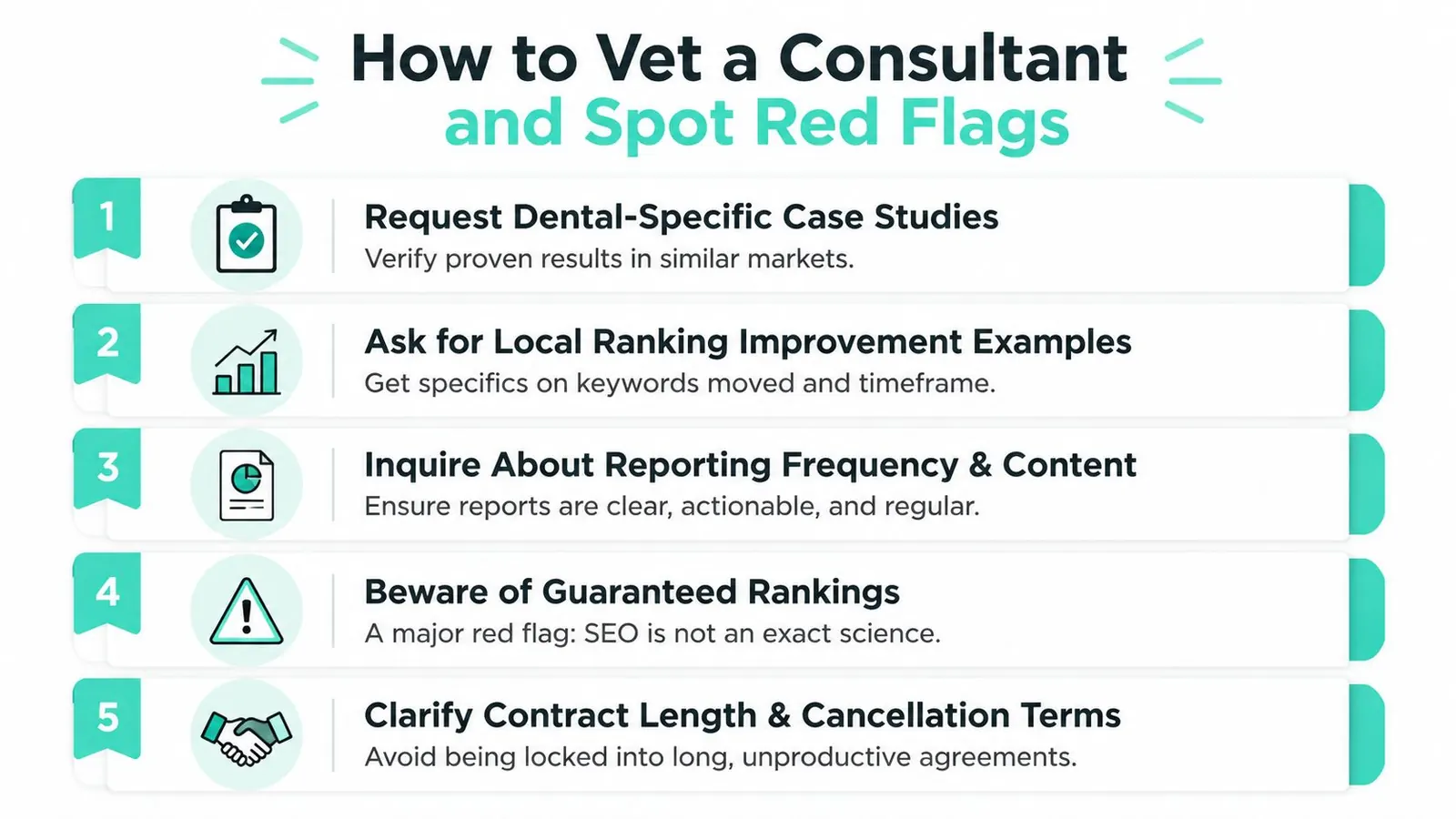
Ask for case studies from dental practices in markets comparable to yours. The consultant doesn't need to disclose confidential information, but they should be able to describe the starting point, priority services, local challenges, implementation work, ranking trajectory, and patient-attribution process.
Then ask for evidence rather than adjectives:
- Which procedure-specific keywords improved? Ask about terms such as “Invisalign near me,” emergency dental services, or implant searches in your market.
- What changed in the Google Business Profile? Look for category accuracy, service alignment, review activity, photos, and location relevance.
- How do you attribute new patients? A credible answer includes call tracking, form attribution, booking-source questions, and Google Business Profile actions.
- What will appear in the monthly report? Request a sample before signing.
- What happens if the engagement ends? You should retain access to your website, profile, analytics, Search Console, content, and reporting history.
Red flags worth taking seriously
Guaranteed number-one rankings are a bad sign. Search systems change, competitors respond, and proximity affects local results. A serious consultant can set targets and show progress, but they can't guarantee a specific position.
“Proprietary methods” also deserve scrutiny. Ask what work will be completed. If the answer is vague, the label is hiding a thin deliverable.
Other warning signs include:
- Backlink volume over relevance: A large number of unrelated links isn't a local authority strategy.
- Generic content calendars: “Ten tips for healthy gums” won't help much if your emergency and implant pages are weak.
- No reporting dashboard: You should be able to inspect performance without waiting for a sales call.
- Long lock-in terms: A contract shouldn't prevent you from leaving an unproductive engagement.
- No patient attribution: Traffic and rankings aren't enough.
For a broader framework on how to measure search ad success, focus on the same discipline here, separate visibility from conversion and conversion from actual business value. You can also review Leaping Lemur Media's approach when comparing partners, but judge every provider by its process and evidence.
If the report talks more about links built than chair time filled, ask harder questions.
Your Prioritized Dental SEO Roadmap and FAQs
If your SEO feels scattered, simplify the order of operations. Start with the assets closest to patient action, then build outward. That keeps the work grounded in visibility, trust, and conversion instead of endless optimization tasks.
Your practical roadmap
Quick wins
- Tighten your Google Business Profile: Correct categories, services, hours, photos, and appointment links.
- Fix conversion friction on the website: Make sure calls, forms, and location details are easy to find on mobile.
- Audit your core service pages: Each high-value treatment should have its own focused page.
Quarterly projects
- Build or improve local service pages: Especially for the treatments you most want to grow.
- Publish patient-question content: Prioritize questions that front desk staff hear often.
- Clean up local citations: Inconsistencies create confusion for both patients and search engines.
Ongoing habits
- Request reviews consistently
- Refresh photos and office updates
- Review Search Console data
- Update pages that generate inquiries
- Build local partnerships that create real visibility
The bigger insight is this. Search engine optimization dentists should not be treated as a collection of disconnected tactics. It works when local search, website experience, content, authority, and tracking all support the same goal: helping the right patients choose your practice with confidence.
Dental SEO FAQs
How long does dental SEO take to show results
It depends on your starting point, market competition, and how much foundation work is missing. Local improvements can show earlier than broader authority gains, especially when your Google Business Profile and website need obvious fixes.
Can I do SEO myself or should I hire someone
You can handle parts of it internally, especially review generation, photo updates, service-page feedback, and patient-question content. If technical issues, attribution, and local strategy become hard to manage consistently, outside help usually makes sense.
What is the single biggest SEO mistake to avoid
Treating SEO like a rankings project instead of a patient acquisition system. If your visibility improves but your office can't trace calls, forms, or booked appointments back to the work, you won't know what to scale.
If your practice needs help turning search visibility into measurable growth, Leaping Lemur Media provides SEO and local search support built around community presence, clear positioning, and patient-focused marketing execution.
Running a dental practice? See our dental marketing services.