

Your firm is getting attention. Prospective clients find you through search, a colleague sends referrals, and paid campaigns generate calls. Yet someone leaves a voicemail during a consultation, another person submits a form nobody owns, and your marketing report still celebrates clicks.
The most useful law firm marketing trends address that disconnect. Owners need more than visibility. They need a coordinated way to attract suitable matters, help people take the next step, and understand which investments produce signed engagements.
Table of Contents
- Why Law Firm Marketing Is Being Rewired
- The Core Principles Behind Effective Growth
- Adapting to SEO and Local Search
- Building a Content Strategy With Expertise
- Choosing Paid and Social Channels
- Using Reviews and Local Visibility
- Applying AI Personalization Responsibly
- Turning Trends Into an Action Plan
Why Law Firm Marketing Is Being Rewired
Consider a prospective client who finds your practice through an advertisement, checks your website, and calls with a time-sensitive concern. Your website promises attentive service, but the call goes unanswered. When someone eventually replies, they ask the caller to repeat information already submitted online.
That's a hypothetical situation, not a case study. It's also a useful test: does the experience after someone contacts you match the promise that persuaded them to reach out?
Owners should treat marketing as a connected acquisition experience, not separate assignments for an agency, receptionist, and attorney. Someone must oversee the handoffs between them.
Advertising Requires Financial Discipline
ATRA's legal-services advertising estimates put spending above $2.5 billion across more than 26.9 million advertisements in 2024; between 2020 and 2024, spending rose approximately 39%, while advertisement volume fell roughly 4%. Higher spending alongside fewer advertisements points toward more expensive or targeted placements, rather than simple volume growth.
That doesn't establish what your firm should spend. It does make a strong case for scrutinizing what your budget buys beyond exposure.
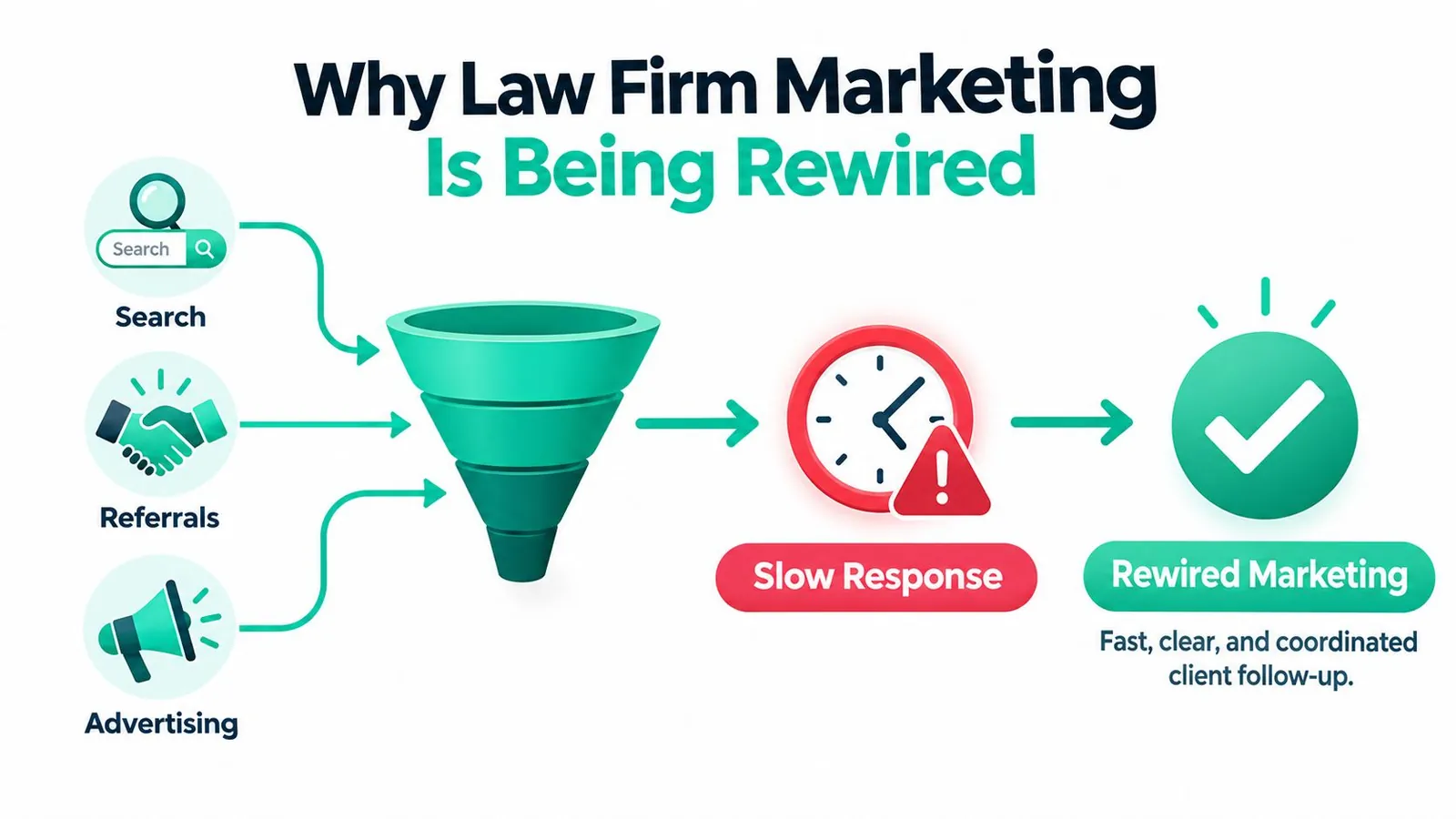
Manage the Entire Acquisition Experience
Use a shared operating map:
- Attention: A suitable prospect discovers your firm through search, advertising, or a referral.
- Inquiry: They contact you through an accessible, clearly explained route.
- Qualified consultation: Staff establish whether the matter fits and arrange the appropriate conversation.
- Engagement: The prospective client understands the scope, terms, and requirements for retaining the firm.
Assign responsibility at each transition. Marketing staff shouldn't declare success at the inquiry stage while intake staff struggle with unmanageable demand.
A website and social profile are starting assets, not a distinctive strategy. Your advantage should come from the clarity of your positioning, the credibility of your expertise, and your team's ability to deliver the experience you advertise.
The Core Principles Behind Effective Growth
Think of your marketing operation as a storefront, a concierge desk, and a reputation system. The storefront attracts attention. The concierge helps visitors understand their options. Your reputation gives them reasons to trust what they see.
A polished storefront can't compensate for an unattended desk.
Clio's 2024 research found that only 33% of 500 tested U.S. law firms responded to email inquiries, and 40% answered phone calls; firms with selected client-facing technologies generated 51% more leads and 52% higher revenues than firms without those capabilities. Those technology comparisons describe associations, not proof that installing software causes financial growth.
Principles for Better Investment Decisions
Evaluate every proposal against these standards:
- Client fit: Specify the matters, jurisdictions, and client needs you intend to serve. A campaign that attracts unsuitable inquiries creates work without advancing that goal.
- Trust before promotion: Show relevant attorney experience and useful explanations. Don't substitute sweeping claims for evidence.
- Frictionless next steps: Make the requested action understandable. People should know whether they're requesting a callback, scheduling a consultation, or beginning an application process.
- Ethical accuracy: Require appropriate legal review of advertising language, substantive claims, testimonials, and automated communications.
- Closed-loop measurement: Connect acquisition activity to qualified consultations and engagements, rather than stopping at clicks.
These principles also clarify staffing decisions. An agency can manage campaign execution, an intake coordinator can own inquiry handling, and an attorney can approve legal content. The owner still needs to resolve gaps between those responsibilities.
Budget rule: Don't authorize more demand until you know who will handle it and how you'll recognize a suitable matter.
Separate Evidence From Assumptions
When a vendor presents a successful technology comparison, ask what else might explain the result. Better-managed firms may also have stronger staffing, clearer positioning, or more resources.
Use outside research to identify promising investments, then test those investments against your own baseline. The right question isn't whether a tool is fashionable. It's whether your team can identify the specific problem it should solve and measure the resulting change.
Adapting to SEO and Local Search
Your homepage shouldn't carry every search objective. Someone considering divorce representation needs different information from a business owner seeking contract counsel or a person checking whether your office is nearby.
The American Bar Association's 2024 Websites and Marketing Technology Report found that 90% of respondents had a website and 80% maintained a social-media presence, with social use declining from 89% in 2022 to 80% in 2024, as summarized in the provided legal-technology reporting. Treat ownership of these assets as a foundation, not proof of effective acquisition.
Build Pages Around Distinct Intent
Start with the services you want to grow and the jurisdictions you serve. Give each priority practice area a clear page describing relevant needs, your approach, and the next step.
A family-law page might explain how an initial consultation works and what information to prepare. A business-law page could distinguish ongoing counsel from a defined contract-review engagement. An office page should help visitors verify location, accessibility, contact details, and appointment arrangements.
Search Visibility Decision Matrix
| Asset | Best Role | Primary Conversion Path | Owner Check |
|---|---|---|---|
| Practice-area page | Match a defined legal need | Relevant consultation request | Does it attract matters we accept? |
| Jurisdiction-specific explainer | Clarify a local legal question | Related service page | Has an attorney checked applicability? |
| Local business listing | Help people verify the firm | Call or office-page visit | Are details accurate? |
| Office page | Explain access and location | Appointment inquiry | Does it describe a genuine office? |
| Attorney profile | Establish relevant experience | Practice-specific contact | Are credentials current and supportable? |
Check Foundations Before Adding Pages
Ask your website provider to review mobile usability, broken contact routes, page indexing, navigation, and loading problems. Use Google Search Console to inspect search discovery and Google Analytics to review on-site actions. These are diagnostic tools, not substitutes for a matter-management record.
Keep business information consistent across your website and Google Business Profile. Don't create location pages that imply offices or capabilities you don't have, and don't publish near-identical pages merely to insert different town names.
Define qualified consultation rate before reviewing performance. Specify both the qualifying criteria and the denominator, such as attributable inquiries, so everyone interprets the measure consistently.
Tag campaign links where appropriate and retain source information through intake. Rankings can help diagnose visibility, but they shouldn't be the final answer to whether search investment supports your practice.
Building a Content Strategy With Expertise
A busy publishing calendar isn't the same as a useful content library. Prefer an attorney-reviewed resource that resolves a meaningful question over a batch of interchangeable articles with no clear audience.
A 2025 American Bar Association article on digital advertising ethics reports that 65% of firms identify their website as their highest-return marketing channel, while 71% of lawyers say social media has generated new leads. These are different measures, so don't interpret them as a direct performance comparison between websites and social platforms.
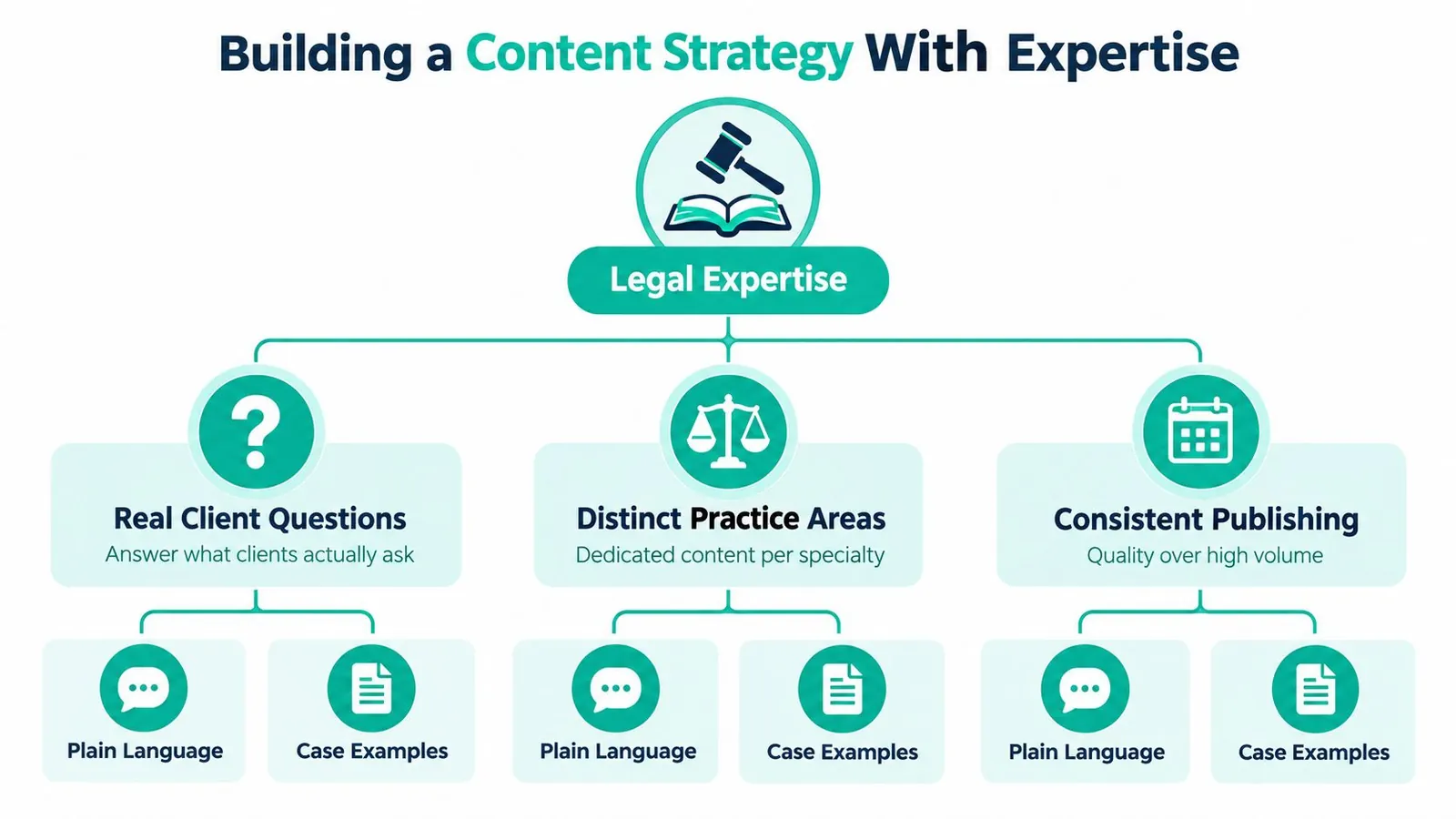
Choose Substance Before Format
Compare the job each asset should perform:
| Content Asset | Useful Application | Avoid |
|---|---|---|
| Legal explainer | Clarify a process in the relevant jurisdiction | Unsupported universal answers |
| Intake-connected FAQ | Address uncertainty before contact | Individualized advice without review |
| Educational video | Let an attorney explain a common concern | Scripted claims the attorney can't support |
| Case-oriented article | Illustrate legal considerations through an authorized or hypothetical example | Promising comparable outcomes |
Give every asset an editorial brief covering audience, question, jurisdiction, attorney reviewer, supporting material, and a relevant call to action. Reserve attorney time for the parts only they can contribute: judgment, practical distinctions, and accuracy.
Maintain Before You Multiply
Review existing material before commissioning something new. Update an outdated explanation, consolidate overlapping articles, or improve a neglected service page when that would better serve prospective clients.
For additional planning ideas, use the marketing strategy journal as a starting point for editorial discussion. CitationOS's resource on how law firms appear in AI search offers another perspective to evaluate as you consider discovery beyond conventional search.
AI can assist with outlines and editing, but your attorney reviewer should approve jurisdiction-specific statements, legal references, and descriptions of potential outcomes. Don't mistake smooth prose for accurate legal information.
Publish something because your attorneys have a useful answer, not because your calendar has an empty slot.
Keep the invitation proportional to the reader's needs. An educational article might lead to a related service page; a high-intent FAQ might invite a consultation. Neither needs a sales pitch after every paragraph.
Choosing Paid and Social Channels
Choose channels according to audience intent, service model, and staffing capacity. Don't buy a package because it includes every platform your competitors use.
Clio's research on mid-sized firms found that 51% of smaller firms identified referrals as their highest source of leads, compared with 16% of mid-sized firms; firms using a combination of e-signatures, online search ads, online schedulers, and online intake forms generated 20% higher revenue than firms without that combination. The revenue comparison doesn't isolate the contribution of advertising or prove that the tools caused the difference.
Compare the Work Behind Each Channel
| Channel | Audience Fit | Control and Attribution | Operational Demand |
|---|---|---|---|
| Paid search | People actively investigating legal help | Control targeting and landing pages; connect inquiries to matters | Search-term review and budget oversight |
| Paid social | Selected geographic or interest-based audiences | Tag campaigns and distinguish inquiries from engagement | Creative testing and qualification |
| Owned social | Professional connections and existing audiences | Track referral visits alongside assisted discovery | Consistent participation |
| Video platforms | People seeking explanations | Connect relevant videos to service pages | Attorney preparation and editing |
| Referrals | Trusted professional or client networks | Record the referring relationship | Relationship stewardship |
| Direct outreach | Appropriate business-development audiences | Track replies and resulting conversations | Careful targeting and ethics review |
LinkedIn deserves consideration for business law, employment, estate planning, and professional-liability audiences. Facebook may suit geographically focused consumer outreach. Those are fit hypotheses to validate, not universal platform prescriptions.
Fund a Test You Can Actually Evaluate
Before increasing search spend, review targeting, irrelevant queries, landing-page relevance, and conversion definitions. NotFair's Google Ads audit legal resource can serve as an additional review prompt, alongside your campaign records and agency's explanations.
Use campaign tags for attributable website visits. When someone calls and later retains the firm, consider offline conversion tracking only with appropriate privacy controls and without sending sensitive matter details into advertising systems.
Require channel-specific messaging. A referral partner needs clarity about suitable introductions; a search visitor needs a direct answer about your service; a video viewer may need an explanation before considering contact.
Include staff time, creative production, management fees, and intake capacity in your investment decision. A cheap inquiry isn't necessarily an economical client, and an expensive inquiry isn't automatically a poor investment. Evaluate matter suitability and acquisition cost together.
Using Reviews and Local Visibility
Accurate office information, authentic feedback, and consistent service descriptions help prospective clients evaluate your firm. Manage these as parts of your service presentation, not as a contest for the largest review count.
Attorney Assistant's guide to client review strategies for attorneys is a useful discussion resource when designing a review-request process. Have counsel check that process against applicable professional-conduct rules, and never disclose confidential information in a public response.
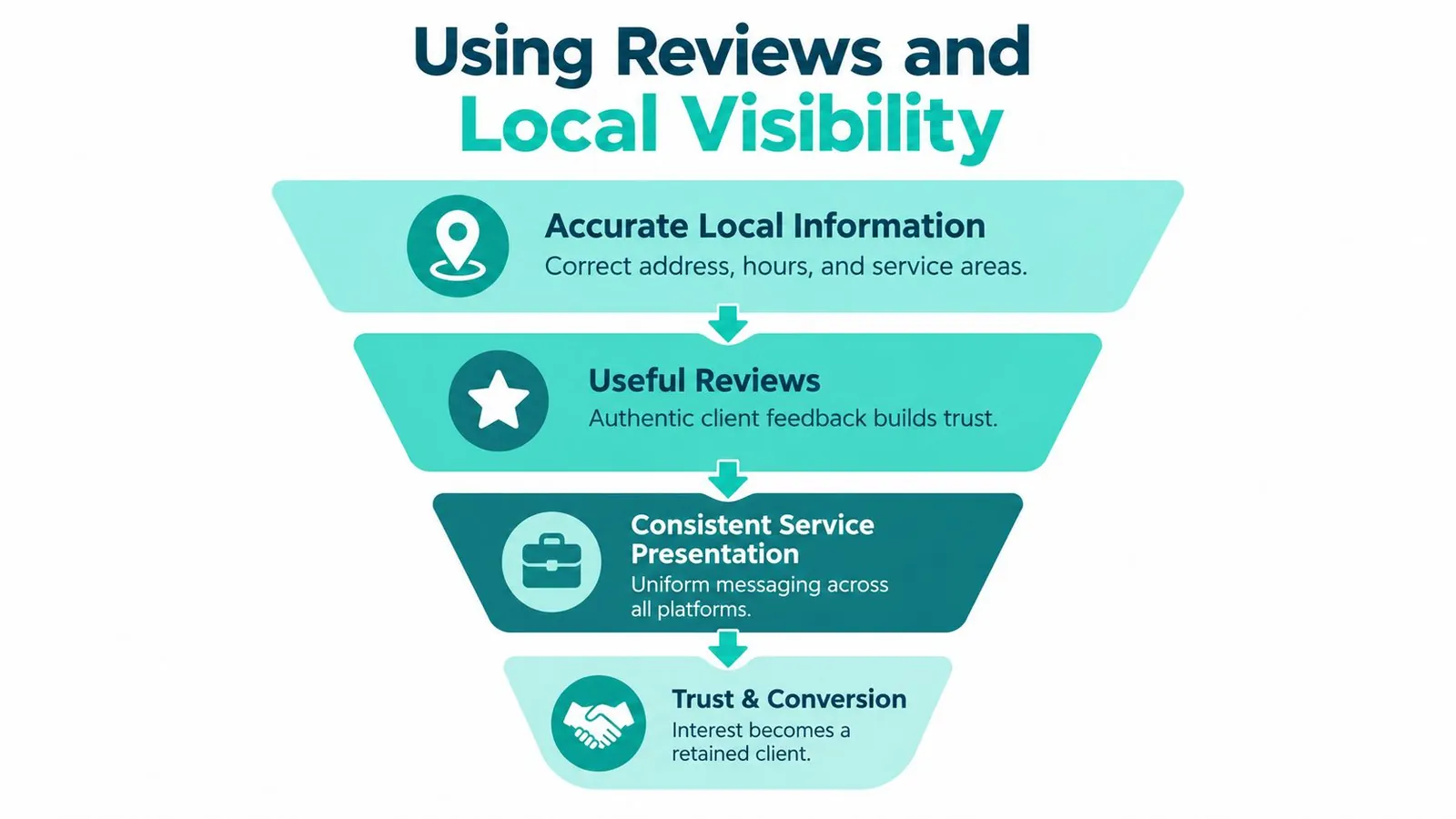
Connect Trust With an Accessible Handoff
The provided reporting on digital intake tools describes Clio's 2025 findings that solo firms using tools such as e-signatures, intake forms, and scheduling experienced 48% more client leads, with reported conversion improvements of 10% for e-signatures, 7% for text messaging, and up to 5% for online intake forms. Treat these comparisons as reasons to investigate friction, not guaranteed results for your practice.
Use an intake checklist that staff can follow:
- Minimize initial collection: Ask for the information needed to route an inquiry, not an unrestricted narrative of sensitive facts.
- Explain availability: Offer appropriate calendar options and distinguish appointment requests from confirmed consultations.
- Confirm receipt: State what happens next and who will respond.
- Assign coverage: Name the person responsible for daytime inquiries, after-hours routing, and unanswered messages.
- Preserve safeguards: Maintain conflict-check procedures, qualification criteria, secure handling, and attorney review before engagement.
- Support access: Check mobile usability, accessibility needs, and language support relevant to your community.
Diagnose the Source of Qualified Demand
Suppose an owner notices inquiries mentioning both local reviews and an advertisement. Record the campaign tag and the prospect's explanation rather than forcing a single-source conclusion.
Compare calls, forms, scheduled consultations, and signed engagements by source, practice area, device, and response time. A missed consultation may reflect scheduling friction rather than poor targeting; an unsuitable matter may indicate a messaging problem.
For firms assessing outside help with regional discovery, this Boise marketing agency overview provides a local-service option to consider. Keep responsibility for confidentiality and legal judgment inside the firm, regardless of who manages visibility.
Applying AI Personalization Responsibly
Publishing more AI-generated material is not a dependable strategy for winning legal clients. Separate content production, campaign assistance, client communication, and AI-search visibility. Each requires different controls and a different definition of success.
A 2025 legal-marketing technology study reports expanding AI use across search, social advertising, proposal generation, and SEO/GEO, with generative AI leading in content creation and editing. That evidence doesn't establish that AI visibility reliably produces qualified matters.

Establish a Reproducible Search Baseline
Create a small prompt set representing branded and nonbranded discovery. Include questions about your firm, a practice-area need, and a relevant location.
Record the platform, date, prompt, whether the firm appears, and which sources the answer cites. Preserve the context so later comparisons mean something. A changing answer isn't automatically evidence that your marketing improved or deteriorated.
Use a monitoring record with these fields:
- Accuracy: Is the firm described correctly, including services and location?
- Source quality: Does the answer cite your material, a directory, or an unreliable page?
- Commercial relevance: Does the prompt reflect a matter your firm wants?
- Downstream evidence: Did a prospect identify AI-assisted discovery, and did the inquiry become a qualified consultation?
Don't assign AI-generated visibility a financial value without supporting acquisition evidence. Self-reported discovery can be useful, but it doesn't establish the full path someone followed.
Personalize Service Without Automating Judgment
Useful personalization might route someone to the relevant practice area, display appropriate office information, or communicate through their preferred approved channel. It shouldn't infer sensitive circumstances unnecessarily or offer individualized legal conclusions.
Guardrail: Automate administrative assistance, not the professional judgment a prospective client reasonably expects from a lawyer.
Require attorney approval for jurisdiction-specific claims and clear escalation when a question needs legal advice. Review tool access, retention settings, and sensitive-information handling before connecting AI to intake systems.
Budget for monitoring and review, not just software access. Continue an AI initiative only when your team can demonstrate useful output, acceptable risk, and a credible connection to the acquisition goal.
Turning Trends Into an Action Plan
Start with the matters your firm wants and can responsibly handle. Define a qualified prospective client using practice area, jurisdiction, scope, and available capacity, then work backward to the investments required.
Response operations deserve early attention. A 2025 survey of 3,000 U.S. legal consumers found that 72% would move on without a response within 24 hours, more than half wouldn't hire a firm without online chat, and 61% were open to lawyers using AI to improve speed or communication when the human relationship remained intact. These are stated preferences, not proof that adding chat alone changes hiring behavior.
Prioritize According to the Constraint
If relevant people aren't finding you, examine search coverage, local information, and referral relationships. If inquiries arrive but consultations don't, inspect contact handling before increasing advertising.
When consultations produce unsuitable matters, revisit targeting and qualification. When suitable prospects decline engagement, ask whether scope, fees, expectations, or communication need attention rather than automatically blaming marketing.
A new website isn't automatically a strategy. More content isn't automatically better, a follower isn't a consultation, and AI use doesn't remove legal-review obligations.
Use the marketing services overview to evaluate potential outside support against a defined operational need. Keep a named internal owner accountable for priorities and approvals.
Give Every Initiative an Owner and Decision Rule
Close your planning meeting with a concise investment checklist:
- Owned asset: Select a service page or resource that needs improvement.
- Local presence: Resolve inaccurate or incomplete public information.
- Trust building: Assign a substantive attorney contribution or review-process improvement.
- Paid or referral activity: Choose an audience-specific test your team can support.
- Measurement: Establish the baseline, responsible reviewer, and evidence needed to continue, change, or stop.
Write down the staffing requirement and full cost before approval. Add technology only when it removes a documented obstacle.
The strongest response to law firm marketing trends isn't constant platform expansion. It's a manageable acquisition system in which your team knows what to improve, who owns the work, and how to judge the result.
Leaping Lemur Media offers SEO and local-search support, ads management, and public relations for law firms. Visit Leaping Lemur Media to discuss your priority practice areas, current acquisition gaps, and the marketing support that fits your team's capacity.