
Attribution modeling is the set of rules that decides how conversion credit is split across every marketing touchpoint. For a dentist, medspa, or law firm owner, that can mean one platform says the ad brought in the patient while another says the blog post did, and both reports look “right” until you compare them side by side.
Table of Contents
- The Moment Every Marketing Report Starts Telling a Different Story
- Single-Touch Versus Multi-Touch Attribution Explained
- The Six Model Types Most Practices Will Actually Meet
- How Data-Driven Attribution Changes the Game
- What Attribution Modeling Does to Your Reporting and Budget
- Why Attribution Shows You Credit, Not Always Causation
- Choosing and Implementing the Right Model for Your Practice
- Bringing Attribution Into Decisions You Can Actually Trust
The Moment Every Marketing Report Starts Telling a Different Story
Your office manager opens one report and says paid search is carrying the month. Your marketing dashboard points to organic traffic. The front desk keeps hearing new patients mention social media. When those stories collide, the budget meeting gets awkward fast.
That confusion is exactly where attribution modeling lives. It is the rule set that decides how conversion credit gets split across the touchpoints that led someone to call, book, or buy. In Google's own language, an attribution model is “a rule, or set of rules, that determines how credit for sales and conversions is assigned to touchpoints in conversion paths” (Google Analytics attribution model definition).
For local practices, the trap is thinking the last click is the whole story. A patient might see a Google ad, read a service page, check reviews, come back through a branded search, and only then schedule. Google and Ipsos research cited in industry analysis says B2B buyers typically interact with 10–15 touchpoints before purchasing, which is why single-touch thinking can miss most of the journey (Google Analytics attribution guidance).
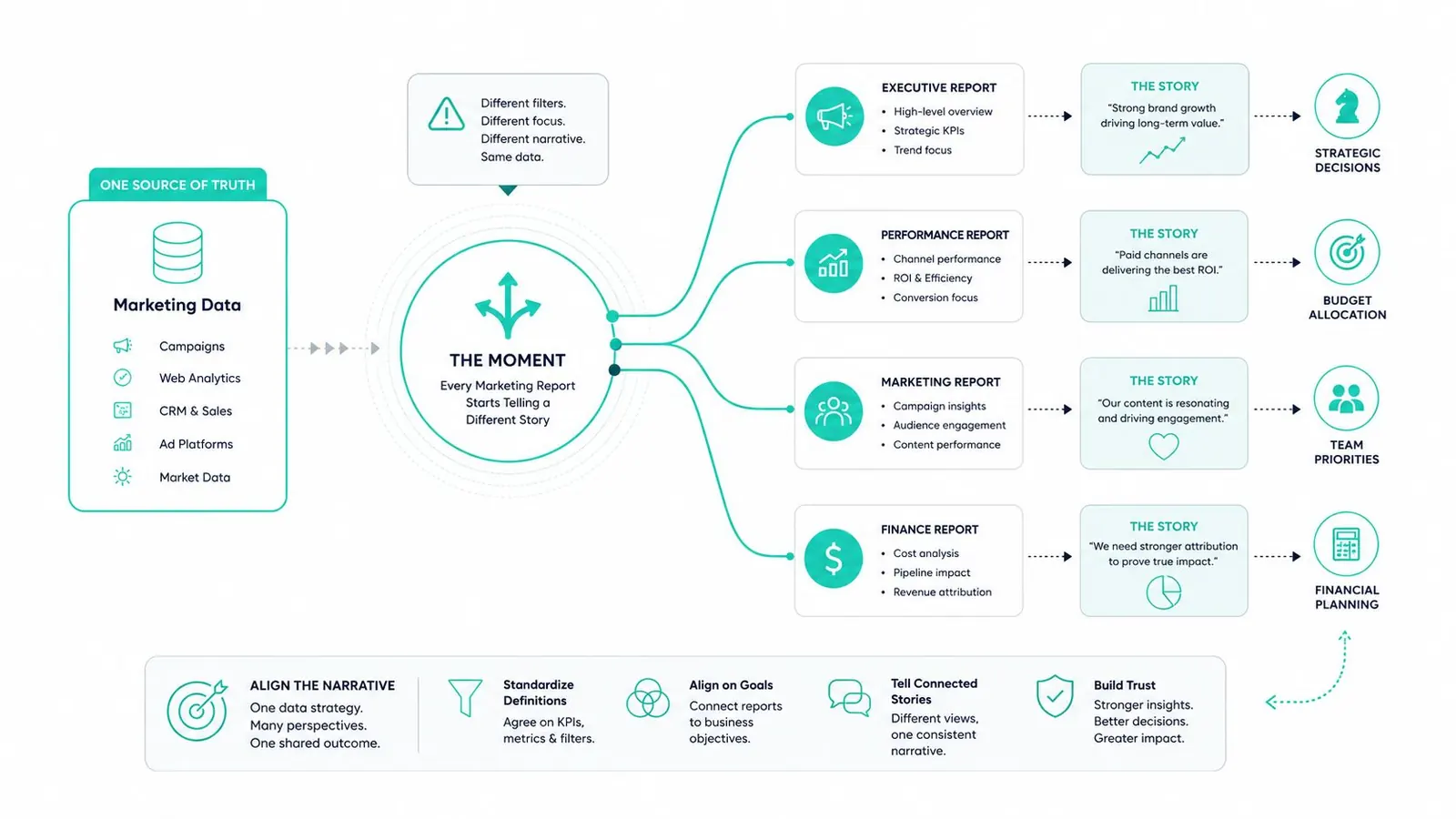
That's why a useful conversation about performance starts with the rules behind the report, not the report itself. If you want a broader local-market perspective on the same issue, Helbling Digital Media's Cincinnati business attribution insights are a helpful companion read.
What makes the story shift
A report doesn't lie when it gives credit to the wrong step. It just follows the model you told it to follow.
Practical rule: if two channels both seem to “win,” the model is probably deciding which one gets to look smarter.
That distinction matters because your budget follows the story your dashboard tells. If the story changes, the money usually does too.
Single-Touch Versus Multi-Touch Attribution Explained
Think of credit for a dinner party. One friend picked the restaurant, another texted the group, and a third showed up on time with the dessert. If you gave the whole credit to only the person who arrived last, you'd miss the planning work that made the night happen.
The basic split
Single-touch attribution gives all the credit to one interaction. First-touch rewards the channel that started the path, while last-touch rewards the final interaction before conversion. In Google Analytics, those two models are built to put 100% of the credit on just one step, which means the same journey can look very different depending on the rule you choose (Google Analytics model definitions).
Multi-touch attribution spreads credit across several steps. That can be even, weighted by position, or calculated by a more advanced system. The point is simple, the conversion didn't happen in one moment, so the credit doesn't have to live in one moment either.
Ruler Analytics reports that 75% of companies are using a multi-touch attribution model, while 41% of marketers still rely most commonly on the last-touch method (Ruler Analytics attribution stats). That mix tells you the field is still in transition, not locked into one best practice.
Why local practices feel the difference fast
A practice owner feels this most when a service page, a call extension, and a retargeting ad all touch the same lead. Under a single-touch model, one of those channels gets crowned and the others vanish from the story. Under a multi-touch model, the full path stays visible, which makes budget conversations less reactive.
The part many owners miss is that model choice changes what looks profitable. If the model is narrow, you may overfeed the channel that closes and starve the one that creates demand.
If you want a practical primer on the broader category, the guide on what is multi-touch attribution is a solid reference point for the terminology.
The Six Model Types Most Practices Will Actually Meet
The easiest way to understand attribution models is to ask a simpler question. Which step gets rewarded, and which step gets ignored? Once you know that, the budget bias becomes obvious.
A quick comparison
| Attribution Model Comparison at a Glance | How Credit Is Split | What It Tends to Reward | Best Fit |
|---|---|---|---|
| First-touch | 100% to the first interaction | Awareness channels, discovery content | Practices trying to learn what introduces new audiences |
| Last-touch | 100% to the final interaction | Closing channels, bottom-funnel actions | Teams focused on immediate conversions |
| Linear | Credit is shared evenly across all touchpoints | Broad participation across the path | Businesses with long consideration cycles |
| Time-decay | More credit goes to recent touchpoints | Late-stage nudges and follow-up activity | Campaigns where recency really matters |
| U-shaped | More credit goes to the first and last touchpoints | Entry and conversion moments | Teams that want to value both discovery and close |
| W-shaped | Credit emphasizes first touch, lead creation, and final touch | The key milestones in a longer path | Practices with defined handoff points in the funnel |
What each model quietly favors
First-touch is strong for awareness, but it can over-credit introductions and under-credit the work that convinces someone to act later. Last-touch does the opposite, it makes the closer look brilliant while hiding the demand created earlier. That is why first-touch and last-touch often pull budget toward different channels, even when the same patient journey produced the lead.
Linear is the fairest-looking option on paper, but it can flatten important differences between a casual visit and a decisive visit. Time-decay helps when the final reminder matters more than the first introduction. U-shaped and W-shaped are more useful when you care about milestones, not just clicks.
For a local practice, the key question is which step you're willing to misread. If the model over-rewards the closer, you'll probably overinvest in conversion capture and underinvest in demand creation.
A useful way to think about it is this.
A model is not a truth machine, it's a credit rule. Pick the rule that matches the question you're trying to answer.
If you want a compact example set, the growth marketing strategy roadmap from Du Marketing is a helpful way to see how channel decisions connect to broader planning.
How Data-Driven Attribution Changes the Game
Fixed-rule models are easy to explain, but they're also blunt. They reward the same steps every time, even when the customer journey behaves differently from one conversion to the next. Data-driven attribution takes a different route because it learns from observed contribution rather than prewritten weights.
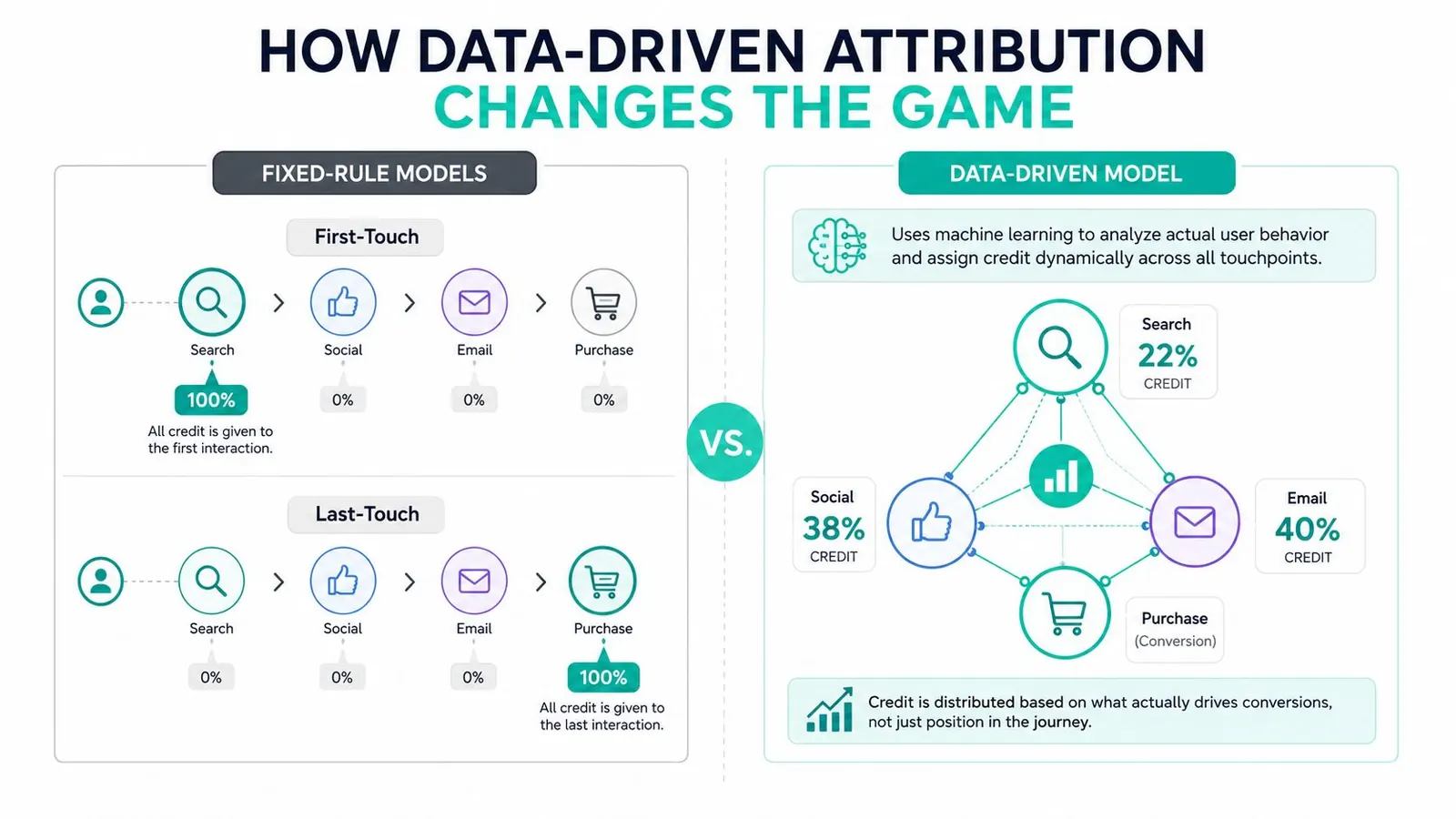
Google describes data-driven attribution as a machine-learning approach that assigns credit based on observed contribution rather than fixed rules (Google Analytics data-driven attribution). That shift matters because it moves the discussion from “Which preset model do we like?” to “What patterns are present in the data we can see?”
What changes under the hood
Instead of forcing every conversion through the same rule, data-driven attribution looks for contribution patterns across paths. That can make reporting feel closer to reality, especially when customer behavior is messy or channels work together in ways a simple formula can't capture. It also means the model is only as strong as the conversion data behind it.
That's the trade-off practice owners should care about. If your tracking is thin, incomplete, or inconsistent, the model can only learn from a partial picture. If a platform can't see a channel well, it can't give that channel proper credit.
For teams comparing marketing systems, it helps to keep the question practical. Which data do we trust, which touchpoints are visible, and which ones still happen offline or outside the platform? The answer shapes whether data-driven attribution is useful or just more polished-looking math.
A smarter way to use it
A data-driven model is not automatically “truer” than a rule-based one. It's a different set of assumptions, and those assumptions should be checked against the world. If you want a deeper strategic frame for how those assumptions fit into a broader plan, the discussion around leaping lemur media journal can sit alongside this topic without turning attribution into a purely technical exercise.
What Attribution Modeling Does to Your Reporting and Budget
The model you choose changes the story your report tells. A last-touch view often makes branded search, retargeting, or a final conversion page look like the hero. A more balanced model can spread credit back to the content, ads, and referral sources that introduced and nurtured the lead earlier.
The same lead can look valuable in different ways
Under last-touch, the budget tends to drift toward channels that close fast. That can make sense for some campaigns, but it can also hide the work of content and awareness channels that created the opportunity in the first place. Under a model like U-shaped, the first and last touches get more weight, so the top-of-funnel and bottom-of-funnel channels look more connected to revenue.
For a practice owner, that difference is not academic. If one report says social never converts and another says it assists more than it closes, the cut line for next month's spend changes. The same is true for service pages, review campaigns, email follow-up, and local SEO pages that help people decide.
Industry research summarized by GTM 8020 says companies without attribution can waste 25–30% of marketing budget on underperforming channels, and advanced analytics capabilities are associated with 15–25% higher marketing efficiency (Ruler Analytics attribution stats). That's why attribution is really a decision system, not just a reporting layer.
What usually gets distorted
- Closing channels get overfunded. If the final click gets all the credit, the channel that happens to sit at the end of the path can look more important than it is.
- Awareness channels get cut too early. If a channel helps people discover your practice but rarely closes on the same visit, last-touch can make it look weak.
- Maintenance campaigns get ignored. Some campaigns do useful supporting work, but the model may not reward that work clearly enough for the next budget review.
The cleanest takeaway is simple. Your model doesn't just explain performance, it nudges where the next dollar goes. That's why the right report can change behavior, and the wrong one can steer spend in the wrong direction.
Why Attribution Shows You Credit, Not Always Causation
Attribution feels precise, but precision isn't the same as proof. A channel can appear in the path without being the primary reason someone converted, and a channel can be highly influential even if the report doesn't give it much credit.
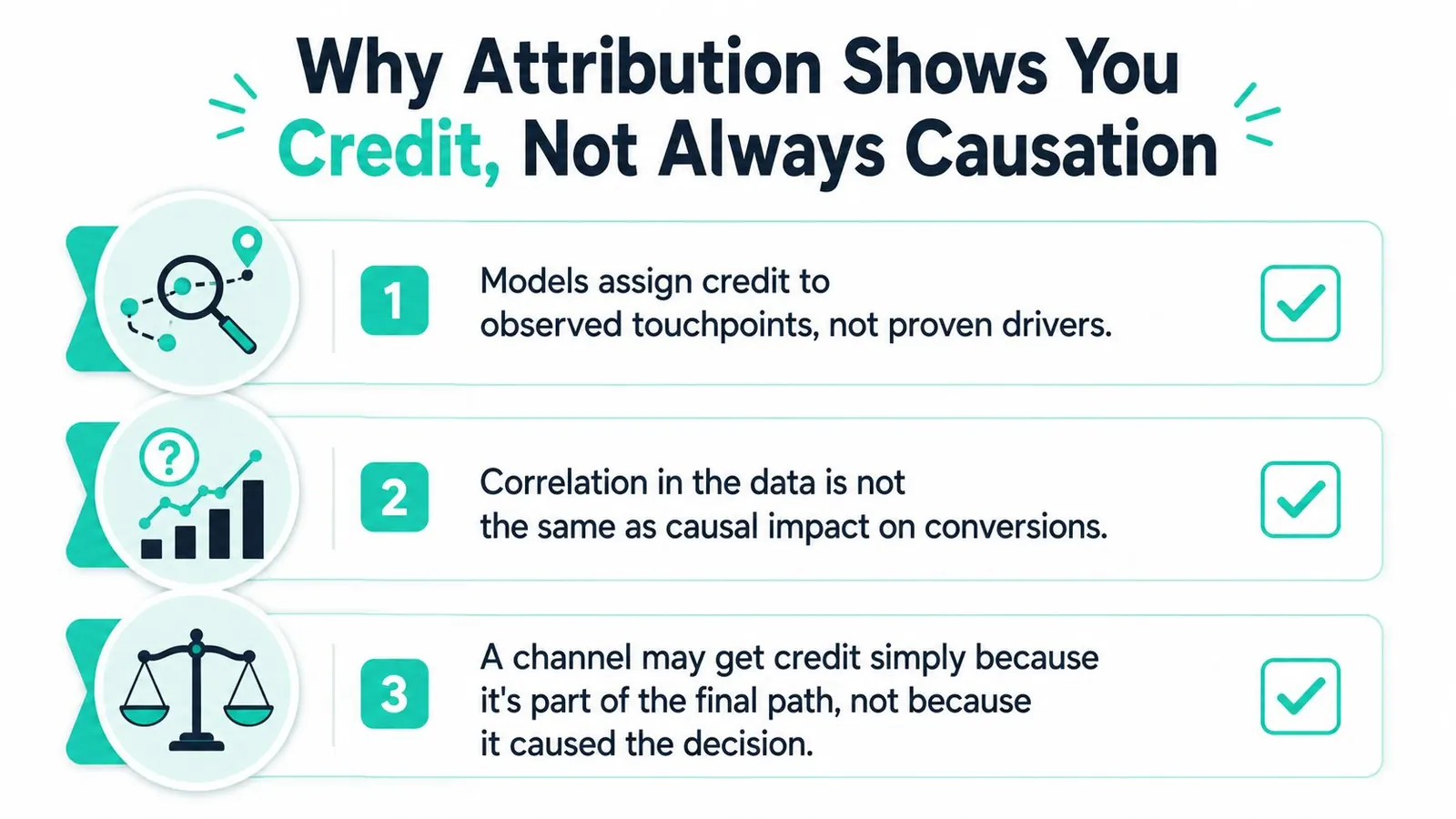
That distinction matters because attribution assigns credit to observed touchpoints, not causal lift. A final click may be the last visible step, not the step that created intent. A channel can also look modest in the dashboard while still helping the buyer feel confident enough to act.
How to keep the model honest
One guardrail is to compare more than one model before making a budget call. Another is to listen to sales and front-desk feedback about how leads found you. If your reception team keeps hearing one source mentioned on the phone but the dashboard barely shows it, that's a signal to question the model, not the people answering the calls.
Adobe recommends that marketing attribution be reviewed regularly, with guidance suggesting the model be checked at least quarterly and adjusted as needed so it stays aligned with changing channels, campaigns, and customer behavior (Adobe marketing attribution guidance). That cadence keeps the report from drifting away from how people really buy.
Where incrementality belongs
Incrementality is the missing partner to attribution. Attribution tells you where credit landed, while incrementality asks what caused extra lift. Those are related questions, but they're not the same one, and treating them as identical can make a channel look more essential than it really is.
The safest habit is to treat attribution as a working map, then challenge it with real-world checks. That keeps the reporting useful without turning it into a false certainty.
Choosing and Implementing the Right Model for Your Practice
The right model usually depends on how people buy from you, how many channels they touch, and how mature your tracking is. A short sales cycle with one dominant channel can live comfortably with a simpler setup. A longer, multi-step journey usually needs a model that shares credit across more than one touchpoint.
Start with the buying path, not the platform menu
If your patients or clients usually compare a few services, read reviews, and come back later, a single-touch model will miss part of the story. If your lead flow involves a consultation request, a follow-up email, and a booking, the path already has multiple steps that deserve attention. Google and Ipsos research cited in industry analysis says B2B buyers typically interact with 10–15 touchpoints before purchasing, which is why single-touch models can miss most of the journey (Google Analytics attribution guidance).
That doesn't mean every practice needs the most advanced setup on day one. It does mean the model should match the path you're asking people to take.
A practical implementation checklist
- Define the conversion clearly. Decide whether the event is a call, form fill, consultation booking, or sale. If the goal is fuzzy, the attribution will be fuzzy too.
- Check tracking consistency. Make sure the same conversion is being recorded the same way across platforms, or the reports will disagree for technical reasons.
- Choose one starting model. Pick the model that best fits your buyer path, then use it long enough to learn from it.
- Set a quarterly review date. Adobe's guidance to revisit attribution at least quarterly is a good operating rhythm, especially when campaigns or channels change.
- Validate with human feedback. Ask the team that talks to leads what they hear most often, and compare that with the dashboard.
If you want help thinking through how that setup connects to services, the overview at Leaping Lemur Media services is a useful place to see how strategy and measurement fit together.
The biggest mistake is treating attribution like a one-time setup. It changes when channels change, when customer behavior shifts, and when your business starts getting better data.
Frequently Asked Questions
What is an attribution model?
An attribution model is a set of rules that decides how credit for a conversion gets split across the marketing touchpoints someone interacted with before calling, booking, or buying. Google defines it as the rule set that determines how sales and conversion credit is assigned across a conversion path. Different models assign that credit differently, which changes how each channel looks in your reports.
What is the difference between single-touch and multi-touch attribution modeling?
Single-touch attribution gives 100% of the credit to one interaction, either the first touch or the last touch. Multi-touch attribution spreads credit across several touchpoints along the path, whether evenly, weighted by position, or through a data-driven approach. Multi-touch is more common for practices with longer buying paths, since it keeps earlier awareness steps visible instead of hiding them behind the final conversion.
What is data-driven attribution and how is it different from other models?
Data-driven attribution is a machine-learning approach that assigns credit based on observed contribution patterns in your actual conversion data, rather than fixed preset rules like first-touch or last-touch. This can make reporting feel closer to reality, but it depends heavily on how complete and trustworthy your tracking data is. If a platform cannot see a channel clearly, that channel will not get proper credit.
Why do my attribution reports from different platforms disagree?
Reports disagree because each platform may be using a different attribution model, so the same customer journey gets different credit assigned to different channels. One report following a last-touch rule might favor branded search, while another using a multi-touch model spreads credit to earlier content or ads. Comparing more than one model and checking front-desk feedback helps you judge which story is closer to reality.
Bringing Attribution Into Decisions You Can Actually Trust
The most useful attribution setups share three habits. They match the model to how people really buy, they get reviewed on a regular cadence, and they're checked against what your team hears in real conversations. That combination keeps the report useful instead of decorative.
The goal is confidence, not perfection
No model can reconstruct every off-site conversation, every browser switch, or every referral that happens in a hallway or group chat. That's why good attribution work is less about perfect measurement and more about disciplined decision-making. You're building a better map, not claiming to own the territory.
For a practice owner, that mindset matters because it turns marketing from a guessing game into a reviewable process. The dashboard stops being a verdict and becomes one input among several. That's healthier for the budget, and it's healthier for the team too.
If you want a closer look at the people and values behind the work, Leaping Lemur Media about gives useful context for how thoughtful strategy gets built.
The next step is simple. Pick the model that matches your current buying path, schedule a quarterly review, and ask your front office or sales team what the numbers don't show. If your current reports are still making channel decisions feel like a coin flip, it's time to tighten the measurement before you tighten the budget.
If you want a clearer attribution setup for your practice, Leaping Lemur Media helps businesses connect marketing strategy with the way real buyers decide. They can help you sort out which channels deserve credit, which reports deserve a second look, and how to turn marketing data into decisions you can trust.