Master Yoga Studio Branding: Attract More Students in 2026
You're probably in one of two places right now. You either have a lease signed, a Pinterest board full of calming interiors, and a notebook full of class ideas. Or you're still earlier in the process, teaching out of rented rooms or sublet spaces, wondering how to make your studio feel like something bigger than […]
LElemurJuly 3, 202616 min read
In this piece
You're probably in one of two places right now.
You either have a lease signed, a Pinterest board full of calming interiors, and a notebook full of class ideas. Or you're still earlier in the process, teaching out of rented rooms or sublet spaces, wondering how to make your studio feel like something bigger than “classes with a logo.”
That tension is normal. Great teachers often come to studio ownership with deep skill in movement, breath, safety, and care. Branding can feel like the shallow part. Colors. Fonts. Taglines. Instagram posts. But the moment you step into ownership, branding stops being cosmetic. It becomes the system that tells people who you are, who you're for, and why they should come back.
The stakes are real. The global yoga and Pilates studios market was valued at USD 180.91 billion in 2025 and is projected to reach USD 638.99 billion by 2036, according to Research Nester's yoga and Pilates studios market report. In a market expanding that quickly, more studios enter, more offers compete for attention, and a generic identity gets lost fast.
If you've mostly thought, “I need a name and a logo,” shift the question. Ask these instead:
What do I want students to feel before class, during class, and after class?
Who is this studio really built for?
What problem do I solve better than anyone nearby?
What kind of community am I trying to create, not just what classes am I trying to sell?
That's the work. The visual layer comes later.
If you want inspiration from another niche where identity has to come through quickly and clearly, this guide on brand awareness for video creators is useful because it shows how repetition, clarity, and consistency shape recognition. The same logic applies to a studio brand. For a broader look at the kind of intentional positioning strong businesses need, you can also review the team philosophy behind this approach.
Introduction: From Passionate Teacher to Memorable Brand
Opening a studio often starts with a personal vision. You want a room that feels safe, grounded, alive, and useful. You want students to walk in carrying stress and leave standing a little taller. That vision matters, but by itself it won't create a memorable brand.
A memorable brand forms when you make a series of aligned decisions. The class names fit the teaching style. The front desk language matches the website. The booking flow feels as thoughtful as the practice. The room itself supports the promise your marketing makes.
Many new owners make the same mistake. They jump straight to visual design before they've answered the harder strategic questions. They choose a lotus icon, a muted palette, and a name with “flow,” “soul,” or “collective” in it, then wonder why nothing stands out.
Practical rule: If your brand could belong to six other studios in your city, it isn't a brand yet. It's a placeholder.
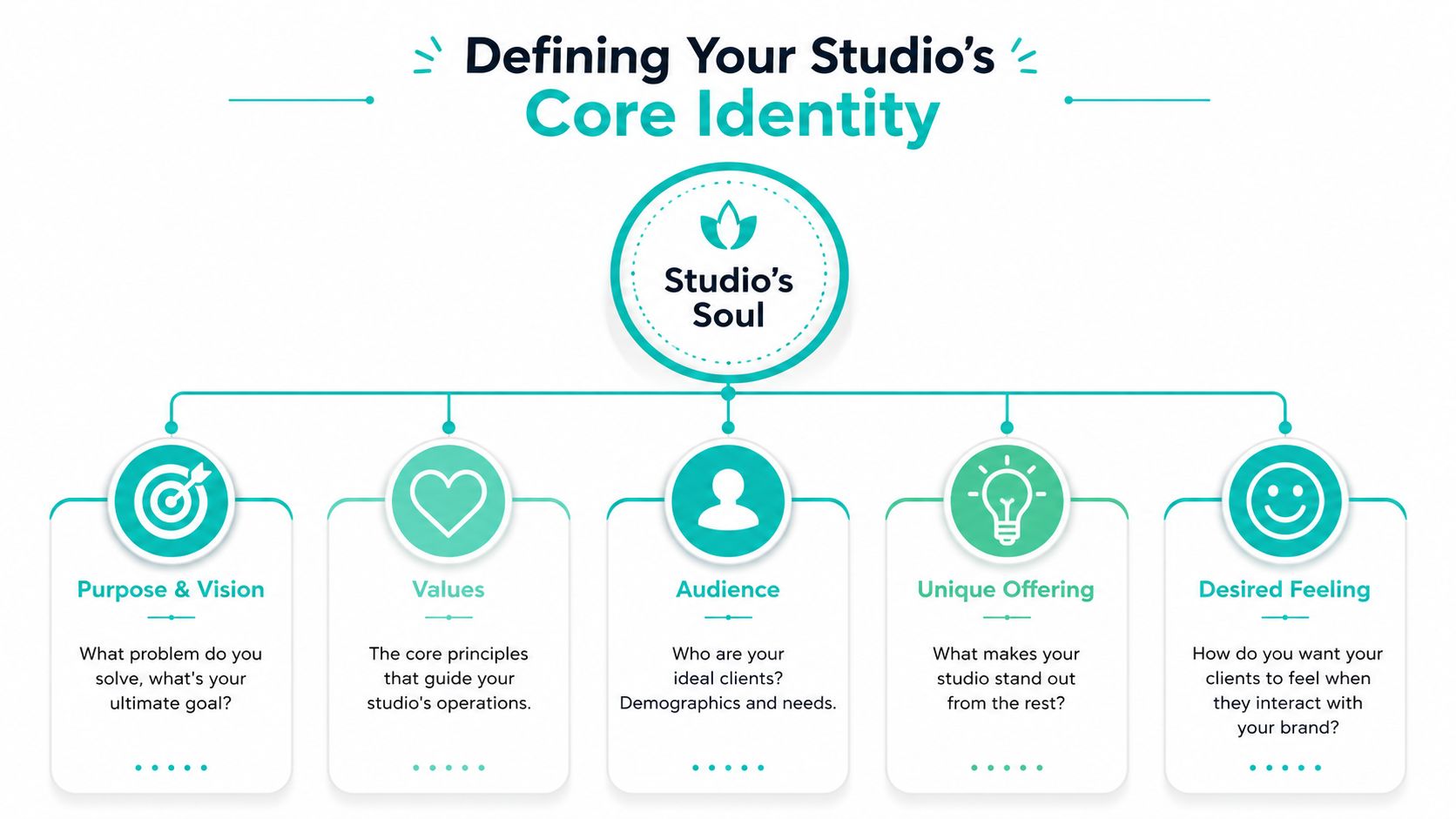
Strong yoga studio branding starts with decisions that are less glamorous and more useful. What are your core values? Which students are you best equipped to serve? What's the one thing your studio will become known for?
When those answers are clear, your brand gets easier to build and easier to run. Hiring becomes simpler. Social content gets sharper. Your instructors know how to speak about the studio. Students begin repeating your language back to their friends, which is when a brand starts to stick.
Define Your Studio's Core Identity
Most owners think differentiation means adding more. More class styles. More promises. More wellness language. Usually it means the opposite. You need fewer, clearer ideas that are repeated consistently.
A strong method for yoga studio branding starts by defining a signature offering and a concise mission statement, because that clarity becomes the base for sustainable growth, as outlined in this yoga studio branding guide from Creative Fit Branding.
Start with the student, not your style labels
“Vinyasa studio” or “mindful movement studio” doesn't tell me enough. The useful question is who the studio helps, and what kind of transformation that person wants.
A better identity exercise looks like this:
Brand question
Weak answer
Stronger answer
Who is this for?
Everyone
Busy professionals with stress-related tension and limited time
What do they need?
Yoga classes
A reliable reset they can fit into real life
What do you offer?
Flow, sculpt, restore
A structured weekly rhythm of strength, decompression, and recovery
Why will they choose you?
Great teachers
Clear guidance, no intimidation, and a community that feels welcoming from day one
That kind of specificity changes everything.
If your niche is seniors, your identity should reflect confidence, mobility, and trust. If your niche is postpartum students, your language should reflect care, nervous system support, and real-world flexibility. If your niche is athletes, precision and recovery may matter more than spiritual language.
Write the mission and signature offering
Your mission statement shouldn't read like wall art. It should guide decisions. A useful mission tells your team how to serve students every day.
Keep it short enough that a front desk lead can remember it and an instructor can use it when speaking to new members. If it's so broad that every wellness business could claim it, tighten it.
Try this simple framework:
We help [specific group]
through [specific method]
so they can [meaningful outcome]
Example structure, not a script:
We help working parents reconnect with their bodies through accessible evening classes and supportive coaching, so they can feel steadier in daily life.
Then define your signature offering. This is the thing you do better than nearby competitors. Not every service you provide. One thing.
That might be:
Beginner progression: A sequenced path that helps intimidated first-timers build confidence.
Therapeutic calm: Restorative classes with a strong sensory environment and slower pacing.
Strength and recovery: Yoga designed for active adults who want mobility without vague instruction.
Life-stage support: Pregnancy, postpartum, or healthy aging programs that feel expertly built, not added on.
Don't pick the offering that sounds trendy. Pick the one your studio can deliver repeatedly, clearly, and well.
A useful stress test is this. Can you finish the sentence, “Around here, we're known for…” If the answer feels fuzzy, your identity still needs work.
Craft a Name and Message That Connects
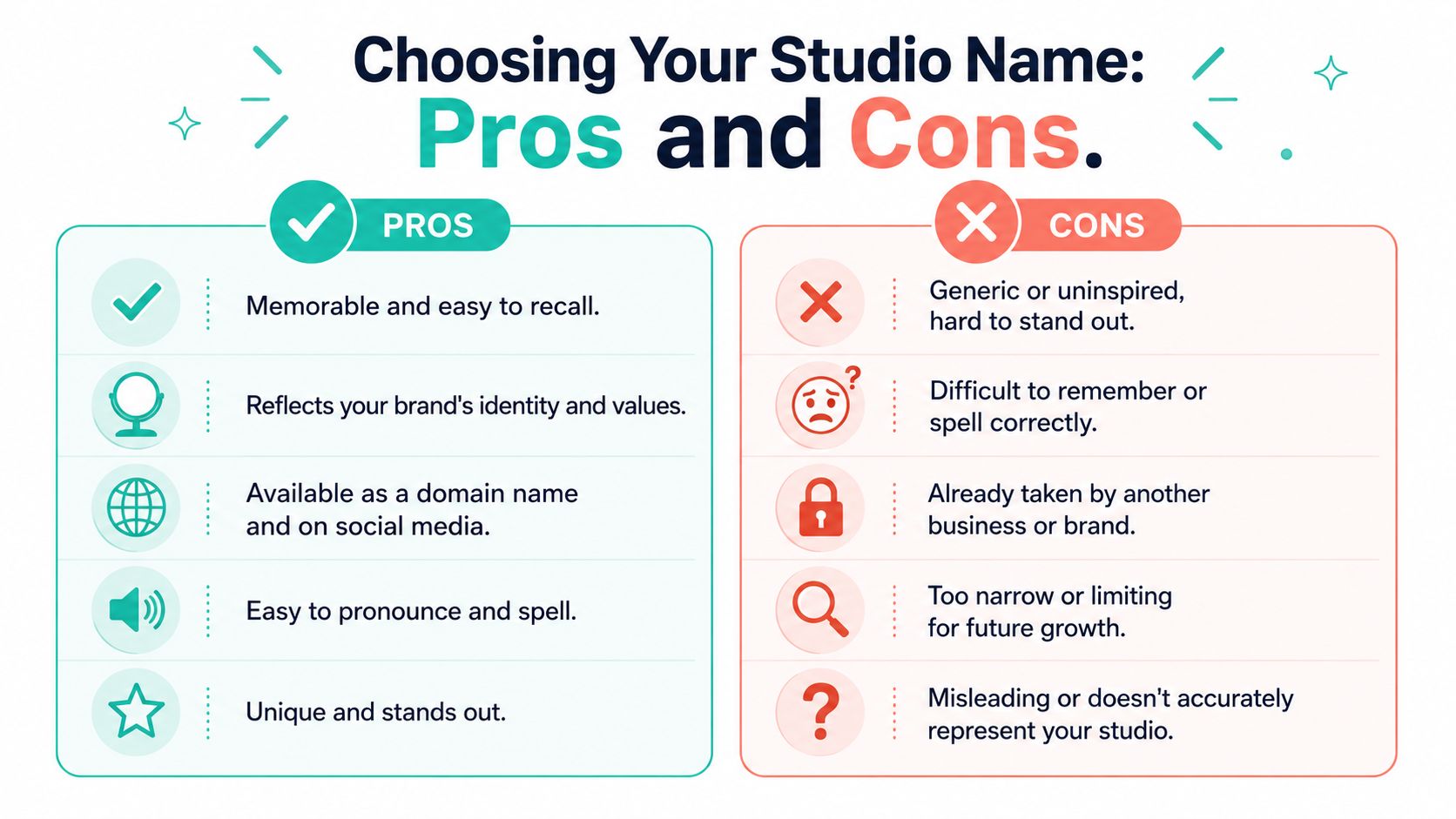
A name should do a job. It should be memorable, easy to say, easy to spell, and aligned with your studio's character. It doesn't need to sound poetic. It needs to work.
One studio owner might be tempted by something airy and abstract, while another goes too literal and boxes the business in. Both mistakes create friction. The best names are distinctive enough to remember and flexible enough to grow with you.
Two studios, two completely different voices
Consider two hypothetical studios.
The first is a high-energy studio built around strong flow classes, mobility work, and early-morning momentum for working professionals. Its language should feel clear, steady, and energizing. It might use words like “strength,” “focus,” “practice,” “rhythm,” and “reset.”
The second is a restorative studio serving students managing stress, burnout, or major life transitions. Its language should slow people down before they even arrive. It might use words like “settle,” “support,” “restore,” “breathe,” and “space.”
Neither voice is better. The mistake is when both use the same generic copy:
Find your best self
Transform your body and mind
Join our supportive community
Enhance your wellness journey
That language is common because it sounds polished. It also says very little.
A major branding pitfall is using pressure-based language instead of authentic, welcoming, community-focused messaging, and successful studios reinforce brand values by having staff use the same vocabulary consistently, as explained in PS Print's guide for yoga and fitness businesses.
How to choose language your staff can actually use
Your brand voice isn't just for the homepage. It should be usable at the front desk, in class descriptions, in DMs, in automated emails, and in review responses.
Build a short vocabulary guide with three parts:
Words you want repeated If your studio values calm structure, choose words such as grounded, clear, supportive, steady, and welcoming.
Words you want to avoid If your brand rejects perfection culture, remove words like shredded, earn, no excuses, summer body, or push past limits.
Phrases staff can use naturally Instead of “This class will challenge you to realize your highest potential,” use “This class is strong, but approachable. We'll offer progressions and options throughout.”
The best studio copy sounds like a caring human who knows what they're doing, not a wellness slogan generator.
For naming, use practical filters before you fall in love with anything:
Say it out loud: If people won't pronounce it confidently, they won't recommend it easily.
Check future fit: A name tied too tightly to one class style can become restrictive.
Test first impressions: Ask a few people what they expect from the name alone.
Review spelling friction: If every mention requires correction, it creates unnecessary drag.
A good name opens the door. Good messaging makes people feel safe walking through it.
Develop a Cohesive Visual Brand
A cohesive visual brand doesn't need to be expensive. It does need to be disciplined.
Many new studios overinvest in a logo and underinvest in the system around it. They get one beautiful mark, then use different colors on Instagram, different fonts on signage, and a completely different mood in the studio. That inconsistency weakens recognition.
Build a small visual system, not a single logo
Think in terms of a toolkit.
You need a primary logo, a simplified version for small placements, a readable type pairing, a color palette, and clear rules for use. Your icon has to work on a website header, a mobile booking app, printed collateral, and a tiny social profile image. If it disappears at small sizes, it isn't doing its job.
Color choices should follow mood, not personal taste alone. Warmer reds and yellows signal energy. Cooler greens and blues suggest calm. Neither is universally right. Match the palette to the feeling your studio promises.
Your type choices matter too. A beautiful script that becomes hard to read on a phone will cost you conversions. Prioritize legibility first, personality second.
Make the digital and physical space match
Your visuals shouldn't stop at the screen.
If your website looks minimal and serene but the studio has fluorescent lighting, cluttered signage, and loud promotional posters at reception, the brand breaks. The same happens in reverse. A warm, grounded in-person experience loses power when the website feels generic or visually chaotic.
Create consistency across touchpoints:
Website and booking pages: Use the same colors, voice, and image style throughout.
Social templates: Keep post covers, quote graphics, and story slides visually aligned.
Printed materials: Intro cards, event flyers, and retail tags should feel related.
In-studio details: Signage, class boards, teacher bios, and product displays should all look like they belong to the same place.
A cohesive visual brand helps students trust that what they saw online is what they're entering in person. That trust reduces friction before anyone even rolls out a mat.
Extend Your Brand into Every Experience
The strongest yoga studio branding doesn't live in your logo file. It lives in the sequence of experiences a student has with you.
They discover the studio on Google. They scan your photos. They visit your website on a phone. They try to understand your offer in seconds. They book. They arrive. They smell the room, hear the playlist, interact with your team, and decide whether this place feels like it knows them.
Your sensory choices shape loyalty
Many owners underperform. They often think branding is visual, then leave the sensory experience to chance.
Yet yoga studios typically achieve net profit margins between 15% and 25%, and those margins are influenced by how well the studio brands scent, sound, and touch, because these elements connect memory and emotion to the brand and increase loyalty and willingness to pay, according to Wellyx's yoga industry statistics overview.
That doesn't mean you need expensive buildouts. It means your sensory choices should be intentional.
A few examples:
Scent: If your studio promise is grounded calm, choose one subtle scent profile and use it consistently. If you're deciding what fits that mood, this guide to explore top oils for relaxation can help you narrow options before testing them in the space.
Sound: A power class studio can support stronger rhythm and energy. A trauma-aware or restorative space should avoid abrupt, jarring audio choices.
Touchpoints: The texture of props, cleanliness of mats, softness of blankets, and feel of retail packaging all contribute to perceived care.
Students remember how your studio felt in their body long before they remember your tagline.
Community is the strongest brand signal
Sensory branding matters, but community is what turns preference into loyalty.
A polished room can win a first visit. It rarely earns long-term retention by itself. What keeps people coming back is the feeling that they belong somewhere specific, with people who understand why they're there.
That's why I push studio owners to think beyond class delivery. Build structures that help students connect with one another around a shared need or identity. Not just “community events” in the abstract. Real recurring formats.
Here's what that can look like in practice:
Align the experience with your niche If your brand is built for beginners, don't create a schedule that assumes insider knowledge. Offer first-visit guidance, orientation classes, and plain-language descriptions.
Name your classes like a real person would understand them “Restore 45 after Work” tells more truth than “Soul Flow Reset.”
Design small rituals A welcome tea station, post-class check-in question, or instructor-led intro circle can make a studio feel socially safer.
Bridge online and offline Your confirmation emails, class reminders, and Instagram stories should feel like extensions of the same studio personality.
Give members a role Invite students to tag the studio, join themed programs, bring a friend to community sessions, or contribute feedback after workshops.
A brand becomes durable when people don't just consume it. They participate in it.
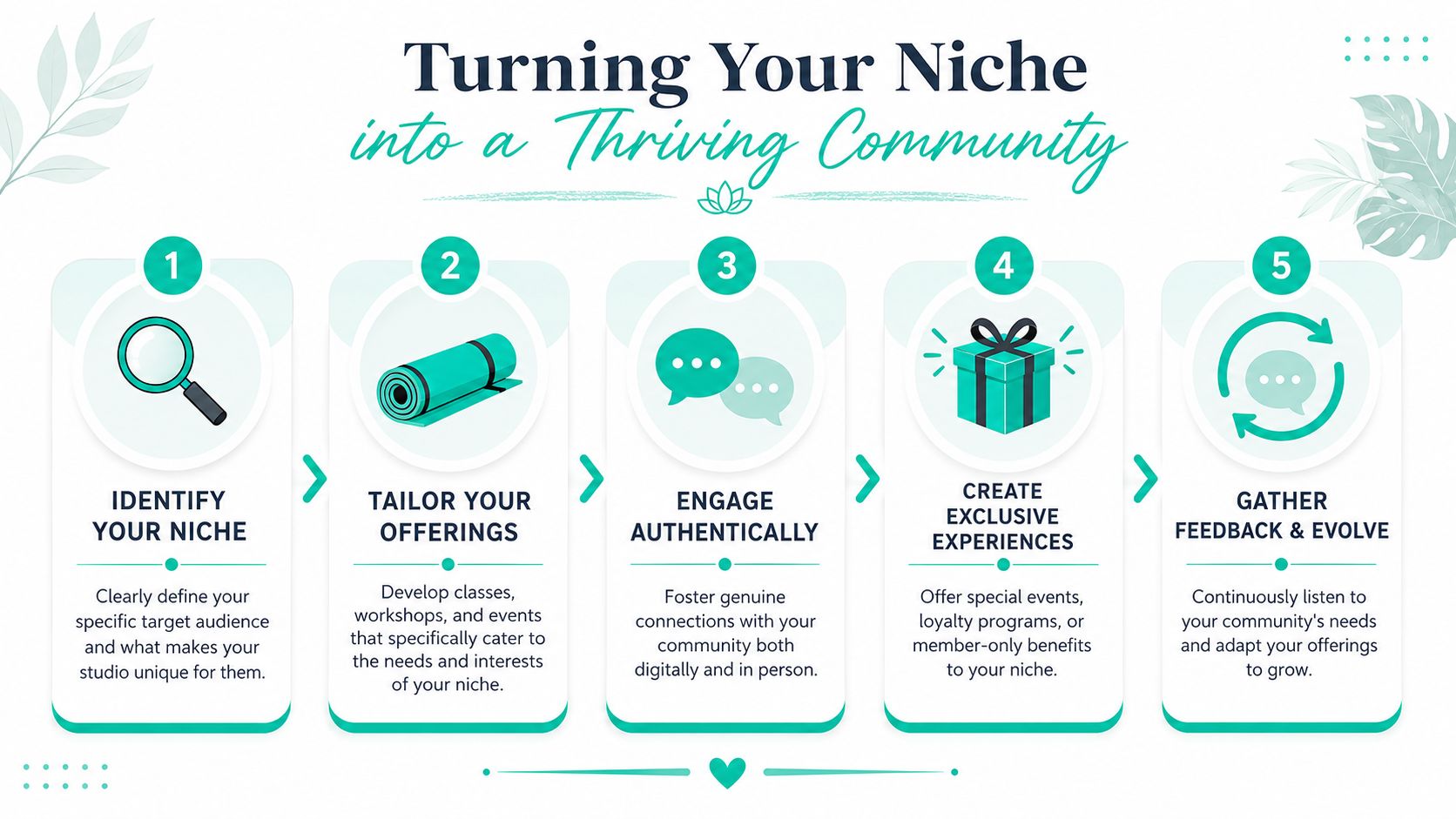
Turn Your Niche into a Thriving Community
Most yoga studio branding advice often stops too early.
You'll often hear, “Find your niche.” Fine. But once you've identified the niche, what do you build around it? That operational layer is where retention happens.
While 76% of students join studios for community, many branding guides still don't explain how to create it. Studios using niche-based community pods, which are small groups built around specific goals or identities, have shown 35% higher retention than general membership models, according to FitDegree's article on branding a yoga studio that succeeds.
How to build niche-based community pods
A community pod is not just a marketing segment. It's a recurring small-group structure with a clear identity, shared purpose, and regular rhythm.
If your niche is prenatal yoga, a pod might include weekly classes, a monthly circle, expert guest sessions, and a private communication touchpoint for members. If your niche is seniors, it might center on balance, mobility, confidence, and social connection. If your niche is athletes, it may combine mobility classes, recovery workshops, and sport-specific education.
Use this framework.
Step one: choose one niche to operationalize first Don't try to launch pods for every audience at once. Pick the one that is already closest to your signature offering.
Step two: create one recurring container This can be a six-week beginner series, a monthly support circle, or a small-group practice cohort. The key is consistency.
Step three: add one event layer Support the pod with a workshop, guest teacher, or local partner event that deepens the identity.
Step four: build peer recognition Encourage member introductions, stories, accountability pairings, or shared milestones.
Step five: give it distinct language Name the pod clearly. Not vaguely. “Prenatal Support Circle” works better than “Bloom Collective” if clarity is your goal.
Here are a few examples of pod structures:
Niche
Pod format
Supporting event
Beginners
Four-week foundations group
Q&A with instructors on props, etiquette, and next-step classes
Postpartum
Weekly gentle movement circle
Pelvic health or recovery workshop with a local specialist
Seniors
Recurring balance and mobility pod
Tea social and fall-prevention education event
Burnout recovery
Restorative pod with check-ins
Evening nervous system reset workshop
A rollout checklist that keeps branding practical
If you want your niche identity to become visible in the world, work through this checklist:
Clarify the niche promise: State who the program is for and what need it meets.
Map the student journey: What does someone see before joining, during the program, and after it ends?
Create one repeatable offer: Start with one pod you can run well.
Train staff on language: Everyone should describe the pod the same way.
Build a local ecosystem: Partner with businesses or practitioners who naturally serve the same audience.
Invite member participation: Ask members to tag the studio, share wins, and bring questions into the group.
Review what resonates: Use student feedback to refine names, timing, and support elements.
For more practical thinking on how content, positioning, and ongoing marketing support this kind of growth, the ideas in the Leaping Lemur Media blog are a helpful complement.
Small, specific communities often outperform broad, undefined membership offers because people stay where they feel recognized.
Track the basics that matter. Keep an eye on member acquisition cost, intro-offer conversion rate, retention rate, revenue per member, and class fill rate. Those are the useful signals for whether your branding is translating into behavior, not just attention.
Launch, Measure, and Evolve Your Brand
A brand launch should feel coordinated, not chaotic.
Update your website, class descriptions, booking flow, email automations, social bios, in-studio signage, and Google Business Profile at the same time. If your direct mail strategy is part of the launch, don't send a single postcard and hope for the best. Repetition is what builds recognition. If you use email, organize it around a welcome series, active-member engagement, upsells for workshops, and re-engagement for quiet members.
Then measure what people do.
Watch intro-offer conversion rate closely. It's one of the clearest indicators that your brand promise, pricing, and first experience are aligned. Retention matters just as much. If students love the first class but drift away, your identity may be attracting attention without building belonging.
For additional ideas on operational marketing that can boost yoga studio income, it helps to study how studios connect offers, retention systems, and repeat communication. If you're getting support on the execution side, review what kind of strategic help fits your stage through marketing services built for growing businesses.
A good brand doesn't stay frozen. It listens, sharpens, and improves as your community grows.
If you want a marketing partner that helps you turn a strong identity into clear positioning, consistent messaging, and a brand people remember, Leaping Lemur Media is worth a look. They focus on intentional strategy, authentic storytelling, and long-term growth so your marketing feels aligned with who you are, not borrowed from another business.