What Is Lead Qualification: Boost Your Practice Revenue
LE
lemur June 23, 202617 min read
Your front desk is busy. The phone rings, a website form comes in, someone sends a Facebook message, and another person asks about pricing through Google. A full day can disappear into conversations that feel productive but never turn into booked appointments.
That's where lead qualification helps.
In plain English, lead qualification is a filter. It helps your team separate the people you can help right now from the people who are still browsing, price shopping, outside your service area, or asking for something you don't offer. Consider the filter in a fish tank. Without it, everything gets cloudy fast. With it, the whole system runs cleaner.
Most articles about what is lead qualification were written for software sales teams, not for dentists, medspas, eye doctors, or law firms. They assume long demos, procurement teams, and corporate buying committees. That's not how a local practice works. Your version is more human. It happens at the front desk, in DMs, through call tracking notes, and in the first few minutes of a consultation request.
A practical qualification process protects your schedule, your staff's energy, and your marketing budget. It also makes your follow-up better, because your team knows who needs a quick booking call, who needs nurturing, and who should be politely declined.
If you want broader context on how teams are qualifying sales leads with AI, that's a useful companion read. For more practice-growth thinking in plain language, the Leaping Lemur Media blog has related articles built for local service businesses.
The schedule is full of callbacks. The inbox has new inquiries. Staff members are answering questions all day. But if too much of that activity comes from people who aren't a fit, the practice stays busy without getting the right bookings. That's the hidden cost behind a lot of “good lead flow.”
What is lead qualification? It's the process of deciding whether a new inquiry matches what your practice offers, where you serve, and how ready that person is to take the next step. In a corporate sales team, that might happen in a CRM with long notes and stages. In a local practice, it usually starts with a phone call, a form, or a text.
Practical rule: If your team treats every inquiry exactly the same, your best opportunities get the same response as your worst ones.
That's why generic lead advice often misses the mark for appointment-based businesses. A medspa lead might be comparing timelines around an event. A dental lead might be in pain and need help now. An optometry patient may just need insurance clarification before booking. Those are not enterprise software buying journeys. They're local, personal, and timing-sensitive.
Why local practices need a different filter
A local practice doesn't need a complicated sales theory. It needs a clear intake filter your team can use without sounding scripted.
That filter should answer simple questions:
Is this a service match: Are they asking for something you want to provide?
Is this a location match: Are they close enough to become a real patient?
Is this a timing match: Are they ready to book, or are they only researching?
Is this the right type of patient: Do they fit the kinds of cases and relationships your practice is built for?
When that filter is in place, the front desk stops playing guessing games. Marketing stops celebrating raw inquiry volume. Owners get better visibility into which channels bring in the right people, not just more names.
What good qualification feels like
Good lead qualification doesn't feel harsh. It feels organized.
Your team asks better questions. Response times improve for strong inquiries. Weak-fit leads don't eat up prime hours. The patient experience gets smoother because the person on the other end feels understood, not pushed.
That's the shift. Less busywork. More bookings that make sense.
Why Lead Qualification Matters for Your Practice
When a practice skips qualification, the cost shows up everywhere. The front desk spends too long on calls that go nowhere. providers block time for low-intent consults. Marketing reports look active, but the schedule doesn't reflect it.
The data behind this is hard to ignore. A 2020 study found that approximately 67% of lost sales opportunities are due to misqualified leads, and Gartner research cited in the same analysis shows organizations using systems to nurture and qualify leads can see a 451% increase in qualified lead volume while shortening the acquisition cycle by 20 to 30%, according to this lead qualification research summary.
Before qualification
Without a process, every inquiry feels urgent.
A staff member might spend fifteen minutes explaining pricing to someone who lives too far away. Another caller wants a service you don't prioritize. A form lead asks for the cheapest option first, then never replies again. None of that is unusual. What hurts is the accumulation.
Here's what usually breaks first:
Staff focus: Good team members get drained by repetitive dead-end conversations.
Follow-up quality: High-intent inquiries wait too long because the queue is cluttered.
Marketing clarity: You can't tell which campaigns bring actual patients versus casual interest.
Poor qualification doesn't only waste ad spend. It also wastes your best appointment slots and your team's attention.
After qualification
A simple filter changes the rhythm of the practice.
The front desk knows which inquiries deserve same-day outreach. The office manager can spot patterns in weak leads. The owner can stop judging campaigns only by how many forms came in.
A better process improves more than conversion. It improves the first impression. When someone is a strong fit, your team responds with confidence because they already know the service, urgency, and likely next step. That feels smoother for patients, too.
Why this matters financially
Lead qualification isn't about turning people away for the sake of it. It's about protecting time and placing effort where it has the best chance to turn into treatment or a paid appointment.
For a local practice, that means:
You spend less time on poor-fit inquiries
You respond faster to high-intent prospects
You learn which channels bring the right people
You reduce friction between marketing and front desk staff
That last point matters more than owners sometimes realize. When intake is messy, marketing blames follow-up and front desk blames lead quality. Qualification gives both sides a shared standard.
The result is a cleaner pipeline, calmer staff, and more predictable bookings.
Frameworks From BANT to a Practice-First Approach
Lead qualification didn't start with local practices. It came from sales.
One of the most established frameworks is BANT, which was popularized by IBM and later became widely used across enterprise sales. In its classic form, BANT looks at Budget, Authority, Need, and Timeline, and reps use questions to score each area so they don't waste time on prospects without money, decision power, a real problem, or realistic timing, as described in Salesforce's overview of the BANT lead qualification framework.
That structure makes sense in many business sales conversations. It's less natural when the inquiry is a patient asking about veneers or Botox.
Why BANT feels awkward in a local practice
If you run a medspa, asking “Do you have budget authority?” sounds stiff. If you manage a dental office, asking “What's your purchasing timeline?” sounds like software sales language. Patients don't talk that way.
The underlying ideas still matter. You do need to know whether someone can move forward, whether they have a real issue you solve, and whether they're ready soon. But the wording and emphasis need to fit a human, appointment-based interaction.
That's why many local practices do better with a lighter framework.
A simpler model for appointment-based businesses
A useful practice-first version is APT:
Authority: Is this person able to decide about their own care, or are they gathering information for someone else?
Problem: Do they have a clear concern your practice handles well?
Timing: Are they trying to book soon, or are they casually exploring?
It's simple enough for a front desk script, a contact form review, or a chatbot handoff.
Here's how the two approaches compare.
Lead Qualification Frameworks Compared
Dimension
BANT (Corporate Model)
APT (Practice-First Model)
Example Question for a Medspa
Budget
Focuses on whether funds are available
Usually handled more gently through service fit and pricing readiness
“Are you mainly comparing options right now, or looking to book the treatment that fits your goals?”
Authority
Checks whether the contact can make the buying decision
Confirms whether the person can choose for themselves
“Will you be making the decision for this treatment yourself?”
Need
Identifies a defined problem the offer solves
Focuses on the patient concern or desired outcome
“What would you like help with most right now?”
Timeline
Measures when purchase may happen
Looks for urgency and booking readiness
“Are you hoping to come in soon, or are you still gathering information?”
The point isn't to reject BANT. The point is to translate it into language your team can use.
“If the script sounds like a sales department wrote it, patients will feel it.”
A strong practice script sounds conversational. It helps your team understand fit without turning intake into an interrogation.
Here's a sample APT-style flow for a dental office:
Start with the problem “What's going on with the tooth?” gets better information than “How can I help you today?”
Clarify timing “Are you in pain now, or looking into treatment options for later?” tells you how urgent the callback should be.
Confirm decision ability “Will you be the one scheduling and making treatment decisions?” avoids confusion later.
APT works because it respects how local practices operate. It keeps the useful parts of qualification while dropping the corporate tone.
Defining Your Ideal Patient Qualification Criteria
Frameworks help your team ask better questions. Criteria tell them what answers matter.
Many practices get stuck at this point. They say they want “more good patients,” but that's too vague to guide intake, ads, or follow-up. A stronger version is an Ideal Patient Profile. In B2B, companies often call this an ICP, and data frequently shows that leads matching the profile convert 2 to 3x more often than those outside it, according to Amplitude's guide to the qualified lead and ICP relationship.
For a local practice, your profile should be specific enough that a front desk coordinator could use it without guessing.
Start with the patients and cases you want more of
Don't begin with demographics alone. Begin with the work you want on the schedule.
If you own a medspa, maybe your strongest-fit inquiries are for treatment plans rather than one-off discount hunters. If you run a dental practice, maybe you want more Invisalign, implants, or family care patients who stay long term. If you're an optometrist, maybe you value routine care patients who also convert into eyewear purchases.
Write down the answers to questions like these:
Which services matter most: What procedures or appointment types create the most value for the practice?
Which inquiries convert smoothly: What kinds of people tend to show up, accept treatment, and return?
Which ones drain the team: What patterns usually signal low follow-through, heavy rescheduling, or poor fit?
Build your profile with practical categories
Once you know the kinds of cases you want, build the filter around them.
Service fit
Some inquiries look promising but don't line up with what you want to emphasize.
A cosmetic dentist might score veneer or Invisalign inquiries higher than general “just checking prices” requests. A medspa may prioritize treatment plans tied to a consultation over generic messages asking for the cheapest unit price.
Geography
Distance matters more than many owners admit.
A lead can sound enthusiastic and still never book because the drive is inconvenient. Decide what your realistic service area is by city, neighborhood, or ZIP code. For law firms or specialty practices, that service area may be broader. For routine care, it's often tighter.
Patient characteristics
This doesn't mean making crude assumptions. It means noticing patterns.
Maybe your best-fit patients tend to value education, ask thoughtful questions, and respond well to treatment plans. Maybe they come in through referrals, reviews, or local search rather than coupon-driven channels. Those are valid qualification clues.
Red flags
Bad-fit leads often announce themselves early if you know what to look for.
Examples include:
Price-first opening: They ask for the cheapest option before discussing need.
No clear service match: They want something your practice doesn't really specialize in.
Outside area: They're far enough away that booking is unlikely.
Chronic vagueness: They won't answer basic timing or service questions.
Watch for this: A lead can be polite, interested, and still be a poor fit. Qualification is about fit, not likability.
Document this profile somewhere visible. A shared Google Doc, a CRM note template, or an intake cheat sheet works fine. What matters is that the whole team uses the same standard.
When everyone knows what a qualified patient looks like, the intake process gets sharper fast.
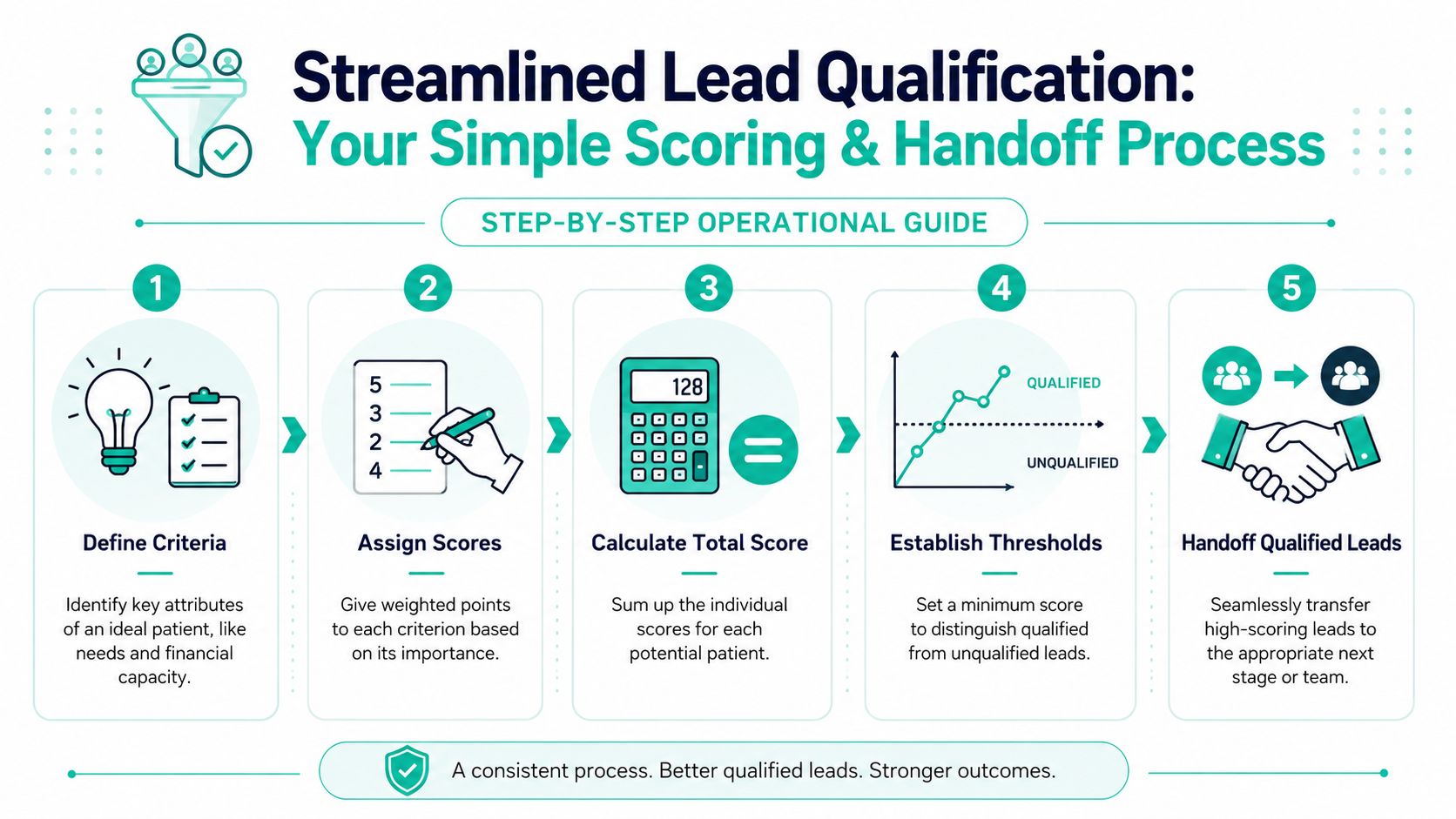
Putting It All Together A Simple Scoring and Handoff Process
Once your criteria are clear, you can turn them into a simple score.
This doesn't require enterprise software. A spreadsheet, your CRM, or intake notes in tools like HubSpot, GoHighLevel, or even a shared front desk worksheet can handle it. The key is consistency. Each new inquiry gets points for fit and intent, then your team uses that score to decide what happens next.
A scoring approach works because it combines two things that matter most: demographic fit and behavioral signals. Research summarized by TOPO says that implementing a lead scoring matrix with those factors can increase sales productivity by up to 30 to 50%, and well-calibrated systems often use thresholds such as 80+ = sales qualified, as outlined in this lead scoring and qualification overview.
A simple score your team can actually use
Here's a practical example for a cosmetic dental or medspa inquiry. Adjust the exact point values to fit your practice.
Signal
Example
Score
High-value service interest
Invisalign, implants, filler consultation, treatment plan
+10
In target location
Lives in your ideal service area
+5
Clear problem stated
Describes a specific concern or goal
+5
Ready soon
Wants to book in the near term
+10
Completed form fully
Gives complete contact details and context
+5
Requested consultation
Asked for an appointment, not just information
+10
Discount-first message
Opens with price-only or deal-only focus
-5
Outside service area
Too far away for likely follow-through
-10
Poor service match
Asking for a service you don't want to prioritize
-10
You don't need a perfect model on day one. You need a usable one.
A practical threshold might look like this:
Low score: Send nurture information or a polite reply
Mid score: Follow up, but not ahead of stronger inquiries
High score: Call fast, personalize the conversation, and move toward booking
If you use software-based intake, one option in this category is Leaping Lemur Media's Always-On Intake system, which is designed to qualify leads and book appointments around the clock for professional service businesses. You can also build a lightweight version manually before adding automation later. If you're comparing support options around intake and growth systems, the service overview from Leaping Lemur Media shows where qualification can fit inside a broader marketing workflow.
How the handoff works in real life
A scoring model only helps if the next step is obvious.
Take a real-world flow. A woman finds your medspa through Google, fills out a consultation form for fine lines before an upcoming event, lives nearby, and asks for an appointment within the next few weeks. That lead scores well on service fit, location, and timing. Your front desk shouldn't treat that the same way it treats a vague “how much is Botox?” message from someone far outside your area.
Use a handoff process like this:
Intake captures the basics The form, call log, or chatbot records service interest, location, and timing.
The lead gets a quick score Staff adds the points or your CRM applies them automatically.
High-score leads get priority outreach These get the fastest callback and a more personalized conversation.
Mid-score leads get clarification The team asks one or two more questions before offering a consult.
Low-score leads get a lighter response Share helpful information, but don't let them block stronger opportunities.
Your handoff process should answer one question instantly: who gets the next available attention?
That's where many practices stumble. They build ads and forms, but not routing logic. Then every lead enters the same messy pile.
A better handoff script might sound like this:
For high-score leads: “Thanks for reaching out. Based on what you shared, I'd love to help you find the best appointment time.”
For unclear leads: “A quick question before we book. Which treatment are you mainly interested in?”
For poor-fit leads: “We may not be the best match for that request, but I'm happy to point you in the right direction.”
That's lead qualification at its most useful. Not abstract theory. A repeatable intake workflow your staff can run on a busy Tuesday.
Measuring Success and Making Your Marketing Smarter
Lead qualification pays off twice. It improves intake today, and it teaches you where better future patients come from.
A lot of practices stop at raw lead count. That's not enough. More inquiries don't always mean better growth. What matters is whether the right people moved from inquiry to consult to patient.
Track outcomes, not just inquiries
You don't need a complicated dashboard. Start with a few simple measures your team can review regularly:
Lead-to-consultation rate: How many inquiries become booked consults?
Cost per qualified lead: Which channel brings the right kind of inquiry at a sensible cost?
Consultation-to-patient conversion rate: Which qualified consults start treatment or book follow-up care?
Those numbers help you spot the difference between noise and signal. One campaign may produce a lot of clicks and weak leads. Another may produce fewer inquiries but stronger bookings.
A channel isn't valuable because it creates activity. It's valuable because it creates the right next step.
Use qualification data to improve your marketing
At this stage, the process becomes strategic.
If review-driven leads qualify well, invest more in reputation and local search. If a certain offer brings mostly low-fit price shoppers, tighten the messaging or stop running it. If a specific service page attracts high-intent patients, build more content around it.
The same logic applies outside healthcare. If you're curious how AI tools are being applied in other local and high-touch industries, this comprehensive guide on real estate AI is a useful cross-industry example of how qualification and response systems are evolving.
Your qualification notes also make agency conversations better. Instead of saying “the leads feel bad,” you can say “these ZIP codes convert,” “these services attract stronger consults,” or “these channels produce too many weak-fit inquiries.” That's actionable.
If your practice wants help turning that insight into a cleaner intake and marketing system, the best next step is to start a conversation through the Leaping Lemur Media contact page.
Lead qualification doesn't need to feel corporate or complicated. For a local practice, it's a practical way to protect your team's time, improve the patient experience, and make your marketing produce better-fit bookings. If you want a marketing partner that helps your practice sound like you, reach the right people, and build smarter intake systems, Leaping Lemur Media is worth a closer look.