Advertising for Dentists: A Practical Playbook for Growth
AD
admin August 26, 202615 min read
Your Google Ads campaign is live. The clicks look affordable, Facebook is getting engagement, and the monthly report is full of activity. Yet the appointment book still has gaps, the front desk says the leads “weren't serious,” and nobody can explain which channel produced an actual patient.
That's the central problem with advertising for dentists. A practice isn't buying clicks. It's trying to turn limited chair time, clinical expertise, and staff capacity into profitable booked appointments. Ads only work when the entire system, from offer and targeting to phone handling, follow-up, compliance, and treatment acceptance, works together.
Why Most Dental Advertising Spends Too Much and Books Too Little
Most wasted dental ad spend comes from three leaks.
The first is intent mismatch. Google Search can reach someone actively looking for an emergency dentist, implants, or cosmetic treatment. Meta usually reaches someone who may recognize a concern but isn't ready to schedule today. Treating those audiences as interchangeable creates bad expectations and poor decisions.
The second leak is an interchangeable offer. “Quality care,” “beautiful smiles,” and “friendly service” sound pleasant, but nearly every competing practice can say them. An offer needs to answer a patient's immediate question: What can I book, what will happen next, and why should I choose this office?
The third leak sits inside the practice. A missed call, a slow reply to a form, or a receptionist who can't explain the offer can waste a lead that your campaign paid to generate. The ad platform may report a conversion, but the practice still has an empty chair.
Start with the patient journey
A campaign should be judged as a chain, not a collection of channel metrics:
Visibility: Did the right local patient see the message?
Response: Did the ad or listing earn a click or call?
Conversion: Did the landing page or phone conversation produce a scheduled appointment?
Attendance: Did the patient show?
Treatment: Did the patient accept an appropriate plan?
Value: Did the relationship become financially and clinically worthwhile?
A monthly budget can look active while funding impressions, clicks, and unqualified inquiries instead of patients. The fix isn't automatically “spend more.” Audit readiness first, match channels to intent, build offers the team can fulfill, and connect reporting to booked appointments.
Practical rule: Never optimize a dental campaign for the cheapest click when the practice can't identify the cost of a booked and attended appointment.
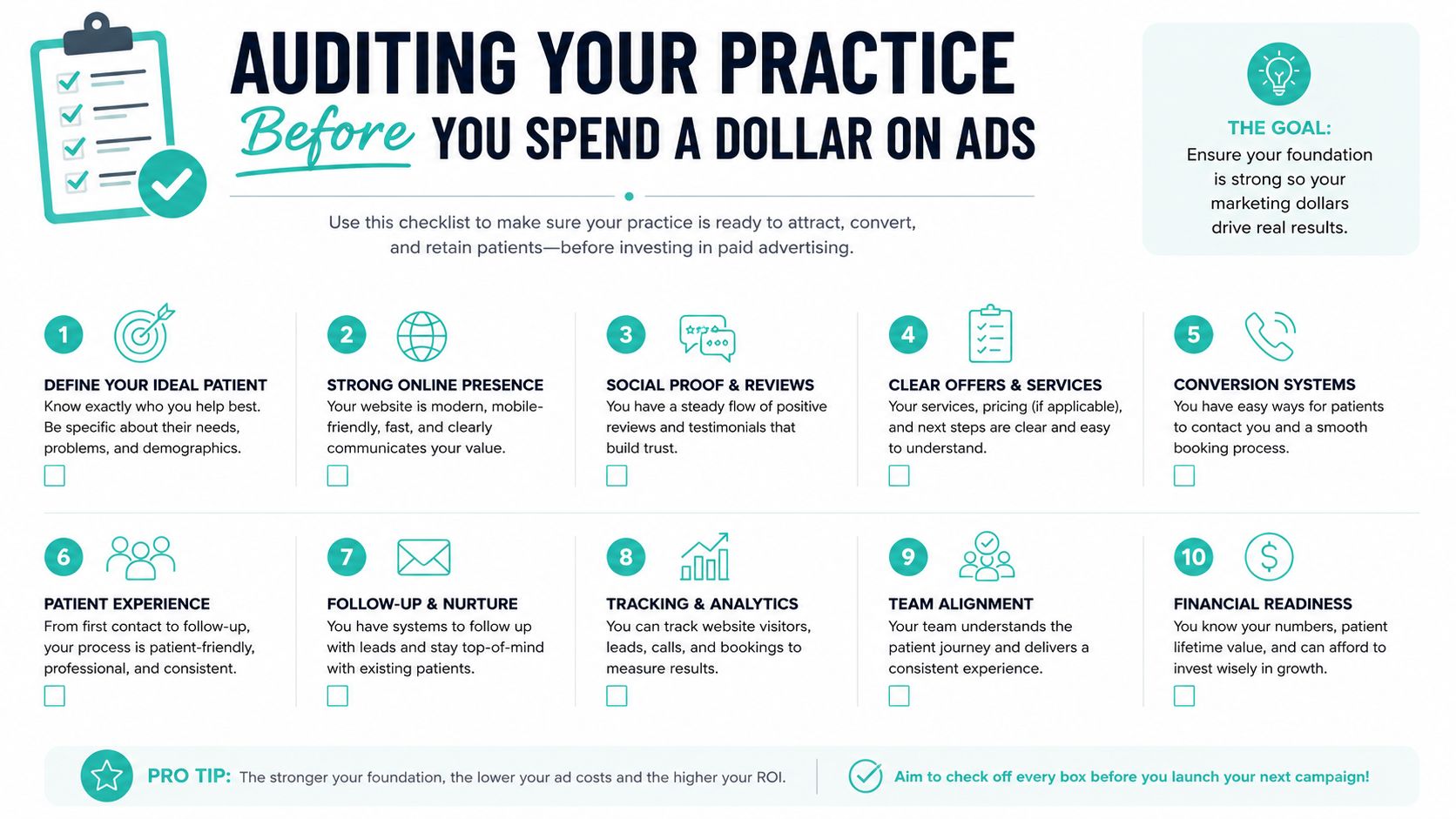
Auditing Your Practice Before You Spend a Dollar on Ads
Advertising amplifies whatever already exists. If your intake process is weak, ads amplify missed calls. If your website is confusing, ads send more people into confusion. If the schedule has no room, successful marketing creates operational pressure instead of growth.
Use five go-or-no-go audits before launching.
Capacity comes first
Look at the schedule by day, provider, procedure, and hour. Identify where the team can absorb new-patient exams, emergency visits, implant consultations, or cosmetic consultations without disrupting existing care.
Pass the gate only when someone owns new-patient capacity and the front desk knows which appointment types to offer. If the practice can't define available windows, fix scheduling before buying traffic.
Service mix must reflect real economics
List the procedures you want to promote, then compare their clinical demand, chair-time requirements, staffing needs, payment process, and contribution to practice economics. Don't advertise a service just because a competitor does. Promote what the practice can deliver consistently and profitably.
A service-mix audit passes when the doctor, office manager, and marketing lead agree on the priority procedure and the type of patient it should attract.
Your digital foundation needs to be credible
Check the Google Business Profile for accurate hours, phone details, services, photos, and location information. Review the website on a phone. Confirm that each important service has a clear page, a visible phone number, and a simple booking path. Review quality and recency matter because paid traffic often checks reputation before contacting the office.
Intake determines whether leads become appointments
Call the office as a prospective patient. Submit a form. Record how long the response takes, whether staff asks useful questions, and whether the caller receives a specific next step. Test the second attempt too, because many inquiries need follow-up.
The gate is open only when calls, forms, texts, and missed-call alerts enter a defined process with an owner.
Competition sets the difficulty
Define the service area before assessing competitors. Compare their offers, review presence, service pages, ad language, appointment convenience, and visible proof. A practice doesn't need to imitate competitors, but it does need a reason for a patient to choose it.
A structured audit guide for digital agencies from MetricsWatch can help organize the paid-search portion of this review. Don't launch until every failed gate has either been fixed or explicitly accepted as a risk.
Choosing the Right Channels for Your Market and Goals
No practice needs every channel. The right mix depends on patient intent, procedure value, geographic competition, available capacity, and how quickly the practice needs results.
Google Search is usually the anchor for urgent and treatment-specific demand. Dental benchmark reporting places Google Ads conversion rates around 5.82% to 9.1%, with offer-specific landing pages reaching 12.5% and call-only ads reaching 18.2% in the cited datasets. The same source reports average dental Google Ads CPC around $4.80 to $7.85 and CPL around $68.40 to $83.93. These figures are benchmarks, not promises, and they make tracking calls essential. Dental-specific Google Ads benchmarks provide useful context for planning.
Local SEO and the Google Business Profile compound more slowly. They're the right foundation for practices that want durable visibility for local service searches, especially when reviews, service pages, and accurate listings are managed consistently. A practice focused on local search should also understand how to boost local rankings with Google reviews, while keeping review requests authentic and compliant.
Meta works differently. It's generally lower intent than Search, so audience qualification and retargeting matter more. Dental benchmark sources cite Meta conversion rates around 1.8% in some datasets, a median of 4.2%, and top-quartile performance near 7.5%, depending on tracking quality and audience fit. Dental ad creative benchmarks for Meta explain why social should usually support awareness, recall, and remarketing rather than replace high-intent search.
Full-arch, clear aligners, other high-ticket services
Referrals and direct mail
Medium
Program and distribution costs
Medium
Established practices with loyal patient bases
Use a simple rule: start with one high-intent channel and one trust-building channel. Add a third only after the first two produce reliable conversion data. A practice with urgent-care capacity may start with Search and local visibility. A cosmetic office with strong visual proof may add Meta after its landing page and intake process convert consistently.
Building a Realistic Budget and 90-Day Rollout Plan
Budget should follow capacity, not ambition. Solo practices typically invest $1,500 to $4,000 per month, multi-provider offices $4,000 to $10,000, and DSOs $10,000 or more, based on the planning framework for this playbook. Those ranges include media and should be adjusted for market competition, staffing, and the value of the procedure being promoted.
A practical allocation puts roughly 50% to 60% into Google Ads, 15% to 20% into Meta, and 10% to 15% into local SEO and reviews, with the remainder available for display, video, and referral programs. Don't treat those percentages as permanent. Shift them when booked-patient data proves a different mix works.
Practice Size
Monthly Budget
Google Ads %
Meta Ads %
SEO/GBP %
Other Channels %
Solo practice
$1,500 to $4,000
50% to 60%
15% to 20%
10% to 15%
Remainder
Multi-provider office
$4,000 to $10,000
50% to 60%
15% to 20%
10% to 15%
Remainder
DSO
$10,000+
50% to 60%
15% to 20%
10% to 15%
Remainder
Days 1 through 30 establish control
Install conversion tracking for forms, calls, booked appointments, and procedure categories. Clean up the Google Business Profile, build branded Search campaigns, confirm landing-page routing, and create a baseline library of ad images, videos, patient-friendly explanations, and approved offers.
Days 31 through 60 create evidence
Launch Meta with a retargeting layer. Test three to five ad variations, each with a distinct hook or visual, then improve the landing page based on real objections. Keep the offer narrow enough that the front desk can explain it without improvising.
Days 61 through 90 cut noise
Pause campaigns that produce inquiries but not qualified bookings. Reduce spend on keywords, audiences, and placements that attract the wrong procedure or geography. Concentrate budget on the top two channels and create a monthly operating rhythm.
If you need outside support for campaign execution, creative, or funnel coordination, review Leaping Lemur Media's marketing services and compare the scope against the gaps identified in your audit.
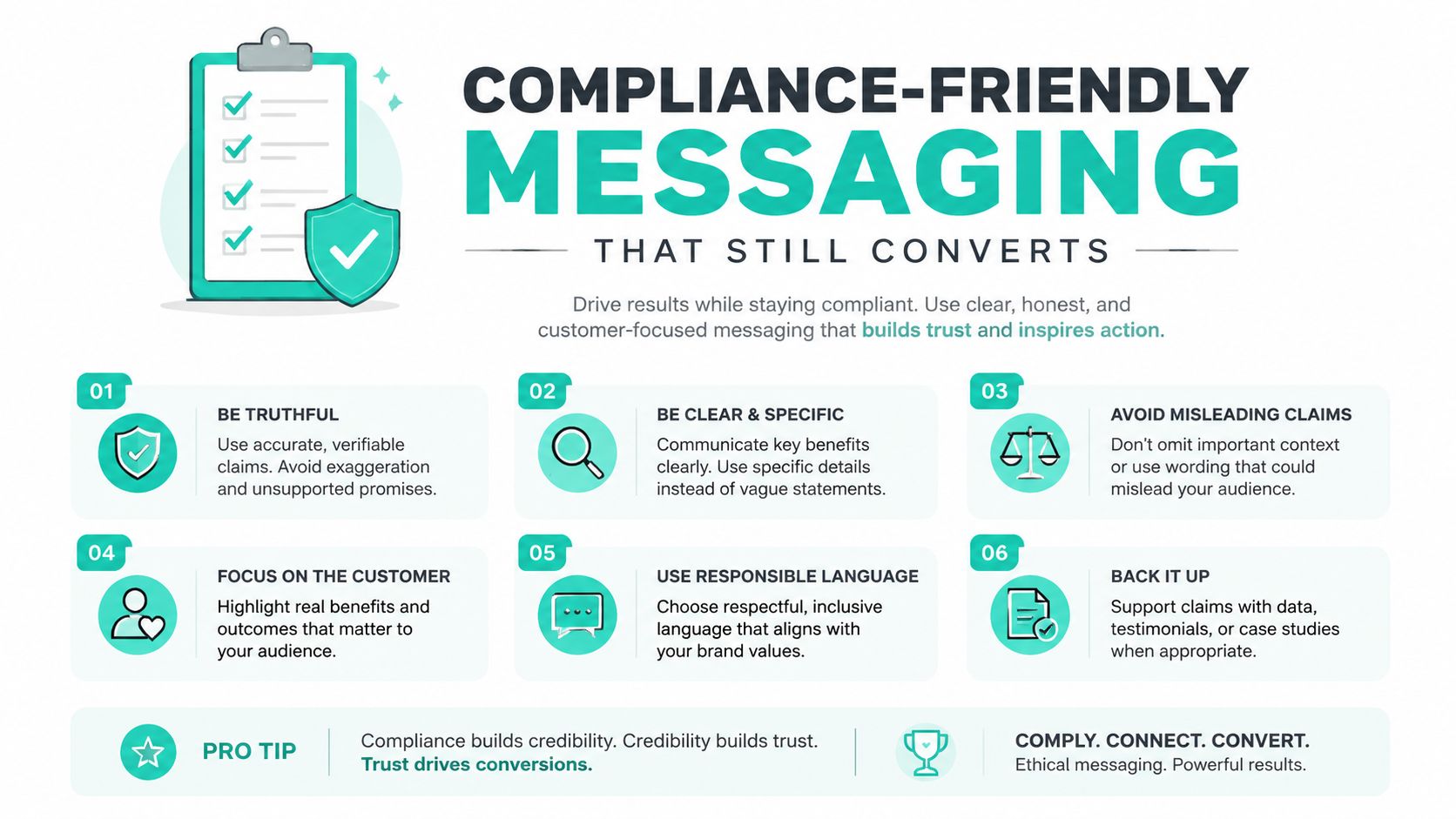
Compliance-Friendly Messaging That Still Converts
Compliance isn't the enemy of performance. Sloppy compliance is.
Dental advertising operates inside professional and legal boundaries that have changed over time. In Ontario, the 1868 Act Respecting Dentistry became the first legislation in the world to grant dentists self-regulation, and the profession spent the next 22 years struggling with “quack advertisements.” By 1890, the Ontario Dental Association's code treated newspaper price ads, superiority claims, free extractions on certain dates, and reduced-rate work as unprofessional advertising. That history shows that commercial dental promotion is relatively recent, not an ancient professional norm. The historical account of dental advertising regulation provides the baseline.
In the United States, California Dental Assn. v. FTC, decided by the Supreme Court in 1999, became a major turning point. The case involved restrictions on truthful, nondeceptive price and quality advertising. The ADA's current guidance says dental advertising must be truthful and non-deceptive, claims need supporting evidence, and ads cannot be unfair. The ADA's marketing and advertising guidance should be part of every campaign review.
Replace vague promises with verifiable specifics
Avoid “best,” “pain-free,” and “guaranteed” unless the claim can meet the applicable legal standard and be documented. Don't imply a treatment outcome that depends on patient factors the practice can't control.
Specificity gives you plenty of room to persuade:
State what the appointment includes.
Explain whether insurance filing or payment plans are available.
Describe the patient experience without promising a universal result.
Add required qualifiers to fees, discounts, testimonials, and before-and-after images.
Check state-specific restrictions before publishing.
Texas rules address false, misleading, or deceptive advertising, quality opinions, anxiety-based appeals, unjustified treatment expectations, and missing price qualifiers. Texas dental advertising restrictions make clear why a broad national template can create local risk. Florida rules similarly address laudatory claims, false expectations, fear appeals, quality comparisons, and fee disclaimers. Florida's dental advertising statute deserves a jurisdiction-specific review.
Create a pre-approved language library. It should cover offers, procedure descriptions, fees, financing, reviews, images, and AI-generated creative. That library protects the practice while forcing the marketing team to write sharper claims.
Creative, Copy, and Landing Pages That Actually Convert
Clicks are rented. Conversion is what you keep.
A searcher who types “emergency dentist near me” needs a different message from a person scrolling through Instagram after avoiding photos because of a damaged tooth. The first wants immediate availability and a clear next step. The second may need emotional recognition, proof, and a low-pressure consultation.
Specificity beats slogans
“Your smile, our passion” doesn't explain what happens next. A practice could test language such as:
Same-day emergency appointments for new patients. Call to check today's availability.
That example is useful because it connects a service, a timeframe, an audience, and an action. The practice must only use it if it can honor the promise.
For implants, the ad could address cost research directly: “Explore implant options in [city]. Schedule a consultation to discuss treatment and fees.” For cosmetic dentistry, social copy could begin with a patient concern: “Tired of hiding your smile in photos?” The message should then lead to proof and an uncomplicated consultation path.
Build the page around one decision
Send paid traffic to an offer-specific landing page, not the homepage. Give the page:
A benefit-led headline: Match the promise in the ad.
A short expectation list: Explain the visit, timing, and next step.
Visible proof: Use real team photos, compliant reviews, credentials, and appropriate treatment examples.
One primary call to action: Repeat it two to three times without adding competing paths.
Mobile priority: Make the phone number and booking action easy to use.
Use procedure-specific pages for emergency care, implants, aligners, and cosmetic consultations. A generic page makes the patient do the sorting. A focused page does that work for them.
Benchmark reporting shows the contrast clearly. Dental website-average conversion is cited at 4.2%, while offer-specific landing pages reach 12.5% in the same benchmark source. That source also reports average dental CPL around $68.40 to $83.93, which makes landing-page relevance and call tracking more than design preferences. See dental advertising performance benchmarks for the cited comparisons.
Test one variable at a time, such as the headline, offer, image, or form length. Rotate creative every four to six weeks when performance or audience response indicates fatigue. Keep a record of what changed, so the practice learns instead of endlessly restarting. For examples of content and campaign thinking, browse the Leaping Lemur Media journal.
Tracking KPIs and Optimizing for Steady Growth
A dental campaign needs two reporting systems. The ad platforms show delivery and engagement. The practice management system, CRM, call tracker, and front desk show whether those interactions became appointments and treatment.
Track these four metrics at the procedure level:
Cost per booked appointment: Pull spend from Google Ads or Meta and booked status from the CRM or PMS.
Show rate: Compare scheduled appointments with completed visits in the PMS.
Cost per accepted treatment plan: Connect marketing source, consultation, and treatment acceptance.
Lifetime patient value: Use practice financial records to estimate the longer-term value of patients acquired through each channel.
Platform conversions aren't the same as booked appointments. A form submission may be duplicated, a call may go unanswered, or a patient may schedule outside the tracked workflow. Reconcile platform data with call recordings, appointment notes, source fields, and staff-entered outcomes.
Use a weekly operating rhythm
Monday is for the snapshot. Compare spend with qualified inquiries, booked appointments, and procedure mix. Look at geography, device, keyword, audience, and appointment availability.
Wednesday is for creative. Check whether the message still reflects the offer, whether comments reveal confusion, and whether one variation is attracting the wrong patient. Refresh only when the evidence supports a change.
Friday is for pruning. Review search terms, negative keywords, locations, placements, and audience segments. Remove traffic that doesn't match the practice's service area or clinical priorities.
Make decisions from the bottom of the funnel
Pause an ad when it repeatedly produces irrelevant inquiries, disallowed claims, or appointments the practice can't fulfill. Raise bids only when qualified appointment data supports more visibility and capacity exists. Test new creative when traffic is relevant but response is weakening. Scale budget when booked appointments, show rate, treatment acceptance, and capacity remain healthy.
The useful question isn't “Which ad got the click?” It's “Which source produced a patient the practice could serve well?”
The FDI's 2025 policy adds another layer for modern campaigns. It says dental ads should disclose AI use, avoid exaggerated claims, protect privacy, and avoid manipulating reviews or search rankings. The FDI policy reference on dental advertising is relevant when a practice uses AI-generated copy, images, video, or automated reputation workflows.
Florida's 2026 telehealth dental statute requires a specific in-ad disclaimer for telehealth dental services. Florida's telehealth dental advertising law should be checked before publishing those campaigns. Compliance belongs inside the reporting process because a campaign that converts by creating legal exposure isn't a growth asset.
Leaping Lemur Media helps dental practices connect paid social, content, brand messaging, and trust-focused campaigns to the patient journey instead of treating each channel as a separate task. Visit Leaping Lemur Media to discuss a coordinated advertising system built around your practice's capacity, offers, compliance needs, and booked-appointment goals.