A prospective patient opens three nearby practice websites after work. Each offers similar services, professional credentials, and a convenient booking button. One site talks mostly about equipment, another lists treatments, and the third clearly explains who the practice helps, what experience patients can expect, and why people trust the team. The third practice is more likely to be remembered when the patient is ready to choose.
That moment captures the practical value of brand positioning and strategy. For dentists, eye doctors, medspa owners, law firms, and other local businesses, positioning isn't a decorative slogan. It's the system that helps people understand your value, distinguish you from nearby alternatives, and feel confident taking the next step.
Table of Contents
- Introduction Why Your Practice Needs Clear Positioning Now
- What Brand Positioning and Strategy Really Mean
- Why Positioning Drives Trust Growth and Choice
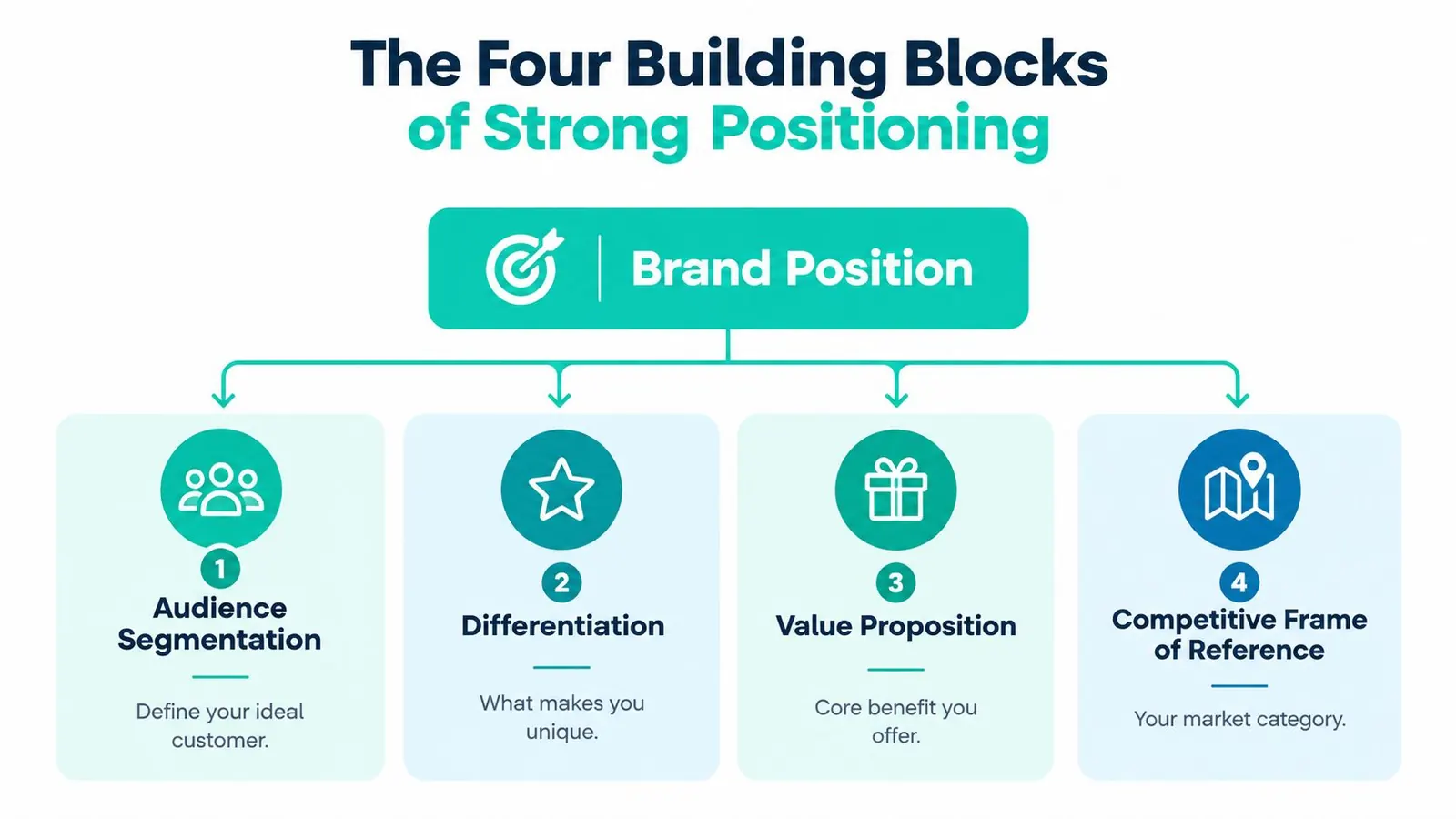
- The Four Building Blocks of Strong Positioning
- How to Write Your Positioning Statement With Examples
- Applying Your Positioning Across Messaging and Marketing Channels
- Bringing Your Positioning to Life and What to Do Next
Introduction Why Your Practice Needs Clear Positioning Now
Local practices often compete in categories where services appear interchangeable. A dental office may offer cleanings, implants, and cosmetic dentistry. An eye doctor may provide exams, contact lenses, and glasses. A medspa may promote injectables, skincare, and body treatments. A law firm may list several practice areas that competitors also claim.
Those service lists are accurate, but accuracy alone doesn't create preference. Patients and clients rarely compare every technical detail with equal attention. They look for signals that answer more personal questions: Will this provider understand my situation? Will I feel comfortable there? Can I trust the promised outcome?
A clear position gives those questions a consistent answer. It connects your audience, your difference, the benefit you create, and the proof that makes the promise believable. It also guides decisions your team makes every day, from the words on your homepage to the way a receptionist describes the first appointment.
The practice that stays in memory
Suppose two optometry practices serve the same neighborhood. Both have qualified clinicians and modern exam rooms. One describes itself as a full-service eye care provider. The other consistently speaks to busy families who want calm, thorough care and straightforward guidance when choosing eyewear.
The second practice has made a sharper choice. Its message gives a specific group a reason to recognize itself, and the team can reinforce that message through appointment reminders, staff language, educational content, and the in-office experience.
Positioning won't replace excellent care. It helps the right people notice and understand that care.
A practical path from idea to execution
You don't need to turn your practice into a national consumer brand. You need a usable decision tool that your team can apply consistently. This guide moves from the meaning of positioning to the building blocks, then to a statement, channel messaging, proof, and a simple review rhythm.
The central idea is straightforward: your position becomes credible when patients encounter the same useful promise everywhere and experience it in real life. That means your website, advertising, intake process, referrals, follow-up, and service delivery should feel like parts of one story.
What Brand Positioning and Strategy Really Mean
Think of a crowded waiting room. A patient may remember one practice as “the place that makes nervous people feel at ease,” another as “the office with convenient evening appointments,” and a third as “the firm that explains complicated options clearly.” Those memory shortcuts help people choose without holding every competing detail in their heads.
Marketing defines brand positioning as the place a brand occupies in a consumer's memory relative to competing brands. A classic positioning structure identifies the target, frame of reference, point of difference, and reason to believe, making positioning a competitive choice rather than a slogan. This marketing reference explains the positioning framework in more detail.
Working definition: Positioning is the distinct place your practice earns in the mind of a specific audience. Strategy is the set of choices and actions that help you earn, communicate, and protect that place.
Positioning is the choice, strategy is the behavior
Positioning answers, “What should people remember about us compared with other options?” Strategy answers, “What will we consistently do so that memory feels true?”
For a family dental practice, a position might center on reducing anxiety through patient-paced care. The strategy could influence the consultation process, staff training, educational content, visual tone, scheduling language, and follow-up. If the practice only prints “gentle care” on a brochure while rushing appointments, the words won't hold.
Brand positioning as a formal marketing concept dates to 1969, when Jack Trout and Al Ries introduced the idea in their paper Positioning Is A Game People Play In Today's Me-Too Market Place. Their work later evolved into the 1981 book Positioning: The Battle for Your Mind, which helped establish positioning as a foundational strategy focused on customer perception rather than product features. The historical discussion of positioning provides that background.
Four questions that make the idea usable
- Target: Who are you especially prepared to serve?
- Frame of reference: What category or local choice are people comparing you within?
- Point of difference: What meaningful benefit or identity signal sets you apart?
- Reason to believe: What evidence, behavior, or experience supports the claim?
A feature says, “We use digital imaging.” A position-led message says, “We help anxious patients understand what's happening and make confident treatment decisions.” The technology may support the promise, but it isn't the promise itself.
For practices building authority through educational content, a clear position also gives every article, webinar, or guide a recognizable point of view. Resources such as WaveGen.ai's guide to drive RFP invites through thought leadership can help connect expertise with the kind of market perception you want to build.
Why Positioning Drives Trust Growth and Choice
A practice can be clinically excellent and still be difficult to choose. If its website, social profile, staff scripts, and follow-up emails describe different priorities, prospective patients must do the work of assembling the story. That uncertainty creates cognitive friction, meaning people spend more effort deciding what the practice stands for and whether its promise applies to them.
Consistency removes some of that friction. Repeated language and recognizable visual cues help people identify the practice across channels. Consistent proof points also make the promise easier to believe because the same idea appears in several parts of the customer journey.
The commercial effect of repetition
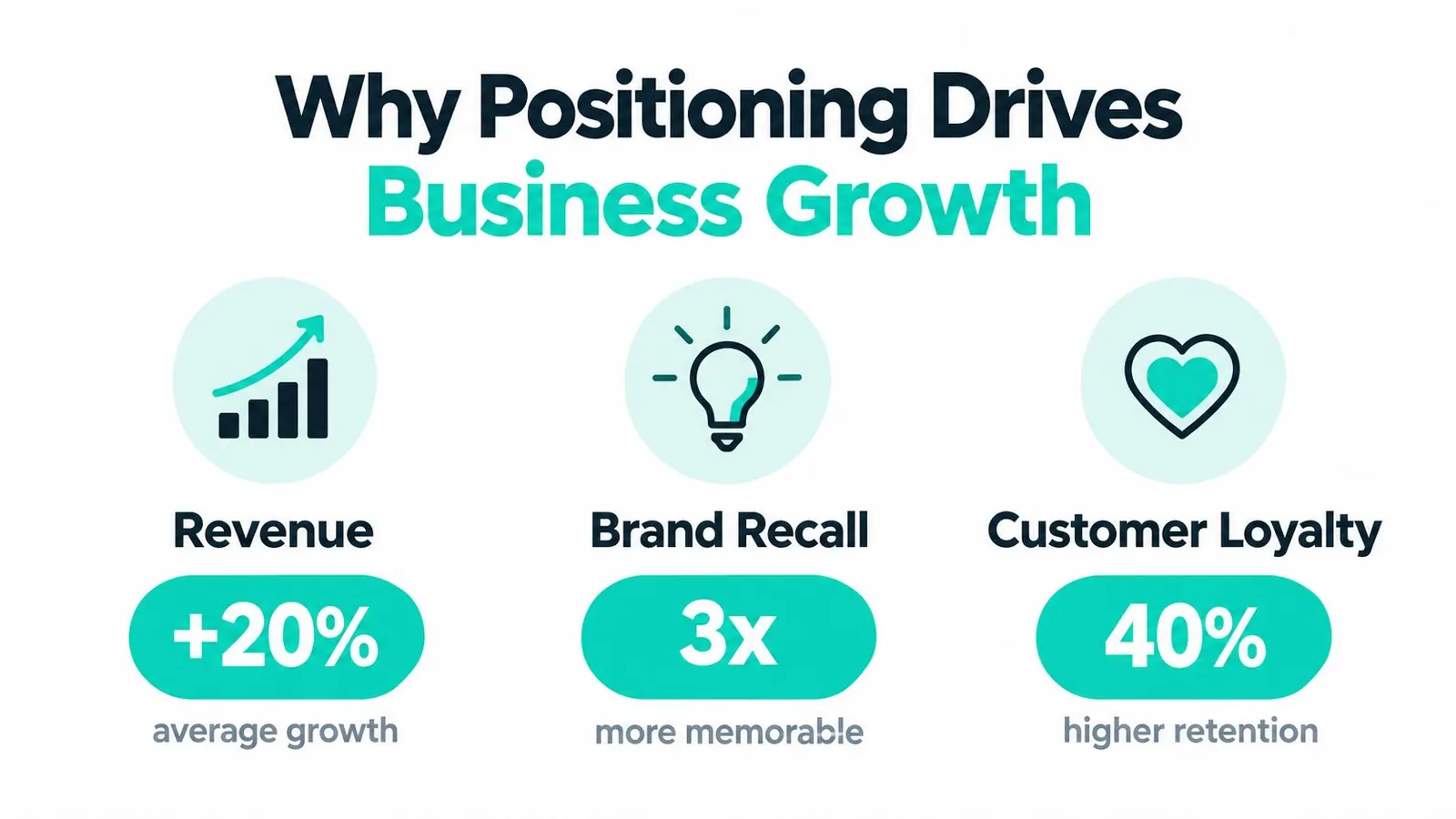
Industry summaries citing Lucidpress and Marq primary research report that consistent brand presentation can raise revenue by 10% to 33%, while 68% of surveyed organizations attributed at least 10% of revenue growth to brand consistency. The cited brand consistency figures and their practical implications are discussed here.
Another industry summary reports that consistent brand presentation across platforms has been associated with average revenue increases of 10% to 20%, with one cited update reporting a 33% increase from consistent presentation in a 2019 study, compared with 23% in an earlier 2016 study. The source summarizes those consistency and revenue figures.
These figures don't mean a repeated logo automatically creates growth. The mechanism is more practical. A consistent promise can improve recognition, reduce repeated explanation, and help a patient connect an advertisement, website, phone call, and appointment experience as evidence of one dependable practice.
Why trust-sensitive practices feel the difference
Dental, eye care, medspa, and legal services involve personal concerns, meaningful financial decisions, or both. People may compare multiple providers before booking, and polished design can't compensate for a confusing or inconsistent experience.
Trust grows when the promise in your positioning aligns with delivered attributes. Literature summarized in a study links that alignment with stronger differentiation, consumer trust, and loyalty, while consistent and differentiated positioning contributes to positive brand equity. The study summary connects coherent positioning with trust and loyalty.
That alignment might look like this:
- A medspa promising thoughtful guidance explains options without pressuring visitors.
- A law firm promising clarity translates legal steps into plain language during intake.
- An eye practice centered on family convenience makes scheduling and follow-up easy to understand.
- A dental office focused on comfort shows patience in both its marketing and appointment flow.
For more context on how Leaping Lemur Media approaches practice growth and brand clarity, visit the about page. The useful test isn't whether your team can recite a slogan. It's whether a new patient would describe your practice in roughly the same way after seeing an ad, speaking with staff, and completing an appointment.
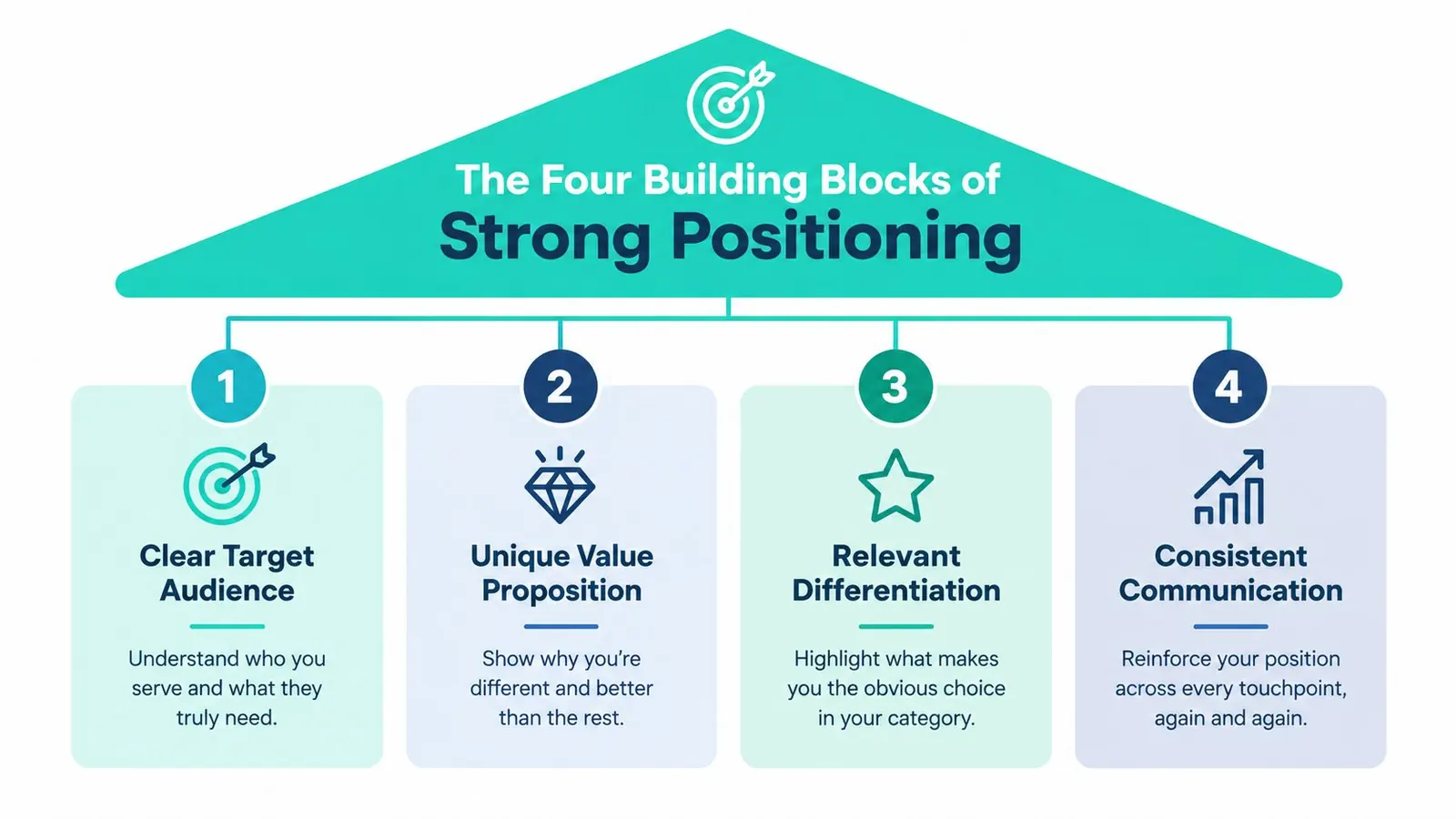
The Four Building Blocks of Strong Positioning
Strong positioning starts with connected choices. You can't define a convincing difference until you know whom you're trying to serve, and you can't make a benefit credible until your team can deliver it consistently.
Audience gives the strategy a clear center
Segmentation helps you move from “everyone who needs our service” to a group with recognizable needs and decision patterns. A standard framework includes demographic, psychographic, geographic, behavioral, and needs-based segments. This segmentation overview explains the categories used to support positioning.
Use the categories as prompts, not as paperwork:
- Demographic: Are you especially suited to families, older adults, professionals, or another group?
- Psychographic: Do your ideal clients value reassurance, speed, education, discretion, or premium attention?
- Geographic: Which neighborhoods, towns, or community networks matter most?
- Behavioral: Do people book reactively, research extensively, follow referrals, or return regularly?
- Needs-based: What concern are they trying to resolve, beyond the service itself?
A cosmetic dentistry practice might focus on adults who want a confident smile but feel uncertain about treatment choices. That insight is more useful than writing “adults aged a certain range,” because it reveals the emotional and practical need behind the decision.
Difference should matter to the audience
Differentiation isn't a list of everything your practice does well. It's the small set of qualities that make the right person think, “That sounds like the kind of place I need.”
Ask what competitors claim repeatedly. If every local provider says “personalized,” the word won't carry much weight unless you define what personalization looks like. Does the clinician explain options using visual examples? Does the team build appointment plans around anxiety? Does the firm provide a clear written summary after consultations?
Value turns features into outcomes
A feature describes your operation. A benefit describes the change the customer experiences. The feature may support the benefit, but the benefit should lead the message.
A law firm might offer video consultations, but the benefit could be easier access for clients with demanding schedules. An eye doctor may have advanced diagnostic equipment, but the patient may care most about a clearer explanation of what the results mean.
Tone makes the position recognizable
Tone is how your position sounds in conversation. A practice built around calm guidance shouldn't use urgent, alarmist copy. A premium medspa may choose polished, selective language, while a neighborhood family dentist may sound warmer and more conversational.
For a broader view of researching competitors and defining a defensible difference, Data Hunters Agency competitive positioning offers a useful reference. Your four choices should reinforce one another, so the audience, difference, value, and tone feel like one coherent practice rather than separate marketing decisions.
How to Write Your Positioning Statement With Examples
A positioning statement is an internal compass. It doesn't need to appear word for word in every advertisement, and it shouldn't try to serve as your entire homepage. Its job is to help your team make consistent choices.
Use this structure:
For [specific audience], [practice] is the [frame of reference] that [meaningful benefit] because [reason to believe].
Before writing, ask three questions:
- Who do we serve especially well?
- What outcome or experience do we want to own?
- What proof makes that promise believable?
Turn features into a reason to choose
Start with a common feature-heavy sentence, then translate it into the patient or client's outcome.
- Dentist: Instead of “We offer comprehensive family dentistry and digital imaging,” try “For families who want calm, understandable dental care, we're the neighborhood practice that helps patients make confident decisions at every stage of care because our team explains options clearly and moves at a comfortable pace.”
- Eye doctor: Instead of “We provide eye exams and carry premium frames,” try “For busy families who need dependable vision care, we're the local eye practice that makes exams and eyewear decisions straightforward because our team combines thorough guidance with convenient support.”
- Medspa: Instead of “We offer injectables, facials, and body treatments,” try “For people seeking natural-looking aesthetic care, we're the medspa that helps clients choose a thoughtful plan without pressure because every recommendation begins with an attentive consultation.”
- Law firm: Instead of “We handle personal injury and family law matters,” try “For clients facing stressful legal decisions, we're the firm that turns complex next steps into a clear plan because our team communicates directly and keeps clients informed.”
These examples don't claim that every practice delivers those experiences. They show how to connect a service to a meaningful outcome and an identity cue.
Run a short team workshop
Write individual drafts before discussing them. Ask each team member to complete the sentence, “Patients choose us when they need…” Then compare the answers. Repeated themes may reveal an existing strength, while disagreements may show that your public message and internal experience aren't aligned.
Next, list proof you can point to:
- Experience proof: What do patients regularly praise about the process?
- Behavior proof: What does the team do that competitors may not?
- Educational proof: What can you explain better than the average provider?
- Community proof: Which local relationships or patient needs shape your approach?
Benefit-based and user, or surrogate, positioning generally outperform feature-based positioning across measures of positioning success in the cited study. The research compares benefit-based, user-based, and feature-based positioning approaches.
Keep the final statement specific enough to guide decisions. If it could describe every practice in your category, it hasn't earned a distinct position yet.
Applying Your Positioning Across Messaging and Marketing Channels
A positioning statement only becomes useful when it changes what people see and hear. Put the central promise into the places where a prospective patient or client makes sense of the practice, then adapt the wording without changing the underlying meaning.
Your homepage should communicate the audience and benefit quickly. An advertisement can lead with the problem you solve. A social profile can express the tone. An intake script can turn the promise into a human interaction. Follow-up messages should confirm that the experience continues after the first inquiry.
Compare the message, not just the format
| Channel | Feature-Based Example | Benefit-Based Alternative |
|---|---|---|
| Website | “Digital scans and same-location consultations.” | “Understand your options clearly with guidance designed around your goals.” |
| Paid ad | “Offering cosmetic consultations.” | “Explore a smile plan that helps you feel prepared before choosing treatment.” |
| Social profile | “Full-service local medspa.” | “Thoughtful aesthetic guidance for clients who want care that feels personal.” |
| Intake script | “We offer several consultation types.” | “We'll listen first, then help you understand the most suitable next steps.” |
| Follow-up flow | “Your appointment details are below.” | “Here's what to expect next, so you can move forward with confidence.” |
The benefit-based alternatives should stay truthful. Don't promise comfort, speed, outcomes, or personal attention unless your team can deliver them in a repeatable way.
Build a lightweight consistency system
Create one shared message sheet containing your positioning statement, preferred audience description, core benefit, supporting proof, tone examples, and words to avoid. Give it to whoever writes website copy, manages ads, answers calls, and sends follow-up messages.
A 2025 B2B SaaS survey found that only 17% of companies track brand metrics frequently. It also found that 29% run only occasional tests and 10% don't track brand metrics at all. The survey details those brand measurement habits.
The same survey found that only 44% have a well-documented brand strategy they actively use, while 35% rely on informal or loosely enforced guidelines. That gap matters because an undocumented position changes every time a new person writes copy or answers a call.
For help translating strategy into practical marketing activity, you can review Big Moves Marketing positioning and messaging. Leaping Lemur Media also provides marketing services for practices and business owners, which can support the move from positioning decisions to channel execution.
Track qualitative signals alongside business outcomes. Note whether prospective patients repeat your language, whether staff describe the practice consistently, and whether reviews reinforce the promise you lead with.
Bringing Your Positioning to Life and What to Do Next
Positioning isn't finished when the statement sounds polished. It earns value when the practice behaves in a way that makes the statement believable. A promise of clarity needs clear explanations. A promise of warmth needs patient interactions that feel attentive. A promise of convenience needs processes that don't create avoidable confusion.
Independent coverage citing B2B Institute research reports that 70% of B2B buyers can't meaningfully differentiate brands in their consideration set. The cited positioning discussion examines that differentiation challenge. Although local practices serve consumers and clients rather than only B2B buyers, the underlying problem is familiar. Generic category language makes it harder for people to remember why one provider fits them better.
Experience can also undo carefully written positioning. The same coverage cites PwC's 2025 Customer Experience Survey, which found that 52% of consumers stopped using or buying from a brand because of a bad product or service experience, while 29% stopped because of poor customer experience online or in person. The point for a local practice is simple: every touchpoint either confirms your position or weakens it.
A focused 30-day positioning check
- Finalize the statement: Choose one audience, one meaningful benefit, and proof your team can support.
- Align three key channels: Update the homepage, the highest-impact campaign or profile, and the intake or follow-up language.
- Audit the experience: Compare the promise with scheduling, phone calls, consultations, and post-appointment communication.
- Create a review rhythm: Revisit the message regularly using patient questions, staff observations, reviews, referrals, and conversion conversations.
- Keep useful flexibility: Refine wording when audience needs or services change, but don't change direction every time a competitor publishes a new headline.
You don't need louder marketing. You need a position people can understand, remember, and verify through experience. Start with the words your best patients already use to describe why they chose you, then turn those words into a promise your entire practice can keep.
If you want help clarifying that promise and translating it into a consistent local marketing system, contact Leaping Lemur Media to discuss your practice, audience, and next growth priority.
Leaping Lemur Media helps practices define positioning, clarify their story, and apply one credible promise across their marketing and patient touchpoints. Visit Leaping Lemur Media to take the next step toward marketing that feels like you on purpose.