
A practice owner finishes seeing patients, checks the marketing accounts, and finds a little of everything: an old ad campaign, a website that looks polished but loads slowly on a phone, and an Instagram page that's been quiet for weeks. Leads come in, but not predictably enough to make planning easy. The problem usually isn't a shortage of marketing ideas. It's the lack of a clear order for putting them to work.
Small business digital marketing gets easier to manage when you treat it as a focused trust-building program, not an endless list of channels to feed. For a dental office, medspa, eye-care practice, or law firm, that means making it easy for the right local person to find you, understand what you offer, and feel comfortable getting in touch.
Table of Contents
- The 90-Day Reality Check for Your Practice
- Define Your Audience and Goals Before Anything Else
- Choosing the Right Channels for a Local Practice
- The 90-Day Launch Plan Month by Month
- Budgets and KPIs That Actually Matter
- Reviews and Trust Signals as Your Real Moat
- Your First 90 Days and What Comes Next
The 90-Day Reality Check for Your Practice
A practice can have a website and social accounts without having a working marketing system. That distinction matters: in 2025, 76.66% of small EU enterprises had a website and 60.59% used social media, compared with 95.65% and 89.09% of large enterprises, respectively, according to Eurostat's enterprise technology data. Those figures show adoption, not effectiveness. A profile that's out of date or a website without a clear booking path can still leave prospective patients unsure what to do next.
A useful reset starts by narrowing the job. Over the next quarter, your practice doesn't need to master every platform or chase every marketing trend. It needs to improve the steps that make a real inquiry more likely: accurate information, clear service pages, credible proof, and a straightforward way to book or call.
The practical test: If a prospective patient finds your practice today, can they quickly tell whether you provide the service they need, where you're located, and how to take the next step?
Set expectations around learning as well as outcomes. A 90-day program can help you identify which messages and channels are generating qualified inquiries, then fix friction that's costing you opportunities. It can't guarantee a specific number of appointments, and it shouldn't be judged by a burst of attention alone. Choose a small number of actions, track them consistently, and give the work enough time to produce useful evidence.
If you want a helpful overview of the building blocks before setting your priorities, Come Together Media's guide to small business internet marketing services provides context for thinking about how those services fit together. The key is to choose what suits your practice, not to buy a menu of tactics you can't maintain.
Define Your Audience and Goals Before Anything Else
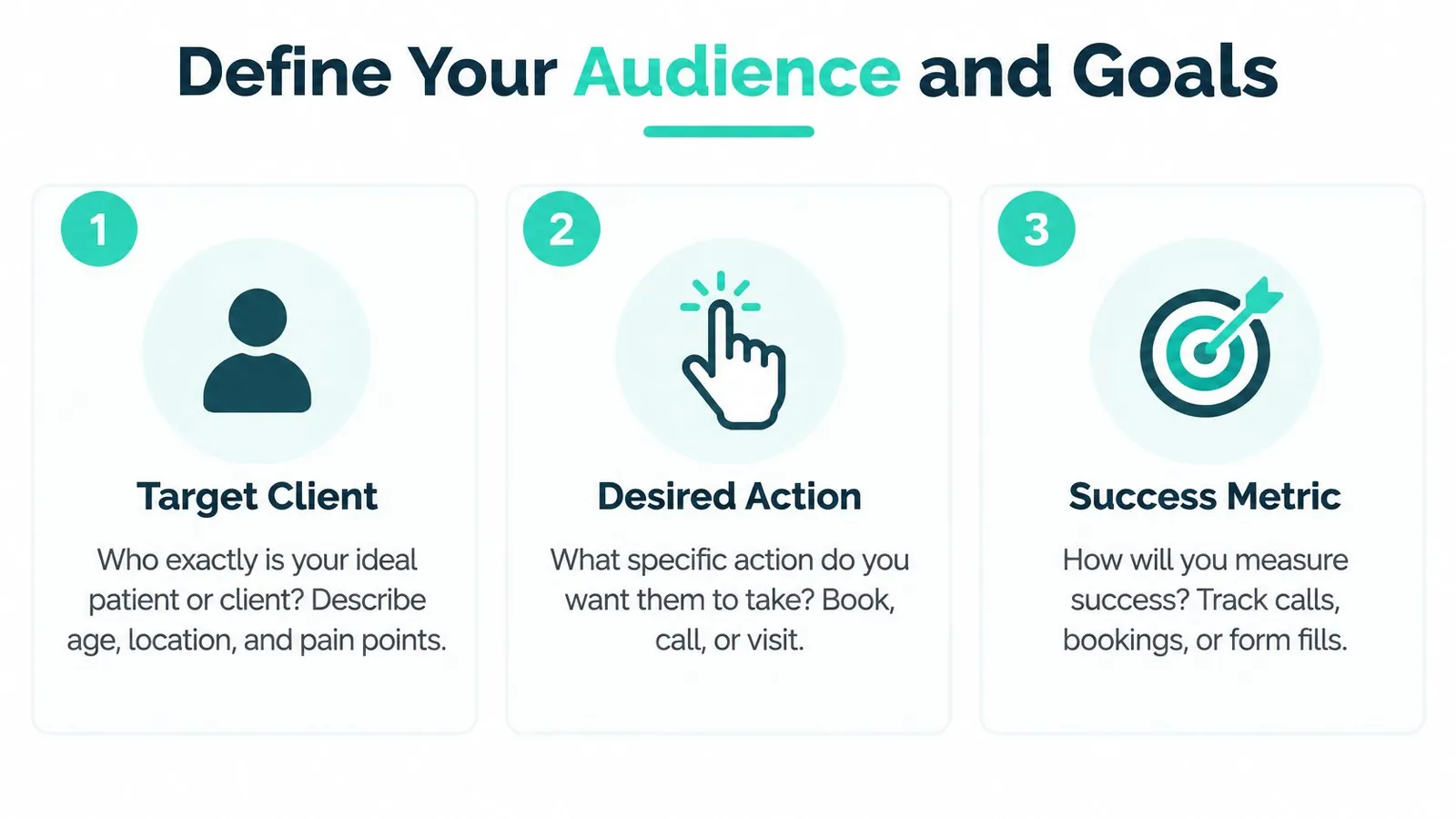
Before changing your website or increasing ad spend, write down who you want to reach, what you want them to do, and how you'll judge progress. This sounds basic, but it prevents the common mistake of optimizing for attention from people who aren't a fit for your services.
Make the brief specific
Start with the people and services your practice can serve well. Which procedures or legal services do you want to grow? Which neighborhoods or service areas are realistic? What questions do people ask before they choose a provider? And which referral sources already bring the right patients or clients?
Then decide what action matters most. A dental practice may want a prospective patient to book an exam; a law firm may want a qualified person to request a consultation. Use one primary action per campaign or page so visitors don't have to guess what to do.
Finally, define success in business terms. Track qualified calls, completed bookings, attended appointments, and signed engagements. A goal such as “get more followers” doesn't tell you whether marketing is helping the practice. A target for qualified consultations or completed appointments can, provided you use your own baseline and capacity to set a realistic expectation.
Keep the plan on one page
Your working brief should capture the audience, priority service, service area, primary action, existing referral strengths, and the outcomes you'll review. Include what the practice can handle: there's little value in generating inquiries if nobody can respond promptly or the schedule has no room.
For a practical companion on making a site support those goals, Otter A/B's marketing on a website playbook can help you think through how content and conversion paths work together. Keep your brief visible when evaluating new ideas. If a tactic doesn't serve the audience, action, or outcome you've chosen, it can wait.
Choosing the Right Channels for a Local Practice
Don't try to be everywhere. For a local practice with limited time and budget, the first job is to make existing demand easier to capture, then build visibility and relationships at a pace the team can sustain.
A 2024 consumer-search benchmark found that 84% of consumers searched online for a local business within a three-month period, 73% began their latest search on mobile, 52% started in Google Search, and 9% in Google Maps, according to BrightLocal's consumer search research. That's a strong reason to prioritize mobile usability and local discovery before investing heavily in broad awareness campaigns.
| Channel | Startup cost | Time to first results | Priority for 90-day plan |
|---|---|---|---|
| Local SEO | Low to moderate, mostly staff time or specialist support | Gradual; profile improvements can be acted on promptly, organic visibility takes sustained work | First. Make profiles accurate and strengthen service and location relevance. |
| Website | Moderate, depending on the condition of the site | Immediate improvement to the visitor experience; lead impact depends on traffic and usability | First. Fix mobile speed, service clarity, and booking or contact paths. |
| Content | Low to moderate, depending on writing and review capacity | Builds gradually as useful pages answer real questions | Next. Create or improve priority service pages and helpful answers. |
| Social media | Low cash cost, ongoing staff time | Can support familiarity and communication; don't rely on it alone for booked leads | Maintain. Choose a suitable platform and post useful updates consistently. |
| Paid ads | Flexible, with spend plus campaign management | Can generate visibility quickly, but lead quality needs close monitoring | Later. Test narrowly after tracking and landing pages are ready. |
| Low to moderate, with consent and follow-up work | Supports existing inquiries and relationships over time | Add when you have a clear, useful follow-up process. |
Local SEO and a conversion-ready website come first because they help people who are already looking for a nearby provider. Content strengthens those foundations, while social media can show the people and expertise behind the practice. Paid campaigns are worth testing only when you can measure what happens after the click. For an example of a channel plan designed for a specific practice type, see this med spa marketing overview.
The 90-Day Launch Plan Month by Month
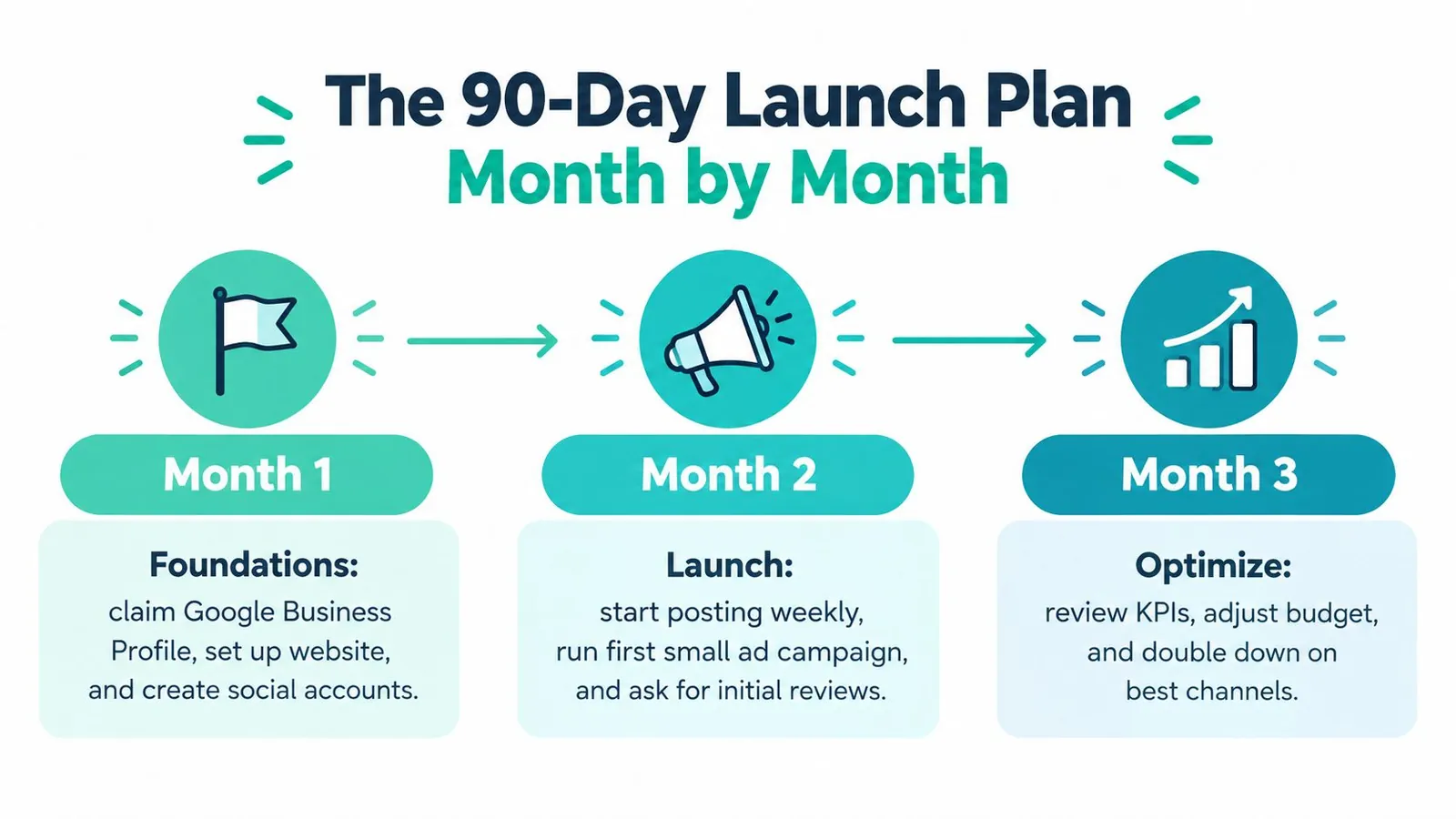
Give every week a practical deliverable. If the team gets busy, protect the work that helps people find you, trust you, and contact you; postpone optional posting or a new campaign rather than leaving the basics unfinished.
Month one, build the foundation
Week one: Review your business listings and correct the essentials, including service categories, location, hours, contact details, and booking links. Make sure the website presents the same information.
Week two: Test the main pages on a phone. Check whether a visitor can understand each service, find a phone number or booking action, and complete the form without unnecessary steps. Fix the most obvious speed and usability problems first.
Week three: Set up tracking for calls, forms, bookings, and appointment outcomes. Use tagged links and call tracking where appropriate, while ensuring your team knows how to record lead quality and source.
Week four: Create a simple process for inviting genuine customers to share feedback. Make the request neutral, voluntary, and easy to complete.
Month two, strengthen visibility
Week one: Improve the pages for priority services. Explain who the service is for, what a prospective patient or client should expect, and how to take the next step.
Week two: Publish a helpful answer to a real question your team hears. Keep it practical and accurate, then adapt it for a social post if that channel fits your audience.
Week three: Review local directories and relevant community or professional sites for accurate listings and legitimate opportunities to be mentioned. Google describes local visibility through relevance, distance, and prominence, with prominence informed by signals such as reviews, articles, directories, and links, as explained in its Business Profile local ranking guidance.
Week four: Check whether visitors can move from profile or search discovery to a clear website action. A small business social media marketing guide can help your team plan a manageable rhythm, but use social media to support the practice's priorities, not replace them.
Month three, test and refine
Week one: Review which sources produced qualified calls, completed bookings, and attended appointments. Don't treat clicks alone as proof of business value.
Week two: If the tracking and landing page are ready, test a tightly targeted paid campaign for a priority service and location. Set a limit, use a clear call to action, and monitor lead quality.
Week three: Create a simple follow-up for new inquiries, using email or text only where appropriate and with proper consent. Answer common questions and make it easy to continue the conversation.
Week four: Decide what to keep, change, or stop. Build on what the practice has learned rather than launching a fresh collection of tactics.
Budgets and KPIs That Actually Matter
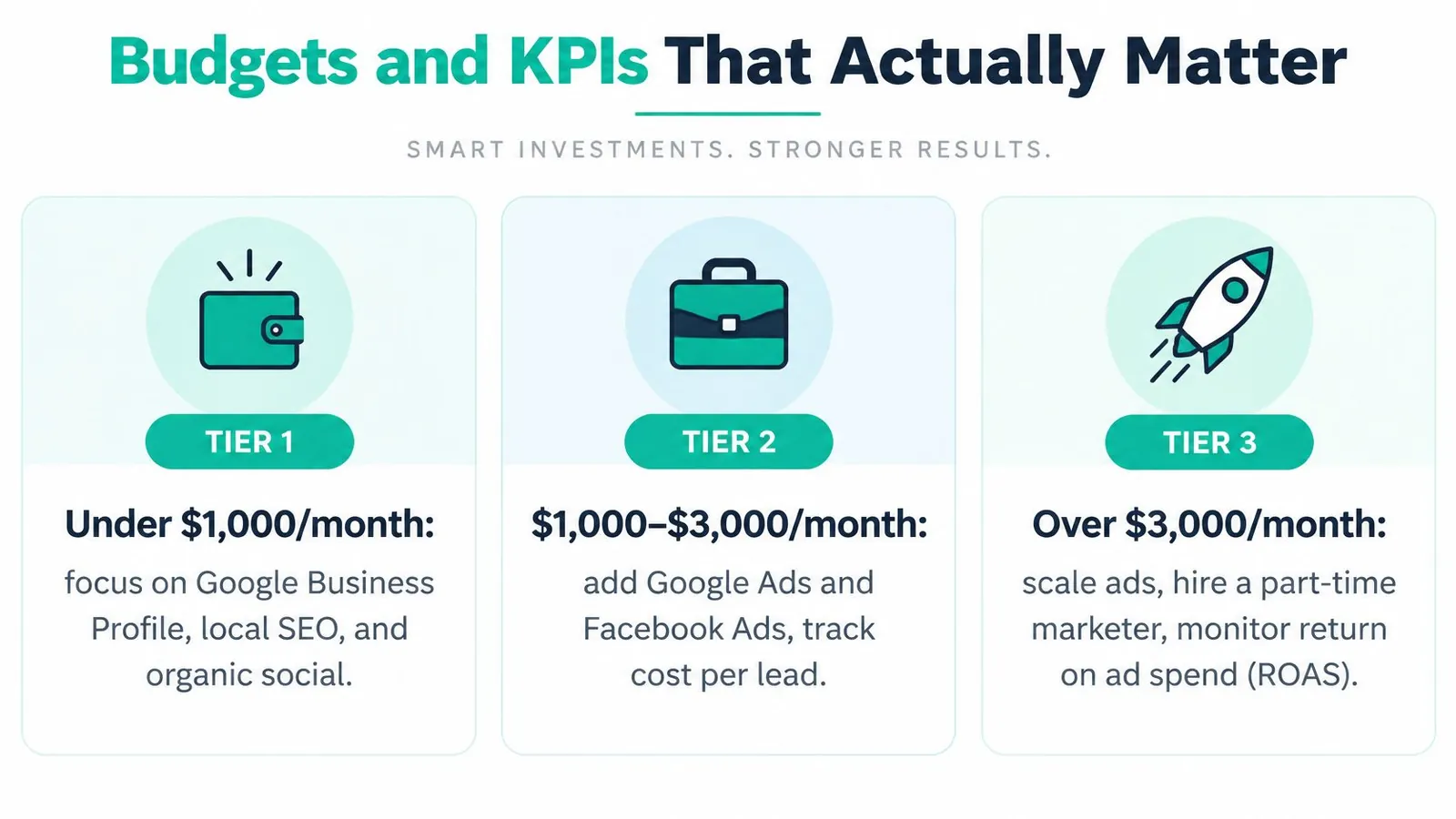
Budget should follow readiness. Spending more won't solve an unclear service offer, a broken booking path, or missing lead tracking. Use these tiers as planning frameworks, not guarantees of results; the right allocation depends on what your practice can execute and measure.
Match the spend to your capacity
- Under $1,000 per month: Prioritize an accurate Google Business Profile, essential local SEO work, and a light organic social presence you can maintain. Focus on fixing the website's most important conversion problems before adding advertising.
- $1,000–$3,000 per month: Once tracking and landing pages are working, consider a carefully scoped Google Ads or Facebook Ads test. Review cost per qualified lead, not just cost per click.
- Over $3,000 per month: Consider scaling campaigns that already produce qualified inquiries, adding dedicated marketing capacity, and monitoring return on ad spend alongside appointment outcomes. Don't scale a channel just because it produces activity.
The case for digital discovery isn't new. A 2011 Pew Research study found that 47% of people seeking local-business information relied most on online sources, while 38% specifically relied on search engines, according to Pew Research Center's local-business findings. For your own practice, use current lead records to decide what deserves investment.
Review the funnel, not the dashboard
Keep a short scorecard of qualified calls, completed bookings, attended appointments, and the value of work by service line. Compare these with impressions, clicks, follower counts, and average position. The latter can help diagnose visibility, but they don't show on their own whether suitable people are choosing the practice.
Run a brief weekly check for broken forms, missed calls, and poor-fit inquiries. Review channel and conversion patterns monthly, then reconsider how to allocate budget quarterly. Ask front-desk staff what new patients say about finding the practice; their answers can reveal gaps that analytics won't explain.
Reviews and Trust Signals as Your Real Moat
People choose a practice based on more than a claim that it offers excellent care or service. They want to understand the experience, see credible evidence, and know that the business will treat their concerns seriously. Reviews, credentials, clear service information, and appropriate photos can answer those questions before the first call.

Build a review process around genuine experiences. Invite real patients or clients to leave feedback without telling them what to say, asking for a particular rating, or offering an improper incentive. Respond calmly to criticism. Acknowledge the concern, avoid sharing private details, and invite the person to continue the conversation through an appropriate private channel.
The FTC's consumer-review rule, effective October 21, 2024, prohibits selling or purchasing fake reviews, undisclosed insider reviews, and AI-generated fake testimonials; knowing violators may face civil penalties, as described in the FTC's announcement of the final rule. Don't buy ratings or followers, script praise, or suppress honest criticism. Those shortcuts can damage trust as well as create compliance risk.
Use recurring questions and feedback to improve service pages and FAQs. If prospective patients often ask about what happens at an initial visit, explain that process clearly. For practices considering a focused dental growth strategy, this dental marketing overview offers a relevant starting point.
A smaller practice can make a strong impression with specific, thoughtful feedback and transparent information. The objective isn't to collect praise at any cost. It's to help a prospective patient or client understand what working with your team may involve, without making promises you can't substantiate.
Your First 90 Days and What Comes Next
A marketing system should make the next decision clearer, not create a permanent stream of new tasks. Keep a simple checklist where the team can see it and review it together:
- Audience: Know which patients or clients and services the practice is prioritizing.
- Findability: Keep business profiles and essential website information accurate.
- Conversion: Make calling, booking, or requesting a consultation straightforward on mobile.
- Evidence: Invite genuine feedback and explain services clearly.
- Measurement: Record qualified inquiries and completed appointments by source.
- Focus: Continue the channels the team can manage well, and pause the ones that aren't serving a defined goal.
Avoid switching providers or strategies every quarter without reviewing the evidence. Don't chase a new social platform because it's getting attention elsewhere, and don't mistake visibility for growth. The slow work of useful content, accurate listings, reliable follow-up, and honest reviews gives a practice a stronger foundation than a series of disconnected campaigns.
For the next quarter, invest more in the channels that produced real appointments, expand content around the questions patients ask, and test one new idea at a time. If you're evaluating outside support, review the services available for practice marketing against the priorities you've set, rather than choosing a package first and finding a purpose for it later.
Start with one action this week: check the mobile booking path, correct a business listing, or make lead tracking usable for the front desk. A consistent small business digital marketing system gives your practice a clearer way to earn attention, build trust, and turn local interest into meaningful conversations.
Leaping Lemur Media helps practices with website design, SEO and content, paid campaigns, and conversion-focused landing pages and reporting. If you want a marketing partner to help turn your priorities into a practical growth program, visit Leaping Lemur Media.