A practice owner opens the calendar in November and realizes the holiday campaign is still an idea. The team rushes out a discount, posts a few festive graphics, and hopes new appointments arrive before the season ends. But the offer doesn't explain why a patient should choose this practice, and the booking page still shows outdated hours.
That scramble is familiar, but it's not inevitable. Strong seasonal marketing campaigns give people a timely reason to take action while respecting the trust, capacity, and service standards a local business depends on.
Table of Contents
- Why Most Seasonal Campaigns Underperform for Local Service Businesses
- Build Your 12-Month Seasonal Calendar Around Local and Professional Milestones
- Segment Your Audience by Need-State and Buying Readiness
- Choose Message Architectures That Build Trust Instead of Eroding It
- Sequence Channels From Awareness Through Availability
- Allocate Budget by Goal and Phase Rather Than by Channel
- Your Year-Round Seasonal Rhythm and Final Checklist
Why Most Seasonal Campaigns Underperform for Local Service Businesses
Consider a common hypothetical: a dental practice waits until November to promote year-end appointments. The owner approves a broad discount, staff squeeze in a few social posts, and the front desk gets a wave of inquiries without a clear way to prioritize them. The campaign may generate attention, but late planning leaves little time to answer questions, prepare staff, or reach people who need to book ahead.
Discount-first thinking creates another problem. A price cut can attract people who are shopping only for the lowest price, while doing little to explain the practice's approach, expertise, or value. For a dentist, optometrist, medspa, or law firm, the decision often involves trust and reassurance, not just a deal.
Timing matters because seasonal demand doesn't necessarily begin when a business starts promoting. Google reported that by June 2021, 31% of U.S. holiday shoppers had already started shopping, and 37% of people who shopped during the previous holiday season wished they had started earlier (Google's seasonal-shopping insights). That's a useful reminder for service businesses: people may be researching well before the date that feels like the obvious campaign launch.
Practical rule: Don't make the season itself the offer. Connect the season to a real customer need, then make the next step clear.
A trust-first campaign starts with a better question than “What can we discount?” Ask what your community needs at this time of year, what your practice can responsibly provide, and how early someone needs to act. The answer might be an educational reminder, a seasonal service package, convenient consultation access, or a community partnership. That shift helps a campaign feel like a useful invitation rather than a last-minute sales push.
Build Your 12-Month Seasonal Calendar Around Local and Professional Milestones
A useful seasonal calendar isn't a list of every holiday. It's a planning tool for choosing the moments that connect naturally to your community and services.
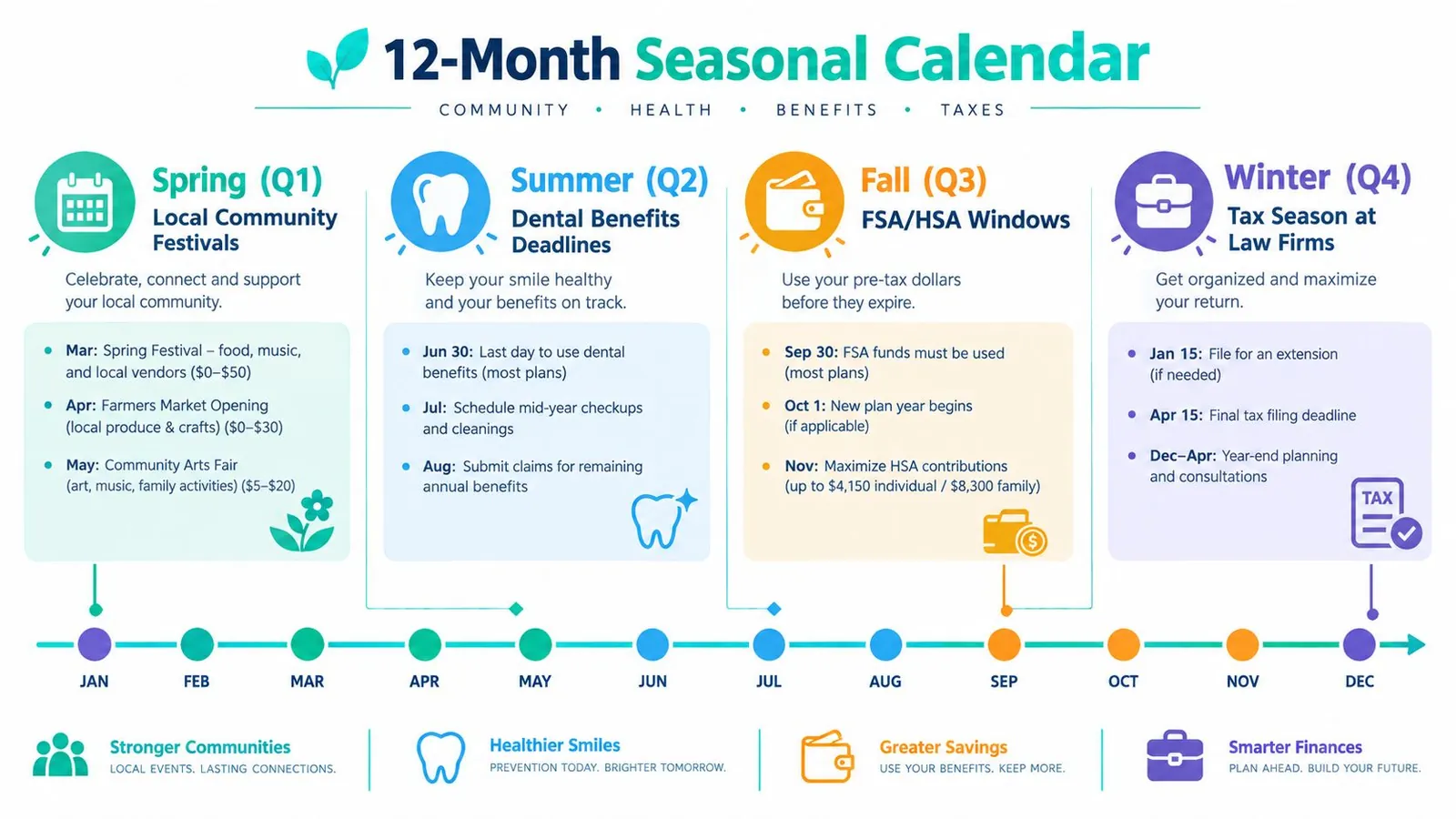
Start by listing the events and needs that affect your customers: local festivals, school transitions, weather changes, benefit deadlines, tax season, and periods when people commonly plan travel or weddings. Then identify which of those moments your practice can support with a relevant service or helpful information. A dental practice might plan around preventive-care reminders and benefits deadlines. An optometry practice could connect back-to-school planning with eyewear needs. A law firm might provide timely information related to tax season or business planning, while a medspa could explain treatment options and appointment lead times.
Map each opportunity to a customer journey
For each promising moment, plan three connected activities: awareness before demand peaks, a clear action when people are ready, and follow-up after the main window. An early message could answer a common seasonal question. A conversion message could offer a consultation or a booking route. Follow-up might help someone use a gift card, complete a planned service, or prepare for the next seasonal need.
Use a simple quarterly draft, then adjust it to your local calendar:
| Quarter | Possible planning focus |
|---|---|
| Q1 | Tax-season information, winter wellness, and community events |
| Q2 | Spring routines, wedding planning, and summer preparation |
| Q3 | Back-to-school needs, local festivals, and return-to-routine messages |
| Q4 | Benefits planning, year-end appointments, and holiday availability |
Keep the calendar selective. Choose the few moments that fit your audience and operational capacity, rather than forcing a promotion into every holiday. A homeowner-facing seasonal checklist can also be useful when planning local content around home upkeep. For example, a business could share a resource on DIY HVAC tasks for homeowners as part of a broader conversation about preparing for seasonal changes.
For a local practice that wants help connecting its marketing to its service area, Boise marketing support is one example of a place to explore local strategy. The key is to keep the calendar grounded in what your community needs, not what other businesses are promoting.
Segment Your Audience by Need-State and Buying Readiness
Two people in the same age group can need completely different messages. One might be exploring a service, another comparing providers, and a third ready to schedule. Segmenting by need-state and buying readiness helps a practice send information that matches where someone is in the decision process.
Research-led behavior makes this distinction especially important. Google reported that 64% of holiday shoppers said scrolling, streaming, searching, and shopping were blended behaviors, and that spontaneous U.S. holiday purchases declined from 30% to 26% year over year (Google's analysis of modern holiday shopping). For a service business, that supports a practical approach: make useful information easy to find wherever a potential customer encounters the campaign, rather than expecting one message to close the decision.
| Readiness Stage | Message Focus | Primary Channel |
|---|---|---|
| Researching | Explain the service, who it may suit, and what to expect | Educational email or website content |
| Considering | Address common concerns and offer relevant proof or reassurance | Social content, reviews, or a follow-up email |
| Ready to book | Clarify availability, next steps, and how to schedule | Booking page, direct response, or appointment reminder |
Early education is for people who aren't ready to act. A medspa, for instance, can explain how to prepare for a consultation without pushing an appointment as the only acceptable next step. For ideas about aligning campaign messaging with medspa services, see med spa marketing.
Warm leads often need clarity, not more urgency. Share service details, answer practical questions, and make it easy to compare options. For someone ready to book, a direct note about remaining appointment availability can be appropriate, provided it reflects real capacity and doesn't manufacture pressure.
Build separate tracks for these groups, and use behavior to move people between them. Someone who clicks through to service details may need a different follow-up from someone who books. The goal isn't to create more messages. It's to make each message more relevant and to stop sending the same generic offer to everyone on your list.
Choose Message Architectures That Build Trust Instead of Eroding It
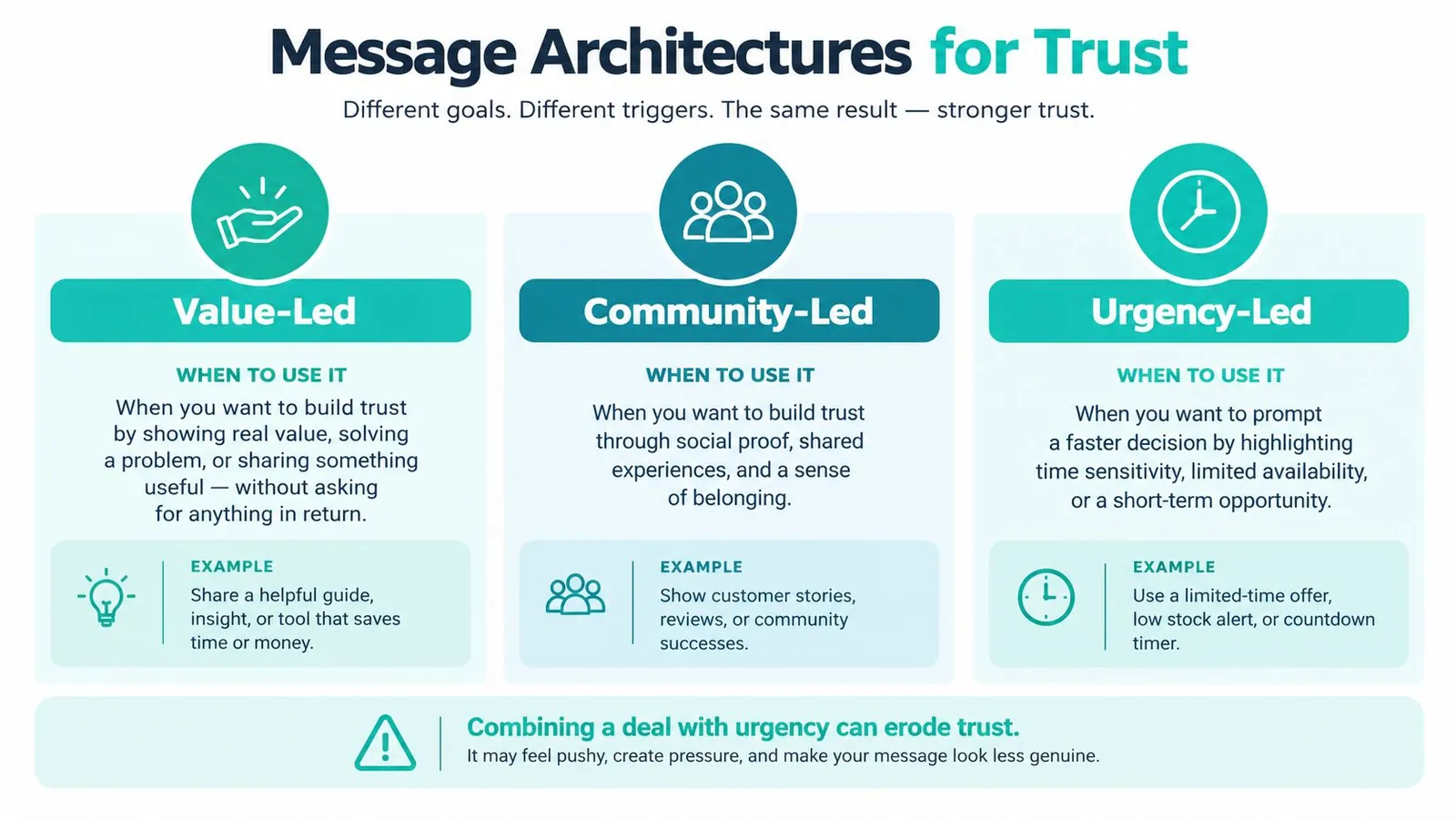
A seasonal message can lead with value, community, or urgency. Each has a role, but a promotion that works for retail may not suit an appointment-based practice.
| Architecture | What it emphasizes | When it fits |
|---|---|---|
| Value-led | A clear, bounded benefit or service option | When customers need help understanding the value or access available |
| Community-led | Local connection, education, or shared seasonal needs | When trust and relevance matter more than a price incentive |
| Urgency-led | A genuine deadline or limited appointment availability | When capacity or a real booking window is closing |
There's evidence that emotional context can strengthen an offer. A study of Twitter users using eye-tracking, facial coding, ad recall, and purchase-intent surveys reported that ads combining a deal with the spirit of giving were 28% more effective than deal-only executions (X's holiday creative guide). For a professional practice, the useful lesson isn't to copy a retail promotion. It's to pair a concrete benefit with a message that feels human and seasonally relevant.
Match the message to professional responsibility
A “20% off” headline may make a practice sound interchangeable with competitors, especially if the campaign offers no explanation of who the service is for or what a customer should expect. A trust-first alternative might focus on access to a consultation, a seasonal service bundle with clear terms, preventative-care information, or a community event. Any offer should fit applicable professional, clinical, and legal requirements. Avoid implying guaranteed outcomes.
Urgency is useful only when it's real. If appointment capacity is limited, say so plainly and keep availability information current. If there's no meaningful deadline, a countdown or repeated “last chance” message can make the practice feel less credible.
Creative also needs to welcome people who don't celebrate the dominant holiday. Use seasonal cues that reflect the service or community, and don't assume every customer shares the same traditions. A campaign can be timely without making a particular holiday the price of entry.
Sequence Channels From Awareness Through Availability
Treat channels as a sequence, not as separate places to repeat the same advertisement. A person might first see a social post, research the service later, and book after receiving an email. The campaign should make those steps feel connected.
Email is useful for existing relationships. Start with a helpful explanation or reminder, then follow with a service detail or booking option when the timing fits. Keep the message focused on one next step.
Social content can introduce a seasonal need and show how the practice addresses it. Use short educational posts, staff explanations, and relevant community updates. When someone wants more information, direct them to a page with service details, contact options, and clear expectations.
Paid campaigns can extend reach when the seasonal window is active. Use them to direct people to a useful landing page, not a vague homepage that makes visitors search for the offer. Make the page readable on a phone and ensure its call to action works on mobile.
Local search and business listings often influence the final decision. A campaign can lose a prospective customer if the website, appointment system, and business profile show conflicting holiday hours. Google Business Profile guidance lets businesses set regular hours, add special hours for holidays or events, and update regular hours when they reopen (Google's Business Profile hours guidance).
Before launch, check that the campaign landing page, listings, and scheduling system agree on services, availability, and contact details. For practices reviewing how their services and digital channels fit together, marketing services can be one reference point.
The sequence is straightforward: introduce the seasonal need, provide proof and practical information, then make availability easy to act on. One message doesn't need to do every job.
Allocate Budget by Goal and Phase Rather Than by Channel
An equal split across email, social, and paid media looks tidy, but it doesn't account for what each part of a campaign needs to accomplish. Budget by campaign phase and goal instead. That makes it easier to protect early planning and creative work from being swallowed by last-minute media spend.

Separate the work into three budget buckets
Early awareness and preparation covers the work that helps people understand the seasonal need before they're ready to book. This might include educational content, landing-page updates, photography, email planning, and local outreach. Keep this budget distinct from conversion media so early activity isn't judged only on immediate bookings.
Peak-season conversion supports the clearest action during the period when the campaign is most relevant. Depending on the practice, that could mean paid search, social promotion, appointment reminders, or a focused service page. Spend should follow capacity. If staff can't handle more inquiries or the schedule is already full, increasing reach may create frustration rather than growth.
Post-season follow-through supports people who weren't ready to act earlier, helps customers use a seasonal service or gift, and carries useful learning into the next campaign. Don't assume the campaign ends on the headline date. Google reported that December 26 through January 8, often called “Q5,” can be a profitable period, and noted that 83% of early-October holiday purchases had been researched beforehand (Google's guidance on capturing holiday shoppers). For a local practice, use that broader timing idea to consider when follow-up makes sense, not as a reason to copy retail tactics.
Pre-commit funds to the early work, the active campaign, and the follow-through. Set aside resources for creative testing as well as media, but keep the test controlled: compare message approaches while holding audience, placement, and landing-page conditions steady. That way, a result is easier to interpret.
Measure incremental impact, not just attributed conversions
A campaign's reported conversions don't automatically prove that the campaign created new demand. Some people would have booked anyway, while seasonal timing, promotions, weather, or competitor activity may affect results. Start with a pre-season baseline using weekly leads, sales or bookings, conversion rate, media spend, and relevant external factors.
Then define a comparison. If feasible, hold out a customer group from campaign exposure or compare campaign performance with a matched market that didn't receive the campaign. Choose a primary KPI before launch, such as incremental qualified bookings, and don't change the main success measure after seeing the results.
A Walmart-focused study using SARIMAX and difference-in-differences found that holiday campaigns increased weekly sales even after controlling for macroeconomic conditions, underscoring why campaign impact should be separated from baseline demand (the study's seasonal measurement analysis). A small practice can apply the principle without building a complex model: compare the campaign period with its baseline and a reasonable control, and account for delayed bookings before drawing conclusions.
Track incremental cost per acquisition and incremental revenue, not only platform-reported conversions. If leads rise but bookings don't, inspect response time, fit, and appointment capacity. If bookings rise in both exposed and holdout groups, seasonality may explain part of the change. Reporting that variance clearly is more useful than claiming every conversion as an advertising win.
Your Year-Round Seasonal Rhythm and Final Checklist
A seasonal calendar becomes valuable when the practice revisits it, learns from each campaign, and adjusts the next one. That doesn't require a new promotion for every occasion. It requires a reliable rhythm for choosing relevant moments, preparing the team, and making the customer's next step clear.
Before a campaign goes live, check the fundamentals:
- Choose a genuine fit: Select a local or professional milestone that connects to a real customer need.
- Set the service boundary: Confirm what the practice can offer, who it suits, and whether staff can fulfill expected demand.
- Match message to readiness: Give researchers useful information, considering prospects reassurance, and ready-to-book customers a direct path.
- Coordinate the experience: Make email, social, landing pages, booking tools, and business listings consistent.
- Define the measurement: Set a primary KPI, baseline, and comparison before the campaign begins.
- Review and refine: Record what produced qualified inquiries, what created operational strain, and what the next campaign should change.
Keep the creative inclusive. Not everyone celebrates the same holiday, and seasonal relevance can come from weather, school routines, community events, preventive care, or year-end planning instead. A campaign can feel timely without leaning on assumptions about what customers celebrate or how they spend.
The most useful default is to plan early, lead with relevance, and let real capacity shape the offer. If a campaign would still make sense to customers without a discount attached, it's more likely to support the practice's reputation as well as its appointment book.
Leaping Lemur Media offers marketing strategy and campaign support for practices that want their outreach to reflect their services and community. If you're planning seasonal marketing campaigns for your practice, visit Leaping Lemur Media to explore how its team approaches intentional, community-rooted marketing.