The most popular advice about a brand positioning statement is also the least useful: write a memorable sentence, add a polished slogan, and assume the market will understand the difference. That approach creates attractive language, not a distinct position.
A positioning statement should do harder work. It should tell your team who you serve, what category you compete in, why your offer matters, and what evidence makes the claim believable. Then it should influence the phone script, the service experience, the review response, the website copy, the Google Business Profile, and the message a prospective patient sees in an AI summary.
For dentists, eye doctors, medspa owners, law firms, and other local businesses, positioning isn't finished when the sentence sounds good. It's finished when the business can prove it repeatedly.
Table of Contents
- Why Most Positioning Statements Never Change Anything
- The Four Parts Every Statement Has to Earn
- How the Same Framework Reads in Healthcare, Legal, and Medspa
- Templates You Can Fill In Without Falling Into Traps
- What Search, Reviews, and AI Summaries Do to Your Statement
- The Five Pitfalls That Quietly Kill a Statement
- A Six-Step Process for Building Yours This Week
- Turning the Statement Into a Daily Operating Tool
Why Most Positioning Statements Never Change Anything
A positioning statement that wins approval in a meeting can still fail in the market. It often ends up in a shared drive while the team continues prioritizing patients, answering reviews, writing service pages, and handling calls without a clear standard for choice.
The problem is treating positioning as polished language. “We provide personalized care with compassion and excellence” sounds pleasant, but it gives a receptionist, clinician, attorney, or marketer no practical direction. Nearly every competitor can claim it. A useful statement must help the team decide what to emphasize, what to refuse, and what proof to show.
Positioning was built for a harder job. The discipline took shape in the late 1960s, when Jack Trout's 1969 article presented brands as competitors for a distinct place in the customer's mind. Al Ries and Jack Trout later developed the idea in Positioning: The Battle for Your Mind in 1981. Marketing began defining how customers should understand an offer against alternatives, rather than merely describing its features. The history of brand positioning) explains that progression.
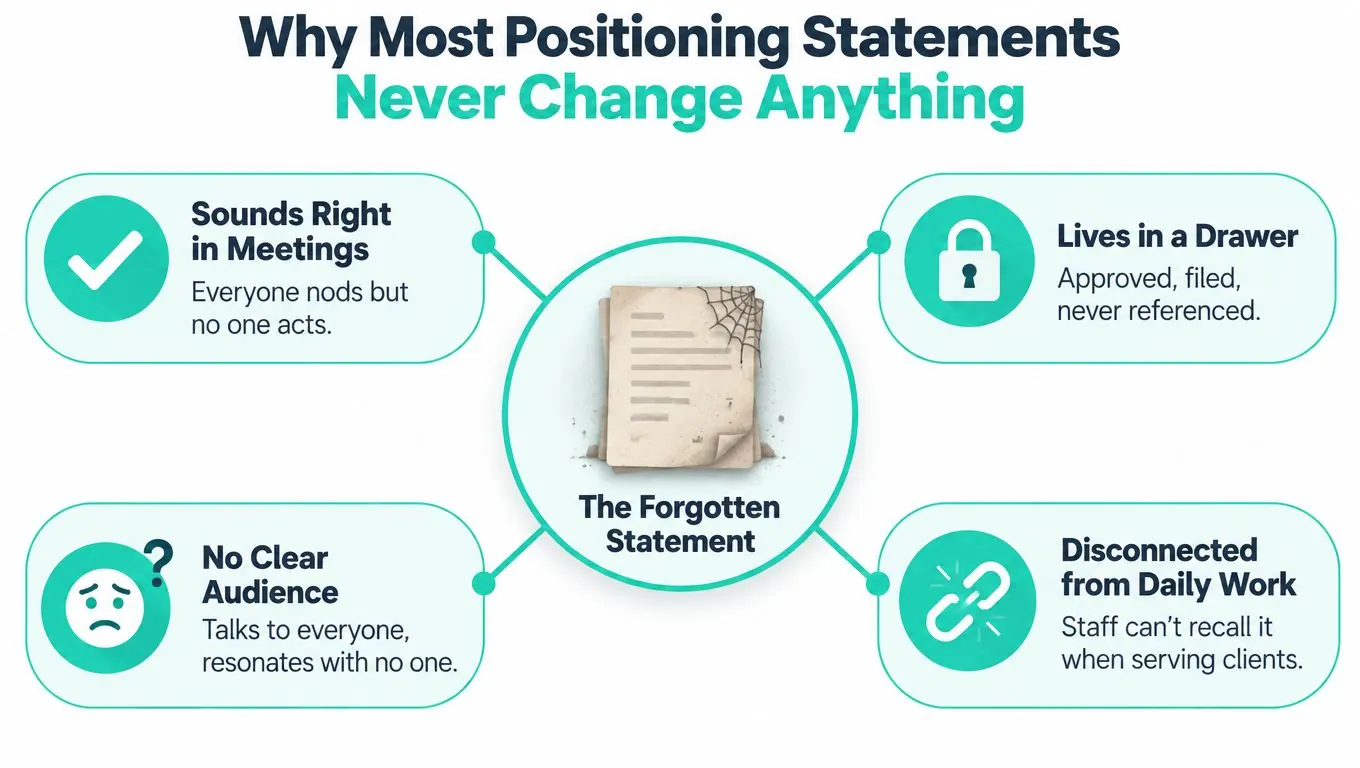
The statement has to make choices
A working statement sets boundaries. It identifies the audience you understand best, the need you can address credibly, and the alternatives buyers should compare with you. It also gives the team a reason to reject messages, services, and partnerships that push the brand back into generic territory.
That standard applies across the proof architecture. Your website, search listings, review responses, AI summaries, phone scripts, and waiting-room experience should reinforce the same choice. If the statement cannot guide those touchpoints, it is a slogan with better formatting.
Edelman's 2025 Brand Trust report found that 80% of people trust brands they use, with trust tied increasingly to relevance, responsiveness, clarity of action, and participation in culture and community rather than purpose statements alone. Edelman's 2025 Brand Trust report points to the operational test: credibility comes from behavior that matches the claim.
Practical rule: If your positioning doesn't change a decision, it isn't positioning. It's decoration.
Use outside examples for structure, never for borrowed personality. A useful collection of positioning statement inspiration shows how brands define an audience, category, benefit, and distinction. Then discard the language and build a statement around evidence your own team can demonstrate consistently.
The Four Parts Every Statement Has to Earn
A real positioning statement has four working parts: target audience, frame of reference, point of difference, and reason to believe. Authoritative marketing texts identify these components as the target market, category, brand promise or point of difference, and credible evidence for the promise. This marketing text on positioning statements provides the formal framework.
Think about a restaurant. The target audience is the neighborhood and type of diner it wants to attract. The frame of reference is the kind of restaurant it is. The point of difference is the signature meal or experience. The reason to believe is why regulars trust the kitchen to deliver it.
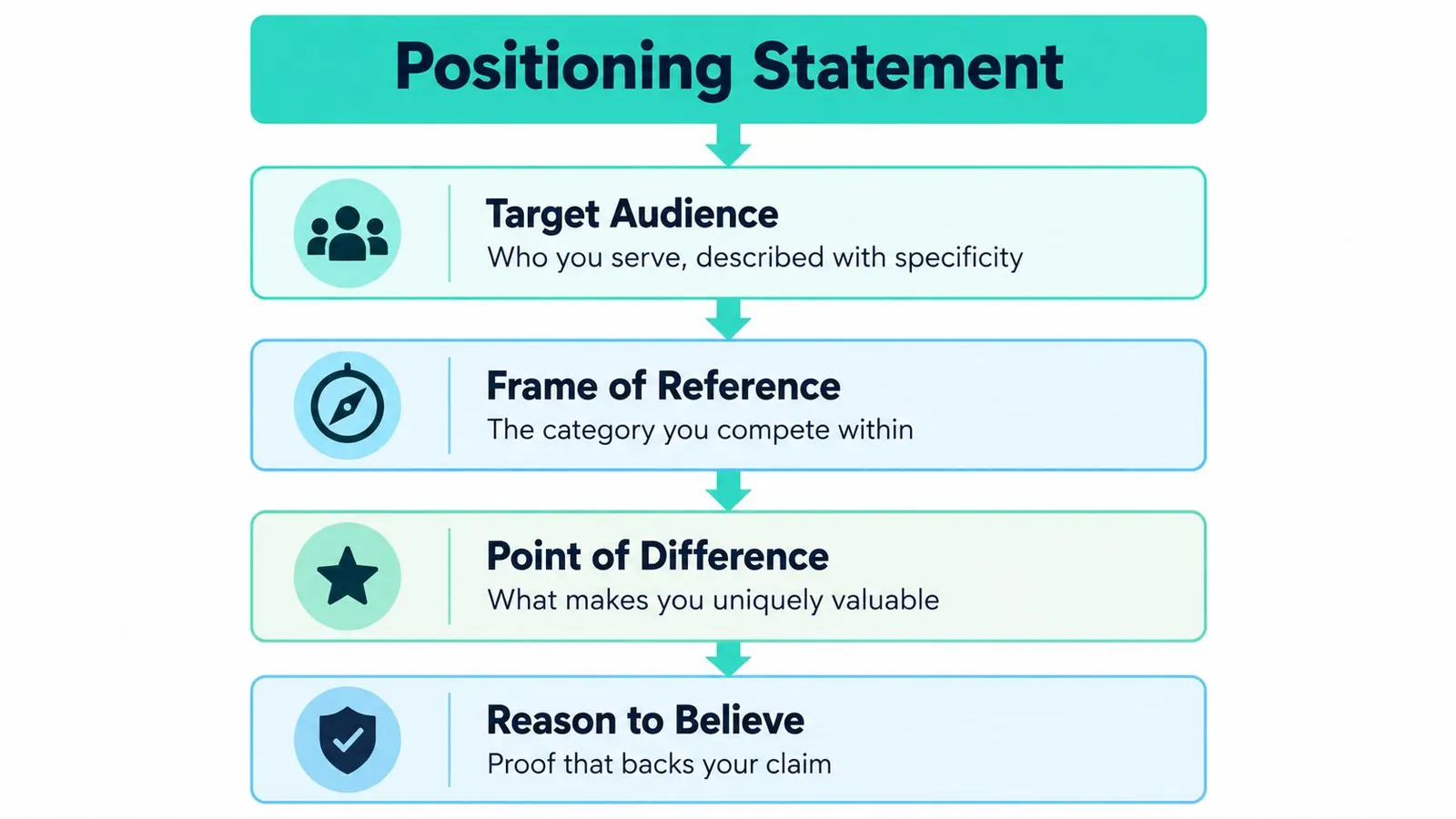
Start with the person, not the service list
Target audience means more than “adults in the local area.” It includes the people you can serve well, their priorities, their concerns, and the kind of experience they value. A dental practice might focus on anxious adults who want calm, unrushed care. A law firm might serve families who need straightforward estate planning and dislike aggressive sales tactics.
Frame of reference tells the buyer what choice they're making. Are you a family dental practice, a cosmetic dentistry group, a boutique estate-planning firm, or a neighborhood medspa? Without this category, the audience can't place you.
Point of difference identifies the meaningful benefit you want associated with the brand. “High quality” isn't enough. A stronger difference might be an unusually clear process for complex legal decisions, a calm experience for nervous dental patients, or identity-aligned treatment planning for a specific local clientele.
Reason to believe supplies proof. It may include the way staff work, the expertise the practice demonstrates, the process clients experience, or the public evidence reflected in reviews and service policies. A promise without proof is an aspiration.
A useful draft follows this logic:
For [specific audience], [brand] is a [category] that delivers [distinctive benefit] because [credible proof].
A positioning statement isn't the same as a mission statement or a public tagline. It is an internal decision tool. If you're also shaping an individual founder's voice, the advice on how to write a personal brand statement can help separate personal identity from company positioning.
How the Same Framework Reads in Healthcare, Legal, and Medspa
The framework does not change. The market, the buyer, and the proof do. That is the point. A weak position tries to sound broad enough for every practice. A serious one makes a clear promise and then forces the brand to prove it everywhere the buyer checks.
Multi-location dental group
Example statement: For adults and families seeking dependable dental care across multiple neighborhoods, [Practice] is a community-based dental group that combines convenient access with calm, relationship-led care because each location follows shared clinical standards while preserving a personal patient experience.
The audience is people who care about access and continuity, not “anyone needing a dentist.” The category is a dental group, which puts the practice in direct comparison with independent offices, discount chains, and hospital-based options. The benefit is a mix of convenience and a human experience. That promise only works if location pages, scheduling, staff behavior, and reviews all match it.
“Community-based” also needs visible support. If the group claims local roots but publishes interchangeable pages for every office, the statement falls apart fast. Each location should show real local context, accurate details, and consistent service expectations.
For practices building this system, dental marketing strategy should connect brand language with local pages, patient education, reviews, and conversion paths instead of treating SEO as a separate campaign.
Boutique estate-planning law firm
Example statement: For business owners and families who need to make complicated estate decisions without courtroom drama or opaque legal language, [Firm] is a boutique estate-planning practice that turns complex choices into clear, coordinated plans because attorneys guide clients through a defined decision process and explain the practical consequences of each option.
This audience is narrower than “people who need legal help.” It includes clients who value clarity, coordination, and a measured relationship with counsel. The frame of reference is boutique estate planning, not every legal service under the sun. The point of difference is the experience of making difficult choices understandable.
The reason to believe has to hold up in a consultation. Does the firm use a defined process? Do attorneys explain choices in plain language? Do clients leave with an organized plan that reflects family and business realities? If not, the statement is just attractive copy.
Neighborhood medspa
Example statement: For appearance-conscious professionals in a defined neighborhood who want subtle, informed treatments rather than an intimidating luxury experience, [Medspa] is a medically guided neighborhood medspa that creates conservative, personalized treatment plans because consultations begin with goals, contraindications, and a staged approach.
This statement names a psychographic preference, not just an age range. “Appearance-conscious professionals” and “subtle, informed treatments” set a sharper expectation than “look and feel your best.” The category frames the comparison against nearby medspas and cosmetic clinics. The proof lives in consultation notes, treatment explanations, practitioner credentials, aftercare, and reviews that mention restraint, clarity, and comfort.
For medspas building this system, a med spa marketing strategy should align consultation language, credentials, and aftercare content with the position.
Every word creates an obligation. If the practice pushes aggressive packages, rushes consultations, or cannot explain why a treatment was recommended, it has chosen a position it cannot defend.
Templates You Can Fill In Without Falling Into Traps
A template helps only when it forces a decision. The weak versions below fail because they use language any competitor can claim.
Dental practice
Weak: For patients who want personalized care, [Practice] is a trusted dental office that provides quality treatment.
Stronger: For [specific patient group] who want [specific experience or outcome], [Practice] is a [dental category] that provides [distinctive benefit] because [observable process, expertise, or patient proof].
Don't put “everyone in the city” in the audience slot. Don't put “excellent service” in the benefit slot. Name the patient and the experience you can repeatedly deliver.
Law firm
Weak: For individuals and businesses seeking legal help, [Firm] provides trusted, personalized representation.
Stronger: For [client type] facing [specific legal situation], [Firm] is a [specific legal category] that makes [important decision or process] clearer because [method, expertise, or service standard].
“Trusted” is an outcome, not evidence. Explain what creates trust. Is it a defined intake process, direct attorney access, plain-language explanations, or coordinated planning?
Medspa
Weak: For people who want to look their best, [Medspa] offers personalized treatments in a welcoming environment.
Stronger: For [specific local audience] seeking [specific treatment philosophy], [Medspa] is a [category] that delivers [distinctive benefit] through [consultation method, clinical standard, or care process].
“Welcoming” becomes meaningful only when the team can describe what a welcoming experience includes. Is it privacy, unhurried consultations, conservative recommendations, or transparent aftercare?
General small-business template
Weak: We help customers with high-quality products and great service.
Stronger: For [specific audience] who need [specific problem solved], [Brand] is a [category] that helps them achieve [meaningful benefit] through [distinctive method], supported by [proof].
Before approving the draft, ask four questions:
- Audience: Can a staff member identify who belongs in this group and who doesn't?
- Category: Does the statement tell buyers what kind of choice they're evaluating?
- Difference: Could a direct competitor paste its name into the sentence unchanged?
- Proof: Can a skeptical customer see evidence of the claim before buying?
If the answer to the last two questions is yes and no respectively, keep editing.
What Search, Reviews, and AI Summaries Do to Your Statement
Your business no longer controls its positioning by itself. Google Business Profiles, directory listings, review platforms, search snippets, and AI summaries all participate in the explanation a buyer receives.
Rio SEO's 2025 study of more than 1,000 U.S. consumers reported that 84% search for local businesses online daily, 60% click AI-generated search overviews, 75% read at least four reviews before deciding, 53% are deterred by inaccurate listings, and 59% expect a business response within 24 hours. Rio SEO's 2025 local search consumer behavior study makes the practical issue clear: a positioning statement must survive research conducted outside your website.
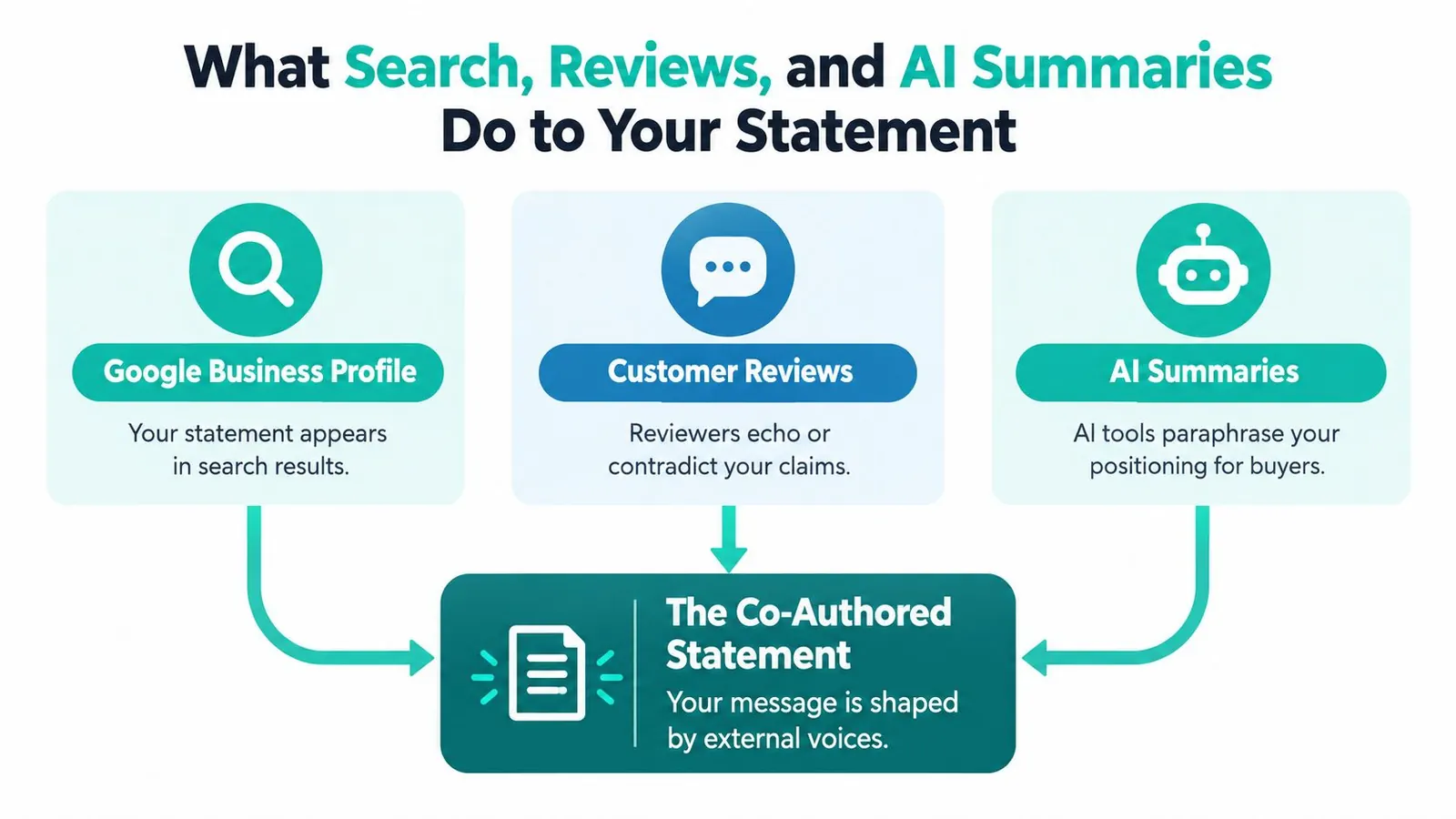
Build a proof architecture
A proof architecture translates the statement into signals people can find, understand, and repeat. It answers three questions:
- What should people see? The same audience, specialty, location, and experience language across the website, profiles, and directory listings.
- What should people say? Reviews that naturally confirm the distinctive experience, such as calm appointments, clear explanations, responsive service, or practical guidance.
- What should people find? Accurate hours, services, locations, clinician or attorney information, policies, and pages that explain who the practice is best equipped to serve.
This isn't a case for stuffing more keywords into a slogan. Search systems and buyers need consistent meaning, not a pile of repeated phrases. A dental practice positioned around calm care should express that idea in the appointment journey, patient education, staff language, review responses, and service pages.
AI summaries add another layer. An automated system may paraphrase your business based on your own pages, customer reviews, listings, and third-party references. If those sources contradict one another, the summary can become generic or misleading.
For teams producing content with AI support, guidance on humanizing AI content for Google is useful because the final copy still needs lived experience, clear authorship, and evidence. A practice's positioning should sound like the people who deliver the service, not like an interchangeable content generator.
The Five Pitfalls That Quietly Kill a Statement
The first failure is the slogan without an audience. “Care that changes lives” may be memorable, but it doesn't tell the team whom to prioritize or what the practice does differently. Ask: Who is this specifically for?
The second is the copy-the-competitor trap. If every nearby law firm says “personalized attention” and every medspa says “natural results,” repeating those phrases doesn't create a position. Ask: What would disappear from the market if we removed our name?
The third is the undeliverable promise. A practice may claim to offer immediate access, complete transparency, or very personal service while its actual process makes those promises impossible. Ask: Can the team demonstrate this claim in an ordinary interaction?
Proof matters more than polish
The fourth is the internal-only trap. A statement can guide the team while still failing to appear in the places buyers research. If the website says one thing, the profile says another, and reviews describe a third experience, the market receives no coherent position.
The fifth is the no-proof trap. “We are the trusted experts” asks the audience to accept the conclusion without seeing the reasoning. Consumer-based brand-authenticity research identifies quality commitment, sincerity, and heritage as measurable dimensions, validated through a 14-item psychometric scale. Experimental evidence also connects perceived authenticity with inferred dedication, anticipated quality, and purchase intentions across utilitarian products, consumables, and non-consumables. The consumer-based brand-authenticity research reinforces the need to make authenticity observable.

A final mistake sits underneath all five: treating positioning as permanent paperwork. Your competitors change, your capabilities change, and your audience's expectations change. Review the statement when the business changes, not every time a new marketing tactic appears.
A Six-Step Process for Building Yours This Week
Start with the audience you serve unusually well. Review intake notes, consultation questions, patient language, staff observations, and lost opportunities. Write one sentence that names the people who benefit most from your approach and are most likely to value it.
Next, name the comparison set. A dental group may compete with independent practices and large chains. A law firm may compete with generalist attorneys, specialist boutiques, and do-it-yourself tools. A medspa may compete with clinics, salons, and at-home options. The frame of reference keeps the statement grounded.
Then choose one benefit. Do not list every service. Pick the outcome or experience that should make the right customer choose you.
Gather proof before drafting. Review reviews, policies, onboarding, consultation steps, staff behavior, credentials, and customer language. If the evidence does not support the claim, change the claim or change the operation.
Draft the four parts in sequence, audience, category, difference, and reason to believe. Read the sentence aloud to someone outside leadership. If they cannot explain who it serves and why it differs, the draft is not ready.
Run a consistency audit last. Check the website, profiles, directory listings, review responses, phone scripts, intake forms, and waiting-room experience. Use focused questions with staff instead of a sprawling retreat. Ask where the statement feels true, where it feels exaggerated, and which behavior would prove it.
That check matters because positioning only works when the brand shows up the same way everywhere buyers touch it. Positioning as a marketing discipline) is about securing a clear place in the mind, but the operating test is stricter. Revisit the statement quarterly, and change it only when evidence shows the position or the business reality has changed.
Turning the Statement Into a Daily Operating Tool
A positioning statement earns its keep when it changes a choice the team was about to make.
A dental practice positioned around calm, relationship-led care shouldn't fill its homepage with urgency-driven offers that make nervous patients feel pressured. Its staff should explain next steps clearly, its follow-up should feel considered, and its review responses should reinforce reassurance rather than argue about ratings.
A law firm positioned around clear estate planning shouldn't bury clients in unexplained legal terminology. The intake process, consultation agenda, proposal, and follow-up should all reduce uncertainty. The position should help the firm decline work that requires a combative identity it doesn't want to own.
A medspa positioned around informed, conservative treatment should train staff to explain why a recommendation fits, what alternatives exist, and what the client can expect afterward. The statement should influence sponsorships and partnerships too. A community event that attracts the right audience can reinforce the position, while a disconnected promotion can dilute it.
A validated structural-equation study of 300 consumers in a high-information-asymmetry context found that perceived authenticity strongly predicted trust, with β = 0.54 and p < 0.001, while trust strongly predicted loyalty, with β = 0.47 and p < 0.001. The study on authenticity, trust, and loyalty supports the operational point: authenticity has value when customers experience the connection between the claim and the behavior.
Use the statement as a filter across marketing services, not as a paragraph to memorize. Keep asking whether the next message, process, partnership, and customer interaction makes the intended position easier to recognize. The statement is finished when the team can quote it, defend it, and use it to say no.
Leaping Lemur Media offers brand strategy that defines positioning, voice, and a single customer-facing promise, then connects that strategy with intentional marketing execution. If your practice is tired of me-too messaging, visit Leaping Lemur Media to explore a more consistent way to become found, trusted, and chosen.