
You know the moment. You're staring at a homepage draft, trying to explain what your practice does, and every sentence sounds like the provider down the street. The services are solid, the team is real, the results are real, but the message lands like a brochure copy-paste.
That's not a writing problem. It's a competitive positioning problem.
The hard truth is that buyers often don't see much difference at first glance. Gartner's 2024 B2B Buying Survey found only 23% of B2B technology buyers said competing solutions were meaningfully different, while 77% saw vendors as largely commoditized, and the average competitive deal win rate across tracked categories was 21% (benchmark summary). When buyers start there, vague language gets ignored fast.
If you want a position that sticks, stop hunting for a clever slogan and start building proof. The Narrareach voice-building method is useful here because it reminds you that a strong voice comes from choices, not decoration. And if you're wondering whether your current message is any good, the quick test is simple, it should clearly answer three things, who you serve, what pain you solve, and what proof makes that believable.
For a deeper look at how a partner-oriented practice talks about identity and community, see the way Leaping Lemur Media frames its work.
Table of Contents
- The Moment You Realize You Sound Like Everyone Else
- What Competitive Positioning Actually Means
- The Three Frameworks That Actually Earn Their Keep
- Score the Market Through Four Lenses
- How to Tell if Your Whitespace Is Real
- Write the Positioning Statement Buyers Can Verify
- Test It, Roll It Out, and Keep It Honest
The Moment You Realize You Sound Like Everyone Else
The realization usually hits in a small, annoying moment. You read your homepage aloud, and every line could belong to three other firms in your market. Same promises. Same friendly tone. Same vague claims about quality, service, and trust.
That's when owners usually blame the copy. They shouldn't. The copy is only revealing the underlying problem, which is that the business hasn't made a hard decision about where it stands and why it should win.
Practical rule: if your homepage could be swapped with a competitor's and no buyer would notice, you don't have positioning yet.
Most practice owners waste time. They ask for a better tagline when they need a sharper market choice. Strong positioning isn't about sounding clever, it's about making a claim buyers can verify, and a useful benchmark is whether that claim can survive a real competitive conversation.
The reason this matters is brutally simple. When buyers see you as interchangeable, they compare on convenience, price, and familiarity. That's a bad place to live because you're now asking your sales team, your website, and your referrals to overcome a perception problem you created.
A better place to start is with your real audience and your real voice. If you've ever worked with a team that tries to sound polished but ends up sounding generic, the issue usually isn't effort. It's that the team hasn't decided what they're willing to stand for, and what they're willing to leave out.
One more thing. A lot of firms confuse “different” with “interesting.” Those are not the same. Interesting gets attention. Different wins preference when it's backed by proof.
So if your current message feels slippery, don't keep polishing it. Decide what evidence you have, decide who needs that evidence most, and then build the message around that. That's the move that turns a bland market statement into a position people can remember.
What Competitive Positioning Actually Means
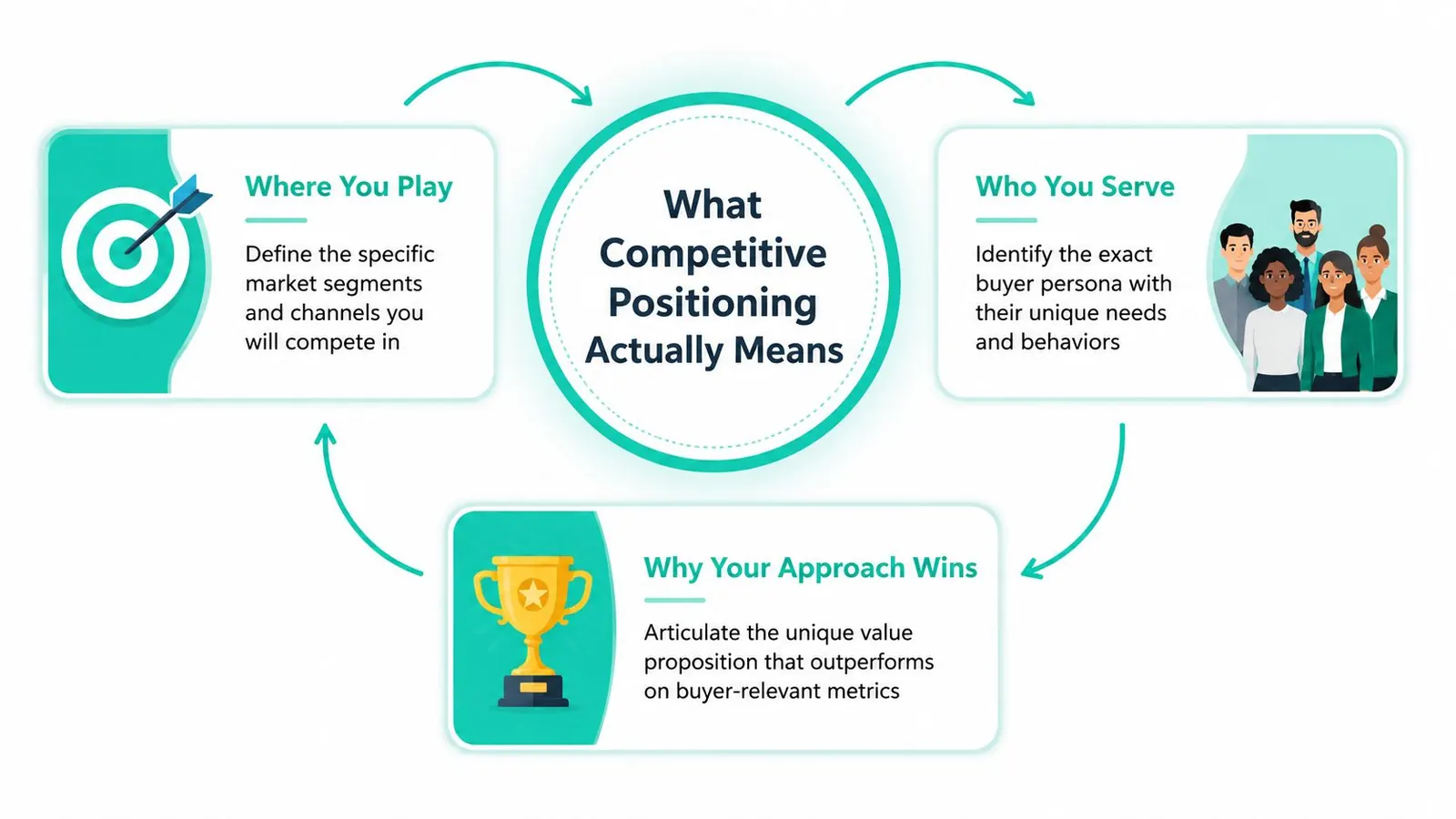
Competitive positioning is the deliberate choice of where you play, who you serve, and why your approach wins on the metrics buyers care about. That's the working definition. If a business can't say those three things cleanly, it's not positioned, it's just present.
The cleanest way to think about it is as a three-part structure.
The three parts that matter
- Who you serve: the exact buyer group, not a fuzzy audience like “small businesses” or “modern families.”
- What outcome you deliver: the result buyers want, not a long list of features.
- Why they should believe you: proof, evidence, track record, or a clear reason to trust the claim.
That structure matters because the two most common failures show up everywhere. The first is feature dumping, where teams list capabilities and assume the buyer will connect the dots. The second is aspirational fluff, where teams describe the identity they wish they had, not the proof they can defend.
A sharp market example helps. Market share is just a company's sales divided by total market sales, expressed as a percentage. So a business with $10 million in sales in a $100 million market has 10% market share, and relative market share compares your position with the leader, where an RMS above 100% indicates leadership (market-share framing). That's useful because it connects positioning to measurable strength, not just brand language.
If you can't tie your claim to a market outcome or a buyer outcome, it's decoration.
That's also why positioning is not branding, even though people blur them constantly. Branding shapes perception. Positioning makes a competitive claim about a specific market and a specific buyer problem. You need both, but they're not the same job.
The same confusion shows up with USP and UVP. A Unique Selling Proposition leans on a specific feature or capability. A Unique Value Proposition translates that feature into a buyer outcome that matters. Buyers don't buy features for their own sake. They buy the result the feature makes possible.
If you need a first draft, use this sentence: For [target customer] who [problem], [product or service] is the [frame of reference] that [point of difference] because [proof]. Then write it once, badly, and make it more specific from there.
The Three Frameworks That Actually Earn Their Keep
The problem with most framework talk is that people treat tools like trophies. A perceptual map hangs on the wall. A USP slides into a deck. Segmentation becomes a spreadsheet no one opens again. Useful frameworks do the opposite, they force decisions.
Perceptual maps should reflect buyer reality
A perceptual map only matters if the axes match how buyers compare options. Using features buyers don't care about is a waste of time. For service businesses, axes like time-to-value versus trust or flexibility versus risk usually reveal far more than vanity dimensions.
That's because the buyer isn't comparing slogans. They're comparing tradeoffs. A map that helps you see those tradeoffs is useful. A map that flatters your internal team isn't.
USP and UVP do different jobs
A USP says what is distinct. A UVP says why that distinction matters. In a dental practice, a USP might be a very specific clinical workflow. The UVP is the patient-facing result, such as less friction or clearer next steps. In a medspa, the same split applies. In a law firm, it may be a process difference that reduces uncertainty, then a value statement that turns that process into confidence.
If you blur the two, the message gets weak fast. Feature language without outcome language sounds technical. Outcome language without proof sounds thin.
Segmentation is about triggers, not demographics
A lot of owners go sideways. They slice the market by age, gender, or geography, then wonder why the message still feels broad. Better segmentation starts with buyer jobs, pain triggers, and the moment someone starts looking for a solution.
The audience definition with Breaker resource is worth a look if you need a cleaner way to define who matters. The reason this matters is simple: a segment is only useful when it changes what you say, what you prove, and how you sell.
For a practical filter, use this rule. If a framework doesn't change a decision, it's theater. If it helps you say no to a bad audience, a weak promise, or a vague category, it's doing real work.
Score the Market Through Four Lenses
This is the part that gets skipped, then wonder why their position feels imagined. You need a way to score the market that's grounded in evidence, not instinct. The simplest working method is four lenses, buyer jobs and triggers, category and substitutes, proof, and economics.
The first lens asks what pushes a buyer into motion. The second names the direct competitors, indirect competitors, and the third option, which is often the status quo. The third gathers evidence from pricing pages, reviews, demos, analyst notes, and similar materials. The fourth asks what each competitor can deliver on outcomes, capabilities, ecosystem, and economics.
Here's the rubric I'd use in a shared document.
| Lens | What to Score | Score 1 Weak | Score 5 Strong |
|---|---|---|---|
| Buyer jobs and triggers | How well the offer matches the buyer's real problem | Weak fit, generic use case | Clear fit, specific trigger, strong urgency |
| Category and substitutes | Whether the real alternatives are mapped correctly | Missing key competitors or status quo | Full competitive set, including non-obvious alternatives |
| Proof | Whether claims are backed by visible evidence | Thin or vague proof | Clear proof from public or referenceable sources |
| Economics | Whether the offer competes on value, not just story | Hard to justify on buyer economics | Strong buyer-relevant economics and clear tradeoff |
The best teams don't stop at scoring. They validate the gaps with win-loss interviews, then convert them into message changes or product changes. If the same weakness keeps showing up in deals, you don't have a messaging problem anymore. You have a market problem.
Use this rule: if a competitor looks weak in theory but keeps beating you in real deals, trust the deals.
If you want a deeper operational reference for how segmentation can reduce churn, the guidance on using segmentation to reduce churn is a useful companion. It reinforces the larger point, better segmentation changes what you keep, what you sell, and what you stop promising.
The one thing I'd add from practice is this. Don't make your scoring exercise too abstract. Keep it close to actual buyer language, because the goal isn't a beautiful matrix. The goal is a clearer decision about who you can win and why.
For your own internal library, the Leaping Lemur Media journal is where that kind of thinking should live, not in a forgotten slide deck.
How to Tell if Your Whitespace Is Real
An empty quadrant on a perceptual map is not a business. It's a hypothesis. Too many firms see a blank space and assume they've found opportunity, when all they've found is uncertainty.
Validate demand before you plant a flag
You need four checks. First, behavioral data, which tells you what buyers search for, click, and engage with. Second, segmentation cuts, which show whether a specific job-to-be-done is underserved. Third, qualitative interviews, especially with churned customers and non-consumers. Fourth, competitor review mining, which surfaces the complaints buyers don't soften for marketing.
A whitespace claim is only real when buyers can prove it with behavior, not opinion.
The fastest way to kill a fake whitespace idea is to ask whether real buyers are already trying to solve the problem in some other way. If they aren't searching, aren't complaining, and aren't switching, you may not have demand. You may just have a neat-looking gap.
Run the three falsification tests
- Real demand: people are actively expressing the need, not just nodding at it in a meeting.
- Credible supply: you can deliver the thing without wrecking margin or quality.
- Defensible differentiation: there's some barrier, like expertise, process, data, or reputation, that keeps the space from getting copied immediately.
If your niche fails any of those, don't romanticize it. Empty spaces can stay empty for a reason. Some are too small, some are too expensive to serve, and some are too easy to imitate.
That's why validation beats optimism. You don't want a “unique” position that dies in the first sales cycle. You want a narrow position with enough evidence behind it to survive contact with the market.
A simple self-check helps here. Can you name the buyer pain in one sentence, point to a proof point that supports it, and identify the segment that feels it most sharply? If not, you don't have whitespace yet. You have a story that still needs testing.
Write the Positioning Statement Buyers Can Verify
The strongest positioning statement isn't clever. It's testable. If a buyer can't check the claim against what they already measure or experience, the statement won't carry weight.
Use this pattern: For [target customer] who [problem], [product or service] is the [frame of reference] that [point of difference] because [proof]. That structure works because it forces specificity in the exact places where teams usually drift into adjectives.
Fill the slots with evidence, not hype
The first slot names the buyer. The second names the pain. The third names what kind of thing you are. The fourth names what you do differently. The fifth names the proof.
The proof matters more than most owners want to admit. A Forbes Council article makes the same point, positioning statements work better when the promise is something customers can easily verify, especially when the claim lines up with metrics buyers already track, like call resolution, time to close, or cost per lead (Forbes Council guidance). That's the standard. If the buyer can't check it, they won't trust it.
Put the same statement to work in four places
- Homepage headline: lead with the buyer and the outcome.
- About page proof stack: show the evidence behind the claim.
- Sales opener: say the same thing in plain language, without jargon.
- Paid ad hook: reduce the claim to one sharp, specific promise.
The mistake I see constantly is treating these as separate messages. They're not. They're different expressions of the same position. If the headline says one thing and the sales call says another, buyers notice the drift immediately.
For proof assets, use whatever is verifiable. That includes customer testimonials, case studies, public pricing models, implementation timelines, certifications, partnerships, or reference customers. A market-positioning guide also argues that claims without evidence are just marketing noise, and that if you promise fast implementation or strong support, you should show the data that backs it up (proof-based positioning guidance).
If your current statement depends on adjectives like personalized or best-in-class, strip them out. Replace them with the exact buyer pain, the exact promise, and the exact evidence. That's how a positioning statement stops sounding like marketing and starts sounding like a decision.
For teams that need execution support across branding, SEO, and authority-building, Leaping Lemur Media's services sit naturally in this conversation because positioning has to show up in the market, not just on a slide.
Test It, Roll It Out, and Keep It Honest
A position that only exists in a deck is just a wish. The version that survives is the one you pressure test with real prospects and real sales conversations.
A 30-day rollout that doesn't waste time
Week 1, internal alignment. Get the owner, the marketer, and the salesperson in the same room and agree on the exact claim. Draft the main message, the proof stack, and the one thing you are not claiming.
Week 2, website and collateral. Update the homepage, the about page, the sales deck, and the basic one-pager. Keep the language tight. Don't bury the point under design.
Week 3, a small paid test. Run two message variants against the same audience and see which one pulls clearer interest. You're not looking for vanity clicks. You're looking for which message attracts the right conversations.
Week 4, win-loss review. Talk to five recent prospects, including at least a couple who didn't buy. Ask what they thought you did differently, what felt confusing, and what they compared you against.
Read the signals honestly
You want to see prospects repeating the differentiator back in their own words. You want stronger qualified interest, cleaner sales conversations, and less explanation work from your team. If you get attention but no conversion, the message is probably too broad or too soft.
If prospects keep saying they didn't understand the category, the problem is deeper. Your frame of reference is off. If they understand the category but still don't see why you matter, your proof is weak. If they understand both but still choose someone else, your economics or your segment choice needs work.
Keep this on your desk: positioning is a hypothesis you keep earning, not a plaque you hang.
The discipline here is uncomfortable, but it's what separates firms that sound thoughtful from firms that win. Test the claim. Tighten the claim. Test it again. That's how you move from generic to defensible without pretending the market owes you attention.
If you want help turning evidence into a position buyers can verify, visit Leaping Lemur Media. They work on branding, SEO, and authority-building in a way that fits the bigger job here, making sure the market sees the same story your team believes.