Your front desk rewrote the dentist bio again. The medspa owner is trying to make an Instagram caption sound polished without sounding pushy. A lawyer is staring at an About page for the third time, certain the draft sounds fine, but also certain it doesn't sound like the firm that sits across from nervous families and accident victims every day.
That's usually the moment people realize the problem isn't writing. It's that the practice has no shared messaging framework, so every person, channel, and service line improvises a slightly different version of the truth. In trust-heavy local businesses, that drift costs more than consistency. It weakens credibility before a patient or client ever books.
Table of Contents
- Why Your Practice Sounds Different on Monday Than on Friday
- What a Messaging Framework Actually Is
- Anatomy of a Strong Message House
- How to Build Your Framework From the Inside Out
- How the Same Framework Adapts Across a Dentist, Medspa, and Law Firm
- Templates You Can Steal and Customize Today
- Keeping the Framework Alive After Launch
Why Your Practice Sounds Different on Monday Than on Friday
Monday morning, the front desk writes “family-focused care” on the website draft because that's what feels safe. By Friday, the hygienist is posting about “gentle technology,” the office manager is editing the bio to mention “personalized service,” and the owner is asking why none of it sounds like the practice they've built.
That kind of drift isn't a copywriting issue. It's what happens when every person is inventing the message from scratch instead of pulling from a shared system. In a local practice, that system matters because patients and clients make fast trust judgments. If the website, voicemail, social media, and referral conversations all sound like different businesses, people feel that inconsistency even if they can't name it.
The real cost is not just confusion
Generic language does more than blur the brand. It makes the practice easy to ignore. A dental office that sounds like every other dental office, a medspa that talks in vague beauty phrases, or a law firm that leans on boilerplate reassurance all end up competing on sameness instead of credibility.
The fix is to treat messaging like operational infrastructure. The people who answer the phone, write the bio, build the homepage, and post the Instagram caption need the same core language because they're all part of one patient or client journey. That's why aligned messaging shows up as a revenue issue, not just a branding issue, and why the gap between strategy and execution matters so much. In the 2024 B2B Revenue Waterfall research, the median messaging consistency rate was just 41%, only 23% of organizations cleared 75% consistency, and those above that threshold generated 2.3x more qualified pipeline per rep than peers below 50% consistency. The point is simple, documented alignment performs better than improvisation, even when the context is different. Messaging consistency benchmark research
If the team can't repeat the same promise in plain language, the market won't repeat it for you.
That's the mindset shift. A messaging framework isn't a slogan folder. It's the internal structure that keeps the practice sounding like itself no matter who's speaking or where the message shows up.
What a Messaging Framework Actually Is
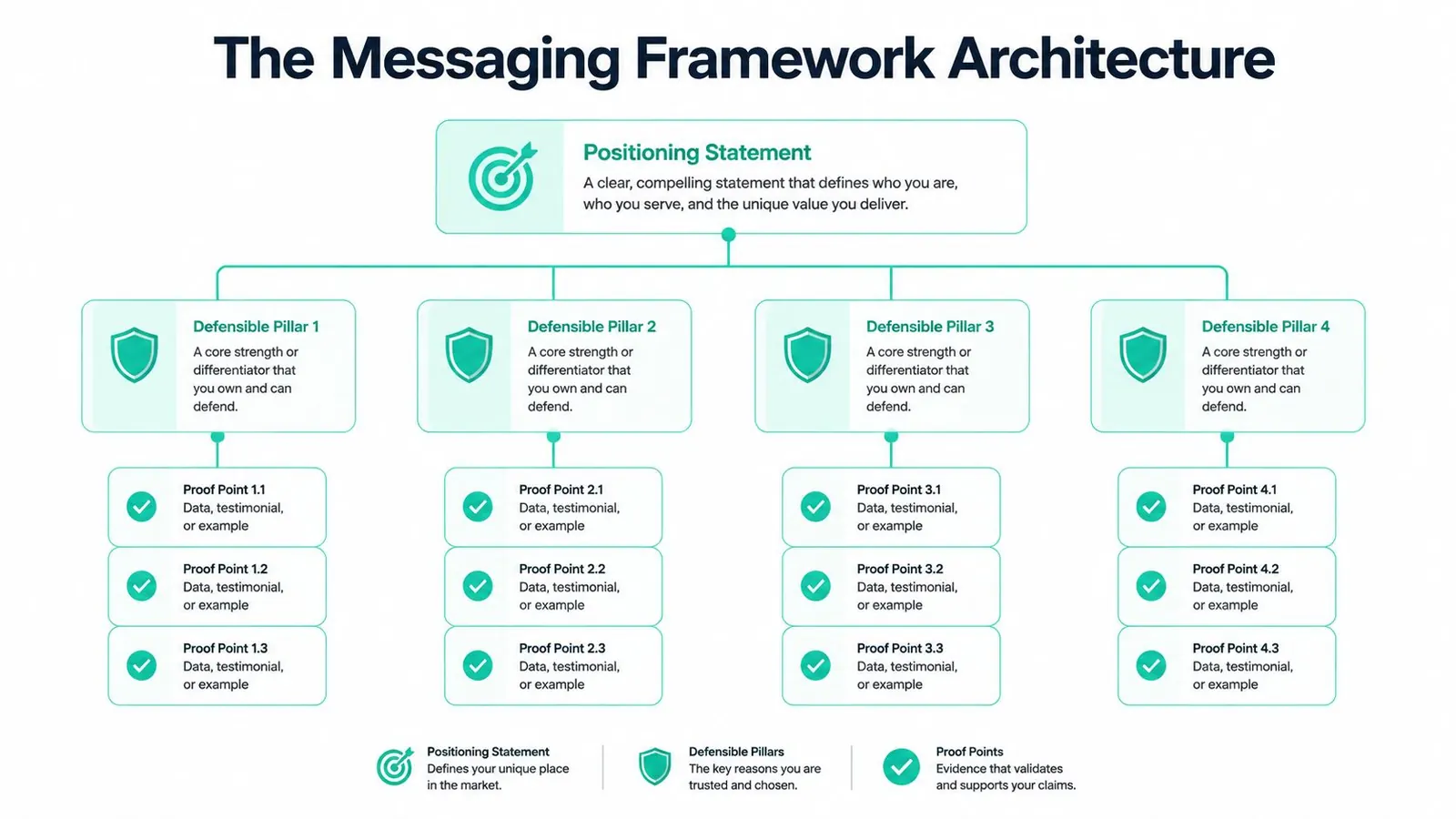
A real messaging framework is layered. It starts with a concise positioning statement, then moves into a small set of defensible pillars, then attaches proof to each pillar so the claims can be checked, repeated, and used in live conversations. That structure is the difference between “We're compassionate” and “Here's the exact promise, the evidence behind it, and the situations where we say it.”
The framework has to be defensible, not just desirable
Lots of practices can list traits they wish they were known for. That's not enough. A pillar like “we care” or “we're high quality” sounds nice, but it's too vague to guide a website, a script, or a referral conversation. If a claim can't be proven, it belongs in the brand vision, not the messaging framework. A practical guide from Kontrol Media makes that distinction plainly and recommends auditing customer-facing assets, interviewing at least 8–10 customers, developing 3–5 pillar statements, and documenting proof for each pillar with a quote, metric, case study reference, or third-party validation. Practical messaging framework guide
That proof-first discipline is what keeps the message auditable. It also keeps teams from drifting into fuzzy language that sounds good in a brainstorm but collapses when a patient asks, “What exactly do you mean by that?”
A clean way to think about the structure is a roof message, supported by 3–4 pillars, with a foundation of proof underneath each pillar. That message-house style shows up often because it's easy to use in sales, service, and marketing. The key is that every pillar needs evidence. If it doesn't, it gets strengthened or dropped. The proof can be data, examples, quotes, certifications, demos, third-party endorsements, policies, or guarantees. Message house framework
Why the framework changes what gets published
Once the pillars are clear, the framework becomes a filter. A new Instagram caption, flyer, homepage section, or referral script has to fit one of the pillars or it doesn't belong. That makes the practice more coherent without making it robotic.
For local healthcare and legal businesses, this also creates room for audience-specific adaptations. A parent looking for a pediatric dentist, a patient comparing medspa treatments, and someone calling after a car accident all need different entry language, but they should still hear the same practice values and see the same proof structure. If you're thinking about how this lives across channels, the logic lines up well with a broader 2026 omnichannel strategy, because consistency only matters when it survives more than one touchpoint.
The simplest working definition is this. A messaging framework tells the practice what to say, what to prove, and what to leave out.
Anatomy of a Strong Message House
The message house works because it separates the promise from the evidence. The roof is the overall message, the pillars are the core ideas that support it, and the foundation is the proof that keeps the structure from floating away into marketing fluff. In healthcare and legal services, that distinction matters because trust is earned through specifics, not adjectives.
Weak pillars sound polished but unproven
A weak pillar usually sounds broad enough to fit any practice in the category. “We put patients first” or “We deliver exceptional care” might be true, but they don't tell a prospect why to choose this office over the one down the street. Strong pillars are narrower, easier to explain, and tied to evidence the team can show.
The proof ladder is useful here. A value-driven framework separates evidence into levels. Level A is independently verified or statistically reliable proof. Level B is customer-reported proof with numbers. Level C is directional or early indicator proof. Value-driven messaging framework That hierarchy helps a practice decide whether a claim belongs in a headline, a case study, or an internal draft waiting for stronger support.
A pillar without proof is just a preference wearing marketing clothes.
Here's how that looks in practice for a dental office.
| Pillar Quality Comparison | Example Statement | Required Proof |
|---|---|---|
| Weak pillar | We offer advanced care | Specific technologies, outcomes, or patient examples |
| Strong pillar | We use digital tools that make treatment planning clearer and appointments easier to understand | Treatment visuals, patient explanations, workflow examples |
| Weak pillar | We care about comfort | Evidence of how comfort is built into the visit, not just the claim itself |
| Strong pillar | We reduce anxiety with a slower, more conversational first visit for nervous patients | Patient feedback, visit process, team training, review language |
A better pillar sounds like a decision, not a slogan
The best way to test a pillar is to ask whether it changes what you'd publish. If a pillar is real, it should shape a homepage headline, a referral script, and the way the front desk explains the practice. If it doesn't change behavior, it's probably too vague.
A strong message house also gives the team a shared answer when a question comes up like, “Should we mention this new service on the homepage?” The answer is yes only if it supports one of the pillars and the practice has proof to stand behind it. That keeps the message disciplined without making it restrictive.
For a local service business, that discipline is a gift. It keeps the practice from sounding like it's chasing trends and makes the actual strengths of the office easier to recognize.
How to Build Your Framework From the Inside Out
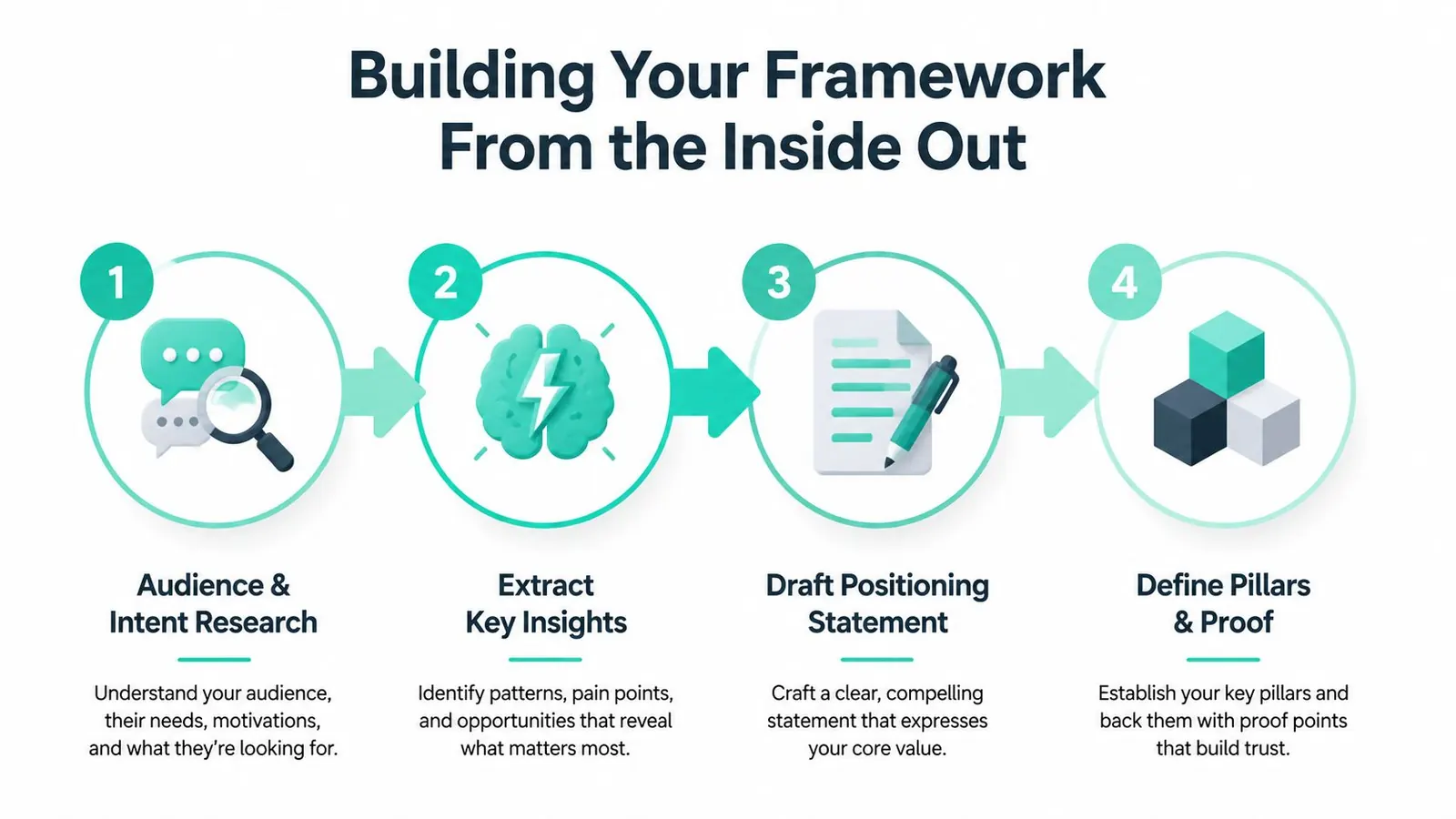
The cleanest framework starts with real conversations, not brainstorming. Office staff, reviews, intake calls, referral conversations, and post-visit feedback all reveal the triggers, fears, and phrases people use. Those words are usually more useful than whatever the team thinks sounds “professional.”
Start with audience and intent, then pull patterns
The first task is listening for repeated patterns. What causes someone to call? What are they afraid will happen if they wait? What words do they use when they describe the problem in their own language? For a dental office, that might be anxiety, timing, or family convenience. For a medspa, it might be looking refreshed without looking obvious. For a law firm, it might be fear of delay, uncertainty, or not knowing what happens next.
From there, write a positioning statement that names who the practice serves, what it does differently, and the outcome that matters most to that audience. Keep it plain. Keep it usable. If the statement takes a paragraph to explain, it won't survive the front desk, the website hero, or the voicemail greeting.
The best positioning statements read like a confident answer to a real question, not like a branding exercise.
Once the positioning is clear, the pillars should emerge from patterns in the research, not from a list of adjectives. That's where the defensible language comes from. Each pillar should then get matched to a proof asset before it's ever used externally. That could be a review theme, a treatment explanation, a process description, a before-and-after example, or another form of evidence the practice can stand behind.
The framework should also be pressure-tested in the places where weak messaging shows up fastest. A homepage hero line. A voicemail greeting. An Instagram bio. The one-minute explanation a staff member gives when a referring patient asks what makes the practice different. If the language breaks in those places, it isn't ready yet.
Build in the order people actually experience it
The order matters because every layer depends on the one before it. If you try to write pillars before you understand the audience, the result is usually generic. If you collect proof after the copy is written, the team starts bending evidence to fit the message instead of letting evidence shape the message.
The internal link that fits naturally here is the one on service alignment and execution, because the framework only works if the team that builds it can also use it. A practical example of that mindset lives in the way agencies support implementation across real client work, which is why a resource like Leaping Lemur Media's services page is relevant to the broader conversation about turning strategy into daily execution.
A simple pressure test keeps the process honest:
- Website hero: Can the positioning fit cleanly in two sentences?
- Front desk use: Can someone say it without notes?
- Proof check: Does every pillar have an evidence asset attached?
- Channel fit: Does the message still make sense in a post, call, or referral conversation?
If any answer is no, the framework needs another pass.
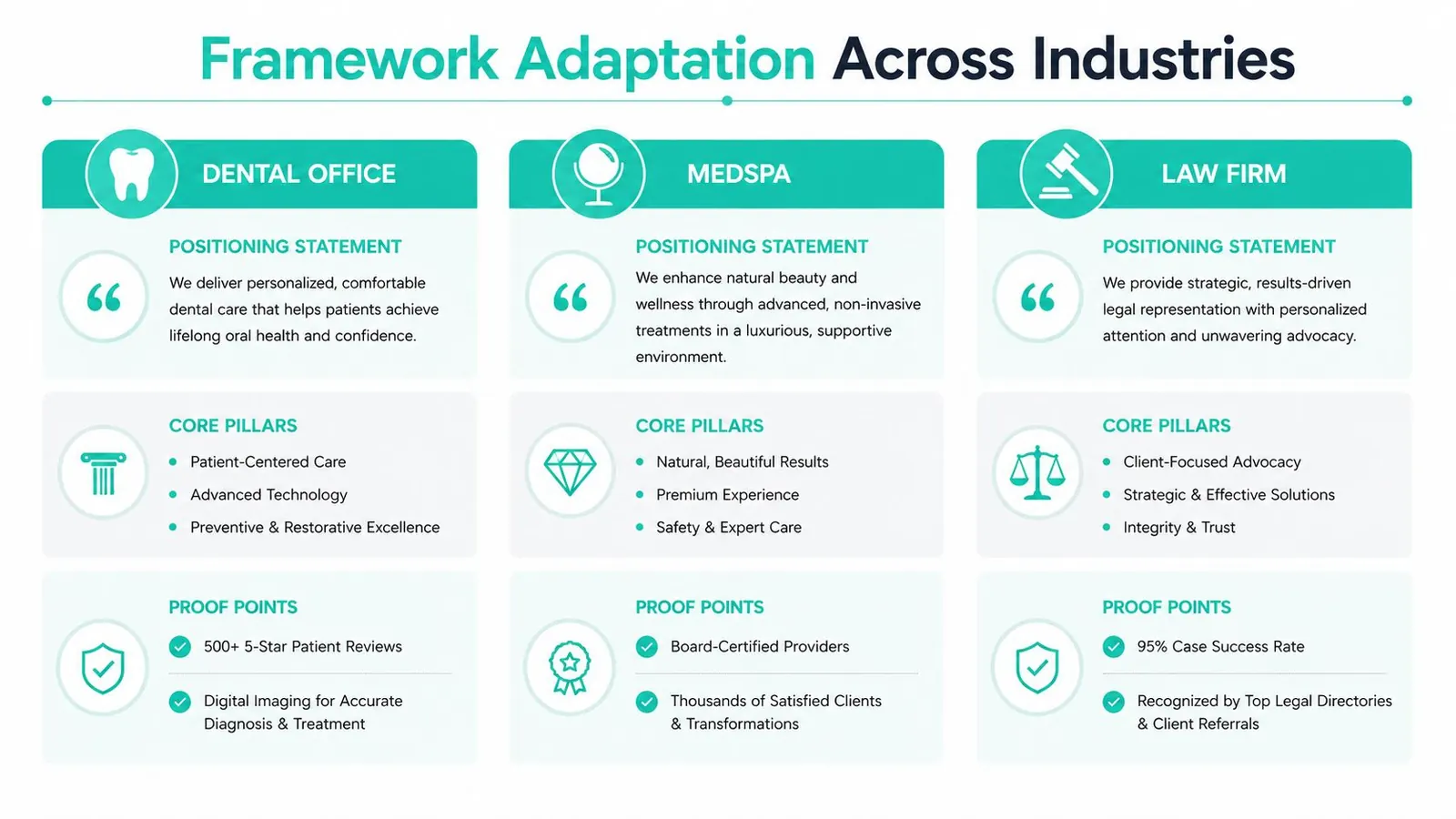
How the Same Framework Adapts Across a Dentist, Medspa, and Law Firm
The structure stays the same, but the proof changes the voice. That's the part most owners miss. They look at a competitor's message and copy the tone, when they should be copying the discipline and writing from their own evidence.
A dental office leads with comfort and clarity
A family dental office usually needs a message that lowers anxiety and explains care clearly. The strongest pillars tend to center on prevention, comfort, and dependable communication, because those are the things families can feel before and after the visit. The proof might come from patient reviews, clear treatment explanations, and the way the team handles first visits for nervous patients.
A medspa has to balance taste, trust, and representation
A boutique medspa can't rely on the same language a dentist uses. Patients want judgment, not hype. They want to know the aesthetic standard, the level of personalization, and whether the practice reflects the community it serves.
That's where the inclusive messaging angle becomes especially useful. A 2024 academic paper proposed an Inclusive Messaging Framework with stages like Awareness and Community Stewardship, plus measures such as share of voice and representation in creative. It argues that credibility for marginalized audiences depends on measurable representation, not just friendly tone. That matters for community-facing medspas because trust is shaped by who appears in the brand, who feels seen, and how carefully the service is framed. Inclusive messaging framework paper
A law firm depends on local credibility and visible proof
A personal injury firm needs different language again. Prospects often want clarity, responsiveness, and a sense that the firm knows the local area. The proof might be case examples, process transparency, and the way the firm handles follow-up with people who are already under stress.
The same framework can support all three practices without flattening them into one voice because the pillars are anchored in different evidence. A dental office might lean on family comfort and clinical explanations. A medspa might lean on visual judgment and inclusive representation. A law firm might lean on local trust and the ability to walk a person through a difficult process.
| Practice Type | Positioning Focus | Core Pillar Shape | Best Proof Types |
|---|---|---|---|
| Dental office | Comfort, clarity, family care | Practical and reassuring | Reviews, process explanations, patient education |
| Medspa | Aesthetic judgment, trust, representation | Polished and confidence-building | Before-and-after galleries, testimonials, creative representation |
| Law firm | Local credibility, guidance, responsiveness | Direct and protective | Case examples, client communication, process transparency |
The best part is that one template can produce three distinct voices without borrowed language. That's what real differentiation looks like.
Templates You Can Steal and Customize Today
A useful template should do more than look tidy in a document. It should help the team write usable copy fast without flattening the practice into generic language. The trick is to build a template that forces proof and audience clarity into the draft from the start.
A positioning template that stays short
Use this structure:
For [specific audience], we help [what problem or outcome], by [what makes the practice different], so they can [result that matters].
A fictional optometry version might read: For busy families and professionals, we help make eye care easier to understand and easier to keep up with, by combining clear explanations with efficient visits, so they can protect their vision without feeling overwhelmed.
A pillar worksheet that demands evidence
Keep each pillar in a simple grid with three fields:
- Pillar statement
- Why it matters to this audience
- Proof we can show today
For the same optometry practice, one pillar might be clear communication, with proof coming from patient education materials, staff scripts, and review themes that mention understanding the care plan. Another might be efficient visits, backed by scheduling process details and patient feedback about how easy the appointment felt.
An objection-to-proof map
This is the piece that keeps messaging grounded in reality. Write the common objection, then match it to the proof that answers it.
- “Will this take too long?”
Match it to the process explanation. - “Will I understand what's happening?”
Match it to the education piece or consultation script. - “Do people like me come here?”
Match it to reviews, visuals, or community examples.
The internal resource that fits naturally with this kind of hands-on implementation is Leaping Lemur Media's journal, because good frameworks get stronger when the team has a place to document, refine, and reuse them.
Before launch, run three checks:
- Every pillar has proof.
- The positioning fits in two sentences.
- The front desk can say it without sounding scripted.
If those three are true, the framework is ready to use, not just ready to admire.
Keeping the Framework Alive After Launch
A messaging framework rarely breaks in one obvious moment. It gets stale in small ways. A new provider joins the team, a second location opens, or a campaign starts pushing a service line that never had a real pillar behind it. Before long, the original language starts to fray. The website says one thing, the staff says another, and the practice slips back into improvisation.
Make review part of the operating rhythm
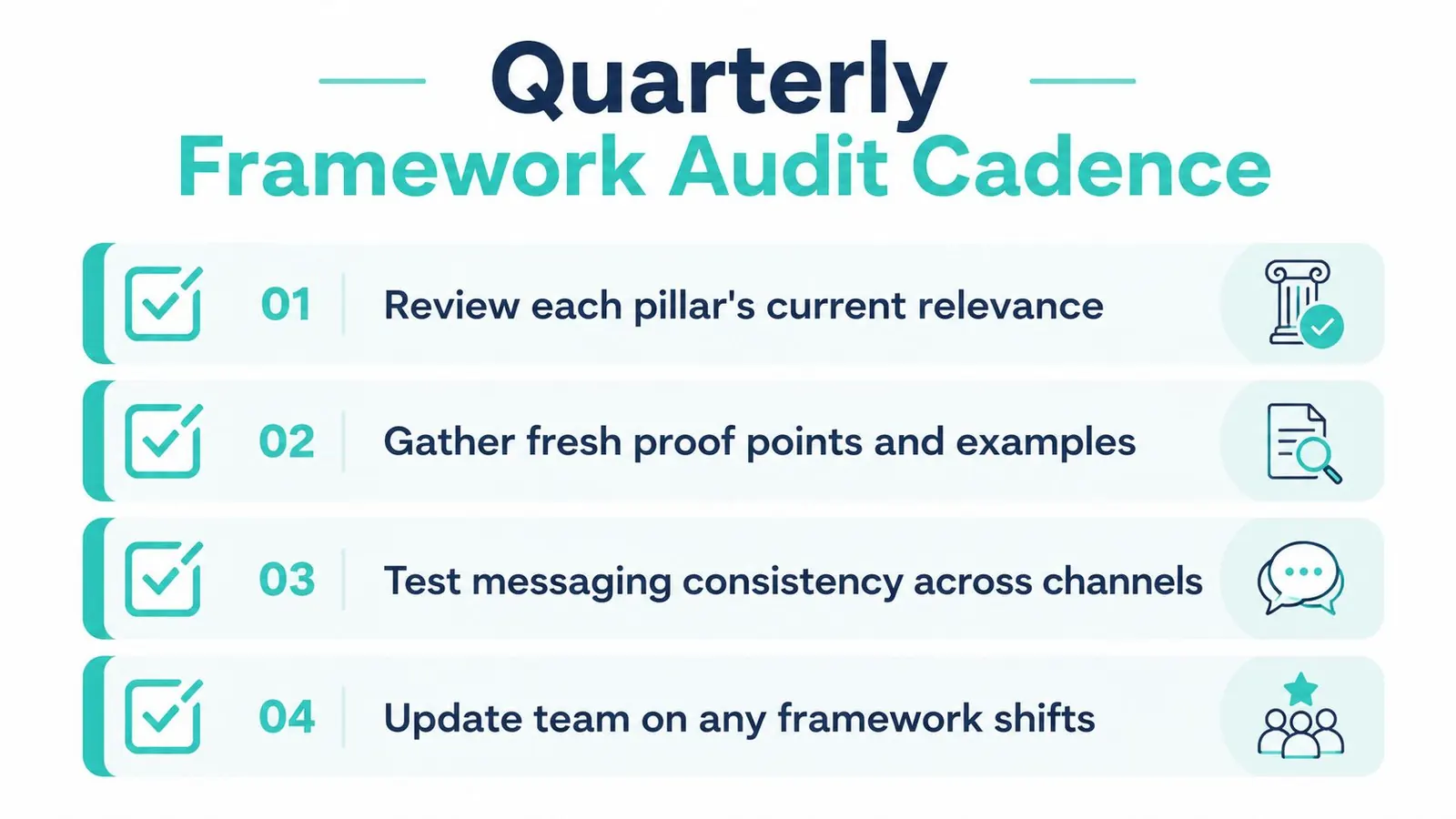
A quarterly audit keeps the framework from turning into a stack of nice-sounding phrases. Review each pillar for current relevance, gather fresh proof points, test messaging consistency across channels, and update the team on anything that has shifted. That cadence keeps the framework aligned with what is true now, not what was true when the document was first written. A living system needs maintenance, and practices feel that right away when the language gets out of sync with the care experience.
An objection log helps too. Front desk conversations, reviews, consult notes, and follow-up calls all surface the phrases people use when they hesitate. Those objections should feed the proof map, because real objections show you where the message is thin. If the same question keeps coming up, the framework needs a better answer, and the team needs a clearer way to say it.
Growth shouldn't fracture the voice
When a practice adds a new service line or hires a new provider, the instinct is often to create a fresh message from scratch. That usually creates more inconsistency. A better move is to ask whether the new offer fits an existing pillar or needs its own approved pillar with proof. The goal is a message that still sounds credible to patients, clients, and referral partners who are checking for signs of care, clarity, and local trust.
Growth should expand the framework, not replace it.
That rule protects the practice as it scales. The messaging stays recognizable even as the business changes, which matters for trust-heavy local practices that have to prove they are competent, accessible, and steady before anyone books. If your practice is ready to build a messaging system that holds up as you grow, learn more about Leaping Lemur Media's approach and how we partner with practices for the long term.
If your practice is tired of sounding different every time someone writes for it, Leaping Lemur Media can help turn scattered language into a clear, usable messaging system. Visit the site to see how thoughtful strategy, proof-driven positioning, and community-rooted messaging can help your practice sound like itself everywhere it shows up.