You've probably had this moment before. A patient nods through a consult, asks a couple of polite questions, then leaves and calls the front desk later with the same confusion you thought you cleared up in the room. That gap, between a solid explanation and actual understanding, is where patient education videos do their best work.
Used well, they give patients something they can watch before a visit, revisit after a procedure, and share with family members who help with decisions. They also give your team a repeatable way to explain common concerns without retyping the same instructions all day.
Table of Contents
- Why Patient Education Videos Matter for Modern Practices
- What the Research Says About Video Effectiveness
- Planning and Scripting Videos That Patients Actually Watch
- Choosing the Right Production Approach for Your Practice
- Distributing Videos and Measuring Real Impact
- Video Topics and Templates for Dental, Eye Care, and Medspa Practices
- Common Misconceptions About Patient Education Videos
Why Patient Education Videos Matter for Modern Practices
A patient can sit in your chair, nod at every explanation, and still walk out unsure about what happens next. That's not a communication failure in the usual sense, it's a memory and timing problem. People are trying to absorb unfamiliar medical information while they're anxious, distracted, or already thinking about pain, cost, and scheduling.
Patient education videos close that gap by turning the same explanation into something patients can absorb at their own pace. A short video on a procedure, aftercare, or treatment option becomes a reusable part of the visit, not a one-time moment that disappears the second the appointment ends. If you want a broader content strategy lens, the explore video creation blog from LunaBloom AI is a helpful starting point, and the agency perspective at Leaping Lemur Media is useful for practices thinking about how education fits into a bigger brand experience.
A bridge between the exam room and the real world
In practical terms, these videos are short, focused teaching tools. They explain one condition, one procedure, one recovery task, or one decision point in plain language and visual steps. That makes them useful for both the clinical side of the practice and the marketing side, because they improve clarity while also making the practice feel more organized and trustworthy.
The best clinics don't treat education as an extra. They build a library of small assets that answer the questions patients ask most often, then reuse those assets across the website, portal, waiting room, and follow-up messages. That saves staff time and gives patients something consistent every time they engage with the practice.
Practical rule: if a team member says the same explanation more than a few times a week, that explanation probably belongs in a video.
The goal isn't to go viral. It's to create reliable, reusable education that helps patients understand what's happening and what they need to do next.
What the Research Says About Video Effectiveness
The evidence for patient education videos is strongest where clinics need fast understanding, not where they need permanent behavior change. A 2018 literature review identified 25 methodologically sound studies and found that video was as good as and often more effective than traditional education for increasing short-term knowledge. The same review also found that video offered no advantage in long-term retention or in improving compliance with medical regimens, which is the part many practice owners miss when they expect one video to solve follow-through by itself. PubMed review
Where video clearly helps
That same evidence base also points to a useful clinical role for video role-modeling. In stressful, well-defined situations, video can reduce anxiety, pain, and sympathetic arousal while improving knowledge and coping ability. That makes it a strong fit for procedure prep, postoperative guidance, and any situation where patients need to see what will happen before they experience it.
A 2022 systematic review of video-based educational interventions for chronic illness found that video tools were the most effective format for improving patient knowledge in 30 of 40 studies (75%). A broader review of 62 empirical studies found that 38 studies (61%) reported a significant positive effect of video-based education on patient outcomes compared with standard education. Those numbers show why video keeps showing up in modern patient communication programs, especially when practices need one clear message delivered the same way every time. Systematic review and evidence base
The catch is quality. A 2023 systematic review in surgical education screened 6,453 citations and included 56 studies covering 6,797 videos, 547 hours of content, and 1.39 billion views. Even with that huge reach, 34 of 49 quality assessments (69%) judged overall educational content to be poor. Surgical education review
That's the core lesson for clinics. Reach doesn't equal quality, and quality doesn't happen by accident. A video can be popular, but if the content is unclear, outdated, or too dense, it won't help patients much.
Patients usually need reinforcement, not just information. Video can start the learning process, but it works best when your team closes the loop after the visit.
Planning and Scripting Videos That Patients Actually Watch
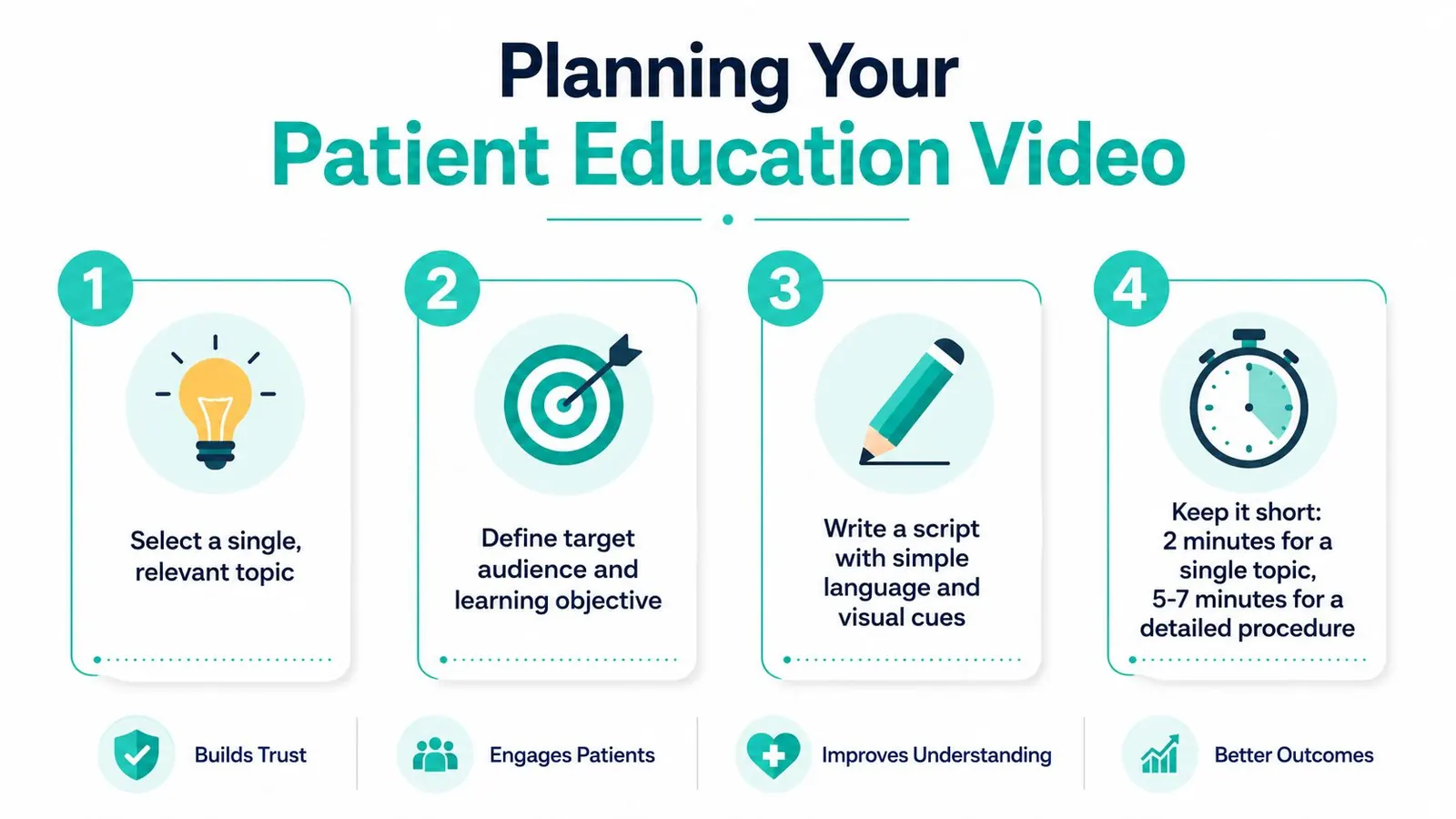
A good patient video starts with one job. Not three jobs, not a broad brand story, just one question a patient has. That focus matters because patients don't want to decode a lecture, they want to know what will happen, what it will feel like, and what they're supposed to do next.
The most usable formats are short. One neutral healthcare production guide recommends 1 to 3 minutes for patient explainer videos and says under 60 seconds works best for quick tips and explainers, while a medical education review recommends keeping instructional videos under 15 minutes, ideally 6 to 15 minutes when the topic needs more depth. A separate industry source for patient-facing healthcare videos recommends 60 to 90 seconds for awareness or education content. The common thread is simple, patients finish what feels concise and relevant. Healthcare video length guidance Patient-facing video guidance
Write for the patient who is already overwhelmed
A strong script uses plain language, a conversational style, and a reading level around 5th to 6th grade. Another peer-reviewed framework says audio and visuals should align, syntax should stay simple, and speech speed should be 160 words per minute or faster when appropriate. Those details matter because a patient who has to pause, re-read, or reinterpret the message is already slipping out of comprehension. Writing framework Readability and accessibility guidance
A practical script structure works better than a fancy one. Start with what the patient needs to know, then show the step, then repeat the action in plain language. If the topic is a procedure, use visual cues for each phase so the patient can match what they hear with what they'll experience.
High-quality educational videos also need a validated storyboard and script, clear learning outcomes, a title that reflects the content, narration by the educator, close captioning, and interactive features. That checklist keeps production tied to patient needs instead of making it feel like generic content marketing. Educational video checklist
Useful standard: if a patient can't understand the video without rereading the title, the script is probably too dense.
For accessibility, include closed captions, multiple titles available in various languages, and printed transcripts and images that can be shared through the patient portal. That combination supports multilingual families, caregivers, and patients who prefer to read along instead of relying on audio alone. Accessibility and multilingual guidance
Choosing the Right Production Approach for Your Practice
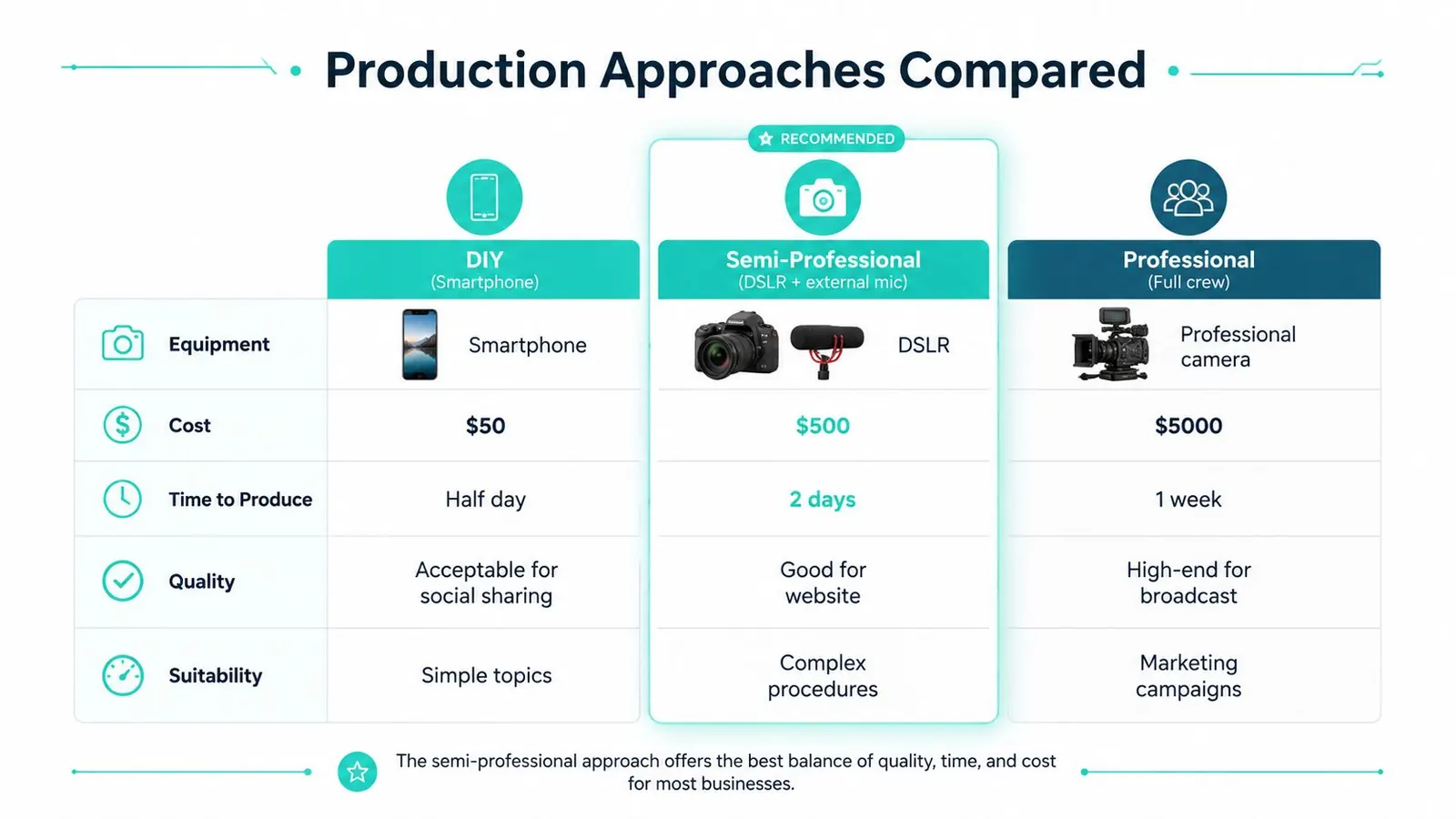
Most practices don't need to choose between “cheap and messy” or “expensive and polished.” They need a process that matches the topic, the audience, and the level of risk in the message. A short aftercare reminder for a routine dental procedure has very different production needs from a detailed surgical prep explanation or a medspa treatment overview.
DIY, AI-assisted, or professional
DIY videos work well when the topic is simple and the person on camera is confident. A smartphone, a quiet room, and basic editing can be enough for an FAQ, a quick tip, or a recurring patient question. AI-assisted platforms can speed up scripting, layout, and versioning when a practice needs lots of repeatable content. Professional production makes more sense when the video will represent the practice publicly, cover a complex procedure, or live on a homepage where brand polish matters.
The choice should also account for technical delivery. Patient education video files should be encoded in MP4/H.264 for broad compatibility across browsers, portals, and devices. Open learning platform documentation recommends 1080p output and a 5 Mbps target bitrate with a max of 6 Mbps, which helps videos play reliably on variable connections. Technical delivery guidance
Practical rule: standardize the format before you scale the library. One clean file structure saves more headaches than any editing trick.
Pick for reliability, not just appearance
A practice should also think in terms of reuse. If the video will be embedded in a patient portal, sent by email, or played on different devices, consistency matters more than cinematic polish. Standard compression and multiple resolutions help reduce playback problems, especially when patients are streaming on mobile data or older phones.
The middle path is often the strongest one. A semi-professional workflow, clear scripting, and standardized export settings can produce videos that look credible without draining the budget. If you want help translating educational goals into production choices, Auralume AI's teaching video advice is useful context for practices weighing efficiency against quality.
The right question isn't “What can we afford?” It's “What level of quality does this patient question deserve?”
Distributing Videos and Measuring Real Impact
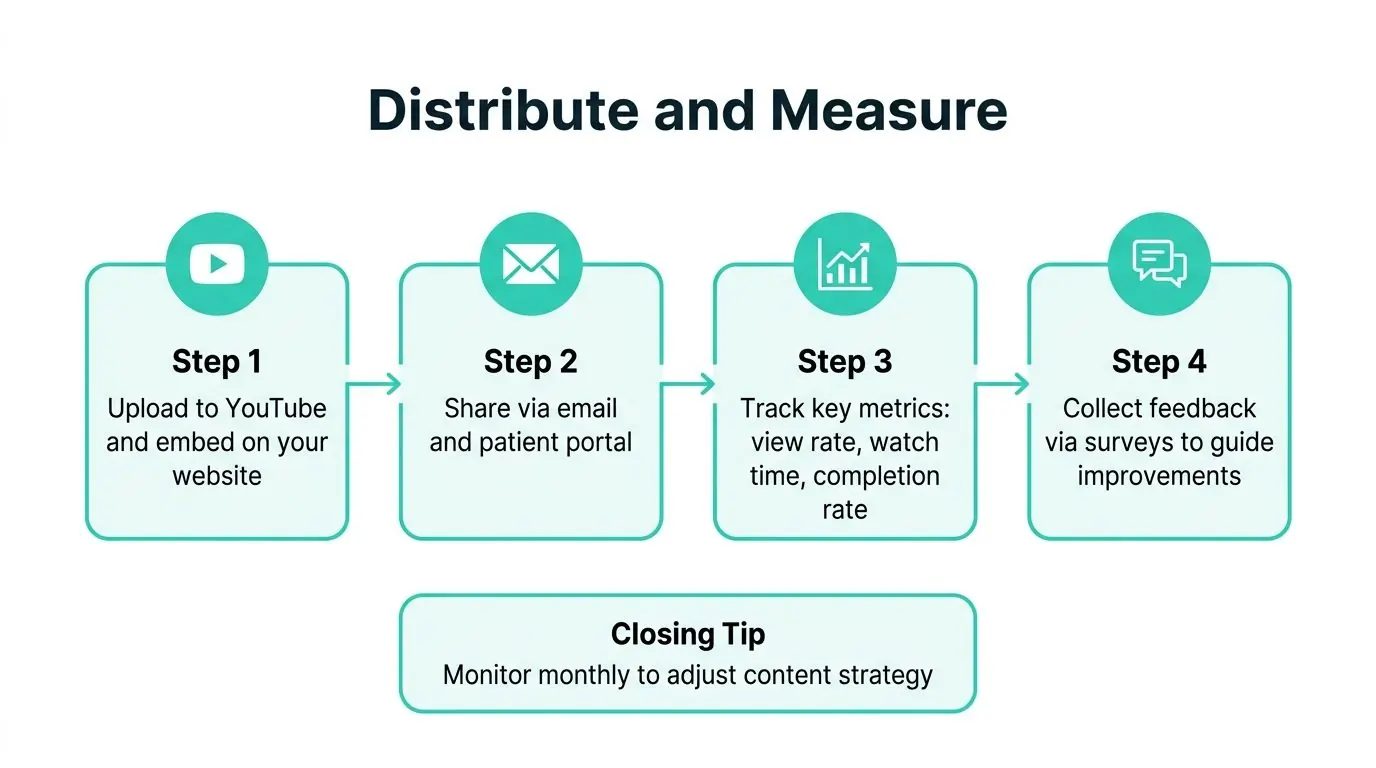
A video that sits in one folder helps no one. The value comes from putting it where patients already make decisions, then watching whether it changes how they move through the care journey. That usually means using the practice website, the patient portal, email, social media, and in-office screens in a coordinated way.
The smartest distribution strategy maps to timing. Pre-consultation videos help patients arrive with better questions. In-visit videos help staff explain a treatment or procedure without repeating themselves. Post-procedure videos give patients something they can revisit when they're home and unsure about the next step.
Measure more than views
View counts are easy to chase and easy to misunderstand. A patient can click a video and still not watch past the first few seconds. What matters more is whether they stayed long enough to absorb the message, whether they came back to the video later, and whether the content reduced confusion enough to cut down on follow-up calls.
A strong measurement plan tracks watch behavior, completion, and feedback, then compares those signals with the point in the patient journey where the video was shared. That's the only way to know whether a video helped someone decide, prepare, or recover. For a broader marketing perspective on this, measuring video performance KPIs is a useful reference point.
The clinical outcome story is more nuanced. A 2023 systematic review found strong short-term knowledge gains, but the evidence was much less consistent for quality of life and disease severity, and some studies showed videos were only noninferior to in-person counseling rather than clearly better. That's not a weakness of video itself, it's a reminder that education is one part of care, not the whole intervention. 2023 systematic review
Build the library around the patient journey
A good library is searchable and organized by use case, not by whoever produced the video. A patient looking for post-op care shouldn't have to scroll through unrelated brand content to find it. Group videos by condition, procedure, concern, and stage of care, then make sure staff know when to assign them.
The clinics that get the most value tend to treat video like reinforcement. The video opens the conversation, and the team follows up with context, questions, and reminders. That's how education becomes part of the workflow instead of a one-time media asset.
Video Topics and Templates for Dental, Eye Care, and Medspa Practices
A generic explainer library rarely matches what patients worry about. A dental patient wants to know about pain, numbness, and aftercare. An eye care patient wants clarity about lenses, drops, or surgery prep. A medspa patient wants realistic expectations, downtime, and how results unfold over time. Those are different anxieties, so the videos should sound different too.
| Practice Type | Video Topic | Duration | Primary Goal |
|---|---|---|---|
| Dental | Dental procedure overview | Short, focused | Reduce fear before treatment |
| Dental | Post-treatment care basics | Short | Reinforce recovery steps |
| Dental | Oral hygiene technique | Short | Improve home care consistency |
| Eye Care | Contact lens insertion and removal | Short | Build confidence with daily use |
| Eye Care | Surgery preparation | Short to moderate | Set expectations before the visit |
| Eye Care | Condition education overview | Moderate | Support informed decisions |
| Medspa | Treatment expectation setting | Short | Align expectations with reality |
| Medspa | Aftercare guidance | Short | Reduce avoidable confusion |
| Medspa | Procedure comparison | Moderate | Help patients choose with clarity |
Dental videos that cut down repeat questions
For dental practices, the highest-value topics are usually the ones staff explain over and over. A procedure explainer can cover what the patient will feel, what tools are used, and what happens immediately afterward. An oral hygiene tutorial works well when it shows brushing angles, flossing technique, or how to clean around restorations. A post-treatment care video can remind patients about soft foods, sensitivity, and when to call the office.
A simple script template works well here. Start with the concern, describe the step, and end with one clear next action. That keeps the video useful for both the patient and the front desk team that has to answer the same follow-up questions later.
Eye care and medspa need different pacing
Eye care videos often work best when they are calm, direct, and visually precise. A contact lens instruction video should show hand placement and lens orientation clearly. A surgical preparation video should walk through arrival, drops, and what to expect in the hours before care. A condition education video can help patients understand why a treatment plan matters without drowning them in terminology.
Medspa videos need a different tone. Patients usually want reassurance about comfort, downtime, and realistic outcomes. A treatment expectation video should state what's normal, what isn't, and how soon to expect visible changes. A procedure comparison video helps patients choose between options without feeling pressured. The strongest versions are honest, clear, and free of overpromises.
If you build these around recurring questions, you'll end up with a content calendar that feels practical instead of abstract.
Common Misconceptions About Patient Education Videos
The biggest mistake is assuming a video replaces follow-up. The research doesn't support that. The 2018 review found no advantage in long-term retention or compliance with medical regimens, which means video is best used as the first layer of understanding, not the final one. PubMed review
Another myth is that longer videos are automatically better. They aren't. Patients usually respond better to short, focused content, especially when the topic is one question or one action. A dense seven-minute explanation may look thorough, but if patients stop paying attention halfway through, the extra detail doesn't help.
Accessibility is not a bonus feature. Closed captions, multilingual options, and transcripts determine whether a video is usable by a diverse patient base. The same goes for source credibility and production standards. A polished video that explains the wrong thing is still the wrong thing.
The best programs treat video as a clinical communication asset. They pair clear scripting with follow-up reinforcement, then keep refining based on what patients still ask afterward.
Leaping Lemur Media helps practices turn patient education into clear, repeatable content that supports trust, understanding, and smoother visits. If you want video that sounds like your practice and fits real patient workflows, visit Leaping Lemur Media and see how a thoughtful strategy can make your education more useful from the first view to the follow-up call.