
Google Ads for Optometrists How to Book More Eye Exams
Google Ads for optometrists: how to target 'eye doctor near me' searches, compete with national chains, and book more eye exams.
Read

Healthcare Marketing

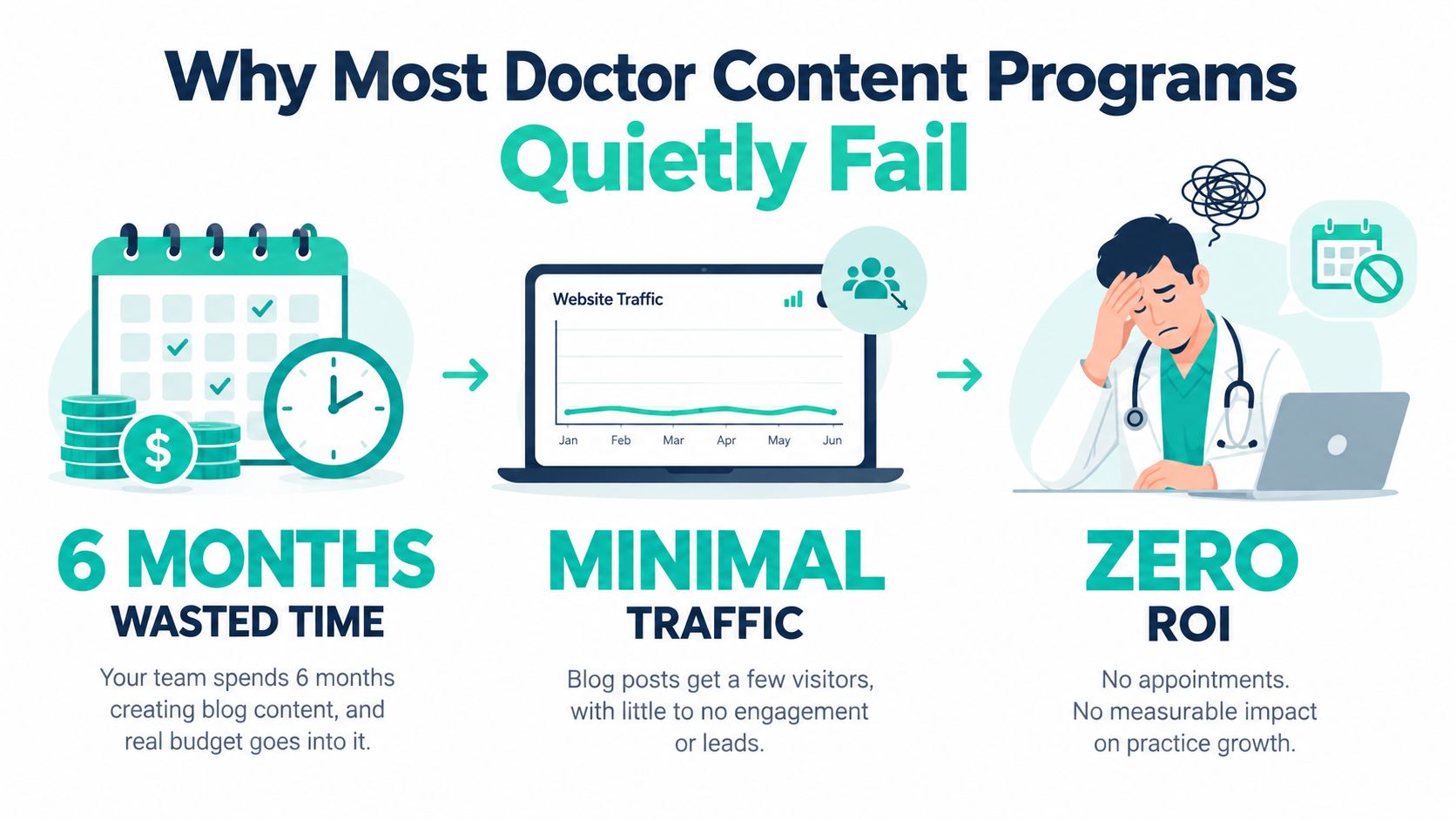
Your practice has probably lived through this cycle: someone suggests “doing more content,” a freelancer writes a few articles, the office publishes them between other priorities, and six months later nobody can explain whether a single appointment came from the work. The pages may be accurate enough, but they don't answer the questions patients ask, show who reviewed the information, or lead visitors toward a sensible next step.
That's the central problem with content marketing for doctors. It isn't mainly a publishing challenge. It's an editorial governance problem involving clinical accuracy, patient trust, search visibility, local discovery, AI extraction, and intake operations. A useful program must serve the patient searching late at night, Google's quality systems evaluating medical expertise, and the practice owner who needs a fuller schedule.
The most common failure is simple: the practice publishes what the doctor wants to explain instead of what the patient needs to decide. A physician may be interested in a broad overview of a condition, while the prospective patient is searching for whether a symptom warrants an appointment, what treatment involves, or whether the practice accepts their insurance.
That mismatch creates content that sounds professional but attracts weak demand. The second failure is generic AI-drafted copy with no visible physician authorship, clinical review, or accountable editor. AI can help organize questions and identify patterns, but raw output is not a medical publishing system.
The third failure happens after publication. The article has no connection to a service page, local search profile, booking path, call tracking, or intake script. Even a well-written page can produce little business value if the reader can't understand who the practice helps, where it serves patients, and what to do next.
A working article has three jobs:
Physicians already encounter digital education throughout the workday. A physician survey found that 71% used social media for specialty news and 93% used social media at least weekly, while another report found that over 98% engaged with medical news or educational information during the average workday. More than 60% reviewed content between patient visits. These findings, reported in the physician online content trends report, make the strategic implication clear: doctors understand the value of useful content, but practices need a disciplined system to produce it safely.
Document the owner, reviewer, approval rule, destination page, conversion action, distribution channels, and update date for every asset. If your team needs a clear picture of who you are and how you work before starting, the Leaping Lemur Media team provides that context. The practice that treats content as an accountable clinical asset will outperform the practice that treats it as a folder of blog drafts.
Start with the patient decision, not the keyword. A practice should know whether a topic is intended to attract a new patient, retain an existing one, support a referral relationship, or answer a question after a visit. It should also distinguish between a person researching a diagnosed condition and someone browsing preventive care without a defined clinical need.
A useful one-page strategy begins with three fields:
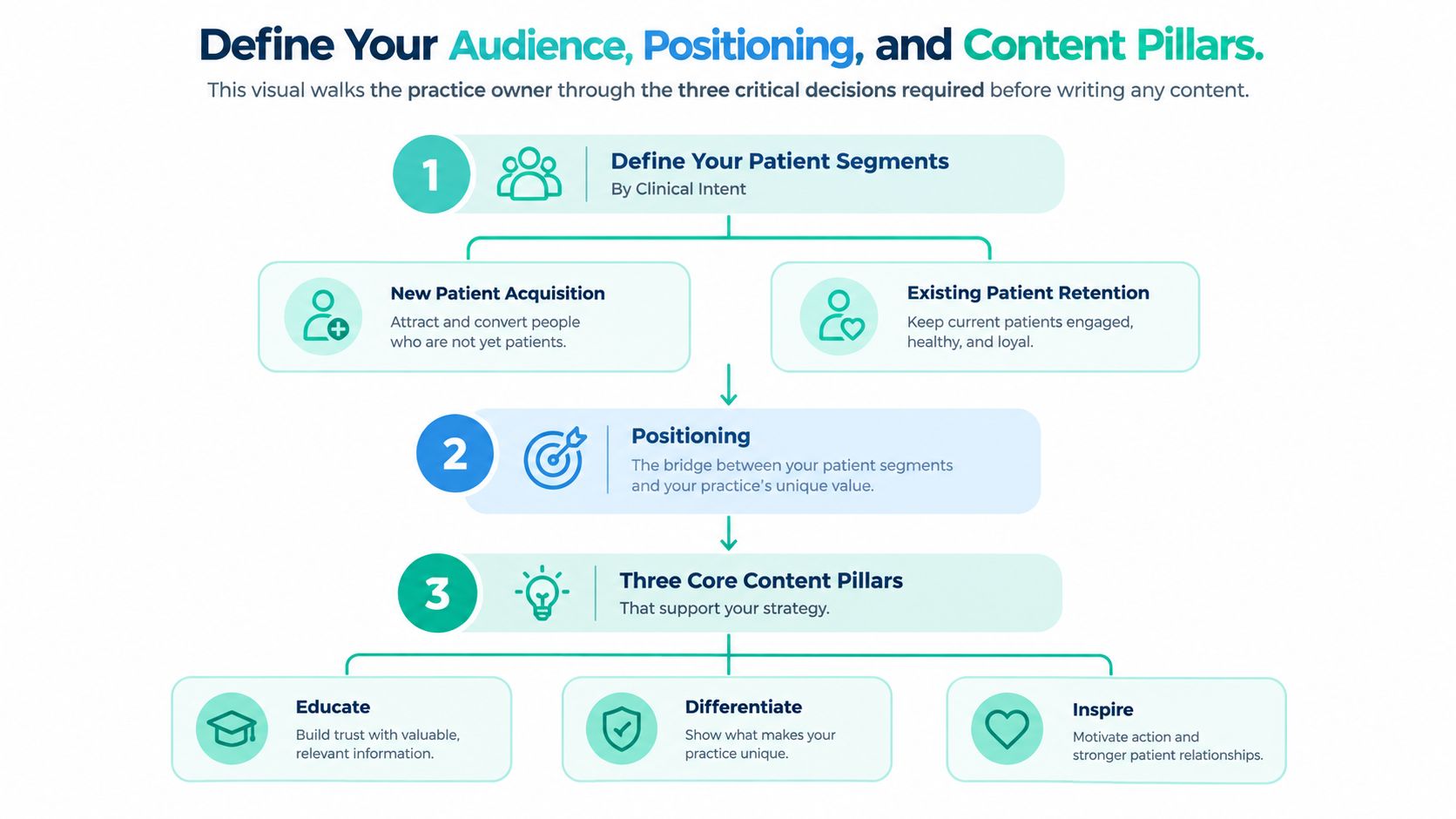
A pediatrics clinic might choose new-parent education as a broad acquisition pillar, or ADHD evaluation as a narrower, higher-intent service line. Those choices lead to different questions, pages, calls to action, and referral relationships.
A dermatology practice should usually separate medical dermatology from cosmetic dermatology rather than placing both in one undifferentiated blog. A patient researching a changing mole needs a different educational journey from someone considering injectables. Separate funnels make the language, evidence, imagery, consent process, and conversion path easier to manage.
Use this planning format for each pillar:
| Planning field | Example |
|---|---|
| Patient segment | Adult patients with a persistent skin concern |
| Positioning | Physician-led diagnosis and treatment in the local service area |
| Pillar | Medical dermatology education |
| Question cluster | Symptoms, evaluation, treatment options, preparation |
| Destination | Medical dermatology service page |
| Conversion path | Request an appointment or call the practice |
Once the choices are documented, a pillar-based posting routine can turn those themes into a manageable publishing habit. Don't create a pillar because it sounds exhaustive. Create it because the practice can support it with clinical expertise, useful destinations, and a clear patient action.
Healthcare content carries a higher risk than ordinary commercial copy because readers may act on it. A patient story, testimonial, before-and-after image, treatment explanation, or outcome statement needs a documented basis, appropriate permission, and a review process that someone can audit later.
HIPAA boundaries matter whenever content could identify a patient or reveal protected health information. Written authorization should cover patient testimonials and identifiable stories, while before-and-after imagery needs explicit consent for the intended use. Sponsored or affiliate material also requires clear FTC disclosure, and outcome claims deserve particular scrutiny in weight loss, hormone therapy, and aesthetics.
Practical rule: If a claim would make a patient choose one treatment over another, route it through clinical review before publication.
Physician authorship and named credentials are not decorative trust signals. They show readers who stands behind the information and give search systems a clearer basis for evaluating medical expertise. Healthcare information is also difficult for the public to judge. More than 80% of Americans search online for health information, but only 11% find it very easy to assess reliability, and just 12% are very confident in its accuracy. Confidence falls to 5% for AI-powered tools and chatbots, compared with 57% for information received directly from a healthcare provider, according to the AANP report on AI and online health information.
The workflow should be short enough to use and strict enough to matter.
| Step | Responsible | Accountable | Consulted | Informed |
|---|---|---|---|---|
| Draft and source claims | Medical writer | Practice manager | Physician reviewer | Marketing team |
| Clinical fact-check | Physician reviewer | Medical director | Relevant clinician | Practice manager |
| Compliance pass | Compliance lead or manager | Practice owner | Physician reviewer | Writer |
| Final sign-off and publication | Practice manager | Practice owner | Reviewer and writer | Front desk team |
Every article should display an author, reviewer, credentials, references to primary sources where appropriate, last-reviewed date, and conflict-of-interest disclosure. Add an expiration or reassessment date for information that can change. AI may assist with outlining, transcription, or repurposing, but it shouldn't publish raw medical content without human review.
Choose a format by the job it must perform. A polished asset that has no discovery, education, conversion, or retention role is a production expense, not a strategy.
| Format | Best Distribution Channel | Primary Job | Effort vs. ROI |
|---|---|---|---|
| Condition hub or long-form guide | Organic search, internal links, AI-readable site sections | Discovery and education | Higher effort, durable value |
| Service page | Website, local search, paid landing path | Conversion | Moderate effort, direct value |
| Short physician video | YouTube, Instagram, Facebook, website embeds | Discovery and education | Moderate effort, strong repurposing value |
| Email sequence | Practice database and appointment follow-up | Retention and nurture | Moderate effort, measurable relationship value |
| Google Business Profile update | Local search profile | Local discovery | Low effort, supporting value |
| Patient story or testimonial | Website and approved social distribution | Trust and conversion | Higher compliance effort, useful when properly authorized |
Long-form condition pages should answer the question directly, explain the clinical context, and link to the appropriate service. Clear headings, short answer blocks, FAQs, lists, and structured data make content easier for patients to scan and easier for AI search systems to extract. The objective isn't to write for a machine instead of a person. It's to make the best physician-reviewed answer unambiguous to both.
Short-form video has a different role. It creates social discovery, gives prospective patients a sense of the physician's communication style, and can send interested viewers to branded searches or a service page. An unedited physician reel rarely performs that job well. Add captions, a focused question, a clear opening, and a safe next step.
A solo dermatologist shouldn't imitate a multi-specialty group with a large marketing department. Start with a strong service page, a small set of condition resources, one local profile, and one channel the physician can sustain. A larger group can add service-line newsletters, referral content, video libraries, and segmented journeys, but only after ownership and review are clear.
Generic infographics often fail because they compress clinical nuance without giving the reader a useful next action. Untagged stock video creates visual activity without trust. Distribution should amplify a reviewed asset, not replace editorial substance.
A small practice can manage content with a simple pipeline:
Idea intake → intent and source check → draft → physician review → compliance approval → publish → distribute → measure → update.
Put every asset in a task system with an owner, due date, reviewer, destination page, target question, conversion action, and review date. A practice manager can run this in Notion, Asana, ClickUp, or a purpose-built content scheduling tool such as TheContentMap.
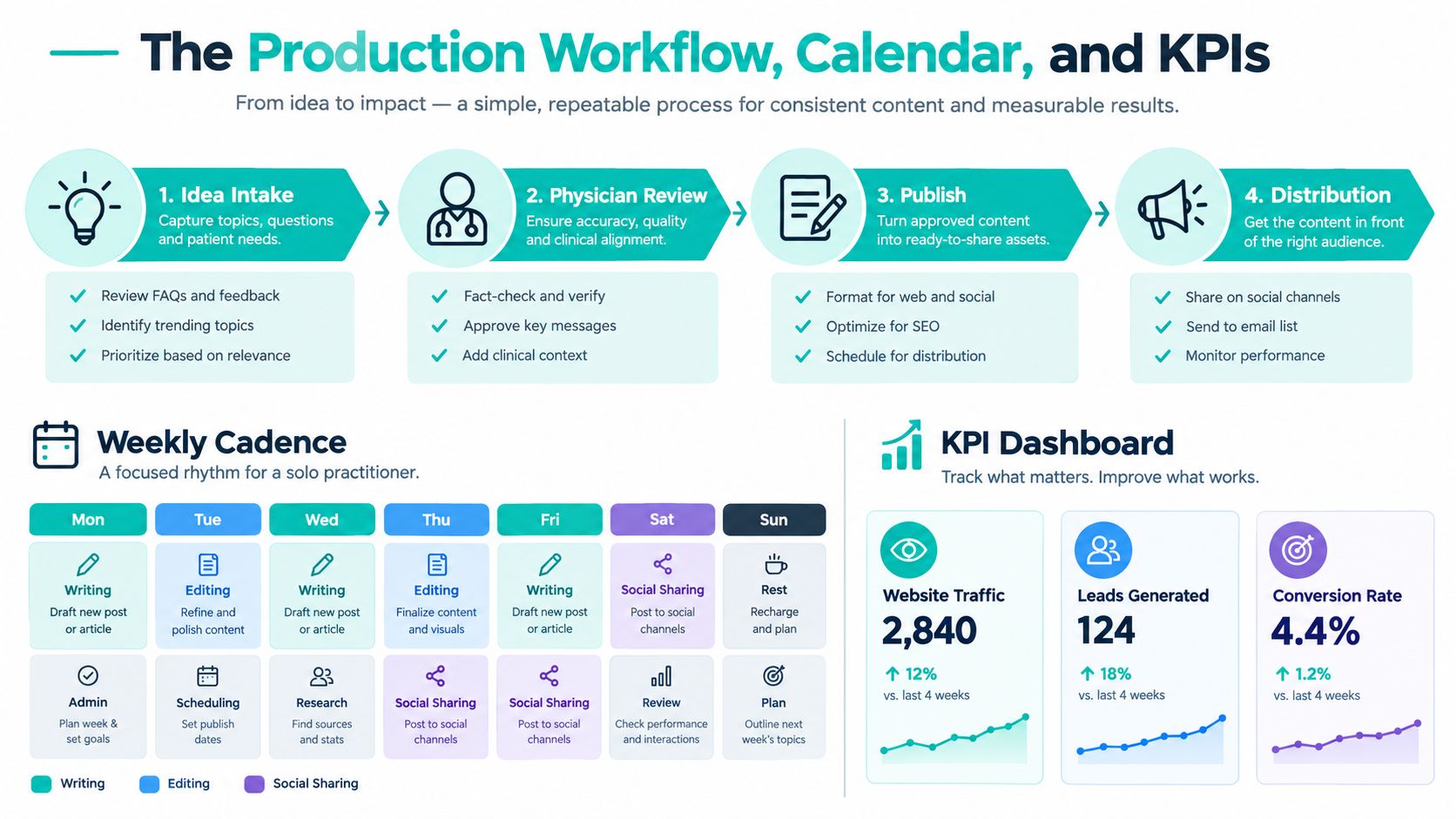
For a solo or two-doctor practice, a workable weekly rhythm can include two long-form pieces, four short posts, and one email, with a monthly analytics review. That cadence is a planning recommendation, not a universal rule. If physician review can't support it, reduce the volume and protect quality.
A sample calendar might look like this:
The KPI framework should separate visibility from business value. Impressions, rankings, and social reach describe discovery. Time on page, scroll depth, and video completion describe engagement. Consult requests, phone calls, and booked procedures tied to UTMs describe conversion.
Traffic is a diagnostic signal. A booked appointment is an operating result.
Track AI citation presence as a visibility indicator, but don't treat an unverified appearance as revenue. Pair it with branded search behavior, tracked calls, form submissions, and intake questions such as “How did you find us?” Vanity metrics become useful when they explain a conversion path. They become distracting when the team celebrates traffic that never reaches the schedule.
For implementation support across SEO, content, and measurement, Leaping Lemur Media's services describe the kinds of marketing work a practice can assign externally while keeping clinical accountability inside the practice.
Consider two fictional practices with similar staffing and local competition.
Practice A is a two-physician dermatology clinic in a mid-sized metro. The owners hire a freelancer, publish when someone remembers, and approve drafts quickly without a formal medical reviewer. The blog covers broad skin topics, but posts rarely link to medical or cosmetic service pages. Calls aren't tagged, the front desk hasn't been told which pages matter, and the clinic can't distinguish a useful inquiry from general website traffic.
During the first part of its six-month effort, Practice A accumulates articles but not an editorial memory. When a physician changes a treatment recommendation, nobody knows which pages need review. Staff spend time answering questions that the website could have handled, while the freelancer spends more time finding topics than improving the practice's strongest patient journeys.
Practice B is a comparable primary care group. The practice manager owns the calendar, a part-time physician reviewer signs off on patient-facing content, and each piece maps to a service line, patient question, and conversion route. The team creates a concise answer, a deeper evidence article, and a supporting visual or video rather than treating every post as a standalone event.
By the middle of the same six-month period, Practice B has a visible queue, documented sources, reviewer bylines, update dates, and a defined route from education to consultation. The front desk recognizes content-driven questions and records them consistently. The group can see which topics attract relevant visitors, which pages assist inquiries, and where patients abandon the journey.
Practice A may still receive occasional traffic, but staff can't explain its quality or contribution. Practice B's AI-overview citations and other search visibility signals are treated as part of a broader measurement system, not as proof of success by themselves. The useful outcome is a steady, traceable flow from patient question to reviewed answer to consult request.
The difference isn't that Practice B publishes more aggressively. It has made accountability visible. Its content system reduces rework, protects clinical credibility, and gives each department a shared understanding of what the practice is trying to achieve.
For examples of how a marketing team can document its thinking and communicate ongoing work, the Leaping Lemur Media journal offers a useful reference point. The practical lesson is direct: a calendar without governance creates activity, while governance turns activity into a repeatable practice asset.
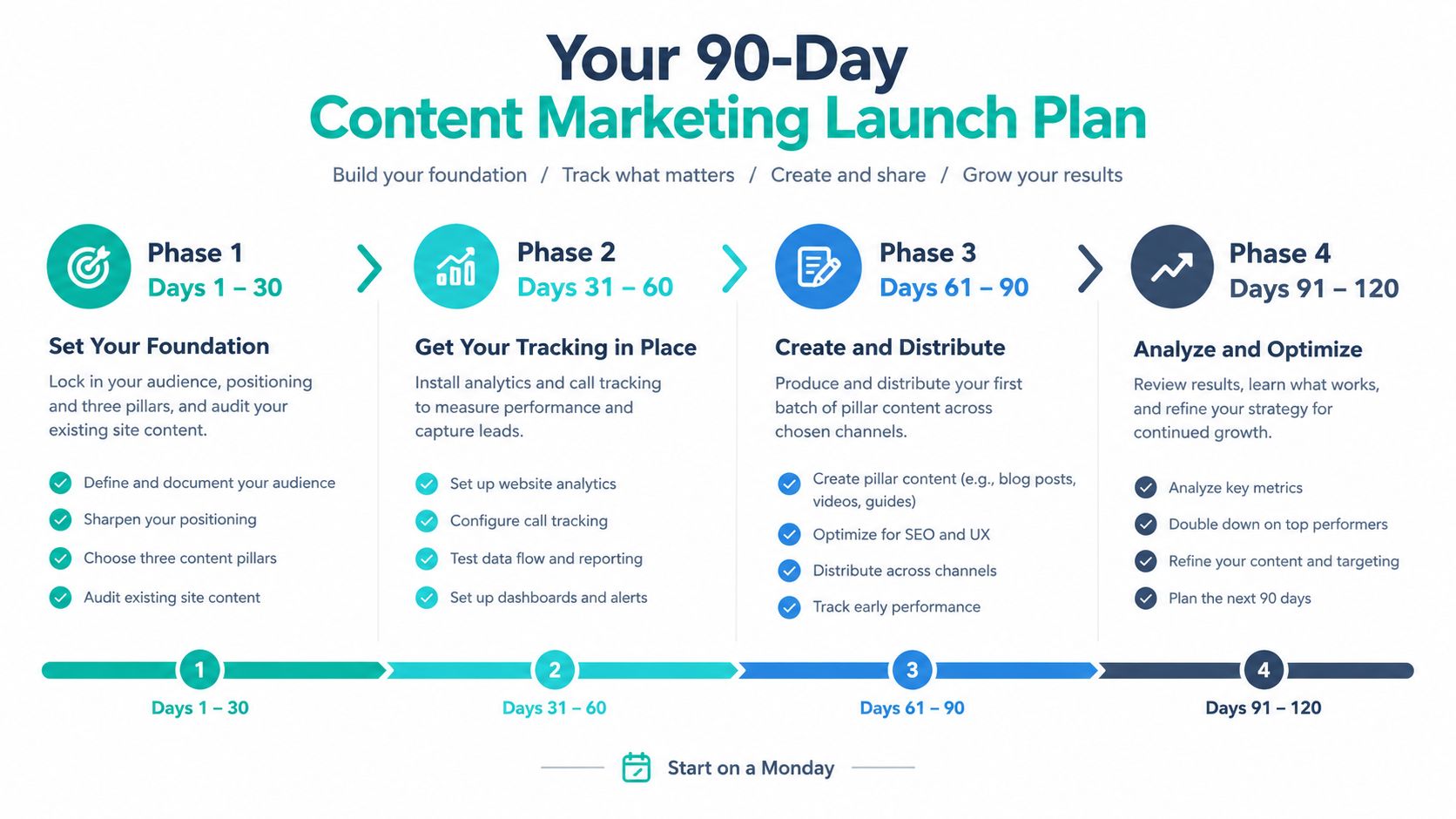
Start on Monday with four planning blocks.
Days 1 to 30: Define the audience, positioning, and three core pillars. Audit existing pages for accuracy, intent, internal links, authorship, review dates, and conversion paths. Install analytics and call tracking, then record baseline discovery, engagement, and conversion indicators.
Days 31 to 60: Publish 8 to 12 physician-reviewed cornerstone pieces mapped to real patient questions. Launch one email nurture sequence and one social channel. Add local SEO schema where appropriate, improve provider and service pages, and keep the Google Business Profile current.
Days 61 to 90: Add short-form video or properly authorized patient-story formats. Build a referral-loop template that gives patients and professional contacts a clear, compliant way to find relevant resources. Compare results with the baseline, then decide which topics deserve more investment and which should be stopped or rewritten.
Keep the operating checklist short:
A 2026 physician survey summarized by SERMO's healthcare content marketing analysis reports that 28% of physicians describe content marketing results as inconsistent, while 22% say it has moderately improved patient engagement and visibility. That is a strong argument for governance, not for publishing more randomly. Reputation belongs in the same operating system, since 9 out of 10 patients use online reviews to evaluate doctors and 75% consider only doctors rated four stars or higher, according to SERMO's digital marketing coverage.
Leaping Lemur Media can help your practice turn physician expertise into research-driven SEO and content that answers patient questions, builds authority, and creates measurable conversion paths. Visit Leaping Lemur Media to discuss a content governance system built around your specialty, community, and growth goals.

Google Ads for optometrists: how to target 'eye doctor near me' searches, compete with national chains, and book more eye exams.

Medical spa digital marketing playbook: SEO, ads, reviews, and booking strategies to stand out in a fast-growing, crowded market.

Medical practice website design guide for 2026: clear services, insurance info, easy booking, and mobile pages that convert patients.
Enough reading
If a dispatch struck a nerve, that's usually the start of a project. Tell us what's broken — we'll tell you honestly whether we can help.