
A new patient calls after seeing your ad. The appointment books, but when you add the advertising bill, staff time, software, and follow-up work, you're no longer sure the campaign paid for itself. Meanwhile, referrals may be slowing, a competitor may have opened nearby, and your marketing budget is being judged by leads instead of profitable new relationships.
That's where customer acquisition cost, or CAC, gives you a clearer view. It tells you what your practice spends to bring in each new patient or client, but the most useful version isn't one blended number. It's a channel-by-channel view that shows whether Google Ads, local search, referrals, social media, email, or partnerships are producing efficient growth.
You'll learn how to calculate CAC, include the costs owners commonly miss, compare performance across practice types, connect acquisition spending to lifetime value, and build a practical review rhythm. If you want additional marketing education for practice owners, the Leaping Lemur Media journal is a useful place to continue.
Table of Contents
- When a New Patient Suddenly Feels Expensive
- The Core Formula and What Actually Goes Into It
- What Healthy CAC Looks Like Across Industries
- Tracking CAC Without Building a Dashboard
- How CAC Connects to LTV and Real ROI
- Why Your Channel Mix Matters More Than Your Blended CAC
- Practical Ways to Bring Your CAC Down
- Your 90-Day CAC Review Plan
When a New Patient Suddenly Feels Expensive
You notice CAC at an uncomfortable moment. A campaign produces fewer booked appointments than expected. A referral source that used to send steady business goes quiet. A new dental office, medspa, eye clinic, or law firm opens down the street and starts bidding on the same local searches.
The first reaction is often, “Marketing is getting too expensive.” That may be true, but it isn't specific enough to guide a decision. You need to know which source became expensive, what you included in the calculation, and whether the new customer is valuable enough to justify the cost.
A practice owner might see ten new patients from a paid campaign and divide the ad bill by ten. That creates a useful starting point, but it may ignore the staff member who answers calls, the CRM subscription, the agency fee, the landing-page work, or the time spent following up with leads. A referral program may look free because there's no media bill, even though the practice offers an incentive and staff members spend time managing it.
Practical rule: CAC is a decision tool, not a verdict. A high number tells you where to investigate, not automatically what to shut off.
Start by choosing a consistent period and counting only new customers. Then separate results by source instead of combining every marketing activity into one average. Finally, compare the cost with the revenue and repeat business each source creates.
That process turns a vague concern into a set of manageable questions:
- Did this channel produce new customers?
- What did it cost after direct and supporting expenses?
- How quickly did those customers generate revenue?
- Should the practice protect, improve, or reduce this source?
CAC isn't reserved for software companies or corporate finance teams. For a local practice, it's a practical way to make every marketing dollar more intentional without guessing.
The Core Formula and What Actually Goes Into It
The basic formula is straightforward:
CAC = Total sales and marketing spend ÷ number of new customers acquired
That definition is used across industry guidance, including explanations of how customer acquisition cost is calculated. The important detail is that the costs and customer count must cover the same period. If you include a month of advertising but count new patients from a longer period, the result won't tell you much.
Start with the simple version
Suppose a mid-sized dental practice spends $4,000 on Google Ads and $1,000 on local sponsorships during a month. It acquires 20 new patients from those efforts. The direct-spend calculation is:
$5,000 ÷ 20 = $250 CAC
That number can help you compare campaign performance, but it's incomplete if the practice also pays an agency, uses call-tracking software, assigns an employee to respond to leads, or pays for creative production.
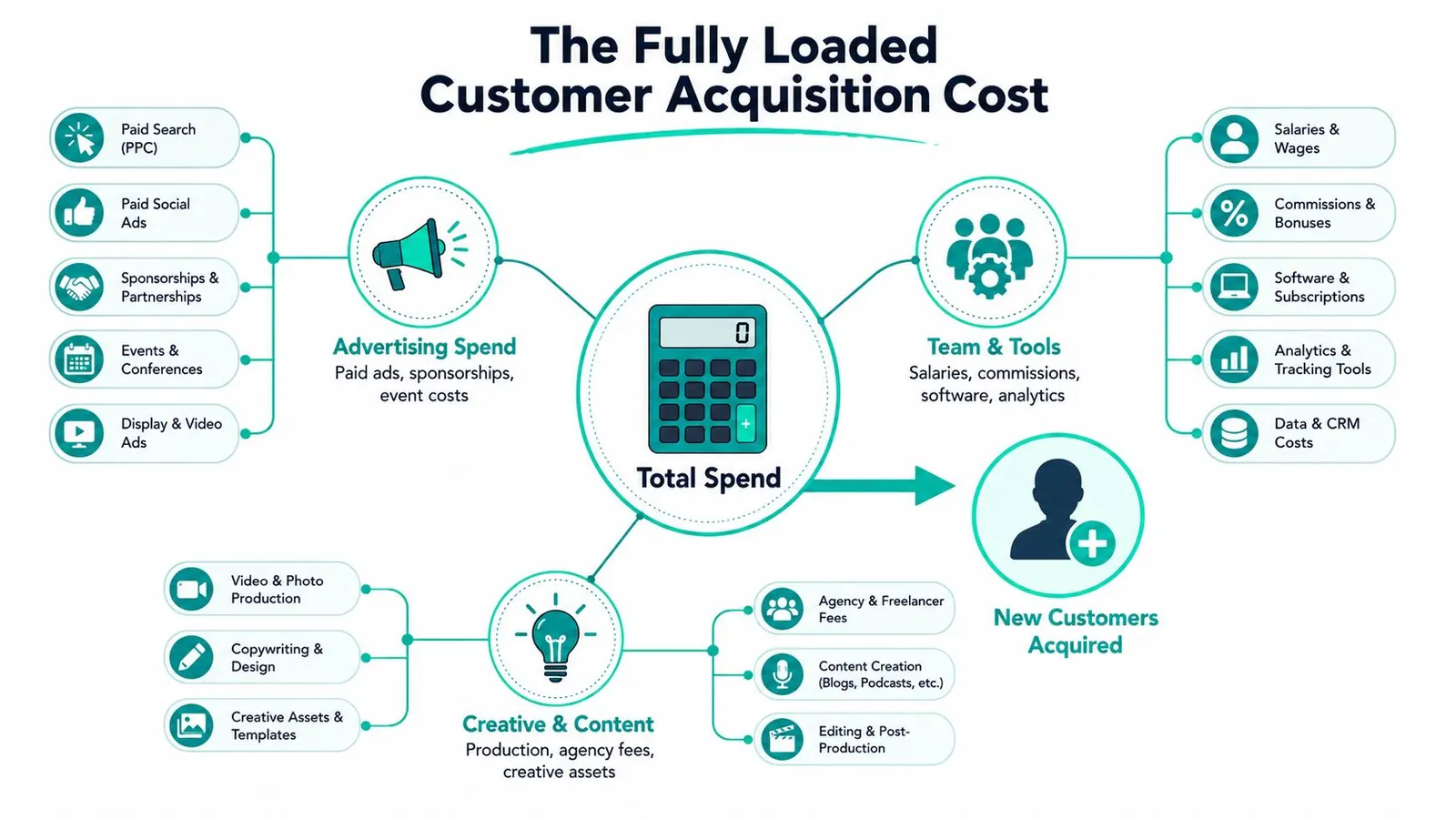
A more realistic calculation adds acquisition-related expenses such as:
- Advertising: Google Ads, Meta ads, sponsorships, events, and promotional placements.
- Team costs: The acquisition portion of marketing or sales salaries, commissions, and benefits.
- Tools: CRM software, call tracking, analytics, scheduling integrations, and marketing automation.
- Creative work: Photography, video, design, copywriting, landing pages, and agency fees.
- Referral or affiliate costs: Discounts, incentives, or commissions tied to new-customer acquisition.
The fully loaded approach reflects the broader industry definition of CAC, which can include advertising, salaries, tools, agency fees, affiliate costs, and creative expenses. The fully loaded CAC formula and cost categories provide useful context for deciding what belongs in your calculation.
Know what to leave out
Don't put every business expense into CAC. Rent, utilities, clinical supplies, and general administrative payroll usually belong in operating expenses unless you can clearly connect them to acquiring new customers. The question is whether the cost helped attract, convert, or onboard someone who hadn't previously purchased from you.
A practice can keep two views:
- Direct CAC, using channel spend only for fast campaign decisions.
- Fully loaded CAC, adding the team, tools, creative, and agency costs for financial planning.
Keeping those views separate prevents confusion. Owners who want to understand how marketing journeys are structured can also review these funnel types that drive revenue, then map each funnel stage to a measurable acquisition expense.
What Healthy CAC Looks Like Across Industries
A “healthy” CAC depends on the economics of the business behind it. Ecommerce often acquires customers at a lower cost than B2B SaaS, while enterprise sales can cost much more because the buying process involves more people, more sales labor, and longer decision cycles.
Current benchmark summaries illustrate that spread. Ecommerce CAC is reported around $30 to $80, with examples including email at $5 to $15, organic social at $10 to $25, Meta ads at $30 to $60, Google Search at $40 to $100, and referrals at $5 to $20, according to ecommerce CAC benchmarks. B2B SaaS can range from about $702 for self-serve or product-led acquisition to approximately $11,400 for enterprise sales-led acquisition, a roughly 16x spread, as described by Stripe's SaaS CAC guidance.
The broader market shows similar variation. Benchmark data reports average CAC around $395 for technology, $644 for financial services, and $1,672 for fintech, while channel examples place organic search around $70 to $120, paid search around $200 to $350, and paid social around $150 to $300 per customer. These figures come from customer acquisition cost benchmark data, and they're best used as context rather than as targets for a local practice.
Directional ranges for local practices
Local practices should set expectations based on service value, appointment availability, conversion rates, geography, and the amount of follow-up required. A cosmetic service with repeat visits may support a different CAC than a one-time legal matter or an insurance-driven dental appointment.
| Practice type | Typical CAC range | Main cost drivers |
|---|---|---|
| Dental practice | Directional, market-specific | Paid search, insurance mix, call handling, treatment value |
| Medspa | Directional, market-specific | Paid social, creative testing, consultation conversion, repeat treatments |
| Eye doctor | Directional, market-specific | Local search, insurance networks, appointment capacity, optical revenue |
| Law firm | Directional, market-specific | Practice area competition, consultation handling, sales-cycle length |
Because verified local-practice ranges aren't universal, avoid treating a national average as a promise. Instead, establish your own baseline by source, then compare CAC with the revenue and margin each source produces.
A blended number might look acceptable while one channel wastes budget and another carries growth. The useful benchmark is the one that matches your market, average customer value, service mix, and acquisition motion.
Tracking CAC Without Building a Dashboard
You don't need a data team to start tracking CAC. You need consistent source labels, a reliable new-customer count, and a habit of reconciling marketing data with your appointment or case-management records.
Begin with four fields for every source:
- Source: Google Ads, Meta, organic search, referral, email, partnership, or another identifiable channel.
- Spend: Direct costs and, when useful, allocated team, tool, and creative costs.
- New customers: Patients or clients who had no prior relationship with the practice.
- Revenue: Revenue connected to those new customers, tracked separately from later repeat activity.
The spreadsheet setup
Create one row per channel and one column for each month. Add columns for spend, new customers, CAC, first-visit revenue, and notes about campaign changes. Use a consistent naming system, such as google_search, meta_paid, organic_search, and referral_partner.
Use UTM parameters on campaign links so Google Analytics and your CRM can identify the source. Your conventions don't need to be complicated. They need to stay consistent across ads, landing pages, forms, and phone-tracking records.
Reconcile the spreadsheet with your scheduling or practice-management system at the same cadence each month. Review the latest month for operational changes, then use a quarterly view before making larger budget decisions. A single month can be distorted by seasonality, delayed appointments, or a campaign that hasn't had time to mature.
The CRM setup
If your practice already uses a CRM, connect lead forms, call tracking, ad accounts, and appointment outcomes. Make “new customer” a defined stage, not a guess based on form fills. A lead isn't a customer until the person becomes a patient or client according to your records.
Keep channel reporting separate from campaign reporting. “Google Ads” is a channel. “Emergency dentist campaign” or “laser consultation campaign” is a campaign. That distinction helps you find the specific source of inefficiency without blaming an entire channel.
Reporting habit: Review channel CAC every month, then use a longer rolling view for budget changes. Consistency matters more than dashboard complexity.
How CAC Connects to LTV and Real ROI
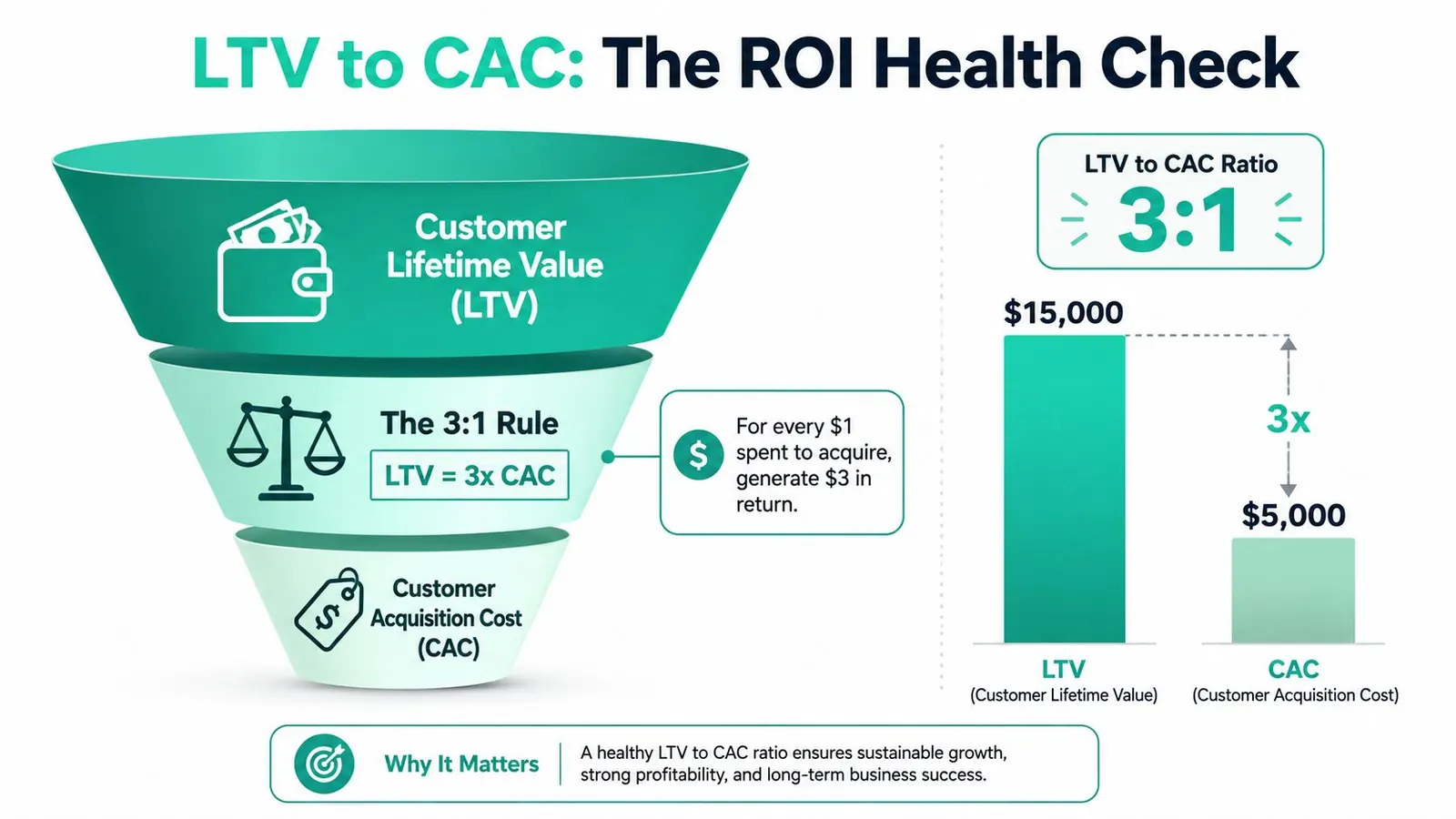
CAC tells you what acquisition costs. It doesn't tell you whether the cost is sensible until you compare it with customer lifetime value, or LTV. LTV represents the revenue or gross profit a typical patient or client contributes over the relationship, including repeat visits, additional services, and in some practices, referrals.
The widely used rule of thumb is a 3:1 LTV-to-CAC ratio, meaning the business aims to generate roughly three dollars of lifetime value for every dollar spent acquiring a customer. This benchmark appears in customer acquisition guidance and SaaS benchmark discussions, including customer acquisition cost benchmarks and LTV:CAC context.
What the ratio means in practice
A dental office might acquire a patient through paid search, receive revenue from the first appointment, and later earn additional value through treatment, hygiene visits, or referrals. A medspa may acquire someone for a consultation and generate value through a series of treatments. An eye doctor may serve a patient through exams, eyewear, or future visits. A law firm may have a longer path from consultation to retained matter and payment.
Those models shouldn't use identical CAC targets. A higher-ticket service may tolerate higher acquisition spending if the practice has clear evidence that the customer produces sufficient lifetime value. A lower-margin or one-time service needs tighter control because there are fewer opportunities to recover the initial cost.
Add payback period
The LTV:CAC ratio looks at total relationship economics. CAC payback period asks a more immediate question: how long does it take to recover the acquisition cost?
A simple version is:
CAC payback period = CAC ÷ monthly gross profit from the customer
Use gross profit rather than top-line revenue when possible. If a new patient costs $300 to acquire and contributes $100 in monthly gross profit, the payback period is three months. That example is arithmetic, not a benchmark. Your own margin, appointment pattern, cancellations, treatment mix, and payment timing determine the meaningful result.
Recent SaaS data shows why this pressure matters. One 2024 benchmark reported a median New CAC Ratio of 2.00, while top-quartile performers were at 1.00, meaning acquisition economics have tightened for many digital businesses. That figure shouldn't be copied into a local-practice target, but it reinforces the need to examine payback instead of celebrating lead volume alone.
Why Your Channel Mix Matters More Than Your Blended CAC
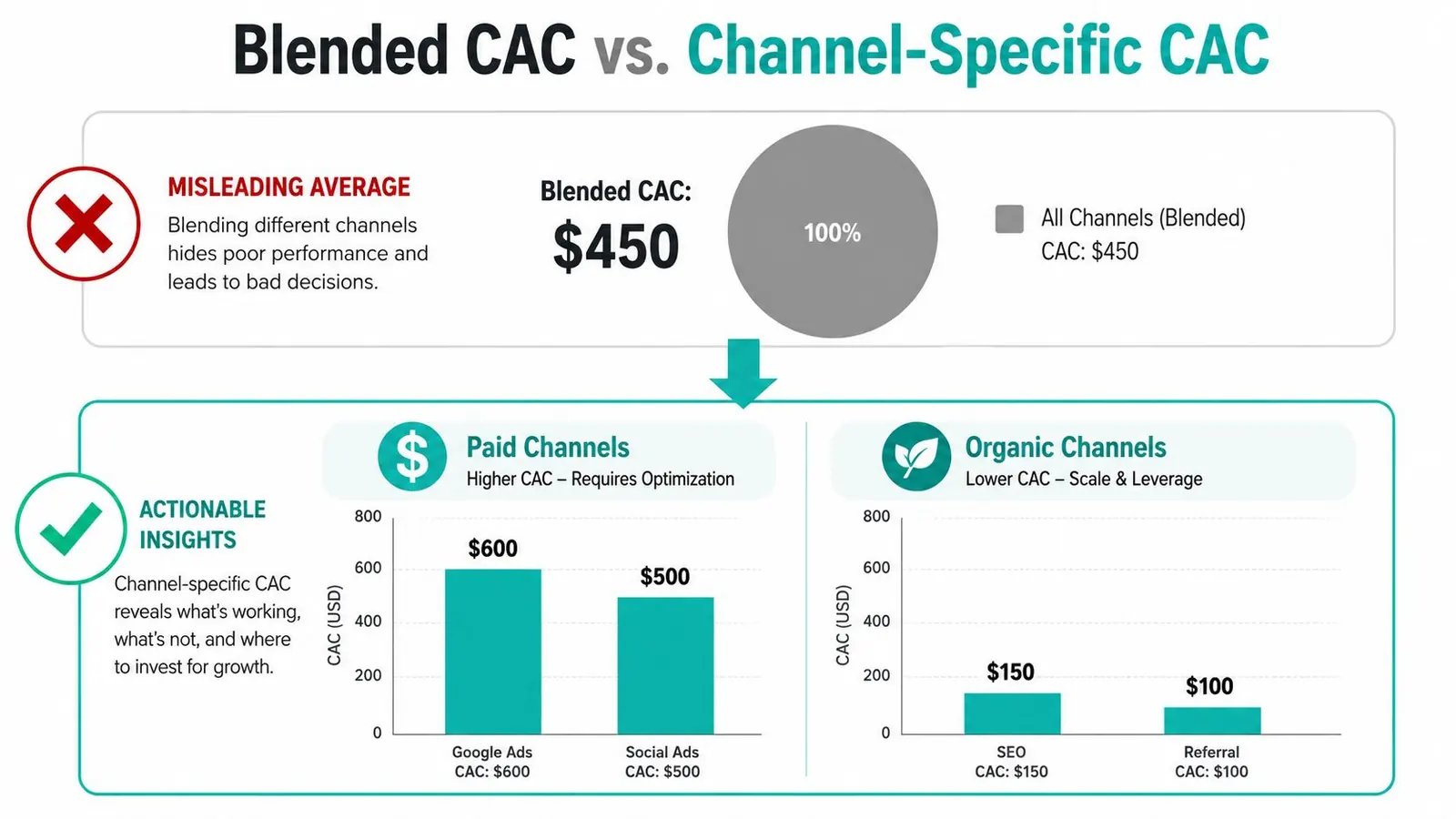
A blended CAC can hide the decision you need to make. If referrals and organic search bring in customers cheaply while paid media costs more, combining them may produce an average that looks manageable. You might then increase the wrong channel because the blended result doesn't show where the efficiency came from.
Recent benchmark reporting places paid CAC at 2.4x to 3.1x blended CAC across most categories, while organic-dominant brands are reported to have 41% lower median CAC and a 4.2 LTV-to-CAC ratio. These figures come from channel-mix CAC benchmark analysis. They point to a practical conclusion for local practices: channel composition can matter more than the headline average.
Read the mix, not just the mean
Suppose your practice reports one CAC for all new customers. That number combines Google Search, Meta, referrals, organic search, and staff follow-up. It doesn't tell you whether paid search is capturing high-intent demand, whether Meta is generating consultations, or whether your referral process is underfunded.
Break the report into at least these views:
- Paid search: Measure spend against booked and completed appointments, not clicks alone.
- Paid social: Track creative, audience, consultation rate, and eventual customer status.
- Organic search: Allocate relevant content, SEO, and local-search costs to new customers attributed to the channel.
- Referrals: Include incentives and program-management time, then compare the result with paid sources.
- Partnerships: Record event, sponsorship, or relationship costs alongside the customers generated.
Paid channels can still be valuable. They offer speed and control, especially when a practice needs to capture existing demand or fill a particular service line. For owners reviewing campaign structure, this Facebook Ads guide for customer acquisition offers additional context on using paid social deliberately.
The strategic question is not “What is our CAC?” It's “Which mix keeps CAC efficient as paid costs rise, and where should the next dollar go?”
Practical Ways to Bring Your CAC Down
Lowering CAC starts with a channel diagnosis. Don't cut every campaign because the blended number rose, and don't add budget to a source because it generated many leads. Give each channel a job, a measurement rule, and a realistic time horizon.
- Local search and SEO: Improve your Google Business Profile, service pages, location pages, and appointment pathways. Organic work can compound over time, but it needs accurate attribution and consistent maintenance.
- Referral systems: Make referrals easy to request and easy to track. A clear thank-you process can perform better than an informal “send us your friends” reminder because staff know when and how to ask.
- Review velocity: Request reviews after a positive visit or completed matter, following platform rules and professional requirements. Reviews strengthen trust before the lead contacts you, which can improve conversion without increasing media spend.
- Paid search: Separate high-intent services into focused campaigns, review search terms, remove poor-fit queries, and send each ad to a relevant landing page. Better alignment can improve the number of customers produced by the same spend.
- Paid social creative: Test different messages, visuals, offers, and calls to action. Track completed consultations or appointments, not just inexpensive clicks.
- Email and SMS: Use consent-based follow-up for leads who haven't booked and reminders for existing customers. Retention and reactivation can improve lifetime value, even though they shouldn't be mislabeled as new-customer acquisition.
- Partnership marketing: Build relationships with complementary local businesses, community groups, and professional networks. Assign each partnership a source label so you can see whether the time and event costs create meaningful customer value.
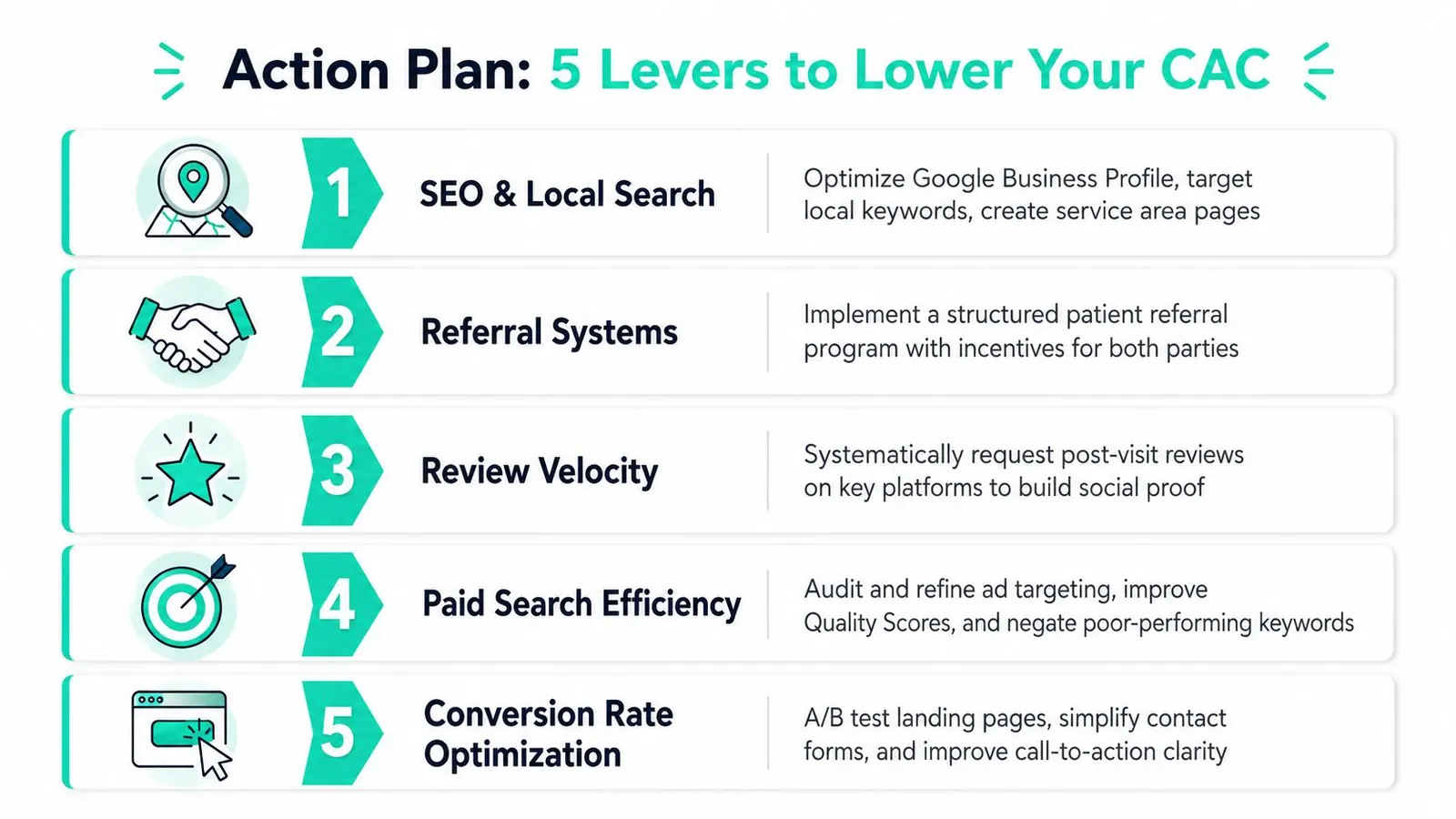
Use a 90-day sequence rather than changing everything at once. Protect channels that consistently produce valuable customers, fix channels that are close to working, and cut or redesign channels that underperform across two review cycles. If you need help connecting paid media, landing pages, and conversion tracking, Leaping Lemur Media's services include paid advertising and conversion-focused marketing support.
Your 90-Day CAC Review Plan
Treat the next 90 days as a measurement cycle, not a hunt for a perfect number. Your first baseline may be imperfect because attribution, staff time, and repeat customer records often need cleanup.
Days 1 through 30
Define the formula, period, and customer qualification rule. List every acquisition channel, decide which costs belong in direct and fully loaded CAC, and agree on what counts as a new patient or client.
Ask:
- Are we counting customers or only leads?
- Do spend and customer counts cover the same dates?
- Which costs are missing from the direct-spend view?
Days 31 through 60
Set a practice-specific benchmark by channel. Compare CAC with first-visit revenue, gross profit where available, and expected LTV. Don't judge a source solely by lead volume or by a single unusual month.
Days 61 through 90
Run focused experiments. Improve one landing page, refine one paid campaign, strengthen one referral process, or repair one source-tracking gap. Record the change, the expected outcome, and the review date before launching it.
Keep the conversation constructive. CAC should help your owner, clinical, front-desk, and marketing teams work from the same facts, not create blame when a channel needs improvement. For support with measurement and channel planning, you can contact Leaping Lemur Media.
Leaping Lemur Media helps practices connect paid advertising, audience insights, and conversion-rate optimization to the customer acquisition cost decisions that shape sustainable growth. Visit Leaping Lemur Media to discuss your channel mix and identify the clearest next step for your practice.