

The most popular advice in medical marketing is wrong: more promotion doesn't automatically produce more patients. A louder ad, a crowded social feed, or a larger media budget can increase visibility while weakening the confidence that makes someone choose a doctor.
Effective medical marketing for doctors works differently. It makes the practice easier to find, easier to understand, and safer to trust. That requires clear positioning, useful education, credible reviews, measurable acquisition, and strict control over patient data. The practices that grow sustainably don't look like sales operations. They look like dependable healthcare resources.
Table of Contents
- Why More Promotion Does Not Mean More Patients
- Defining Your Ideal Patient and Brand Position
- Local SEO and Reputation Signals That Drive Bookings
- Compliant Messaging in an AI and Pixel Tracking World
- Comparing Paid and Organic Patient Acquisition Channels
- Measuring What Matters and When to Hire an Agency
Why More Promotion Does Not Mean More Patients
Doctors have good reason to be cautious about self-promotion. The original American Medical Association Code of Ethics, adopted in 1847, described advertising as “highly reprehensible.” The AMA began relaxing its ban in 1977, after a 1975 Federal Trade Commission case pushed the profession toward permitting advertising. In October 1979, the FTC ruled that the AMA couldn't bar doctors from advertising their services. This history of medical advertising regulation marks the transition from professional promotion being treated as unethical to marketing becoming a legitimate part of practice growth.
Other markets followed their own paths. Germany's Medical Advertising Law took effect in July 1965, while the UK's General Medical Council relaxed its advertising policy in 1990. The modern lesson isn't that doctors should promote themselves without restraint. It's that factual, profession-related information can be legitimate while exaggerated or commercially aggressive messaging remains dangerous.
Patients now discover doctors before they ever enter an office. One healthcare marketing dataset found that 77% of patients consulted the internet before scheduling a medical appointment, while 66% of internet users searched for information about diseases or health issues. The same dataset reported that 47% searched for doctors or healthcare professionals through search engines and social networks, and 56% of searches related to medications or surgeries. These healthcare search behavior figures explain why search visibility, educational content, and reputation now matter more than broad broadcast promotion.
The trust problem appears inside the clinical environment, too. Recent evidence found that seeing a company logo in a doctor's office, meeting a sales representative, and experiencing longer waits associated with sales activity were each linked with lower trust in physicians. Free samples slightly increased trust in physicians, but not in companies. The PLOS ONE research on commercial cues and physician trust supports a point many marketing playbooks miss: promotion can become a liability when patients interpret it as commercial motivation inside care.
Market the judgment, not the transaction
Your website shouldn't sound like a retail storefront. It should answer the questions a worried patient asks before booking:
- Who is this doctor for? State the conditions, procedures, age groups, or patient concerns you routinely address.
- What happens next? Explain the consultation, preparation, scheduling process, and follow-up in plain language.
- Why should I feel safe here? Show the team, care philosophy, accessibility, communication standards, and relevant credentials.
- What can I verify? Keep services, locations, insurance information, and patient-facing policies accurate.
Avoid guarantees, manufactured urgency, and vague superlatives. “Book today before spots disappear” may fit a retail campaign, but it can make a medical practice feel transactional. A better message gives patients useful context and a clear next step without pressuring them.
Practical rule: If a marketing claim would make you uncomfortable repeating it to a patient in the examination room, remove it from the campaign.
The strongest practices act as community resources. They publish explanations, clarify treatment options, answer recurring questions, and make access less confusing. That approach still supports bookings, but it earns the booking through confidence rather than pressure.
Defining Your Ideal Patient and Brand Position
Before you spend on Google Ads, social advertising, or content production, decide which patient you're trying to help and how you want that patient to describe your practice. “Everyone in the area” isn't a useful audience. It produces generic messaging, weak landing pages, and campaigns that attract inquiries without a clear fit.
Start with a patient profile built around real decision factors. A pediatric practice may serve parents who need reliable communication, convenient scheduling, and a calm environment for children. An ophthalmology practice may attract adults comparing surgical options, insurance questions, recovery expectations, and physician experience. A cosmetic surgery practice may need to speak to candidates who want discretion, realistic outcomes, and a consultation that feels informative rather than pressured.
Build the profile around decisions
Write down the practical and emotional questions behind the appointment:
- Trigger: What causes the patient to begin searching now?
- Concern: What could stop the patient from calling?
- Selection criteria: What makes one doctor feel more credible than another?
- Access requirement: What information must be clear before booking?
- Trust signal: What evidence can the practice provide without making an exaggerated promise?
Keep the language close to the patient's actual problem. “Treatment options for persistent knee pain” is more useful than “advanced orthopedic excellence.” “What to expect during a child's first eye exam” is more reassuring than “pediatric vision care.”
Your positioning statement should connect the patient, the service, and the experience. A solo physician might use this internal formula: We help [specific patient group] address [specific need] through [distinctive care approach], with [credible experience or access benefit]. A multi-location group can adapt it by location, service line, and audience while keeping the underlying promise consistent.
Do not confuse differentiation with spectacle. A practice can stand apart through responsiveness, coordinated care, language access, transparent education, or a focused specialty. Those qualities are more durable than decorative claims such as “world-class” or “premier.”
Turn positioning into every patient touchpoint
Your profile should guide the entire experience, not just the homepage. Use it to shape:
- Service pages: Explain the patient problem, the available care, and what the first appointment involves.
- Ad copy: Match the searcher's intent instead of sending every audience to a generic practice message.
- Social content: Share practical education tied to your specialty and community.
- Intake language: Make the transition from marketing to scheduling feel consistent and respectful.
- Review responses: Reinforce professionalism without discussing private clinical details.
Keyword research can sharpen this work, especially when your team needs to understand how patients describe symptoms, procedures, and local services. A healthcare keyword research tool can help organize search language before you build pages or campaigns.
Audit the practice from the patient's perspective. Ask a colleague who isn't involved in marketing to search for your services, read the first page, and attempt to schedule. Note every point where the person must guess. Your brand is defined as much by those moments of uncertainty as by your logo or color palette.
For a broader perspective on how a marketing partner approaches positioning and practice identity, review Leaping Lemur Media's approach. The useful question isn't whether the language sounds polished. It's whether the message accurately reflects the care patients receive.
Local SEO and Reputation Signals That Drive Bookings
Patients compare doctors online before they call. Local search therefore isn't a technical side project. It's the public layer of your practice, where a patient evaluates location, services, availability, photographs, reviews, and basic credibility in a short session.
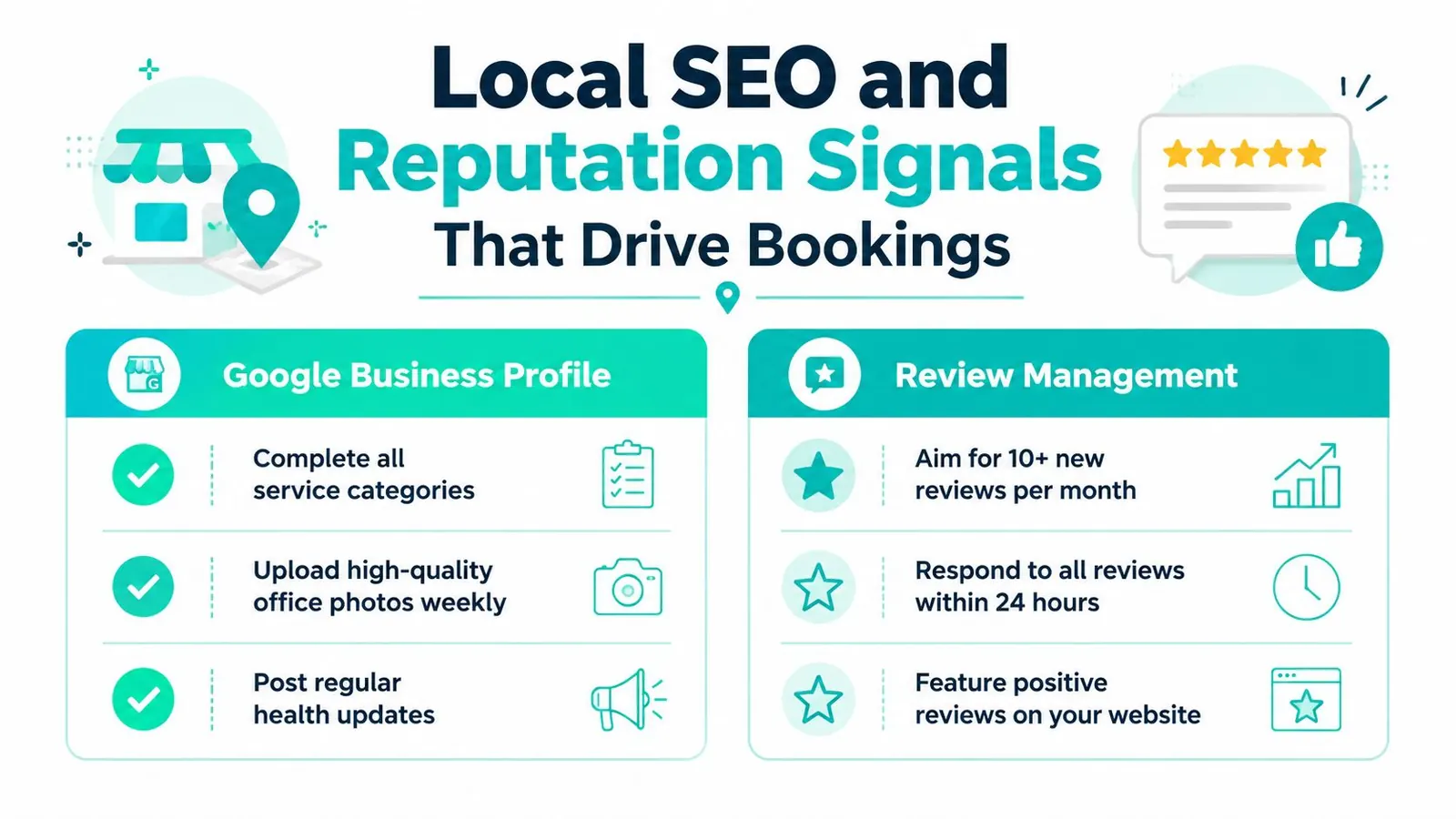
Your Google Business Profile deserves operational ownership. Confirm the practice name, address, phone number, hours, appointment URL, service categories, and locations. Add current photographs that show the exterior, reception area, clinical environment, and team. Keep the profile aligned with the website, because conflicting information creates unnecessary doubt.
Reviews carry unusual weight because they provide social evidence at the moment of comparison. One healthcare survey found that 73.28% of patients considered online reviews when choosing a provider, and 91.27% of those patients placed moderate or higher trust in reviews. The patient review survey from RepuGen shows why reputation management belongs beside search optimization, not after it.
Treat reviews as a system, not a campaign
A practice should make feedback easy to provide without manipulating what patients say. Ask for an honest review after an appropriate interaction, provide a direct platform link, and ensure the request doesn't depend on a positive rating. Train staff to protect privacy in every response.
A separate U.S.-focused healthcare survey reported that 80% of respondents expected five or more reviews before considering a provider trustworthy, while 72% would choose a doctor only when the provider had reviews of 4 stars or higher. The survey findings reported by GlobeNewswire turn reputation into a practical threshold problem. A practice with excellent care but sparse reviews may lose comparisons before a patient understands its strengths.
Use this audit:
- Profile accuracy: Check every location, service, phone number, and appointment path.
- Category fit: Select categories that reflect actual care, not every possible service.
- Visual credibility: Replace outdated photographs and remove images that no longer represent the office.
- Review coverage: Compare your volume, rating, recency, and response quality with nearby competitors.
- Response discipline: Reply professionally without confirming that a reviewer received treatment.
- Conversion path: Test the booking button and phone route from a mobile device.
A response should acknowledge the experience without revealing anything about the patient. “Thank you for sharing your feedback. Our team takes concerns about communication seriously. Please contact the office directly so we can listen and help,” is safer than discussing appointment details publicly.
Reviews don't replace clinical quality. They help prospective patients decide whether they have enough confidence to discover it.
Reputation management software can support monitoring and response workflows, but automation shouldn't produce robotic replies or pressure patients into favorable feedback. Practices evaluating these workflows may find RecensioAI B.V.’s healthcare reputation management useful as a reference point for organizing review activity.
Local SEO also extends beyond the profile. Build clear location pages, maintain consistent listings, and publish useful specialty content. Don't create thin pages that repeat a city name without adding patient value. For ongoing marketing observations and practical resources, the Leaping Lemur Media journal offers another place to evaluate how search and reputation fit into a broader growth plan.
Compliant Messaging in an AI and Pixel Tracking World
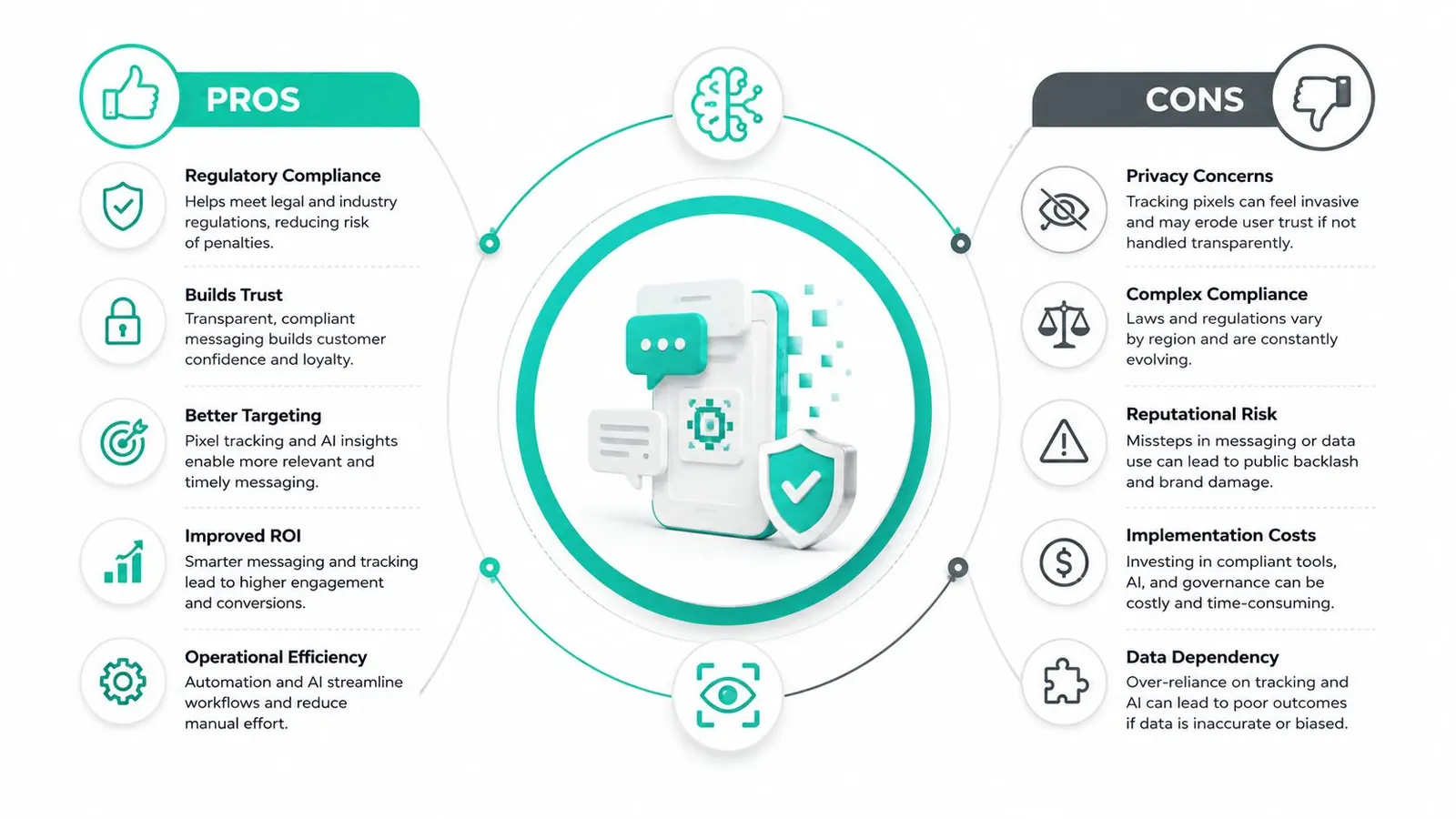
The most serious compliance risk may not appear in the ad copy. It may sit in the invisible data flow behind the website. A tracking pixel on a form, portal, appointment page, or condition-specific page can potentially transmit information to an advertising platform in ways the practice didn't intend.
HHS states that HIPAA requires authorization for marketing communications involving protected health information, except for narrow exceptions. The HHS HIPAA marketing guidance should be treated as an operational reference, not a box to check once and forget.
Audit the full path from visit to follow-up
Create an inventory of every tool that touches the website or patient journey:
- Analytics: Identify what URLs, events, search terms, form fields, and identifiers enter analytics systems.
- Advertising pixels: Review Google Ads, Meta Ads, remarketing, and other scripts on forms, portals, and condition pages.
- Scheduling platforms: Confirm what information passes between the website, scheduler, CRM, and staff inbox.
- AI tools: Check whether an AI assistant receives names, symptoms, appointment details, messages, or other protected information.
- Review workflows: Ensure review requests don't disclose treatment, diagnosis, or the patient relationship.
- Access controls: Record who can view lead data and how long the practice retains it.
A compliant measurement plan can still track business outcomes. Count appointment bookings, form submissions, calls, and source channels without sending unnecessary clinical details to advertising systems. Keep personalization broad and service-oriented. “Request an appointment with our dermatology team” is different from targeting a person based on a condition inferred from a form submission.
Retargeting deserves particular scrutiny. A visitor who reads a page about a sensitive condition may not expect that behavior to shape ads across the internet. Before enabling remarketing, ask what the platform receives, whether the data could identify a health interest, and whether the practice has the authorization and agreements required for the activity.
Make quarterly review part of governance
Run the audit with your compliance lead, web developer, agency, and scheduling vendor. Don't assume a vendor's default settings are appropriate for a medical practice. A new form integration, analytics update, or AI feature can change the data path without changing the visible website.
The NMC's 2026 guidance for doctors explicitly treats digital advertising as part of Section 6 compliance, including Google Ads, Meta Ads, Instagram, YouTube, WhatsApp marketing, programmatic display, and influencer marketing. It also says paid testimonials are prohibited, while unpaid testimonials must be authentic and voluntary, and testimonials can't be solicited as a condition of treatment. The NMC guidance for doctors illustrates the direction of modern professional oversight: digital channels don't sit outside ethical duties.
Use a simple rule for AI-assisted nurturing. Let automation handle administrative routing and general information, but keep clinical interpretation, sensitive responses, and patient-specific advice under qualified human control. Marketing can create access. It must never blur into unreviewed medical judgment.
For patient-facing transparency, keep your privacy policy current and consistent with actual data practices. A policy can't make an unsafe workflow compliant, but an outdated policy makes the practice harder to trust and harder to govern.
Comparing Paid and Organic Patient Acquisition Channels
Paid and organic channels solve different problems. Paid search can capture urgent intent quickly, while SEO and educational content build discoverability over time. Social advertising can introduce a service, but it often needs a stronger trust path before a patient books. Choose by specialty, service line, urgency, and downstream revenue, not by whichever channel is fashionable.
The benchmark data below shows why a blended healthcare average is a poor planning tool. Patient acquisition cost ranges from about $155 in pediatrics to $610 in cosmetic and plastic surgery, according to healthcare patient acquisition data from The Relay Co.. The same source reports specialty-level CPC and click-to-appointment ranges.
| Specialty | CPC Range | Click-to-Appointment Conversion | Patient Acquisition Cost |
|---|---|---|---|
| Pediatrics | Not specified in the benchmark | Not specified in the benchmark | About $155 |
| Cosmetic and plastic surgery | Not specified in the benchmark | Not specified in the benchmark | $610 |
| Urgent care | Roughly $4 to $9 | 12% to 20% | Not specified in the benchmark |
| Dermatology | $6 to $14 | 6% to 12% | Not specified in the benchmark |
| Orthopedic surgery | $8 to $18 | 5% to 10% | Not specified in the benchmark |
A high-intent service may justify paid search because the patient is already looking for an appointment. A complex elective service may need educational pages, physician videos, consultation preparation, and review depth before an ad produces a qualified conversation. Organic content can support both, but it requires accurate authorship, careful clinical review, and a publishing process your team can sustain.
Allocate by economics and intent
Use paid campaigns when the service has clear demand, a defined booking action, and enough downstream value to support acquisition costs. Use organic investment when patients need education, comparison, or reassurance before they act. Use social content to show the people and values behind the practice, not to recycle claims across every platform.
Track the full funnel. One benchmark reports average website conversion at 3.6%, PPC landing page conversion at 6.1%, and call-only ad conversion at 12.5%. A more granular medical-practice benchmark reports average website conversion at 3.36%, with top performers at 5.31%. The medical practice benchmark analysis from CUFinder also gives an example where only 1 in 5 qualified leads books, producing an effective conversion of 0.672%.
That difference is why a lead isn't the outcome. Calculate CAC by channel, compare it with first-year revenue and lifetime value, and separate inquiries from booked consultations and completed procedures. For a practical framework on intake and campaign structure, review these healthcare lead generation strategies, then adapt the approach to your compliance requirements and specialty economics.
Measuring What Matters and When to Hire an Agency
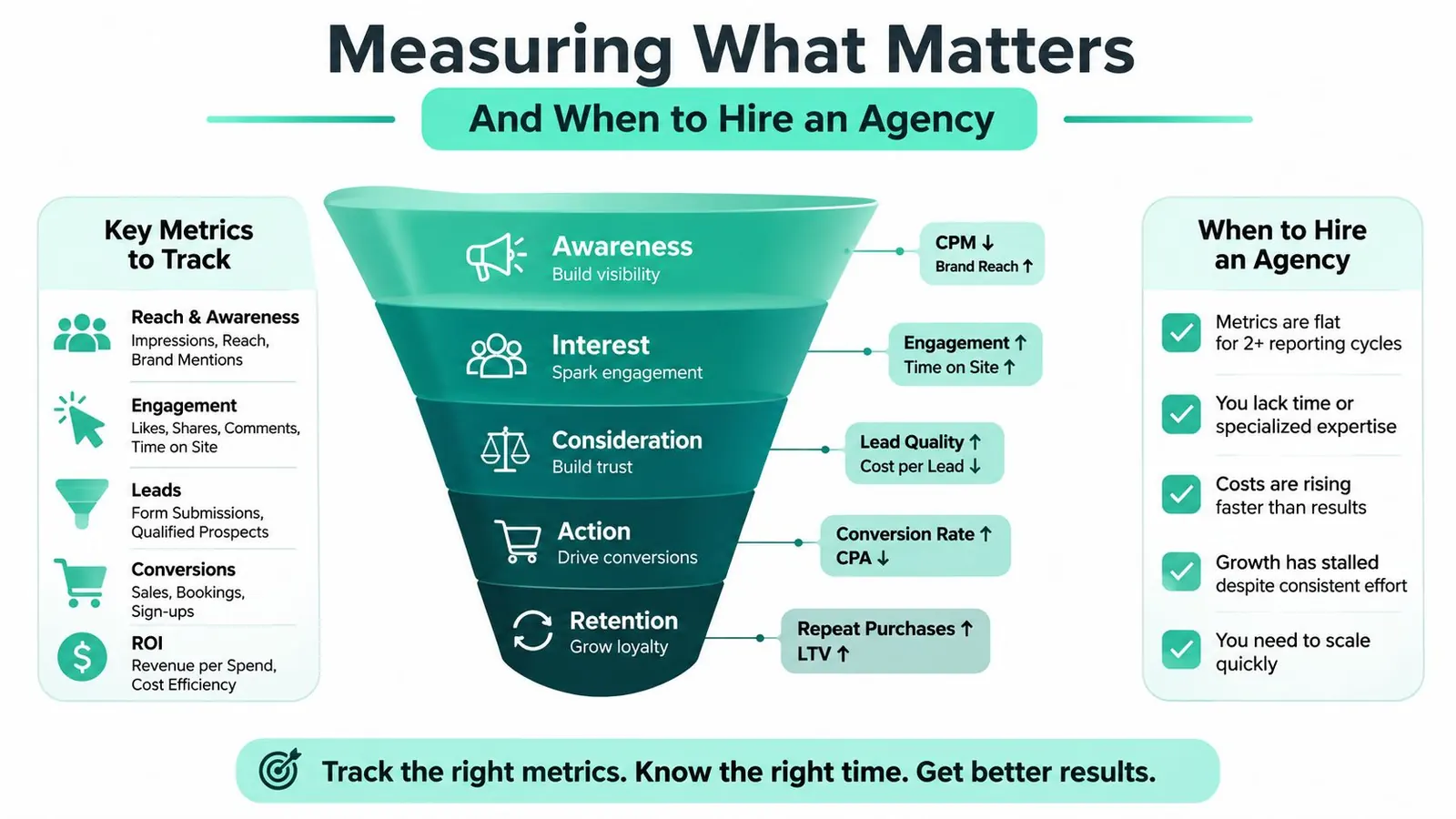
A dashboard full of impressions can still hide an underperforming practice. The useful metrics connect source, cost, booking, attendance, treatment, and revenue.
Track the new patient source on every inquiry. Use channel-specific call tracking, online scheduling attribution, and a quarterly patient acquisition cost review by channel. The medical-practice benchmark guidance recommends this full-chain measurement because incomplete attribution and slow intake can undermine campaigns before scheduling occurs. The benchmark guidance on measuring medical acquisition provides the operational foundation.
Build a decision dashboard
Include:
- Lead source: Where the patient first found the practice.
- Qualified lead rate: Which channels produce an appropriate clinical and geographic fit.
- Booked consultation rate: How many qualified inquiries become scheduled appointments.
- Completed appointment rate: Whether the patient reaches care.
- Service-line CAC: What each channel costs for each new patient or booked consultation.
- Downstream value: Whether the acquired patient generates appropriate first-year revenue and longer-term value.
Hire help when staff can't maintain tracking, campaigns run without reliable attribution, landing pages remain generic, or no one has time to review compliance before changes go live. Keep work internal when the practice has a capable owner, limited service lines, and enough time to publish, respond, and measure consistently.
Use the first 90 days as a controlled implementation period, not a promise of instant scale. Establish tracking and compliance controls first, clarify positioning next, then improve the local profile, review process, landing pages, and campaign allocation. At the end, keep the channels that produce booked and completed care at acceptable economics, and stop funding activity that only looks busy.
Leaping Lemur Media offers healthcare and wellness practices ads management focused on bookings, consultations, and revenue, along with SEO, local search, and answer engine optimization for stronger visibility. Visit Leaping Lemur Media to discuss a growth plan that builds patient trust while keeping measurement and compliance in view.