
“Dentist” was estimated at 7,480,000 global monthly searches in one 2026 dataset, while “dentist near me” reached 2,740,000. Yet those numbers don't mean a dental practice should publish a page targeting the broadest phrase it can find. They show why keyword research for dentists is an intent-filtering exercise. The opportunity isn't just attracting more searchers. It's identifying which searchers need your service, in your area, at the moment they're ready to contact you.
A strong local SEO strategy connects patient language to the right page, location, treatment, urgency, and emotional context. It also accounts for searches that competitors overlook, including symptom-based phrases, age-specific needs, seasonal concerns, and pages already close to page-one visibility.
Table of Contents
- Why Dental Keyword Research Is an Intent Game
- Building Your Seed List from Patient Language
- Layering Local Modifiers and Geographic Context
- Mapping Keywords to the Patient Journey
- Finding Wins in Lower-Difficulty Keyword Clusters
- Adjusting for Seasonal and Emotional Search Patterns
- Prioritizing Keywords and Tracking What Matters
Why Dental Keyword Research Is an Intent Game
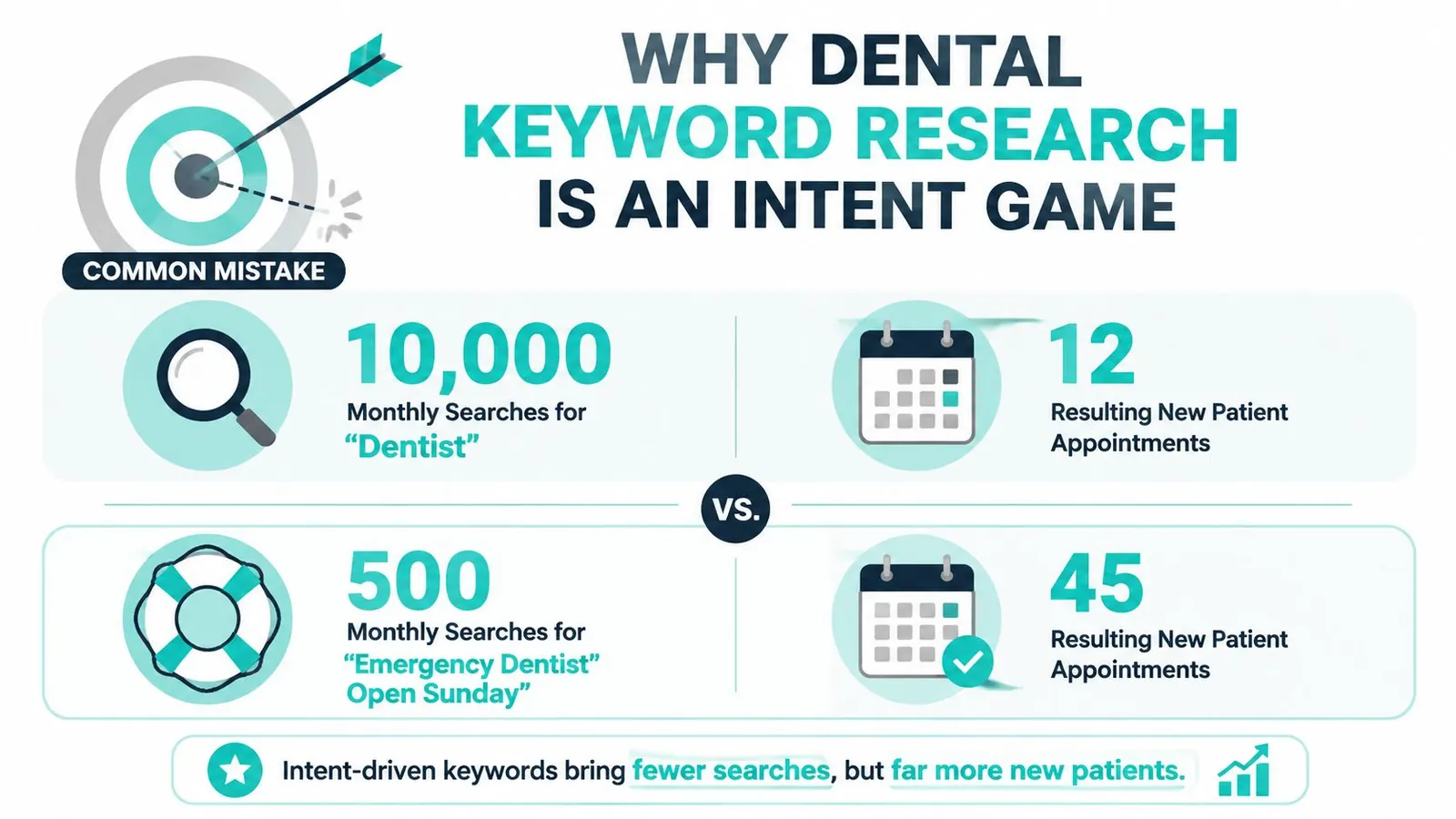
A broad term such as “dentist” can represent almost anything. One person may be researching what dentists do, another may be looking for a practice's phone number, and someone else may be comparing providers. By contrast, “dentist near me” carries a much clearer local and transactional signal. The searcher may be ready to compare nearby offices, check availability, or request an appointment.
A separate 2026 dataset listed “dentist” at 550,000 monthly searches and “dentist near me” at 450,000 monthly searches, reinforcing the same conclusion: a relatively small group of core dental terms carries substantial demand, but the terms don't all represent the same business value. The dental SEO keyword data provides useful context for evaluating that difference.
Volume tells you scale, not suitability
High-volume keywords can help a practice understand the size of a market, but they rarely tell you which page to build or which patient will call. A treatment-plus-location phrase, such as “dental implants in [city],” usually gives a service page a clearer job than the isolated term “implants.” A symptom query may deserve an educational article, while an urgency phrase needs a direct conversion page with clear contact details.
Google's local ecosystem has also changed the practical meaning of dental search. By 2026, one industry source reported 823,000 monthly U.S. searches for “dentist near me” and connected that demand with visibility in the Google Maps Local 3-Pack and leading organic results. The same source reported that more than 70% of dental-related queries are long-tail keywords, including combinations of treatment, symptoms, urgency, and location. This overview of searched dental SEO keywords illustrates why a practice shouldn't build its entire plan around head terms.
Practical rule: A keyword earns priority when its intent matches both your service and the action you want the patient to take.
For a deeper framework on connecting related concepts rather than collecting disconnected phrases, use this guide to how to do semantic keyword research from SemDash. The useful takeaway is simple. Build around patient needs and page purpose, not a list of impressive-looking volumes.
Building Your Seed List from Patient Language
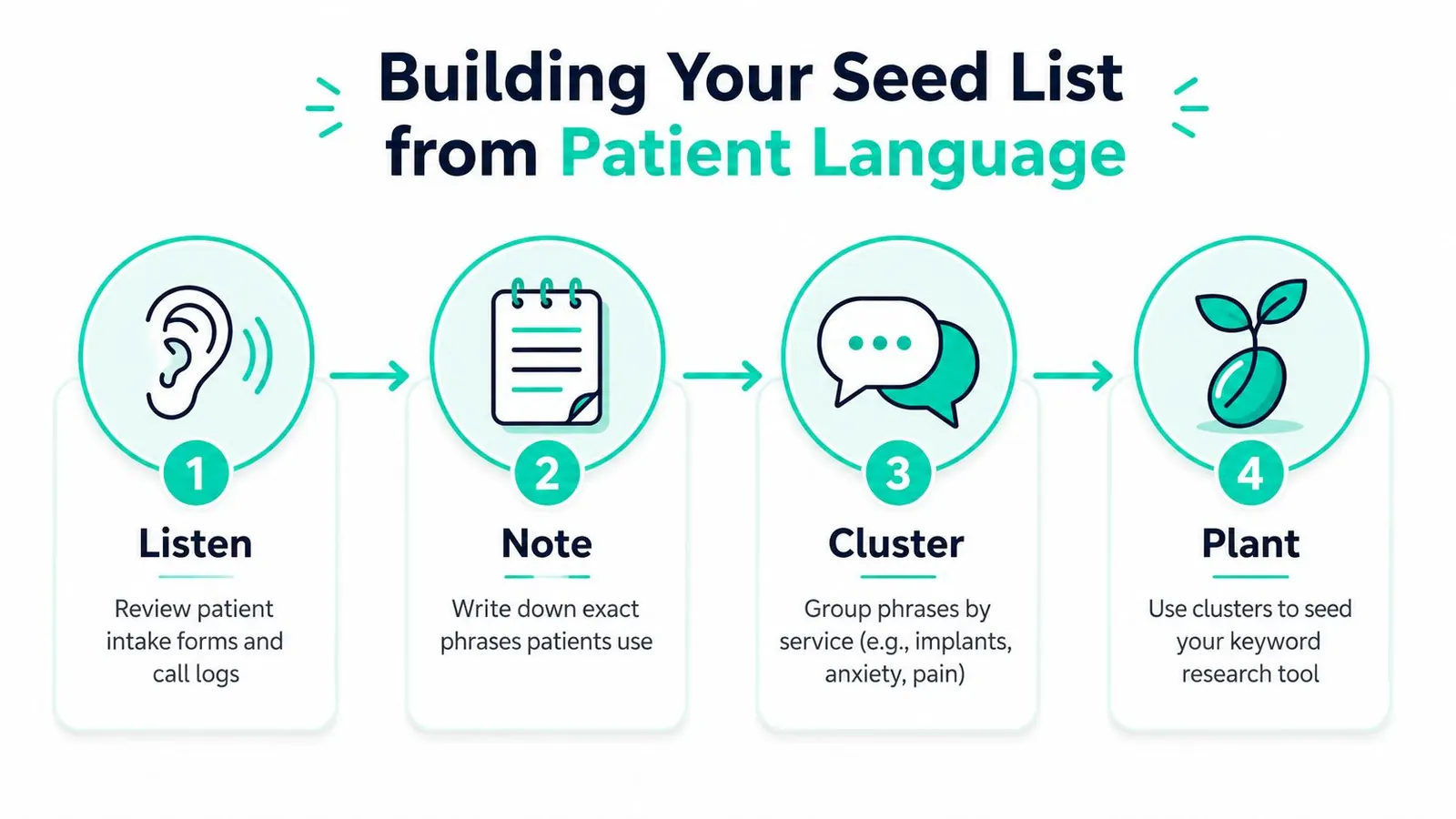
The best seed list usually starts outside the keyword tool. It starts at the front desk, in intake forms, appointment notes, voicemail transcripts, and conversations about what patients are worried about. Patients may say “my tooth broke,” “my gums keep bleeding,” or “I need a dentist who won't judge me.” Those phrases often reveal more about search intent than a clinical service label.
Listen before you expand
Begin with a short list of services and problems your practice handles. Include general dentistry, emergency care, implants, pediatric services, cosmetic treatments, periodontal concerns, anxiety, insurance questions, and appointment availability where relevant. Then add the wording patients use to describe each topic.
A practical workflow can produce about 20 target keywords in one week, divided roughly between location-based and treatment-based phrases, based on UK-focused dental keyword guidance from Remedo's dentist keyword research process. Treat that as a manageable starting benchmark, not a quota that matters more than relevance.
Use the following sources to expand the raw list:
- Autocomplete: Type a service, symptom, or concern into Google and record suggestions that reflect natural phrasing.
- People Also Ask: Capture questions patients ask before choosing a provider, such as whether a treatment hurts or how quickly an emergency visit can happen.
- Related searches: Look for variations Google associates with the original query.
- Google Search Console: Review queries already generating impressions for your pages, especially phrases that use everyday language rather than professional terminology.
- Front-desk feedback: Ask staff to record recurring wording instead of translating every concern into clinical language.
Cluster the phrases by patient need
Group phrases around themes such as pain, implants, anxiety, children, preventive care, and urgent visits. A condition-focused approach can uncover opportunities beyond procedure names. A peer-reviewed Google Trends study identified search clusters related to dental decay, periodontal diseases, oral cancer, and oral lesions of HIV, showing that patients also search around oral-health problems themselves. The oral-health search study supports building content around the terms patients use to describe conditions.
Keep the raw wording visible in your spreadsheet. A page can include accurate clinical language while still using the phrases patients recognize in titles, headings, FAQs, and explanations. For ongoing content and audience research, the Leaping Lemur Media journal offers another place to explore practical marketing ideas.
Layering Local Modifiers and Geographic Context
A dental practice serves a defined community, so local context should shape the keyword set from the beginning. Start with the city where the office is located, then add nearby neighborhoods, suburbs, districts, landmarks, and communities within a realistic service area. Patient language often changes by location, especially for urgent care, family dentistry, and searches tied to a familiar landmark.
The phrase “near me” needs careful handling. Repeating it across a page will not make Google show a practice for every nearby search. Local visibility also depends on proximity and business information, while patients may search with a city, neighborhood, landmark, or availability phrase such as “open Saturday.” Build natural variations including “family dentist in [city],” “[treatment] near [neighborhood],” and “emergency dentist near me.” Then assign each variation to a page that genuinely answers that need.
Make keyword tools reflect your market
Broad keyword data can misrepresent the opportunity for a local office. Set Google Keyword Planner and similar tools to the specific city served or a 15-mile radius, following the local dental SEO guidance in MilkCan Marketing's dental keyword research resource. National estimates may look impressive but reveal little about demand from patients who can reasonably travel to the practice.
Build a local modifier matrix:
| Core topic | City variation | Neighborhood variation | Intent |
|---|---|---|---|
| Emergency dentist | Emergency dentist in [city] | Emergency dentist near [neighborhood] | Immediate care |
| Dental implants | Dental implants in [city] | Dental implants near [neighborhood] | Treatment comparison |
| Pediatric dentist | Pediatric dentist in [city] | Dentist for toddlers near me | Family service |
| Dental cleaning | Dental cleaning in [city] | Dentist near me for cleaning | Routine booking |
Use the wording naturally. A location page should include distinct information about the area and the practice's relationship with local patients. Publishing near-identical pages for every neighborhood creates thin content and gives patients little reason to choose one page over another. A stronger opportunity is often a near-miss page that already receives impressions for a local variation but does not address that wording clearly.
Connect local phrases to your profile
Your Google Business Profile should accurately show the practice name, address, categories, services, hours, appointment options, and service area. One dental local SEO summary reported that GBP signals account for 32% of Local Pack ranking weight, so profile completeness and local relevance deserve attention. The dental local SEO statistics summary provides that benchmark.
Use keyword findings to guide service descriptions, location pages, patient-facing FAQs, and profile content. Keep the language readable rather than filling the profile with repeated phrases. For practical guidance on website and local search presentation, Leaping Lemur Media covers considerations relevant to practices serving nearby patients.
Mapping Keywords to the Patient Journey
A keyword list without a page assignment is just a spreadsheet. Every phrase needs a destination and a purpose. If the page can't satisfy the intent behind the search, ranking for the term won't create a useful patient experience.
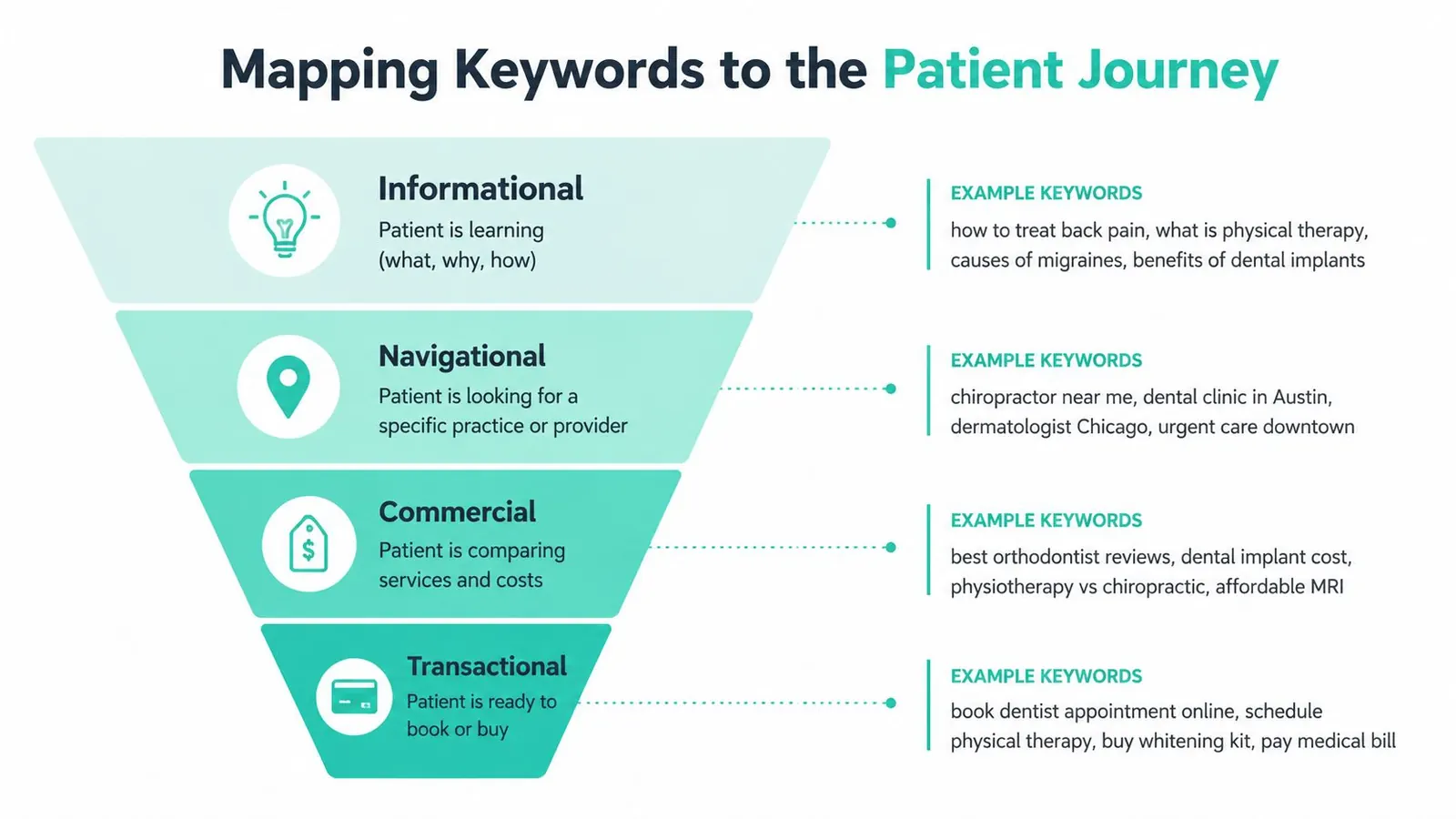
Match the query to the decision stage
Informational searches usually express learning. Queries about bleeding gums, tooth sensitivity, dental decay, or what happens during a root canal can belong on educational articles or detailed FAQs. These pages should explain the issue clearly, identify when professional care matters, and guide the reader toward a relevant service without pretending that online information replaces an examination.
Navigational searches point toward a known practice or provider. The homepage, contact page, Google Business Profile, and location page need accurate identity information, consistent contact details, and an obvious route to booking.
Commercial searches indicate comparison. Patients may be evaluating implants, cosmetic dentistry, pediatric care, sedation options, payment information, or providers in a particular city. These phrases generally map to service pages that explain candidacy, process, benefits, limitations, and next steps.
Transactional searches show immediate action. “Emergency dentist,” “dentist open Sunday,” and “same-day dental appointment” need dedicated pages with prominent phone access, hours, address, appointment instructions, and honest availability information.
Build clusters instead of thin pages
A cluster groups closely related phrases around one authoritative page. An implant page might address dental implants in the city, implant consultations, missing teeth, candidacy, recovery, and common cost questions. A separate FAQ or supporting article can answer narrower questions when those questions deserve more depth.
This approach prevents a common failure pattern: creating a page for every minor variation while giving none of them enough useful information. Map one primary intent to each page, then use related language naturally in headings, body copy, internal links, and FAQs. The result is a site architecture that follows the patient journey instead of a pile of pages written for algorithms.
Finding Wins in Lower-Difficulty Keyword Clusters
The terms every competitor targets are often the least practical starting point. “Dentist near me,” “dental implants,” and “cosmetic dentist” may have strong demand, but they also attract chains, directories, established practices, and pages with significant local authority. A small or mid-sized practice can waste months trying to defeat those pages before addressing more specific opportunities.
Lower-difficulty phrases can produce a better strategic fit when they describe a real service gap. Recent dental SEO guidance highlights niche modifiers such as “geriatric dentist near me,” “dentist for toddlers near me,” and “walk-in emergency dentist near me.” These searches narrow the audience, but that narrowing can make the page more useful and the patient more qualified.
Look for the patient groups competitors skip
Review your services and ask which groups need specialized reassurance:
- Older adults: Search themes may involve mobility, dentures, implants, or a geriatric-focused provider.
- Parents of young children: Phrases around toddlers, first visits, fear, and family scheduling can reveal distinct needs.
- Urgent-care patients: Walk-in, weekend, evening, and same-day wording can signal a patient who needs immediate clarity.
- Anxious patients: Language about pain, judgment, sedation, and nervousness can support a dedicated experience page or FAQ cluster.
- Condition-focused patients: Queries about gum bleeding, tooth decay, lesions, or sensitivity may begin with symptoms rather than a procedure.
Don't create a page for a niche phrase unless the practice can serve that audience. A highly specific page with no relevant service, proof, or operational support creates disappointment rather than qualified demand.
Mine near-miss pages in Search Console
Google Search Console is particularly valuable for pages ranking below the first page. Filter queries and pages to identify terms where an existing URL appears in positions 11 through 30. These near-miss pages already have some relevance, so improving them can be more efficient than starting from an empty document.
Look for mismatches such as:
- The page ranks for a treatment phrase but doesn't mention the location naturally.
- The title promises general dentistry while the query indicates emergency care.
- The page answers a symptom question but lacks a clear next step.
- A service page receives impressions for a related treatment that deserves a stronger section or internal link.
- The content uses clinical terminology while Search Console reveals patient wording.
Refresh the page around the actual query, improve the answer, clarify the service area, and strengthen the call to action. Don't just add the keyword repeatedly. Google can see relevance through the surrounding concepts, and patients can tell when copy was written for a ranking report rather than for them.
Adjusting for Seasonal and Emotional Search Patterns
Dental demand changes with circumstances. A keyword plan built once and left untouched will miss moments when patients become more motivated to act. Search trend coverage has identified examples including “free dental check up” peaking in January, emergency dental care surging in March, and growing interest in emotionally charged terms such as “dental dreams.” This coverage of dental search trends shows why timing and wording deserve a place in the strategy.
January content can address preventive visits, annual planning, and questions about what a checkup includes. Before school routines resume, a family practice might prioritize children's appointments, exams, cleanings, and scheduling convenience. During periods when emergency interest rises, the practice needs a page that answers the immediate questions: whether same-day care is available, what counts as urgent, how to contact the office, and what to do outside regular hours.
Patients don't always search for the treatment name. They search from the situation they're experiencing.
Emotional language needs the same care. “Dentist for nervous patients,” “does a root canal hurt,” and “gentle dentist near me” express fear as much as service intent. A page that acknowledges anxiety, explains the visit, describes communication options, and gives patients control can perform a more useful role than a generic treatment page filled with clinical terminology.
Life-stage clusters deserve their own review. Toddlers, older adults, parents preparing for school, and patients dealing with sudden pain may use different vocabulary and need different reassurance. Use Google Trends, autocomplete, related searches, and Search Console impressions to identify wording shifts, then publish or update pages before the seasonal moment rather than after it has passed.
Frequently Asked Questions
How do you do dental keyword research?
Start with patient language from front-desk notes, intake forms, and voicemails, then expand with autocomplete, People Also Ask, related searches, and Google Search Console data. Cluster phrases by patient need, layer in local modifiers like city and neighborhood names, and map each keyword to a page that matches its intent, whether informational, navigational, commercial, or transactional.
What are the best dental keywords to target?
The best keywords match a clear intent and service rather than just high search volume. Treatment-plus-location phrases, symptom queries, urgency terms, and niche modifiers like 'geriatric dentist near me' or 'walk-in emergency dentist near me' often convert better than broad terms like 'dentist' because they attract less competition and more qualified patients.
What are primary keywords for general dentistry?
Primary keywords for general dentistry typically combine a core service with a location, such as 'family dentist in [city]' or 'dental cleaning in [city].' These pair well with symptom-based and condition-focused phrases, like bleeding gums or tooth sensitivity, which patients often search before they know the clinical name for a treatment.
Where can I find a dental keywords list?
Build your own list from autocomplete suggestions, People Also Ask questions, Google Search Console query reports, and front-desk feedback rather than relying on a generic list. This approach surfaces the exact wording your patients use, which tends to perform better than a one-size-fits-all keyword list pulled from outside sources.
Prioritizing Keywords and Tracking What Matters
Keyword priority should reflect patient action, local fit, and the page's ability to compete. Assess each phrase with four questions: Is it relevant to the practice? Does it show meaningful demand? Can the site realistically rank? Does it match how nearby patients search? Search volume is only one input.
A useful priority model gives preference to urgent, service-specific local terms, then to moderate-difficulty clusters with a credible ranking path. Give emergency care, implants, pediatric dentistry, or other services their own pages when the practice provides them. Avoid spending the entire budget on broad head terms dominated by large directories and established competitors.
Near-miss pages often offer the fastest gains. Review existing URLs ranking in positions 11 through 30, especially pages attracting impressions for related patient-language variations. Strengthen the page's local context, answer the missing question, improve internal links, or clarify the next appointment step before commissioning a new content cluster.
Informational content still has a role. Symptom, anxiety, condition, and treatment-question pages can support service pages when they address a real concern and link clearly to an appropriate action. Seasonal clusters belong in the plan too, because demand and wording change with school routines, holiday periods, and urgent-care needs.
Use Google Keyword Planner for directional demand, Google Search Console for impressions and clicks, and Google Trends to check wording shifts over time. For ideas on local SEO strategy with AI Tools for, review the linked resource, then validate every recommendation against the practice's services, location, and conversion data.
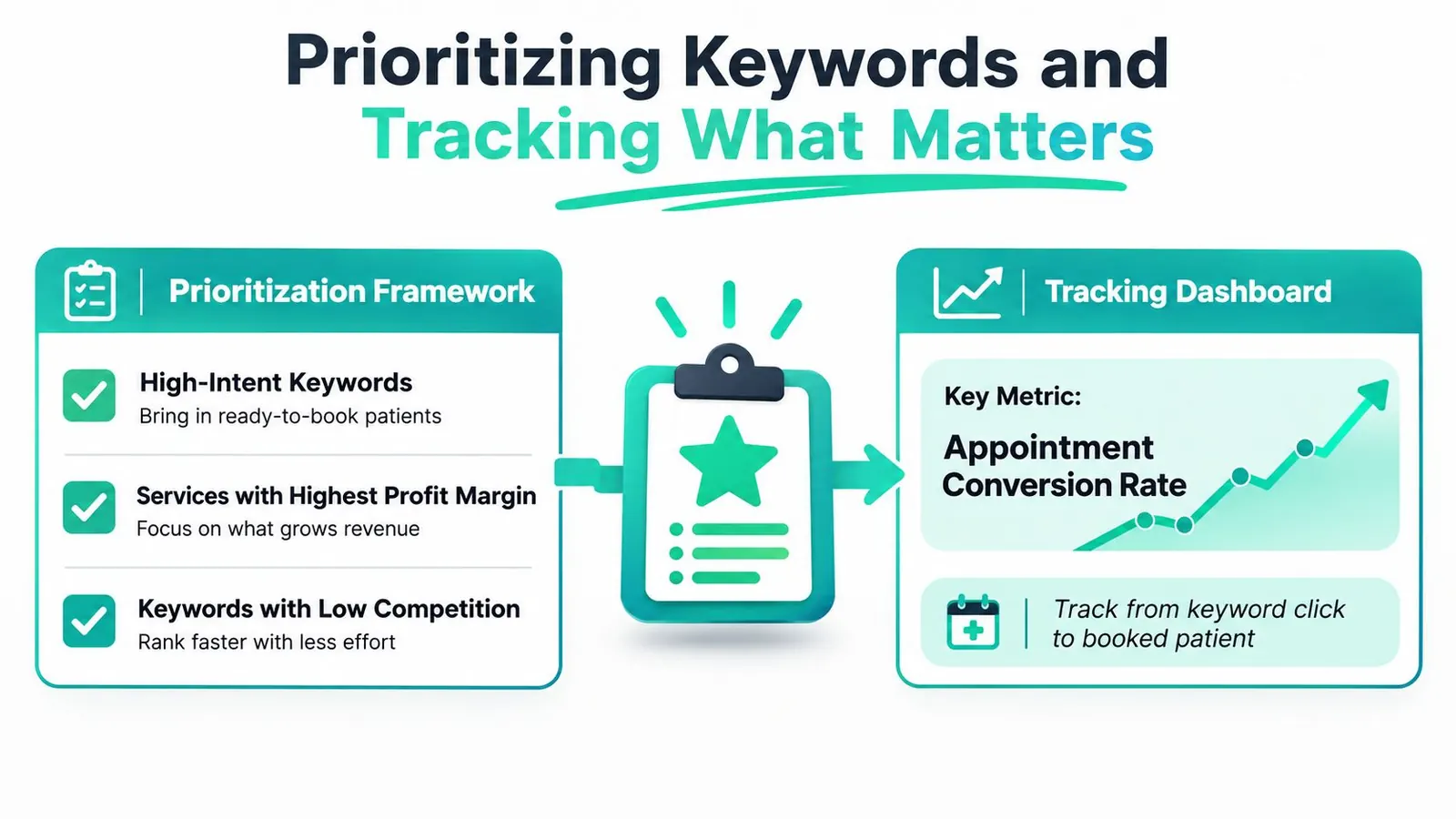
Track each target page from impression growth to clicks, calls, form submissions, direction requests, and booked appointments. A ranking increase matters only when it brings the right patient and makes contact easy. Practices needing audits, opportunity analysis, or implementation can review the Leaping Lemur Media services as part of a broader local search plan.
Leaping Lemur Media can assess a practice website, rankings, competitors, and patient audience to identify high-intent dental keyword opportunities, including near-miss pages and gaps competitors have missed. Visit Leaping Lemur Media to explore an SEO and local search approach shaped around the practice's voice, community, and appointment goals.
Running a dental practice? See our dental marketing services.