

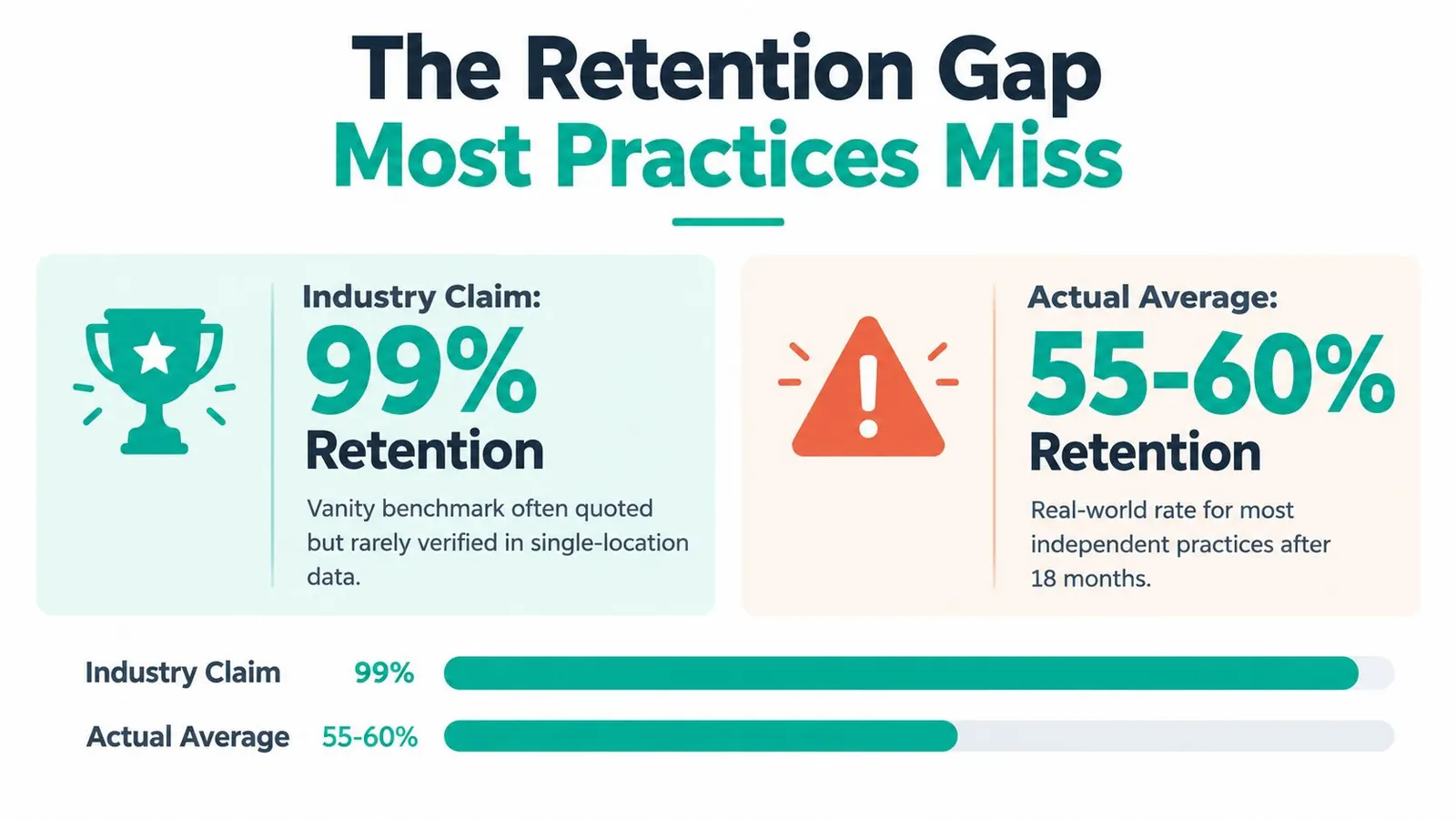
A dental practice can retain 57% of its patients on average, while the top 10% reach 99% retention, according to Becker's Dental reporting on scheduling and patient retention. That gap isn't a branding problem. It shows how much revenue stability depends on what happens after the first appointment, when the front desk books the next visit, when a treatment plan remains unscheduled, and when a missed recall becomes a lost relationship.
Dental patient retention is best understood as an operating discipline. Marketing can fill the schedule, but the practice team determines whether patients return, accept recommended care, and remain active through the next recall cycle. The most useful question isn't how many names sit in the database. It's how many patients have a realistic next step with your practice.
Table of Contents
- The Retention Gap Most Practices Miss
- Mapping the Full Dental Patient Lifecycle
- Building Recall and Reminder Workflows That Work
- Front-Desk and Clinical Scripts That Earn Reappointments
- Loyalty Programs and Reactivation Tactics That Actually Convert
- Measuring What Matters and Proving Retention ROI
The Retention Gap Most Practices Miss
57% average retention compared with 99% among top practices shows a wide performance gap, according to Becker's Dental. The comparison still needs context. Retention figures can use different patient groups, measurement windows, and definitions, so a practice owner should treat the benchmark as a prompt for investigation, not a target to copy blindly.
Stop counting the wrong patients
A growing database does not prove that the practice is retaining patients. Old records may remain in the system while active hygiene patients lapse, diagnosed treatment stays unscheduled, and family referrals decline. The number that matters is the active-patient count, supported by the behavior that creates future production.
Use active-patient retention as the operating measure. Define the active population as patients who completed a visit during a selected period, then check how many of those same patients returned within 12 months and 18 months. The 12-month view tests the annual care cycle. The 18-month view identifies patients who are nearing dormancy and need a defined recovery process.
Your practice management system can supply the raw records, but staff must review them before using the report for decisions. Remove deceased patients, people who moved away, duplicate charts, and patients who formally transferred care. A patient is retained only when a qualifying return visit occurs, not merely because the chart remains open.
Practical rule: A retention report should show who returned, when they returned, and why excluded records were removed. Without those details, it is not ready for an owner-level decision.
Connect retention to production
The average reappointment rate is 77%, so roughly one in four patients leaves without a future visit booked, according to Becker's Dental. That result points to a front-desk process. The patient may still return, but the team has lost control of the next step and created more follow-up work.
New-patient retention can be weaker still. One industry summary reports that practices retain only 41% of new patients after the first visit, as outlined by Quo's dental retention analysis. Marketing can create the appointment, but the practice earns the return through clear findings, an understandable treatment plan, a booked follow-up, and a recall process the patient can follow.
Run a simple audit using patients seen during the previous 12 months:
- Active base: How many qualifying patients visited?
- Return rate: How many returned within 12 months?
- Lapse rate: How many had no visit by 18 months?
- Checkout discipline: What percentage left with a next appointment?
- Unscheduled value: How much diagnosed treatment remains unbooked?
Compare these results with monthly production, hygiene reappointment performance, and the value of unscheduled treatment. A healthy new-patient flow alongside weak active-patient retention usually points to scheduling, follow-up, treatment communication, or the patient experience. Owners can also review practical ways to keep customers longer, then adapt those principles to clinical scheduling and patient trust.
Mapping the Full Dental Patient Lifecycle
Retention doesn't belong to one coordinator or one automated campaign. It belongs to the handoffs between people, systems, and appointments. A patient can feel well cared for in the operatory and still disappear because nobody clearly owned the next transition.
Print the table below and annotate it with staff names during a team meeting. The exercise works because it turns a vague retention goal into a sequence of observable responsibilities.
Patient Lifecycle Stages and Retention Triggers
| Lifecycle Stage | Typical Drop-Off | Owner | Trigger | Minimum Touchpoint |
|---|---|---|---|---|
| First call | The caller doesn't receive a clear next step | Front-desk coordinator | New inquiry or appointment request | Confirm appointment, expectations, forms, and contact preference |
| New-patient visit | The patient leaves without understanding findings or priorities | Dentist and clinical team | Examination and diagnostic review | Explain findings, recommended next action, and timing |
| Diagnosis and treatment planning | The patient says they'll decide later and receives no structured follow-up | Treatment coordinator | Treatment plan presented but not scheduled | Document concern, financial question, and follow-up date |
| Active treatment | The patient completes one procedure but doesn't know what comes next | Dentist, assistant, or coordinator | Treatment milestone completed | State the next clinical step before dismissal |
| Reappointment at checkout | The patient leaves with no appointment reserved | Front desk and hygienist | Visit reaches checkout | Offer a specific future appointment and confirm it |
| Hygiene recare | The patient misses the expected recall window | Hygiene coordinator | Recall interval approaches or passes | Send the planned reminder sequence and make rescheduling easy |
| Lapse and reactivation | The patient ignores outreach and reaches the 18-month lapse cliff | Reactivation owner | No qualifying visit within the defined window | Use personalized outreach, a convenient booking option, and live follow-up |
The most common leaks occur after a treatment plan, during the 30- to 60-day recare gap, and as a patient approaches the 18-month lapse cliff. Those moments need named owners, not shared assumptions. “Someone will call” usually means nobody can verify whether the call happened or what the patient needed.
Turn the map into a staff worksheet
For every transition, record four details: the trigger, the owner, the required action, and the evidence that the action occurred. In a practice management system, that evidence might be a scheduled appointment, a documented call outcome, a task with a due date, or a completed two-way text conversation.
A useful team discussion asks, “Where can the patient say yes and still disappear?” The answer often exposes a gap between clinical confidence and administrative execution. Your team can use the Leaping Lemur Media journal for broader communication and marketing ideas, but the practice must translate those ideas into a specific handoff inside the patient record.
The lifecycle map also clarifies what not to automate. A reminder can prompt action, but it can't explain a complex treatment decision, resolve a financial concern, or repair a poor interaction. Use automation for consistency and people for judgment.
Building Recall and Reminder Workflows That Work
A recall system fails when the practice confuses message volume with patient movement. Sending reminders without a booking path, a risk segment, or a rescheduling owner creates activity reports without reliable reappointments.
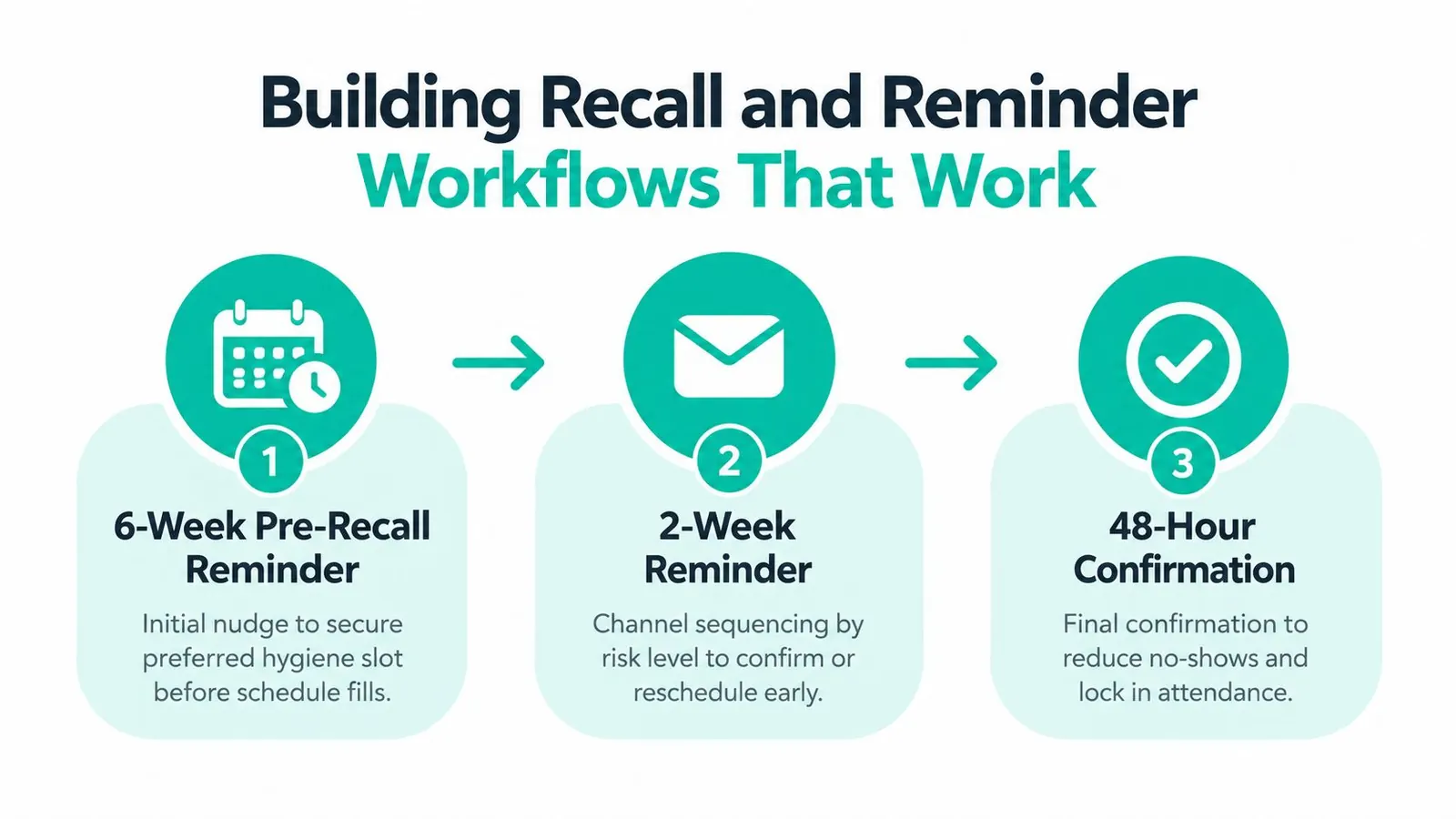
A practical workflow starts with three timing points. For routine check-ups, CareCredit's scheduling guidance describes reminders commonly sent 1 to 4 weeks before the appointment and again 3 to 5 days before. The exact cadence should fit the appointment type and patient preference, but every message needs an easy confirmation or rescheduling route.
Use a three-touch sequence
Start with a 6-week pre-recall reminder for patients who are due to return. The purpose isn't to pressure them. It's to secure a preferred hygiene time before the schedule narrows. Give the patient a direct booking option and identify the practice clearly.
At 2 weeks, segment the message. Stable patients with a dependable attendance history may need a concise SMS. A lapsed patient or someone with repeated cancellations may need SMS, email, and a personal call. A systematic review found that prior no-show history strongly predicts future missed appointments, and that Mondays and the first week of the month are associated with higher no-show rates. That evidence appears in the systematic review of dental appointment no-shows.
The final 48-hour confirmation should ask for a decision, not invite an ambiguous response. Try: “Your hygiene visit is reserved for Tuesday at 10 a.m. Reply C to confirm or R if you need a different time. If you reply R, our team will help you reschedule.” The coordinator then owns every reply that signals a problem.
Build around risk, not convenience
Reminder channels should follow patient behavior. High-risk patients receive more human follow-up, while stable patients shouldn't be buried under unnecessary messages. In one controlled reminder study, the overall no-show rate was 2.43%, with SMS at 1.90%, email at 2.68%, and phone calls at 3.49%, although the channel differences weren't statistically significant, as reported in the systematic review linked above.
That finding matters because no channel works in isolation. The team still needs to address appointment timing, prior attendance, transportation concerns, and the patient's ability to reschedule. A reminder won't fix an appointment that was difficult to book in the first place.
When the 3 p.m. cancellation avalanche hits, don't leave the list to chance. Create a same-day fill queue with patients who have requested earlier appointments, overdue hygiene patients who are ready to return, and treatment-plan patients who can use the opening. The coordinator should contact those patients in a defined order and record outcomes.
Troubleshoot stalled recall
Check the PMS integration first. Then review whether messages are reaching the right time zone, whether patients receive duplicate reminders, and whether staff close the loop on replies. Message fatigue also matters. If every patient receives the same wording at the same frequency, important prompts become background noise.
A useful external reference for nurture sequencing is Silva Marketing's guide to Prescott service lead strategies. Apply its broader follow-up logic carefully, then keep clinical scheduling, consent, and privacy requirements at the center. Your communication platform and operational support options can also be reviewed through Leaping Lemur Media's services.
Front-Desk and Clinical Scripts That Earn Reappointments
The words used at checkout often determine whether a patient becomes part of the active base or becomes another open task. A warm team can still lose patients if the language is vague, especially when the patient is tired, worried about cost, or eager to leave.
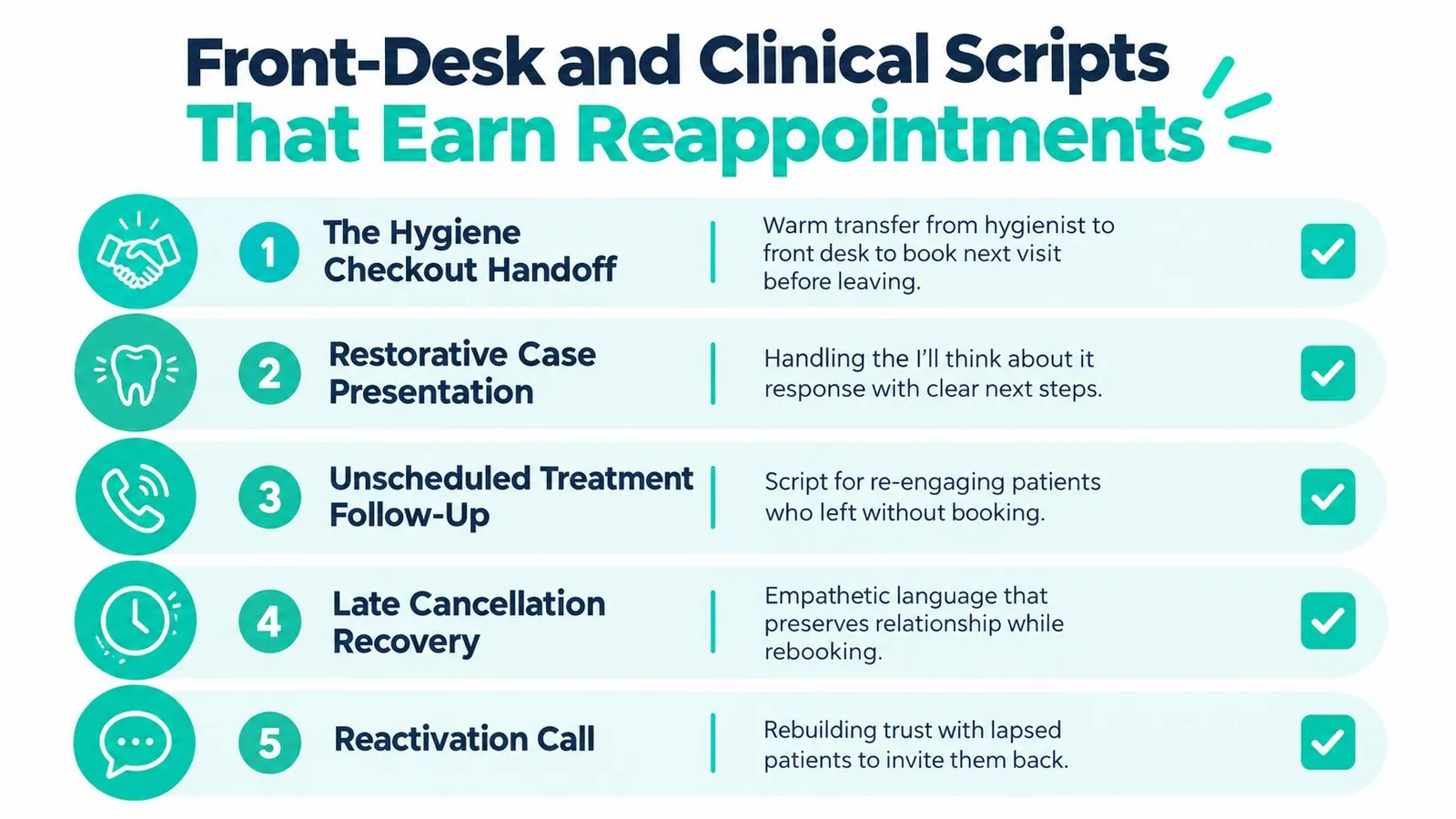
The hygiene checkout handoff
The weak version is, “Call us when you're ready for your next cleaning.” It places the entire burden on the patient and makes the next visit optional.
A stronger handoff happens before the patient leaves the chair. The hygienist says, “Your next hygiene visit is due in six months. I'm going to walk you to the front desk so we can reserve a time that works for you.” The front-desk coordinator then offers two specific options and confirms the preferred contact method.
The restorative case presentation
When a patient says, “I'll think about it,” don't answer with pressure or retreat into silence. The coordinator can say, “Of course. What part would you like to think through, the timing, the investment, or the treatment itself?” That question identifies the actual barrier.
If cost is the concern, use plain language: “Let's review what your plan is expected to cover and what your estimated portion may be. If you aren't ready to schedule the full treatment, we can reserve a consultation or begin with the priority step.” The patient should leave with a documented next action, even if that action is a follow-up call rather than treatment.
The post-operative call
After a same-day crown or another significant procedure, “Just checking in” sounds routine. A better call connects care to the patient's experience: “How has the tooth felt since yesterday? I want to make sure your bite and comfort are progressing as expected. I also see that your next exam is due after this phase, so we can reserve that visit while we're talking.”
The clinician or assistant can hand off ownership without sounding rehearsed: “I've explained what comes next, and Jordan at the front desk will help you choose the appointment time. You won't need to figure that out later.”
The insurance question
A patient who calls “just checking” on insurance may be testing whether the office is safe to engage. Answer the immediate question, explain what remains estimated, and offer a clinical next step without forcing it: “I can review the information we have and explain what still needs verification. If you'd like, we can also reserve a planning visit so the dentist can answer your treatment questions.”
The missed-recall outreach
For a patient who has ignored two reminders, avoid “You're overdue again.” Try: “We noticed we haven't found a convenient time for your next visit. Has your schedule changed, or is there something we can make easier?” That opens a conversation instead of assigning blame.
Don't use guilt scripts, scare tactics, or double-booking pressure. They may fill a slot temporarily, but they erode the trust that dental patient retention depends on.
Loyalty Programs and Reactivation Tactics That Actually Convert
Points cards rarely solve the reasons patients leave a dental practice. A patient who can't get a convenient appointment, doesn't understand a treatment plan, or feels surprised by a bill won't become loyal because a rewards balance exists.
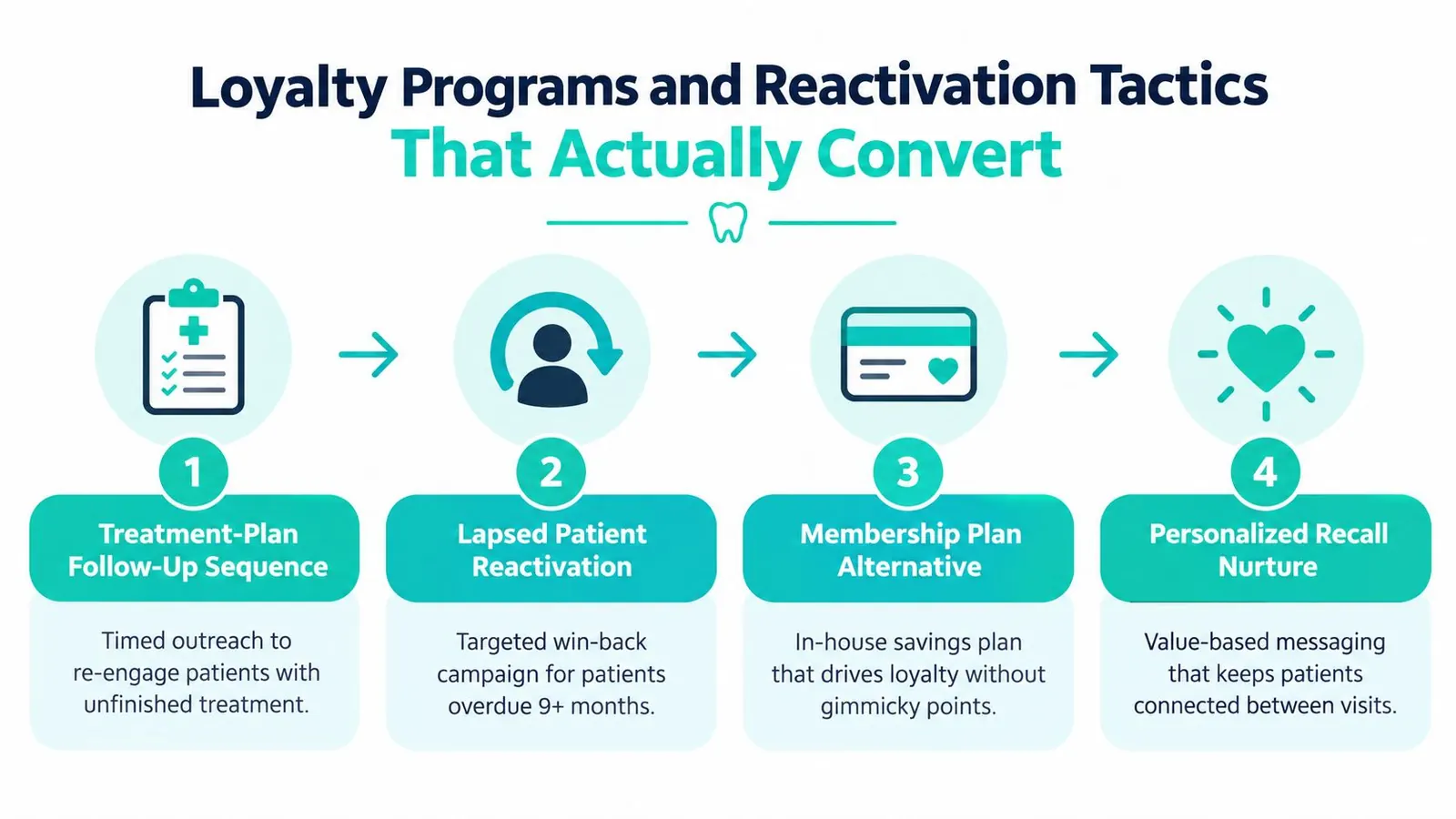
Loyalty should reduce friction and reinforce continuity. An in-house membership option can make preventive care easier to understand, but it needs transparent terms, appropriate clinical boundaries, and a simple enrollment process. The offer should support regular care, not turn treatment decisions into a contest.
Follow up on value already created
Unscheduled treatment is one of the clearest opportunities. RevenueWell's dental practice statistics notes that an average practice may hold $500,000 to $1 million in unscheduled treatment plans. That value shouldn't sit in a static report. Assign each patient a follow-up path based on the clinical priority, the patient's concern, and the last conversation.
A practical sequence can include outreach around 30, 60, and 120 days, with each contact adding useful information rather than repeating “Are you ready?” The first message may clarify the recommended next step, the second may address financing or timing, and the third may offer a fresh conversation with the coordinator or dentist.
Make family care easier
Family scheduling is a retention tool because it removes administrative work. Offer parents a coordinated block when appropriate, document school or work constraints, and make it easy to schedule siblings together. A family that can manage care in one predictable process has fewer reasons to move routine dentistry elsewhere.
Milestone touchpoints can also keep the front desk relevant between visits. A new baby, a move, a work anniversary, or a meaningful family event may justify a brief personal note when the patient has shared that information willingly. These messages shouldn't become automated noise. Their value comes from being specific and proportionate.
Local partnerships create another continuity loop. Employers, orthodontists, and pediatricians can refer patients who need a dependable dental home. The practice should make the handoff warm, document the referral source, and communicate promptly so the referred patient doesn't have to repeat their story.
Reactivate lapsed patients with human escalation
For patients lapsed between 12 and 24 months, begin with SMS, follow with email, then leave a personal voicemail from the patient's last hygienist. The final step should hand the patient to a live call when they respond or show interest. The message might say, “Hi, this is Maya from the hygiene team. We'd be glad to help you find a comfortable time to return. Reply here and we'll make the next step simple.”
Review every campaign by reappointment rate, not by message volume. Retire incentives that don't move booked visits, and redirect that budget toward clearer treatment follow-up, better scheduling access, and personal outreach where the data shows a response.
Measuring What Matters and Proving Retention ROI
A retention dashboard should answer one operational question: Is the practice building a dependable future schedule from the patients it already serves? Appointment volume can rise while the active-patient base shrinks, so the dashboard must connect patient behavior with future production, reappointment performance, and treatment that remains unscheduled.
The five numbers worth reviewing
Active-patient count shows the size of the currently engaged patient base. Define the qualifying activity window consistently, then remove records with legitimate non-return reasons, such as a documented relocation or a completed episode of care. Review the count monthly for direction and quarterly when making staffing, scheduling, or marketing decisions.
12-month and 18-month retention show whether patients return within the expected care cycle and whether they are approaching dormancy. The 12-month view reveals whether annual continuity is holding. The 18-month view identifies patients who have passed the point where routine recall has become a reactivation problem.
Reappointment rate at checkout measures whether the team books the next visit before the patient leaves. Treat a weak result as a workflow signal first. The cause may be limited hygiene availability, an unclear handoff from the clinical team, a checkout conversation that ends too quickly, or a rescheduling process that loses patients. More advertising will not correct those gaps.
Unscheduled-treatment value captures diagnosed care that has not converted into an appointment. Track it by patient age, clinical priority, treatment coordinator, and last contact. A growing balance means the practice is identifying care without creating enough clarity, urgency, or follow-through for patients to proceed.
Patient lifetime value per hygienist column connects retention with clinical capacity. Compare columns by active status, completed hygiene visits, checkout reappointment behavior, and treatment follow-up. The purpose is not to rank hygienists unfairly. It is to identify handoff differences, scheduling constraints, or communication habits that coaching can improve.
These measures belong together. An active-patient count can look stable while reappointment performance weakens. Unscheduled-treatment value can also rise even when recall appears healthy. Review the relationship between the numbers before choosing a marketing response.
Pull the data from the PMS
Most practice management systems can export appointment history, provider assignment, recall status, treatment plans, and communication tasks. Build one consistent patient-level file, then use a spreadsheet to calculate return windows and flag patients without a qualifying visit.
A practical dashboard can use the following structure:
Retention KPI Dashboard Snapshot
| KPI | Definition | Target | Source |
|---|---|---|---|
| Active-patient count | Patients with a qualifying visit inside the selected activity window | Stable or growing after legitimate exclusions | PMS patient and appointment reports |
| 12-month retention | Active patients who returned within 12 months | Improve against the practice baseline | PMS appointment history |
| 18-month retention | Active patients who returned before reaching the lapse threshold | Reduce dormant patient volume | PMS appointment history |
| Checkout reappointment rate | Patients leaving with a future visit booked | Move consistently above the practice baseline | Scheduling and checkout report |
| Unscheduled-treatment value | Diagnosed treatment without a completed booking | Declining balance with documented follow-up | Treatment-plan report |
| Lifetime value per hygienist column | Revenue and completed care associated with retained hygiene patients | Identify coaching opportunities | PMS production and provider reports |
Review the dashboard briefly each week for tasks, cancellations, and open treatment follow-up. Review it monthly for movement and quarterly for structural decisions. If reminders are being sent but reappointments remain weak, inspect appointment availability, the clinical-to-front-desk handoff, message replies, and rescheduling before purchasing more advertising.
Calculate improvement without inventing assumptions
A one-point improvement can be valued with a simple formula:
Retained patients gained = eligible active patients × 0.01
Added recurring value = retained patients gained × average expected annual hygiene value
Added treatment opportunity = retained patients gained × average unscheduled treatment value per retained patient
Use the practice's own PMS figures for both revenue inputs. Do not substitute an industry average for a practice-specific amount, because hygiene mix, fees, insurance participation, and treatment needs vary widely.
For example, if the eligible base is 1,000 patients, a one-point improvement represents 10 additional retained patients. If the average annual hygiene value is $X and the average associated unscheduled-treatment value is $Y, the modeled opportunity is 10 × ($X + $Y). Keep each variable visible so the owner can test the assumptions rather than accepting a polished but weak projection.
Present the result in two minutes: “Our active base is moving in this direction. Our checkout reappointment rate is this. Unscheduled treatment is this. If we improve retention by one point, our patient and production data indicate this modeled opportunity. The next action is to fix this handoff, not increase acquisition spend.”
Privacy belongs in the same ROI discussion. A 2026 outlook reports that 53% of patients would switch healthcare providers after a data breach, making secure scheduling, messaging, and data handling part of patient loyalty, as described in Planet DDS's 2026 dental industry outlook. Automation should make care easier without making patients feel watched or abandoned. Explain how messages work, give patients control over communication preferences, and keep a human available when judgment is required.
If your team needs outside support, Leaping Lemur Media offers marketing strategy, reputation management, patient reactivation, reminders, and post-visit communication systems. If you want help aligning recall and reactivation with these KPIs, contact Leaping Lemur Media to review your active-patient dashboard and identify the front-desk actions most likely to improve reappointments and unscheduled treatment follow-through.
Running a dental practice? See our dental marketing services.