
A new patient calls five minutes before closing. “I'm nervous,” she says. “What do other people say about your office?” The front desk representative opens Google, scans the latest comments, and realizes the answer isn't the practice's average rating. It's a recent complaint about a long wait, a detailed note about gentle care, and several short reviews that say almost nothing.
That moment happens every day. Dental patient reviews aren't a marketing checkbox. They're public evidence of how your practice communicates, schedules, explains treatment, handles discomfort, and responds when something goes wrong. The practices that manage reviews well don't merely chase more stars. They build a repeatable system for collecting honest feedback, protecting patient privacy, identifying operational problems, and helping prospective patients judge whether the practice fits their needs.
Table of Contents
- Why Dental Patient Reviews Matter More Than Star Counts
- What the Research Says About Real Dental Reviews
- Asking for Reviews the Right Way
- Responding to Reviews Without Crossing the Line
- Turning Negative Reviews Into Operational Insight
- Choosing the Right Platforms Without Spreading Too Thin
- Leveraging Reviews Across Marketing Without Looking Desperate
Why Dental Patient Reviews Matter More Than Star Counts
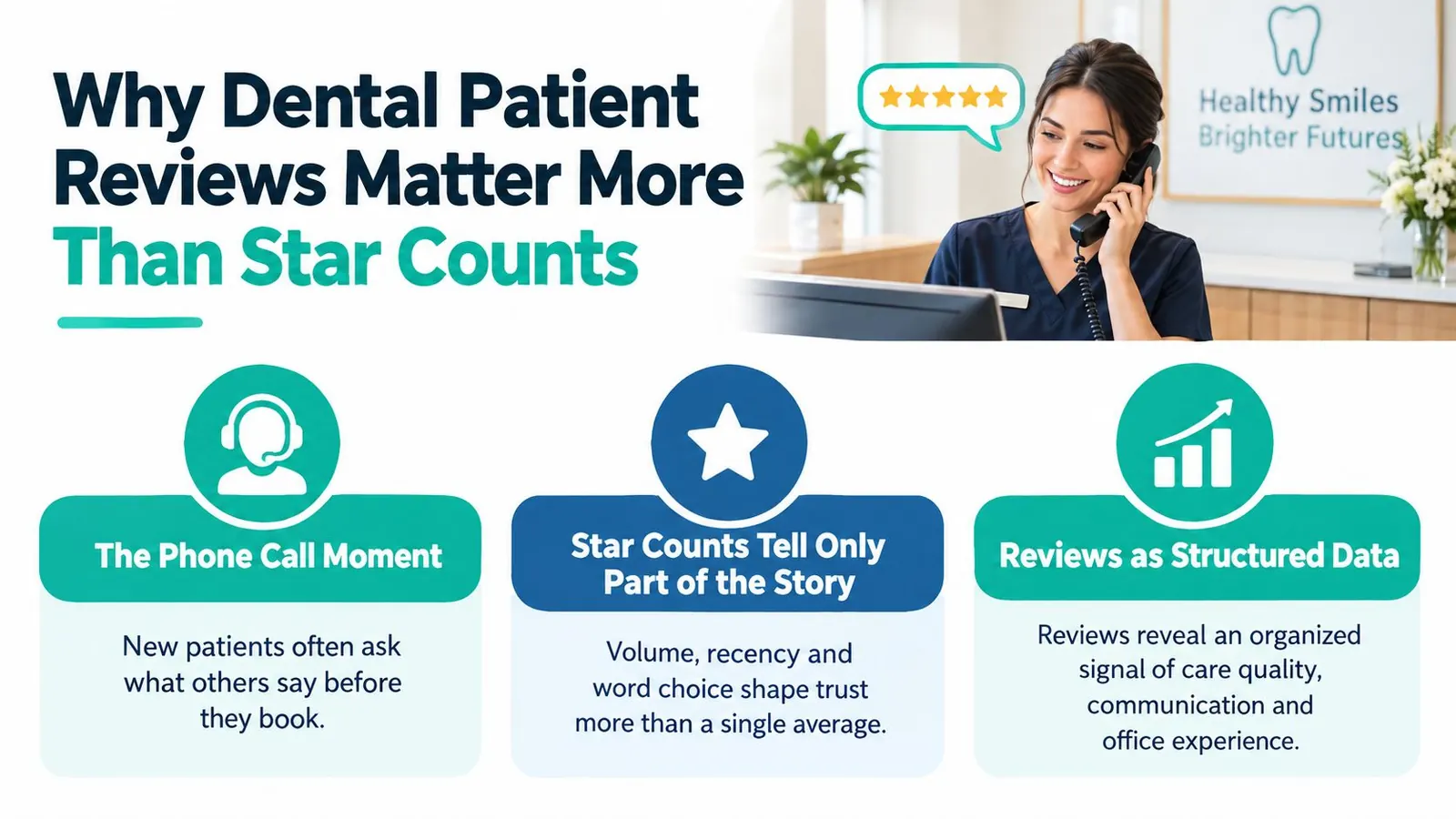
The phone call above usually ends with a question about the stars, but patients are often listening for something more specific. Was the team patient with someone who was afraid? Did the office explain costs clearly? Did the dentist take time to answer questions? Could the practice accommodate a busy schedule or a mobility concern?
A 2026 peer-reviewed study found that 64% of participants reported reading a dentist's reviews before deciding whether to use that dentist, while 48% based trust decisions on perceived competence, technical skills, and professional reputation (the study on dental-patient trust). That makes reviews part of the decision process, not a decorative section on a profile.
What a review profile actually communicates
A star average gives a quick impression, but volume, recency, and language provide context. A profile with a high average and only a few comments may not offer much evidence. A slightly lower average with a substantial body of recent, specific feedback may help a patient feel more informed.
Review comments also give the practice structured patient-experience information. The front desk can tag recurring concerns about waits, scheduling, billing, communication, comfort, or follow-up. That turns scattered public comments into an operational record the team can discuss at a staff meeting.
The useful question isn't “How do we get more five-star reviews?” It's “What are patients repeatedly telling us about the experience we deliver?”
Reviews still have limits. People choose whether to post, and unusually positive or negative encounters may be more likely to appear. The feedback is voluntary, non-random, and shaped by selection bias, so it shouldn't be treated as a definitive measure of technical clinical quality.
That distinction matters. A practice can use reviews to monitor patient experience, particularly communication and access, without claiming that sentiment proves treatment quality. The goal is a more honest conversation inside the office. If patients praise kindness but complain about waiting, the response isn't to celebrate the stars and ignore the queue. It's to preserve the warmth and fix the delay.
What the Research Says About Real Dental Reviews
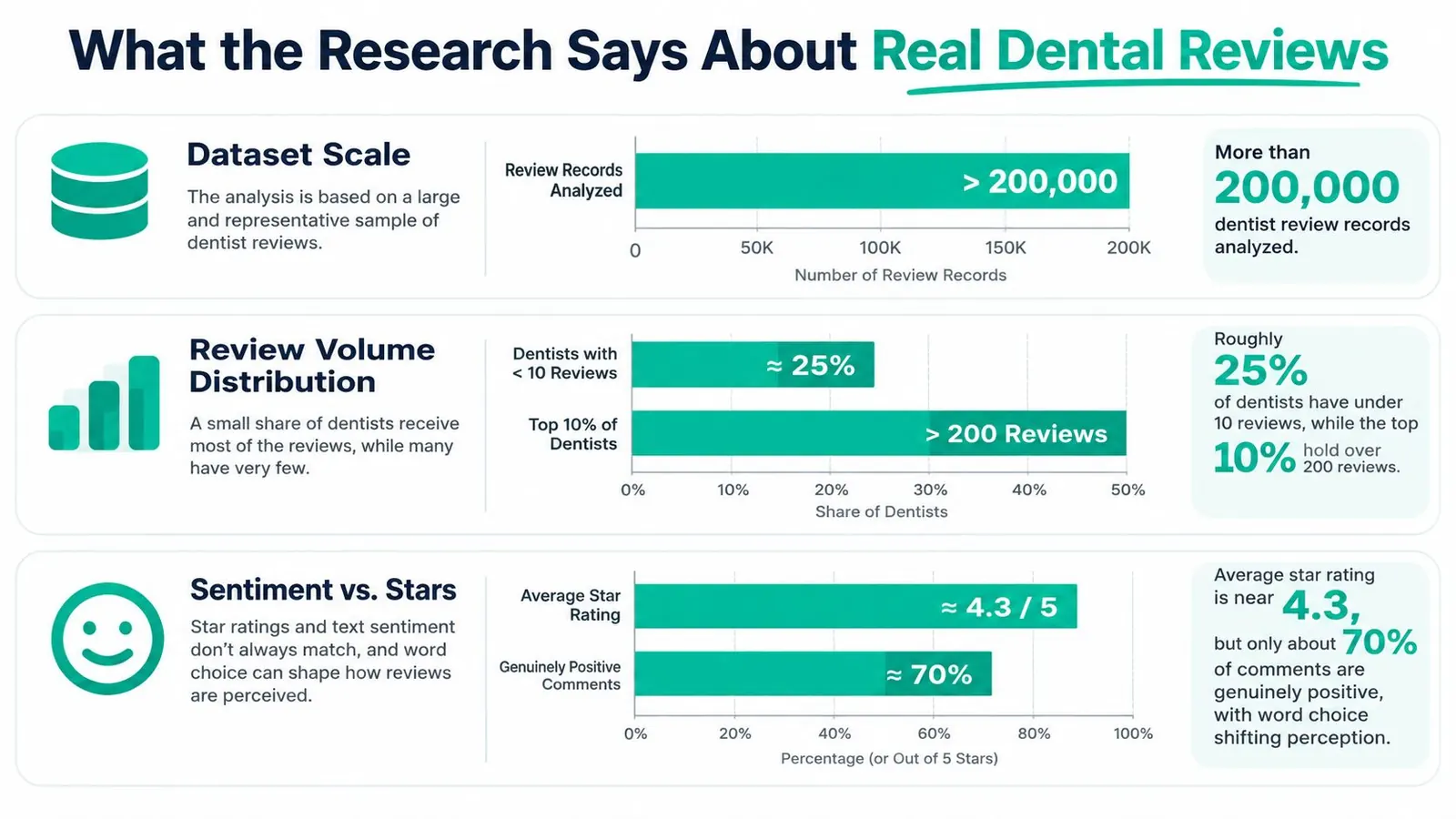
Large datasets show why review averages need careful reading. A 2020 U.S. study analyzed 204,751 dentists listed on HealthGrades, and 154,683, or 75.55%, had at least one rating or written review (the U.S. dental-review analysis). Individual dentists had between 1 and 1,789 reviews, which means public feedback is distributed unevenly across practices.
That range changes how a practice should interpret its profile. A strong average supported by a small number of reviews is not equivalent to a similar average backed by a deep, recent collection. Review count doesn't prove care quality, but it does tell prospective patients how much public experience is available to examine.
Ratings are only the structured layer
A Norwegian study examined 11,764 dental patient reviews posted between 2013 and 2020, covering 2,950 dentists. 93.31% of reviews received four or five stars, while 5.84% received one or two stars, and the average dentist had 3.9 reviews (the Norwegian review study).
That positive skew makes a high average less informative than many practice owners assume. If almost all visible reviews cluster toward the positive end, the written explanation becomes more valuable. The same dataset found an average review length of 48.9 words, giving patients enough room to describe communication, professionalism, pain, treatment, or the office environment.
The U.S. analysis also found that shorter waits were significantly associated with higher ratings, with the reported result (F_{4,150055}=10417.77, p<0.001, g=0.18) (the PubMed abstract and study record). Waiting time is a practical signal because the team can measure it, discuss it, and change the workflow.
Build a theme dashboard
Export reviews by location and period. Normalize the star scale if you're comparing multiple platforms, then code comments into categories such as:
- Access: Scheduling, availability, cancellations, and wait times.
- Communication: Explanations, listening, informed consent, and follow-up.
- Comfort: Anxiety support, pain, and chairside behavior.
- Treatment experience: Perceived outcomes and procedure concerns.
- Business clarity: Fees, insurance, estimates, and payment conversations.
- Environment: Cleanliness, privacy, parking, and comfort.
Review the themes alongside rating distributions. Don't use sentiment alone to infer clinical quality. Use monthly trends, sensible minimum-volume thresholds, and manual review of comments that involve clinical risk or possible patient harm.
Asking for Reviews the Right Way
A patient leaves the chair pleased, reaches checkout, and then gets buried in a busy afternoon. If the request depends on someone remembering later, it will be missed. Build review invitations into the visit so eligible patients receive the same clear, voluntary opportunity to respond.
Create one compliant request flow
Choose a consistent moment and channel. A hygienist can mention feedback after a patient offers a genuine compliment. The front desk can provide a direct link at checkout or send it in a post-visit message. Email, text, or a QR card can work, provided the patient can reach the review page without searching.
Use neutral wording:
“We appreciate your feedback. If you'd like to share your experience, this link takes you directly to our review page. Please write whatever feels accurate to you.”
Keep the invitation free of treatment details, diagnoses, and health concerns. “Thanks for visiting our office today” protects privacy better than naming a procedure or discussing a clinical issue.
Google Business Profile rules prohibit money, discounts, free products, or services in exchange for a review. They also prohibit requesting reviews only from patients likely to respond positively, pressuring patients to post on the premises, and asking for specific content. The Google's Business Profile review policy sets those boundaries. Make the invitation open-ended and voluntary.
Train the team around the guardrails
The FTC's final rule on consumer reviews and testimonials, approved in August 2024, prohibits creating, selling, purchasing, or distributing fake or false reviews. It also addresses testimonials that materially misrepresent the reviewer's experience. The FTC announcement explains the rule.
Give staff a short checklist:
- Ask everyone through the same process: Do not filter requests according to a patient's mood or perceived satisfaction.
- Use a direct link: Reduce effort without controlling the response.
- Avoid incentives: A gift or discount can turn feedback into a prohibited exchange.
- Protect privacy: Keep clinical information out of invitations and public replies.
- Respect hesitation: One invitation is enough. Do not corner patients at checkout.
- Keep wording flexible: Patients should use their own words rather than follow a script.
For practical ideas on running requests with less front-desk friction, see The Advertising Suite review guide. For hands-on help assigning review workflows and training staff, see Leaping Lemur Media's services.
Responding to Reviews Without Crossing the Line
A public reply serves two audiences. The reviewer sees it, and prospective patients judge how your team handles pressure. Write as though a future patient is reading every sentence. Acknowledge the experience without confirming that the reviewer received care at your office.
Use a three-part reply
Thank the person for sharing feedback, respond to the concern in human terms, then move case details to a private channel. Keep the tone calm, even when the review seems unfair. A reply should show that the practice listens without turning the review into a public case file.
Positive example
A patient writes that a hygienist was gentle and reassuring.
“Thank you for sharing this feedback. We're glad our team helped make your visit feel comfortable, and we appreciate you taking the time to write about the experience.”
Leave out the procedure, appointment date, diagnosis, and treatment outcome. Supplying details the reviewer did not publish can create a privacy problem, even when the review is complimentary.
Negative example
A reviewer complains about a long wait.
“Thank you for raising this concern. We're sorry the visit didn't feel as smooth as it should have. Please contact our practice manager through the private number on our profile so we can listen and review the situation directly.”
This response recognizes the frustration without confirming the person's identity or discussing the appointment. It also gives the team a route to investigate the underlying workflow instead of debating the complaint in public.
Keep public and private conversations separate
The same Google review policy that governs requests also governs replies: no incentives, selective solicitation, on-site pressure, or scripted content. A reply should remain useful without steering what patients say or revealing protected information.
Publicly safe content includes:
- Appreciation for the person's time.
- A general statement that the practice listens and reviews concerns.
- An invitation to contact the office privately.
- Recognition of a concern without confirming treatment.
Keep these details private:
- Whether the reviewer is a patient.
- Appointment history or dates.
- Procedures, diagnoses, medications, or outcomes.
- Insurance claims or account balances.
- Team-member names, unless the reviewer included them and the response remains general.
Assign one trained person to review replies before publication. A quick response that confirms protected information creates a larger problem than a careful response posted later. Complaints involving possible injury, medication, infection, or treatment safety should go to the dentist or practice manager before anyone posts. That approval step protects the patient, the team, and the practice's credibility.
Turning Negative Reviews Into Operational Insight
A one-star review creates an emotional reaction, especially when the team believes the account is incomplete. That reaction is understandable, but it's a poor management system. The useful move is to separate the tone of the review from the operational signal inside it.
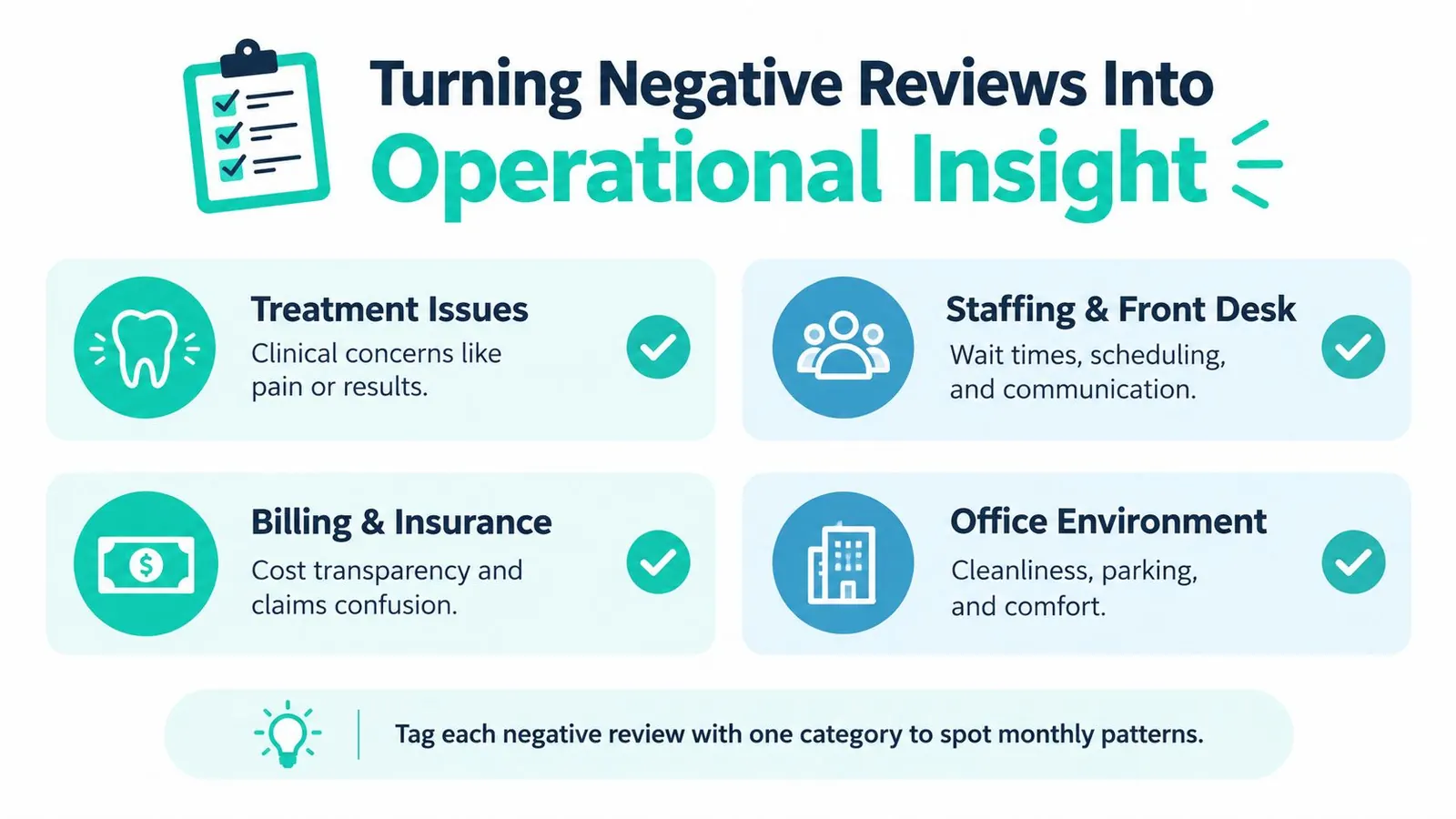
An analysis of 413 negative Google dental reviews identified 1,071 individual complaints. Treatment issues represented 37.1% of complaints, followed by concerns involving staffing, communication and professionalism, finances, and premises (the analysis of negative dental reviews).
Code the complaint, don't debate the reviewer
Create a shared spreadsheet or dashboard. Give every negative review a primary category and, when necessary, a secondary category. One comment can mention a painful procedure, a confusing bill, and a dismissive interaction, so counting the review as one problem loses useful detail.
Use categories the team can act on:
- Treatment issues: Pain, perceived results, post-treatment concerns, or unclear instructions.
- Staffing and front desk: Scheduling, wait times, handoffs, phone communication, and professionalism.
- Billing and insurance: Estimates, claims, payment expectations, and financial explanations.
- Office environment: Cleanliness, parking, noise, privacy, and comfort.
- Access: Availability, language support, disability access, transportation, or emergency capacity.
At the monthly huddle, calculate each theme as a share of all coded complaints. Then choose one operational change, assign an owner, and set a date to review whether the pattern has shifted. Don't launch five initiatives because of one angry paragraph.
Treat serious comments differently
A complaint about a rude interaction belongs in a service review. A comment describing uncontrolled pain, an adverse event, or a possible safety failure needs clinical escalation. Preserve the record, notify the appropriate dentist or manager, and avoid debating medical facts in public.
A negative review is not automatically true, but it is always worth sorting for information.
Never ask a patient to delete legitimate criticism in exchange for attention or resolution. Fix the process, respond with restraint, and use aggregated themes to guide improvement. Suppression protects the profile for a moment. Operational change protects the next patient.
Choosing the Right Platforms Without Spreading Too Thin
A practice doesn't need to become active everywhere. It needs accurate listings, a primary platform that matches local search behavior, and a secondary platform that matters to the patient groups it serves.
| Platform | Primary Audience | Review Behavior | Best For |
|---|---|---|---|
| Google Business Profile | Local searchers comparing nearby practices | Quick ratings, recent comments, public owner replies | Primary visibility and new-patient decision-making |
| Healthgrades | Patients researching healthcare providers | Provider-focused ratings and written experiences | Additional clinical and provider context |
| Yelp | Consumers using local business directories | Detailed praise or criticism, strong opinion language | Monitoring local reputation |
| Zocdoc | Patients comparing availability and booking options | Feedback connected to appointment experiences | Practices relying on online scheduling |
| Existing followers and community members | Recommendations and conversational comments | Community trust and social proof | |
| Industry-specific platforms | Patients using niche healthcare directories | Platform-specific ratings and profile information | Secondary coverage and referral validation |
Claim the profiles that matter, correct duplicate listings, and keep the practice name, address, phone number, hours, and services consistent. A neglected profile can create confusion even when the reviews themselves are favorable.
Choose one weekly monitoring block. Read new comments, answer what needs a reply, flag policy violations, and record recurring themes. Practices that serve multiple specialties can also borrow the platform prioritization principles used in optometry marketing strategy, while keeping the patient journey specific to dentistry.
Leveraging Reviews Across Marketing Without Looking Desperate
Reviews work hardest when they answer a question a prospective patient already has. A generic five-star quote belongs nowhere unless it tells the reader something useful. “The team was great” is pleasant, but “The hygienist explained each step and gave me time to ask questions” addresses anxiety and expectations.
Place specific, permission-based feedback where the related decision happens:
- Homepage: Use a small proof area with varied, recent comments rather than a wall of praise.
- Service pages: Pair comments about comfort, explanations, or follow-up with the service they describe.
- Location pages: Surface feedback that helps a local patient understand access, parking, language support, or scheduling.
- New-patient emails: Link to the full profile so readers can examine positive and negative feedback themselves.
- Community partnerships: Share approved patient-experience themes in local education or outreach, without turning community work into an advertisement.
Don't fabricate testimonials, hide every criticism, or create a review widget that suggests all comments are independent when the practice controls what appears. Authenticity matters more than polish. The FTC rule covers fake, purchased, and materially misleading testimonials, and Google requires genuine experiences.
Teach patients how to read reviews
Most reputation advice falls short here. A practice can have excellent reviews and still be the wrong fit for a patient who needs public insurance, interpreter support, wheelchair access, sedation options, flexible payment arrangements, or emergency capacity.
A 231-person study found that 94% valued previous experience, 86.5% valued painless treatment, 93.1% valued availability, and roughly 95% valued interpersonal communication and staff behavior. Only 42% agreed that online reviews were important, while 72.7% doubted the accuracy of social-media dental information (the study of patient priorities and online information).
Use your website to encourage better questions:
- Can the practice explain fees and insurance before treatment?
- Does the team support dental anxiety or offer sedation options?
- Is the office accessible for mobility needs?
- Can patients receive care in their preferred language?
- How does the practice handle urgent concerns and referrals?
- Do reviewers describe listening, consent, and follow-up?
For broader local-search context, local SEO for contractors offers a useful reminder that local visibility should support real-world trust, not replace it. Dental practices can apply the same principle while keeping patient privacy and healthcare compliance central.
A practical 30-day starting plan
Days 1 through 7: Audit Google Business Profile and other priority listings. Remove duplicates, correct contact information, choose a response owner, and create a neutral request message.
Days 8 through 14: Train the front desk, hygienists, and dentists on the ask and the privacy boundaries. Add one direct review link to the post-visit workflow.
Days 15 through 21: Code recent reviews by theme. Discuss wait time, communication, billing, comfort, and access with the people who own those processes.
Days 22 through 30: Publish useful review themes on the website, respond to outstanding comments, and ask new patients how they found the practice. Use dental marketing support from Leaping Lemur Media when your team needs help connecting reputation work with the wider patient-acquisition system.
Questions practices should answer honestly
Can excellent reviews still hide a bad fit? Yes. Reviews describe individual experiences, not guaranteed affordability, accessibility, language support, or clinical suitability. Verify the practical details directly with the office.
How should you speak to a fearful patient? Look for comments about listening, pacing, explanations, and comfort. Then ask the practice what anxiety-support options it provides.
What if one negative review feels unfair? Don't argue in public. Give a privacy-safe response, investigate internally, document what happened, and use the review to test whether any process needs attention.
Leaping Lemur Media helps dental practices build review-request workflows, train teams on ethical collection, and respond to positive and negative feedback without losing their voice or patient privacy. Visit Leaping Lemur Media to connect dental patient reviews with a practical, community-rooted marketing system.