The hygiene schedule looks healthy until someone checks the gaps. A few patients cancelled, several never booked their next visit, and a treatment plan is sitting in the chart because nobody followed up. By midweek, the front desk is calling the same people who were already willing to hear from the practice.
That's where email marketing for dentists earns its place. Used properly, it isn't a stream of discounts sent to everyone in the database. It's a retention and reactivation system that helps patients take the next sensible step, whether that means confirming an appointment, booking overdue hygiene, or learning more about treatment they've already discussed.
Table of Contents
- Why Email Still Works for Dental Practices
- Building a Consent Based List and Smart Segmentation
- Automated Campaigns That Keep Chairs Full
- Subject Lines and Templates Patients Actually Open
- Scheduling Frequency and Measuring What Matters
- Staying Compliant and Connected Without the Headaches
Why Email Still Works for Dental Practices
A dental practice starts with an advantage many businesses would like to have. Its email list usually contains people who already know the team, have visited the office, or have agreed to receive communication. That audience is different from a cold prospect who has never heard of the practice.
Healthcare email benchmarks report average open rates ranging from 21.5% to 44.6%, while dental campaigns commonly fall near 25% to 35%. Appointment reminders often perform higher, at roughly 30% to 40%, and some message types reach 55% to 70%, depending on the purpose and audience. These benchmark ranges are reported by healthcare email marketing benchmarks.
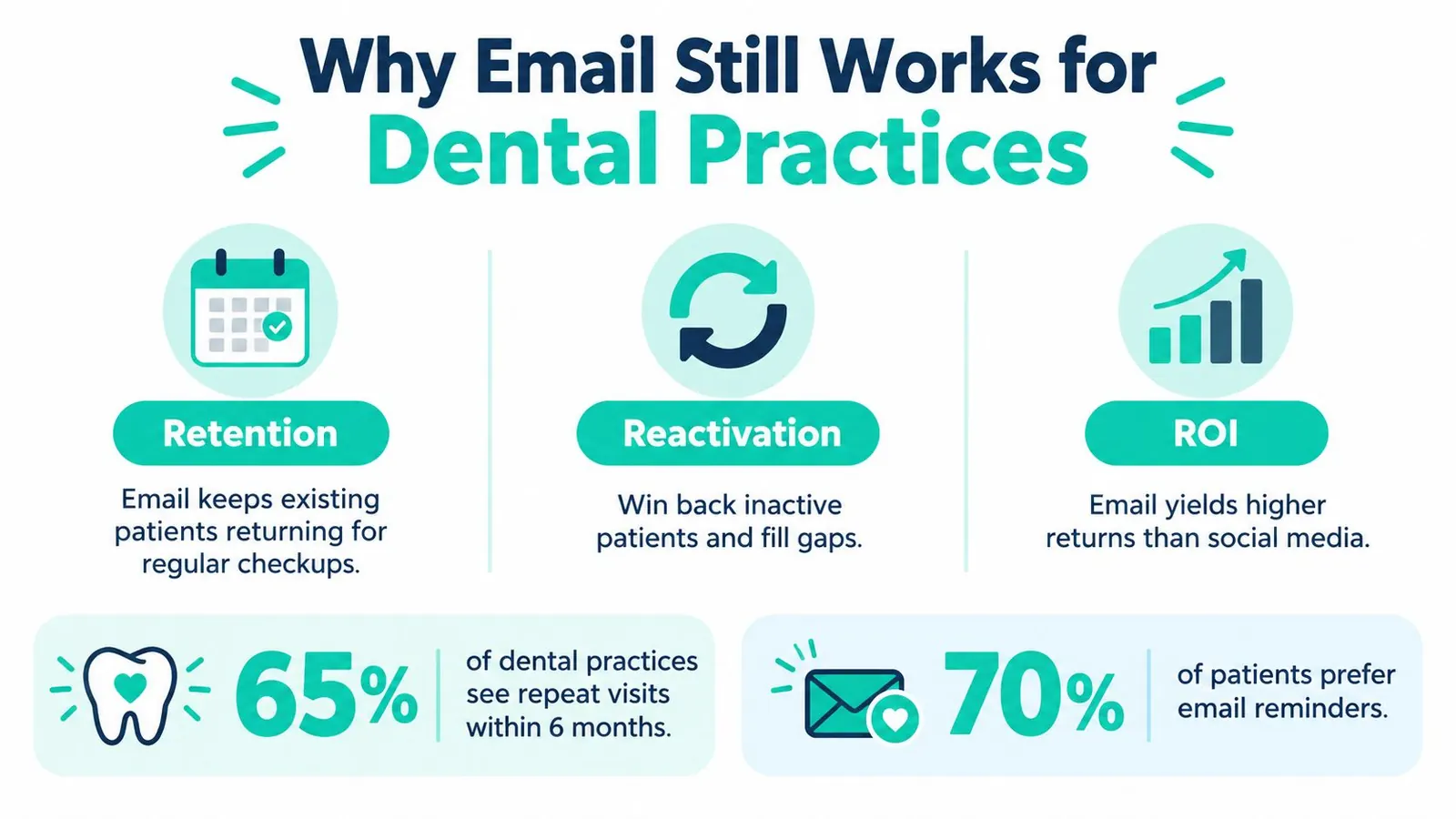
The practical reason is simple. A recall email reaches an existing patient at the moment a routine visit is relevant. A post-visit message arrives while the experience is still fresh. A reactivation email speaks to someone who already has a relationship with the practice. Those messages have more context than a generic promotion.
Email has served as a relationship channel since the first marketing email was sent in 1978, and dentistry remains especially suited to recurring communication because patients return for ongoing care. That recurring appointment model gives the practice several natural reasons to send useful, timely messages without manufacturing urgency.
Practical rule: Send email to help a patient complete a likely next step, not simply to make the practice visible.
Email is not one channel in practice
Operational email and marketing email deserve separate treatment. A confirmation or reminder supports an appointment already on the schedule. A newsletter or whitening promotion asks the patient to consider something new. The first category is high intent, while the second depends on relevance, timing, and restraint.
Dental benchmarks illustrate the difference. Appointment reminders can reach an open rate of 68.4%, while dental marketing newsletters average 24.8%, according to dental email benchmarks. That gap doesn't mean newsletters are useless. It means a practice shouldn't judge every email against its reminder performance.
Email also works alongside text and phone rather than replacing them. A reminder sequence may use the channel a patient prefers, while email handles education, recall context, and follow-up. The strongest program usually stays quiet when there isn't a clear patient benefit.
Building a Consent Based List and Smart Segmentation
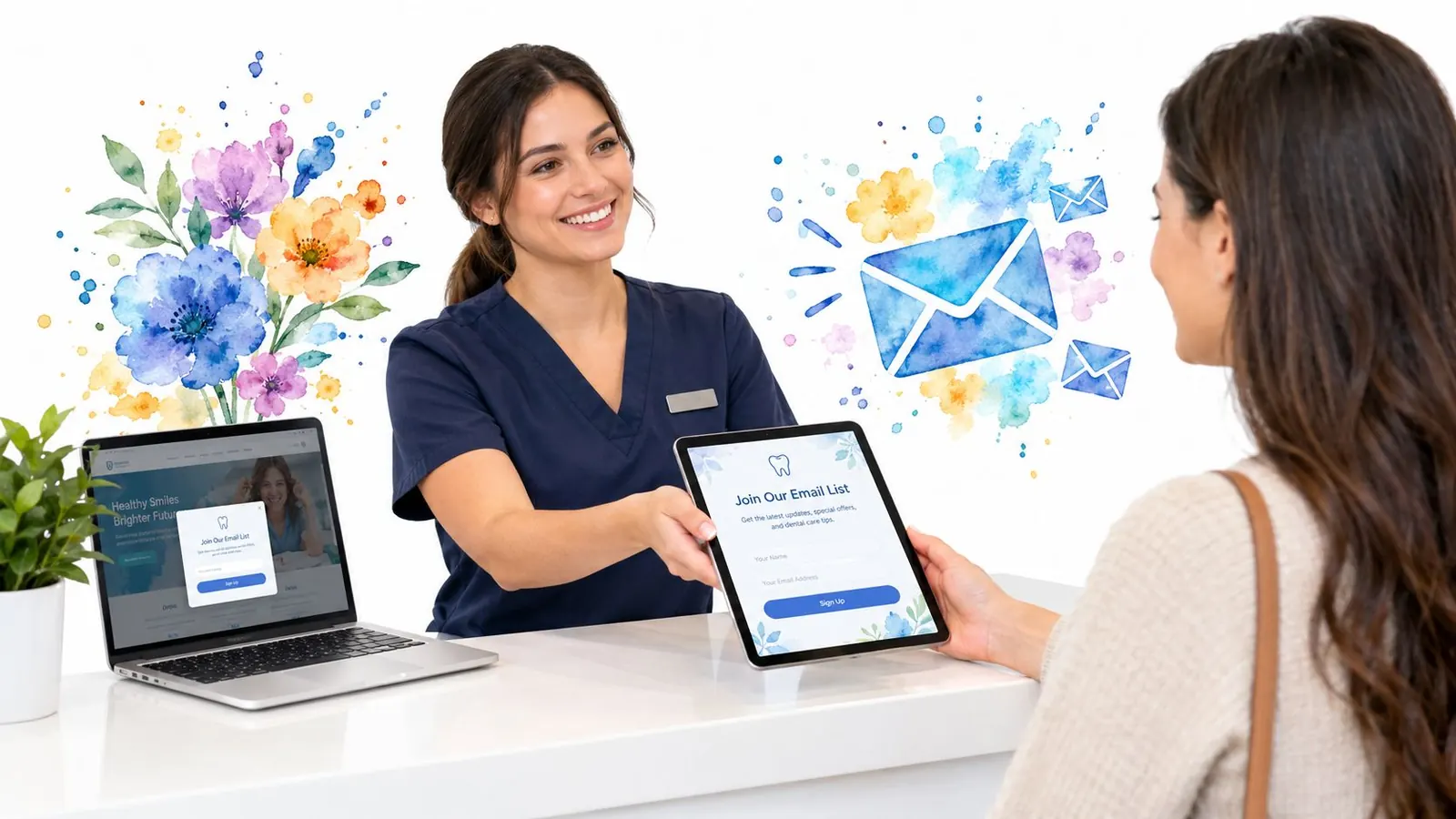
A clean list starts at the front desk, not with a purchased database. Ask every patient for an email address during registration, confirm that the address is accurate, and explain what types of communication they may receive. Keep marketing consent distinct from permission to receive operational messages.
A website form can invite visitors to receive oral health education, practice updates, or appointment-related information. After a visit, the practice can offer an optional subscription for general education and news. The language should be clear enough that a patient understands what they're agreeing to, and the practice should retain the consent record.
Start with useful fields
You don't need a complicated data model. Begin with information that changes what the patient should receive:
- Patient stage: New patient, active patient, overdue recall, or inactive patient.
- Care intent: Hygiene, restorative care, cosmetic interest, orthodontic education, or an unscheduled treatment plan.
- Appointment context: Upcoming appointment, cancelled appointment, missed appointment, or completed visit.
- Household relationship: Family member, individual patient, or guardian-managed communication.
- Communication preference: Email for marketing, email for operational updates, text, phone, or a combination.
Tag individuals rather than treating a family as one contact. A parent may manage appointments for children, but each person still has a different recall history and clinical relationship with the practice. Store the household connection separately so a family reminder doesn't produce confusing or inappropriate messaging.
Segment by intent and stage
A new patient needs orientation, not a reactivation message. An active hygiene patient benefits from a simple next-visit prompt. Someone with an overdue recall needs a direct booking invitation, while a patient who accepted a crown recommendation but hasn't scheduled may need educational reassurance and a conversation with the team.
Keep the marketing audience consent-based and remove invalid, disengaged, or unwanted contacts through a documented process. Good list hygiene helps protect sender reputation, which matters because repeated bounces and complaints can affect whether future messages reach the inbox.
Don't buy contacts to make the list look larger. A smaller audience with clear permission and meaningful segmentation gives the team better targeting, cleaner reporting, and fewer deliverability problems.
Automated Campaigns That Keep Chairs Full
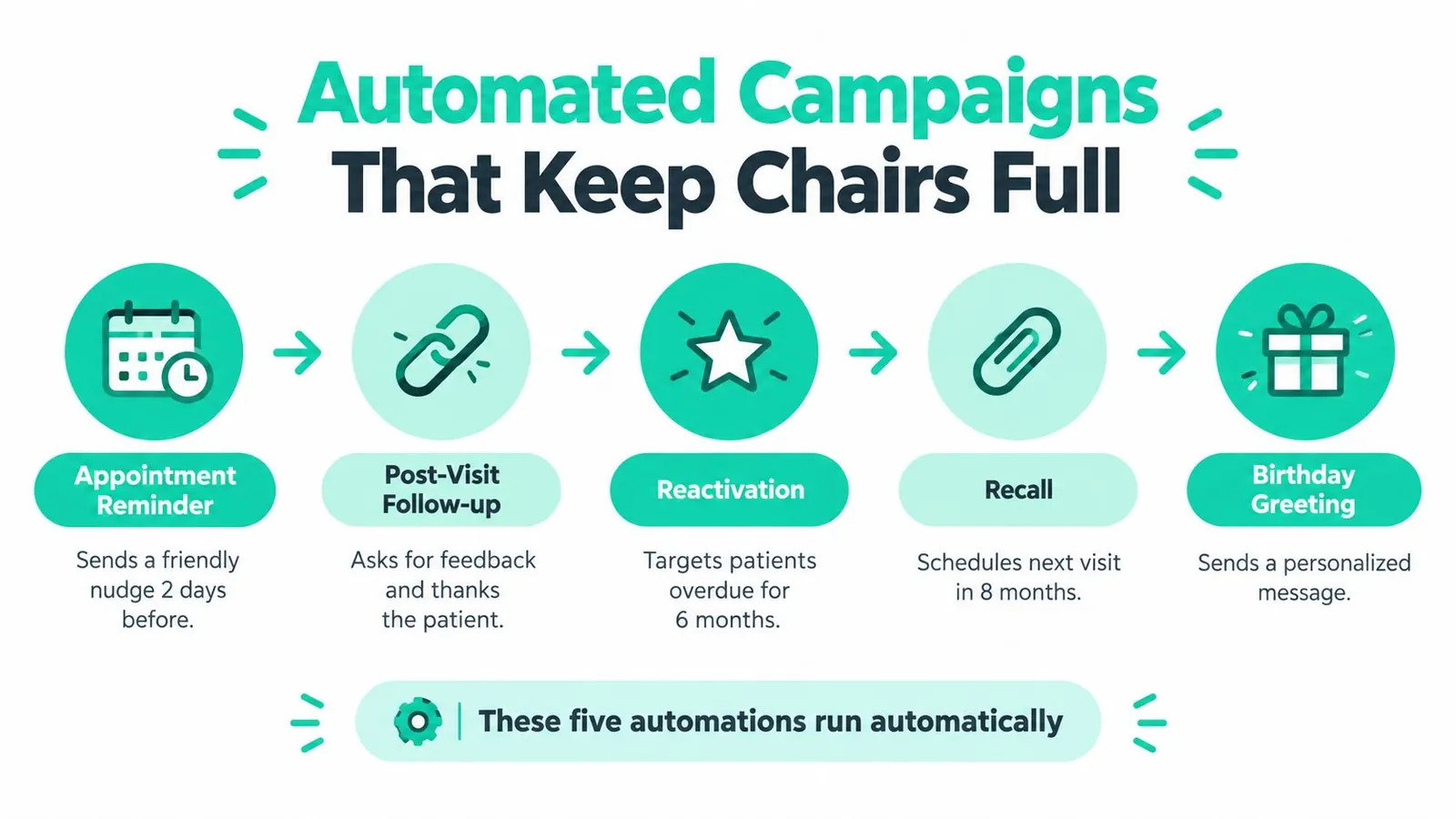
Automation works when the practice defines a trigger, a useful message, and one action. It fails when every patient enters the same sequence regardless of appointment status, treatment history, or consent.
Build the workflow around the practice management system. The system should tell the email platform when an appointment is created, changed, completed, cancelled, or missed, and when a recall interval has passed. Before building a large program, map each event and decide who owns exceptions.
1. Appointment confirmations and reminders
The trigger is a scheduled appointment. Send a confirmation immediately, then a reminder close enough to the visit that the patient can act on it. The CTA should be limited to confirming, rescheduling, or contacting the office.
A peer-reviewed study of 1,193 appointment reminders recorded no-show rates of 2.68% for email, 1.90% for SMS, and 3.49% for phone calls. It found no statistically significant difference among the three methods, while electronic reminders performed better than phone calls overall. The findings are available in this peer-reviewed appointment reminder study.
Don't include unnecessary treatment details in a standard marketing workflow. If a message contains patient-specific information, route it through the secured clinical communication process.
2. Hygiene recall
The trigger is a due or overdue recall status. The message should remind the patient why routine care matters, offer a clear booking path, and make it easy to contact the office. Avoid sending the same reminder indefinitely. After a defined sequence, move the patient to a human follow-up queue or suppress the campaign temporarily.
Family scheduling can work well when handled carefully. A household email might say that several family members are due for care, but the booking process should preserve each person's record and appointment details.
3. Reactivation
Reactivation targets patients who have stopped returning. Start with a helpful, low-pressure message that acknowledges the missed rhythm without blaming the patient. The CTA can be a booking request, a reply, or a call to the office.
A no-show should create a different path from a routine overdue recall. The front desk may need to resolve the missed appointment first, while the automation sends a brief invitation to reconnect. Don't send a generic promotional offer to someone who needs an easier way to reschedule.
For teams building a broader workflow, a practical step-by-step marketing automation guide can help organize triggers, conditions, and handoffs. A dental-specific implementation should still be reviewed by the practice team.
4. Post-visit education and feedback
The trigger is a completed appointment. Thank the patient, provide general aftercare or educational guidance where appropriate, and invite feedback. Keep patient-specific clinical instructions inside the approved secure system.
A review request can be the single CTA when the experience was positive. If the practice wants feedback first, link to a private feedback form rather than combining a survey, review request, newsletter subscription, and promotion in one message.
5. Low-frequency promotions
Promotions belong at the bottom of the priority list. Send them only when the offer is relevant to a defined audience, such as patients who have expressed interest in a service. A single-action email about whitening education should not also ask the recipient to follow social media, read three articles, and book a cleaning.
Practice teams that want support connecting strategy, content, and execution can review Leaping Lemur Media's services as one possible marketing resource.
Subject Lines and Templates Patients Actually Open
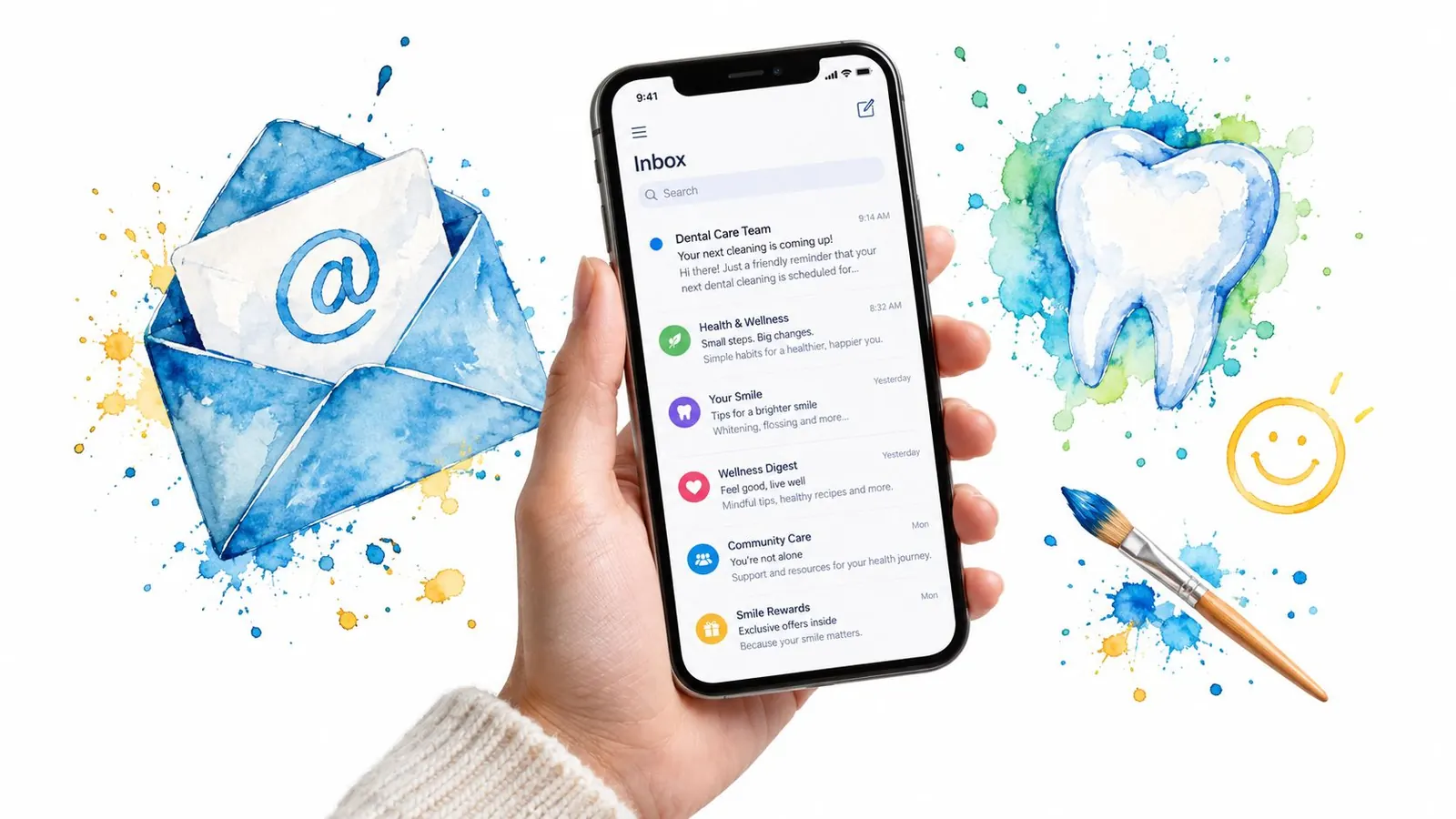
Good creative starts by matching the subject line to the patient's reason for receiving the message. A reminder should sound like a reminder. An educational email should promise useful clarity. A promotion should identify the service without disguising the commercial purpose.
Operational messages can be plain and specific:
- Appointment reminder: “Your dental appointment is coming up”
- Recall: “Ready to schedule your next cleaning?”
- Reactivation: “Would you like help finding a new appointment?”
- Post-visit: “How did your visit go?”
- Education: “What to know before choosing teeth whitening”
The preview text should complete the thought rather than repeat the subject line. For example, “Reply to this email or call the office if you need a different time” gives the patient a clear next step.
Use one compact structure
A reliable dental email template has four parts:
- Context: Explain why the patient is receiving the email.
- Value: Give one useful point, answer, or reassurance.
- Action: Ask for one next step.
- Human close: Sign the message from the practice or team member.
For Invisalign-style education, the value might be an explanation of how a consultation works, followed by a single invitation to request a consultation. For whitening, explain what the patient should ask before choosing a treatment, then link to the service page. For hygiene, answer a common question about maintaining a routine and invite the patient to schedule.
Make promotions simpler
Promotional messages usually perform better when the reader doesn't have to decode the offer. Use one primary image or none, short copy, one CTA, and a clear expiration or availability statement when applicable. Avoid stuffing a promotional email with unrelated practice news.
Benchmark context supports this distinction. Routine dental campaigns commonly show open rates around 28% to 34%, with click-through rates ranging from 1.75% to 7.31%, while unsubscribe rates are typically 0.06% to 0.25% when relevance is high, according to dental email marketing statistics.
Before sending a campaign, check rendering on a phone, confirm that the CTA works, and review the subject line for language that could appear misleading or overly aggressive. A spam word checker can provide an additional pre-send review, but it won't replace permission, accurate content, or sound list management. For broader content and practice marketing ideas, the Leaping Lemur Media journal offers another planning resource.
Scheduling Frequency and Measuring What Matters
Frequency should follow patient need, not a calendar that forces the team to send something every week. Appointment reminders run from appointment events. Recall messages follow due dates. Reactivation campaigns use a defined inactivity rule. Marketing newsletters and promotions should be less frequent and more selective.
The important measurement decision is to separate campaign types. A single newsletter average can hide a strong reminder sequence and a weak promotion, or make a useful educational email look unsuccessful because it isn't designed to drive immediate bookings.
| Campaign type | Primary objective | Useful measures |
|---|---|---|
| Appointment reminder | Attendance or completion | Confirmation, rescheduling, and attendance |
| Recall | Next hygiene visit | Booking and recall completion |
| Reactivation | Return of inactive patients | Replies, booking, and completed visits |
| Education | Patient understanding and interest | Click-through rate and service-page action |
| Promotion | Qualified service response | Click-through, conversion, and unsubscribe trend |
Healthcare benchmarks reported in 2025 show an average open rate of 22.6% and click-through rate of 2.8%, providing context for patient newsletters, recall campaigns, and educational emails. These figures are reported in healthcare email benchmarks for 2025.
Track the appointment outcome
Open rate is useful for diagnosing delivery and subject-line performance, but it isn't the business result. Mailbox privacy features can inflate opens, so the practice should connect email activity to scheduling and attendance wherever possible.
A practical dashboard can show:
- Attendance: Did the patient keep the appointment after receiving a reminder?
- Recall completion: Did an overdue patient schedule and complete care?
- Conversion: Did a treatment education email lead to a consultation or booking?
- Unsubscribe trend: Are certain campaigns creating avoidable fatigue?
- Revenue contribution: Which completed hygiene or treatment appointments can be associated with an email touch?
Test one variable at a time
A small practice doesn't need a complex experimentation program. Test one subject line against another, compare two send windows, or change the CTA from “Book online” to “Reply to our team.” Keep the audience and offer consistent enough that the result is interpretable.
Run tests on a campaign type with a clear outcome. For reminders, measure attendance or rescheduling. For reactivation, measure booked and completed visits. For education, evaluate clicks and subsequent inquiries instead of expecting every reader to book immediately.
If a campaign generates opens but no bookings, check the landing page, scheduling friction, CTA clarity, and segment definition before rewriting the entire email. If unsubscribes rise, reduce promotional frequency and return to value-led communication.
Staying Compliant and Connected Without the Headaches
Many dental teams assume that adding a HIPAA-compliant label to an email platform solves the problem. It doesn't. The practice must understand what information the message contains, who has consented to receive it, which system sends it, and whether the provider has agreed to handle the information appropriately.
Marketing email should remain general and consent-based. A newsletter about brushing technique, a practice update, or a broadly described service can sit in the marketing workflow. Patient-specific treatment details, diagnoses, clinical instructions, or sensitive appointment information belong in an approved secure communication system.
Set the technical baseline
For a healthcare or dental program that exchanges patient information, require:
- A signed business associate agreement: The provider should support a BAA. Standard consumer email setups don't satisfy that requirement by default.
- Encryption: Use encryption in transit and at rest, with configuration reviewed rather than assumed.
- Multifactor authentication: Require MFA for every staff account handling patient communication.
- Role-based access: Give staff access only to the lists and systems their work requires.
- Separated workflows: Keep marketing automation apart from clinical messaging.
HIPAA-oriented guidance for dentists also warns that default platform encryption may be insufficient without additional configuration. The dental email compliance guidance provides benchmark context and reinforces the need to evaluate security controls separately from marketing performance.
Follow promotional email rules
For U.S. promotional campaigns, CAN-SPAM requires accurate sender information, a subject line that matches the content, a visible unsubscribe mechanism, prompt handling of opt-out requests, and a valid physical business address. If the list includes subscribers in the EU, GDPR requires explicit consent before sending marketing email. The email marketing compliance guidance for dentists outlines these requirements.
Integrate the email platform with the practice management system only after defining data ownership and permission rules. A completed visit should trigger the correct follow-up, a cancelled appointment should stop an irrelevant reminder, and an opt-out should suppress marketing without blocking necessary operational communication.
Review your privacy and data-handling practices alongside the Leaping Lemur Media privacy policy as part of a broader compliance conversation. The goal isn't to send more messages. It's to send the right message, to the right consenting patient, through the right system, with a clear operational reason.
Leaping Lemur Media helps dental practices build segmented email campaigns, patient nurture sequences, content, and reporting that reflect the practice's voice and priorities. Visit Leaping Lemur Media to discuss a practical email marketing system designed to support retention, reactivation, and fuller appointment books.
Running a dental practice? See our dental marketing services.