

A parent searches for a family lawyer late at night after a sudden separation. On a phone screen, several firms look similar. One has a clear service page and recent reviews. Another has a slow website and no obvious way to call. A third promises aggressive results but says little about process, safety, or communication.
The first firm to answer may not be the firm with the largest office. It may be the one that makes the next step feel safe and straightforward. Visibility gets the firm considered. Trust signals make the prospect pause. Fast, respectful follow-up earns the call.
That is the practical center of family law firm marketing in 2026. The strongest system connects local search, useful education, paid campaigns, reputation management, mobile intake, community relationships, video, and lead follow-up. Each tactic should meet a prospect at a specific moment while protecting confidentiality, avoiding misleading claims, and respecting the emotional pressure behind the inquiry.
Table of Contents
- 1. Local SEO and Google Business Profile Optimization
- 2. Educational Content Marketing and Practice Area Resources
- 3. Google Ads and Pay-Per-Click Search Campaigns
- 4. Online Review Generation and Reputation Management
- 5. Website Design and Conversion Optimization for Intake
- 6. Community Engagement and Referral Partnerships
- 7. Video and Social Media Storytelling
- 8. Lead Intake Follow-Up and Email Nurture Sequences
- Family Law Firm Marketing: 8-Point Strategy Comparison
- Turning Eight Tactics Into a Ninety-Day Plan
1. Local SEO and Google Business Profile Optimization
A parent searching “divorce attorney near me” or “child custody lawyer [city]” may need a safe next step immediately. Local visibility helps your firm appear during that search. A well-managed Google Business Profile can support map results and traditional search, provided it accurately describes the firm, office location, and services.
Google identifies relevance, distance, and prominence as primary local ranking factors. Relevance reflects how closely the profile matches the query. Distance considers the searcher's location. Prominence may be shaped by information across the web, including links, directories, articles, review count, and review score. Google's explanation of local ranking factors also makes clear that no firm can guarantee a top position.
Build a profile that reduces uncertainty
Complete the profile with care. Choose accurate categories, such as Family Law Attorney and Divorce Lawyer, and list services including mediation, prenuptial agreements, and custody modification. Keep the firm name, address, and phone number consistent across legal directories and local listings.
For a multi-office firm, create a separate profile and location page for each eligible office. Include attorney bios, office details, local court information, parking guidance, and the communities served. A solo practitioner can compete by answering reviews thoughtfully and publishing useful local content, rather than trying to match a larger firm's scale.
Use genuine office and team photos. Stock images may make a sensitive practice feel distant. Post profile updates at least twice a month, covering FAQs, office news, community events, or common process questions. Audit directory information quarterly with tools such as BrightLocal or Whitespark.
Practical rule: Never confirm that someone is, or was, a client in a review response. A warm, general reply can protect privacy.
Request genuine reviews after an appropriate service milestone, and check your jurisdiction's requirements first. Before requesting reviews, confirm your state bar's rules on client solicitation and testimonial use, since several states impose stricter limits than Model Rule 7.1. The ABA Model Rule 7.1 guidance provides relevant guidance on communications about legal services.

2. Educational Content Marketing and Practice Area Resources
At midnight, a parent may not be ready to call. They may first search, “How is child support calculated?” or “What happens to retirement accounts in a divorce?” A plain-language answer can reduce anxiety and show that your firm understands the question behind the search.
Educational content should follow the client journey. Start with first questions about divorce, custody, support, mediation, and safety. Then publish resources for comparing options, preparing for a consultation, and understanding what happens after a case begins. A state-specific guide to the stages of a contested divorce can become a durable reference when it explains the process without promising a particular result.
Write for a worried reader
Use direct headings that resemble real questions. Answer the central question early, then explain exceptions, preparation steps, and jurisdictional differences. Define legal terms the first time they appear. A strong article might explain the difference between legal custody and physical custody, identify documents a prospective client may gather, and state clearly that the answer depends on local law and individual facts.
Content can also support referral conversations. A therapist, mediator, financial professional, or community organization can share a useful guide without endorsing a guaranteed outcome. Attorney publishing networks such as LexBlog's legal publishing platform can also be considered as part of a broader publishing and visibility strategy.
Every resource needs a clear next step. Offer a consultation invitation, a secure contact option, or a downloadable preparation guide. Place an informational disclaimer where appropriate, explaining that the material isn't legal advice and doesn't create an attorney-client relationship.
Avoid writing only for search engines. A long article filled with generic phrases won't help a parent decide whether your firm is a safe fit. Explain how the firm communicates, which matters it handles, where it serves clients, and what a first conversation involves.

3. Google Ads and Pay-Per-Click Search Campaigns
At 11 p.m., a parent searches “emergency custody attorney” from a phone. That searcher needs a clear, trustworthy next step, not a generic promise. Google Ads can reach high-intent prospects while organic visibility develops, but paid search also exposes weak copy, poor intake, and unclear targeting quickly.
Build separate campaigns for divorce, child custody, mediation, and prenuptial agreements. Match each campaign to a relevant landing page, call to action, negative-keyword list, and intake question. This structure helps the firm shift budget toward practice areas that produce qualified consultations instead of treating every click as equally valuable.
Control spend before expanding
Start with exact and phrase match keywords, then review search-term reports weekly. Add negative keywords for employment searches, free forms, unrelated jurisdictions, law school queries, and matters the firm does not handle. The goal is to reduce wasted spend while keeping sensitive searches connected to an appropriate response.
A mobile visitor may call immediately, while another submits a consultation form. Use call tracking and form attribution to follow the path from search term to inquiry, consultation, retained matter, and eventual outcome. Configure recordings and form-data handling carefully. Family law inquiries can contain highly sensitive information, so measurement should not collect more than the firm needs.
Start with a conservative budget. Increase it only after conversion tracking works and intake staff can respond promptly. An ad that generates a call nobody answers buys frustration instead of trust.
Before launch, have a lawyer review the copy against state advertising rules. Avoid claims such as “best lawyer,” guaranteed custody results, promises to win, or vague outcome assurances. Review the complete presentation, including disclaimers and landing-page context, rather than checking isolated phrases only.
A marketing partner can provide law firm services such as SEO, PPC, content, and web strategy. The firm should retain control over legal accuracy, ethical review, and messaging that could affect a vulnerable client's decisions.
4. Online Review Generation and Reputation Management
A person searching for help with divorce or custody late at night is looking for more than a star rating. Reviews can reveal whether a firm communicates clearly, prepares clients, shows empathy, and treats sensitive matters with dignity. They may influence the decision to call, but reputation management should focus on trust and useful feedback, not review volume.
A 2024 U.S. survey of 2,000 adults who had experienced a legal need within the previous year found that 82% of respondents who contacted an attorney after discovering them online used online reviews in their decision-making. Nearly 40% identified reviews as their primary information source. The findings appear in FindLaw's 2024 consumer legal needs survey.
Ask ethically and respond carefully
After a meaningful milestone, such as a closed matter or completed mediation, invite voluntary feedback if the timing feels appropriate. Do not offer discounts, gifts, or other incentives. Do not pressure a client to describe custody, support, settlement, or other private outcomes.
A mobile prospect may read a review before calling, so responses should remain calm and general. Thank a positive reviewer without confirming representation. For criticism, acknowledge the concern without discussing facts. Invite private contact only when the wording does not suggest a confidential relationship.
The FTC says testimonials must reflect the endorser's honest opinion, experience, or belief. An endorsement also cannot make a claim the firm could not legally make itself. The FTC's endorsement guidance applies when a testimonial mentions results or sensitive family-law issues. Have counsel review the process against applicable bar rules.
Monitor Google, Avvo, Yelp, and relevant social platforms. Track recurring themes, not only ratings. A pattern of complaints about missed calls points to an intake problem that can affect a distressed prospect before any attorney speaks with them. Use that feedback to improve response procedures while protecting client confidentiality.
5. Website Design and Conversion Optimization for Intake
The first mobile visit often happens when a prospect is stressed, distracted, and comparing several firms. Your website has a short window to answer basic questions. Do you handle this matter? Do you serve this location? Can I reach a person? Will my information be treated carefully?
Put the phone number and consultation button above the fold on every important page. Keep the path to contact short. A three-field form and click-to-call option may be more appropriate than a long intake questionnaire on a first visit. Detailed screening can happen after the firm establishes a secure and suitable communication channel.
Make reassurance visible
Use attorney bios that explain experience without inflated claims. Add office photos, service-area information, clear practice descriptions, and reviews that have been published with proper permission. A short introduction from the lead attorney can make the firm feel more human, especially for someone who fears being judged.
Write headlines around the situation, not the firm's internal vocabulary. “Facing a Custody Dispute? Here's What to Do Next” is clearer than a slogan that says little about the prospect's problem. Explain what happens after someone submits a form, who reviews it, and what the form does not create.
Test mobile speed with Google PageSpeed Insights. Compress images and remove scripts that don't support intake or accessibility. Include a privacy-focused message near forms, but don't promise absolute confidentiality if the form isn't designed for sensitive information.
A separate reference on conversion benchmarks for criminal defense sites can provide ideas for website measurement, but family law firms should interpret any benchmark cautiously and prioritize their own consultation and retention data.

When the page is ready, direct prospects to a clear family law contact path with expectations about response time and urgent situations.
6. Community Engagement and Referral Partnerships
A therapist may hear a client ask what happens next. A financial advisor may recognize that someone needs guidance about separating assets. A pediatrician, pastor, mediator, CPA, real estate agent, or community advocate may become the first trusted person a family member approaches during a stressful transition.
Referral relationships work when the firm offers value before requesting introductions. Host an educational session with a family therapist on co-parenting and custody basics. Speak at a support group without turning the event into a sales pitch. Volunteer with a legal-aid organization to learn which questions people struggle to answer before contacting private counsel.
Build relationships without compromising independence
Create a focused list of complementary professionals in the communities the firm serves. Schedule introductory conversations and ask what clients bring to them, which resources they use, and where people become confused. Then offer a useful guide, presentation, or referral pathway that respects the professional's role and the family's circumstances.
A quarterly webinar with a local therapist can help both professionals explain their roles while keeping legal and therapeutic advice separate. A firm can also share a plain-language resource with organizations serving survivors, older adults, rural families, or people who need language support. Keep examples general and protect anyone who may be identifiable through a sensitive family situation.
Track the source of every inquiry in the intake system. Record whether the person came from a therapist, mediator, event, community organization, or former client. This shows which relationships produce appropriate consultations, rather than merely which contacts remain active.
Review state rules before formalizing any referral arrangement. Model Rule 5.4 and its state analogues restrict some paid referrals, reciprocal referrals, and fee sharing with nonlawyers. Put the arrangement in writing only after confirming that its structure, communications, and professional independence meet applicable requirements.
7. Video and Social Media Storytelling
Before calling, many prospects want to see how an attorney explains difficult information. A short video about a first custody mediation session can answer a practical question while giving the viewer a sense of the lawyer's tone. That matters when the prospect is worried about conflict, privacy, or being dismissed.
Use each platform for a clear purpose. YouTube can host longer explainers. Instagram and Facebook can distribute short educational clips and community updates. LinkedIn can support professional visibility among financial planners, therapists, mediators, and other referral partners.
Protect the people behind the content
Batch-record several short videos in one session. Topics might include what to bring to a first meeting, what mediation does and doesn't do, how custody terminology works, or how someone can prepare questions for counsel. Add captions because many people watch without sound.
Keep short-form videos concise and reserve deeper explanations for YouTube. A polished studio isn't necessary. A quiet office, accurate script, good lighting, and a calm delivery usually matter more than production effects.
Never show case files, names, court documents, or recognizable client details. Obtain written consent before featuring any client story, and confirm that the story doesn't reveal confidential information. The ABA's family-law ethics guidance emphasizes the confidentiality risks that social media can create.
The same standard applies to comments and direct messages. Don't answer individualized legal questions publicly. Invite the person to use a suitable intake channel, and explain that social media messages aren't a substitute for representation.
For measurement ideas, review this guide to measuring video marketing ROI, then connect views to website visits, inquiries, consultations, and source-attributed outcomes rather than celebrating reach alone.
8. Lead Intake Follow-Up and Email Nurture Sequences
The missed call is a critical moment. A prospect may have contacted several firms, and silence can feel like rejection. A missed-call text-back, a clear voicemail process, and a human follow-up can preserve the opportunity without turning a vulnerable person into an automated sales record.
Clio's 2019 consumer research surveyed 2,000 consumers alongside 2,507 legal professionals. Among consumers who had recently sought a lawyer, 59% asked for a referral, while 57% searched independently. The research also found that 82% identified response timeliness as the most important factor when looking for a lawyer. The cited summary of Clio's consumer research supports treating response time as part of marketing, not merely administration.
Design the handoff from automation to people
Set a target of responding within one business hour, and sooner whenever possible. The first response should confirm receipt, explain the next step, and provide a safe way to continue. It shouldn't give individualized legal advice or imply that representation has begun.
A CRM such as Clio Grow, Lawmatics, or HubSpot can track the inquiry from first contact through consultation and outcome. Use fields for source, practice area, jurisdiction, response time, missed calls, booking status, and disposition. Keep access limited and review data-retention practices before sending sensitive information through any system.
A gentle email sequence may include a practice-area guide, consultation logistics, and a reminder. Keep the tone personal. Don't create artificial urgency, repeatedly pressure someone, or continue messages after an unsubscribe request. Include an unsubscribe option and follow applicable state and federal solicitation rules.
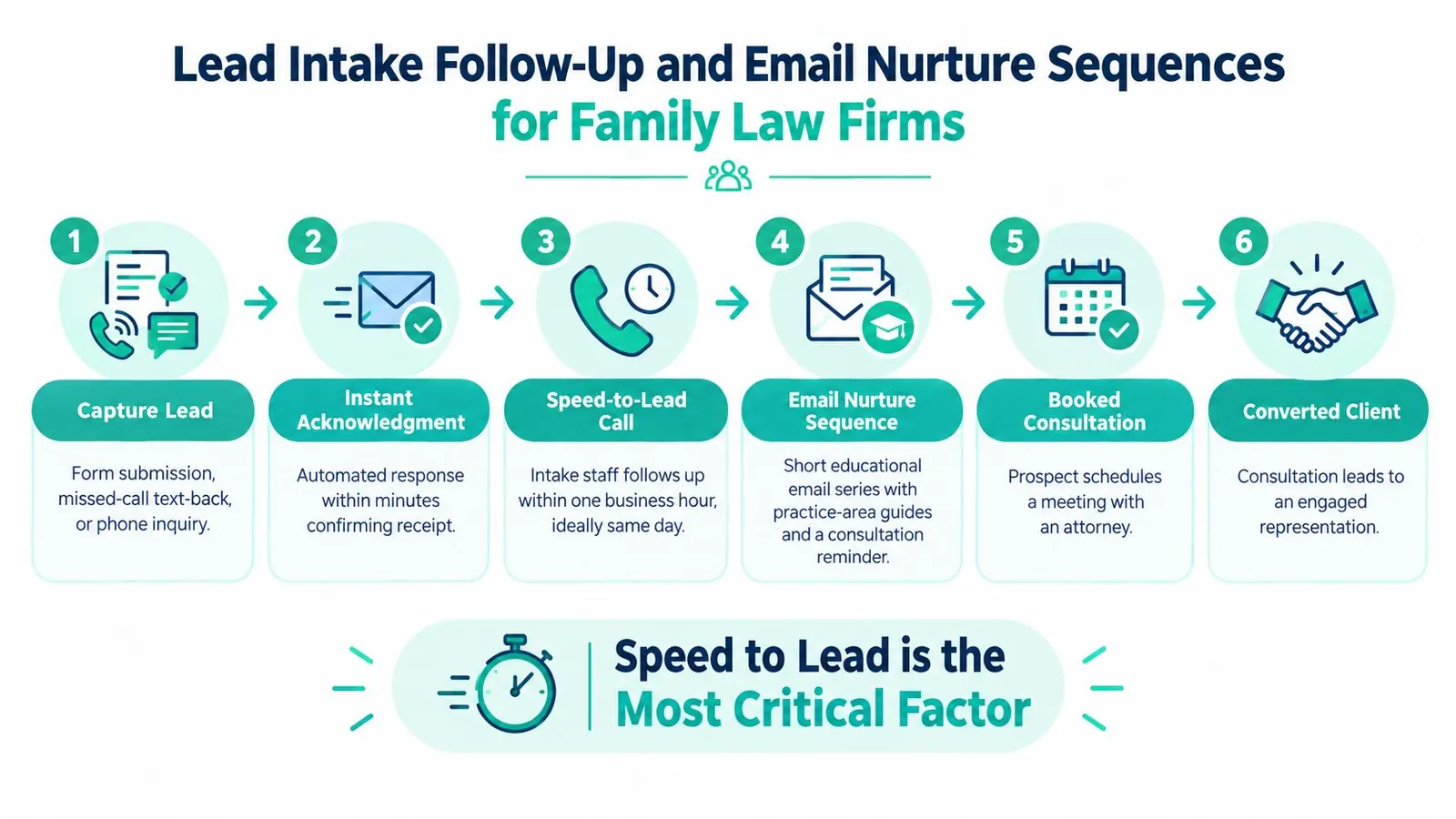
Automation should handle scheduling and office logistics. A trained person should handle safety concerns, urgent custody issues, conflict disclosures, and individualized questions. The legal virtual assistant resource may help firms think through administrative capacity, but technology can't replace professional judgment or a compassionate conversation.
Family Law Firm Marketing: 8-Point Strategy Comparison
| Strategy | Implementation Complexity 🔄 | Resource Requirements ⚡ | Expected Outcomes & Impact 📊 | Effectiveness/Quality ⭐ | Ideal Use Cases 💡 |
|---|---|---|---|---|---|
| Local SEO and Google Business Profile Optimization | Medium, GBP setup, citation audits, ongoing maintenance | Low–Medium, time, citation tools, occasional content | Increased map-pack visibility and high-intent local leads; typical timeline 3–6 months | ⭐⭐⭐⭐, very effective for nearby searches | Firms serving defined geographic areas; urgent local-intent queries |
| Educational Content Marketing and Practice Area Resources | Medium–High, content strategy, editorial workflow | Medium, writers, SEO, time for ongoing publishing | Builds topical authority and organic traffic over time; supports other channels | ⭐⭐⭐⭐, strong for trust and organic growth | Firms prioritizing education, lead qualification, and SEO depth |
| Google Ads and Pay-Per-Click Search Campaigns | Medium, campaign setup, compliance monitoring, optimization | High, significant ad spend, PPC specialist, landing pages | Immediate visibility and measurable leads; higher CPL in competitive markets | ⭐⭐⭐, fast visibility but costly and variable lead quality | Time-sensitive lead generation; testing messaging; competitive metro markets |
| Online Review Generation and Reputation Management | Low–Medium, workflows for requests and responses, monitoring | Low–Medium, automated tools, staff time for responses | Boosts trust and local rankings; improves conversion from searchers | ⭐⭐⭐⭐, critical trust signal for sensitive practices | Firms needing credibility improvements and stronger local presence |
| Website Design and Conversion Optimization for Intake | Medium–High, UX, CRO testing, secure forms | Medium–High, design/dev, CRO tools, content updates | Higher conversion rates across channels; faster first-contact outcomes | ⭐⭐⭐⭐, multiplies ROI from other marketing efforts | Firms with traffic but low conversions; mobile-heavy audiences |
| Community Engagement and Referral Partnerships | High, relationship building, events, ongoing outreach | Low–Medium, time, event sponsorships, travel | High-quality, high-trust referrals; slow-to-measure long-term gains | ⭐⭐⭐⭐, excellent for referral quality and reputation | Relationship-driven practices; community-rooted firms |
| Video and Social Media Storytelling | Medium, planning, production, platform strategy | Medium, equipment, editing time, content cadence | Humanizes attorneys, builds familiarity; indirect lead impact | ⭐⭐⭐, great for awareness and reassurance, harder to track ROI | Firms wanting to personalize brand and educate visually |
| Lead Intake Follow-Up and Email Nurture Sequences | Medium, CRM setup, automation, staff training | Medium, CRM/software, trained intake staff or VA | Faster response → higher consultation-to-client conversion; quick wins | ⭐⭐⭐⭐, high impact on conversion when executed promptly | Firms losing leads to slow response or with high inquiry volume |
Turning Eight Tactics Into a Ninety-Day Plan
Don't launch every channel at once. Start with the two points where a family law firm most often loses an otherwise qualified prospect: local visibility and response speed.
During the first phase, audit the Google Business Profile, directory information, location pages, call handling, form delivery, voicemail, and after-hours process. Call the firm as a prospective client would. Test the mobile website. Submit a form. Track how long it takes to receive a useful response and whether the next step is clear.
Also review the profile for accuracy. Confirm the primary category, services, hours, office locations, photos, and review responses. Remove language that promises outcomes or uses unsupported superlatives. Check every page for jurisdiction, practice-area, and contact information.
The next phase should add useful content and a deliberate review process. Choose questions that prospects already ask about divorce, custody, support, mediation, safety, or preparation for a consultation. Give each resource a specific location and jurisdiction where necessary. Add a clear disclaimer and a respectful contact option.
Ask for reviews only through an ethical process. Don't edit a client's words to create a stronger result claim. The FTC's endorsement guidance requires honest opinions and disclosures when a material connection could affect how people evaluate an endorsement. Client permission and confidentiality remain essential even when a testimonial is genuine.
Then build community relationships. Contact therapists, mediators, financial professionals, CPAs, pastors, pediatricians, real estate agents, and community organizations. Offer education before requesting referrals. Record every referral source in the intake system so the firm can compare channels by qualified consultation, retained matter, and fit.
Paid search and video can follow once the foundation is stable. Review ad copy with counsel before launch. Make sure conversion tracking distinguishes calls, forms, booked consultations, and actual outcomes. A firm shouldn't increase ad spend just because clicks rose.
Finally, decide what the firm will not automate. A chat tool may schedule a consultation or explain office hours. It shouldn't give legal advice, collect unnecessary sensitive facts, or create confusion about whether an attorney-client relationship exists. Publish clear expectations about response times, data handling, and communication channels.
Family law firm marketing works best as a connected system. Search gets the firm found. Content explains the problem. Reviews and community relationships build trust. The website makes contact easier. Intake determines whether that trust becomes a conversation. Measure each step, review compliance before publishing, and use the data to improve the client experience rather than chase attention for its own sake.
Leaping Lemur Media offers SEO, PPC, content, web design, social media, email marketing, and brand strategy for firms that want their marketing to sound human and serve their communities responsibly. Visit Leaping Lemur Media to explore a thoughtful partner for building a clearer, more trustworthy family law marketing system.