
Your schedule looked healthy a few months ago. Now a Tuesday has open exam slots, the front desk is waiting for the phone to ring, and your practice is competing with national optical brands, nearby clinics, and every “eye doctor near me” result on Google. Posting more often on social media may build awareness, but it won't necessarily reach the person actively trying to book an appointment today.
That's where Google Ads for optometrists earns its place. The channel can connect a specific service, a nearby searcher, and a measurable appointment action, but only when the account is built around patient intent and first-party tracking. Generic campaigns may generate clicks. A segmented system is far more likely to show which searches produce calls, forms, directions, and completed bookings.
Table of Contents
- Why Google Ads Works So Well for Optometry Practices
- Building an Account Structure That Matches Patient Intent
- Choosing Local and Service Keywords That Drive Appointments
- Writing Ads Targeting Bids and Budgets That Convert
- Landing Pages Tracking and Reporting That Prove ROI
- Ongoing Optimization That Keeps Costs Low and Schedules Full
Why Google Ads Works So Well for Optometry Practices
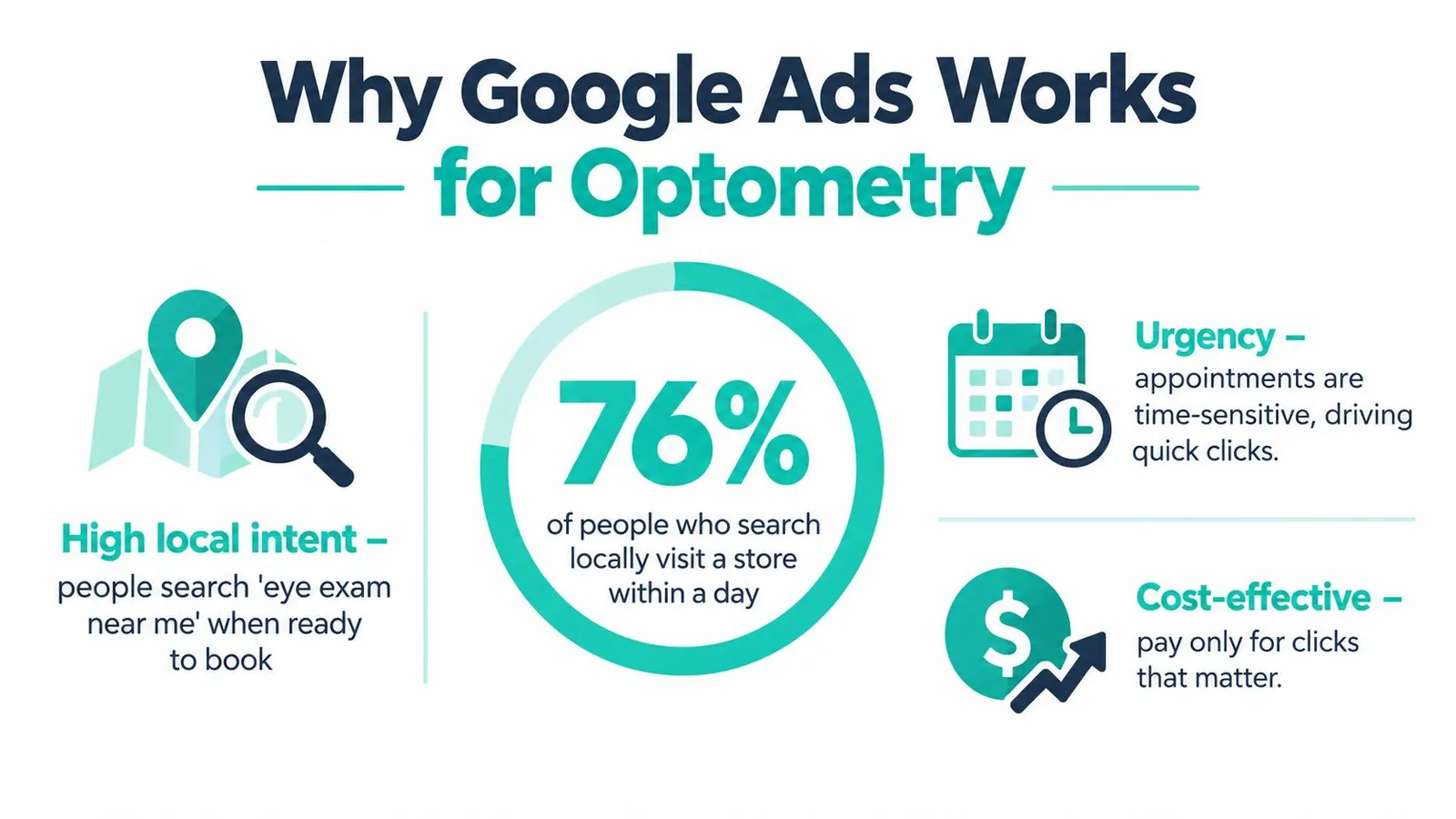
A patient searching for “eye exam near me” isn't browsing casually in the same way someone reading a general eye-health article might be. They may be comparing appointment availability, location, insurance information, or reviews. Your ad appears at the moment that need becomes active, which makes paid search a direct-response channel, not merely a branding placement.
Local relevance strengthens that relationship. A 2026 industry roundup reported that 46% of Google searches have local intent, while 76% of mobile local searchers visit a business within 24 hours. The same roundup reported that 88% call or visit after a local search the same day, and 64% of smartphone users contact a business within one hour. These figures come from the 2026 local search statistics roundup, and they explain why proximity, clear service pages, and fast booking paths matter so much.
Relevance beats broad exposure
Google's advertising platform developed around relevance, intent, and measurable interaction. Its modern search-ad model traces back to AdWords, which launched on October 23, 2000 with about 350 advertisers in a managed-service beta. Google opened the system to self-service advertisers in 2001, introduced pay-per-click bidding in 2002, added Quality Score in 2005, and rebranded AdWords as Google Ads in June 2018. By 2022, Expanded Text Ads had been deprecated and Responsive Search Ads had become the standard search format. The history of Google Ads shows why the platform fits local, appointment-driven services so well.
A practice benefits most when it has a defined service area, a reliable phone or booking workflow, and landing pages that match the search. It won't fix an unanswered phone, a confusing scheduler, or a homepage that forces visitors to hunt for eye-exam information.
Practical rule: Pay for the opportunity to be chosen, then make choosing your practice easy.
Your Google Business Profile, reviews, hours, directions, and service pages still influence whether a paid click turns into a patient. Google Ads can create immediate visibility, but the rest of the local experience has to support the promise in the ad. For more perspective on building a connected marketing system, explore the Leaping Lemur Media journal.
Building an Account Structure That Matches Patient Intent
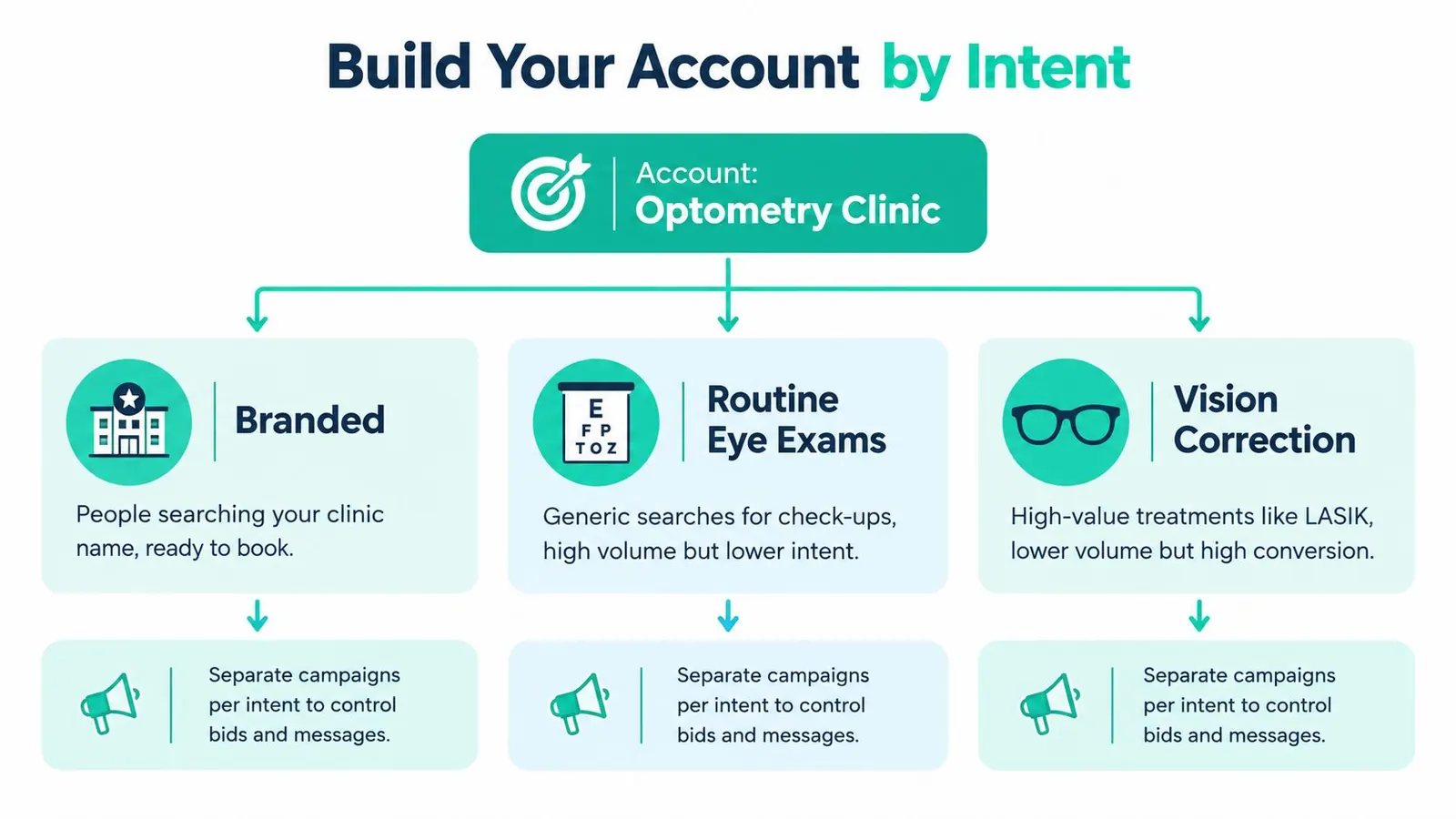
The most expensive structural mistake is treating every eye-care search as if it has the same value. Someone searching your practice name is different from someone researching dry eye symptoms, and both behave differently from someone looking for frames. Their ad copy, landing page, conversion value, and bidding target shouldn't be blended together.
Start with separate campaigns for the major intent tiers:
| Campaign | Typical searcher | Primary goal |
|---|---|---|
| Branded | Searching your practice name or doctor name | Capture existing demand efficiently |
| Routine exams and vision correction | Looking for an eye exam, contact-lens fitting, or glasses-related service | Generate appointment enquiries |
| Specialty care | Searching for dry eye, pediatric care, myopia management, or a specific condition | Match a focused need to a focused page |
Give each campaign a job
A branded campaign protects the demand your other marketing creates. Use ad groups for the practice name, doctor name, and location variations, then send traffic to a page with the phone number, booking button, address, hours, and trust signals immediately visible.
Routine exam campaigns need tighter themes than one large “eye doctor” ad group. Separate exams, contact-lens fittings, pediatric exams, and vision-correction services when the pages and messages differ. A patient looking for a child's exam shouldn't land on copy centered on adult contact lenses.
Specialty campaigns deserve their own economics. Condition-specific searches can have stronger motivation but require careful wording, accurate clinical information, and compliant audience settings. Google's personalized advertising policy treats health as a sensitive interest category, including health-related services and conditions, so targeting should focus on the user's search intent rather than inferred medical identity. The Google personalized advertising policy explains the restriction and provides the defined process for editing or appealing a disapproved ad.
Use a scalable naming and matching system
A clean naming convention makes reporting usable:
- Campaign: Location, intent, service, and network.
- Ad group: One tightly related query theme.
- Ad: Benefit-led message matched to that theme.
- Landing page: The page that completes the same patient task.
Use exact and phrase match for high-intent terms while the account gathers reliable search-term data. Broad expansion can come later, but only after you know which queries produce qualified actions. Negative keywords should be managed at both campaign and account level, with care around terms that may be useful for one service but wasteful for another.
Google Ads now relies on Responsive Search Ads rather than the former Expanded Text Ad format. Build multiple headlines and descriptions around the same patient need, then review which combinations appear alongside meaningful conversion actions, not just clicks.
Choosing Local and Service Keywords That Drive Appointments
Keyword selection should begin with the appointment someone wants, not the clinical vocabulary your practice uses internally. Patients may search for “eye exam near me,” “contact lens fitting,” “pediatric eye doctor,” or “dry eye treatment,” while your website may describe the same services using different language. Build the account around the words that connect a local need with an action.
A useful keyword has three ingredients: service intent, geographic relevance, and a realistic path to booking. “Eye exam [city]” is usually more actionable than “what is an eye exam.” “Contact lens exam near me” has a clearer commercial purpose than “contact lens information.”

Build themes around services
Create a separate ad group when the search requires a distinct promise or destination:
- Eye exams: eye exam, routine eye exam, eye doctor appointment, eye exam near me.
- Contact lenses: contact lens exam, contact lens fitting, optometrist for contacts.
- Pediatric care: children's eye exam, pediatric optometrist, eye doctor for kids.
- Dry eye care: dry eye optometrist, dry eye consultation, eye care for dry eyes.
- Vision correction: vision correction consultation, refractive consultation, glasses prescription update.
Don't assume that adding “near me” is the only way to capture local demand. Searchers may use a city, neighborhood, landmark, or no location modifier at all while Google still interprets the query locally. Your location settings, ad relevance, Google Business Profile, and landing page must reinforce the service area together.
Filter curiosity and low-value traffic
Negative keywords protect the budget, but they need to reflect your actual business model. Common candidates may include terms related to jobs, training, homework, definitions, symptoms research, free services, or products you don't sell. Eyewear shoppers require special care. If your campaign is designed to book exams, searches for frames, sunglasses, repair, or online glasses may be poor matches, yet those terms could belong in a separate retail campaign.
Review the search terms report frequently. Add negatives based on actual irrelevant queries rather than guessing blindly, and keep a shared record so exclusions don't become inconsistent across campaigns. A practical resource for teams learning how to structure negative keyword lists can help organize that process.
Every ad group should lead to a page that uses the same service language. A dry-eye search should not land on a generic home page, and a contact-lens query shouldn't require three clicks before the patient finds the booking option. Relevance improves the visitor experience and gives Google clearer signals about the relationship between query, ad, and destination.
Writing Ads Targeting Bids and Budgets That Convert
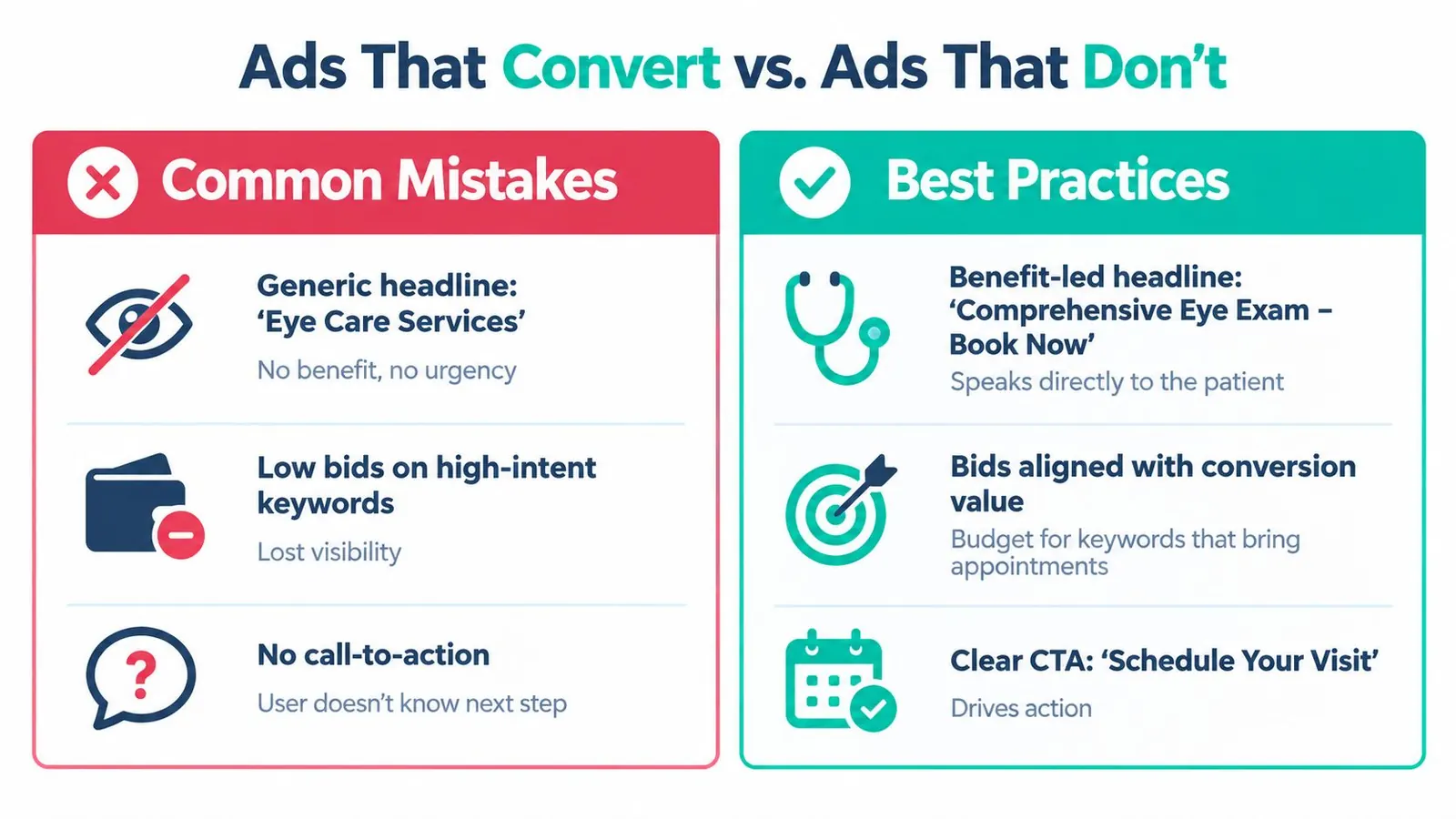
A strong optometry ad answers three questions quickly: Can you help me, are you nearby, and what should I do next? “Eye Care Services” answers none of them. “Eye Exam in [City], Schedule Your Visit” gives the searcher a service, location, and next step.
Use Responsive Search Ads to test messages such as:
- Eye Exams Near You
- Convenient Appointments for Adults and Children
- Contact Lens Fittings With a Local Optometrist
- Book Your Eye Exam Today
- Call Our Friendly Optometry Team
Don't promise availability you can't support. If same-day appointments, insurance acceptance, or specific clinical services are real and current, state them accurately. Otherwise, use dependable benefits such as convenient location, experienced staff, family care, or online booking.
Match the ad to the conversion value
The benchmark picture isn't uniform. One 2026 optometry dataset reports $2.04 CPC, a 5.60% conversion rate, and a $36.40 CPA, while another optometrist benchmark places average CPC at $3.65 and CPA between $55 and $75. The optometry benchmark data makes the important point: geography, intent mix, and account maturity can move acquisition costs substantially.
A separate vision and eye-care dataset covering 2023 to 2025 reports conversion rates ranging from 10.0% to 16.8%, CPC from $1.81 to $2.34, and CPA from $10.79 to $23.44 across tracked accounts. Its reported zero-conversion accounts fell to 0 in 2025. Those numbers are a performance ceiling, not a promise. The vision and eye-care benchmark dataset also reinforces why tracking quality and intent alignment matter.
Set distinct CPA targets for branded, routine, and specialty campaigns. A low-intent campaign shouldn't borrow the same bidding target as a branded campaign because both generated a form. Budget should follow qualified appointment actions, not the cheapest clicks.
Make location and scheduling practical
Target the areas your practice can serve, and check whether the campaign is configured for people physically present in or regularly in the location rather than people merely showing interest in it. Review location reports for towns, neighborhoods, and postal areas that produce calls and bookings.
Schedule ads when someone can reach a person or complete a booking. A call asset is useful only if staff answer it, and a booking link is useful only if the scheduler works on mobile. For broader campaign and service planning, the Leaping Lemur Media services page outlines the type of marketing support practices may combine with paid search.
Google also includes Optometrist in the health category eligible for Local Services Ads and a Google Verified badge. However, Google states that booking leads aren't available for healthcare verticals, so an optometry practice shouldn't assume this format will provide the same appointment workflow available in other categories. The Local Services Ads information from Google clarifies the category and limitation.
Landing Pages Tracking and Reporting That Prove ROI
Clicks don't pay the bills. Booked visits and attended appointments do. A campaign can report attractive click costs while producing weak acquisition economics if the searcher wants eyewear, lives outside the service area, or can't find a usable booking path.
Build one landing-page experience per intent segment. An exam page should explain the exam, establish local trust, show the primary booking action, and make calling effortless. A specialty page should address that service directly, answer common concerns without making unsupported medical promises, and use a focused form or scheduling path.
Design for the device and the decision
Mobile visitors need the phone number, address, hours, and booking button without excessive scrolling. Keep forms short enough to complete comfortably, make click-to-call work correctly, and test the scheduler from an actual phone. A homepage may be attractive, but it often forces a patient to go through unrelated services before taking action.
Trust signals should support the decision rather than decorate the page. Include clinician credentials, accepted insurance information when accurate, patient reviews where permitted, clear directions, and a consistent practice identity. Don't hide the next step below a wall of clinical copy.
Track actions separately
Create distinct conversion actions for:
- Phone calls: Calls from ads, calls from the website, and meaningful call durations where appropriate.
- Booking forms: Completed forms, not button clicks alone.
- Online appointments: Confirmed booking events from the scheduling platform.
- Directions: Map or directions interactions that indicate local consideration.
- Offline outcomes: Booked, attended, and qualified appointments imported from the practice system.
Google defines cost per conversion as total cost divided by tracked conversions, and conversion rate as conversions divided by eligible clicks. If calls, forms, or booked visits aren't tracked, the account's reported performance is incomplete and automated bidding receives distorted feedback. The benchmark discussion above makes the same operational point, especially for accounts that appear efficient on clicks but fail at the appointment stage.
Enhanced conversions and offline booking imports help connect the initial ad interaction with what happened at the front desk. Use first-party data from the booking system and call records, with appropriate consent and privacy controls, rather than relying on impressions or platform-reported leads alone.
Respect healthcare advertising limits
Google treats health as a sensitive interest category. Personalized advertising restrictions affect remarketing and customer-list audiences for patient acquisition, and Google's May 2025 policy update created a professional-capacity exception for campaigns aimed at licensed healthcare professionals, not patients. The Google healthcare advertising guidance describes why many legacy retargeting tactics no longer fit healthcare acquisition.
Vision insurance also has specific policy treatment. Google's healthcare and medicines policy says advertising exclusively for dental, vision, or travel health insurance coverage isn't restricted, while broader health and medical insurance coverage in the United States generally requires certification. Review the Google healthcare and medicines policy before building insurance-related campaigns.
Reporting should answer practical questions: Which intent segment generated the booking? Which location produced it? Did the patient attend? Which campaign created revenue-quality demand? Those answers come from first-party systems, not from click volume alone.
Ongoing Optimization That Keeps Costs Low and Schedules Full
Optimization is a routine, not a dramatic rebuild. The accounts that stay efficient usually have someone checking whether the traffic still resembles the patients the practice wants, whether staff can handle the response, and whether the reported conversion is a real appointment action.
Start with the search terms report. Remove irrelevant research, job, product, and out-of-area queries, then protect the best themes with carefully chosen negatives. Don't expand match types just because impressions are available. More traffic can reduce efficiency when it introduces eyewear shoppers or people looking for general information.
Use a practical review cadence
Weekly checks:
- Search terms: Identify irrelevant queries and add appropriate negatives.
- Calls and forms: Confirm that recorded conversions represent genuine enquiries.
- Location performance: Compare serviceable areas with qualified actions.
- Budget pacing: Keep priority campaigns funded without letting low-value traffic consume spend.
- Landing-page function: Test phone links, forms, booking buttons, and mobile display.
Monthly checks:
- Intent economics: Review branded, exam, vision-correction, and specialty campaigns separately.
- Ad messaging: Replace weak assets and test clearer service benefits.
- Conversion quality: Compare leads with booked and attended appointments.
- Bidding: Adjust targets only after tracking is stable and there is enough reliable data.
- Scaling: Add closely related services or locations only when the current path converts.
A low CPC isn't automatically good news. If the query doesn't lead to a qualified appointment, the cheap click is still wasted spend. Conversely, a higher-cost specialty click may be useful when the service has appropriate value and the landing page turns the right searcher into a booked visit.
For a structured diagnostic, a pay per click audit guide can provide a useful checklist for reviewing settings, queries, ads, tracking, and wasted spend. The key is to audit the patient journey, not just the Google Ads interface.
Leaping Lemur Media offers ads management that can help identify high-value services, define the patients worth reaching, and connect campaign activity with a broader practice marketing system. If your account has clicks but your schedule still has gaps, contact Leaping Lemur Media with your current campaign data, booking process, and service priorities.
Leaping Lemur Media helps optometry practices connect Google Ads strategy with service-specific landing pages, local visibility, and first-party appointment measurement. Visit Leaping Lemur Media to discuss an ads management plan built around the patients and services you want to grow.
Run an eye care practice? See our optometry marketing services.